







Abstract
The purpose of this study is to document the number of accredited, funded, and filled forensic pathology fellowship positions in the United States and to document the subsequent work effort of forensic pathology fellowship graduates in terms of whether they go on to practice forensic pathology full time, part time, only as a consultant, or not at all. Also studied is the portion of fellows who become board certified in forensic pathology and/or become members of the National Association of Medical Examiners (NAME). Using surveys of training program directors and the NAME membership, information was obtained for 190 persons who did a forensic pathology fellowship sometime during the years 2000-2005. Information was also obtained from the 35 program directors about the number of accredited, funded, and filled positions in their programs. Among the 35 active programs, 78 positions are approved by the ACGME of which 53 are funded and 42 filled in 2011. Thus, only 68% of approved positions are funded, and 79% of the funded positions are filled. For the 2011 training year, 8 of the 35 programs (23%) have no fellow. Almost equal numbers of men and women trained during the study period. Board certification in forensic pathology was achieved by 67% of 190 trainees and 67% practice forensic pathology full time for an office which conducts official medicolegal death investigations. Unfortunately, 21% end up not practicing forensic pathology at all. 55% of past trainees belong to NAME. A lower portion of women trainees practice forensic pathology full time, and a higher portion of women (26%) do not practice forensic pathology at all, compared with men (15%). For those who obtained board certification in forensic pathology (n=128), 78% were working full time. For those who lacked board certification (n=62), 44% were practicing forensic pathology full time. Forensic pathology fellowship training directors need be aware of these statistics when developing strategies for program development, financial support, and fellow selection. More rigorous evaluation of candidates may be needed to identify those who truly plan to work full time in the field of forensic pathology. Training directors should also take measures to ensure that their programs are not discouraging fellows from continuing their career in forensic pathology. NAME may need to consider ways to attract more graduating trainees into its membership.
Introduction
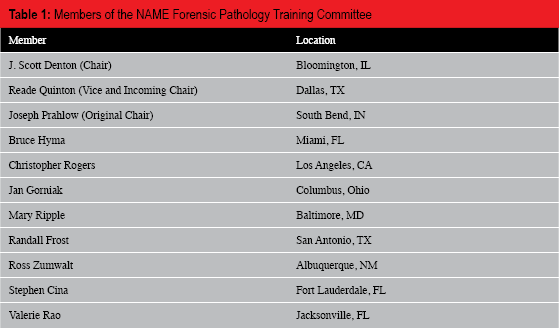
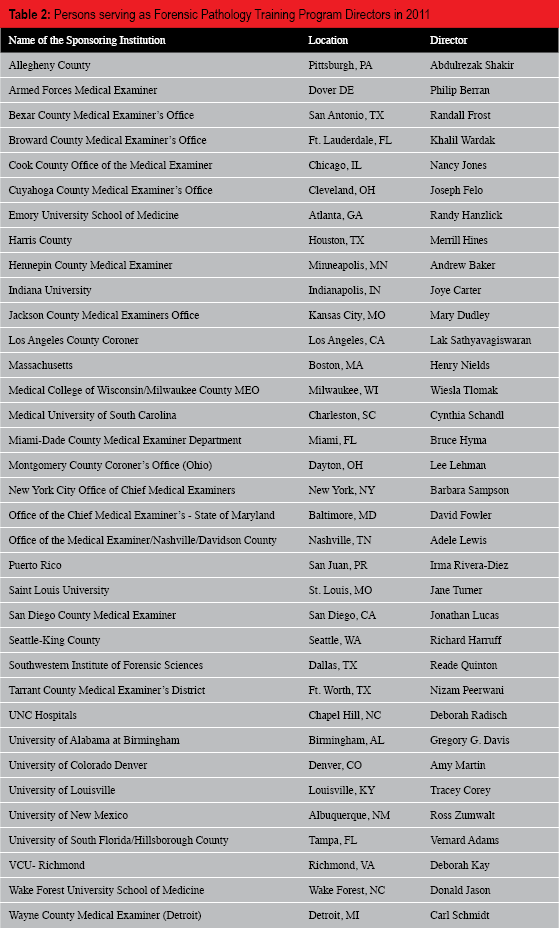
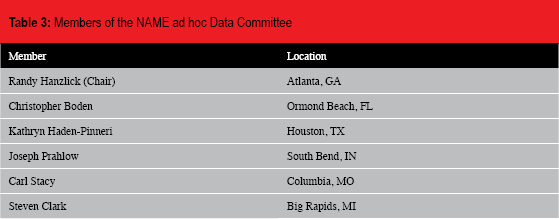
The National Association of Medical Examiners (NAME) has a Forensic Pathology Training Committee (FPTC) which meets at each NAME annual meeting and communicates via email periodically when training issues arise. The committee consists of 10 NAME members, at least 75% of whom must serve as forensic pathology fellowship training directors at their respective institutions. The members of the FPTC are listed in Table 1. NAME also has an ad hoc Data Committee that maintains an email distribution list of forensic pathology fellowship training directors, and this group also communicates periodically throughout the year to conduct surveys of fellows and fellowship programs. Current Training Directors are listed in Table 2. The ad hoc Data Committee also conducts surveys and prepares reports concerning various aspects of forensic pathology, death investigation, and forensic pathology training. The members of the ad hoc Data Committee are shown in Table 3.
Members of the NAME Forensic Pathology Training Committee
Persons serving as Forensic Pathology Training Program Directors in 2011
Members of the NAME ad hoc Data Committee
A previous publication discusses the reasons people select forensic pathology as a career and also considers ways to attract people into the field (1). Other more recent articles have documented forensic pathologist training lineage over the decades, the history of forensic pathology training programs which have existed in the United States, and the emerging problems and time commitments faced by program directors in order to comply with requirements of the Accreditation Council on Graduate Medical Education (ACGME) (2–4).
What has not been formally documented in the literature is the following: The number of ACGME-approved forensic pathology training positions, the number of positions that are actually funded, and the number that are actually filled; the sex demographics of forensic pathology fellows over time; the portion of forensic pathology fellowship graduates who become board certified in forensic pathology and/or become members of NAME; and post-fellowship employment statistics with regards to those who practice forensic pathology full-time, part-time, as a consultant only, or not at all. This article provides data regarding these previously unreported statistics.
Methods
Using annual surveys of forensic pathology training program directors conducted since 2007, the gender of forensic pathology fellows was tabulated for the years 2008-2011. Based on the most recent such survey, the number of ACGME-approved, funded, and filled training positions was also tabulated.
Using a previous ad hoc Data Committee survey regarding the history of forensic pathology trainees, a list of forensic pathology fellows, including when and where they trained during the academic years starting in July 2000 through June 2005 was generated. The names on this list were then compared with the NAME membership roster to determine what portion of fellows belonged to NAME and to a list of persons board certified in forensic pathology by the American Board of Pathology in 2001 or after to determine what portion of fellows obtained their forensic pathology board certification.
The list of fellows’ names was also distributed to all forensic pathology training program directors and to the general NAME membership to obtain follow-up information about whether each of the fellows in the study group was:
Working full time as a forensic pathologist working for an office that officially conducts medicolegal death investigations;
Working part time as a forensic pathologist working for an office that officially conducts medicolegal death investigations;
Using forensic pathology skills as a consultant but not working for an office which conducts official medicolegal death investigations;
Not practicing forensic pathology at all.
Results
Among the 35 active programs shown in Table 2, in 2011, there are 78 positions approved by the ACGME of which 53 are funded and 42 filled. Thus, only 68% of approved positions are funded, and 79% of the funded positions are filled. For the training year 2011-2012, 8 of the 35 programs (23%) have no fellow.
During the study period (July 2000 - June 2005) 190 persons were identified as forensic pathology fellows who trained in the years 2000-2005. Using the survey methods described above, data were obtained for 186 (98%) of them. Based on this very good sample size, the following general trends can be predicted:
55% of forensic pathology fellowship graduates will become/remain NAME members
67% of forensic pathology fellowship graduates will become board certified in FP
67% of forensic pathology fellowship graduates will practice forensic pathology full-time for an office that conducts official medicolegal death investigations
7% of forensic pathology fellowship graduates will practice forensic pathology part-time for an office that conducts official med-icolegal death investigations
21% of forensic pathology fellowship graduates will not practice forensic pathology at all
3% of forensic pathology fellowship graduates will practice forensic pathology as a consultant but not work for an office that conducts official medicolegal death investigations
For those who obtained board certification in forensic pathology (n=128), 78% were working full time. For those who lacked board certification (n=62), 44% were practicing forensic pathology full time. Of those with FP board certification, 66% are NAME members while 26% of those lacking FP board certification belong to NAME.
Regarding the gender of forensic pathology fellows, the portion of fellows which are women has increased each year since 2008 (41% in 2008, 51% in 2009, 58% in 2010, and 65% in 2011). In the study group, however, the number of men and women is essentially equal. Table 4 shows gender-specific information about work effort, NAME membership, and board certification status. Gender was determined for all 190 persons in the study group. The portion of women who practice forensic pathology full time (60%) is lower than that for men (74%) and the portion of women who do not practice forensic pathology at all (28%) is higher than that for men (15%). A higher portion of men than women belong to NAME, and the portion of women who become board certified is slightly higher than that for men. Three of the 190 individuals are now deceased, two women and one man.
Work effort, NAME Membership, and Board Certification status by gender
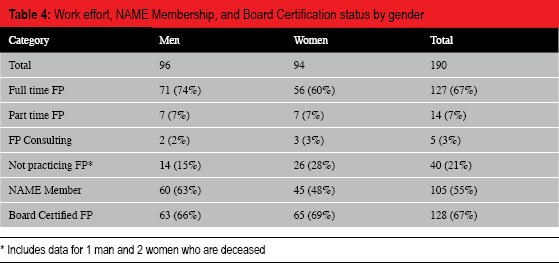
Includes data for 1 man and 2 women who are deceased
Among the 190 fellows, 5 (2.6%) did not successfully complete their fellowship because they quit, were terminated, or did not demonstrate that they were capable of practicing forensic pathology independently and without direct supervision. We did not determine which of these three reasons applied to the 5 individual fellows.
Information from the American Board of Pathology regarding the 62 former fellows who did not become board certified in forensic pathology within the time frame of this study disclosed that 6 subsequently became certified in forensic pathology (FP). Of the remaining 56 past fellows, 28 (50%) took but did not pass the requisite primary AP or AP/CP board examination. An additional 10 (18%) did not apply to take any pathology board examination. Another 7 (13%) passed the primary examination but have not taken the FP examination, and 3 of those have subsequently taken and passed a board examination in another pathology subspecialty area. Another 7 (13%) passed their primary examination but did not pass the FP examination. Finally, 4 others are scheduled to take the FP examination in September 2011.
Discussion
If board certification is eventually required to practice forensic pathology for a medicolegal death investigation office, considering that 67% of fellows will become board certified and that 78% of those will subsequently practice forensic pathology full time, then long term predictions are that for every 100 forensic pathology fellows who are trained, there will be 52 board certified forensic pathologists who ultimately practice forensic pathology full time. The number of forensic pathologists working full time per 100 trainees would increase to 67 if board certification were not required for employment. These predictions need to be borne in mind when trying to predict eventual production of forensic pathologists for the work force. Also needing to be addressed regarding future manpower is the finding that a significant number of forensic pathology training positions are unfunded or unfilled. The number of current ACGME-accredited forensic pathology training programs that are operational (n=35) is the smallest number of programs in recent years.
The somewhat low rate of return on the training investment is a bit disturbing. This study found that 21% of trainees do not practice forensic pathology (at least in the period which is 5-10 years after their fellowship ends). In fact, it is almost three times more common for a recent fellow to not practice forensic pathology at all compared with the option of practicing it part-time. Forensic pathology fellowship training directors may need to be more rigorous in screening applicants if the goal of their program is to produce forensic pathologists who will continue to practice forensic pathology, and especially those who will go on to practice full time. A role and potential market for part-time forensic pathologists exists, especially, perhaps, in smaller jurisdictions, but the statistics gathered in this study suggest that part-time work, for whatever reasons, is not a popular or practical choice amongst forensic pathologists. Training directors should also take measures to ensure that their programs are not somehow discouraging fellows from continuing their career in forensic pathology. NAME may also need to consider ways to attract more graduating fellows into its membership. The data show that a very high percentage (about 98%) of fellows successfully complete their fellowship, and the subsequent loss of some from the work force is due to factors other than failing to complete a fellowship through dropout, termination, or inability to demonstrate competence.
The 190 fellows reviewed for this study include a few that did more than one fellowship year or did not actually complete their fellowship. Each of the 190 fellows has had a minimum of five years and up to 10 years to obtain the forensic pathology board certification. Thus, those that will become board certified probably have become board certified because of the three year limit on the board qualification period. Further, most of these fellows will now be at least in their mid-thirties if not early forties and should have had time to settle into a stable work setting. Therefore, the work effort data are probably valid to predict general trends.
Anecdotally, there have been observations that some fellows do not obtain forensic pathology boards because they have difficulty passing the pre-requisite AP or AP/CP exam. The data support that impression as two-thirds of the fellows are not board certified in FP because they took no pathology board examination at all or they did not pass the requisite primary pathology board examination.
Regarding the 6 fellows who obtained their FP board certification after the study period, some administrative aspects of ABP procedures shed some light on why we did not initially know that these 6 did subsequently become board certified. If a person completed a FP fellowship in 2005 and then applied to take the requisite AP board examination, he/she would have a 3 year period of qualification in which to pass the AP exam. If unsuccessful, the candidate could apply for another 3 year period of qualification based on work experience. Thus, 6 years could elapse before even taking the FP exam, assuming that the AP exam was eventually passed. Further, a candidate for FP certification has 3 years of qualification to pass the FP exam. Therefore, it is possible for a person who had difficulty in passing both the AP and FP exam to take up to 9 years after their forensic pathology fellowship to become board certified in FP, such that a forensic fellow graduating in 2005 could conceivably take until 2014 to pass both AP and FP board examination. With this information, some of our study group could potentially still become board certified in FP. If we add the 6 additional people who later passed their FP boards to the 128 who passed their FP board during the study period, then the portion of fellows who become board certified in FP would increase from 67% to 71%.
The increasing portion of women among forensic pathology fellows is probably little more than a reflection of the same trend in medicine as a whole and in the work force in general. One might perceive that forensic pathology is a good fit for women (especially ones who are mothers) because of the fairly predictable work hours and the availability of part time positions. However, the data does not really support that idea because the same portion of men and women work part time, and the percentage that does is low (7%).
We were unable to find easily accessible and comparable statistics for other pathology or medical training programs regarding board certification rates of program graduates or the portion of residency positions which are ACGME-approved, funded, and filled.
Finally, it is not unexpected for some forensic pathologists to leave the field of forensics. The continued exposure to violence is difficult for some. Providing expert opinion and testimony, and the critical questioning that sometimes accompanies it can be mentally and emotionally challenging. High profile and/or complex cases may result in forensic pathologists being portrayed in an unfavorable light by the media. Add to that the fact that the pay scale for forensic pathologists is lower than other areas of pathology and medicine, and it is not difficult to imagine why medical students and residents chose other fields. Further, the recent fiscal crisis affecting governments has probably dampened the employment prospects of newly trained forensic pathologists, and large student loan debts may deter medical students from selecting forensic pathology in favor of specialties which are more remunerative. To reduce eventual forensic pathology fellow dropout, training directors need to ensure that their fellow candidates and incumbent fellows are aware of and understand these factors, are willing to accept them, and are taught how to deal with such issues.
Footnotes
ACKNOWLEDGEMENT
We wish to thank the Program Directors and the many members of NAME who provided information used to identify trainees, their training place and year, their program directors, and the current work effort status of the 190 fellows reported in this article. We also thank John Cross for assisting with determination of NAME membership status, and the American Board of Pathology for providing summary information about board certification status.