







Abstract
The great majority of counties in California have elected sheriff-coroners conducting medicolegal death investigations. State law enabling such a combination of official duties, favorable administrative structures, available staffing, funding and training issues have supported the intra-state spread of this death investigation system. Criticism of death investigation systems lead by officers whose primary duty is policing have centered on the perception of a conflict of interest in deaths investigated criminally by the sheriff-coroner and in deaths in the custody of the sheriff-coroner. Though such deaths are intermittently publicized and questioned in the media, no objective data has been collected and reported to support or refute such concerns.
Introduction
California is one of the few states in which the sheriff in many counties also serves as the coroner. This article is a brief review of that situation and is offered as an example of how law enforcement and death investigation duties are sometimes conducted by personnel who wear more than one work-related hat.
Methods
The author has reviewed the California statutes and has also relied upon knowledge gained during 28 years of death investigation experience in California. The state statutes are available to the public online in a word searchable format (1).
Results and Discussion
California has a mix of coroner, medical examiner (ME), and sheriff-coroner county-based systems of death investigation. Long established coroner state law allows for the combination of several county elected/appointed offices (
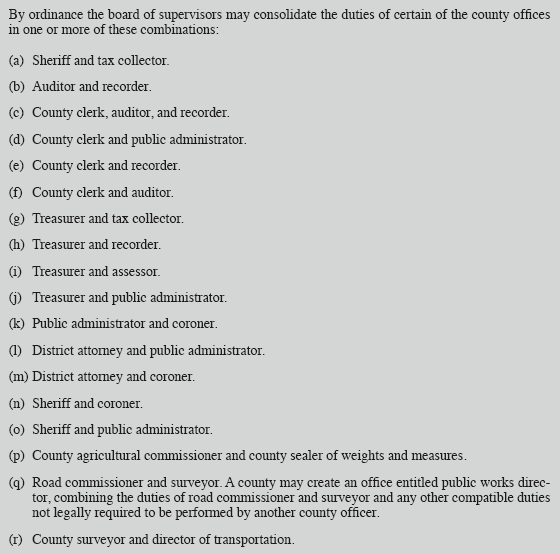
California government code section 24300–24308 outlines the possible consolidations of duties for county elected/appointed offices (2).
The choice to combine offices and how to do it is made at the county level by the five-member, elected board of supervisors. Local county problems have historically frequently precipitated changes in how certain offices are administered. Of note is the possibility of combining the elected office of sheriff with the elected office of coroner.
Counties have the legal option of making some offices, including the coroner, appointed rather than elected by vote of the board of supervisors. They also have the option of abolishing the coroner office and replacing it with an appointed medical examiner by an enacting ordinance (3). Some county ordinances title the new medical examiner position as the “medical examiner-coroner”, in an attempt to clarify the role of the new medical examiner to the public. Several of the county medical examiner offices still use the term “coroner” formally or informally to describe their function, given the wording of state law and the predominance of coroners in the state. A county medical examiner in California must be a “qualified” physician pathologist by statute, but board certification in forensic pathology is not specifically stated as required:
“Notwithstanding any other provision of law, the board of supervisors may by ordinance abolish the office of coroner and provide instead for the office of medical examiner, to be appointed by the said board and to exercise the powers and perform the duties of the coroner. The medical examiner shall be a licensed physician and surgeon duly qualified as a specialist in pathology”(3).
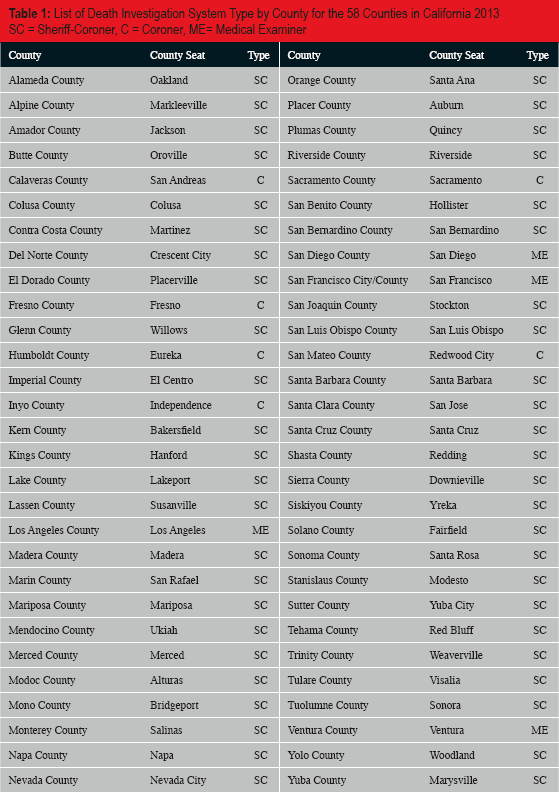
As of 2013, California had a total population of 40,000,000 distributed among 58 counties (4). Four of the counties have medical examiner systems, six have elected or appointed lay coroners, and the remaining 48 counties have elected sheriffs who also run the coroner functions of their counties (i.e., they are sheriff-coroner offices). California currently only has four medical examiner counties that together contain over 15,000,000 people, 38% of the state's population. The six coroner counties contain 8% of the population and the 38 sheriff-coroner counties have the remaining 54%. So, the combined sheriff-coroner office structure is not only the most common in California, but the majority of the state's population is served by such officers. The type of system by county is shown in
List of Death Investigation System Type by County for the 58 Counties in California 2013 SC = Sheriff-Coroner, C = Coroner, ME= Medical Examiner
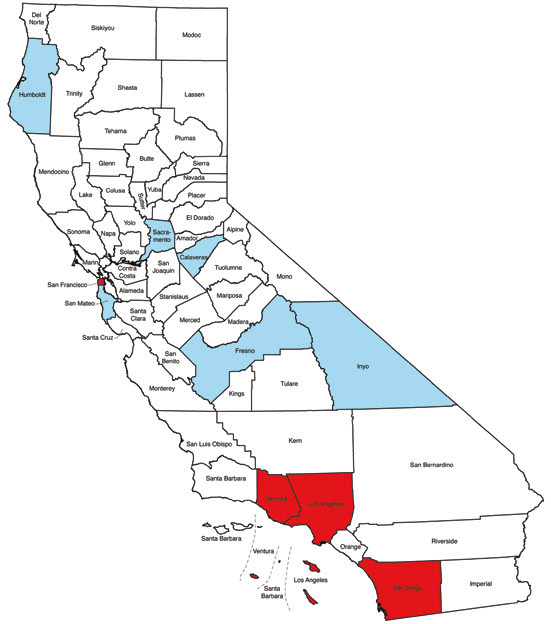
Map showing locations of sheriff-coroner counties in California, 2013. All counties are sheriff-coroner except counties with non-sheriff-coroners (blue) or medical examiners (red).
All of the four medical examiner counties employ forensic pathologists. Los Angeles County, with a population of over ten million, is one of the largest medical examiner systems in the world. San Diego County has a population of over three million, while San Francisco and Ventura Counties each have populations of slightly less than a million each. All were established between 1960 and 1980. Two other counties, Shasta and Santa Clara, had medical examiner systems that were replaced by sheriff-coroner systems during the last two decades.
A few of the larger population sheriff-coroner counties and lay coroner counties directly employ forensic pathologists, some even title the pathologist positions “medical examiner,” apparently for the status associated with the title, though it is somewhat confusing to the public. The smaller population counties generally contract for coroner pathology services either with individual pathologists or with groups of pathologists in various business arrangements, often sharing pathologists among nearby counties. Most sheriff-coroners and lay coroners hold the view that in deaths that are autopsied, the pathologist determines the cause of death and the coroner determines the manner of death. In either case, the coroner or a deputy coroner signs the death certificate since the pathologist is not a deputized coroner.
The reasons many California counties have chosen to move toward sheriff-coroner systems include facilitating statutes, indirect cost savings, preexisting management structure, availability of subsidized death investigation training, and copying other sheriff-coroner counties that are already functional.
Coroners (sheriff or not) and medical examiners in California have the same responsibility and authority. Both are sworn peace officers by statute with limited police authority. They are not extended the enhanced job benefits of public safety officers (e.g., police and firefighters). However, sheriffs-coroners and their deputies retain their police authority and benefits as public safety officers in their coroner role. In some large sheriff-coroner offices, the coroner division is staffed by deputy coroner investigators who are not deputy sheriffs and do not have the financial benefits of public safety officers. This can be a considerable cost savings for the county. In most of the smaller sheriff-coroner offices, deputy sheriffs are used as deputy coroners. Sometimes all deputy sheriffs are also deputy coroners and can at least conduct initial coroner death investigations at scenes. Usually, however, one or more deputy sheriffs are assigned to the coroner detail on a full-time basis for at least a few years and acquire some degree of expertise in death investigation issues during those assignments. The well established, standardized management structure of a sheriff departments appeals especially to smaller counties with limited funds for death investigation services. The smallest population county in California is Alpine, with only 1,200 people.
The actual economy of using the sheriff department to operate coroner functions may be a false economy, at least for counties large enough to support medical examiner systems. Following the national recession of 1991–92, Los Angeles County explored the possibility of reducing costs by having the Sheriff research the cost of taking over the Medical Examiner Department (LACME). At that time, the LACME total annual budget was $13,000,000. The Sheriff determined it would require $23,000,000, nearly twice as much, to operate as the sheriff-coroner. LACME stayed intact with no additional funding for the next year.
However, there is no denying that police and sheriff services are relatively well funded in California. In 1993, voters statewide passed Proposition 172, which added 1/2 cent to the state sales tax and dedicated it to “public safety.” Promotion of the proposition focused on law enforcement and fire protection services but it was left up to each county to determine how their share of the new revenue would be distributed. Sheriff-coroners received sizeable funding increases but medical examiners and lay coroners didn't necessarily share in the funds. In Ventura County, the Sheriff Department proposed to take over medicolegal death investigation from the medical examiner department and to assume the cost of the medical examiner's $1,000,000 annual budget with Proposition 172 revenue. Last minute lobbying by the ME changed the Board of Supervisor's majority vote in favor of preserving the ME department and funding it for the next fiscal year exclusively with Proposition 172 funds. That vote was not well received by local public safety departments and the Sheriff and District Attorney spearheaded a drive the following year that ended the funding of the ME via Proposition 172 money but left the ME intact, once again funded by county general funds.
The 58 California coroners and medical examiners are represented statewide by the California State Coroners Association (CSCA). In 1989, the Orange County Sheriff-Coroner Department, in conjunction with the CSCA, took the lead in providing the first statewide training program for basic death investigation in California: an 80 hour course held at various Orange County hotels. In 1991, the Orange County Sheriff-Coroner, with the support of the CSCA and the State Sheriffs Association, created legislation designating $1.00 from every burial permit for coroner training. California Peace Officer Standards and Training (POST) was designated as the agency to distribute the new funds. However, county medical examiners and coroners who wanted to receive partial reimbursement for training costs in Orange County had to accept other costs associated with county departmental POST certification. Since all sheriff-coroner operations were already POST certified as sheriff/police agencies, the transition was easy for them. Not all independent coroner or medical examiner departments chose to accept the training funds through POST because of the increased costs associated with POST certification and annual staff training requirements by POST.
In the year 2000, Orange County was successful in getting the state to allocate $10,000,000 toward building a statewide coroner training center. With an additional $5,000,000 of county funds, Orange County built a new 52,000 square foot Sheriff-Coroner death investigation office/morgue that houses the State Coroner Training Center on the upper floor. With Orange County's legislative, funding and training successes, it is not hard to understand why other counties in California have imitated that county's sheriff-coroner system.
Major criticisms of California's sheriff-coroner county systems center on the perception of potential bias on the part of a sheriff who also wears the hat of the coroner in homicides and the hat of potential civil defendant in most in-custody deaths. In nearly all California counties, the sheriff is the largest provider of police services: staffing county jails and providing deputies as police for all unincorporated areas and often providing police service to several cities contractually. Thus, there is the perception that the sheriff's interest in assuring the arrest of suspected murders might bias the handling of an objective death investigation. Deaths of people during police encounters and while under arrest always raise some suspicion and public interest. Since the sheriff operates the county jail in addition to providing much of the county's police patrol services, in-custody deaths not uncommonly involve issues of wrongful death liability for the sheriff and sheriff's staff. Cover-up of injuries and hiding the true cause of death have been the usual concerns written about by local news reports and expressed by families and plaintiff attorneys.
Once again the largest sheriff-coroner county in the state, Orange County with 3.2 million people, set the precedent for dealing with the perception of bias in handling in-custody deaths. For over two decades, the Orange County Sheriff-Coroner has been hiring forensic pathologists from other jurisdictions to come into their facility and do the autopsies of deaths in-custody involving the sheriff personnel, rather than using their usual contract pathology staff. How much information the outside pathologist is provided about the circumstances of the custody death may be a concern. Other large sheriff-coroner counties have adopted the practice of using outside pathologists for custody deaths as well. Additionally, many counties hold a public sheriff-coroner hearing several months after the in-custody death autopsy. In the public hearing, investigator staff, a toxicologist and the autopsy pathologist usually present, discuss and answer questions from attendees about the death investigation findings before the sheriff-coroner finally certifies the cause and manner of death.
In December of 2013, the Board of Supervisors of Fresno County (approximate current population one million) voted to change from an elected coroner system to a sheriff-coroner. Lead by a supervisor who believed the change would save money by eliminating the salary of the elected coroner and produce other unspecified efficiencies, the board voted three to one (with one supervisor abstaining) for the change. The current coroner, the only physician coroner in the state, and his chief forensic pathologist argued that a sheriff-coroner system would cost even more with a sheriff's management system and the costly benefits of police officers in California. The coroner had urged the county to adopt a medical examiner system for years. Ironically, the county had a sheriff-coroner system until 1978 when the elected coroner office was re-established based on the sheriff-coroner at the time convincing county supervisors there was a conflict of interest for the sheriff to hold both offices (5).
No objective data has been collected and reported that supports or refutes the proposition that a sheriff-coroner death investigation system increases civil litigation or the success of civil litigation against a county sheriff based on conflict of interest issues. No data shows a law enforcement or prosecution bias in sheriff-coroner death investigations as compared to medical examiner systems. No study has objectively compared the true cost of county medical examiner systems with sheriff-coroner systems or the satisfaction of stakeholders and interest groups with one or the other system. Such studies would be difficult given the demographic, geographic, and population differences between counties in California. Internal differences in approaches to staffing, accounting, and scope of work only compound the difficulty of objective comparisons.
California is not unique in having counties with police officers as coroners: Hawaii has police-coroners on all island-counties except Oahu (Honolulu). Nevada and Montana also have some sheriff-coroner counties. But no state comes close to the size, scope and influence of California's current major death investigation system, the sheriff-coroner. Medical examiner death investigation systems and elected or appointed coroner systems in California are slowly being replaced by the sheriff-coroner structure.
Footnotes
The author, reviewers, editors, and publication staff do not report any relevant conflicts of interest.