







Abstract
Specialty ammunition and projectile types may present a challenge to a forensic pathologist as they can alter the appearance of wounds and have unique structural components that can make interpretation of gunshot wound patterns more difficult. Although specialty projectiles have existed for years, several new projectile types have recently been developed. These include ammunition tailored around new hunting regulations, around new polymer usage, and around new handgun types that can fire both conventional ammunition and shotshells. In this article the authors will discuss known design and forensically relevant characteristics of some new ammunition types including the Hornady Critical Defense cartridges and shotshells, the Hornady Critical Duty cartridges, the Cor-Bon Glaser Pow'RBall cartridges, the Winchester PDX1 .410 shotshell, and the Winchester Blind Side shotshell.
Introduction
Interpretation of gunshot wound patterns is a critical part of a forensic pathologist's duty. Unusual projectiles can create unusual patterns and make interpretation of wound patterns more difficult; however, knowledge of unusual projectile types can facilitate a pathologist's ability to interpret wound patterns. Unique and specialty projectiles have existed for many years, probably as long as firearms have been in existence. Since its introduction in the 1890s, the “Dum Dum” bullet (named after the location of the arsenal of production in India), produced by Captain Bertie Clay by removing the jacket from the tip of a .303 British bullet to allow expansion, seems to be first unusual projectile that widely captured the attention of the general public (and the name still is sometimes erroneously used to refer to any unusual ammunition type) (1, 2). Since this time, innumerable types of unusual ammunition have been created and are discussed in many forensic pathology texts. These include ammunition with unique jacket characteristics such as the Winchester Silvertip Hollow Point with its aluminum jacket that may not be visible on radiographs, the Winchester Black Talon and similar Supreme SXT with their notched jackets and characteristic barbed appearance to the naked eye and on radiographs (but no alteration in wounding potential), the spiral notched Remington Golden Saber, and the Federal Nyclad ammunition with its nylon jacket that may separate from the projectile and leave a projectile devoid of rifling marks (2). Ammunition containing pellets produce characteristic wounds or radiographic features. These ammunition include the Glaser type projectile with its polymer tip (of varied colors during its course of production), jacket, and numerous small pellets that produces a characteristic radiographic appearance, “snakeshot” handgun cartridges with pellets covered by a plastic capsule (again of varied coloration during the course of production), and the Winchester Expanding Point .25 ACP ammunition with the characteristic piece of number four steel shot at its tip (2). A list of additional types of unusual ammunition such as the Federal Hydra-Shok with its characteristic post, flechettes, exploding ammuntion, frangible range ammunition, KTW ammunition, sabot ammunition (such as the Remington Accelerator), and others could probably occupy a complete book. These unusual ammunition types have been discussed in numerous articles and texts; however, new types of specialty ammunition are constantly being developed, and this article will discuss a subset of the newly developed specialty projectiles that a forensic pathologist may encounter.
Discussion
Polymer components of projectiles may be found in wounds and cause confusion for the pathologist who encounters them; conversely, if discovered, they can also provide information as to what type of projectile is used. Multiple projectiles with polymer components are made by Hornady Manufacturing and include the Hornady Critical Defense, Critical Duty, LEVERevolution, and V-Max cartridges and projectiles. In these projectiles and cartridges, the polymer is used for two major purposes. In the case of LEVERevolution and V-Max cartridges and projectiles, the polymer is designed to allow for high ballistic coefficient, flat trajectories, and use in tubular magazines (the flexibility allows a pointed projectile to not trigger the primer of the cartridge in front of it) while still allowing hollow point type expansion (3, 4). According to Hornday Manufacturing Company's Chief Ballistics Scientist, Dave Emary, as cited in the journal “American Rifleman”, the Flex Tip eXpanding (FTX) polymer as used in LEVERevolution ammunition acts as a “pseudo-hydrostatic material” and not only allows the projectiles to be shaped in more aerodynamic manner, but also allows for better expansion of a projectile by distributing pressure evenly around the inside of the hollow point like cavity that it fills (5). Although according to the sources cited above, one of the main uses of the polymer in LEVERevolution and V-Max projectiles is to improve external ballistics. The increased expansion provided by the polymer and greater downrange energy imparted by better ballistic coefficients would, in theory, produce greater temporary and permanent wound cavities.
Alternatively, in the case of the Critical Defense and Critical Duty cartridges (on which this portion of this article will focus), the use of this polymer is less for projectile aerodynamics, but is intended for aiding in expansion and preventing the hollow point-like cavity from clogging with clothing or debris and failing to expand (6, 7). The Critical Defense projectile appears almost exactly like a conventional jacketed hollow point, except for folds within the jacket that are meant to weaken it in certain locations and provide more reliable expansion and for the red polymer material in the cavity (
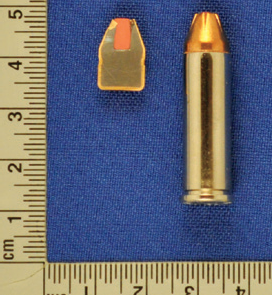
An illustration of a Hornady Critical Defense cartridge, demonstrating the polymer material within the hollow point-like cavity.
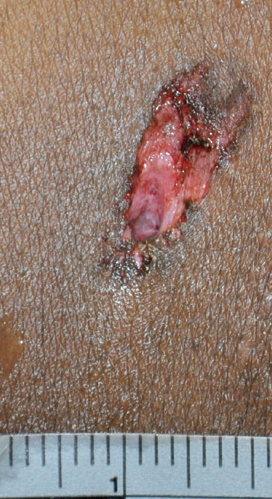
The unremarkable cutaneous entry wound of an injury cause by a Hornady Critical Defense projectile.
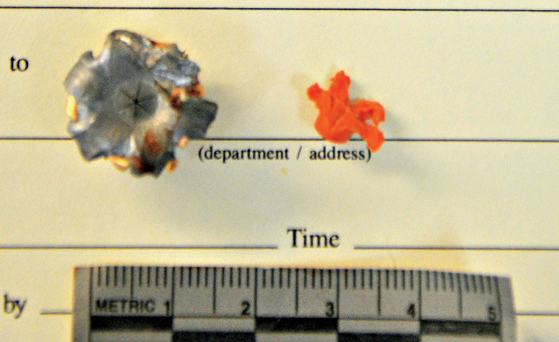
A Hornady Critical Defense projectile recovered from a decedent's body with separation of the core and polymer material.
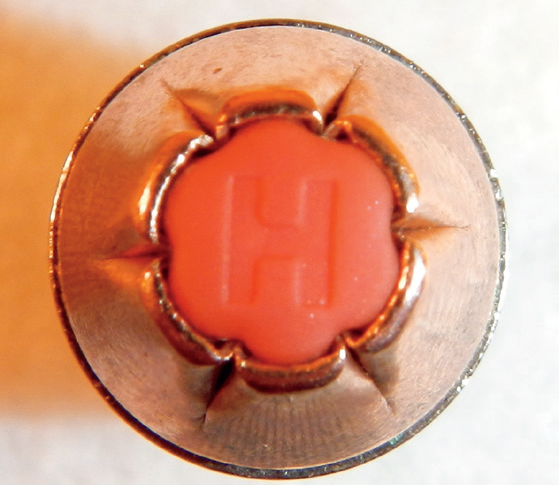
The ‘H’ imprinted on the tip of a Hornady Critical Duty projectile.
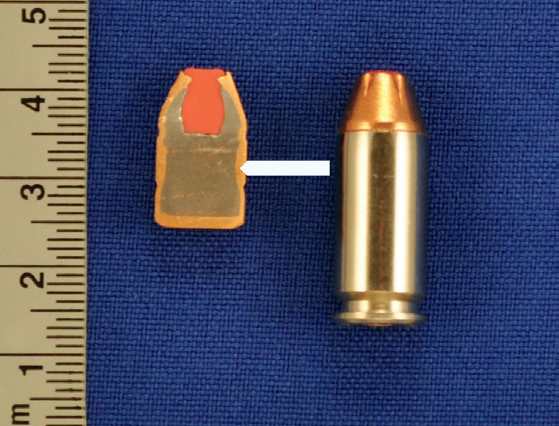
An illustration of a Hornady Critical Duty cartridge, illustrating the polymer material in the hollow point-like cavity and the interlocking band of the jacket (arrow) extending into the core.
The Cor-Bon Glaser Pow'RBall is another type of ammunition with a polymer component of its projectile. In this case, like the previously described ammunition types, a polymer component fills a hollow point-like cavity on what would otherwise resemble a conventional jacketed hollow point. In this case, the polymer component is in the form of a round ball (
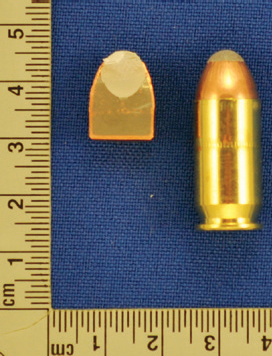
An illustration of a Pow'RBall cartridge, demonstrating the white polymer material within the hollow pointlike cavity.
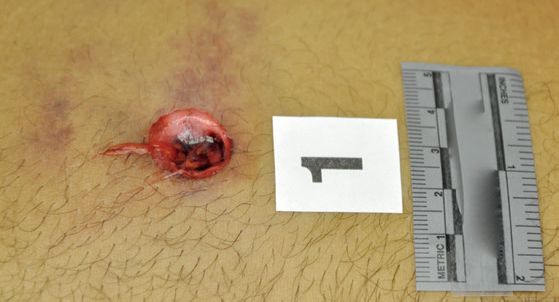
The unremarkable cutaneous entry wound created a Pow'RBall projectile.
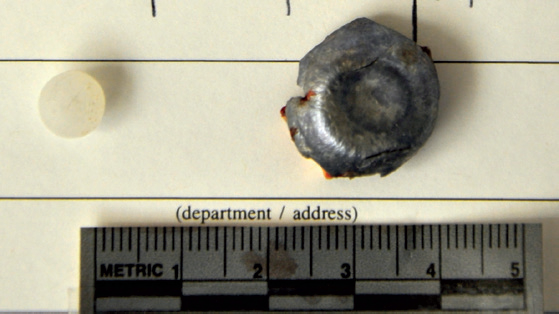
A Pow'RBall projectile recovered from the decedent's body. Note the separation of the core from the polymer material.
The creation of handguns such as the Taurus Judge and Smith & Wesson Governor, that can fire both .410 shotshells and other types of ammunition (such as .45 Colt and .45 ACP) has lead to the development of specially designed .410 shotshells (9). These firearms, unlike conventional .410-bore shotguns, are rifled to avoid being classified as short barreled shotguns under the National Firearms Act. The projectiles are designed to utilize the rifling, unlike conventional .410 shotshells (9). Additionally, these shotshells are designed in a way to utilize the available space within the cylindrical shotshell in the most efficient way possible (9).
The first type of ammunition designed with these unique firearms in mind is the Winchester PDX1 .410 shotshell. This type of shotshell contains .40 inch by .240 inch flattened projectiles called “Defensive Discs”, BB shot, and a conventional-appearing three “petal” wad that only covers the shot (
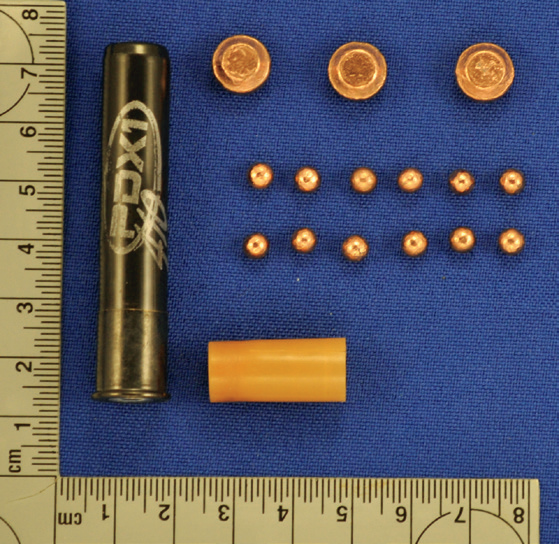
Components of a Winchester PDX1 .410 shotshell including the wadding, shot, and “Defensive Discs”.
In a case of an individual who came to autopsy after being shot with such ammunition, three defects caused by discs were observed and spread over a seven by nine inch area and the shot did not injure the decedent (
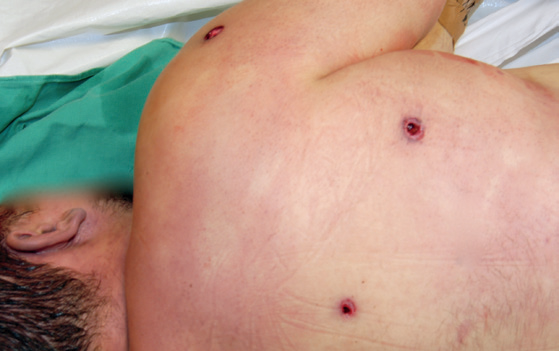
Cutaneous entry wounds on an individual shot with a Winchester PDX1 .410 shotshell (Image courtesy of J. Sullivan MD).
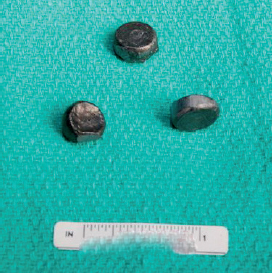
“Defensive Discs” recovered from an individual shot with a Winchester PDX1 .410 shotshell (Image courtesy of J. Sullivan MD).
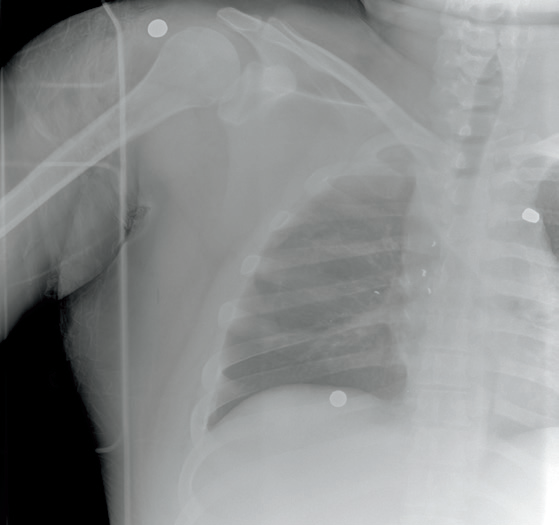
Radiographs of an individual shot with a Winchester PDX1 .410 shotshell (Image courtesy of J. Sullivan MD).
Hornady has also designed a 2 1/2 inch shotshell for the same type of handgun and it is called the 410 Hornady Critical Defense shotshell (12). This shotshell contains a .41 caliber non-jacketed slug, with a weight of 115 grains, and two .35 caliber lead balls (
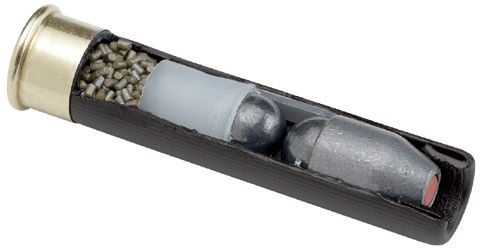
A .410 Hornady Critical Defense shotshell (Image downloaded from the Hornady Manufacturing Company media center in accordance with the stated usage policy).
Not all new types of shotshell ammunition are designed around new weapons. Some, such as the Winchester Blind Side shotshells, are created to observe hunting regulations. Specifically, many areas ban the use of lead shot for waterfowl hunting, and steel ammunition is often used. Steel is less dense than lead, which requires shot-shells with steel projectiles to have higher velocities in order to have as much energy as lead (13). Additionally, steel doesn't deform, which results in the high velocity steel over-penetrating and not transferring its energy to the target (13). To solve some of these problems and not resort to other heavy metal shot types (such as bismuth or tungsten), Winchester has created a shotshell with some very unique features. First, the steel shot is hexahedron shaped, which has two effects. First, due to greater packing efficiency, a greater mass of shot can be carried, which solves one of problems associated with steel shot (13). For example, in a 12 gauge 3 inch shotshell, 1 3/8 ounces of shot are carried when hexahedral shot is used, verses 1 1/4 ounces when using round shot (13). Additionally, the hexahedron shape results in a “tumbling” motion of projectiles that allows more energy to be transferred to the target (13). Ballistic gelatin testing seems to indicate, that the nature of shot in Winchester Blind Side shotshells caused greater initial wound cavities, but less penetration than produced with conventional spherical shot (13). Examination of ducks shot with this ammunition confirms the production of larger wound cavities with the hexahedral shot (13). The “tumbling” of this type of shot as well as the increased surface area to mass ratio may both contribute to the relatively high initial wounding and lesser penetration. In addition to their unique shape, these projectiles are plated with zinc-chromate, which gives them a unique yellow color (
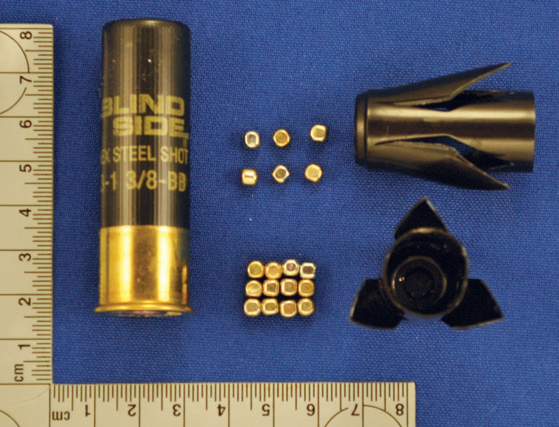
A Winchester Blind Side shotshell with the hexahedral shot and the unique wad configuration.
Conclusion
Although unique and specialty projectiles have existed for years, new varieties continue to be developed. The unique nature of the projectiles can cause confusion when they are observed during an autopsy or provide the pathologist and firearms examiner with useful information regarding the wounding pattern and ammunition involved. Awareness of these and other new types of ammunition, characteristic images of such ammunition on radiographs, and characteristic wound patterns created by unusual ammunition types can help the pathologist recognize unique types of ammunition and avoid confusion during autopsy examinations.
