







Abstract

Anterior-posterior radiograph of the head.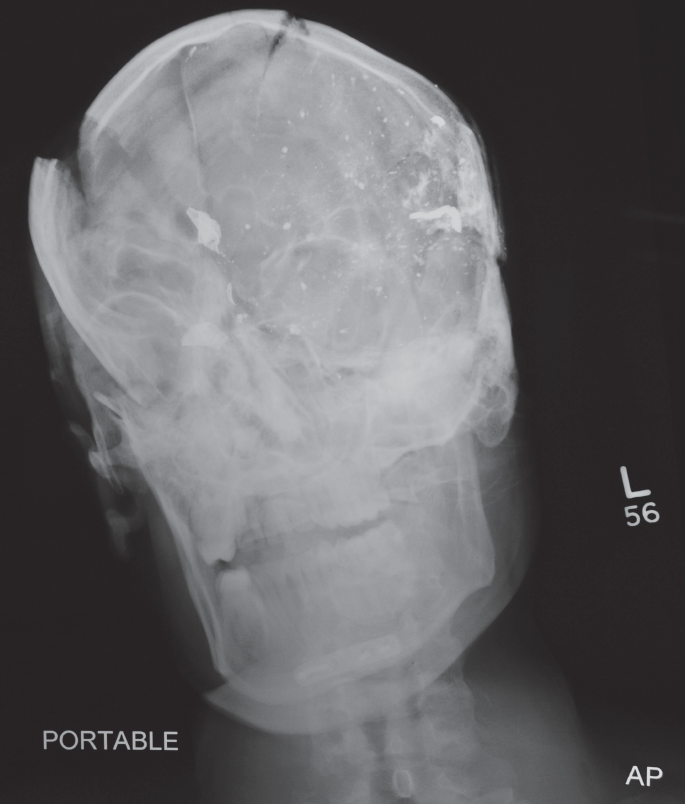
The firearm and ammunition industry is constantly changing and forensic pathologists tasked with the examination of wounds sustained from firearms are obliged to stay abreast of new developments. Novel ammunition can produce atypical injury patterns and effect the collection of evidence. The case presented exemplifies this concept and highlights a new twist on a class of ammunition, its salient features at autopsy and the likely future use of this ammunition.
A 24-year-old man was witnessed to shoot himself in the right temple with a .45 caliber pistol. At autopsy the wound was noted to be penetrating and the entrance wound was typical. A radiograph of the head had an unusual appearance for a wound incurred from a handgun and was more akin to the “lead snow storm” associated with high velocity hunting ammunition
On internal examination of the head, the inner surface of the left temporal bone had abundant copper colored granular deposits in the area where the projectile struck the skull but failed to exit
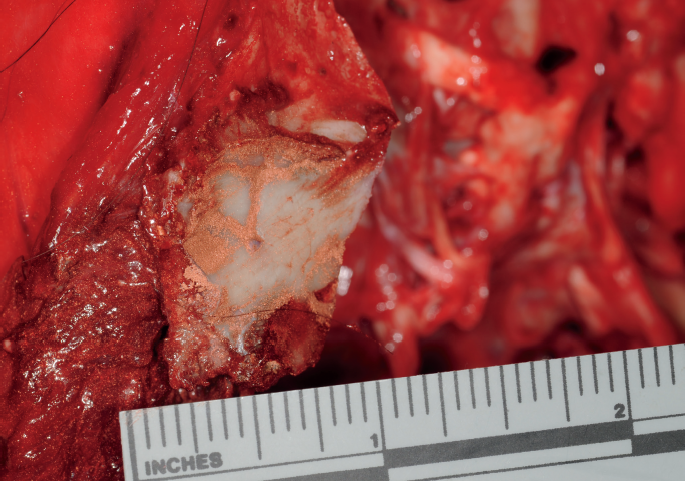
Internal surface of the left temporal bone with copper particulate deposits.
Given the atypical nature of the projectile fragments and the presence of copper colored particulate material, the ammunition and spent shell casing were requested for examination. Using the inscription on the spent casing, the ammunition was identified as Dynamic Research Technologies .45 ACP 150 grain Terminal Shock. One of the unfired cartridges from the magazine was pulled from its casing and the partially jacketed projectile was carefully cut in cross section. The cut surface showed a cup of bright silver metal at the base of the hollow point and an apparent copper core, encased in a copper colored jacket
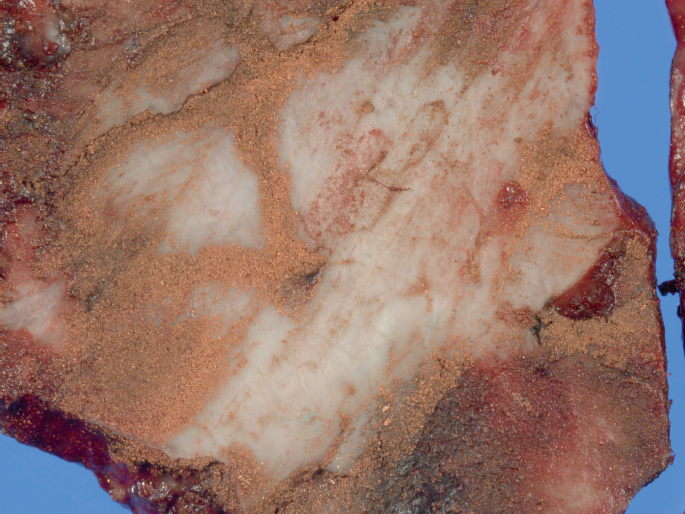
Internal surface of the left temporal bone with cooper particulate deposits.
Traditional frangible ammunition is designed to break apart when it strikes an object and has been used in shooting ranges, for animal slaughter, and by law enforcement during training exercises for its low ricochet potential (1). To enhance this property, the core is usually not jacketed. Some defensive ammunition, such as Glaser and Mag Safe, have similar properties but are composed of a shot pellet core encased in a copper jacket. These ammunitions have been called “prefragmented” and have characteristic findings on radiograph and at autopsy. The newer copper particulate ammunition discussed in this report is a true frangible projectile that has been designed for added penetration and is advertised for self-defense. The Dynamic Research Technologies Terminal Shock ammunition is labeled as a penetrating frangible round and the manufacturer claims it is capable of penetrating soft barriers (e.g., sheet rock, plywood, car doors, windshields) (2).
One of the unique properties of this ammunition is the addition of jacketing over the particulate core, thus melding the properties of the jacketed, prefragmented Glaser and Mag Safe ammunitions with those of traditional frangible training ammunition. Another important feature of the ammunition in this case is the conventional rifling impressions left on the jacket fragments recovered at autopsy and upon test firing. Kaplan et al. examined unjacketed copper particulate training ammunition and found land and groove impressions with insufficient rifling striations for bullet to gun comparison (1). This does not appear to be the case with jacketed copper particulate ammunition. Furthermore, a nonjacketed copper particulate projectile that strikes an object would by design fragment, potentially destroying the rifling impressions. Given the new attributes of modern jacketed frangible ammunition and the marketing as a defensive ammunition, it should be expected that the forensic pathologist will encounter wounds sustained from this unique projectile and should be able to identify the characteristic findings.
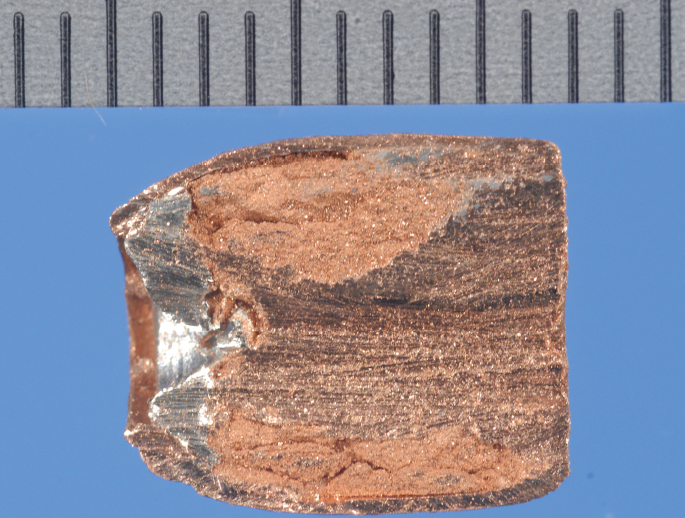
Projectile cross section demonstrating the silver colored metal cup at the tip and the copper particulate core partially encased in a copper colored metal jacket.
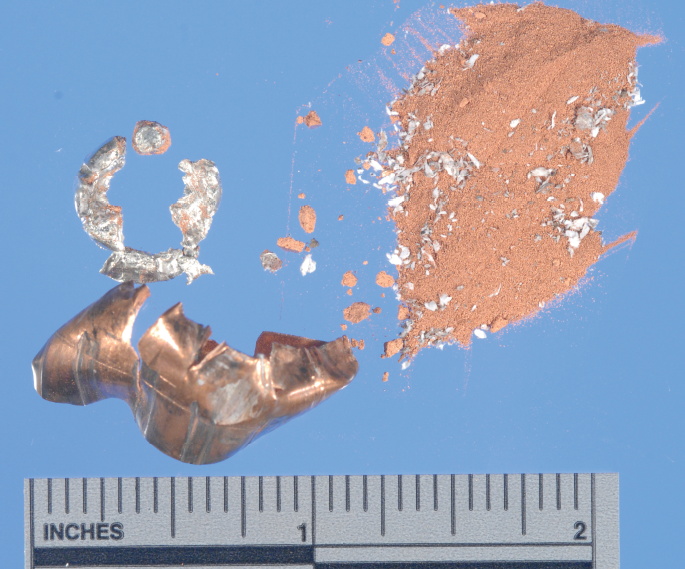
Test fired projectile composed of a fragmented silver colored metal cup, stripped jacket, and pulverized copper particulate core.
Footnotes
Acknowledgments
Special thanks go to Sangamon County Coroner Cinda Edwards for her support of this project and to Morgan County Corner Jeff Lair and Sangamon County Chief deputy Coroner Jim Allmon for assistance during the autopsy. Sangamon County Deputy Coroner Chris Fulscher assisted with test firing and medical photographer, Bobbi Wiseman, provided the impressive images.