







Abstract
Death investigation throughout the United States is conducted by medical examiners, coroners, or combined systems, based on the laws of individual states. Larger counties in Texas employ medical examiners, but smaller counties rely on justices of the peace. Texas is unique in the use of justices of the peace in the place of county coroners. These justices have multiple responsibilities, including small claims courts, civil marriages, and inquests and death certification. In Texas counties with medical examiner offices, the justice of the peace relinquishes the responsibilities of death investigation and certification.
Introduction
Medicolegal death investigation in the United States is typically the jurisdiction of either a coroner or medical examiner system. While a higher percentage of counties across the country are covered by coroner systems, more densely populated areas tend to be medical examiner systems. Some states have combined systems that include both medical examiners and county coroners.
The justice of the peace (JP) is a political office with a history that can be traced back to the 12th century and can be seen in one form or another in many countries throughout the world. In the United States, the JP is an elected official who presides over a small precinct within a particular county. Depending on state and county laws, these individuals may preside over a court that hears misdemeanor cases, traffic violations, and small claims including debts and tenant issues. The justice of the peace also presides over civil marriages. Unique to the state of Texas, justices of the peace are also given the power to perform inquests, and rule on cause and manner of death in counties that do not have a medical examiner. In this sense, the JP functions as a coroner. Of the 254 counties in Texas, there are 13 that have medical examiner offices. Thus, death investigation in the majority of counties is under the jurisdiction of the justice of the peace.
History
The Constitution of the Republic of Texas determined in 1836 that two justices of the peace would be elected from each militia captain's precinct to serve a two-year term (1). Subsequent constitutional amendments divided Texas counties into four to eight precincts, each of which was to be overseen by a justice of the peace. In areas of higher population, a second justice was elected. A constitutional amendment in 1954 extended the term of office to four years, which is the current term length.
In 1955, the Baker Bill enabled counties, based on their population, to form medical examiner offices and eliminate the coroner-like jurisdiction of the JP (2). While some major metropolitan areas such as Houston quickly moved to form medical examiner offices, others such as Dallas chose to remain JP systems. This would eventually contribute in part to the confusion concerning autopsy jurisdiction in the aftermath of the Kennedy assassination. The wording of the Baker Bill was updated two years later in 1965 to make medical examiner offices mandatory in areas with a population greater than 500,000.
There are approximately 820 JP courts in the state of Texas at this time. Under current Texas law, counties have one to eight JP precincts, each presided over by one or two JPs (based on population). At this time, the largest county is Harris County, which includes the city of Houston, in which there are eight precincts and 16 justices of the peace. In this particular example, none of the justices would have inquest responsibilities because the Harris County medical examiner would cover this jurisdiction.
Justices of the Peace and Coroners
Unlike a coroner, whose responsibilities solely focus on death investigation, the JP has responsibilities in multiple areas specified in the Texas Occupations Code, Transportation Code, Government Code, Health and Safety Code, Property Code, Educational Code, and Local Government Code (3). The JP presides over small claims court (minor misdemeanors, civil cases <$10,000), hearings to suspend drivers’ licenses, and marriage ceremonies. He or she may also issue arrest warrants and summon juries in criminal matters. The majority of the responsibilities of the JP pertaining to medicolegal death investigation are outlined under the Texas Code of Criminal Procedure, and include inquests, death certification, and permission for organ and tissue procurement.
Justices and Medical Examiners
There are 254 counties in Texas, which has a total population of over 26 million (2012 U.S. Census Bureau estimate) (4). Three cities currently have a population over one million: Dallas (1.2 million), San Antonio (1.4 million), and Houston (2.2 million). There are 13 counties with facilities defined as medical examiner offices, covering 16 counties and approximately 40% of the total population (5)(
Texas Medical Examiner Offices, 2013
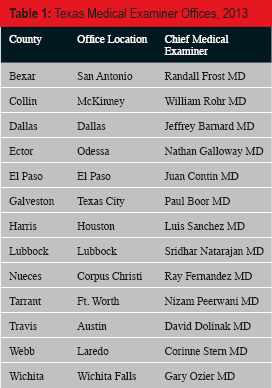
The Texas Code of Criminal Procedure defines both the role of the JP and the role of the medical examiner under Chapter 49: “Inquests Upon Dead Bodies” (6). In section 1, article 49.25 (Medical Examiners), it is stated that “the Commissioners Court of any county having a population of more than one million…shall establish and maintain the office of medical examiner…” Any county with a smaller population may establish an office of medical examiner if they wish. In addition, the statutes allow for multiple counties to form a medical examiner district if they so desire.
Transfer of duties of the JP is defined under section 12 of article 49.25. In the event that the county commissioners choose to establish an office of medical examiner, “all powers and duties of the justice of the peace in such county relating to the investigation of deaths and inquests shall vest in the office of the medical examiner.”
Educational Requirements
There are no specific educational prerequisites for holding the position of justice of the peace. Justices may occasionally be lawyers, but they are more often educators or law enforcement officers. Under Texas Government Code section 27.005, the justice of the peace is required to complete a general 80 hour training course during their first year elected (not before), and must maintain 20 hours of continuing education each year thereafter (7). The 80 hour training is divided into three seminars (20 hours in December, 40 hours in January, and 20 hours in March), and provided by the Texas Justice Courts Training Center (TJCTC).
The number of hours of training specifically devoted to death investigation is not mandated, but multiple hours during the first 80 hours are devoted to inquests and death certification. These lectures are given by medical examiners, representatives from the Texas Department of Health and Human Services, and the National Center for Health Statistics at the Center for Disease Control and Prevention. The 20 hours per year of continuing education include many different topics including lectures on inquests and death certification, ethics, domestic violence, organ and tissue transplant, and children with disabilities.
It should be noted that the requirement for medical examiners, as outlined by the Texas Code, must be licensed by the Texas Medical Board and must have “training and expertise in pathology, toxicology, histology, and other medico-legal sciences” (6). There is no requirement that the physician is necessarily a pathologist, has completed a forensic pathology fellowship, or is board-certified in forensic pathology. However, many of the medical examiner offices have established these requirements on their own or through their own county codes. Legislation had been proposed recently to require medical examiners to be board-certified in forensic pathology, but that proposal failed. There are no plans at this time to reintroduce this proposal in the next legislative session.
Death Investigation and Certification
As with the coroner system, it is the responsibility of the JP to complete the death certificate in their jurisdiction, unless that county has a medical examiner. The JP is not obliged to report a death to a medical examiner, since it is the responsibility of the JP to complete the death certificate. Thus, it is possible that a case that should be investigated and autopsied may not be.
The justice of the peace is free to choose any pathologist to perform an autopsy, and is not required to consult a forensic pathologist. Many choose nearby medical examiner offices, while others opt for private pathologists or occasionally private groups. In this manner, some medical examiner offices effectively function as “regional” offices, but the ultimate responsibility of death certification is left to the justice of the peace. The author's office in Dallas currently has this type of arrangement with roughly 60 counties.
The decision to order an autopsy may be influenced by the justice's training and experience, personal knowledge of the family involved (particularly in smaller counties), or budget limitations placed by local county commissioners. In the author's own experience, an “obvious” suicide was not sent for autopsy by a justice of the peace, but was found to be a homicide years later. On the other hand, the JP may order an autopsy on a case that a medical examiner may feel is unnecessary. This may also be due to the experience and training of the JP, but it may also be done to keep voting constituents happy.
The consulting pathologist provides an autopsy report to the JP, who then opines on cause and manner of death. The JP is not legally bound to the opinion of the pathologist, and may choose to modify or completely ignore the opinions of the consulting medical examiner. Some justices of the peace have suggested legislation that would prevent the consulting pathologist from providing a manner of death in their report, but this proposal has not gained significant traction and has never been put forth for a vote.
There are no data available through the Texas Department of State Health Services Vital Statistics Unit concerning the rate of death certification errors of justices of the peace versus forensic pathologists or hospital physicians. While forensic pathologists clearly have the most training in this area, justices arguably have substantially more training in death certification than regular hospital-based physicians, and also know their limitations (thus knowing when to consult a forensic pathologist). Medical schools spend little if any time teaching physicians about death certification, and often residents learn “in the trenches” from staff with equally poor training.
In some states, the office of Justice of the Peace has been replaced with other municipal courts (8). The American Bar Association has been an active supporter of the abolition of the position of JP, contending that judges, regardless of jurisdiction, should be formally trained lawyers. This sentiment echoes those expressed by many forensic pathologists, in that death certification should be limited to formally trained physicians and not lay coroners or justices of the peace.
In Texas, there has not been a substantial push to abolish the position of Justice of the Peace, but there have been suggestions that death investigation should be limited to the medical examiner. In effect, most of Texas already functions informally as regional medical examiner systems, and some feel that this should be formalized.
Conclusions
In Texas, justices of the peace are an important part of death investigation and death certification. These judges serve the majority of counties in Texas where the population is small and medical examiner offices do not exist. Although JPs come from various backgrounds and often have no formal training in medicine they are relied upon, much like coroners in other states, to certify cause and manner of death. Justices of the peace have required training during their first year in office and continuing education during subsequent years, and arguably understand death certification better than most nonforensic pathologist physicians. Forensic pathologists that perform autopsies at the request of a justice of the peace should make every effort to communicate effectively with these judges to ensure quality death investigation and certification.
Footnotes
Acknowledgements
The author would like to thank Judge Judy Hobbs (JP, Williamson County) and Susan Rodriguez (Texas Dept. of State Health Services) for their valuable input.
The author, reviewers, editors, and publication staff do not report any relevant conflicts of interest.