







Abstract
The National Institute of Standards and Technologies (NIST) has transformed the majority of the Scientific Working Groups (SWGs) into the Organization of Scientific Area Committees (OSAC). The OSAC has been created to foster the development of standards and guidelines for the practice of documenting evidence by methods that are technically sound and accepted by the consensus of forensic practitioners. The OSAC is composed of 33 committees arranged in a hierarchy. Potential standards begin in a Subcommittee and must work their way through approval by the Subcommittee, the Subcommittee's parent Scientific Area Committee (SAC), and finally the Forensic Science Standards Board (FSSB) before being adopted into the FSSB Registry of Approved Standards. NIST hopes to find existing standards with technical merit that were developed through a standards development process for adoption as national standards of practice. The OSAC provides forensic scientists the unprecedented opportunity of validating their own scientific practices within the framework of sound scientific practice.
Keywords
Introduction
In 2009, the National Research Council of the National Academies published Strengthening Forensic Science in the United States: A Path Forward, which called for more rigorous basic and applied research to underpin the practice of forensic science (1). In the ensuing five years, the Federal Government has turned its attention toward the practice of forensic science. The White House Office of Science and Technology Policy recommended that federal involvement in forensic science be split between two agencies: the Department of Justice and the Department of Commerce. The contribution of the Department of Justice to oversight of forensic science is the National Commission on Forensic Science (NCFS), which focuses on policy recommendations to the Attorney General. The Department of Commerce houses the National Institute of Standards and Technology (NIST), and it is the application of the expertise of NIST to scientific standards for forensic practice that completes the Federal Government's plan to require forensic examiners of all sorts to demonstrate the science in their work. NIST has transformed the majority of the Scientific Working Groups (SWGs) into the Organization of Scientific Area Committees (OSAC).
The OSAC has been created to foster the development of standards and guidelines for the practice of documenting evidence by methods that are technically sound and accepted by the consensus of forensic practitioners. These standards and guidelines are intended for adoption by the entire forensic science community. The OSAC itself is to work toward becoming a sustainable organization that will one day be a part of the forensic science community, independent of NIST.
The OSAC is composed of 33 committees arranged in a hierarchy
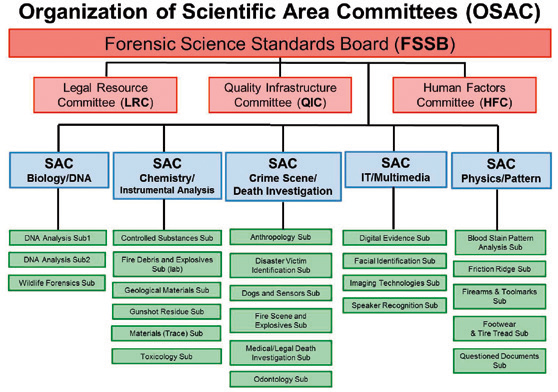
Organization of Scientific Area Committees organizational chart displayed in traditional hierarchy.
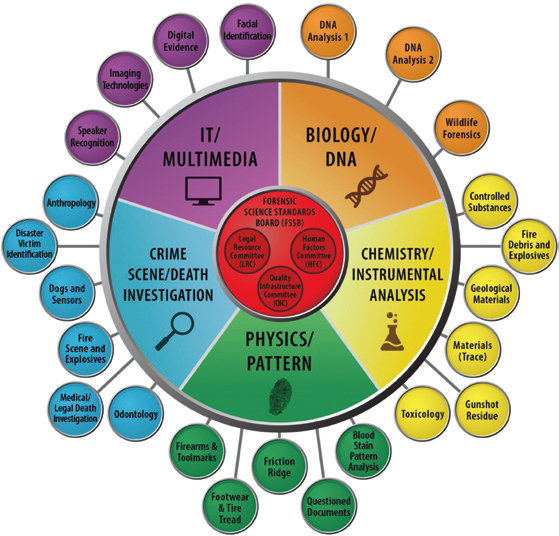
Organization of Scientific Area Committees organizational structure displayed as a circular chart, modified and updated in accordance with Figure 1.
List of National Association of Medical Examiner Members in Organization of Scientific Area Committees
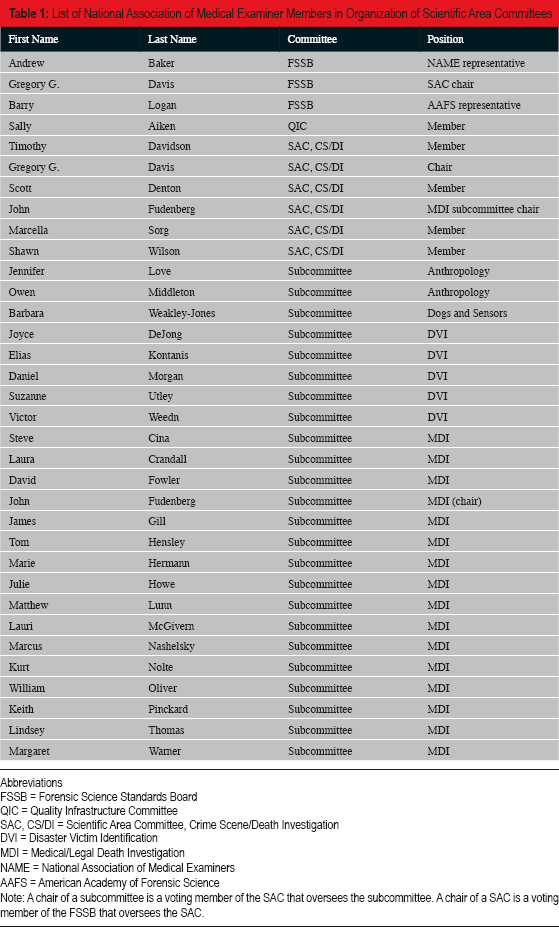
Abbreviations
FSSB = Forensic Science Standards Board
QIC = Quality Infrastructure Committee
SAC, CS/DI = Scientific Area Committee, Crime Scene/Death Investigation
DVI = Disaster Victim Identification
MDI = Medical/Legal Death Investigation
NAME = National Association of Medical Examiners
AAFS = American Academy of Forensic Science
Note: A chair of a subcommittee is a voting member of the SAC that oversees the subcommittee. A chair of a SAC is a voting member of the FSSB that oversees the SAC.
The subcommittees develop and vet formal documents as directed by their respective SAC. The subcommittees submit these documents for approval by their SAC and the FSSB. The subcommittees are to review existing SWG documents as well as other pertinent documents, such as standards endorsed by forensic science organizations, and consider how to transform the contents of these various documents into the OSAC registries of standards and guidelines (further described below). Thus, the work of a given project begins in a subcommittee. The subcommittees are composed of up to 20 voting committee members and up to five additional consultants, formally titled “invited guests.” A subcommittee is generally composed of 70% practitioners, 20% researchers (e.g., statisticians, certification specialists, epidemiologists), and 10% research and development technology partners and providers. A practitioner is defined as someone actively doing or managing casework (4). Practitioners are to be a mixture of individuals working at the federal, state and local, and civil levels (private practice). Subcommittee members were proposed by a task force of members from the SAC that oversees the subcommittee, typically formed from the subcommittee chair and the other members of the SAC with expertise pertaining to the subject matter of the subcommittee. Proposed subcommittee members were then reviewed and approved by first the SAC and then the FSSB. Finally, NIST and the Department of Justice (DOJ) reviewed the proposed members and extended an invitation to join the subcommittee to all the applicants approved.
Subcommittee deliberations are not open to the public. Overlap in interest in the subjects of each subcommittee (e.g., forensic pathology and forensic anthropology) is fostered by having all the subcommittees meet simultaneously, allowing individuals from subcommittees to participate in other subcommittee deliberations as interested or requested. SAC members are also welcome to participate in the subcommittee deliberations, but they have no vote in subcommittee decisions with the exception of the subcommittee chairs (the chair of each subcommittee is a voting member of that subcommittee's SAC).
In our hypothetical case, the subcommittee has deliberated the benefits and costs of all practitioners in a field being certified by an independent board as being competent to practice in that field. (Pathologists receive such certification from the American Board of Pathology). The subcommittee has voted to recommend certification for all practitioners. This recommendation now goes up to the SAC for review.
The SACs are to be composed of up to 15 members comprised of each subcommittee chair, representatives of professional forensic science organizations that are appropriate to the scientific area of the committee, researchers, and measurement scientists (including statisticians and epidemiologists). For the Crime Scene/Death Investigation SAC, the pertinent professional forensic pathology organizations are the American Academy of Forensic Sciences (AAFS) and the National Association of Medical Examiners (NAME). The chair of a subcommittee cannot be chair of the SAC, nor may the chair of the SAC also chair a subcommittee. The membership of the SACs was initially determined by the NIST-DOJ Leadership/Membership Committee.
Each SAC sets the priorities for subcommittee work, bringing a larger view to the subject area for each subcommittee. For example, the members of the Crime Scene/Death Investigation SAC are fairly evenly divided among anthropologists, pathologists, coroners, odontologists, scene investigators (including fire scenes, explosion scenes, and dogs and sensors), and researchers. Many individuals have experience in more than one area, such as odontologists with experience working in mass disaster victim identification in addition to the identification of single decedents on occasion. SACs recommend to the FSSB any adjustments needed to the composition of the subcommittees that the SAC oversees, whether creating a new subcommittee, merging existing subcommittees, or abolishing a subcommittee. The SACs are intended to be the workhorse of the OSAC, identifying or developing standards that will affect the entire scientific area covered by the SAC.
The meetings of each SAC will be open to the public, and agendas will be made available prior to meetings. NIST intends for the first open SAC meetings to occur during the annual meeting of the AAFS. Thus, the hypothetical recommendation from the Medical/Legal Death Investigation Subcommittee that all practitioners be certified in their area of practice will be reviewed and debated by the SAC in public forum. The public will be given opportunity to comment on the topic, not only at the SAC meeting but also online during a period of time, much as NAME members may comment upon potential NAME position papers (5). The SAC can approve a recommendation, reject a recommendation, or return a recommendation to the subcommittee for additional work before reconsideration by the SAC.
Just as the subcommittees are overseen by a SAC, the SACs are overseen by the FSSB. The FSSB is composed of 17 members: the five SAC chairs, six representatives of professional forensics organizations (currently AAFS, the Association of Firearm and Toolmark Examiners, the American Society of Crime Laboratory Directors, the International Association for Identification, NAME, and the Society of Forensic Toxicologists), five members at large from the research and measurement science communities, and one NIST ex-officio member. The initial selection of the FSSB was made by NIST-DOJ Leadership/Membership Committee. NIST solicited recommendations from each professional forensics organization for the individual that the organization wished to represent it.
The FSSB will review each recommendation made to it by the SACs, and either approve the recommendation, reject the recommendation, or send the recommendation back down for revision. Remembering that NIST is the National Institute of Standards and Technology, it is hardly surprising that the FSSB is intended to review and approve forensic science methods as being technically sound and endorsed by the consensus of forensic science practitioners. Those methods approved by the FSSB will be on the FSSB Registry of Approved Standards. Attorneys may refer to this Registry of Approved Standards when preparing for trial. If the method that a forensic scientist used is on the Registry of Approved Standards, then questions concerning that method should be few and easily answered by the scientist while testifying. NIST allows for the existence of valid methods not on the Registry of Approved Standards in several ways. Any method not yet approved should be the method most fit for the purpose for which it was used, and the scientist should be able to justify use of the method when asked to do so in a trial. Likewise, the scientist should be able to justify either the use of an alternative method when an appropriate method already exists in the Registry of Approved Standards or the use of an approved method in a novel way.
The FSSB has available three support committees - the Legal Resource Committee, the Quality Infrastructure Committee, and the Human Factors Committee. The Legal Resource Committee is composed of judges, attorneys, and legal experts available if the FSSB has a question pertaining to law or legal interpretation. The Quality Infrastructure Committee is composed of standards experts, accreditation and certification specialists, quality system managers, forensic science practitioners, and forensic science laboratory managers. The Quality Infrastructure Committee will provide guidance on matters pertaining to quality, as well as impact statements to inform agencies how specific standards may affect laboratory operations. The Human Factors Committee is composed of psychologists, quality systems managers, and usability experts and will provide insight into the influence of systems design on human performance, particularly ways to reduce errors in complicated tasks. The NIST-DOJ Leadership/Membership Committee selected the initial members of these support committees.
Picking up the hypothetical recommendation that all practitioners be certified, the FSSB can approve the recommendation, reject the recommendation, or send the recommendation back down for revision. If approved, then certification would become the expected standard for practitioners in the field for which certification is now, essentially, mandatory.
OSAC members may serve a term of three years, and a given term is renewable. Initial terms are being randomly distributed as terms of two, three, or four years so that the entire membership will not turn over every three years. OSAC is actively evolving within the framework described in this article. NIST continues to accept applications, and any NAME member interested in serving should apply. NAME is well represented within the OSAC because NAME had so many of its members apply initially.
Creating standards de novo would be costly and time-consuming. Therefore, NIST hopes to find existing standards with technical merit that were developed through a standards development process. NIST considers a reasonable process a process that is transparent and free from undue influence. Further, a reasonable process represents a balance of interests with open debate leading to a consensus. Technical merit is shown by standards that have detailed scope and are fit for the purpose for which they were created, taking into account potential bias and measurement of uncertainty. If no such standards exist, then NIST hopes to catalyze the development of the standard through existing standards development organizations or through the OSAC itself. NAME wishes for the NAME Autopsy Standards to become the standard for autopsy practice in the Registry of Approved Standards. The NAME Autopsy Standards will have to go through the same path outlined above for a hypothetical recommendation, but the NAME Autopsy Standards were developed by experts in autopsy pathology in an open forum and have proved their merit both technically and practically.
NIST intends to foster the OSAC long enough for OSAC to become self-sustaining before NIST sends the OSAC forth on its own. One might imagine that a forensic science organization would be the perfect entity to host OSAC. The financial cost of OSAC is great, however, and even the largest forensic science organizations, such as the AAFS and the International Association for Identification, must consider carefully before taking on the responsibility of overseeing the OSAC. All of this is some years in the future, but this is the eventual goal of NIST concerning the OSAC.
Conclusion
The tension between unregulated practice and regulation of practice has existed since before the United States was founded. Nothing is happening now that has not happened before. One hundred years ago, medical schools that were little more than diploma mills led to the appointment of Abraham Flexner, an educator who was not a physician, to investigate all the medical schools in the United States and Canada (6). After investigating the schools, Flexner issued his report stating that schools that taught physicians medicine based on a scientific foundation were sound or could be made sound, and that all other schools ought to be abolished. The schools that remained were to follow certain standards of practice in education. Flexner's recommendations were enacted, which surely engendered protest and charges of illegal suppression of practice. All physicians trained in the United States and practicing today are the direct products of the Flexnerian revolution in medical training, and the past century has seen medical advancements unimaginable in Flexner's day. Now forensic science faces this same call to base its training and practice on sound scientific principles or risk being put out of business. Such a revolution cannot help but lead to suspicion in some and frustration for many more. Nevertheless, this represents a spectacular opportunity for forensic practitioners. Heretofore courts have tried to assure the practice of sound forensic science in court by judicial means, such as Daubert rules (7). But judicial attempts to regulate the sound practice of forensic science have relied on individuals with legal training to review and validate the science used by forensic scientists rather than relying on individuals with scientific training to validate science and scientific procedures. The OSAC provides forensic scientists the means to validate their own scientific practices. Moreover, we forensic scientists have been given access to statisticians and other experts essential to the practice of sound science, a luxury that we could not have afforded on our own. We forensic scientists must seize this spectacular opportunity with extreme care and create a valid Registry of Approved Standards through deliberation at once cautious and bold.
Footnotes
Acknowledgments
The authors thank John Paul Jones II for providing Figures 1 and  and for review of this manuscript. The authors thank Gregory A. Schmunk MD for his work in compiling NAME members who are members of the OSAC.
Both authors are part of the Organization of Scientific Area Committees.
The reviewers, editors, and publication staff do not report any relevant conflicts of interest.