







Abstract

Firearms may be modified in a number of ways, either for aesthetic reasons, functional purposes, or both. The forensic pathologist should be aware of some of these modifications, particularly modifications to the muzzle end of the barrel, which may produce unique patterns or marks that can be transferred to the body during contact range firing. Common alterations or additions to the muzzle end of the barrel include compensators, muzzle brakes, door breaching brakes, flash suppressors, and sound suppressors (silencers). Some stock firearms are produced with these features as integral parts, but many will be added as aftermarket modifications.
The most common modifications to the muzzle of a firearm each have a unique function. A compensator consists of ports or slots in the superior aspect of the end of the barrel that direct the expanding gases in an upward direction when the firearm is discharged. The purpose of a compensator is to increase the speed and accuracy of subsequent firing by reducing muzzle rise after each shot (1). A muzzle brake usually consists of ports in the barrel that direct the muzzle gases rearward in order to decrease recoil. Muzzle brakes may also function as compensators, and the terms are often used interchangeably (2). Door breaching brakes are muzzle devices that are commonly used on tactical shotguns. The device is usually attached to the terminal end of the barrel and often consists of a piece of metal with multiple jagged points at the end. The jagged points are meant to secure the barrel against the door or door frame when using the weapon to make a ballistic breach. These devices will often also have ports to allow the expanding gases to escape from the barrel when the weapon is fired very close to a hard surface. Flash suppressors usually consist of longitudinal slots at the terminal end of the barrel that are intended to decrease and break up the smoke, soot, and muzzle flash created when the firearm is discharged. Flash suppressors are meant to improve the shooter's line of sight during repetitive firing, prevent temporary blindness of the shooter when firing in low light settings, and to decrease identification of the shooter's position. Sound suppressors (silencers) function to decrease the sound created by the sudden expansion of gases leaving the muzzle of a firearm when it discharges (3). This is usually accomplished by containing and routing the escaping gases through a cylinder containing a series of baffles attached to the end of the barrel. Hot gas, soot, and burnt and unburned powder can escape the muzzle through all of these modifications and may create characteristic patterned abrasions, soot deposition, or stippling on the skin.
We present a case of a 61-year-old male with a contact gunshot wound of the left side of the chest with an irregular pattern of abrasions and stippling. The decedent had a history of depression and suicidal ideation. He called 911 and reported that he had shot himself. When the police department responded to his location, the decedent was found to have a gunshot wound of the chest but was still responsive. He stated that he wanted to die and a suicide note was found at the scene. His death was pronounced in the emergency department.
At autopsy, the decedent had an entrance gunshot wound of the left side of the chest with a circumferential marginal abrasion, soot extending up to approximately 6 mm from the margin circumferentially, and soot within the wound track
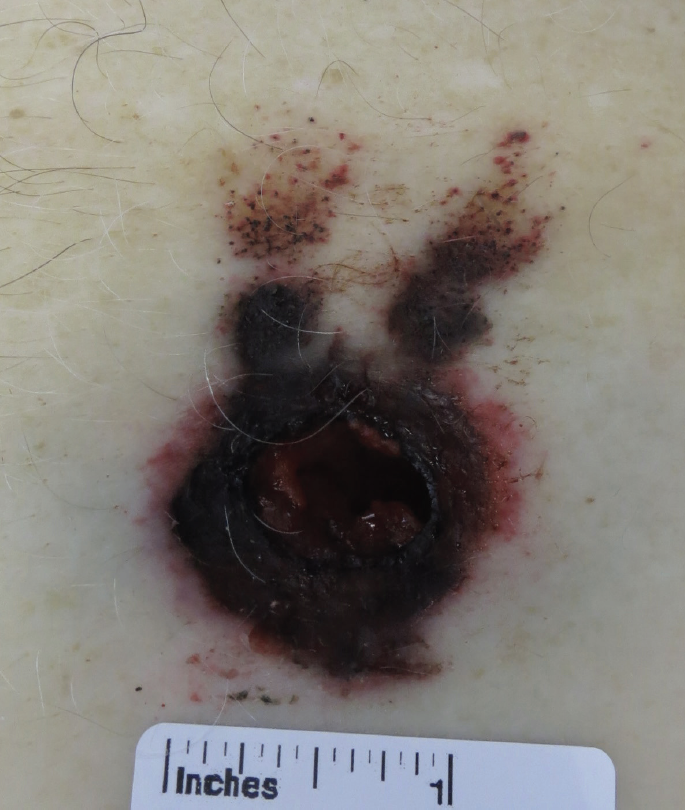
Contact gunshot wound of the chest.
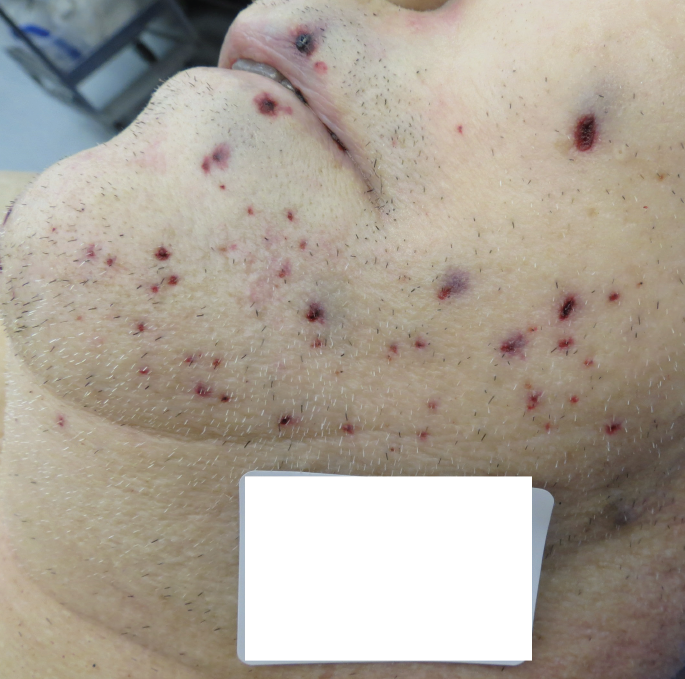
Coarse stippling of the face.
The firearm recovered at the scene was a .357 Magnum revolver, which the decedent had modified by creating a compensator consisting of six round holes in two parallel lines on the superior aspect of the muzzle end of the barrel
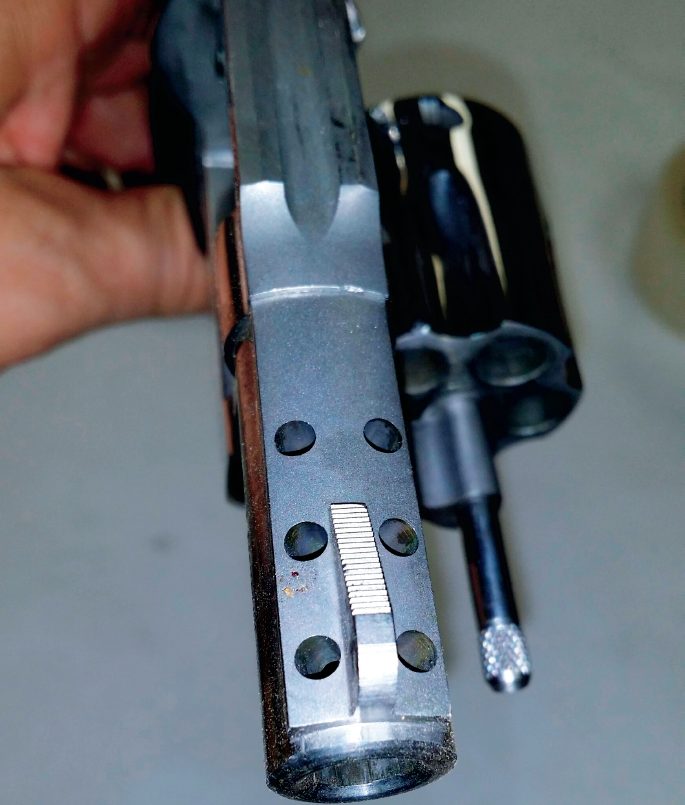
Revolver with drilled compensator holes in the superior aspect of the barrel.