







Abstract

A disclaimer: what follows is a first-person account of my experience following the 9/11 attack. I've read over what I've written, and will warn you now that it is spotty and self-indulgent, repetitive, peppered with gaping holes from things I've forgotten or repressed. You will likely find it irritating – it's essentially 8000 words of meandering, mawkish bleating – but it is fairly honest, and only minimally self-censored. One thing it is not in any way at all is a representation of the positions or opinions of the City of New York, or the Office of the Chief Medical Examiner of the City of New York. I left that agency at the end of 2015, after 25 years in service to the city; the thoughts and words here are my own.
What I remember most about 9/11 – the day itself – is the weather. Sunny, hotter than average. Bright blue skies, a perfect late summer day.
No, scratch that – I don't want to open with the weather. Too clichéd, even for me.
What I remember most about 9/11 – the day itself – is the girl. A blonde twenty-something with a Hamptons summer tan; she looked like she worked in Editorial at Condé Nast. Ray-Bans, hair up in a loose ponytail, pink Juicy sweatpants with a gold softpack of cigarettes tucked into the waistband. She stepped off 30th onto Second Avenue in front of me, then did a slight double take, wrinkling her pretty little nose at the flood of office workers walking Downtown. She turned her head, scanning the scene, sniffed the burning metal and ash smell of the air, then seemed to shrug internally. She picked a navel orange from the wooden crate in front of Todaro's; I followed her into the cool gloom, looking for a sandwich.
Ugh. What a fanciful, affected start to this article, a beginning worthy of a self-published noir novel! I'll be honest: 9/11 is something I have a hard time thinking about, let alone talking about. Let alone writing about. And I thought of that girl a lot during the following year, and I think of her still. When I sat down to talk about 9/11, she seemed like an easy way into it.
I mean, after all, she was important to me.
Obviously, this is nothing like a scientific article – it's the opposite, really. My memories of that year are completely disordered and fragmentary, shot through with active repression and subjective distortions. I don't really want to talk about the scientific approach to how we handled the worst mass murder in American history – Jim Gill has already done a fantastic job with that (1). What I want to talk about is what it was like to do that work, how it affected me, and how it affected others. And more generally, about how working with death – especially violent, unnatural death – affects all of us. Because I almost never hear us talking about this among ourselves – Lord knows I never talk about it. So brace yourself: this is probably going to get ugly. Or uglier, depending on your opinion of what I've written so far.
Anyway, yes, late morning on September 11 in 2001, I left the morgue, walked up to Second Avenue to get lunch, and saw a pretty blonde. And I've remembered that 30-second encounter for the rest of my life.
In the initial rush of a disaster, your perspectives get screwed up, your priorities get weird. By that point, I'd been a medical examiner about a dozen years, and had worked on a number of mass fatality incidents. What happens first – no matter how well-rehearsed an office may be – is a moment of intense logistical kabuki, a shuffling and rushing of organizational responsibilities as the emergency response team tries to assess the nature of the crisis, and to start funneling appropriate resources to where they're needed. It's like a dense fog within which many things are happening at once, the outcomes and purposes of which are not immediately clear. A wave of URGENCY floods the institution, a kind of unresolved adrenaline burst, a frantic instruction to fight or flight or both.
Yes, by all means, you must follow the instructions issued by whomever's issuing instructions. But be sure to look after yourself first. The first bodies are never there when the coordinators say they'll arrive. They'll always wake you too early to tell you to assemble. If you're smart, you'll set in the things you're going to need – something to eat, a stock of snacks. A few bottles of water or whatever to drink. Clean clothes, maybe a toothbrush and a towel etc., if it looks like it could go long.
But I'm getting ahead of myself. Or away from myself.
I was taking a break from the empty waiting when I saw the girl. We were in the midst of a major disaster, but nothing was actually happening at the office yet. The planes had only recently hit, and Charles Hirsch, the Chief Medical Examiner, had taken a team down to Ground Zero to assess the situation and start figuring out how we would work the triage. It was obviously going to be a while before I'd be able to do something, so I left the office and headed up 30th to get my sandwich. On the plaza outside New York University Medical Center, there was a flotilla of gurneys attended by tense residents and medical students in green scrubs, young, terrified, waiting. That was a hard part of this, at the beginning – not knowing the scale of what we were dealing with. Not knowing the number of fatalities, what sort of injuries we'd be called to handle.
That said, our office was pretty well prepared for a major attack. On the afternoon of February 23rd of 1993, I was doing autopsies in the basement when a detective came in to announce that a bomb had gone off in the basement of the World Trade Center. I dismissed it out of hand – the notion was absurd! It was probably just a blown transformer or a steam pipe explosion, and what we were seeing was typical cop overreaction.
But, of course, the cop was right. Ramzi Yousef, as a gesture of solidarity with Palestine, had parked a box van loaded with over a thousand pounds of urea nitrate in the basement garage of the World Trade Center. He hoped that the North Tower would topple into the South Tower, killing (by his estimate) 250 000 people. He flicked a cigarette lighter, lit four 20-foot fuses covered in surgical tubing, then hurried away. The explosion killed six people; between the bomb itself and the evacuation, over a thousand were injured.
The 1993 World Trade Center bombing was a wakeup call for New York's emergency managers. Preparations for large-scale attacks were stepped up, disaster plans were revamped, and joint agency mass fatality incident exercises were begun. Without that first attack, we would not have been ready to meet the challenges of 9/11 as well as we did.
My own reaction to that bombing was telling. Statistically, based on the number of terrorist bombings I'd personally experienced – zero – it was a reasonable response. By the time we started autopsies on the victims the next day, I knew we'd been attacked by terrorists – after all, the explosion had left a crater almost a hundred feet wide through four basement subfloors. But at some level I continued to wrestle with what psychologists call normalcy bias – the internalized belief that the world as we know it will keep going in the way that we know it, with only minor and reasonable excursions from that trajectory. (The citizens of Pompeii, for example, watched Mount Vesuvius spurting lava for hours without evacuating, until the eruption became explosive, drowning the city in ash and pumice and killing most of the town's 20 000 inhabitants).
Normalcy bias is useful because it streamlines our thoughts and actions, and makes us more efficient in our everyday life. The problem is that the same phenomenon that helps us in the ordinary stretches of a lifetime can be paralyzing when an unexpected threat happens. With normalcy bias, if we hear the sound of explosions a block or two away, we rationalize them as “backfiring cars” or something similar, rather than gunshots. Along those lines, if you've done external examinations on one thousand 80-year-old women with previous medical history found dead in bed, it'll be easier for you to dismiss signs of subtle asphyxiation homicide in the thousand and first.
Of course, we now live in a world where we're all so cognizant of the threat of terrorist violence that our expectations of normalcy have shifted to accommodate the threat, even to hypervigilance. Just recently, the end of a concert in Brooklyn devolved into a stampede after the crowd mistook the sound of equipment being dismantled for gunshots.
But back in September, 2001, I was far from hypervigilant. I had the day off, and was sitting at home at my computer when a friend direct-messaged me, “A plane just crashed into the World Trade Center!” I think my response was “Haha, very funny.” (Normalcy bias). She replied, “No, I'm serious! TURN ON YOUR TV!” I was still doubtful, but I said, “A small plane?” (Normalcy bias). For, of course, how could a large airliner fly into a skyscraper? To which she replied, “No! It's a big jet! Oh my God! The building is on fire!”
I turned on the TV; the television transmission antennas on the towers hadn't yet failed, and all the networks were broadcasting live, all showing the North Tower in flames. I left the TV on as I filled a bag with a change of clothes and a Dopp kit. The transit system was still running, so I took the Third Avenue bus uptown. An old man had a transistor radio, and all the passengers were silent, listening. I think I was still trying to rationalize the plane crash – modern jetliners have a high degree of automation, and are computer-directed along particular flight paths. Could there have been some malfunction in which the plane was locked into the wrong coordinates, the pilot unable to pull it out of that path in time to avoid both towers? There had to be a reasonable explanation. (Normalcy bias).
Then the voice on the radio grew shrill as the second plane hit; a couple of women on the bus screamed. And then the truth was unavoidable. When I walked into the body intake bay, the staff was massing, grimfaced, prepping our disaster response. The Feds were saying there'd been other planes, that it wasn't just New York. That we were under attack.
Looking back on that first day, the overwhelming memory was one of uncertainty. And of fear, the flip-side of the coin of uncertainty. We were under attack, but from where? Four planes so far – what else? What next? Would there be ground-based assaults? The 9/11 attacks are all now neatly braided into the fabric of history, but in the information void on the day itself, we had no way of knowing what we were facing.
I went up onto the roof of the hospital next door. I could see smoke rising in lower Manhattan, the towers hidden just behind the Downtown skyline. At first the smoke formed gray turrets, but then it turned blacker, and bent west toward New Jersey. I remember standing there, wanting something to change, wanting something to happen – for some kind of clarity, for some definitive resolution – and of course, what happened next was that the towers fell.
When the first tower collapsed, the advance team – Hirsch, our anthropologist Amy Zelson-Mundorff, and a crew of senior medicolegal investigators – couldn't outrun the falling debris. Hirsch got torn up, had some ribs broken, I think – he was very discreet, that man. Amy was concussed. One of the investigators suffered severe crushing injuries of her leg, with ongoing disability today, both physical and emotional. They were among thousands who needed treatment at area hospitals that day. Hirsch got stitched up a bit in the emergeny room, then made his way back to the office. He was always immaculately dressed in crisp white shirt, impeccably knotted tie, and suspenders, but when he walked back into the lobby that afternoon, he was still bloodied, chalky with debris, his hair spackled with dust, his suit jacket in tatters. I was there – a receptionist literally cried out in shock at the sight of him.
And that man walked into his office, wrecked and disheveled, sat down, and proceeded to run the largest forensic mass fatality response in modern history. (An aside: it may be irritatingly obvious that I was in awe of him. I worked closely with him for almost 25 years, and he almost never put a foot wrong. He demanded a circumspect approach to death certification, and insisted on precisely reasoned wording for cause and manner of death. Most – but not all – of the forensic pathologists who trained under Hirsch idolize him. He was effortlessly epigrammatic, and even now, in any discussion of a problematic case, a Hirsch trainee will likely quote one of his aphorisms: “Bacchus has drowned more men than Neptune” or “Common things are common because they are the things that occur with the greatest frequency.” Trite, perhaps, but as neat a summation of Occam's razor as you're likely to find. And funny).
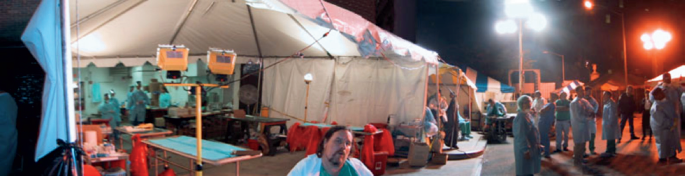
A field morgue was set up down at the disaster site for the primary triage; some of you reading this will have worked there. Up at the office in Midtown, our end of East 30th Street – a less than salubrious stretch, straddled by the back end of New York University Medical School and the Bellevue Men's Shelter – was closed to traffic, and a main body triage area was built out off the mortuary loading dock. Initially, we worked in the garage on makeshift tables on sawhorses, but canvas awnings miraculously sprouted along 30th, and soon the street, previously a popular hangout for the homeless, had become a seaside carnival alley of tents holding representatives of different agencies, from NYPD and FEMA to a makeshift cafeteria run by the Salvation Army.
There were few bodies the first day. The first victims were fairly intact – they were recovered from the periphery of the collapse radius, and had sustained extensive blunt trauma. They were readily identifiable, because their personal effects were still on their bodies, and they hadn't been burned. But after the initial trickle, things slowed as the bodies became harder to access.
It was still slow enough on the night of the 12th of September that I decided to ride down to Ground Zero with the morgue wagon to get a look at what we were dealing with. Under the emergency lighting, the scenario was utterly apocalyptic, a cratered and pocked lunar surface where the day before buildings had stood. Most of the visual landmarks were gone, and on the ground under our feet, a deep layer of debris and ash had been tamped into a plaster-like mud pathway. We walked in single file through the dark into the cavernous skeleton of the Winter Garden, a glass and iron structure inspired by the Crystal Palace of Victorian London, its ornamental palm trees now tipped and scattered, its marble floors layered with silt and ash. We moved through the gloom on to Ground Zero itself, a pile of smoking rubble, smashed concrete slabs and exposed industrial metal. Crawling across the wreckage, an army of men and women labored under vast spotlights in the desperate search for survivors. The scale of the disaster was really unimaginable. I couldn't make myself go back to the Winter Garden until 2008.
As the workers on the pile began to recover remains, the analytic approach – which evolved constantly in the first weeks (and continues to evolve even now, as more remains are recovered, and the identification process continues) – assumed its initial shape. Remains (or possible remains: extreme fragmentation, postmortem drying and heat artifact were challenging confounding factors in the recovery) were brought from Ground Zero up to 30th Street. The materials, typically tagged onsite, were triaged by the anthropologist, and then divided between the tables for documentation and analysis.
Again, after those first few days, much of what we saw was fragmentary; indeed, we saw a progressive diminution of the size of recovered tissues over time. At the beginning, we were examining full bodies, then limbs, then fragments of limbs, until finally we were poring over debris, looking for any possible human tissue the size of half a little fingernail. Henry Ford would've been proud of us – fairly quickly, we had a tight little production line going, with specimens proceeding in staged fashion, starting with the anthropologists, then to the pathologists. Each ME worked with a missing persons cop and a circulating photographer, and, in the first months, a medical student from NYU or Columbia to act as scribe. Personal effects were documented photographically. A lot of the remains were radiographed, and our forensic odontologists played a big role in the early identifications. Finally, we submitted DNA samples on all possible tissue (red muscle where available, bone or tooth where not), the little red-topped test tubes (or were they blue?) carried to a freezer by a chain of fresh-faced, terrified-looking NYPD recruits.
Oh, wait, the anthropologist! Amy had been knocked out in the collapse of the South Tower. After a stay in hospital, she showed up on the morning of the 13th with the most spectacular (forgive the pun) set of black eyes I'd ever seen; when he saw her, Hirsch hugged her and told her she was beautiful.
And then, just like Hirsch, Amy put aside any emotion she might have felt, and got on with the work. I think that Hirsch made the New York office so strong because he set an unrealistically high standard. And when you had role models like him and Amy, there was no possible excuse for slacking, whining, no excuse for fatigue or absence. Sometimes, I'd be on the line at 3 am, and look up to see Hirsch there, walking through, saying encouraging things. (It was also the first time I'd seen him in shorts).
It was grueling, grim work. The hours of picking through debris and rubble, trying to discern whether a leathery brown scrap was wet cardboard, rotting leather or human skin. We staffed the processing line 24 hours a day, for eight months, when officials declared the excavation of the site complete. The smell of jet fuel, then smoke, the cold as winter came on; the doldrums of sitting at the table with nothing to work on; the wired unease whenever rumor spread that they'd found a “pocket” (a cluster of remains in a cutoff section of stairwell, for example), only for it to ebb as it turned out, time and again, to be a false alarm. It was hard work, and long. And that became a problem.
In the background, the office's daily caseload continued unabated – murders dropped off radically in the first weeks after attack, but it was New York, and it had eight million stories, and there were always plenty of other cases to take care of. Plus, of course, eventually the murders came back. There was a fantastic flood of volunteers, experienced forensic pathologists from across the nation who wanted to help with the identification process. But Hirsch decided to work with pathologists who were already affiliated with the city, and who would be available for follow-up in the months and years to come, rather than coordinating volunteers coming in for a week or two at a time. He decided that only OCME MEs would work on the remains identification; visiting forensic pathologists worked down at Ground Zero, or, later on, at the Staten Island landfill. (As the diggers excavated the site, removed material was searched preliminarily at the scene, then shipped to a landfill on Staten Island. A second processing system was set up there, and all of the transported rubble and debris was reevaluated for possible tissue overlooked during the onsite search).
That decision not to accept extra help on the processing line was hard – it meant that most of the analytical and sampling work was handled by a core group of fewer than 20 New York City pathologists, all of whom were also pulling a full caseload of regular work. We worked initially in 12-hour shifts, but as time went by, and exhaustion set in, and the recovery rate dwindled, we settled down to dividing the work into 8-hour shifts. Years later, Hirsch told me that if he'd had to make the choice about accepting help from outside pathologists again, he'd have chosen differently.
So, yeah – it was hard, and it sucked, and it went on for a long time. And the very hardest part about it was this: the cops and the firemen who'd given their lives trying to save others. They were heroes, and we spared no effort to help get them identified and home to their loved ones – they were a key reason the digging at Ground Zero went on 24/7, and why we kept the line running 24/7. Whenever the possible remains of a member of service were recovered – a piece of a fireman's bunker gear, fragments of navy pants with a belt of possible NYPD issue – an entire firehouse or a squadron of cops would assemble to greet the ambulance as it carried the remains, always draped in a flag.
All work would halt, and we would stand silent to honor the hearse as it rolled slowly down 30th to the triage area, the cops or firemen lining the street in formation. In the late summer heat, in autumn rain, in winter snow, three o'clock in the afternoon, three o'clock in the morning. It was right, and it was grim, and it was just utterly heartbreaking. There was no way to protect yourself from this endlessly renewing well of grief. In New York, police and fire service are often family commitments, with families of cops and firemen going back generations. So many of them were lost on that day, and their crushing burden was devastating to behold.
I've worked plenty of mass disasters; it's tough work, emotionally and physically exhausting, but you can get separation from it. You maintain separation from the loss, keep your head down and focus on doing the work – getting the identifications done, getting the dead back to the people who love them. In events with a large number of victims, the ME rarely sees the families – she or he is in the back, busy with the work.
And that's what we were doing after 9/11; except that every day, we participated in these rituals of abject grief. Sometimes, a relative of a tentatively identified victim would be present, flinging themself forward to embrace the body inside the pouch. It was truly agonizing to witness such complete anguish and loss up close, over and over again. Our task became not so much Sisyphean as Promethean: every day the wound was torn open afresh.
The flip side of that is that I felt unworthy of any grief I experienced, guilty for any anguish – after all, I had lost no one, and I had lost nothing. Friends of friends, relatives of friends, but no one close to me had died. And my apartment suffered nothing worse than a few weeks of bad air and dust, and the ravages of a neglected, wired cat. I swallowed the despair I felt as time went on. What right had I to grieve? So many had lost so much, and I was one of the lucky ones. I was just doing my job.
There were good things, too – mostly the people, the endless kindness of the people. Volunteers of all stripes, from all over the country, from DMORT's forensic anthropologists and pathologists, to the Salvation Army crews who ran their little tent kitchen throughout the winter (a belated shout-out for Christmas Dinner 2001!). Everyone wanted to help. Indeed, that was one of the great privileges of our work: particularly in the post-apocalyptic early days, when all the bridges and tunnels into and out of Manhattan had been shut, when the city was closed off below 14th Street (the borders of Downtown Manhattan were patrolled by armed National Guardsmen – I had to show ID to get to my apartment), when there was still fear about what would happen next, those of us working on identifying the remains had a true purpose, an authentic, substantial meaning at a time when everyone's lives had been kicked over. We knew what we were doing, and we knew that it was important.
Important and desperate. Rapidly after the attack, the neighborhood around the morgue became transformed into something between a shrine and an information repository, as relatives covered every square inch of brick wall, or fencing or lamp post or traffic light with MISSING flyers. Each day, we'd walk to work through a gauntlet of faces of the lost, photographs of young women and men – family photos, vacation photos, photos of the younger victims at their high school graduation. It was hardest at the beginning, when the crowds were dense and the pain so clear-cut and inevitable. All the families holding toothbrushes or razors, there to hand in hair samples from combs, or to have their mouths swabbed, carrying traces of those they had lost on them and in them.
For the first time, I really understood the old curse, “May you live in interesting times.” Even after the city returned to normal, and the bridges and tunnels opened and the barricades in the militarized zone along 14th Street came down, life seemed to become increasingly unhinged. The long hours on the line, picking painstakingly through debris and gravel in the chill of the processing room, the smell of fuel and smoke acid in my nose, then the regular caseload autopsies, and finally crawling home to feed the cat and lie awake, wired and exhausted – it all took its toll. I stopped hanging out with my friends, stopped going out much, mostly ate alone at restaurants. When I did see friends, it was almost always one person at a time; crowds became uncomfortable, then intolerable.
I did manage to find some balance. I'd been writing professionally for a few years, mostly about food and music. I was a contributing food editor at Martha Stewart Living, so most months I was assigned to write something for the magazine. They would send me the layouts – mock-up pages from the magazine, with beautiful photographs and dummy text where my words would go – and I would bang out some appropriately deathless prose. I remember coming home to my loft after one particularly grim day on the line, working on a story for the 2001 Holiday issue, an article called “Nutcracker Sweets.” The piece was a collection of Christmas recipes and decorations inspired by Tchaikovsky's The Nutcracker Suite, and it was Martha at her most uncut. The images were just exquisite, and the content really charming: pastries, confections, garlands at their most whimsically genteel, Christmas as an Xtreme Sport.
I remember that night trying to dissolve my stiff back in a hot bath for hours, then lying down in bed to write copy for “Nutcracker Sweets” with the cat on my shoulder. One of the desserts was an elegant oval sponge cake with praline or chestnut buttercream frosting; some kitchen elf had transformed the cake into a pinecone by patiently pressing hundreds of slivered almonds into the buttercream. The cake looked amazing; I knew the precise application of the nuts into the icing must have taken hours. To me, it was profoundly meaningful: the contrast between the cruelty and destruction in which I was immersed every day, and this abstract world of beauty and delicacy, where it was a reasonable idea to spend so much time making a pretty thing just perfect. Writing my Martha articles became exercises in Zen meditation.
And I played a Playstation game called Ico, a dizzyingly beautiful game where you saved a neurasthenic princess from an island fortress filled with traps. It was a puzzle game, requiring focus and analysis to solve each step, but more than that, it was stunningly designed, the sort of immersive game held up when fans talk about video games as art. You could climb a turret and gaze out over a wide sea, the sound of wind and seagulls in your ear, blinking in the glare of the sunlight. I suspect that that virtual escape was more anodyne than I recognized at the time. A few years later, I was in Tokyo visiting a friend, who arranged for me to meet Fumito Ueda, Ico's creator, and tell him how much his game had meant to me. Ueda was super polite, but I think he thought I was a bit nuts. Still, to me, the meeting felt like one of those 12 steps that people must complete in addiction recovery, a sincere acknowledgement of debt.
I think I knew I was gradually getting fucked-up, but being fucked-up felt unreasonable, a self-indulgent position of weakness. After all, everyone else was doing the same work I was doing without complaint, working the same ridiculous hours, confronting the same relentless onslaught of loss and grief and pain. And everyone seemed to be keeping it together. And I was keeping it together, too, for the most part.
I don't want to give the impression that there weren't services available. A number of therapists generously donated their time, and there was a motley assortment of alternative “healers” scattered in the tents along 30th like camp followers in a Napoleonic war, offering everything from massage to energy therapy. (This latter treatment modality was completely lost on Hirsch, who visited one for help with his ankle injury, expecting some therapeutic manipulation. For the rest of his life, he loved to mime the actions of the healer, who hovered a hand on either side of Hirsch's ankle, floating about two inches above the skin. He then screwed his eyes up tight [the high point of Hirsch's reenactment] and focused beams of psychic energy from his palms through Hirsch's damaged ankle. Hirsch lasted about two minutes).
Anyway, therapy was available, but the therapists' tents remained fairly empty – people had more important things to do than sit and jaw with some shrink.
Oh wait, there was something else.
Over the first few weeks of the process, we had developed a fairly smooth running system, the virtual conveyor belt I described above. The process continued to evolve as the nature of the material we were seeing changed – again, from whole bodies, to limbs, to fresh fragmentary remains, and then progressively more and more degraded material – we kept recovering remains for eight months, and the underground fires at Ground Zero burned into December. By November, we were working like a sleek machine. There were huge challenges in the DNA identification of such profoundly damaged tissue, but in terms of going through the material and getting it properly documented and sampled, we were nailing it.
But we were exhausted. We'd burned through the first stage adrenaline rush, and we were running flat out, with no sense of how much longer we had to keep going. They were excavating Ground Zero - there was no way of knowing how deep that would go, how long that would take. It even took a long time before we developed a fairly accurate estimate of the fatality total with which we were dealing. I remember one day a bunch of us were crashed in an office, sharing a communal lunch in silence, wiped out. Out of the blue, Kelly Lenz, an administrator, said, “If we only had a monkey, just think how happy we'd be!” There was a moment of confusion, and then everyone roared with laughter, the shell of exhaustion punctured by the absurdity. I know – idiotic, right? But everyone who was there remembers it, and “If only we had a monkey” has become an in-joke among us, a tacit and tolerable reference to a horrible time.
Anyway, that “something else.” On November 12, 2001, I was standing in the loading bay when Yvonne Milewski, one of the senior medical examiners, called to tell me a plane had just gone down across the East River, in Queens. American Airlines Flight 587 out of La Guardia, bound for Santo Domingo, had gotten caught in the slipstream of the jet that had taken off before it, and had crashed into the Belle Harbor neighborhood. The impact killed all 260 passengers and crew, as well as five people on the ground.
And just like that, we were running a second operation on top of the first, the second largest air disaster in American history on top of the nation's biggest mass murder. We started a second series of Disaster Case numbers and got down to work. I remember standing amid gurneys filled with bright orange disaster body bags with Hirsch, the air cold and with the reek of fresh jet fuel, and him saying calmly, “Jon, we've got to think of this as just a short sprint in the middle of a marathon.”
We were ready for that short sprint now, logistically lean and fast through practice. We moved efficiently, documenting the bodies, the personal effects. We had a flight manifest, so we had tentative identities for all involved. Most had relatives nearby who were quick to provide descriptions of personal effects and photographs, dental and medical records, buccal swabs. By almost exactly one month to the day after the crash, we had identified every victim of Flight 587. At some level, that success – our pride in returning their loved ones to the families in this discrete disaster – bucked up our spirits a little, at least for a while.
Of course, the main 9/11 identification work never let up, and I soon began to see people fraying. At the beginning, someone had taped a sign to the processing area wall, scrawled in big black Magic Marker: DAY 1. After DAY 99, someone tore the sign down, and no one wanted to restart it.
People were having a hard time, but it was never overtly expressed – on the line, people were focused and professional. The misery only seeped out around the edges, in hidden corners; I'd find myself comforting a colleague weeping in a stairwell, her eyes red-rimmed from fatigue and tears. That was a healthy response – I didn't cry at all. Oh, except that one time! Sometime in late November, I lectured on the drugs of the rave scene at a death investigation summit in Iowa, and decided to share a little bit about what we were doing and seeing in New York. Bad idea! As I tried to talk about it, in front of a hundred or so coroners and cops and investigators, I began to choke up. I felt a rush of shame, and hurried back to the dangers of ketamine or whatever.
Back in New York, I could feel myself unraveling a bit, and those around me too. All the old vices came back. For me, it was eating – in the couple of years after 9/11, I put on a huge amount of weight. As a scientist, I should be thrilled to have a quantifiable variable to demonstrate a particular pathologic behavior, but I shall just say coyly that I've now lost well over a hundred pounds, and have a good way to go yet.
But enough about me! Others were falling apart, too. The regular, discreet Alcoholics Anonymous meetings weren't quite enough, and many people started drinking heavily. One colleague got busted buying crack cocaine in Washington Square Park. A lot of marriages and relationships came apart, and new ones formed furtively and abortively. I think that this was in part because you'd come home after a shift completely spent, and no matter how much your partner or your friends pressed you to share with them what you were going through, even trying to find the words to convey the experience was just too much. It was just easier to be with people who were there too, who knew what it was, and who didn't want to talk about it. There was one suicide attempt that I know of, a bad one.
But still we continued. And I never saw anyone's personal struggles with the experience interfere with the attention and care they gave to the work. People working the line were hurting, but focused. And beyond that, there were always several sets of eyes at each processing station, all looking for the same thing.
What else is there to say? By the time initial excavation of Ground Zero was completed, we had examined 19 964 total remains. The identifications were fast at first, but as the months dragged on, and the fragmentary material we were seeing grew smaller and smaller, and more and more degraded, the rate of identification dwindled. The majority of the single-modality identifications were done through DNA. As of August 7, 2017, 1641 victims out of 2753 victims have been identified.
The frustratingly slow progress on identifications precipitated an administrative intervention. Though it became pretty clear who had been in the World Trade Center at the time of the attack, some sort of certification of death was needed so that family members, struggling with the loss of the person who was often the sole breadwinner, could collect death benefits. Hirsch was instrumental in setting up a system whereby families of unidentified victims could submit affidavits to a judge, attesting to a set of facts that established, compellingly, that a particular individual had died in the attack. The MEs were responsible for reviewing and okaying these affidavits before they went to a judge for approval; they were just heartbreaking, probably the worst professional ordeal of the whole disaster.
A typical set of documentations might start off with a statement that the missing person had been employed as an investment banker at one of the prestigious financial services quartered at the top of the Twin Towers; that he had left his Connecticut home at 6:30 am on the morning of September 11, 2001 to prepare for a 9 am meeting; that he had called at 10:15 am to say that he hadn't been able to get out of the building, and that he was unlikely to survive, and that he loved his wife and children more than anything; that subsequent to that call, they had never heard from him again; that he had not been seen again after that morning; that colleagues from the firm who'd made it out had stated that he had been in the office that morning; that his car had been recovered still parked at Old Saybrook station. Et cetera, et cetera, et cetera, a spilling skein of absence, of loss, of grief. They really were crushing, little jigsaw puzzles of utter devastation. I could only read a few folders at a sitting – really, it was one of the hardest things I've ever done.
Focus on the good things! The generosity, the incredible kindness! From small towns all across the country, there were outpourings of support – care packages from Ohio, letters from third graders in California, crayon drawings from kindergarteners in Nevada that we hung on the walls or inside the tents. And the Salvation Army, endlessly friendly, endlessly kind, endlessly smiling at us as we shuffled through the line in their cafeteria tent.
And of course, there was some fairly high impact bonding on the line. We'd never before worked so closely with the cops, and we grew closer. After it was over, we would occasionally get together with the folks we'd worked with, but it quickly became clear that all that did was remind us what it had been like, and no one really wanted to be reminded of that. Those reunions petered out after the first year, and we all tried to go on with our lives. We occasionally bump into each other, or are friends on Facebook, but we never mention it. Or if it does come up, we fall silent, and nod at the memory, and move on.
Going on with our lives wasn't easy. In the years after 9/11, a number of the cops I'd worked with got sick and died. Cancer, strokes, heart attack – they seemed far too young for that. I know other people who've developed ongoing medical problems, apparently from their exposure – sarcoidosis, most frequently. There's a large project ongoing at Mt. Sinai, where most first responders and other victims of 9/11 exposures are followed up with and cared for.
Then, of course, there's the mental side of things. Since I've already volunteered myself as the patron saint of post-9/11 PTSD, I may as well get into it.
I figured I'd done pretty well (other than catastrophic weight gain, increasingly poor work performance [tied in part to the mechanical challenges of being severely overweight] and the collapse of my engagement to a wonderful woman [still my emergency contact when I fly!]). But I gradually found out that, actually, when it came right down to it, I really kind of hadn't done all that well, after all.
I stopped dreaming after 9/11. For a couple of years, I didn't dream – or at least had no dreams I remembered on waking. That was odd. I didn't have any particular flashbacks, or other classic PTSD symptoms. One thing I noticed, though: whenever I saw a plane flying over Manhattan, in my mind I'd continue a trajectory that carried them straight on into a tall building. I still get that, actually, from time to time. My reclusiveness became rather complete, and I stopped going out, pretty much. Stopped seeing people. I couldn't handle being in large groups or crowded rooms.
I finally hit the wall at the AAFS meeting in Chicago in February 2003. It wasn't particularly dramatic – my behavior, the way I interacted with attending colleagues and friends from across the almost 15 years of my career at that point, had become a little erratic. But then, one day, I found I couldn't make myself leave my hotel room. I just couldn't… go out. I mean, I managed to give my lecture, but aside from that, I just stayed on my bed and looked at the ceiling. And I knew something was wrong.
Back in New York, I made arrangements to see a shrink. There was a program of counseling or whatever to look after the first responders. The psychologist was a nice young guy with a beard, earnest and sympathetic. He told me that my experiences were just one way PTSD could manifest. He told me studies of Viet Nam veterans had shown that while a fair number of soldiers who'd fought in the conflict developed PTSD, among those responsible for handling the bodies, the PTSD rate was effectively 100%. I found the statistic kind of reassuring – I hadn't seen other pathologists flaming out in spectacular fashion and was worried that I was unduly weak.
I wrote about my experience of PTSD in an article for New York magazine (2). It was an uncomfortable thing to write, to be so explicit and public in my self-pity; and, even to this day, the politics of talking about 9/11 are incredibly sensitive. But to my astonishment, after the article came out, I got emails and phone calls from cops and firemen, telling me that until they'd read my article they'd had no idea that other people had been having the same problems they'd been dealing with. I encouraged them to seek help, and gave them information about the therapists working with 9/11 first responders on PTSD. Also reassuringly, quite a few people from my office came forward to tell me they too had been dealing with their own versions of my crisis; a surprising number were already seeing therapists. I wasn't the only one who'd gotten fucked-up, after all!
Look: the work we do as forensic pathologists is hard. It can be mentally, physically, and emotionally brutal, and most of us rarely stop to examine the lives we lead. We are steeped in death, and I think that in order to do what we do there has to be an intellectual sleight of hand at play in which we become witnesses to death, but are not affected by it ourselves. Death becomes the property of the bodies we examine; we ourselves transcend that. Death is something that happens to other people, not to us.
But we are not immortal, and I think that to do this work – unless you're a spiritual giant on the level of Master Po, Kwai Chang Caine's blind master on the TV show Kung Fu – you have to have a gift for denial. Denial keeps us functional – for the rest of the world, it's normal to shut down at the sight of a dead child, but forensic pathologists are asked to set any emotional response to one side, and, as a family member once screamed into my face, “cut them up like a chicken!” And then move on with life as if nothing has happened.
Gradually we glaze over and encyst, become hardened to the carnage – we couldn't do this work without that armor of self-protective distance. I remember one morning I walked the length of the eight dissecting tables in the main autopsy room in Manhattan, and it wasn't until I reached the end that it occurred to me that at the second table I'd walked past the mangled body of a man who'd been cut in half, thought, “fall from great height or jumped in front of train,” and moved on without giving him another thought.
So we do it, time and again, hundreds of cases a year, thousands of cases over a career. Men, women, children, in peaceful circumstances, in the most horrific circumstances imaginable. This is the contract we sign, and we do it – or at least I do it – because we believe that our life's work is important work, work that needs to be done, and done well. That it needs to be done with expertise, and without bias. We understand that the results of our work will affect the lives of others, that our conclusions may save lives, and that at other times could be used to condemn others to death.
Emotionally, we stay stable through denial and compartmentalization, through rationally according the property of mortality to the dead, and denying it to ourselves. But there has to be a limit. At some point, horror at the misery and the violence that soak our lives has to tear through. It's that old Nietzsche trope: “Remember that when you are staring into the abyss, the abyss is staring into you.”
By the time 9/11 hit, I think that, between my fellowship in Miami and a busy decade in New York, I'd probably done almost 3000 autopsies; nothing had affected me the way 9/11 did. With the World Trade Center disaster, it was the sheer numbers, the relentlessness, all the hours on the line, day in, day out. It was the constant sharing in the anguish of the cops and firemen, of their loss, of all the grief of the thousands of shattered families. All of it, all of it just welled over and crushed whatever defensive mechanisms I had in place.
Wait, an analogy, of sorts: they'd been using cadaver dogs down at Ground Zero, and apparently, after recovering bodies and having their success met time and again with grief, the dogs became depressed and wouldn't go back on the pile. Eventually, to help the dogs feel better, they had to get someone to pretend to be dead in the rubble, and to spontaneously revive and be met with great joy when the dogs discovered him.
I don't know what I'm getting at here – I honestly don't want to sit around in a circle with all of you, holding hands and singing “Kumbaya.” I don't stand at the end of the autopsy table before each case, weeping and wringing my hands – like you, I'm there to do the fucking job. And I try to do it right.
Maybe I'm just compensating for the problems I had with this stuff by trying to make emotional reactions something every ME should have. But I would like to preach honesty about the work and what it does to us. I would like to say, “Watch your colleagues, see how they're doing.” If someone does a vicious battered child homicide, ask them – using words spoken out loud – if they're OK, or if they want to talk about it. If something has upset you, try to talk about it with your partner, with anyone. In mass fatality situations, particularly where the deaths are genuinely numerous, I think there should be compulsory time spent with a therapist for all first responders – I don't care if the responder sits there saying nothing, but there should be a space where they could speak if they wanted to, where the spiritual insult inflicted by working with violent death could be acknowledged, honored.
Anyway.
Oh, that girl in the pink Juicy sweatpants from the beginning of this article: she was important to me not because she was pretty, but because even after the attack had happened, it hadn't really affected her, hadn't damaged her or changed her or filled her with grief. For me, she became a symbol of the Life Before, blithe, carefree and golden, the life we lost in the fire.
Footnotes
The author has indicated that he does not have financial relationships to disclose that are relevant to this manuscript