







Abstract
There is a dearth of empirical research on coaching for social impact. Accreditation bodies are committed to delivering social impact through coaching initiatives. Yet, there are no clear attempts to define this field of practice. This study asks, what is the reality of coaching for social impact (CFSI) from the perspective of the coach? Using constructivist grounded theory, semi-structured interviews were conducted with the aim of understanding how coaches discuss CFSI. The findings suggest that CFSI is a complex, multi-layered, anti-oppressive practice that requires an intersectional feminist approach. The CFSI Ecological Framework provides an informative starting point for the coaching profession.
Keywords
Introduction
Underpinning this research question is Bachkirova’s paper on the purpose of organisational coaching, where it addresses how coaching contributed to the ‘growth’ era of the 1990s, and where economic progress assumed a positive correlation with development, happiness, and wellbeing. (Bachkirova, 2024). Although the paper’s ultimate intention is to provide a framework for organisational coaching, it raises profound questions about the state of the world we currently reside in and tenuously indicates the coaching profession’s role in this. A refugee crisis, famine, genocide, climate emergency, social and political polarisation; these are all problems civilisation is facing today (Bachkirova, 2024, Blakeley, 2024, Mor Barak, 2020, Greif et al, 2020). The paper also suggests that coaching may want to consider distancing itself from the ‘movement for more’, indicating that coaching as a profession should reflect on how it may need to reassess its purpose to respond to these global crises (Bachkirova, 2024). Indeed, the notion that coaching may have promoted an individualistic society is also gaining traction (Bachkirova and Borrington, 2020, Shoukry, 2018, Einzig, 2017), and for a fast-growing field it is important to pause and reflect on the role that coaching plays in both perpetuating and remedying the problem (Greif et al, 2020).
The ascension of coaching as a transformative human development intervention (Shoukry and Fatien, 2024) raises the question of whether it can help transform wider society. It is encouraging to see some academics discussing the potential coaching has to contribute to social change (Gannon, 2021, Shoukry, 2018). However, there is little in the literature that explains what this entails and how it is implemented. This study aims to understand the reality of coaching for social impact from the perspective of the coach. In the next section I will provide an overview of the literature. This is followed by the methodology and findings section, including an introduction to the CFSI Ecological Framework. The article ends with a conclusion and suggestions for future research.
Literature Review
Coaching commonly seems to focus on individual growth and potential (Cox et al, 2024, Du Toit, 2020). Studies claim that coaching is an effective intervention in the pursuit of goal attainment and personal growth (Greif, 2017, Grant 2014). Measuring the impact of coaching might be somewhat tenuous (Grant, 2014, Western, 2012), but it’s rapid growth can create a positive impact for leaders working in turbulent organisations (Grant, 2014). Little literature exists from the early decades of its rise in popularity on coaching’s role in wider society or towards a movement of change. This is not to say that coaching has not previously been concerned in this space, however generally the perception of coaching is that it is aimed at the individual executive leader (Shoukry, 2018).
There is little in the literature delineating how the term coaching for social impact is used in coaching practice. The same can be said for the term’s ‘social justice’, ‘social good’, and ‘social change’ (Shoukry, 2018). This is suggestive of two factors, that the terminology is not widely recognised, or that little empirical research exists on coaching for social impact. Shoukry (2017) offers this definition of social change,
change that makes societies or workplaces more humanizing, in terms of fostering human rights and thriving towards what would seem more just, ecologically sustainable, inclusive, powerful and peaceful
(Shoukry, 2017, writing in Bachkirova et al, 2017, p. 177)
This could potentially provide a starting point for coaches interested in social change. However, it does not provide a definition of social change coaching. In addition, it does not offer comparisons to social impact or social justice within coaching.
Coaching for social impact
While there has been an increase in research into coaching overall (Cox et al, 2024), there is a lack of research on best practice examples of coaching for social impact. (Nacif, 2022, Gannon, 2021, Shoukry, 2017). Gannon (2021) observes that some publications have begun to describe coaching as a social process, positing that perhaps coaching has a role to play in social change. Each of these authors highlight that discussion of coaching in this area is limited. This lack of discussion may indirectly disengage coaches unfamiliar with CFSI, reducing the likelihood of attracting more coaches to this space.
In a conceptual study from 2021, Chiu asks whether coaching needs to shift from supporting high-level, high-powered individuals, and how perhaps it has a duty to perform beyond these parameters (Chiu, 2021). Chiu posits that “by adopting an allyship-informed approach, coaches can…contribute to disrupting systems of oppression” (Chiu, 2021). The study’s output offers some insight into a practical element of what CFSI may require, providing further guidance for coaches looking into this in relation to working in this space.
Shoukry and Fatien’s (2024) recent study involving 12 coaches and 22 coachees aimed to explore the relationship between coaching and their understanding of oppression. (Shoukry and Fatien, 2024). The findings provide a valuable insight into the reality of coaching people who are facing oppression, indicating the need for the coach to be a “reflexive, co-partner”. While the study helpfully highlights the gap in our understanding of oppressive environments in both the UK and globally, the participants reside in a specific country location, which limits the transferability of the findings.
In a similar vein to Shoukry (2018), Meldrum (2021) argues that the individualist nature of interventions in the career development sector, of which coaching falls under, can inadvertently contribute to inequality. Grounded in a Freirean critical pedagogical approach, Meldrum constructs a model based on a counselling and coaching structure with the aim of “transforming the career development and life options of the group” (Meldrum, 2021). This model however combines both counselling and coaching, which may be problematic, given that historically the issue of boundaries between the two are challenging to resolve (Bachkirova and Baker, 2018).
An interesting case study based in the US makes use of stories and metaphors using Adlerian principles in the coaching intervention to address equity and social injustice (Day, 2018). Undoubtedly, the intention of this study is to show the impact of using a model to facilitate conversations that move towards equity, yet the Adlerian foundation seems problematic as there is still an uncomfortable reliance on the individual to make change. This seems at odds with where most academics seem to be heading. For example, both Shoukry (2016) and Chiu (2021) posit that we need to consider the harm that the individualistic focus of coaching might be having. (Shoukry, 2016, Chiu, 2021). An emerging pattern from these studies is that limited research has prompted academics to develop their own specific training guidelines or frameworks. While these are inherently useful, they do not provide a holistic view of what a coach can expect from coaching for social impact.
Social impact in other disciplines
As coaching tends to adopt learnings from other disciplines, it is worth exploring outside of coaching for descriptors or definitions of CFSI. However, finding these across other disciplines proved challenging. Therefore, the search was extended to include the terms social justice, social good and social change, recognising that these have been used interchangeably within coaching.
One approach to defining social justice in applied psychology used the Delphi technique to interview practitioners (Shriberg et al, 2008). The dominant agreement among the respondents was that social justice in this area should centre on “the importance of ensuring the protection of rights and opportunities for all” (Shriberg et al., 2008). Mor Barak (2020) offers a lengthy “multi-dimensional” definition of social good, mentioning the individual and collective well-being, incorporating the term ‘social justice’ (Mor Barak, 2020). Their study presents quantitative data on literature that mentions social good across the social science disciplines. While coaching is not mentioned, there were 14 articles listed under ‘Other’ and solely 7 listed as qualitative. (Mor Barak, 2020). This might tell us that coaching lags behind the other disciplines in engaging with its role in social good. Conversely, the absence of related terms such as social impact, social justice, and social change is more likely presenting an incomplete picture, suggesting that there is an absence of research across all disciplines, not solely in coaching.
Interestingly, the studies discussed above showed concern for establishing an agreed definition of terms before using ideas to develop respective interventions. An advantage of this approach is that collective understanding is established prior to the work taking place, which may lead to increased impact. A disadvantage is that it may hinder progress towards any positive, significant action. It begs a question about whether we should act and monitor the output, using this to build theory and definition, or agree terms and frameworks in order to understand the action required.
Summary
The papers found and presented here show some agreement that coaching can be used as a tool for social change. Whilst the current literature raises some thought-provoking questions, there is a significant dearth of data on the reality and practicalities for coaches working in this space. However, there are studies that address this outside of the coaching discipline which coaches and researchers can learn from. While the motivation and the values for CFSI may be clear, and a recognition of who may benefit from this work, the field lacks guidelines for coaches who wish to enter this practice. In some cases, coaches have developed their own models or frameworks, seemingly in response to a lack of agreed-upon definitions and theories in this field. Though these are generally successful, they are typically small in scale and lack any empirical testing.
Methodology
It is unclear how widespread coaching for social impact is, however, I was aware of social impact programmes that coaching accreditation bodies run. Table 1. provides a summary of these and lists those where no social impact programmes are mentioned. While there are many coaching accreditation bodies, I have focused on the globally recognised governing accreditation bodies and am aware that these are largely based in the Global North. The EMCC (2024), ICF (2024) and the IAC (2024) all have programmes that refer to social impact or sustainability. This is juxtaposed against a dearth of research on the reality of CFSI.
Summary of social impact programmes 2024
Participant Recruitment and Selection
I began with purposive selection and used a number of methods to recruit participants including Google search, my workplace network, and LinkedIn. Through these methods, I recruited 10 participants. I recruited a further 5 participants via snowballing (Bryman, 2012). To ensure depth of experience and consistency, participants needed to be professional coaches who have accreditation or higher education qualifications and then at least one of the following as listed in Table 2.
Selection criteria
Selection of 15 coaches who met the criteria resulted in 15 virtual interviews. They consisted of 2 who identify as male and 13 who identify as female. 1 based in Belgium, 1 in Canada, 1 in South Africa, and 12 in the UK. Table 3 presents the participant demographics. Details on how they identify as a coach or who they coach have not been included in order to preserve anonymity.
Participant demographics
Data Collection
Semi-structured interviews (between 43 and 63 minutes) were conducted with each participant. These were virtual interviews using the video-conferencing platform Zoom, which also provided tools to record and transcribe the data.
Data Analysis
I undertook qualitative coding to understand the data (Charmaz, 2014), choosing to do this manually rather than with computer-based coding software. Open coding enabled me to construct and interpret meanings, with data collection and analysis occurring simultaneously. Table 4. summarises the stages of constructivist grounded theory (CGT) coding.
Stages of CGT coding
This study adheres to Oxford Brookes University’s Code of Practice of Ethical Standards for Research involving Human Participants, where all participants signed a consent form and received a study information sheet. Data was anonymised and held securely, and recordings deleted post-analysis. Pseudonyms have been used to ensure anonymity.
Reflexivity and Rigour
In line with social constructionist approach, I was continually aware of my position as a researcher. (Burr, 2015). Occasionally it was challenging to differentiate between my biases and using an interpretative approach during the data analysis phase. I am acutely aware that my personal and political values have inherently influenced the development of my questions, my data analysis and ultimately the output and conclusion of this study. (Burr, 2015). As a novice researcher, my attempt to address my inexperience and practice reflexivity was to enlist a volunteer secondary coder who was knowledgeable in qualitative research, (O’Connor and Joffe 2020) and who was not involved in the data collection. Their coding was cross-referenced against my emergent themes, thus improving rigour and reflexivity.
Experience in CGT is important for the co-creation element of the methodology that results in meaningful theory (Charmaz, 2006). More skilled researchers may have gleaned alternative meanings from the coding and analysis phase. Although the use of a secondary coder was helpful, they were not “close to the data” (Charmaz, 2014) and therefore my inexperience is a limitation.
The majority of participants are White/Caucasian and based in the Global North. Naturally, this will present a White, Western-centric bias. Additionally, there were only two male coaches, so this may present a gender bias within the findings.
Findings
What is gleaned from the literature is a distinct lack of definitions and practical guidance for CFSI. The coding resulted in three overarching concepts: Emancipatory (Figure 1), Movement Building (Figure 2), and Igniting Change. The deliberate focus on two of the three concepts is to emphasise the key themes that outline the values and considerations that the CFSI coach should pay attention to.
Theme 1 – Intersectional Feminist Approach
Derived from the Emancipatory concept, Theme 1 highlights the value of adopting an Intersectional Feminist approach to coaching.
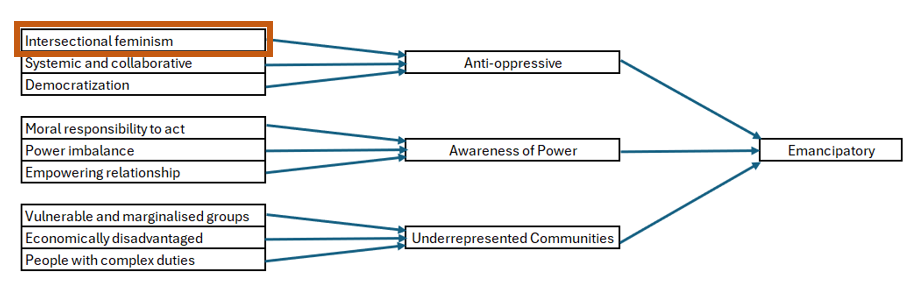
The emancipatory concept, categories and sub-categories
An early emergent theme was that for the coach CFSI is anti-oppressive in nature and this became clear when participants discussed their definition of CFSI. Most agreed that CFSI “is not an easy term to define. It’s a ‘multi-layered, multi-faceted term, and complex” (Amber). The complexities that they refer to are different to those of mainstream coaching, and my interpretation of what was described is that CFSI needs to take an intersectional, feminist approach (Figure 1). For most of the coaches this means “acknowledging the structural inequalities” (Gemma) that people face. The majority of participants stressed the importance of intersectionality, “understanding that the people that come through the space of coaching are living in contexts where there are often multiple realities playing out” (Sabrina). It is important to look at the individual within their social context in CFSI, compared with the individualistic nature of mainstream coaching.
For Leah, CFSI “sits more firmly as a helping profession”. The tools and techniques that dominate mainstream coaching are largely Western-centric and often “alienating and triggering” (Sabrina). For Sabrina the word triggering was about her own personal experiences of coaching where the absence of acknowledgement of structural oppression was challenging. The problem with the mainstream approach is that “some of the coaching tools, approaches…were politically problematic…and there is a gap that fails to acknowledge structural oppression” (Chloe). This appeared to be a view held by the coaches who were more aligned with social justice.
CFSI requires a commitment to equity and a desire to use coaching to challenge systems of oppression. The coaches wanted “structures and systems to change, so that people are valued individually and collectively” (Caitlyn). The need for a systemic approach is evident and “part of the problem is that we work individually, not systemically” (Katherine). There was a visceral frustration with how coaching has been slow to recognise systemic inequalities and that it is “unfathomable that coaches who work with systems don't acknowledge systems of oppression” (Leah).
To resolve social impact coaching and social justice coaching within this group of participants. There was a mix of those who identified as CFSI vs. coaching for social justice. Inclusion of those who mentioned social justice proved useful, as the findings suggest that the coaches are fundamentally operating in a similar way, though there are also variations, and disagreements on this. CFSI coaches were less likely to use precise terminology or language, e.g. anti-oppressive, intersectionality, but how they described their work can be defined by these categories. Those who were more aligned with social justice named these terms explicitly, with similar descriptors to the CFSI coach.
Theme 2 – Safe Space and Connection
This theme derives from the Movement Building concept and is concerned with the safe space and connection that the coach brings to the practice.
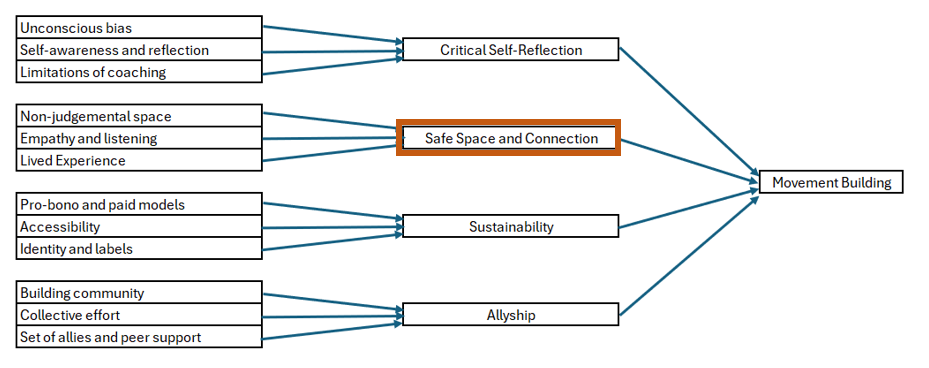
The movement building concept, categories and sub-categories
A firm view amongst the participants was that CFSI must prioritise creating a safe, non-judgemental space where the coachee is given the opportunity to be heard and “getting used to being listened to” (Sophie). Caroline explained that “it means that we spend quite a lot of time at the beginning just listening...often the end point of the coaching is being able to articulate a goal”. Most felt that CFSI is different to mainstream coaching in that often the session itself can be dedicated to creating this space and establishing trust. The outcome might not always be goal-oriented, where mainstream coaching often produces modest change, Sophie said “you have to meet them where they are…. you have to be super flexible”. This can often be the case in mainstream coaching, suggesting that the participants saw the coaching they were doing as different.
Creating this space suggested a holistic approach that is not just about the individual’s growth or capabilities as a leader. Shabnam said,
So, when a leader is speaking to me, and I can in the first few minutes, I can identify that this person has had certain needs that haven't been met, and they're craving them in their leadership. And so that's what I bring to the coaching space…it's not just about leadership in your professional role, but it's about what you're like outside of your role
The participants felt strongly that the coachee could bring their authentic self to the sessions, creating, as almost every coach described, a “safe, non-judgmental space” (Shabnam) that allows the coachee to be present in a way that they may not feel able to be in mainstream coaching. Some of the coaches describe being able to create this space because of cultural similarities and shared lived experience. For others, there was recognition that without lived experience “you cannot make up for it, no matter how open you are, how much understanding you have, how much knowledge you have” (Sheena). Leah said that “lived experience is crucial for recognising certain dynamics in coaching, but it's not the only way to be effective.” The majority of coaches were able to speak to a shared lived experience with their recipients, and the benefit of this for building trust and connection. However, there was a consensus that with educational learning and development in understanding intersectional inequalities, coaches who don’t have lived experience can and should still engage with CFSI. In the absence of this “getting them to collaborate with you on the coaching process” (Annabel), creating an involved, empowering partnership is essential. However, many of the coaches mentioned that being trauma-informed allowed them to maintain the safe space for the duration of the session. The underlying emotion present in the data here was empathy; equipping themselves with trauma-informed or mental health training was vital. There was an allusion to having “a healthy amount of empathy” (Sabrina) to ensure they adhered to the boundaries of practice, but also to avoid burnout which many felt posed a high risk when coaching in this space.
For Felicity, mainstream coaching is “too linear, you get to this bit, and then you do this, and then you do that, and it feels too staged”, and the data showed that most coaches felt that CFSI allows for a deeper client-led approach than mainstream coaching offers. Conversely, others felt that the practice of CFSI should not be different per se, as long as the scope of practice involved an intersectional approach.
The safe space theme also brought up the lack of ethnically diverse coaches in the coaching profession and the importance of having a choice of diverse coaches so that the coachee can find someone that resonates with their ideology, culture, or background. Amber reflected that “ideally the coaches will come from the demographics that they serve”.
Theme 3 – Sustainability
This theme derives from the Movement Building concept and relates to Sustainability, recognising that there are various models at play.
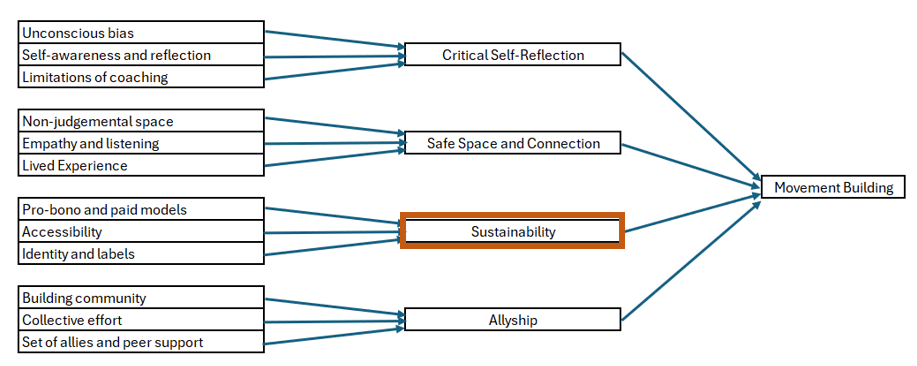
The movement building concept, categories and sub-categories
A significant challenge that arose for all participants was “money, money, money. If you want to do coaching for social impact, there’s no money” (Chloe). This sentiment was shared by almost all the participants. Many coaches would operate solely within CFSI if funding barriers did not exist.
There were differences of opinion on whether CFSI recipients should be charged. Chloe said “I don’t want people to pay for coaching. I think it’s excessively exclusive, pricey and inaccessible”. This was a view shared by others where it was important that “all the coaching we offer is free” (Caroline). Conversely, others took a different approach, explaining that financial reimbursement, considering a person’s resources, created a “psychological engagement” (Sheena) that was necessary for commitment to the sessions. Sabrina said, “I used to do it for free, but I also think that there’s something about giving something for free that people don’t always value as much”. There was also a sense that in the current economic environment “people struggle spending money on themselves, even if they have the means, they struggle investing in coaching for themselves” (Matthew). Overall, the coaches described that working in CFSI makes it challenging to live up to an ideal. All the coaches agreed that generally coaching should be more accessible, and CFSI is a space that enables this.
The data also showed that the participants did not label CFSI as pro-bono coaching, despite some of them operating within pro-bono structures to make a living. Amber said
I get a little bit fed up with people who think coaching for social impact is coaching for charity. Or pro-bono coaching. That is not the case. It does a disservice to coaches…I’m not against pro bono coaching but coaching for social impact is not coaching that we do as a philanthropic endeavour.
Almost all of the participants shared the difficulty with CFSI providing a sustainable income. Most reported having a “diversified income stream” (Matthew), often continuing to work as an executive coach to supplement CFSI income. Graham explained, “I have a whole Robin Hood thing going on, corporates pay me large amounts of money to coach them and then I charge little to nothing to voluntary sector organisations”. An observation during the analysis revealed that almost half of the coaches were satisfied with this setup, while others desired financial security to enable them to focus on CFSI. Some coaches worked on programmes that were subsidised by governmental grants, with the coaches spending time on bid-writing and submitting applications to interested organisations.
Some coaches did not identify as social impact, social justice or climate coaches. For some this was to ensure that they did not exclude anyone who might not understand the terminology. For others, it was to engage those who may be detached from social and environmental issues: “I don't want folk who are interested in the climate to come to me. I want to be working with people who aren't interested in the climate” (Felicity). Conversely, others collectively shared their identity as social impact coaches, including through membership of a special interest group. Legitimacy as a subcategory emerged during the focused coding. Using CFSI to describe their work denoted a legitimacy that they found was lacking, especially considering how it is often perceived as pro bono coaching.
When asked how their recipients access their coaching, most agreed that it is almost exclusively online, such as through websites or LinkedIn, or via word of mouth and peer relationships. Caroline said, “it's a bit more scattergun in that respect, because we depend on the individuals out there knowing that the offer is there”. Most felt strongly that accessibility and awareness were issues, but they also reported being “regularly contacted by individuals saying ‘help’” (Caroline).
CFSI Ecological Framework
Whilst the themes and concepts that emerged from the findings helped develop a list of considerations for CFSI, it was important to demonstrate the role of the coach in this space and acknowledgment of structural oppression that the coachee may be experiencing.
I began with an elementary framework that consolidated the 3 concepts; however, this did not validate the findings in a meaningful way. CFSI requires a model that exemplifies the intersectional identity of the individual coachee, as well as the coaching environment and the influence of wider society on both. This led me to Bronfenbrenner’s ecological systems framework (Bronfenbrenner, 1979, 1992), where the model outlines four concentric systems that impact and influence a child’s development. The micro, meso, exo, and macro systems provides a memorable and explanatory visual of the role that the environment has on a person’s development. The CFSI Ecological Framework (Figure 4.) was adapted from Bronfenbrenner's ecological systems theory (Bronfenbrenner, 1979, 1992) and illustrates the interconnection between environmental and social systems for the CFSI coaching relationship. The coach in CFSI reports the need to be aware of the wider systems in which the individual is situated. The CFSI coach can focus the coaching intervention on self-actualisation of the individual with a more holistic awareness of their intersectional identity and/or direct their intervention toward the Exosystem and the Macrosystem.
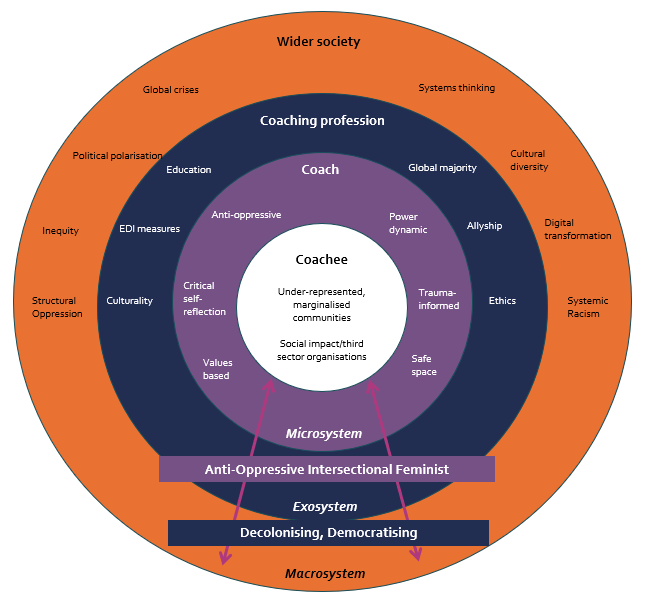
CFSI ecological framework
The CFSI coach should understand the intersectional identities (Crenshaw, 1989) of the coachee, where they are likely to be experiencing oppression in multiple spheres. The Microsystem informs the CFSI coach of the approach required. Both the coach and the coaching profession can work towards an anti-oppressive practice by using an intersectional feminist approach to coaching. The coach can do this by ensuring, for example, critical self-reflection or becoming trauma aware. The coaching profession can amplify the voices of the global majority coaches, offer learning and development opportunities on anti-oppressive coaching, and encourage allyship in this space. There is also a need to address the ethical position of CFSI where coaching governing bodies and educational institutions can play a role on both the question of neutrality (Fatien and Heitner, 2015) and encouraging further research on underrepresented communities (Collins and Nacif, 2024).
Other helping interventions are using exercises incorporating use of Social GGRRAAACCEEESSS (SG) (Burnham, 2013) to improve therapists’ self-reflexivity (Totsuka, 2014). Use of SG, standing for gender, geography, race, religion, age, ability, appearance, class, culture, ethnicity, education, employment, sexuality, sexual orientation and spirituality could be helpful for both self-reflexivity and epistemological reflexivity. This supports the findings where the coaches stress the importance of questioning our sources of knowledge and how they are culturally bound (Shoukry and Fatien, 2024). The social impact coach can use the CFSI Ecological Framework and SG in tandem to strengthen the Anti-Oppressive and Intersectional Feminist approach.
Conclusion
By attempting to understand the reality of what CFSI entails from the perspective of the coach, this study has developed a framework that coaches interested in working in this field of practice can adopt. The CFSI Ecological Framework illustrates the interconnection between environmental and social systems. It acknowledges that the CFSI coach benefits the recipient by taking an intersectional feminist approach to coaching, understanding the intersectionality of oppressive environments, and internalised socialisation of these systems, for example, the patriarchy, white supremacy, ableism, amongst others.
The coaches interviewed for this study have different approaches to this area of coaching but share similar values and desires for change. Coaches report that to work in this space, addressing power dynamics, privilege, and structural oppression across a number of levels is essential. Practitioners, who balance careers in other sectors face challenges in sustainability and accessibility. Despite financial constraints, the coaches feel that the impact of coaching on marginalised individuals, leaders and communities is significant. Building a supportive community and allies, and gaining recognition are crucial for the growth of social impact coaching. There is also a tension in the professional identity of the coach. Advancing their work in social impact sometimes relies on coaching executives whose values may not align. The CFSI coach holds values that are rooted in challenging structural oppression, including capitalism, yet working in this space suggests a dependency on capitalism and indeed embracing it for part of their income. There is also the question of ethics. For an intervention that expects coaches to remain neutral, there are ethical considerations concerning the values that the coach in CFSI holds.
Future research
It would be beneficial to resolve the differences between coaching for social impact, social justice, and social change. This research highlights the need for coaching to look at these definitions to understand their similarities and differences, as well as exploring how the coaches identify with the respective terminology. This study does not include the perspective of CFSI recipients. Further research is necessary to understand both their experience of this coaching, particularly in contrast to mainstream coaching, as well as its impact and how it might be measured. The development of a CFSI theory to support coaches seeking to acquire the necessary specialist knowledge and competencies for practice in this area would be an important and relevant next step.