







Abstract
This research concerns how team members and team coaches perceive coaching to be productive. Using Constructivist Grounded Theory, it presents a theory to explicate how emergence works in team coaching, and the foundational and influencing conditions which need to be in place for emergence to occur. The key contributions are, firstly, to show that meeting the new, emergent goals and achieving beneficial unexpected outcomes are perceived to be more helpful than meeting the goals contracted at the outset. Secondly, team members find experiencing the processes of emergence more helpful than focusing on a predetermined variable or set series of steps.
Introduction
This research arose from my own experiences and curiosities when coaching teams. I had noticed, for example, that sometimes I had different perceptions and understanding compared with team members of what part of a session proved most useful. I had also experienced sessions where I felt we had helped a team very little, yet at our next meeting they expressed how helpful it had been (and vice versa). Further, the original goals agreed at the outset of coaching often changed during the course of the engagement and teams frequently appeared to derive significant benefit from developing insights which were completely outside any goals set. This study thus explores how team members and team coaches perceive their sessions to be productive, and what influences those perceptions. It contributes to the growing body of studies, research and commentary on team coaching from an academic perspective, which nonetheless continues to lag significantly behind dyadic coaching in terms of its development (Graves, 2021).
With no agreement upon its definition and a wide range of potential interventions which might be considered as team coaching (Lawrence and Whyte, 2017), a lack of clarity remains over what team coaching constitutes (Jones et al., 2019). Many definitions exist of “team coaching” and, whilst these differ significantly, what they have in common is the desire to help teams change something in service of improving, for example, performance, collaboration or learning. The role of the team coach can thus be encapsulated as that of a change agent; that is, a person who raises awareness of the inconsistencies in existing constructions (Lincoln & Guba, 2013), so allowing team members to construct new meaning. With the team coaching literature base remaining immature (Graves, 2021), researchers and practitioners are striving to develop greater understanding of coaching processes and outcomes in order to work better with coachees (Henderson and Palmer, 2021). In the absence of specific literature discussing how team coaching is helpful, a starting point to understanding could be by asking “productive in relation to what?”. Many of the existing definitions of team coaching offered by various practitioners and coaching bodies talk of improving performance or effectiveness. If the definitions of team coaching conceive it as dealing with performance in some way (such as Jones, Napiersky and Lyubovnikova, 2019; Widdowson and Barbour, 2021), it can be argued there is an implicit assumption that value is judged by how much performance or effectiveness has improved as a result of the coaching.
This research adopts a social constructivist paradigm which is understood as a “collaborative activity in which individuals engage, and the role of the cultural context within which they are embedded to co-construct meaning” (Hurlow, 2022, p. 126). In the absence of existing literature on understanding how sessions are perceived to be productive, scope exists for a theory to be developed which addresses these gaps. Thus, for this study, constructivist grounded theory (CGT) was the chosen methodology, enabling a new theory to be constructed from emerging data (Charmaz, 2017, 2021). Data generation consisted of purposive sampling of twenty-five team members and team coaches in total, using semi-structured interviews. Analysis followed CGT practice of coding fragments of transcripts, which formed the basis of common categories and the final theory. The remainder of this article will offer a brief review of the literature, explain the methodology and set out some of the salient findings. It will then discuss those findings, and share the grounded theory which emerged to explain how team members and team coaches find coaching helpful.
Literature review
The existing team coaching literature is dominated by a small number of practitioners whose work is mainly experience-based. A significant proportion of their models and approaches are focused on achieving high performance (e.g. Grieve & Miller, 2024; Papalexandris & Kostopoulos, 2022; Peters & Carr, 2013). However, as Garvey (2011) has stated, whilst much of the dominant thinking in business around performance can be linked to a (largely male) fascination with sports, the analogy is limited in its applicability to the complexities of the business world.
Current approaches to understanding how (dyadic) coaching is productive vary widely. These range from Coaching Return on Investment (Phillips, Phillips and Edwards, 2012), goal achievement (Grant, 2019; Greif, 2016; Müller & Kotte, 2020; Ordóñez et al., 2009), through to learning (Bennett & Campone, 2016). Nonetheless, there is a strong tendency in the literature to consider “productive” in relation to the coaching goals: this is unsurprising because coaching is largely seen as a goal-focused activity (Grant, 2014; 2019; Clutterbuck and Spence, 2016; Greif, 2016). The preponderance of the literature in this field suggests that, for many practitioners and researchers, the underlying assumption is that the perception of how productive a team coaching engagement will be judged against goals in some way. Team coaching is similarly seen as a goal-focused activity (Weldon and Yun, 2000; Kristof-Brown and Stevens, 2001; Pedersen, 2015).
What is team coaching for?
It is clear from reading the literature that the term “team coaching” covers a broad spectrum of practices and interventions. Given such a wide range of definitions, it is unsurprising that there is little consensus on what team coaching is for. Moreover, there is little literature which specifically explores the purpose for which teams engage in coaching; that is, what they believe they wish to address and achieve. Nonetheless, irrespective of the authors’ beliefs, theoretical underpinnings of the coaching and the ostensible reason for undertaking team coaching, it appears that all the approaches have a common aim or desire to change something within the team or within the system in which it exists. Such change may be explicit – “we want to improve our performance” or “we recognise we are not working as effectively as we could be” – or implicit – “we know something is not right in the team, even if we do not know what that is”. Because of the preponderance of goals in the coaching literature, coaching sessions are often seen as productive with reference to whether the original goals contracted at the outset of the programme or session have been achieved. A large body of work exists which points to the importance of goals and goal setting in embedding change in individuals (Boyatzis & Howard, 2016). However, there remains a lack of empirical research on goals (Müller & Kotte, 2020), particularly in team coaching.
Which factors are important in achieving productive sessions?
Few studies have investigated what happens during sessions. In the absence of such literature, the factors considered in this section are those which appear to influence individual sessions (as opposed to the overall programme). It should be noted that all these factors may manifest differently according to the context (Erdös et al., 2021). Whilst relationships remain an important part of the perceived usefulness of sessions (Fox, 2022; Wotruba, 2016), the other factors can be summarised as shown in figure 1.
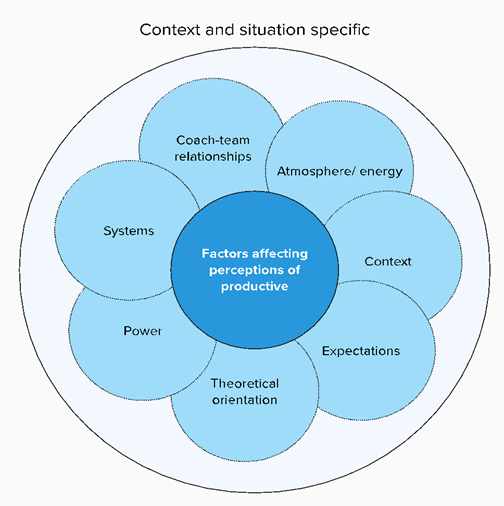
Factors influencing perceptions of sessions
Whilst few studies of relationships in team coaching exist, there are some studies and meta-analyses which examine dyadic coaching or therapeutic outcomes in relation to the working alliance in particular (e.g., Gessnitzer and Kauffeld, 2015; Athanasopoulou and Dopson, 2018; Bozer and Jones, 2018; de Haan, Molyn and Nilsson, 2020; Molyn et al., 2021). However, these largely quantitative studies do not offer conclusive proof of the links between the various ingredients analysed and their effects, even if they indicate there is a correlation between the working alliance and perceived outcomes (Henderson & Palmer, 2021). Few of the other variables are considered within the team coaching literature.
There remains the question of whose perspective is being sought in understanding whether a session has been productive? The potential for differences can be illustrated by the “Rashomon” effect, whereby the same event is described in different ways by observers (Myers & Bachkirova, 2020). A study in dyadic coaching by Prescott (2010), which investigated how progress is determined, also highlighted that different stakeholders may have very different agendas which influence the meaning of progress. Being clear on whose perception is being investigated has important implications for this study, as different parties may have differing opinions on whether the coaching has been productive. As de Haan, Culpin and Curd (2011) noted from research in psychotherapy, clients’ and therapists’ perceptions of the process are somewhat different. However, very few of the team coaching empirical studies have included team members as participants. Moreover, the time frame involved in any assessment of whether coaching has been productive, is important (Ladmanová, Řiháček and Timulak, 2022).
Methodology
My belief is that reality is understood through individuals’ subjective interpretation and meaning making guided by their history, social environment and context, formed through interaction with others. Thus, I see this research as located within a social constructivist paradigm (Creswell & Poth, 2018). Ontologically, it “assumes that multiple realities reflect different activities, interactions, and context-specific frames of reference. Epistemologically, it focuses on the collaborative activity in which individuals engage and the role of the cultural context within which they are embedded to co-construct meaning” (Hurlow, 2022, p. 126). Within the context of this study, which seeks to understand how individuals perceive the phenomenon of team coaching in organisations, an approach which recognises the complex interaction between social forces in teams, negotiation within and between individuals, and context in co-constructing meaning would seem appropriate. I am effectively co-creating with participants a new conceptualisation around how team coaching is perceived to be productive in their contexts. Other methods of researching the question I considered included Conceptual Encounter (de Rivera, 1981) and Interpretive Phenomenological Analysis (Smith et al., 2009), however, I was initially concerned to avoid imposing my own views of what constitutes “productive” coaching and, in the absence of existing studies, chose to build a theory from the data. Accordingly, I selected Constructivist Grounded Theory (CGT) (Charmaz, 2008) as the most appropriate methodology for this study. The processes involved are shown in figure 2.
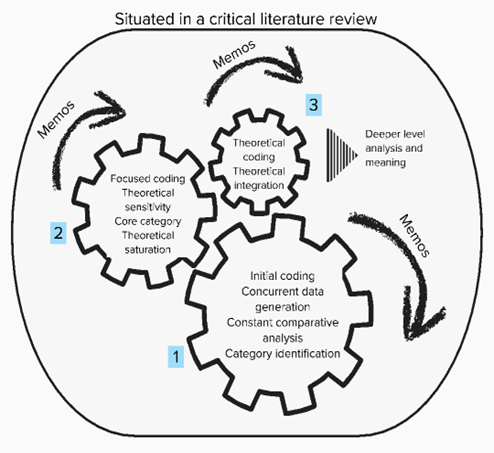
Constructivist Grounded Theory (Adapted from Birks and Mills 2015, p. 13)
Twenty five participants were recruited, comprising 5 team members and 20 team coaches, based in thirteen different countries. Their details are shown below in table 1:
Demographics of study participants: Team Member Participants
*The team started with five but two left during the coaching
**Participant previously known to me
*Status: Employed = employed as a coach in a coach provider; Self-employed = as a coach in their own business;
In house = employed as a coach in a non-coaching organisation
*Locations have not been specified for each individual to protect their anonymity due to the small number of team coaches in some of these locations
*Team leaders are also working as coaches
**Participant previously known to me
Data was collected through semi-structured interviews recorded using Zoom (audio only), lasting between 50 and 90 minutes, transcribed via Otter.ai and analysed using Nvivo. Following CGT methodology, cycles of interviewing, coding and comparative analysis were carried out concurrently (Birks & Mills, 2015). Analysis was complicated by the research aims which required a definition of “productive”. Because CGT requires fracturing the data (Charmaz & Thornberg, 2021), in doing so, the context for the comment was no longer clear, and it was striking how two apparently similar metaphors – “a bomb going off” and “a dam bursting” – in their contexts were polarities in their meaning. Thus, in order to ensure that I had clarity on which bits of data related to the definition of productive coaching, I carried out additional analysis. This consisted of attaching the word “Definition” to the relevant parts of fractured code for each interview to gain clarity on the way participants defined productive coaching. This iterative process of comparative analysis enabled me to identify whether further data was needed to saturate the developing categories. In total, five cycles of interviews and analysis were conducted and continued until I reached theoretical saturation; that is, until no new data was emerging (Terblanche, 2020).
The initial analysis resulted in over 900 individual codes. However, a further issue arose as I compared transcripts and codes. I found it very difficult when carrying out initial coding to distinguish how participants defined productive coaching and why they felt certain parts of sessions were productive. To bring greater clarity to my data, I decided to carry out complementary analysis: for each transcript, I created a mind map of the key categories which seemed to define “productive” and those which seemed to influence perceptions of productive sessions. I concurrently proceeded to create categories from the focused codes (Charmaz, 2014). These explain ideas and processes and aggregate the patterns or concepts emerging from the focused codes. When I had completed sufficient interviews for me to have confidence that the main categories were emerging (17, after 3 cycles), I felt I could consolidate the different analyses. This comparison allowed me to understand the overlaps and additional nuances which may have been missed from any of the coding analyses of their own, to produce a unified set of categories. Once I had created initial categories, I was able to start creating the theoretical categories described by Birks & Mills (2015) and which form the underpinning of the final theory.
Findings
The findings showed that team coaching is perceived to be productive when certain foundational and influencing conditions are in place which, in turn, may lead to emergence. From this emergence, teams develop new awareness and can choose what they wish to do next in service of achieving the desired change. This section explains how the foundational conditions are a de minimis for productive sessions and serve as an underpinning for the factors which influence emergence. The section has three sub-sections and, where participants are quoted, they are suffixed as “TM” (Team Member) or “TC” (Team Coach):
Foundational conditions
Influencing conditions
Emergence
Foundational conditions
The foundational conditions for emergence are shown in figure 3 below.
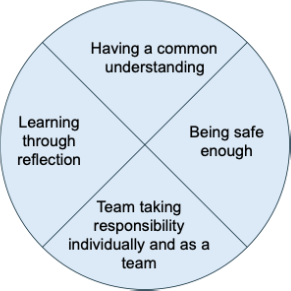
Foundational conditions for helpful coaching
These four factors are not dissimilar to what is commonly discussed in the literature with regard to the key conditions for effective coaching. “Establishing a common understanding” is akin to what is understood by “contracting”, however, whilst it includes the formal agreement between coach and client it extends to eliciting and managing expectations – the team’s, sponsor’s and coach’s. These are essential reference points for understanding whether a session has been helpful or not. Similarly, “Being safe enough” has commonalities with “psychological safety”. Whilst the latter is defined as a team construct (Edmondson, 1999) the findings showed that, first and foremost, it is an individual construct:
I think an individual can certainly feel safe when another doesn’t in a team context, for a whole load of reasons…I also get in a team context, you might feel like you’re ready to move on when someone else isn’t yet (James – TM).
This appears to indicate that feeling safe cannot automatically be considered as a monolithic construct which either is, or is not, present when working with teams, risking overlooking the potential for individual team members to feel unsafe in the moment.
For teams to achieve some form of lasting change, they need to take responsibility for the work involved. There are several aspects to taking responsibility including team members doing the work during and after sessions, accepting their own agency within their system, being accountable for their success, and owning responsibility for their part in change: “it’s like, everyone has to be pulling an even amount of the rope, you know, for the weight at the end of the rope to move” (Ellie – TM). It is clear that without accepting their own agency and owning the work needed, the team will not be able to affect change.
“Learning through collective reflection” forms the final condition. Coaches explained it was a fundamental part of the team’s ability to change: “reflective process is the treasure, the learning. Because we learn to reflect, we don’t know how to do it, but we’re learning that process” (Iona – TC). If team members can adopt this skill it allows them to cope with new situations and issues as they arise. For the team – rather than its individuals – to adapt and change, there needs to be collective understanding of what has been learned and collective agreement about next steps.
Influencing factors
The influencing factors are what participants focus on when recounting what helped them experience a moment or a more extended time during a session which felt particularly productive. The factors are shown in figure 4 below.
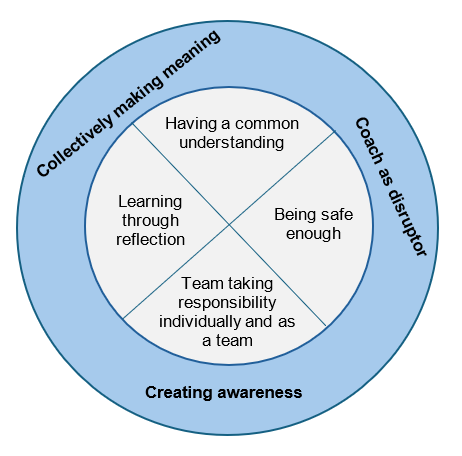
Influencing conditions for helpful coaching
The coach disrupting existing patterns and bringing them to team members’ awareness is the starting point for team members to create their own awareness of what is being noticed. Team members can then start creating their own awareness through surfacing these topics, which they find highly useful. As James (TM) commented: "So what's coaching in that context? If it's good, I imagine… it starts to surface some of this stuff”. However, because each team coaching intervention is context and situation specific, it is not possible to offer an exhaustive list of what may be surfaced, named or present for teams. Nonetheless, there seems to be two broad categories of topics. The first are the “elephants in the room”; that is, what most or all team members know to be present but which they are unable or unwilling to talk about. The second are those things about which the team members have no awareness until they are named by the coach acting as a disruptor.
Finally, team members collectively need to make meaning of what is in their awareness. This allows them to see things in a different way, providing the team with a useful and sustainable way to help them outside the coaching. For the team to progress, sufficient agreement is required amongst team members as to the collective meaning made. Without this, the team may not be able to move on, particularly if certain individuals do not feel comfortable enough to engage. This is important, because emergence is not a linear process, as Michele (TM) explained:
…is very important also with the team leader and the team to be flexible, and to renegotiate the agreement … because… teams is not linear, is a continuous spiral. So, you have to renegotiate… again, re-contracting.
Whilst I have described each process as a discrete step in the journey to emergence, in practice there is likely to be overlap between one process and the next and the coaching may move between them without it necessarily being noticed. Moreover, whilst the processes are sequential there may be many reasons why the team members, coach or both choose not to follow through and create new awareness and collective meaning.
Emergence
This is the process whereby new topics and goals, not evident at the outset of coaching, are discussed and agreed upon at a later stage when team members reach a better understanding of their issues:
So, there was a starting point, but there was an evolution that took place as well. For example, we didn't even, I mean, the identification of the specific problems happened later, right? (Ajay – TC)
Emergence during sessions enables adapted or new topics and goals for coaching to surface, which was highlighted by participants as an important element of productive team coaching:
I also think that's why some of the contracting at the start for the goals and the aims, really then morphs so much and become so emergent and so responsive to what's happening, you know, between them at any, any one point (David – TC).
Emergence typically starts with something being brought to team members’ attention by the coach. Coaches might do this in many different ways; for example, by sharing what they are noticing around the power structures, the impact of the wider system, perhaps a somatic experience, or something else. It enables team members’ and the team’s unknown, unspoken or implicit needs to be raised in the team members’ awareness and discussed, potentially leading to a shift. Such implicit needs are different from the explicit aims or goals agreed to during upfront contracting, yet may have a greater impact on the perceived outcomes:
I notice that maybe many organisations, that unknown things is more important than the known things, so that unknown maybe is a very strong bad impact on the organisation. So put on surface the unknown thing (Michele – TC).
In turn, these shifts in awareness from something that was previously implicit to being explicit enable the team to have a choice: they can recontract to work on whatever outcome is needed from the new awareness, or not. Importantly, the findings indicate that surfacing the team’s and team members’ unknown needs, and re-contracting for new goals, result in more helpful sessions than if only the original goals are met. It might seem paradoxical – given the importance of common understanding – that achieving the goals agreed at the outset is perceived as less productive than if those goals are superseded by ones addressing implicit needs which have been surfaced and addressed. The explanation for this is, perhaps, in recognising that team members “don’t know what they don’t know” when they set out on the coaching.
It appears that for team coaches, although they expected new goals to emerge, achieving the original, contracted goals remains important (perhaps to enable demonstration of what has been achieved). For team members, however, it is the surfacing and achievement of new goals and unexpected outcomes which is more important. Such emergent goals can lead to unforeseen outcomes: “someone leaving the team was unexpected but was a benefit in the end” (James – TM). This can make a significant difference for the team: “it was a game changer in terms of how we then sort of worked as a team, which was highly successful for a period and, as I say, accelerated the business difference” (Robert – TM). The next section will discuss the findings.
Discussion on Findings
As highlighted in the findings, whilst coaches largely expected emergent goals, team members did not. I believe these differing views make sense in the wider context of coaches’ and team members’ respective experiences. Coaches working emergently expect the team to create new awareness and meaning, thus potentially giving rise to unexpected outcomes and ending up somewhere very different to originally planned. Team members, who have not previously experienced coaching, probably do not know what to expect and adapt their expectations based on what they have found to be most useful. It is particularly helpful to address their implicit, and previously unspoken, needs. Thus, sessions are seen to be productive in both the achievement of planned aims or objectives, and responding to what is emerging in terms of the implicit needs of both team members and the team.
I suggest that since it is the team members who recognise the importance to the team of identifying and meeting emergent and unexpected outcomes, these may be more important in terms of perceptions of how productive a session has been. This phenomenon might be termed the “paradox of emergence”: coaching practice commonly suggests contracting early on to agree on certain goals or outcomes and then to refer back to whether these have been achieved. Yet, it seems to be more productive for team members when those original goals are adapted or changed completely to reflect team members’ goals or outcomes based on their new awareness of what is impeding their effectiveness.
Taking both these aspects into account, I propose a definition of how team coaching is perceived to be productive as follows:
Team coaching is perceived to be productive when the team members work through the process of achieving what they set out to do (their explicit aims/outcomes) and through emergence to surface and address the team’s implicit or unspoken needs, in service of creating change.
To be clear, I believe the most important finding is that team members find achieving the emergent goals and experiencing unexpected (beneficial) outcomes more productive than meeting the original goals. This is because, it seems to me, to be counter to conventional wisdom in the literature and coach training about being clear on the coaching goals at the outset, and then assessing how productive the coaching has been against those goals.
When new awareness has arisen or a shift has occurred in a sufficient number of team members, the team and coach have a choice and can re-contract and decide to work on what is now surfaced to agree on an emerged goal which replaces the original goal agreed at the start of coaching. That is, the formerly implicit or unspoken need has become an explicit goal, and the former explicit goal is no longer what the team works on. This process of implicit goals becoming explicit and former explicit goals fading into the background can be visualised as the coaching switching between the explicit and implicit – illuminating the shadows – according to the team’s needs. Further, I suggest that it is the process of emergence, switching between the explicit and implicit, experiencing shifts, and achieving the planned and emergent goals which creates productive sessions and enables the team to achieve their desired change, as shown in figure 5.
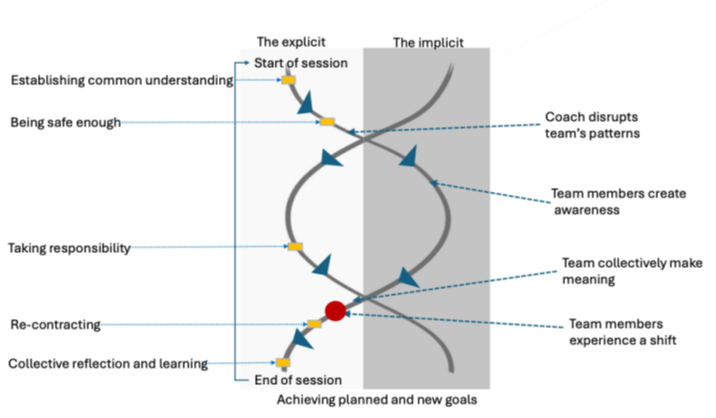
A grounded theory of emergence in team coaching
Limitations and future research
This research was subject to several limitations. I deliberately did not define what I meant by “team coaching” for participants, leaving them to decide for themselves and leading to a potential problem of different understanding of the practice. Other limitations include data being collected from individuals, not intact teams, and the lack of enough team leaders in the sample to analyse and compare their data independently from that of other team members. Moreover, my coaching is heavily influenced by Gestalt-orientated practitioners and even though the grounded theory and framework I have produced are very different from how I initially conceptualised helpful sessions, I recognise there are similarities with Gestalt theory, particularly around the concept of emerging awareness and processes.
The academic and practitioner literature would benefit significantly from both qualitative and quantitative studies to understand more about how team members view and experience their team coaching. This could include understanding why team coaching is being undertaken, its purpose, and what it is hoped would be achieved. Whilst research into whether and how to measure achievement of objectives remains a thorny issue, providing alternative perspectives to measuring ROI or binary goal achievement would be helpful. A second fruitful area of research is comparing the same sessions from the perspective of team members and the coaches. Further, given the role emergent goals appear to play in enabling teams to arrive at their desired outcomes, it would be both interesting and useful to carry out further research into this topic. How are “emergent goals” conceptualised?
Conclusion
This study has shown that team coaching is perceived to be most helpful when teams experience emergence, allowing team members to discuss issues which otherwise remain hidden, even if it leads to unintended outcomes. The processes of emergence, that is, the coach acting as a disruptor, the team members creating their own awareness and collectively making meaning enable teams to choose whether they wish to work on what has been brought into their awareness, or not, and recontract for new goals accordingly. It is acknowledged that achieving the originally contracted goals may still be productive in some situations and contexts, particularly where teams want a more facilitative approach, or are unable or unwilling to work with the uncertainty of emergence. The research has also shown that teams find the processes of emergence more helpful than focusing on pre-determined variables or steps. This suggests that for team coaches it is important to hold any preferred model or approach lightly, only using it if the situation shows that it is the best option in that particular situation and context. Otherwise, they risk overlooking what the team really needs to change in order to meet their desired outcomes.