







Abstract
Understanding agriculture in tropical landscapes is an interdisciplinary task, focusing the interest of the ecological, physical and social sciences. Reporting on results of a long-term collaborative study of Lakandon Maya agroforestry, I review our recent insights into successional processes and the genesis of anthropic soil under Maya management. Milpa, a multicropping system centered on maize with a range of many companion crops is the axis of traditional Maya resource use. Intervention in the early stages of regeneration after cycles of maize swidden cultivation ensures the rapid recovery of original woody vegetation, enriched by species valued by humans. Maya farmers and forest ecologists have approached the tropical environment in similar ways, identifying and working with functional groups of woody species, to enhance biodiversity and ecosystem resilience. Planting or encouragement of selected tree species and the judicious use of low- intensity fires, help create anthropic soil of high organic matter and nutrient content, similar to the dark earths observed in Amazonia. The knowledge and skill revealed in Maya milpa agroforestry are invaluable tools for conservation of tropical biodiversity.
Introduction
Understanding agriculture in tropical landscapes is an interdisciplinary task, focusing the interest of the ecological, physical and social sciences. The research reported here is part of an on-going, long term study of Lakandon Maya agricultural and forestry practices of an interdisciplinary community of researchers. The Lakandon milpa system was first described in detail in a co-authored paper (Nations and Nigh 1980). Nearly twenty years later, Levy produced a study of successional dynamics in Lakandon fields which revealed unsuspected ecological sophistication (Levy Tacher 2000; Levy Tacher and Aguirre Rivera 2005). In recent years, ethnobotanists, biologists and social scientists have collaborated on further work as reported in joint papers (Diemont et al. 2006) and in graduate theses (Diemont 2006; Durán Fernández 1999) This paper reports the results of further ethnographic fieldwork carried out by the author during several visits to the study area in 2005 to 2007.
Our interdisciplinary theme is the relationship between traditional Maya agriculture and the tropical woodlands matrix within which it is practiced. We focus on the specific functional components of the milpa multicropping agroecosystem as it moves through the phases of managed secondary succession after the cultivation phase. Ecosystem function has been defined as “the minimum aggregated set of processes (including biochemical, biophysical and biological ones) that ensure the biological productivity, organizational integrity and perpetuation of the ecosystem. “ (Swift et al. 2004). Though there is no formally defined minimal set of such functions, we know that they are primarily supplied in forest ecosystems by two classes of organism: trees and microorganisms. These species necessarily relate to other secondary key organisms, including birds, bats and other mammals, as well as lianas, ferns and epiphytes, among others.
In this paper, I present preliminary analysis of two Lakandon agroforestry practices intended to increase soil fertility: enrichment planting in early successional stages of selected tree species and the controlled use of fire. Technical assessment of these practices has been presented elsewhere (Diemont et al. 2006; Levy Tacher and Aguirre Rivera 2005). An underlying purpose here is to compare Lakandon practice and knowledge concerning secondary forest regeneration with the knowledge of Western-trained forest ecologists. The considerable convergence of native and biological plant taxonomies has been extensively documented in the Maya area and elsewhere (Berlin, Breedlove and Raven 1974). The possible correspondence of categories for and understanding of ecological processes among native farmers and forest ecologists is, however, less studied. I analyze ecological succession in traditional Lakandon Maya agroforestry as perceived by farmers and researchers to explore the degree to which they share an understanding of the successional process. Not surprisingly, Maya agroforesters and field ecologists have arrived at similar representations of succession. The process of documenting this conclusion reveals many interesting aspects of secondary succession management in forest garden systems (Belcher et al. 2005).
Study Area
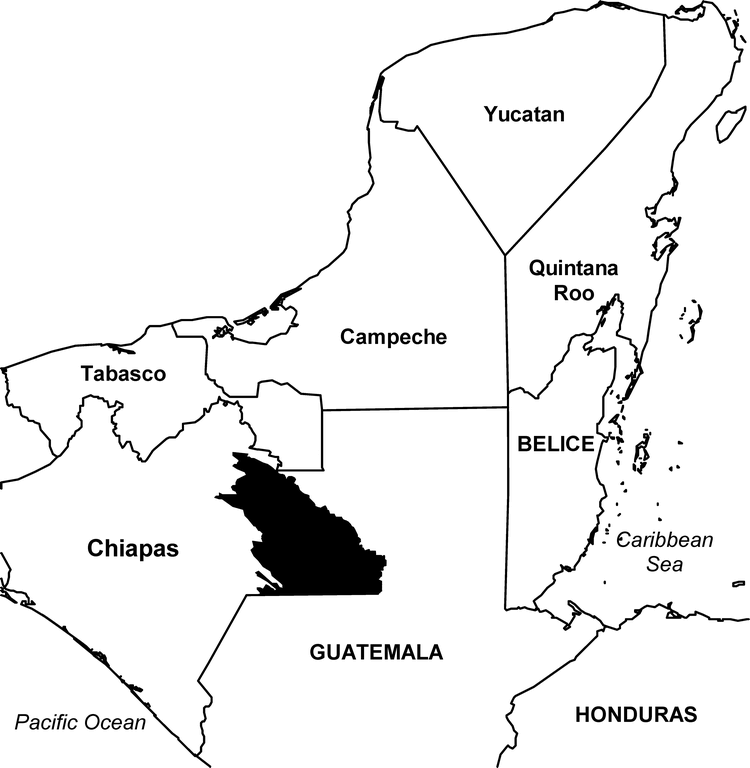
The communal lands of the Comunidad Lacandona are located in the Lacandon rainforest of northeast, lowland Chiapas, Mexico (Figure 1). The Lakandon settlement of Lacanjá Chansayab lies on the intersection of latitude 16°45′38″N and longitude 91°07′49″W. The region is characterized by long, low, ridges (600 to 1000 m) running in parallel from northwest to southeast to the Lacantún River. Fanning out between the ridges, in the relatively level, though undulating land among abundant small streams we find the sites where the Lakandon Maya disperse their dwellings and their agriculture. The climate is humid tropical, with an annual rainfall of 2300 to 2800 mm and average temperature of 25°C with minimal seasonal variation (Muench 1982). Soil is predominantely Redzina associated with limestone and derived sand and extensive alluvial deposits. Of agricultural interest is a highly fertile mollic A horizon formed on all soil types by leaf litter on the limestone base (Beach et al. 2006; Fedick 1996). Some of the deeper alluvial deposits are also fertile but of high clay content with a tendency to water-logging and thus are agronomically challenging.
The Lacandon Rainforest.
Vegetation is characterized by types of tropical woodlands called tropical rainforest, lower montane rainforest and evergreen seasonal forest (Breedlove 1981). These woods typically show three or more strata and present a fairly uniform canopy between 35 and 45 meters with occasional emergents up to 60 meters tall (Miranda 1952). The most common canopy species in the Lacanjá area are Brosimum alicastrum Sw., Aspidosperma megalocarpon Muell.Arg, Dialium guianense (Aubl.) Sandwith, Guatteria anomala R.E.Fr., Terminalia amazonia (J.F. Gell.) Excell., Swietenia macrophylla King, among others (see below).
The Lakandon Maya are Yukatek speakers, closely related to the Itzaj Maya of the Petén, Guatemala (Atran 1993). The population of around 800 currently resides in three villages in eastern Chiapas, Mexico. They are the smallest Maya group, sharing their original territory with some 500,000 Tzeltal, Ch'ol and Tojolabal Maya. The Lakandon are the oldests residents of the Lacandon lowlands, with a complex ethnogenesis in the region reaching back to the 18th and 19th centuries (Palka 2005). The other Maya groups are more recent colonists from nearby highland areas (Ascencio F. and Leyva Solano 1992).
Milpa Agroforestry as Successional Management
The term milpa refers to an agricultural system with a deep history of practice throughout Mesoamerica. It is centered on the production of maize (Zea mays L.) but is always a polyculture with companion plants selected from a basket of dozens of annual and perennial crops, according to taste and the particular local ecology. Milpa is often practiced as a swidden, a clearing for agriculture surrounded by woodlands, established as a rotation with secondary vegetation. The Maya milpa systems discussed here are of this type (Bernsten and Herdt 1977; Gomez Pompa and Kaus 1999; Hernández Xolocotzi et al. 1995; Nations and Nigh 1980; Terán and Rasmussen 1994). We distinguish ‘traditional’ from ‘conventional’ milpa, commonly practiced today in the Maya area. Traditional milpa is a highly diverse, intensively managed swidden system, probably far more common among all Maya groups in the past, also called the ‘high-performance milpa’ by Wilken (1971).
Early ecological studies of forest succession demonstrated that the initial floristic composition of a disturbed area is a strong determinant of later vegetation composition (Eglar 1954) and suggested the long-term legacy of chance colonization events in determining the composition of secondary vegetation. Rather than allowing ‘chance colonization events’ during the early phases determine the course of succession, humans intervene in the early stages of regeneration. The purpose is to influence the eventual structure and function of secondary vegetation in ways that favor human subsistence. The initial goal of secondary vegetation management, according to Lakandon farmers, is canopy closure, though this may require soil fertility restoration as a prerequisite.
There are two principle factors to control in early secondary succession on agricultural fields: 1) the germination substrate, including resprouts and the soil seed bank and 2) species composition during the early stages of woody stem regrowth. Resprouting is the most important form of recolonization after swidden, but in unmanaged contexts may lead to uneven cover and clumping (Schmidt-Vogt 2001). Enrichment planting directly influences the species composition and the nature and rate of successional processes (Ramos and del Amo 1992). Our (and others') research has shown that management during the cultivation period greatly affects recruitment rates, total biodiversity and growth rates during subsequent succession (Ferguson et al. 2003). Management of the transitional phase between annual cultivation and the reestablishment of woody vegetation is especially critical for the farmer, as that is when the field is most vulnerable to invasion by exotic species that can delay or deflect succession from desirable vegetation associations (Schnitzer and Bongers 2002). In contemporary Mesoamerica, the principle threats in this regard are Old World pasture grasses and the universal bracken, Pteridium aquinilum, L. Kuhn (Gleissman 1978; Manson 2005; Rice 1984)
Lakandon farmers take conscious measures to ensure that species composition of regenerating vegetation rapidly approaches that of the original mature forest. This concern is evidenced during the maize cultivation cycle by careful weeding of the cropping area, involving several techniques. In the traditional Lakandon milpa, weeding is a daily activity, as emerging plants are cut or pulled and usually left on the ground, or are removed to avoid resprouting. Repeated year after year, such thorough weeding maintains a reduced presence of annuals (weeds) in the soil seed bank. These practices, along with the forest landscape surrounding the field, affect the process of secondary succession resulting in rapid establishment of desirable secondary vegetation (Chazdon and Coe 1999; Guariguata and Ostertag 2001).
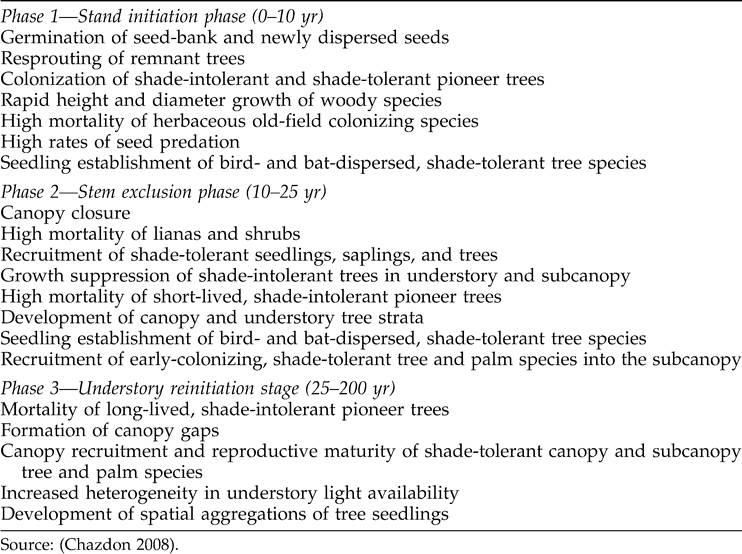
Under Maya management in the evergreen and seasonal rainforests of eastern Chiapas, canopy closure of the ‘stem exclusion stage’ is achieved in two to three years, rather than up to ten as described by ecologists (Table 1), through the propagation of fast-growing pioneer trees. Bats and birds are attracted to these pioneer species and bring the seeds of more shade-tolerant trees that eventually make up the canopy of the mature forest. Thus, the transition into the ecologists' ‘Understory reinitiation stage,’ normally occurring at least 25 years after the disturbance event (Table 1), is reached in half that time under Lakandon management, that is, in around 12 to 15 years. Though most Lakandon farmers would probably prefer to prolong the forest-growth stage for many more years, the field is theoretically ready to be reconverted to milpa at that time (Levy Tacher 2000; Nations and Nigh 1980).
Phases of Neotropical secondary forest succession, and vegetations dynamics, as defined by forest ecologists.
An example of steps taken to build soil fertility in the earliest stages of succession is provided by the Lakandon Maya's management of Ochroma pyramidale Cav. ex Lam (Bombacaceae), the balsa tree,
Where soil has been exhausted by extractive land use, such as prolonged extensive cattle grazing, early stages of secondary succession are vulnerable to invasion by bracken. Balsa is effective in the control of such invasive species that can dominate space rapidly and detour succession from desired afforested states. Furthermore, balsa is crucial to succession as a kind of keystone species around which occur interactions that further determine the direction of the successional process. The species involved have not yet been identified, but the star-shaped, aromatic blossoms attract bats, who are also responsible for pollinating the balsa tree. Bats and birds are the crucial vectors of the seeds of intermediate and long-lived trees that sprout on the newly shaded conditions provided by fast growing pioneers such as ramón (Brosimum alicastrum), hog plum (Spondias mombin L.), and Santa Maria (Calophyllum brasiliense Camb.), among others.
Maya Farmers and Forest Ecologists
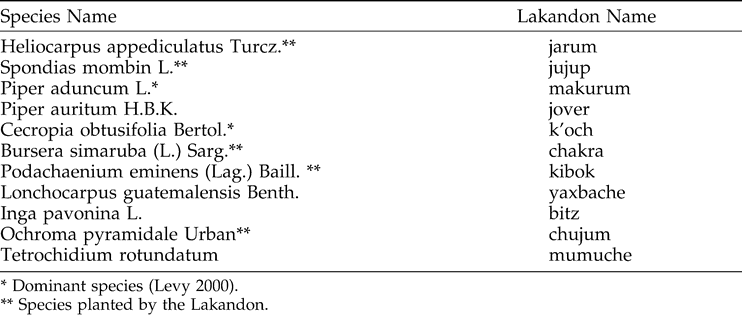
The Lakandon name the distinct successional stages, indicating a concern with the type of vegetation that ideally develops after several years of maize polyculture (Table 3). On comparing Lakandon stages with those defined by forest ecologists, we find similarities and some important differences that reflect Maya management concerns. For example, Chazdon (2008), following previous authors, defines the three basic stages in the process of re-establishment of mature woody vegetation after disturbance (Table 1). Lakandon classification divides Chazdon's second stage, ‘stem-exclusion’ into three separate stages and then distinguishes a fourth stage of mature vegetation, corresponding to ecologists' ‘old-growth’ or ‘mature forest’.
The principle event defining Lakandon stage 2 (
Lakandon Terminology for Successional Stages, approximate chronology and characteristic species according to Lakandon farmers.
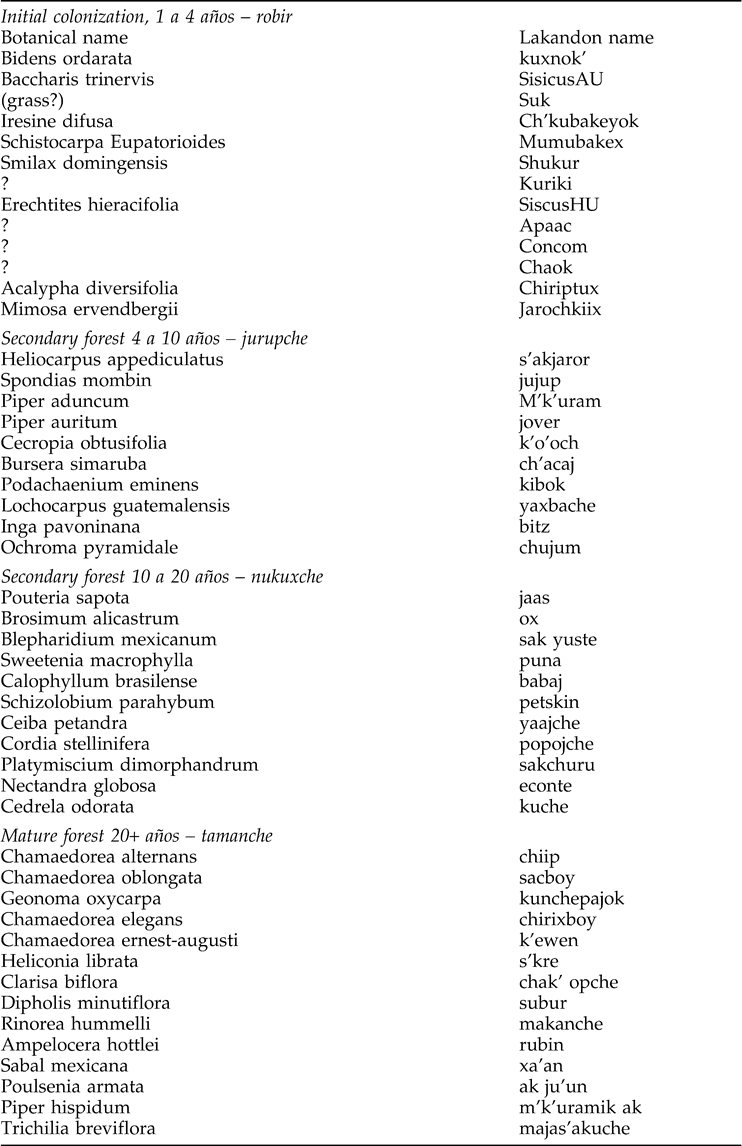
Trees most commonly found by ecologists in the jurupche phase of Lakandon succession.
It is important to note that the secondary associations that develop from traditional Lakandon agroforestry practices differ from those deriving from land use practices by more recent colonists to the region, or by Lakandon Maya who have adopted the conventional milpa system. Traditional Lakandon mature successional stages are more similar to old-growth forest in species composition and other characteristics (Levy Tacher and Aguirre Rivera 2005; Nations and Nigh 1980) than regrowth on conventional fields. Lakandon farmers encourage certain tree species for their ecological functions and their consequent desirable impact on succession (Diemont et al. 2006; Levy Tacher and Golicher 2004) Practices, such as the weeding techniques described above, along with the tree-covered landscape surrounding fields, prepare the process of succession resulting in rapid progress to desirable secondary woody vegetation (Chazdon and Coe 1999; Guariguata and Ostertag 2001).
Soil and Succesion
Fire is a defining feature of swidden agriculture. For a number of reasons this complex form of land management and its key technology have been cast as villains in the drama of tropical development, a process that may well have obscured a more careful and perhaps more fruitful analysis of the roles that fire and succession might have had in the creation of soil fertility over longer stretches of time (Hecht 2003:355).
Under high-performance management, such as practiced by the Maya and other tropical farming people, repeated intensive cycles of cultivation and regeneration can actually lead to enhanced soil fertility, a fact about swidden agriculture that contradicts widely held views. Hecht (2003) has reported a similar observation for Kayapó vegetation management in the Xingu region of the Brazilian Amazon. The standard stereotype of slash-and-burn or shifting cultivation as a destructive or wasteful practice fails to recognize the potential range of labor and knowledge intensity of tropical agriculture, varying from high-performance milpa and forest gardens to something that might be legitimately be called slash-and-burn. The amount of skilled forestry management carried out by Maya smallholders is also variable. The long-term stability and development of these agroforestry systems depends on specific enabling ecological and socio-economic conditions. The outcome for soil varies widely with the intensity of application of traditional skills. Under favorable conditions, intensive management such as described here can lead to greater soil fertility after each cycle of swidden cultivation.
One of the keys to the increases in fertility during the anthropogenic soil building process is the formation of black carbon (BC) as a significant fraction of the soil profile (Glaser et al. 2002; Sombroek et al. 2003). In contrast to the conventional milpa system, in traditional Lakandon practice, small piles of residues of weeds or crops are incorporated directly into the soil or are burned occasionally in small, cool fires, throughout the year. These low-temperature burns produce charred plant material, and cause charcoal to be spread about the field; a hot burn over the entire field occurs only once in the 8 to 30 year swidden cycle, when the initial vegetation is felled to initiate cropping. Even then, a controlled fire can lead to greater charcoal formation. During the maize cultivation phase, most of the weeds pulled or cut are not burned at all but left in the field to decompose, providing a continuous supply of labile organic matter to the soil.
Low-intensity burning results in incomplete combustion of vegetable material from crop residues and weeds and a significant addition of pyrogenic charcoal to the soil. Black carbon has a dramatic positive effect on soil fertility, providing surface area for microbial activity and the fixing of nutrients. High BC in soil is associated with higher P levels (reaching 200–400 mg P/kg) and causes higher cation exchange capacity (CEC), pH and base saturation of soil (Glaser et al. 2002; Liang et al. 2006). These soil characteristics not only help succession to move towards desired vegetation associations, but assure agricultural productivity in future cycles as well.
Increased BC provides increased surface area for the formation of electronically negative sites that capture positively charged nutrients. Temperature must be controlled in the fire to avoid all the biomass being converted to ash, leaving no fixed carbon behind. This is mainly achieved by frequent small fires that prevent the accumulation of flammable biomass. CEC is believed to be increased through the oxidation of aromatic C on the charcoal surface resulting the formation of carboxyl groups with negative charge, or through the adsorption of highly oxidized OM onto the BC surfaces (Glaser et al. 2002; Lehmann et al. 2005). Carbon stored in soil is also highly persistent, remaining for centuries (Sombroek et al. 2003) and constituting a significant part of the soil carbon store.
The propagation of balsa, weeding, and the use of fire are critical tools, part of a range of such tools forest farmers may use to mold and maintain the tropical woodland environment. Traditional Maya milpa involves a high demand for labor and skill in horticultural practices that result in the formation of an anthropogenic soil of increasing fertility. Under proper conditions, one outcome of this process, intensified over generations, could be the formation of anthropogenic dark earths found throughout the Neotropics. This example supports the suggestion of Graham (2006:58) of “encouraging the expansion of dark earth research in the Neotropics beyond the Amazonian region.”
Conclusions
Traditional Lakandon milpa is an intensive agroforestry system that enhanced soil fertility and encouraged the rapid development of secondary forest after maize cultivation. Guiding and accelerating the successional process is a form of intensification of swidden agriculture (Johnston 2003). Shortening of the fallow period is usually thought to lead to soil degradation and forest loss. But under Maya management repeated cycles of intensive milpa could result in the formation of highly productive anthropogenic soil similar to those known as dark earth in Amazonia. It is likely that intensive milpa was more widely practiced in the past when it formed the axis of the rural subsistence system in the Maya area.
Far from being a destructive force in the forest, traditional Maya milpa is an efficient tool for maintaining and restoring biodiversity and creating fertile anthropogenic soil. Policies oriented towards discouraging investment in milpa agriculture are mistaken and in fact worsen conservation rather than promoting it. As the Maya farmer's labor is ‘transferred to other more productive activities,’ energy is diverted from the management tasks necessary for the maintenance of the woodland matrix in which the Maya have lived for some 5,000 years.
In the Maya forest we need conservation policies supportive of local management alternatives and oriented towards programs of participatory restoration based on the synergy of traditional knowledge and contemporary scientific ecology.