







Abstract
In this article, we investigate the loss of local ecological knowledge (LEK) of wild mammals among quilombolas in southeastern Brazil. Using an Event Ecology approach, free listing exercises, questionnaires, and semi-structured interviews, we recorded local knowledge relevant to wild mammals as well as key events in the life histories of residents. Next, we built a causal model connecting age; formal education; years outside the community; years in the pre-village context; and individuals’ degree of LEK. Statistical analysis showed that the formation of sedentary communities and the abandonment of swidden cultivation among young people are the main sources of the erosion of LEK observed. This is the first study connecting a decrease in swidden cultivation with loss of local knowledge about fauna. The importance of swidden cultivation for non-agricultural domains of knowledge was somewhat surprising and particularly relevant in the current scenario of a worldwide collapse of this horticultural system.
Introduction
Historically, researchers address local ecological knowledge (LEK) in terms of its cultural variability and cognitive structures (Berlin 1973; Hunn 2006), its contribution to collaborative conservation projects (Davis and Ruddle 2010; Posey et al. 1984; Tengö et al. 2014), and its forms of distribution and transmission within different populations (D'Andrade 1981; Romney and Moore 1998; Ross and Revilla-Minaya 2011). More recently, ethnobiology and related fields have examined the transformation of LEK in the face of economic and socio-cultural changes in rural populations (Ohmagari and Berkes 1997; Reyes-García et al. 2007; Zent 1999).
In this paper, we analyze the changes in LEK associated with wild mammals among quilombolas (descendants of runaway slaves) in the Ribeira Valley (southeastern Brazil), who have undergone significant economic and socio-cultural changes over the past century (Adams et al. 2013 Carvalho 2006; Munari 2009; Paes 2007; Pedroso Junior 2008). Using an Event Ecology approach (Vayda and Walters 1999; Walters and Vayda 2009), we investigate the role of specific historical events in the life histories of residents and their effects on the complexity of LEK among different generations.
Study Area: Environmental and Historical Context
The Ribeira Valley is located in southeastern Brazil between the states of São Paulo and Paraná, covering an area of 2,830,666 ha in the Brazilian Atlantic Forest biome (Carvalho 2006). The region harbors the largest concentration of quilombola communities in the state of São Paulo (Andrade et al. 2000; Pedroso Junior et al. 2008; Queiroz 2006). Currently, fourteen quilombola communities are distributed along the Ribeira Valley in São Paulo (Santos and Tatto 2008). The communities included in this research are São Pedro, Pedro Cubas, and Pedro Cubas de Cima (Figure 1).
The quilombola communities in the middle Ribeira River began as refuges for runaway, freed, or abandoned slaves during the late eighteenth and early nineteenth centuries (Munari 2009; Queiroz 2006). In addition, traditionally, local families had a very dispersed pattern of settlement over the landscape and have based their economy almost exclusively on subsistence cultivation (Adams et al. 2013; Futemma et al. 2015; Pedroso Junior et al. 2008).
Beginning in the first half of the nineteenth century and continuing through the early twentieth century, the acceleration of rice production across the Ribeira Valley transformed the farming practices and trade relations of quilombola populations of the region (Munari 2009; Valentin 2006). Ever since, quilombola interactions with regional markets have been characterized by cycles of greater or lesser intensity of trade and varying demand for different products at different times.
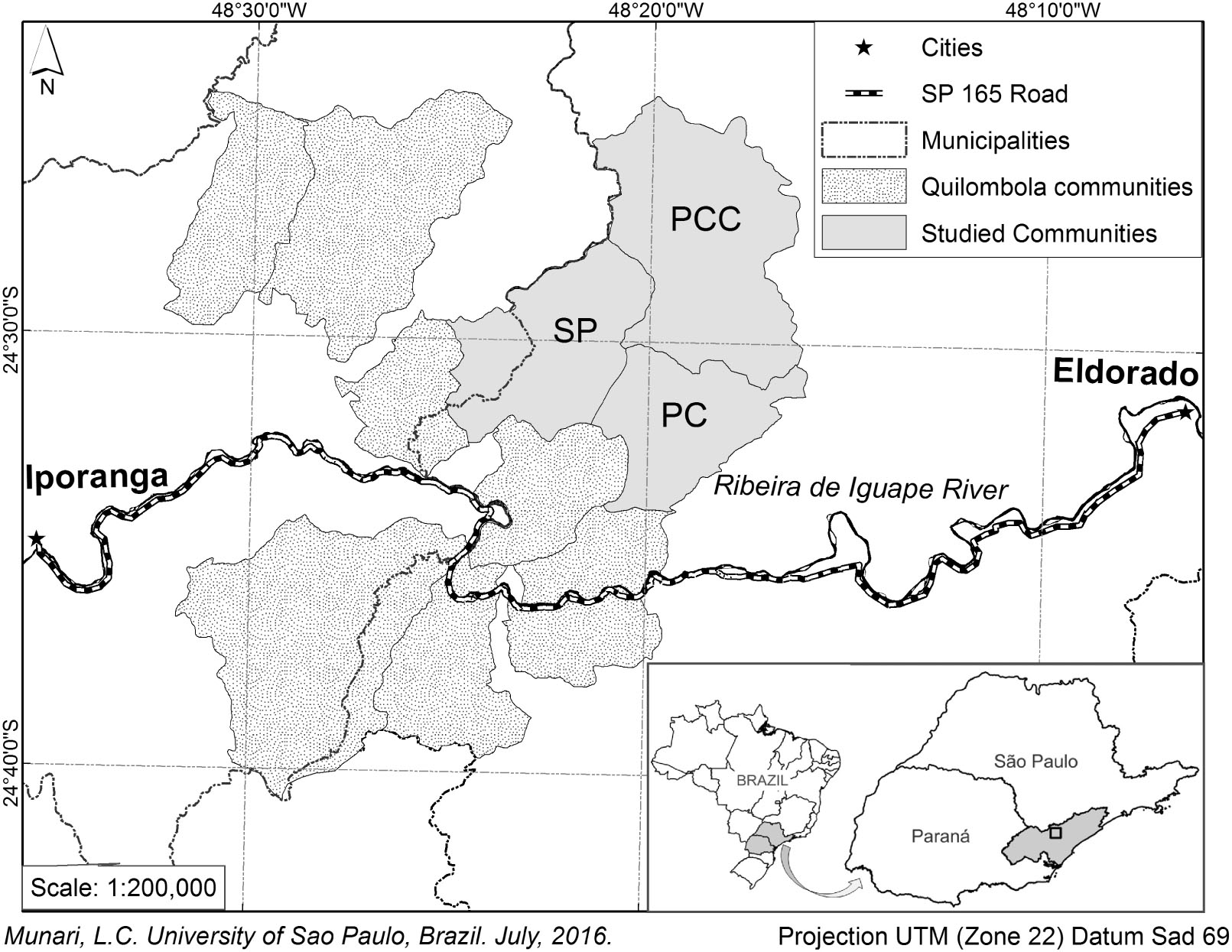
Study communities in the Ribeira valley and surrounding areas. SP: São Pedro; PC: Pedro Cubas; PCC: Pedro Cubas de Cima communities.
Historical and anthropological studies have identified a series of government policies between 1930 and 1950 that aimed at integrating the region with the rest of the State of São Paulo, culminating in the intensification of tea and banana production in the Ribeira (Munari 2009; Paiva 1993). For example, between 1930 and 1940, the Colonization Program by the Federal Government (Programa de Colonização do Governo Federal) was implemented in the lower Ribeira in order to assimilate part of the rural and urban workforce that was affected by the great coffee crisis of 1929 (Paiva 1993). Between 1940 and 1950, the settlement of banana growers in the Ribeira intensified (Paiva 1993). This event had an especially large impact on rural communities of the middle Ribeira, attracting labor throughout the region to large banana-producing farms.
In 1940, a palm heart factory was built along the middle Ribeira (Paes 2007), triggering a significant increase in demand for juçara palm (Euterpe edulis) exploitation by rural communities. Some authors consider the palm heart boom of the 1940s and 1950s to be the first major event in the erosion of the region's historical economic dependence on agriculture (Paes 2007; Queiroz 2006). In 1956, this process was further intensified by the construction of the Regis Bittencourt (BR-116) highway, connecting the Ribeira to major market centers in São Paulo and Curitiba.
Between the 1960s and 1970s, farmers in the middle Ribeira experienced a market consolidation of both palm hearts and bananas (Munari 2009; Pedroso Junior 2008). Records show that a steady flow of migration to cities such as São Paulo and Curitiba took place throughout the twentieth century, a trend that was greatly intensified in the 1970s (Pedroso Junior et al. 2008). This time period also saw an increase in land conflicts (Carvalho 2006; Hogan et al. 1999), as commercial farmers and land-grabbers moved to the region drawn by colonization incentives provided by the military dictatorship to develop, populate, and integrate the region (Queiroz 1967).
The late 1970s and early 1980s saw an expansion of the state's presence in the region through the establishment of rural schools, access roads, and community health services. Environmental monitoring in the region was also intensified during this period, as the government began strengthening its environmental policies, for example, through implementation of the Brazilian Forest Code (Código Florestal Brasileiro) of 1965 and the creation of a new category of Environmental Protection Areas (Áreas de Proteção Ambiental or APA). The most significant effect of these policies in the region was the creation in 1984 of the Serra do Mar Environmental Protection area (APA Serra do Mar), which overlaps with areas occupied by the quilombola communities studied here (Adams et al. 2013). Together, these events caused an increasing flow of families towards schools, government services, and roads. Because of this historical process, local quilombolas evolved from a very scattered occupation of the landscape to a more restricted settlement in the form of villages that exist today (Adams et al. 2013; Munari 2009; Pedroso Junior 2008). It is important to note that, throughout this paper, we will use the term “pre-village” to designate the historical period before the formation of the village settlement pattern above mentioned.
Methods
Theoretical and Methodological Considerations
Studies on human cognitive development directed to the knowledge of the natural world have shown a general pattern of early acquisition of LEK in children and adolescents, which structures the complexity of this knowledge through the entire lifespan of an individual (Hunn 2002; Reyes-García et al. 2005; Wilbert 2002; Zarger 2002). Thus, given that the ages of our respondents vary between 20 and 70 years (as detailed below), we assume that the differences in the degree of LEK among local residents are largely due to generational factors (i.e., the historical, socio-cultural, and environmental contexts in which the individual developed) and not to age, per se (Godoy et al. 2009).
When faced with local events and historical processes that are potentially associated with the erosion of LEK, we believe that it is appropriate to bring to our study certain insights from the analytical model of Event Ecology (EE), proposed by Andrew P. Vayda and Bradley B. Walters (1999; Walters and Vayda 2009). In EE, specific environmental events and their causes are the objects of study, based on the identification of a set of other previous events. More specifically, EE makes use of abductive reasoning by inferring the cause from the effect (Peirce 1931), whereby a set of explanatory hypotheses are generated (Hintikka 1998). Additionally, in EE, the criteria for choosing the most plausible hypothesis is by means of a counter-factual analysis, operationalized by questions such as “If the event ‘A’ had not occurred, would the event ‘B’ have occurred in the same way?” (Tetlock and Belkin 1996).
In this study, we adopt the strategy of analyzing the causal events to be investigated from their manifestations in the life history of local residents, in the form of factors or variables. Walters and Vayda (2009) draw attention to the fact that in Human Ecology, analyses are generally focused on factors (i.e., family income) that are potentially associated with a particular event of interest (i.e., decisions over land use), without any attempt to reveal the causal chains that promote such correlations. Here, we analyze factors conditioned by specific historical events as an indirect way to access these events’ role in LEK erosion.
Analytical Design, Hypotheses, and the Statistics Used
Initially, we noted a decrease in the LEK repertoire among younger residents compared with older ones. We then treated this decrease in repertoire as our event of interest. Next, we selected some local events and historical processes potentially related to this transformation. These events and processes included: (1) the migration of residents from their communities; (2) the establishment of rural schools; and (3) the spatial reconfiguration of dwellings in the format of villages among the study populations (Adams et al. 2013; Carvalho 2006; Munari 2009; Paes 2007; Pedroso Junior 2008).
Other studies have shown that both the migration of young people to urban centers (Bonsi 1980) and the establishment of rural schools with educational programs unrelated to the local customs can trigger or accelerate the processes of LEK erosion (Ohmagari and Berkes 1997; Reyes-García et al. 2010; Zent 1999). The same seems to occur with the greater involvement of local communities in the regional economic market and an increasingly urban way of life (Godoy et al. 2009; Gómez-Baggethun et al. 2010).
With the aim of conducting statistical analysis, we work with variables that can be taken as the manifestations of these events in the life histories of residents. In this sense, we assume that the educational level (in years) of each resident expresses the effect of the arrival of rural schools in the resident's life history. Similarly, the years of residence in the community (the result of age minus the time the individual stayed outside the community) express the migrations of residents from their communities. Finally, the years lived in the pre-village context express the effect of the formation of local villages on each individual respondent (see Supplementary Appendix for data set used in statistical analyses).
We have adopted this strategy based on the understanding that events and historical processes differentially affect the individuals of a given population. For example, with regard to the arrival of the school in the region, although it is a single event in the history of communities, its effect on a given individual is dependent on his or her involvement with the school, which can be measured by his or her educational level. In addition, historical moments of greater or lesser local migration of residents and the length of stay of individuals outside their communities are linked to demands, opportunities, and individual choices. Similarly, the transfer of residences, which culminated in the formation of local villages, has been experienced at different times by different families. In this case, from the individual's perspective, having lived childhood and youth in the pre- or post-village context may have had profound implications for the structuring of LEK.
After defining the variables to be analyzed, we built a theoretical model that links the factors associated with the life story of individuals to the complexity of their LEK. Given the occurrence of the historical events analyzed here, it was expected that the age of each individual was highly correlated with his or her educational level, years in the community, and years in the pre-village context. In this sense, in our theoretical model, the individual's age directly affected schooling, years in the community, and years of pre-village context. These latter variables, in turn, directly affected LEK (Figure 2).
Because our interest focuses on the elucidation of possible causal chains that would have contributed to an individuals’ LEK competency, we chose to make use of path analysis as a statistical tool. Path analysis is an extension of multiple linear regression that is used to investigate the structural relationships (direct and indirect effects) between manifest variables (exogenous and endogenous) from the correlational structure observed between these variables (Byrne 2010; Kline 2011). This technique is a specific application of structural equation modeling (SEM), whose structural relationships, reflecting causal hypotheses concerning the direct and indirect effects of manifest variables, are particularly appropriate for testing mediation hypotheses and moderation hypotheses between variables (Byrne 2010; Kline 2011).
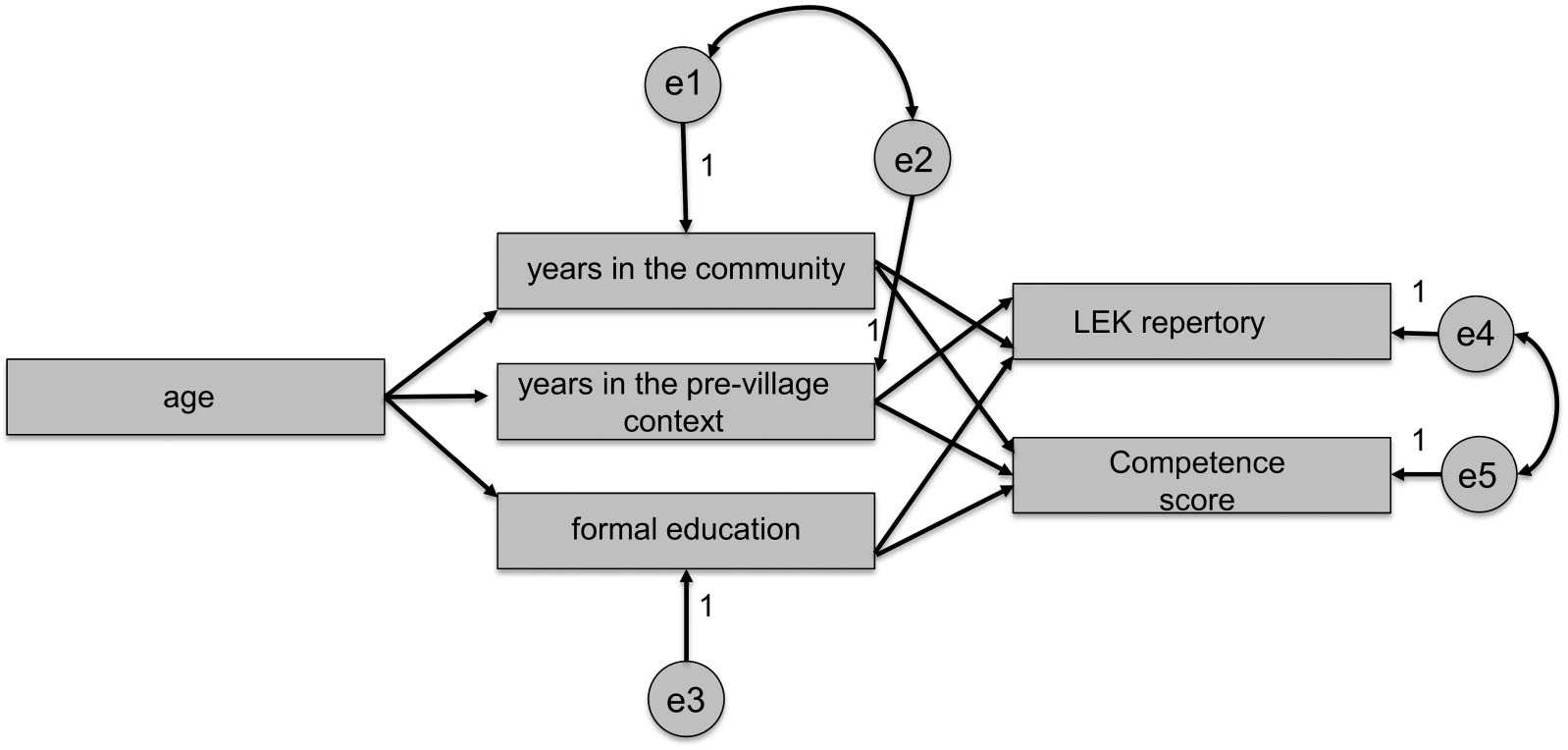
Initial model for explaining the degree of local ecological knowledge among the quilombolas of the Ribeira Valley, Brazil.
Among our more specific hypotheses, we tested whether educational level has negatively affected the LEK and whether age, years in the community, and years in the pre-village environment have positively affected LEK. In our sample of respondents, the variable “years in the pre-village context” is chronologically aligned with the age of the individuals. For example, the fact that a resident spent 15 years in the pre-village context means that he or she was born and remained in this context up to the age of 15, and so on. In this sense, once again based on the general pattern of the early acquisition of ethnoecological repertoire (see “Theoretical and Methodological Considerations”), we expected that the individuals’ time of experience during childhood and early adulthood in the pre-village period acted most expressively on LEK compared with the other variables considered here.
In the path analysis, the significance of the effects of age, years in the community, years in the pre-village context, and educational level on LEK was evaluated using the parameters estimated by the maximum likelihood method (ML) in the AMOS software package (v. 22, SPSS, An IBM Company, Chicago, IL). The existence of outliers was assessed by the squared Mahalanobis distance (D2) and the normality of the variables was evaluated by the uni- and multivariate (Mardia's test) coefficients of asymmetry (Sk) and kurtosis (Ku) (Byrne 2010; Kline 2011). No variable of the model had Sk and Ku values indicating severe violations of the univariate normal distribution (|Sk|<3 and |Ku|<10). The value of the multivariate Ku (Mardia's test) did not present any indications of severe violation of the multivariate normal distribution. In addition, there was no evidence of the presence of extreme values, such as D2 values, whose removal is suggested (Byrne 2010; Kline 2011). Multicollinearity was evaluated with the variance inflation factor (VIF) statistics. No strong multicollinearities were found between variables (VIF>5) that indicated the need for their removal. The need to re-specify the model was evaluated by the modification indices. The significance of direct, indirect, and total effects (βY←X) was evaluated with bootstrap resampling (n = 2000) (Byrne 2010; Kline 2011).
Sampling and Data Collection
Selected Knowledge Domain
In this study, we analyzed LEK about the habits and diet of medium and large terrestrial mammals of the Ribeira Valley (Atlantic Forest) (Prado et al. 2013), which present mainly herbivorous and omnivorous feeding habits. The twelve mammals that comprise the focus of this research are tapir (Tapirus terrestris), deer (a local term that covers the two most common deer species in the area, Mazama americana and Mazama gouazoubira, in addition to Mazama Nana and Mazama bororo, which are also potentially found in the region), collared peccary (Pecari tajacu), white-lipped peccary (Tayassu peccary), lowland paca (Cuniculus paca), Azara's agouti (Dasyprocta azarae), ring-tailed coati (Nasua nasua), crab-eating raccoon (Procyon cancrivorus), tayra (Eira Barbara), crab-eating fox (Cerdocyon thous), big-eared opossum (Didelphis aurita), and armadillos (a local term that covers the species Dasypus novemcinctus, Dasypus septemcinctus, Euphractus sexcinctus, and Cabassous sp.). The choice of fauna was due to the recognized importance of these animals in the hunting activities and subsistence of rural populations in the Neotropics in general (Redford and Robinson 1987; Robinson and Bennett 2000) and specifically among the populations of the Ribeira (Munari 2009; Prado 2012). In theory, this relevance is also reflected in the greater degree of LEK about these animals compared with other groups of fauna. In addition, this fauna has been the subject of a long-term study developed by the authors in the area (Prado et al. 2013, 2014).
Format of the Interviews and LEK Measures
We applied three models of interviews in this study: (1) a semi-structured interview on aspects of the life history of respondents; (2) a free listing exercise recording the residents’ knowledge of items that compose the diet of these species; and (3) a questionnaire for recording LEK of the foraging habits of mammals. Regarding life history, we focused on recording the educational level of the respondents, their occasional migrations and years of residence outside the community, and individuals’ times of experience in the context herein designated as pre-village. The free listing exercise and the questionnaire were used to produce two independent measures of LEK, repertoire and “competence score” (consensus-based), respectively (see Supplementary Appendix for data set used in statistical analyses).
Free Listing and Repertoire as a Measure of LEK
One method for measuring the degree of knowledge of respondents was through the size of the residents’ repertoire of food items composing the diet of the animals considered. To that end, we used the free listing technique (Quinlan 2005). We asked respondents to list the names of all the resources he or she judged as composing the diet of each one of the mammals separately. We asked the following question: “Can you list everything that you remember that makes up part of the diet of this animal?” When the cited resource consisted of a plant, we asked the respondent to indicate the parts of the plant consumed by the animal (e.g., fruits, roots, and leaves) if these had not been noted spontaneously.
To systematize the records, we organized the elements of the diet of the fauna into three levels of specificity: (1) the class of food, which is the most comprehensive category, consisting, for example, of the categories of plants, animals, and minerals, among others; (2) specific item, which represents a plant, an animal, or a particular mineral; and (3) resource type, which represents a specific part of a given plant (e.g., leaf, fruit, root).
Questionnaire and “Competence Score” as a Measure of LEK
Another method for measuring the respondents’ degree of knowledge is through consensus analysis (Romney et al. 1986; Weller 2007), through which we estimated the “competence score” for each respondent in this knowledge domain. To that end, we applied a multiple-choice questionnaire in a dichotomous format (yes/no), consisting of seven questions about mammals and involving the existence of seasonality in their distribution; their frequency of visits to swidden fields in the landscape; and the presence of leaves, sprouts, fruits, roots, and animals in their diet. Applying these seven questions for each of the 12 species resulted in 84 questions to be answered by each respondent. Affirmative answers were coded as 1 and negative answers as 0. We analyzed the data from the multiple-choice questionnaire using the statistical package “SubCultCon” (“Maximum-Likelihood Cultural Consensus Analysis with Sub-Cultures”) (Meyer et al. 2014), implemented on the platform R (R Development Core Team 2013).
In Consensus Analysis, competence score is an estimate of maximum likelihood generated by factoring a correlation matrix (constructed by the numbers 1 and 0, as above mentioned). In addition, the competence score is calculated as a function of the level of agreement between each individual and the rest of the interviewees, considering all the questions used (Romney et al. 1986). For further theoretical and methodological considerations involving consensus analysis, see Aunger (1999), Romney (1999), and Weller (2007).
Population Sampling
Men are the main hunters among quilombolas in the Ribeira (Prado et al. 2013, 2014). Because hunting is a direct and a profound way of acquiring knowledge about the behavior and ecology of large mammals, we interviewed men only. We sampled the population in a stratified manner, sorting residents within different age groups or generations, resulting in a sample of 51 respondents distributed as follows: born in the 1940s (6 inhabitants), in the 1950s (12), in the 1960s (11), in the 1970s (11), and in the 1980s (11). No other sampling criterion (i.e., occupation) was used here. Sampling of respondents was based on the information provided in the demographic census conducted in these communities by Pedroso Junior (2008). Stratification in sampling (and not its simple randomization) was due to our explicit interest in evaluating the role of the generational/historical element in LEK.
In terms of the organization of field activities, we first applied the semi-structured life history interview with sampled residents, in addition to the multiple-choice questionnaire on the ecology of mammal species. Both procedures were employed in the same interview event. Afterwards, we applied the free listing exercise, a strategy that was more appropriate given the field work being undertaken at that point (Prado 2012; Prado et al. 2013, 2014). Interviews lasted from 50 minutes to an hour.
Prior to initiating research, we carried out consultation visits to the communities, including meetings with community organizations. The resident associations of São Pedro, Pedro Cubas, and Pedro Cubas de Cima all authorized this study and the Ethical Committee of the Bioscience Institute (University of São Paulo) approved the research. We also obtained prior informed consent from each interviewee. Interviews were scheduled in advance and conducted at the individuals’ residences.
Results
General Characterization of the Recorded LEK
The record of the local repertoire on the diet of the twelve mammals, based on free listing, resulted in the citation of 299 resources, comprising 213 items and five classes of food: plants, animals, decaying organic matter (carrion and feces), minerals (ash, clay, and salt), and other (eggs and honey). The citations presented a highly dominant pattern, in which a small portion of the resources was widely cited, while most items were mentioned only infrequently. For example, of the 299 resources, 217 (72.5%) had less than 10 citations. However, only the six most frequently cited resources accounted for 31.5% of the total of 3884 citations. These resources were worm, orange (not identified taxon), Cattley guava (Psidium cattleianum), cassava (Manihot esculenta), corn (Zea mays), and banana (Musa acuminata). Together, corn and cassava accounted for approximately 20% of total citations.
Notably, most cited resources are fully domesticated plants or plants managed in anthropogenic environments in the local landscape, such as fallows, backyards, and secondary forest vegetation. This pattern reinforces what we have already observed in the specific case of the diet of ungulates (Prado et al. 2013). Consensus analysis applied to the closed questionnaire, from which the “competence scores” were estimated, resulted in a single vector of responses (conv = 0, val = 61,673.67) (Meyer et al. 2014), suggesting the existence of a statistical consensus in the population regarding the knowledge domain.
Factors Related to Intergenerational Changes in LEK
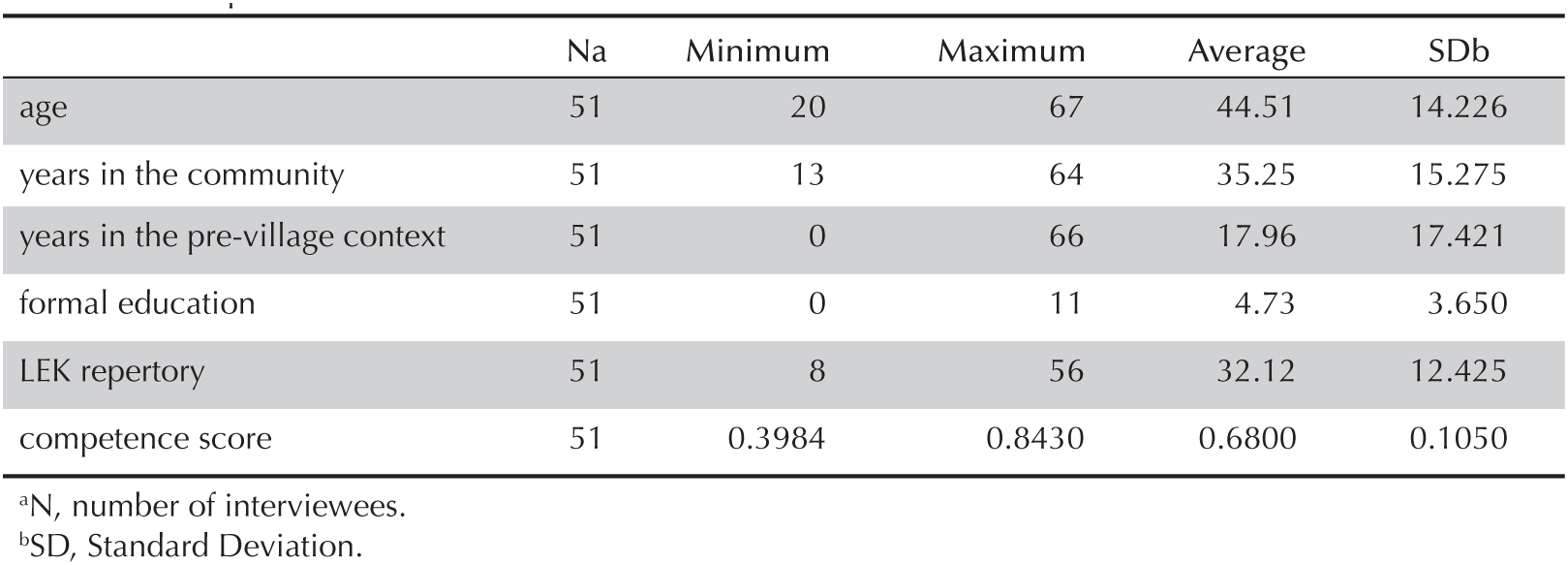
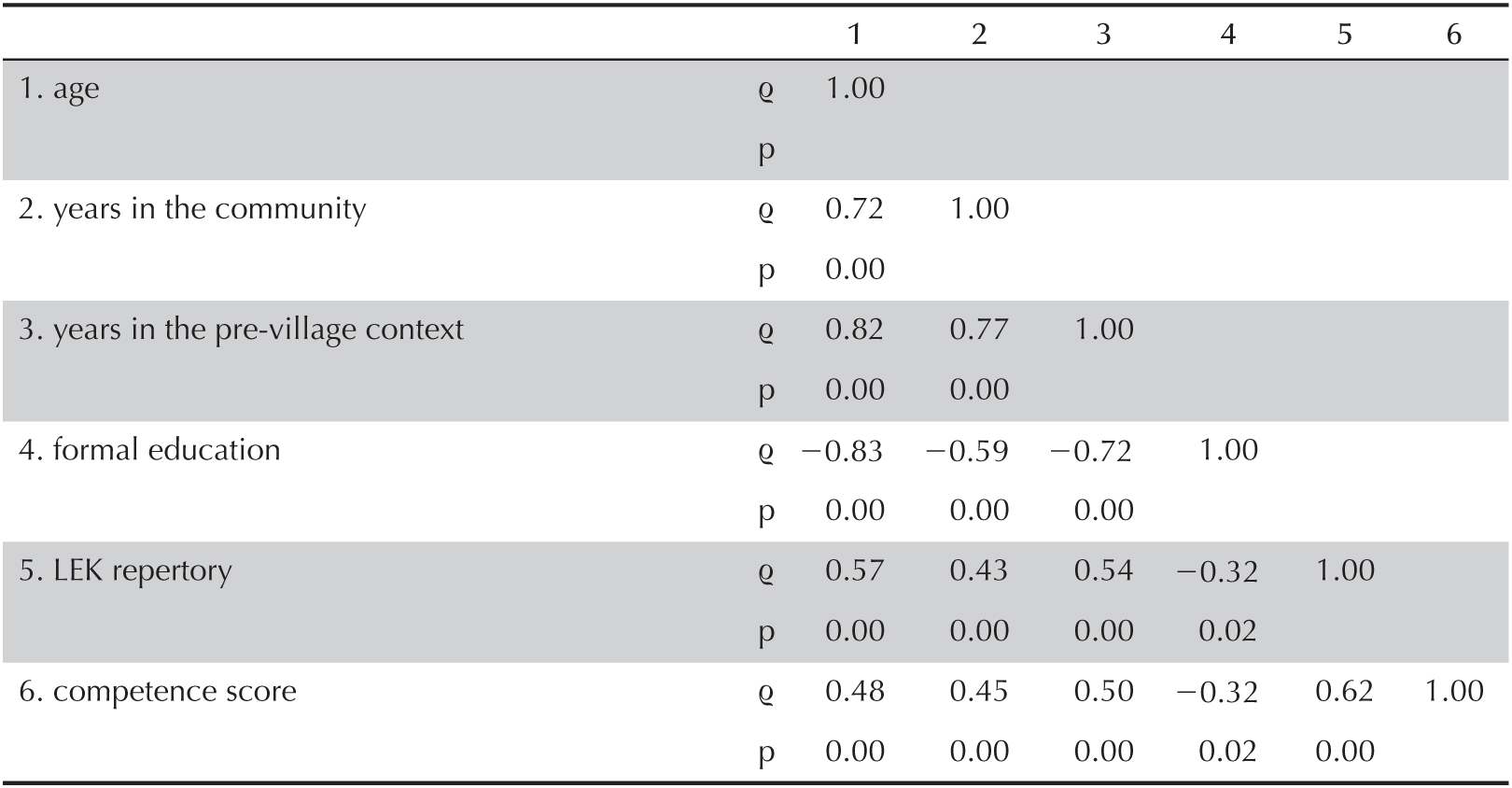
Table 1 shows descriptive statistics for the variables considered. Table 2 shows the high levels of the Spearman's correlation (ϱ) between all variables, with coefficients higher than 0.80. Regarding the relationships of interest (repertoire and competence score versus the other variables), the correlations show lower magnitudes, although they are highly statistically significant (p < 0.02). We also note that the nature of the relationships confirms our expectations regarding age, years in the community, and years in the pre-village context as having a positive relationship with respect to repertoire size and competence score. Moreover, increase in educational level in the formal educational system tends to result in a smaller repertoire and lower competence among individuals.
The adjusted model in the path analysis explains 26% of the variability of the variable repertoire and 17% of the variability in competence score. Figure 3 presents the resulting model with the standardized estimates of the regression coefficients and the R2 of the dependent variables. All paths derived from age are highly significant (p ≤ 0.01) and only one path, that comes to the variable of repertoire βrepertoire←previllagetime=0.48 (p = 0.086), is significant at the 10% level. The modification indices do not suggest any required specification and the highly significant correlation between the errors of repertoire and competence score (ϱ = 0.40; p = 0.000) suggests that they should be treated together, not in separate regressions. These findings indicate that only the variable of pre-village years has a mediating effect on the degree of ecological knowledge, more specifically on the repertoire. Age has a total and indirect effect of 0.40 on repertoire (p = 0.002) and a total and indirect effect of 0.34 on competence score (p = 0.008). The direct and total effect of pre-village years on repertoire is 0.48 (p = 0.10), and the direct and total effect of pre-village years on competence score is 0.17 (p = 0.56). It is worth noting that the initial model (Figure 3) presents adjustments that are considered to be acceptable [χ2 = 10.110 (p = 0.039); CFI = 0.965; GFI = 0.938], according to the benchmarks presented in Kline (2011).
Description of the research variables.
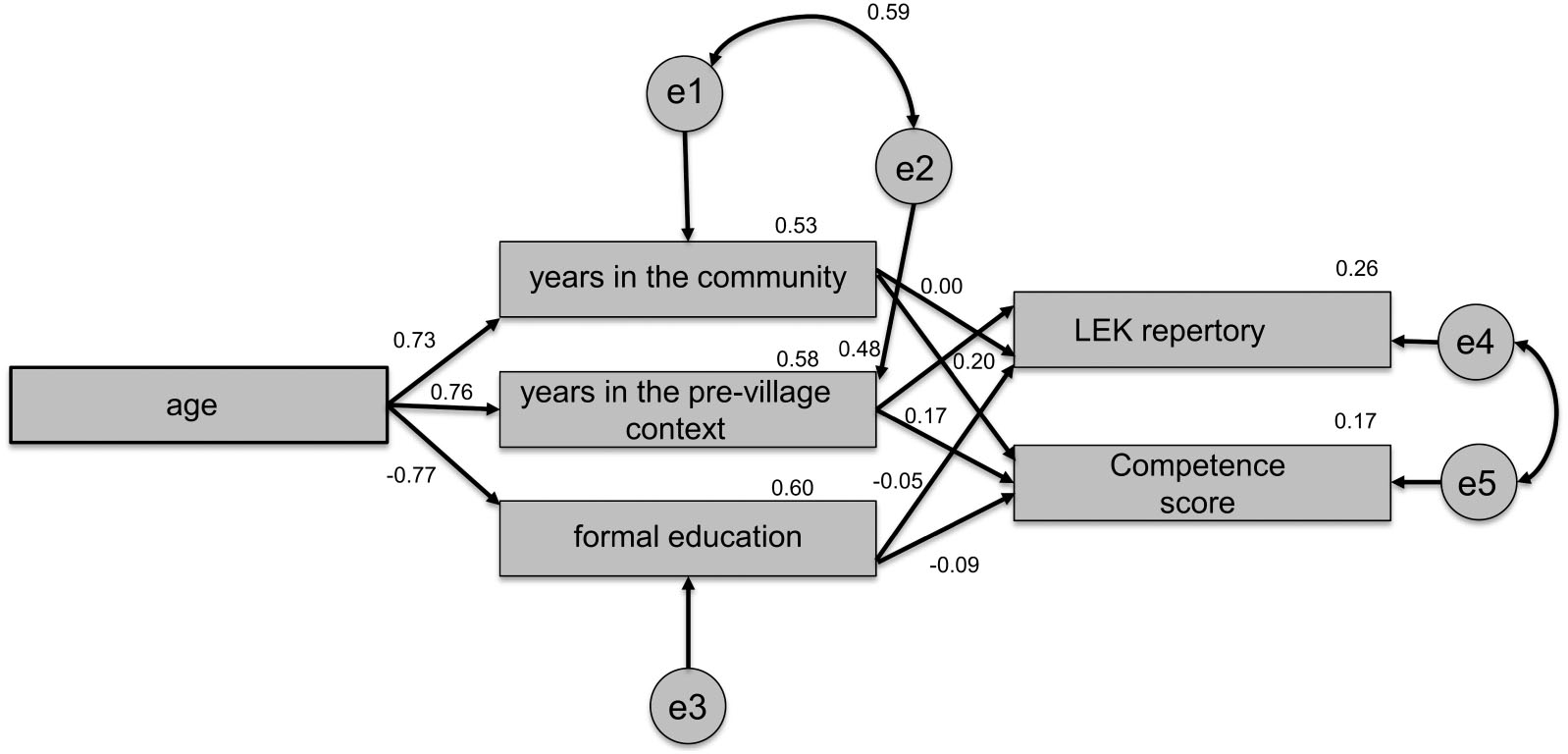
Adjustment of the initial model to explain the degree of local ecological knowledge among the quilombolas of the Ribeira Valley, Brazil.
Given that all of the other paths that reach the response variables of interest were not significant, we decided to adjust the model, as shown in Figure 4, to evaluate the stability of the findings and obtain a more parsimonious model. This new model continues to explain 26% of the variability in the variable of repertoire. But in this model, all paths are highly significant (p ≤ 0.01), including the coefficient βrepertoire←previllagetime, which was only marginally significant in the initial model. It is also noted that the magnitude of the coefficients is almost the same between the two models (initial and final), showing the stability of the results. The modification indices do not suggest any other required specification and these findings support that only the variable of pre-village years has a mediating effect on repertoire.
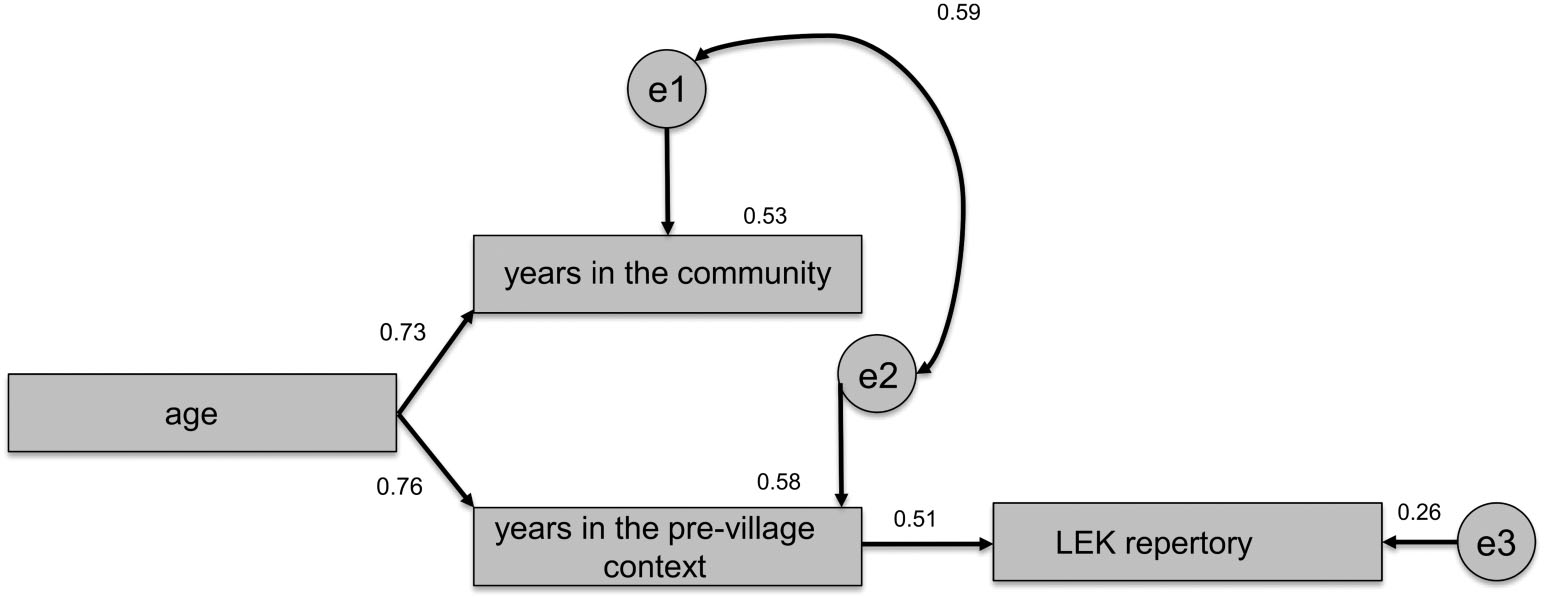
Adjustments to the final model to explain the degree of ecological knowledge among the quilombolas of the Ribeira Valley, Brazil.
Age had a total and indirect effect on the repertoire that was almost identical to the previous model (βrepertoire←age=0.39; p = 0.000). The direct and total effect of the variable of pre-village years on repertoire was also nearly the same (βrepertoire←previllagetime = 0.51; p = 0.000) but highly significant. The model in Figure 4 also presents acceptable adjustments [χ2 = 6.995 (p = 0.030); CFI = 0.958; GFI = 0.939] and lower information criteria [AIC = 22.995; BIC = 38.450; MECVI = 0.495] than that of the model in Figure 3 [AIC = 44.110; BIC = 76.951; MECVI = 0.993].
In short, the first model suggests that only the experience of individuals in the pre-village context (in years) has a direct effect on LEK, specifically the repertoire. Additional analyses in the second model reinforced this result.
Discussion
In the methodological framework, we observed that two methods for measuring LEK behaved differently in our analysis. The repertoire measure, obtained by the free listing technique, was more sensitive than the competence score, which was generated through consensus analysis. Apparently, the degree of generalization of the questionnaire used to generate the competence score tended to smooth out differences between individuals, presenting a more homogeneous situation of LEK among the residents compared to free listing of animal dietary items. By demanding more specific knowledge from the respondents about wild mammal diets, free listing turned out to be more effective in diagnosing variation in LEK among the study population.
Many studies have suggested that the establishment of rural schools with formal educational programs that are alien to local customs and values have contributed to the erosion of LEK (Bonsi 1980; Cristancho and Vining 2009; Godoy 1994; Ohmagari and Berkes 1997; Reyes-García et al. 2010; Wilbert 2002; Zent 1999). Migration of residents from their home communities has also been shown to be a factor (Bonsi 1980). In our study, we found a negative association between education and migration versus LEK. However, the effect of such factors on LEK was barely expressed—statistically significant but only small in their effect (Table 2; Figure 3).
The same cannot be said regarding the formation of the villages in the region. Indeed, people's time of experience in the pre-village period was not only relevant (corroborating our main working hypothesis) but also the only variable with a significant effect on the knowledge of mammals’ dietary repertoire. Thus, for residents of the quilombola communities of São Pedro, Pedro Cubas, and Pedro Cubas de Cima, the key historical event for understanding the process of LEK erosion among the younger generations was the formation of villages and their ensuing consequences for the way of life of the residents.
With over a decade of research in the region, our experience, combined with local historiography, allows us to illuminate the relationship between the village context and LEK repertoire. Younger residents, especially those born in the post-village context, have minimal interactions with swidden cultivation (see also Pedroso Junior 2008) in the area. As noted above, the formation period of the villages was marked by increasing constraints by state environmental agencies on the clearing of new agricultural areas (Adams et al. 2013) as well as land disputes with commercial farmers and land-grabbing colonists from outside the region (Carvalho 2006; Hogan et al. 1999; Queiroz 1967). These factors also seem to have discouraged involvements with swidden cultivation, as recorded by Pedroso Junior (2008) and Munari (2009) by means of interviews with the locals.
Correlations between the research variables.
Swidden cultivation has been central in these communities’ livelihood since their formation over two hundred years ago (Pedroso Junior 2008) and remains an important element of cultural identity for these populations (Andrade and Tatto 2013). In swidden cultivation, small areas of forest (between 0.5 and 1 ha) are slashed and burned to be cultivated for short intervals of time (approximately 3–5 years). After the cultivation period, the area is abandoned for the land to “rest” (or fallow) for a longer period sufficient for the woody vegetation to become dominant (Conklin 1961). In this sense, swidden cultivation involves a complex spatial and temporal management of the landscape. As a consequence of the rotational nature of the system, the landscape is a mosaic formed by fallows and secondary forests of different ages of regeneration, in addition to farms currently in use. In the case of the Ribeira, two centuries of swidden cultivation has created a complex and diverse mosaic with a wide variety of environments with different levels of anthropic influence (Gomes et al. 2013; Munari 2009).
Throughout the twentieth century, as a result of a combination of economic forces and government policies (as described in “Study Area” section), and especially during the formation of rural villages between 1970 and 1980, this complex way of managing the landscape has gradually been replaced by intensive farming. This way of cultivation is practiced in the vicinity of residences and dominated by cultivars of high commercial interest, such as bananas, passion fruit (Passiflora incarnata), and peach palm (Bactris gasipaes) (Adams et al. 2013; Munari 2009; Pedroso Junior et al. 2008). In this sense, the creation of villages appears to have resulted in the formation of a new socio-cultural context characterized by greater interaction of individuals with commercial agriculture and urban values at the expense of more traditional practices and experiences linked to swidden cultivation.
Quilombola knowledge of the ecology of wild mammals is strongly associated with cultivated environments within the swidden cycle: swiddens, fallows, house patios and their surroundings, and secondary forests (Prado 2012; Prado et al. 2013, 2014). In residents’ perceptions, it is these anthropogenic landscape elements (and not mature forests) that mammals use most often and where they find the most abundance and diversity of food. Thus, swidden cultivation has shaped the main environments in which residents interact with the fauna, therefore structuring this domain of LEK.
In short, as the central activity in the residents’ everyday lives during the pre-village period, swidden seems to have acted as a means through which the experience of quilombolas with the local Atlantic Forest was structured—including the hunting practice, an activity directly related to wildlife knowledge. It is noteworthy mentioning that we could not report yet the involvement of different generations of quilombolas in hunting activities. However, based on our findings, indicating a high association between swidden practice and wildlife local knowledge, we hypothesize that, in parallel with the abandonment of swidden among quilombolas, hunting may have become more infrequent over the last few decades as well (but this is an issue still waiting for other studies in this ethnographic context).
Thus, complementing other findings (Adams et al. 2013; Munari 2009; Pedroso Junior 2008), we can state that the creation of villages associated with the accelerated abandonment of swidden cultivation over the past four decades has had a significant role in the process of quilombola LEK erosion reported in this study. The younger generations of the communities studied here seem to experience what Atran and Medin (2008) have called the “extinction of experience in the natural world” or what Ingold (2000) would call the disengagement of residents from core practices and experiences to certain forms of perception (and knowledge) of the environment.
Simultaneously, we can also consider older men as LEK repositories in an inactive or dormant state (Leopold 2011; Volpato and Puri 2014). Logically, the possibility of revitalization and acquisition of LEK by the younger generations still exists, but the chances seem remote given current trends. Such a process would require a total redirection of the political, economic, and sociocultural forces that, for decades, have been removing local residents from the ecological context that shaped their knowledge of the mammal fauna.
Conclusion
In this article, we demonstrate how studies on transformations in LEK can be integrated with an Event Ecology (EE) approach (Walters and Vayda 2009). This dialogue appears especially productive with regard to identifying and investigating historical events that led to changes in LEK. Initially, we selected historical events and processes of interest. Next, we conducted an analysis based on statistical modeling. At the end of this process, we interpreted the findings in light of our ethnographic experience in the field. In this sense, we engaged in what Walters and Vayda (2009) call an “adaptive process” of research. This process was sufficiently open to incorporate information from the different analytical approaches noted above. This is the first study to our knowledge showing a connection between the erosion of the swidden system and the loss of LEK concerning wild fauna. This important implication of swidden practice beyond the domain of agricultural knowledge is both non-intuitive and yet highly particularly relevant considering the current decline of this cultivation system worldwide (Mertz et al. 2009; Van Vliet et al. 2012).
Footnotes
Acknowledgments
This study was funded by the São Paulo Research Foundation (Fundação de Amparo à Pesquisa do Estado de São Paulo—FAPESP) through doctoral (2008/50951-3) and post-doctoral scholarships (2012/51333-7) granted to Prado and by a research aid granted to Murrieta (2009/52539-5). We also acknowledge the theoretical contributions of Eduardo S. Brondizio (Anthropological Center for Training and Research on Global Environmental Change, Indiana University) during Prado's doctoral internship at Indiana University. Glenn H. Shepard Jr. (Museu Paraense Emílio Goeldi) and anonymous reviewers carefully revised the text and gave constructive comments on the manuscript. We are grateful to Professor Cristina Adams, from the School of Arts, Sciences and Humanities at the University of São Paulo (Universidade de São Paulo—USP) for co-leading, with Murrieta, a group of studies in the Ribeira Valley that have figured as central references for the full development of this research. We would also like to thank Pablo Silva for the support on statistics and the following students for their help during the computation of data from the interviews: Fausto de Oliveira Gomes, Paula Giroldo, and Ramiro Araújo. Finally, to the residents of São Pedro, Pedro Cubas, and Pedro Cubas de Cima communities, we would like to extend our sincere gratitude for authorizing this research and sharing with our team much of their knowledge about the ecology of the region.