







Abstract
Songs among the Tlingit of Alaska and Canada are important means for communicating and aligning relationships, knowledges, and emotions among humans, non-human persons, and ancestral lands. As potent expressions of individual and collective identity, heritage, and destiny, songs encapsulate ethnobiological, social, and geographic knowledges in a melodious, interspecific lingua franca. A particular ancestral or communal context, such as a potlatch or
Introduction
The ethnobiological contexts for composing and singing songs have been largely understudied among Indigenous peoples. Often, songs are analyzed in their sociological and emotional contexts or within particular ethnomusicological frames, but seldom with their full range of ecological links in mind. There are exceptions to this, including the path-breaking work of anthropologist-musician Steven Feld (1990, 2018). Feld shows how the rich sounds of place and other-than-human species of the Bosavi Rainforest inform and infuse the music and singing of its Papua New Guinea inhabitants. He has documented the rich layering of sounds of the tropical rainforest as a constituent part of Kaluli singing and the execution of particular livelihood tasks, such as processing sago palm. This is consistent with other literature on what may be broadly termed “ethnobiology and song” that shows the integrated nature and indivisibility of music, landscape cognition, emotion, and activities on the land, especially among Indigenous peoples. Examples include the Yaqui Deer Songs of the Sonoran Desert (Evers and Molina 1987), Arctic Inpuiat and their whaling songs (Sakakibara 2009), Subarctic Sakha agropastoralists and their improvisatory singing (Crate 2006), and Malaysian forest Temiars' horticultural and foraging songs (Roseman 1998).
Similarly, although ethnobiologists are commencing to examine music as a tool for the maintenance and transmission of biocultural knowledge, ethnomusicologists, among others, have long recognized the fundamental role of song in transmitting the cultural identities of Indigenous peoples, as well as their deep, synaesthetic senses of place (Abram 1996; Brabec de Mori and Seeger 2013; Simonett 2014). Songs and singing, in particular, are part of the multiplicity of media marking and recalling culturally salient phenomena in time, space, and human experience (Thornton 2008).
The matrilineal Tlingit of Southeast Alaska are widely known for their oratory and singing, two modes of oral expression that often accompany each other (Emmons and de Laguna 1991; Dauenhauer 2000; Dauenhauer and Dauenhauer 1987, 1990, 1994). In these genres, audience is always important and, ideally, known, so that the speaker can formally relate to the listeners, who, in turn, may be expected to participate or reciprocate. This balance is especially important in so-called “clan songs,” which are typically sung at potlatches (known in Tlingit as
In contrast to the heavy songs are the “happy songs,” which help transition from the grieving part of the memorial potlatch to the celebratory stage, when the guests are thanked with gifts for having taken care of the deceased and his or her family during mourning, and for witnessing and validating the bestowing of names, regalia, and other prerogatives on members of the host clan. These songs are meant to be uplifting but, like the heavy songs, also convey important heritage and events on the land. Musically, they may be livelier in terms of tempo and beat, but not necessarily; some, like Mary Sheakley's song, featured here, are plaintive in tone because they convey feelings of longing or love for members of the opposite moiety. During this stage of the ritual, the host clan pays thanks to—and demonstrates love for—their guests with food and gifts for their support.
In addition to these heavy and happy ceremonial songs referencing ancestors and beloved kin, grief and joy, are shamanic “spirit imitating songs” (yéik utee daa sheeyí) that typically include unintelligible words meant to appeal to an individual shaman's spirit helper (Kan 1990). The speaker/singer, thus, must be cognizant of his or her audience members and the relationships, protocols, and knowledge bases that govern their status and interactions. Ignorance or willful violation of protocols for performing powerful songs, such as spirit songs, especially in secular contexts, could lead to a diminishing of their potency and meaning, as well as other negative consequences.
de Laguna (1972) proposed a more comprehensive classification of Tlingit songs in her majesterial study of the Yakutat Tlingit, including sib (matrilineal clan) songs, walking, resting, and dancing songs (often foreign in origin), peace songs, funny songs, songs for children, shamans' songs (the “spirit imitating songs” referenced above), and Haida mouth songs. The latter are typically recorded by known composers, such as Mary Sheakley, and addressed to the children of the opposite moiety, usually a clan with which the composer has close ties, as is also the case with the song presented here.
Balancing the power of songs and oratory is important, as is calibrating them to the audience and social needs of the occasion. As Julie Cruikshank (1991, 1997) points out, this can be a challenge when performing for new audiences in unfamiliar settings, such as urban storytelling festivals. To mediate these potential problems, Tlingit orators/singers will avoid certain “powerful songs” in secular contexts or offer a preamble to their performances in order to establish a “linking landscape” (Thornton 2008) with the audience, so they can interact respectfully and journey together through the song or story (though perhaps at different levels). This linking landscape provides a common, mediated ground and relational frame for bringing forth a song, thereby increasing its resonance and significations. By creating both lateral (horizontal—e.g., collateral human and non-human persons) and lineal (vertical—e.g., ancestral relatives, including totemic animals) dimensions of unity and interplay, songs further engender kincentric ties (Salmon 2000) among the community of beings present.
The song presented here was spontaneously composed by Chookansháa (Woman of the Chookaneidí clan), Mary Sheakley, in response to an encounter with a group of howling wolves in what is now Glacier Bay National Park in Huna Tlingit territory in the early twentieth century. The song's history reflects the genesis and evolution of Tlingit songs from individual creative expression within a particular ethnoecological context to status as clan at.óow or sacred property. The song was nearly lost, however, due to acculturation, dispossession, and language loss, until it was spontaneously remembered in situ and in vivo during a berry picking trip to Glacier Bay in 1996 (Thornton 1999) by Mary Sheakley's younger clan sister, Amy Marvin (1912–2001), whose Tlingit name was
The aim of this paper is to present this song in its social and ethnobiological context, including its remembrance and deployment in the subsistence and ceremonial context of a berry picking trip to Glacier Bay National Park. We first describe social and ecological foundations of Tlingit songs. Second, we describe the methodology used to document and analyze the song, and the ethnobiological and intergenerational context for revitalization and transmission. Third, we present a full bilingual transcription of the second version of the song with annotations and discuss the circumstances concerning its revitalization and deployment during Amy Marvin's last gathering trip to Glacier Bay. And, finally, we suggest ways that cultural and ecological contexts support each other in the performance, remembrance, and transmission of sacred songs composed on the land.
The Social and Ecological Foundations of Tlingit Songs
The Chookaneidí clan are of the Wolf moiety of the Huna Tlingit tribe (Xunaa
The Chookaneidí clan is widely known among Tlingit matrilineal groups for their songs, which have been recorded, published in bilingual texts and Native American literature anthologies (e.g., Dauenhauer and Dauenhauer 1987; Swann 1996), and discussed in the context of place, identity, and social and environmental change (Cruikshank 2005; Culp et al. 1995; Thornton 2008). The Chookaneidí composed several songs when they were forced to leave Glacier Bay, their homeland and birthplace, due to the violation of a taboo by Kaasteen, a young clanswoman in menarche, which caused a glacier to advance, destroying their village near the present-day Glacier Bay Park headquarters at Bartlett Cove. The larger ethno-geological context for this exodus was the Little Ice Age (Connor et al. 2009). When the Little Ice Age ended, beginning in the nineteenth century, the glaciers retreated, and the Chookaneidí and other clans re-inhabited Glacier Bay. The Chookaneidí have continued to perform the exodus songs to commemorate the events and engage respectfully with the spirits of their ancestors and of the glacier, which are believed to dwell there still. As Amy Marvin put it, “We composed two songs, sorrow songs, when we were thinking of our family that are deceased, and we're going to repay the kindness that was shown by the Raven tribe [moiety; the opposite moiety having bolstered Wolf/Eagle Chookaneidí during mourning], that is when we use these songs” (Culp et al. 1995:306, translated by Ken Grant).
These songs of exodus are “heavy” and spiritual, conveying sadness and mourning for the loss of relatives, but also for their ancestral village and homeland left behind. They are sung with a strong, slow beat, typically accompanied by a hand-held skin drum. In presenting these songs to an audience of largely non-Native scientists at Glacier Bay in 1993, Amy Marvin emphasized, “It was very difficult for my grandparents to tell this story—it always brought tears to their eyes. I experience that difficulty… I have the same feeling” (Culp et al. 1995:306). Grieving songs take great strength and fortitude to sing. At the same time, Amy Marvin pointed out that they also engender strength through their capacity to make present the ancestral spirits, uniting past and present Chookaneidí kin in their sacred Glacier Bay homeland. Moreover, the agentic spirits of the land may respond to the singing by giving manifest signs of their presence, such as the shedding or calving of ice chunks by the glacier (said to be Kaasteen's tears). This process of identification and bonding with ancestors and homelands through song is itself a sacred act, one that Amy Marvin and Mary Rudolph have enacted at Glacier Bay, typically by singing one of the exodus songs in the vicinity of Margerie Glacier (the largest remnant of the glacier that destroyed the Chookaneidí village), or at mouth of the bay, where the original song was composed during the Little Ice Age.
The identification with place, embodied and enacted in such songs, also extends to other cultural domains, including personal and place naming and regalia design. For example, personal names, including Kaasteen, are passed on to descendants of the matrilineal clan and held today by Chookansháa, the women of the Chookaneidí clan. The Chookaneidí take their name from the place name where they settled, Chookanhéeni (“Grassy Creek”), named for the salt-tolerant grass (chookán) that thrives at Berg Creek estuary, an important salmon and subsistence watershed within Glacier Bay. A button blanket, a type of regalia and at.óow (sacred property), commemorates the story of Kaasteen and acts as a kind of copyright to that history and title to Chookaneidí property in Glacier Bay, claimed as a result of the clan's settlement and losses there (Thornton 2008:108). Most Tlingit clans possess songs of this nature, typically stemming from their historical circumstances of settlement, loss, or migration. Like regalia, names, and narratives, songs are “brought forth to reconfirm” (gágiwdul.aat, see Nyman and Leer 1993:xxi) this enduring heritage (shagóon) on certain poignant occasions, such as a
More personal songs, be they “happy songs” or “heavy songs,” are also inspired by social and ecological events. The Tlingit song we explore here belongs to this genre and is also a Chookaneidí clan song, though not widely known beyond Hoonah. When it was remembered by Chookansháa leader Amy Marvin (Figure 1) on a trip to Glacier Bay National Park in 1996, it was very near the place where it had been originally composed about a century prior by her older clan relative, Mary Sheakley (L
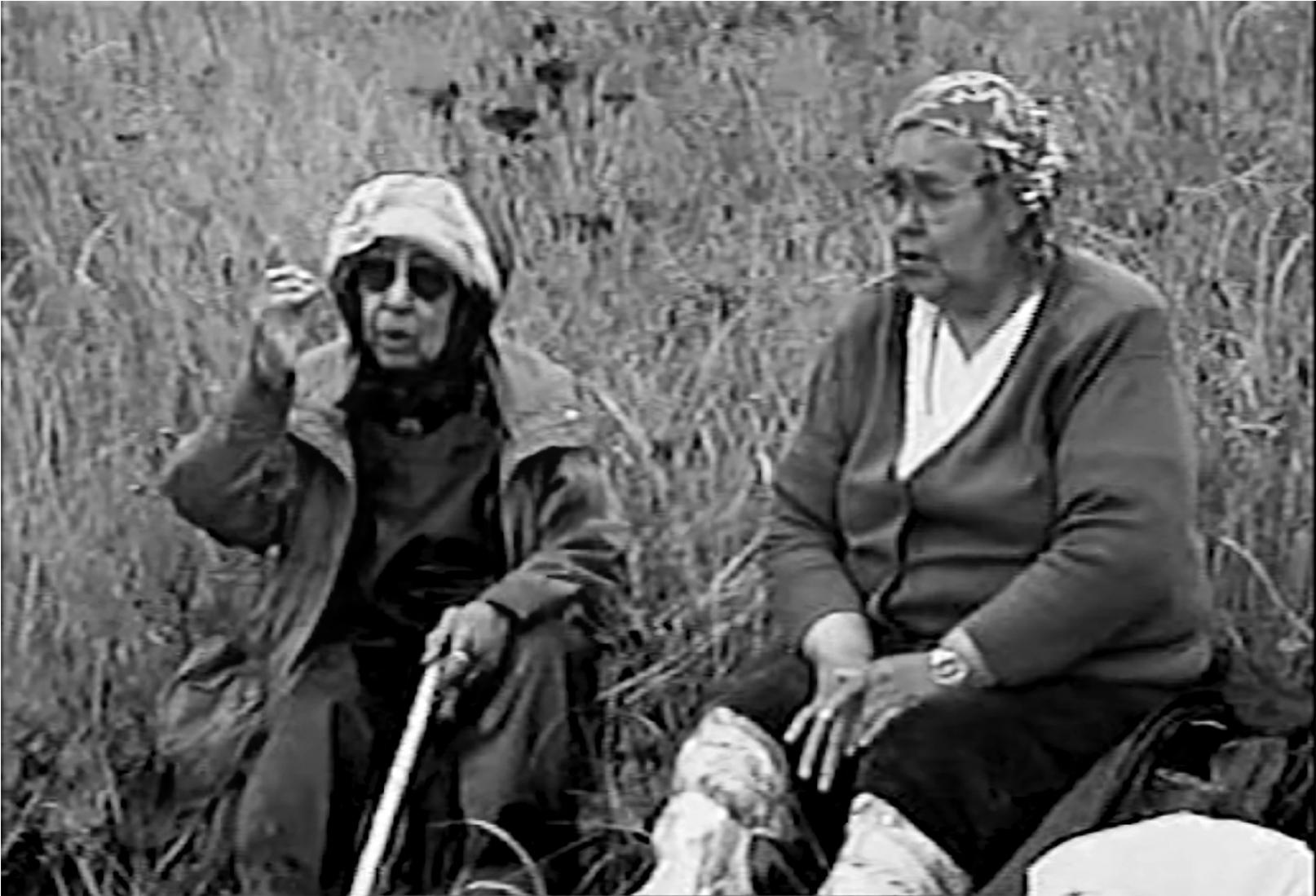
Amy Marvin (l) teaches Mary Sheakley's song to fellow Chookansháa clan member, Winnie Smith (r), in 1996 near the place in Glacier Bay National Park where it was originally composed approximately a century earlier, in response to a pack of wolves howling. (UAS 1999)
Recording and Analysis of Mary Sheakley's Song
Our method for analyzing this song can be perhaps best characterized as “opportunistic retrospective collaborative ethnography.” Tom Thornton originally recorded the song incidentally with a small University of Alaska Southeast film crew in 1996, as part of a National Park Service (NPS) and Hoonah Indian Association (HIA) study on Tlingit berry picking traditions and practices at Glacier Bay National Park and Preserve (Thornton n.d. [1998], 1999). NPS and HIA personnel coordinated the logistics and worked with University of Alaska Southeast staff to provide ethical review and consent forms, ensuring free, prior informed consent for interviewing and recording the invited elders for the planned report, documentary film, and publications. It was not a specific objective of the project to record songs, but rather to interview and document knowledge and practices concerning berry picking. However, Amy Marvin chose to record the song twice during the berry picking trip, once in a relatively private setting with her younger clan daughter, Winnie Smith, to whom she wished to teach the song, and once as part of a more formal oration.
Amy Marvin's first performance of the song is important in the context of remembrance and transmission. When she spontaneously remembers the song, Amy Marvin is sitting with her younger Chookansháa clan relative, Winnie Smith, near the very place where Mary Sheakley composed the song in response to the howling gray wolves (
Thornton was struck by the song and the significance of Amy's two presentations of it during what was to be her last gathering trip to Glacier Bay. He inquired further about it, making additional notes on its origin and meaning, but did not return to it in earnest for almost 20 years. Finally, in 2015, Thornton, having been haunted by the song for two decades, had an opportunity to discuss it with Amy Marvin's daughter, co-author Mary Rudolph, and decided to work further on it, since it was of significance not only to the original occasion but also to the legacies of Mary Sheakley, Amy Marvin, Winnie Smith (all now deceased), and the Chookaneidí clan of which Mary Rudolph is now a Chookansháa leader. Mary Rudolph agreed to collaborate in analyzing the song but, due to the death of her husband, Paul, and other commitments, was not able to take up the work until the spring of 2018. By that time, Mary was living with her daughter, co-author Amy Starbard, in Juneau, where it was easier for the authors to meet in person. As a younger generation Chookansháa, with children and grandchildren of her own, Amy Starbard was eager to learn more about the song and to teach it to her children, who were becoming increasingly “hungry” to learn more about their clan and culture. Co-author William Geiger, a linguist employed at Sealaska Heritage Institute, was invited to join the project to transcribe the two versions of the song. He carried out this work from digital copies of the original video recordings, producing draft transcriptions that were shared among the co-authors, who, in turn, added further commentary and insights. Two meetings with the four authors were held to further clarify and probe the meanings and contexts of the two versions of the song. We then composed the final article in several iterations.
The Ethnobiological Context of Mary Sheakley's Song
Thesongwascomposedandrememberedin the context of berry picking in Glacier Bay, part of Huna Tlingits' traditional territory. Berry (tléi
Historically, prime berry picking areas, like prime salmon rivers and other key resource patches, were named, owned, cultivated, conserved, and celebrated as places (Thornton 1999, 2007). The unique environmental conditions at Glacier Bay National Park, including its comparatively cooler, drier microclimates and glacier-scoured forelands, ripe for vegetative succession, served as fertile ground for a rich abundance of berries. These fruits were internationally renowned for their quality and widely gifted and traded among the northern Tlingit and their inland neighbors, providing important nutrients, including vitamin C, to the diet, as well as symbolic and spiritual communion in ceremonies (Thornton 1999). They are nourished not only by the soils but the dung of animals, like wolves and bears, who also consume berries alongside their Tlingit relatives.
Tlingits employed a variety of interspecific strategies to cultivate berry supplies and to manage demand, thus avoiding shortages. One method that elders discussed on the 1996 trip was “feeding” the berries, typically with dog salmon (Oncorhynchus keta) eggs and especially on large strawberry (shákw, Fragaria chiloensis) and nagoonberry (neigóon, Rubus arcticus) patches demarcated and claimed at Glacier Bay and Dundas Bay. This technique was not simply an act of fertilization, but rather was conceptualized in Tlingit animistic ontology as “feeding the spirits” of the berries, which, like humans and other animals, were comprised of both an outer body (stems and fruits, which go dormant in winter) and an inner spirit (which animates regrowth each spring). Thus, picking the fruits of berry plants and feeding their regenerative sprits were part of the productive annual cycle, as well as powerful ways of connecting with ancestral landscapes, although the practice of feeding berries has declined with the Tlingits' alienation from their berrying grounds in Glacier Bay National Park (Thornton 1999). Tlingit ethnobotanical knowledge holds that leaving berrying grounds unpicked actually reduces the annual productivity of patches, a common belief among Northwest Coast Indigenous groups (Deur and Turner 2005; Turner et al. 2013).
On the 1996 trip, wild strawberries and nagoonberries were the main fruits gathered, but others, including prized soapberries (xákwl'i, Sheperdia canadensis) and gray currants (shaa
Intergenerational Knowledge Transmission and Songs
In addition to this ethnobiological context, intergenerational transmission of Indigenous knowledge was an important impetus for the presentation of the song and of the berrying trip in general. Amy Marvin learned the song from her older clan relative, Mary Sheakley, and sought to teach it to her younger clan daughter, Winnie Smith, so that it passes on to future generations. In an oral culture, Amy Marvin was perhaps the only possessor and embodiment of the song. This motivates her to recite it for her clan daughter and to have Winnie Smith re-present it by translating it for the camera audience. This remembrance and instruction is augmented by the women's reinhabitation of the original geographic and subsistence context of the song, when the Chookansháa are leaving their berrying grounds at the end of the season. This congelation of contemporary and ancestral time and space renders the occasion an especially poignant one and a “teachable moment” to pass on the song and its moral and spiritual lessons. Intergenerational transmission of knowledge and identification with the land of her ancestors and relatives further stimulates Amy Marvin to sing the song again the next day.
The encore performance of the song was staged at Dundas Bay, to the west of Glacier Bay, during the second day of berry-picking. The context was more formal—an impromptu ceremony. We were led by the Elders to the site of a small engraved stone marker that was placed as a memorial to Huna Tlingit victims who drowned in a tragic boat accident near the mouth of the Dundas River several decades earlier. As the dozen or so of us on the trip gathered around the memorial, leaders of the three Glacier Bay clans present each spoke about their relationships to the deceased, to each other, and to the land, establishing a linking landscape for the experience we were having in retracing some of the subsistence trails and harvesting activities of Glacier Bay Tlingits of previous generations. The song served as a capstone to the ceremony.
The song was preceeded with oration. Richard Dalton Sr. spoke first on behalf of the T'a
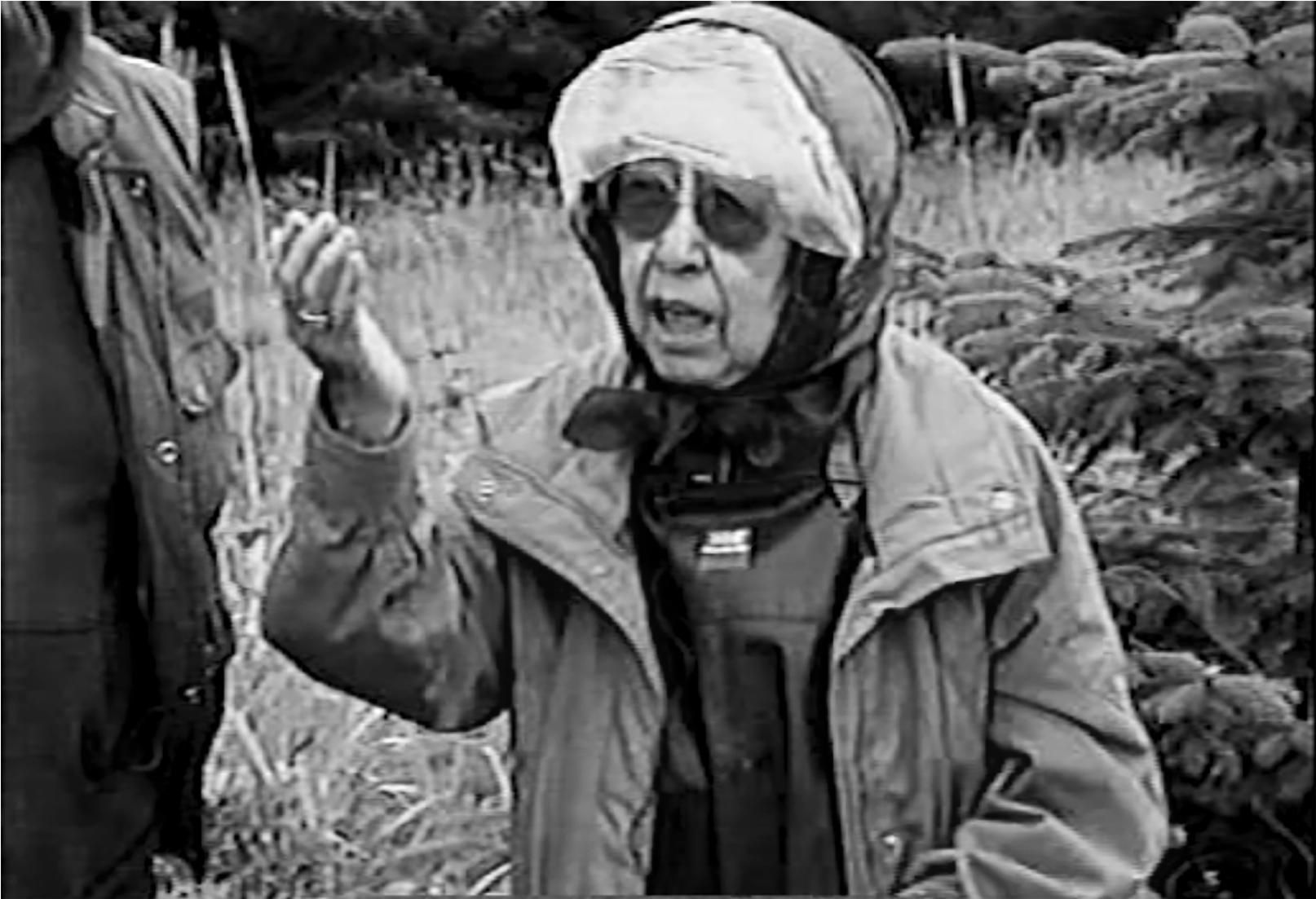
Amy Marvin performs Mary Sheakley's song (with embracing gestures) in 1996 to close an impromptu ceremony at Dundas Bay, Glacier Bay National Park, held to commemorate relatives that died in a tragic boating accident there decades earlier. The song is offered to connect and buoy those present, including the spirits of the ancestors, and to reflect on what would be Mrs. Marvin's last gathering trip to Glacier Bay. (UAS 1999)
Mary Sheakley's Song
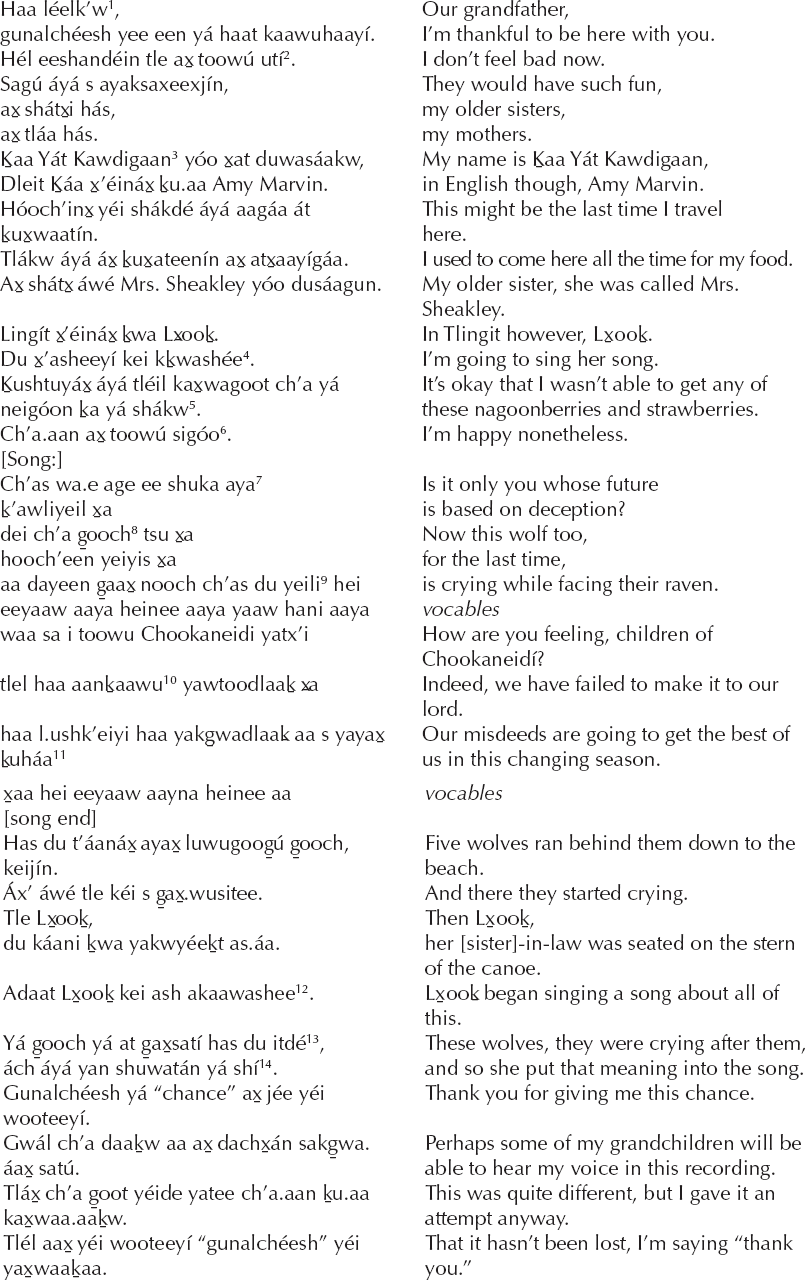
Here we present an annotated text of the song as Amy Marvin performed it at the memorial marker for the deceased Hoonah Tlingit boaters at Dundas River. As noted above, this was the second time she sang Mary Sheakley's song, having spontaneously remembered it in situ the day before while taking a break from berry picking with her younger clan relative, Winnie Smith.
Importantly, while performed solo, the song is accompanied by paralinguistic gestures, particularly a set of sweeping arm motions, which serve to embrace those present including both living and deceased relatives of the singer and song composer. Amy Marvin's gestures support the explicit genealogical references and queries in Mary Sheakley's song. The gestures can be viewed in the video clip of the song in Audio Supplement 1. Although Amy Marvin, then in her eighties, was frail and suffering from Parkinson's disease, she projects vibrantly and her integrative combination of oration, gestures, and singing highlights her unique mastery of these traditionally intertwined Tlingit domains of expression.
Lx ook X 'asheeyí, Mary Sheakley's Song
Introduced and sung by Amy Marvin, August 1996 at Dundas Bay Transcription and Translation
Discussion: Ethnobiology and Song
Like many Indigenous peoples, Tlingits regard songs as a special, primal language among sentient beings, “a kind of ‘lingua franca of the intelligent universe'” (Evers and Molina 1987:18). Tlingit songs are composed by individuals but, as they gain stature, may be incorporated by matrilineal clans as intellectual property and potent emblems of a collective identity, heritage, and destiny on the land. As such, song performances are often poignant ethnobiological, social, and geographic phenomena. They are ethnobiological in the sense that they evoke not only past relatives and events, but also habitats, species, and situations that are encountered in the exigencies and taskscapes (Ingold 2000) of life, including berry picking. They are social in that they evoke, query, and harmonize cognitive, emotional, behavioral, and spiritual orientations and connections among the beings that inhabit particular places or cultural landscapes in Lingít Aaní (Tlingit Country). A particular ancestral or existential context often stimulates memory of a past singer, song composer, or motif—crying wolves, picking berries, drinking hooch, leaving at season's end—and motivate a singer to bring forth a song to reinforce social identities and solidarity among the community of beings that surround the singer, all of whom are similarly following in their ancestors’ pathways. Finally, there is the geographic context of the song; the power and synesthetic experience of place itself, which may serve as a wellspring and stimulus for remembering (Casey 2009) and reanimating emotions and experiences encapsulated in song. Mary Sheakley's song is perhaps the first Tlingit song to be recorded in its original geographical and ethnobiological context. In this context, the song served to mediate the social, ecological, and emotional situation, while at the same time enabling Amy Marvin to make a link to her own lineage through the Glacier Bay song of her Chookansháa elder sister, Mary Sheakley.
The evocations of emotions and experiences encapsulated in Tlingit songs may, in turn, serve as invocations for remembrance and reflection on social and cultural identity, as well as for transmission of important biocultural knowledge. In these and other ways, Tlingit songs continue to resonate and bind individuals, lineages, and communities in their unique identities and mutual dependencies as a common people of diverse lineages with reciprocal relations. Songs can be framed and drawn upon to link past and present time, human and non-human species, and lineal and lateral relatives in succinct, yet poignant, ways.
As an example of this, consider how wolves hold ontological status as non-human persons among the Tlingit (Swanton 1908; Thornton and Kitka 2010). Kaagwaantaan and other Wolf moiety clans have stories about intercommunications, reciprocations, and other encounters with wolves who, in some cases, reveal their personhood beneath their wolf skins.
puzzled the minister with the question, “Have wolves souls?” The Indians believe that they have [spirits or yak
In terms of their ethnobiological status, brown bears (xóots, Ursus arctos) and, to a lesser extent, black bears (s'eek, Ursus americanus), like wolves, were also conceived as powerful other-than-human persons (Hallowell 1960), stealthy predators, and potential competitors for food sources. An important technique for managing this interspecies competition during berry picking was to address the brown bears as kin, as Amy Marvin did on the 1996 trip, calling upon them as “our grandparents” (haa léelk'w hás) and requesting they “have pity on us” (eesháan uháan) and move out of peoples' way while they gathered their modest food supplies. Because of ancient intermarriages with bears, the animal is considered a totemic ancestor to certain Wolf moiety clans (Emmons and de Laguna 1991), including the Chookaneidí, and, thus, like a grandparent, can be coaxed not only into non-competitive avoidance in food gathering, but even to protect and provide for its kin. In Mary Sheakley's song to the wolves, however, the appeal is not for encounter avoidance or good luck in provisioning, but rather for interspecific and intra-moietal (also inter-moietal with her Raven relatives) empathy, commiseration, and forgiveness for having been deceived (by alcoholic drink) and committed misdeeds, hence not quite living up to godly or ancestral standards.
The story may also relate to an ancient legend of the Wolf clans, wherein a starving man cried out against the wolves for taking too much game in the valleys where he was hunting, before he lay down exhausted and starving. He awoke at night surrounded by members of the Wolf tribe, who revealed themselves as non-human persons. The outer circle of wolves wanted to kill the man for disrespecting them, while the inner circle empathized with the man and decided to teach him to be a better hunter, and to leave more game to the humans. In the end, the man lived up to their expectations and became a successful hunter. To commemorate the event, the Wolf tribe gave him the name Yaan Jiyeet
As Mary Rudolph commented, in the context of one of her mother's earlier song performances at Glacier Bay:
A lot of our history—our songs and the things that are told us as Chookaneidí—stems back to Glacier Bay. There has never been any doubt in my mother's mind that this is still her home, and this is still part of her life that nothing or anybody is ever going to take it away from her…[N]ow I feel like it's coming back to me, and thank goodness it's part of our lives again… for us it's our history. Our food and the things that we have are not something that we violate. (Culp et al. 1995:305)
Through food gathering in historically and culturally salient places, like Glacier Bay, Amy Marvin was able to bring forth and reconfirm a key song from an ancestral composer, which is now being learned by several new generations of Chookansháa, including Mary Rudolph's daughters and granddaughters, to be performed at ceremonies.
Conclusion
Songs are a universal and elemental form of communication that speak to and influence human, ecological, and even cosmological conditions. A close lyrical analysis of Mary Sheakley's song, Amy Marvin's in situ, in vivo remembrance, social performances, and transmissions of the song, and the her Chookansháa descendants' desire to carry on singing and sharing it, illustrates why and how songs still hold a revered and vital place in Tlingit ethnobiology and culture. This is especially true when songs are combined with other expressive forms (oratory, gestures, dance, feasting) and social tasks (like gathering food) in order to engender common feelings of identity, solidarity, productivity, wellbeing, balance, heritage, and destiny among social groups, between species, and across generations. As such, Tlingit songs, like those of other human societies and social animals, warrant conservation and study in their fullest cultural and ecological contexts. The ethnobiological context of the song matters to its meaning, how it is conveyed and understood, and, thus, to its ultimate durability and social utility. If Amy Marvin had not returned to Glacier Bay after many years of absence to pick berries, joke, reminisce, commemorate, and sing with her relatives, in the very place where her clan sister, Mary Sheakley, composed a song in response to a cry “song” by her ancestral relatives, the wolves of Glacier Bay, would this song have survived into the twenty-first century? If so, in what form? Or would it have been forgotten like many of the composer's other songs? Fortunately, we do not have to contemplate the distressing counterfactual in this case.
As a song leader and drummer for her clan and for the Mount Fairweather Dancers of Hoonah, Amy Marvin had a keen appreciation and embodied memory for the songs of her people and took care of them. When asked how she learned to sing and drum the songs, she noted, “When my father's feasts took place, I listened for the dignified sections and I lived by them” (Dauenhauer and Dauenhauer 1994:468). As a result of Amy Marvin's not only remembering but “living the songs” with dignity, we can see how and why Tlingit songs are born, how they are animated with oration, gestures (and in other contexts, drumming and regalia) in performance, and how they are remembered in particular ethnobiological contexts and deployed, improvisationally but expertly, to achieve important social ends. Indeed, Tlingits can experience in songs a powerful mechanism for connecting people to place, history, ancestry, and to each other through emotion and the trials of living up to the high standards set by those who came before them, whose heritage and destiny they bear.
Footnotes
Acknowledgments
The original research was supported through cooperative agreement #9910-6-9027 between the National Park Service and the University of Alaska Southeast (UAS). We give special thanks to the Hoonah Indian Association, Glacier Bay National Park, and to the UAS media services team. We are especially grateful to elders Ken Austin (d.), Wanda Culp, Richard Dalton Sr. (d.), Ken Grant, Alice Haldane, Esther Kaze (d.), Herman Kitka Sr. (d.), Martha Kitka (d.), Harold Martin, Amy Marvin (d.), Pat Mills (d.), George Obert (d.), Richard Sheakley (d.), Winnie Smith (d.), Lilly White (d.), and Frank White Sr. (d.), who contributed to the research, and to Carolyn Elder, Wayne Howell, and Mary Beth Moss who helped coordinate the project on behalf of the park. We also thank Sealaska Heritage Institute for making space and Will Geiger's time available to carry out the 2018 meetings among the co-authors.
1 This is a reference to Herman Kitka Sr., who in a preceding speech referred to Amy Marvin as “granddaughter.” This is an affectionate reference to the Chookaneidí as a grandchild clan of the Kaagwaantaan (Mr. Kitka's clan, of the same Wolf moiety). Thus, Amy Marvin respectfully acknowledges and reciprocates the kinship connection by calling Mr. Kitka “our grandfather.” (TT)
2 Here she signals the change of emotion, moving from the solemn remembrance of those that drowned and what has been lost, toward more pleasing memories and good feelings, culminating in the song. (TT)
3 This is a Wooshkeetaan clan name (MR). Perhaps it is used here not only to expand Amy Marvin's identity (many prominent Tlingits carry multiple names, in some cases from another clan of the same moiety, as is the case here) but also to recognize the Wooshkeetaan, which, though not represented in this gathering, still dwell in Hoonah and are also descendants of Glacier Bay, having settled there along with the other clans.
4 Amy pronounces du  :58–59), so we leave it as du
5 This is somewhat of an exaggeration, perhaps with the aim of modesty and to underscore the fact that we often do not live up to expectations, a theme of the song. In fact, Amy Marvin did collect a significant quantity of berries, though perhaps not as many as she might have if she was younger, or if there were not other objectives besides berry-picking for the trip. Note, too, that the English term “nagoon” is simply an Anglicized borrowing of the Tlingit term neigóon, a rare instance of a biological species being given an English popular name based on its Tlingit equivalent (). (TT)
6 Amy employs an Indigenous oral literary device that Richard Dauenhauer (1975:78–122) termed the “narrative frame,” though in this case the “narrative” is a song. Amy frames the song with a statement about her relations to individuals both present (our grandfather) and not present (my older sisters, my mothers), subsistence in the specific place she is standing (“I used to come here all the time for my food…these nagoonberries and strawberries”), and her very personal feelings in this moment (“I don't feel bad now, I feel happy”). This positioning helps provide what we term above as a “linking landscape” to accomplish more transformative social ends (). In doing this, she implicitly connects her feelings to one of the affective images in the lyrics, employing the same term as in the song lyrics, hooch'een “(for) the last time.” In the song, it is the wolves' last cry while looking upon their raven; in Amy's framing, she is bitter sweetly thinking that this may be the last time she travels to Glacier Bay. Amy thus figuratively occupies the position of the wolves in the song “crying for the last time”; and as a Chookansháa of the Eagle, or Wolf, moiety, this establishes a symmetry at the level of social structure, and a continuity with the composer Mary Sheakley, also Chookansháa. Whether or not any of this was intentional, there are multiple levels of poetic unity, or continuity, at work between the singer, the song, the composer, and the place, while also tying in the relation to the opposite (du yéili), as both an in-law (káani) and a child (Chookaneidí yátx'i). This completes the introduction to the song which serves to further affect the emotional transition from the somber memorial to more wistful, happy memories of life in Glacier Bay and the intimate social, ecological, and emotional bonds formed at this place.
7 Following the convention established by Dauenhauer and Dauenhauer (), tone marks are excluded from the transcription of the song lyrics. Because the melody of Tlingit song overrides the tone system of Tlingit speech, the inclusion of tone marks in song lyrics would run the risk of introducing errors or inconsistencies into the melody. (WG)
8 This refers to her status as a member of the Wolf moiety, Chookaneidí clan. (TT)
9 This refers to her canoeing partner's status as member of the Raven moiety, T'a
10There are Christian overtones here, as this song is composed in the era just after missionaries arrived in Hoonah. However, the term also meshes with the concept of the great spirit in Tlingit. “Failed to make it to our lord” can be interpreted more generally as a failure to live up to virtuous expectations, be they of a Christian God or their own Great Spirit, ancestors, and elders.
11 The actual misdeeds are not revealed, but the understanding by Amy Marvin's daughter, co-author Mary Rudolph, is that they have been preparing and drinking alcohol, also known as “hooch.” In this respect, there is a playful sense of shame or mischief, for, like
12 Using the third person proximate pronoun ash, also known as the third person salient, which typically refers to the discourse-prominent or foregrounded subject of a narrative. The folklorist-linguist Richard Dauenhauer once remarked on the difficulty of translating this term into English, describing it as “the guy we're talking about” (). English lacks an equivalent. (WG)
13 This line is difficult to reflect in English. It seems literally like “these wolves, this being-of-crying [they did] towards them.” The plural “crying” verb used for the wolves is remarkable. It seems to literally mean “being of crying,” with
14 The exact interpretation of this line was inconclusive in the authors' meetings. Shuwatán can mean “mean, denote, signify,” which makes sense here after giving a description of what led L