







Abstract
Ethno-ornithological studies have shown the complexity of indigenous systems of classification of local biota. However, there is still a lack of knowledge about the etymology of bird names used by indigenous peoples in many locations and about the phenomenological meaning of these names. We conducted an extensive literature review of Mapuche bird names and their etymologies. Because of the relative importance of onomatopoeias as the origin of Mapuche bird names, we compared the proportion of onomatopoeic names used by different forest-dwelling indigenous peoples worldwide. We found 219 bird names in Mapuzugun for 92 species and 135 etymologies for 72 different species. Sixty-four (47%) etymologies were onomatopoeic, while 29 (21%) etymologies came from the bird's appearance and 21 (16%) from its behavior. Out of a total of 13 different indigenous peoples examined, only the Mbuti (Congo) showed a higher percentage of onomatopoeic names (67%) than the Mapuche. Using a phenomenological framework, we utilized the notion of “sonic incarnation” to discuss how a bird's voice does not necessarily guide the listener's eyes to it but, instead, the experience of hearing it is equated with “seeing” the bird. Onomatopoeic influence is a key root of the bird names used by different indigenous peoples of the world, including the Mapuche, and it may reflect onomatopoeia's great ability to capture immediacy in the landscape of human-bird encounters.
Introduction
The local systems used by sociocultural groups to name and classify birds (i.e., ethno-taxonomy) are rich in meaning as regards the processes involved in the codification and maintenance of culture. The names given to birds are created by humans as a means of making sense of the diversity of experiences that arise in the landscape of human-bird encounters (Berlin 1973; Bonta 2008). These names emerge as dynamic and locally adapted devices that are significant for those who use them and reflect interaction between culture, ecology, psychology, and discontinuities in the natural world (Ellen 1993, 2008). For example, the Mbuti and Efe indigenous peoples of the Congolese Ituri rainforest name some birds according to how edible they are (Terashima 2003). In Brazil's Três Ladeiras District, the name given to a bird can be related to its size, behavior, habitat, diet, or morphology, determined by analogy, or take the form of an onomatopoeia (Beserra de Farias and Chaves Alves 2007).
Bird sounds are often represented and imitated by humans and are sometimes even assimilated phonetically to words in the listeners' own language (Wyndham and Park 2018). The use of onomatopoeia (i.e., the formation of a word from a sound associated with what is named) has been cited as an important mnemonic element in the ethno-taxonomy of animals (Berlin 2006; Bonta 2003; Dupree 1974; Evans-Pritchard 1961; Plath 1976) and a key root of the bird names used by different indigenous peoples (Berlin 1973; Madroño 2016). This is particularly the case for many forest birds, which do not generally allow themselves to be seen and are mainly identified by the sounds they make (Feld 2012; Hunn 1992; Ng'weno 2010). Onomatopoeias are also easy to learn and remember for naming animals (Berlin and O'Neill 1981). However, apart from whether birds are “seen” or not in forests and whether their names are easy to remember or not, in this paper we propose another possible explanation for the crucial role of onomatopoeia. This has to do with the phenomenological level of “sonic incarnation” (Ingold 2000:279), where a bird's sound or song does not guide the listener's eyes to it but, instead, the experience of hearing it is equated with “seeing” the bird (Benavides 2017). Berlin and O'Neill (1981) suggested that the use and functionality of onomatopoeias should decrease, and eventually disappear, as (i) societies become more socio-technologically complex; (ii) indigenous territories are incorporated into larger states; and (iii) disconnection with local biodiversity increases. This hypothesis has, however, not been tested in regards to whether onomatopoeic names of components of biodiversity have survived in the vernacular of a particular place or country.
The Mapuche are Chile and Argentina's largest group of Indigenous people and historically lived between the Choapa River (31°S) and the island of Chiloé (42°S) in Chile, and from the city of Mendoza (32°S) south to the Río Negro Province (40°S) in Argentina. Until the first half of the nineteenth century, the Mapuche practiced a subsistence economy based on hunting and gathering, supplemented with horticulture and livestock (Bengoa 2014; Nahuelpan Moreno 2012; Pichinao 2012; Torrejón and Cisternas 2002). While their economy has since diversified, in rural areas of southern Chile's La Araucanía Region, it is still based mostly on horticulture and livestock, supplemented with the collection of a series of non-timber forest products (Barreau et al. 2016; Bengoa 2000). Because of these livelihood practices, the Mapuche have acquired an extensive knowledge of the environment over time, reflected in a complex range of denominations, uses, and symbols for animals and, in particular, birds (Aillapan and Rozzi 2004; Coña 2010; Massardo and Rozzi 2004; Rozzi et al. 2010; Villagrán et al. 1999). The Mapuche's traditional language is Mapuzugun (mapu = land; zugun = language or “act of speaking”). Although a gradual loss of the language has been reported (Bengoa 2014; Paillan and Llancao 2015), some authors have suggested that onomatopoeias are frequently used as names for birds in Mapuzugun (Aillapan and Rozzi 2004; Armengol Valenzuela 1918; Lenz 1905; Villagrán et al. 1999).
This paper explores principally the Mapuche ethno-ornithology of the temperate forests of the southern part of South America, although it also includes some species with habitats adjacent to these forests (for example, sclerophyllous scrub, Patagonian steppe, and wetlands). Specifically, the research consists of (i) an exhaustive review of the ethno-taxonomy systems of birds in the Mapuche world, particularly the etymology of the names of birds from temperate forests; (ii) an evaluation of whether bird names of Mapuche origin have survived and permeated the Chilean vernacular and scientific names of birds from temperate forests; and (iii) a comparison of the proportion of bird names that have an onomatopoeic origin for different peoples who inhabit forested landscapes of the world. We further discuss the historical and contemporary role of onomatopoeias for bird naming using a phenomenological framework, employing the notion of “sonic incarnation” in the landscape of human-bird encounters.
Methodology
Twenty-six bibliographic sources were reviewed in order to compile a list of Mapuche names for birds that inhabit temperate forests and adjacent habitats (sclerophyllous scrub, Patagonian steppe, and wetlands). The sources included dictionaries, books, scientific papers, and project reports (list of bibliographical sources reviewed is available as a footnote in Supplementary Table 1). When transcribing names in Mapuzugun from these bibliographic sources, the original spelling was kept, according to the grapheme used by each author. Each species of bird with a name in Mapuzugun was recorded in a table that included its Chilean vernacular name, English name, scientific name, name in Mapuzugun, and, if reported in the source, its etymology (Supplementary Table 1). Names that were spelled differently but referred to the same species were grouped together but counted separately. Thus, for example, in the case of the bird whose Chilean vernacular name is tiuque (Milvago chimango) and can be written in Mapuzugun as triuke, triuque, or chiuque, depending on the author; the latter were counted as a total of three Mapuche names but only a single different name.
The etymology of each name was classified according to whether it refers to specific attributes, such as onomatopoeia, appearance (morphology of the bird), behavior (aspects of the bird's conduct), habitat (the bird's physical place of use or socialization), and sensory or symbolic perceptions (physical or emotional sensations experienced by the observer in the presence of the bird; Martínez Mauri et al. 2014; Villagrán et al. 1999). We did not assign etymologies of bird names to the attributes identified unless they were explicitly reported in the bibliographical sources analyzed. The attributes of the names whose etymologies were identified were used to calculate both the occurrence of attributes (number of etymologies found by attribute) and the relative frequency of occurrence (%) (occurrence of the attribute divided by the total number of etymologies identified).
In order to compare the origin of Mapuzugun bird names with those used by other peoples inhabiting forested landscapes, an extensive search of ethno-ornithological work on the etymology of bird names was performed (books and scientific papers). In each case, the name of the people reported in the bibliographical source and the number of etymologies of bird names described were recorded along with the number of onomatopoeic etymologies, the percentage of etymologies that corresponded to onomatopoeias, and the type of environment and country inhabited by the people. Finally, the Chilean vernacular names and the scientific names for birds from the temperate forests of South America, as listed in Jaramillo (2005), were examined in order to identify those with their origin in Mapuzugun.
Results
A total of 718 names in Mapuzugun were found, of which 219 corresponded to different names for 92 species of birds that inhabit the temperate forests of the southern part of South America and adjacent habitats (Supplementary Table 1). Out of the 92 species, 135 etymologies were found for 72 species. The occurrence of attributes and their relative frequency of occurrence (in parentheses) was 64 (47%) for onomatopoeic etymologies, followed by 29 (21%) for etymologies associated with the appearance of the species, 21 (16%) with its behavior, three (2%) with its habitat, and 18 (13%) with sensory and/or symbolic perceptions (Figure 1). The species with the largest number of different names (N = 7) was the Dark-bellied Cinclodes (Cinclodes patagonicus). It was followed by the Magellanic Woodpecker (Campephilus magellanicus) and the American Kestrel (Falco sparverius), each with six different names.
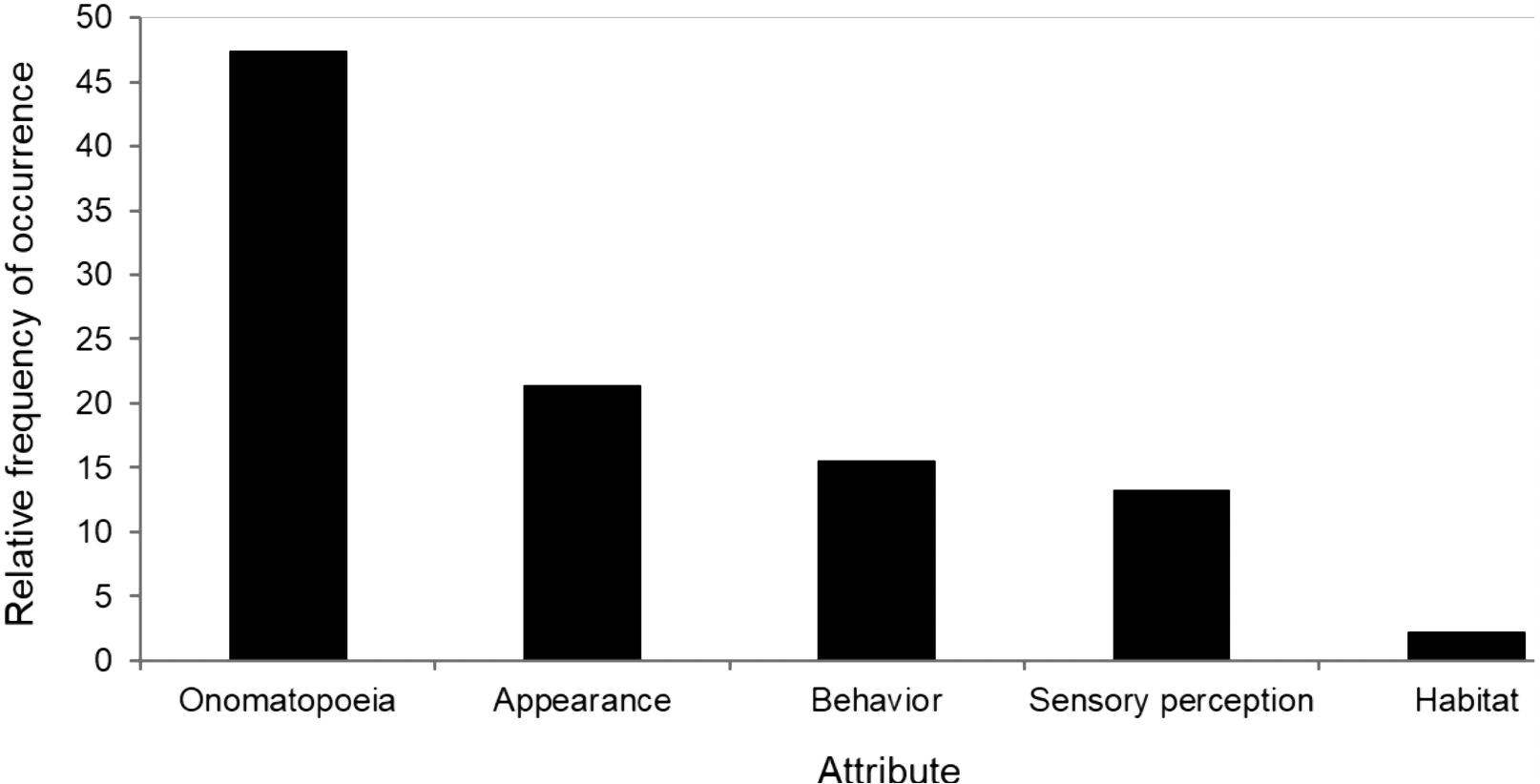
Relative frequency of occurrence (%) of bird attributes for 135 etymologies of names given to 72 species from South American temperate forests and adjacent habitats.
A high proportion (49%, N = 45) of the vernacular names used in Chile for temperate forest birds correspond to names from the Mapuzugun of which 52% (N = 24) were identified as being of onomatopoeic origin. Eight scientific names were found to come from the Mapuzugun, including Ardea cocoi, Colaptes pitius, Mimus thenca, Diuca diuca, and Phytotoma rara, which are of onomatopoeic origin as well. In addition, in reference to the bird's appearance, scientific names have been found to have Mapuzugun origins. For example, Curaeus curaeus comes from küri (the color black in Mapuzugun) and Sturnella loyca from lloyca (sore or wound in Mapuzugun; Armengol Valenzuela 1918), while Egretta thula is from tula, the Mapuzugun name for this type of egret.
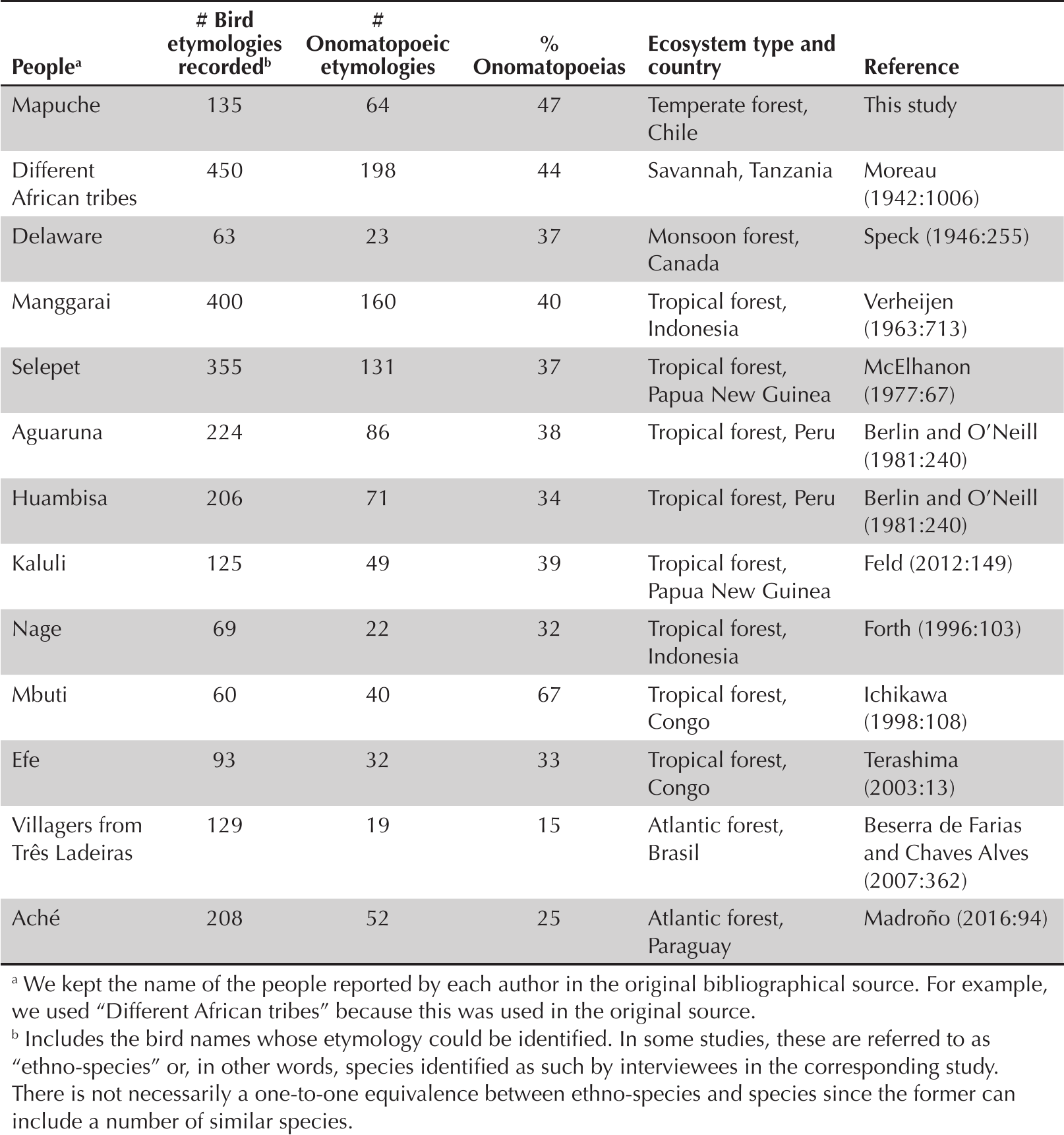
Twelve ethno-ornithological studies reporting the proportion of bird names of onomatopoeic origin were found for different peoples inhabiting forested landscapes (Table 1). The Mbuti, who inhabit the Congolese Ituri rainforest, were the only people with a higher percentage of onomatopoeias in the etymologies of bird names (67%) than the Mapuche (47%) (Figure 2).
Discussion
This paper reports the largest number of Mapuzugun names, with their respective etymology, recorded for 92 species of birds from the Mapuche's homeland (including temperate forests and other adjacent habitats). The analysis revealed a high frequency of onomatopoeias in the origin of the names for birds from the temperate ecosystems of the southern part of South America. It also showed that almost half (49%) of the vernacular names currently in use for birds from the south of Chile come from Mapuzugun. In addition, on the basis of information about the bird names used by the 13 forest-dwelling indigenous peoples (including the Mapuche) analyzed, it could be concluded that only the Mbuti have a higher percentage of onomatopoeic names than the Mapuche.
Diversity of Names in Mapuche Ethnoornithology
Many birds have more than one name in Mapuzugun, reflecting a high level of linguistic diversity that may be associated with different Mapuche territories (Bengoa 2000; Loncon 2017; Massardo and Rozzi 2004; Villagrán et al. 1999). A bird may, for example, be given one name by the Lafkenche (the Mapuche of the coast) and a different one by the Pewenche (the Mapuche of the mountains). A similar phenomenon has also been reported for other indigenous peoples. Moreau (1942), for instance, found up to seven different names for the same bird species (although he did not report the species to which he was referring).
Onomatopoeic origin of bird names used by 13 peoples in different forested landscapes of the world.
Another explanation may be that birds can make different sounds, giving rise to different names of onomatopoeic origin (Forth 1996; Moreau 1942). For example, the Austral Pygmy-owl (Glaucidium nana) is referred to as chucho, chuchu, and chonchon (all three analyzed as a single different name) and as kijkij, kill kill, or quil quil (also analyzed as a single different name) and they all have an onomatopoeic root. The first name could be associated with the owl's call of contact, while the second resembles its high-pitched territorial call (Norambuena and Muñoz-Pedreros 2018).
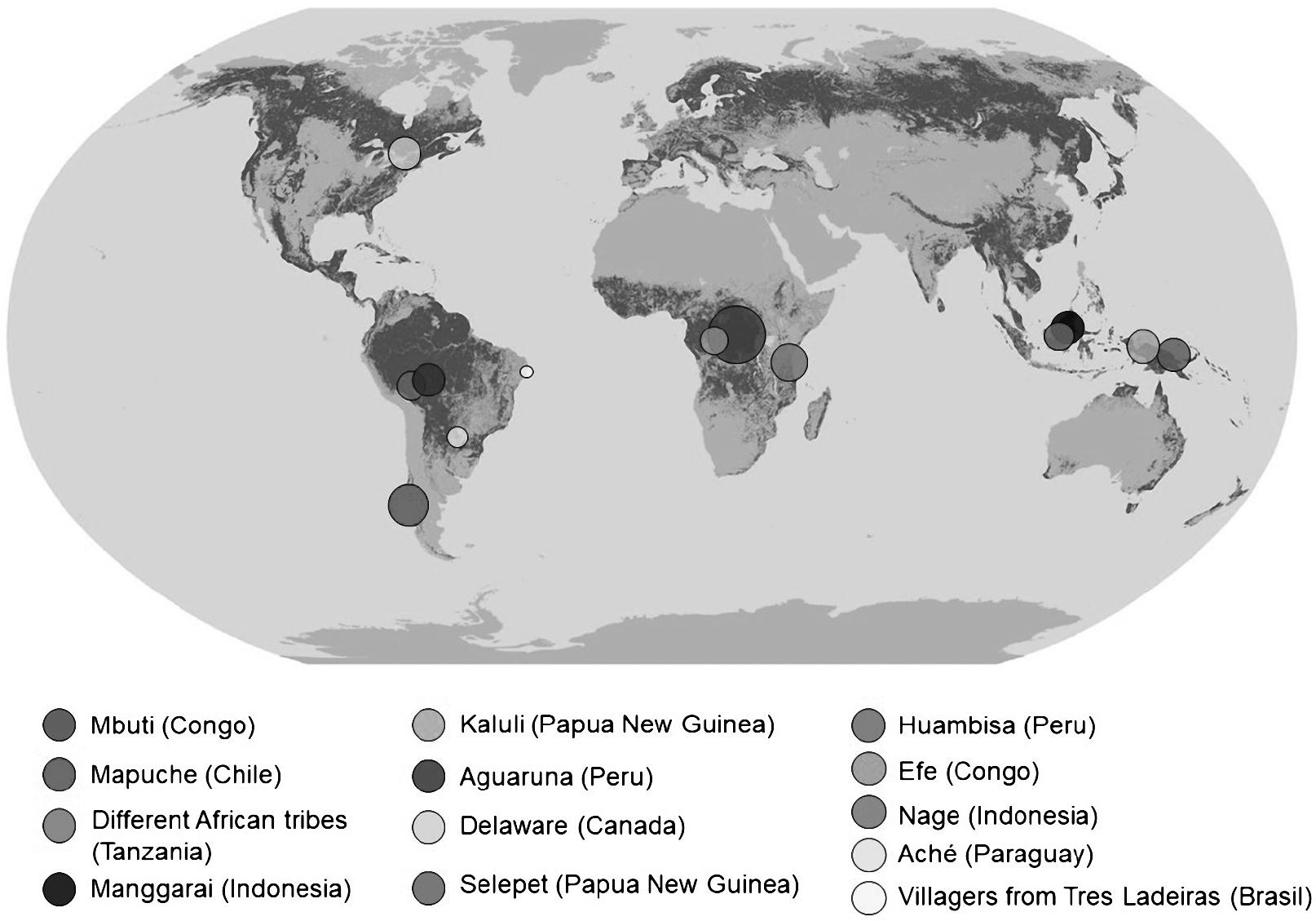
Location of 13 peoples associated with forests for which the proportion of onomatopoeic names given to birds was analyzed. The size of the circle indicates the relative importance of onomatopoeic names for each people in relation to the total sample (Adapted from FAO 2010; available at http://www.fao.org/forestry/fra/80298/en/).
Although this research indicates that onomatopoeia is the most frequent root of Mapuche names for birds, names related to a bird's appearance, behavior, and, to a lesser extent, the sensory perception it triggers are also important. A striking case is that of the Magellanic Woodpecker (Campephilus magellanicus) and its large number of different names (with their root in its appearance and behavior, as well as onomatopoeia). They include kürupütriu (appearance: “black woodpecker”), concona (behavior: conconn = penetrate), and rere (onomatopoeia). This diversity of names may be related to the bird's high aesthetic, ecological, symbolic, and utilitarian value for a number of peoples in the extreme south of the continent (Arango et al. 2007, 2010). For example, it serves as an indicator of changes in the weather for communities in the Andean part of southern Chile's La Araucanía Region since, like another six species, it comes down from the mountains when poor weather, such as snow, rain, and/ or a storm, is imminent (Ibarra and Barreau 2014; Ibarra et al. 2017). Observation of its movements, and those of the other six species, and their sudden appearances in low-lying areas is believed to have been part of a sophisticated local weather forecasting system that reduces the uncertainty related to management of natural resources (Ibarra and Barreau 2014).
Omnipresence of Onomatopoeias Globally and Locally: A Phenomenological View
Ethno-ornithological documentation for 13 forest-dwelling indigenous peoples showed that the proportion of bird names with an onomatopoeic origin varies between 15% and 67%. The question this raises is why onomatopoeias are so common in bird names (Berlin and O'Neill 1981). A hypothetical answer lies in the origins of language because the vocal tract of human beings already allowed them to reproduce sounds and their ears were sensitive enough to perceive the most obvious sound components of birds and the environment (Kurashkina 2012). For this reason, and because of their familiarity, onomatopoeic names may be easier to remember and use for people (Berlin and O'Neill 1981; Wyndham and Park 2018). However, it has also been suggested that the use of onomatopoeias and the symbolism of birds were closely related factors that reinforced the ongoing use of their names over time (Forth 2010).
Here we propose a third possible explanation on why onomatopoeias are so common in bird naming, using a phenomenological framework based on the anthropological reflections of Ingold (2013) and Whitehouse (2013). According to these authors, a bird's correct identification in daily life can be said to consist in relating certain, sometimes isolated, characteristics with the creature as a whole: a footprint, a type of feather, or, more commonly, a certain type of sound. Indeed, the detectability of organisms by a human being depends on cross-referencing their respective umwelt (Von Uexküll 2010), that is, the ways in which they each exist in their environment. As such, a range of parameters, such as size, speed, and shape, as well as the sounds they make and their loudness and frequency, play a decisive role (Ellis 2011; Lorimer 2015). Together, they constitute what naturalists refer to as “jizz” or the unique combination of properties that permits an organism's identification and its differentiation from other organisms (Ellis 2011; Lorimer 2015). As Whitehouse (2013) indicated, identification seeks to link direct perception with a conventional classification system, matching the “subjectivity” of the act of perception with the “objectivity” of a pre-existing system of taxonomic knowledge. In this context, a bird's song serves to indicate its physical presence when there is no visual contact, providing a type of clue through which the observer can locate it and visually confirm which bird it is. However, as indicated above, it is often only the song that is perceived and, in this case, observers who are confident of their identification of the song tend to say that a particular bird was present.
Is visual confirmation absolutely necessary, therefore, in the most frequent encounters with birds? Analyzing the case presented by Hallowell (1960:32) of the so-called “Thunder Bird” among the Ojibwa of northern Canada, Ingold (2013: 737–738; see also Ingold 2000:278–279) explains that it makes itself heard principally through thunder and, therefore, becomes a phenomenon of sonic experience: the thunder is not the sound “produced” by the bird, but its “sonic incarnation” (Ingold 2000:279). It does not serve to guide observers towards the creature; instead, the auditory experience is equivalent to “seeing” the bird, which enters their consciousness and affirms its existence through its sound. At this level of analysis, the song of a bird, the thunder, or even a person's voice become ontologically equivalent as sonic manifestations. Experientially, just as the sound of thunder is the thunder, the song of a bird is the bird and not merely an indicator of its presence (Ingold 2013:744). In fact, “seeing” a Black-throated Huet-huet (Pteroptochos tarnii) only makes sense once the denomination has become “conventional.” Thus, and functional to its identification process, listening to the “hued hued” call provides a direct perception of the bird that does not require the intermediation of other elements (Whitehouse 2013). Although not based on direct participants' accounts, it is possible to speculate that naming a bird by imitating its song captures this more frequent experience of encounter and its sonic incarnation in line with an “acoustic ecology” of the bird (Lorimer 2015:35). This would also occur more broadly and in a less limited manner as a result of encounters at a greater distance and different rhythms of activity, as in the case of nocturnal birds that are difficult to see.
The Mapuche Root of Vernacular and Scientific Bird Names
In an important result, this research shows that almost half of the contemporary Chilean vernacular names for South American temperate forest birds come from Mapuzugun and 47% of these Chilean vernacular names are onomatopoeic. In addition, eight scientific names come from the Mapuzugun, of which five are onomatopoeias. These findings reinforce the notion that onomatopoeias are omnipresent (Berlin and O'Neill 1981) and that they endure over time, especially when they are devices associated with spaces of symbolic significance (Forth 2010). For example, all the owl species (N = 6) present in Mapuche territory were found to have onomatopoeic names and five of these are currently in use as Chilean vernacular names (chuncho, concón, nuco, tucúquere, and pequén). In both indigenous and non-indigenous rural areas of southern Chile, the owls' cries are viewed as portents and bad omens, and as indicating a change in the weather (Ibarra and Barreau 2014; Plath 1976; Valenzuela 2013).
Some ornithologists have advocated the standardization of vernacular names across Latin America (Bernis et al. 2000; Vuilleumier 1999), as has already occurred in English-speaking countries. However, the research presented here raises doubts about this proposal which, in addition to being difficult to implement, would pose a threat to the survival of a complex nomenclature that is part of the Mapuche and Chilean historical-biocultural heritage and enshrines conventions characteristic of its sociocultural sphere, particularly its codes, symbols, and values (Valdés Chadwick 2016). For example, the vernacular name of the Magellanic Horned Owl (Bubo virginianus) is tucúquere in Chile and ñacurutú in Argentina (both names onomatopoeias), suggesting that people in different regions “hear” different sounds from the same bird, so the naming will be different, and to impose a change may be culturally disruptive.
Recommendations for Future Ethno-Ornithological Studies
“…To you they are birds, to me they are voices in the forest” (Feld 2012:44). This quote is a remark made to Steven Feld by a Kaluli after months of work gathering ethno-ornithological information in Papua New Guinea. According to Feld, this insightful comment underscores the role of birds as part of a complex Kaluli cultural system under which birds are viewed as more than mere objects of knowledge. For different Indigenous and non-Indigenous peoples, birds are present in various cultural domains that are more than simply systems of classification (Ibarra et al. 2012; Ibarra and Pizarro 2016; Jacques-Coper et al. 2019; Tidemann and Gosler 2010). Researchers undertaking ethno-ornithological studies should bear in mind that local participants often recognize birds more by their sounds, local uses, impact on crops, cultural significance, the time of year when they are present, or their habitat, than by their morphology.
Analysis of the etymology of Mapuche bird names reported in the literature suggests that the presence of onomatopoeias may, in practice, be greater than reported because a number of names with a possible onomatopoeic root were not classified as such by the authors. However, the opposite could be the case as well. For example, when researchers miss the significance of a name or are not deemed ready to know such information that is sacred, they may be told that the name is just what the bird sounds like, when, in reality, the name has particular meaning. It could also be that only local specialists know the true meaning of the name; this is similar to avoiding naming the dead, or naming spirit birds that are dangerous (Madroño 2016; Ng'weno 2010).
In addition, in a common problem seen in the recording of local bird names, a number of researchers who have worked in this field did so without ornithological training or being fluent in the local language (Moreau 1942; Ng'weno 2010; Verheijen 1963). For example, the priest de Moesbach (1991:99) identified the White-crested Elaenia (Elaenia albiceps) and the Patagonian Tyrant (Colorhamphus parvirostris) as the same species, while Aguas Deumacán and Clavería Pizarro (2009:53) associated the Turkey Vulture (Cathartes aura) with a photograph of a Black Vulture (Coragyps atratus). Researchers who have worked for years with indigenous peoples in forest environments in Kenya and Paraguay have suggested methodologies for avoiding errors of this type (Madroño 2016; Ng'weno 2010). The refinement of conceptual frameworks and interdisciplinary and trans-disciplinary methodologies would permit not only a better understanding of the complexity of the relations between birds and human beings, but also respect for the different ways of viewing and listening to birds, with all the complexity that these relations involve.
In this paper we have shown that onomatopoeia is the dominant root for bird names for the Mapuche from the southern Andes. Furthermore, onomatopoeias are pervasive in many Indigenous territories around the world. The notion of “sonic incarnation” is useful to understand how a bird's voice does not necessarily guide the listener's eyes to it but, instead, the experience of hearing it is equated with “seeing” the bird for forest-dwelling peoples around the world.
Footnotes
Acknowledgments
Centre for Intercultural and Indigenous Research (CIIR) (CONICYT/ FONDAP/15110006), ANID PIA/BASAL FB0002, Explora-CONICYT (ED210025), and the Center for the Socioeconomic Impact of Environmental Policies (CESIEP), which is a Millennium Nucleus supported by the Millennium Scientific Initiative of the Chilean Ministry of Economy, Development and Tourism. We thank the Indigenous Documentation Centre of the La Frontera University (UFRO) for its support and facilitation of access to documentation. Dr. Andrew Gosler and two anonymous reviewers provided comments that helped improve a prior version of this article.