







Abstract
This study is an investigation of specialized knowledge of birds (
Introduction
One of the great heritages of today's Iran is its cultural diversity. Among other facets of indigenous knowledge, this heritage is evident in the area of ornithology—the knowledge and classification of birds.
A number of studies explore the relationship between Iranian languages and their classification of the approximately 490 bird species that are found within the borders of the country (e.g., Mokri 1947; Schapka 1972). These studies have revealed a wealth of terms in language varieties throughout the country. It has been demonstrated that the naming of birds varies from province to province and, as is the case in the area studied in this paper, from one river valley to another. This struck me when I was researching bird names similar to those found in Southern Luri. After perusing some of the materials that discuss bird names in Farsi (=Persian) (including dialects and older forms of the language), Luristāni, Laki and other closely related languages, I discovered that almost none of the names were the same as in Southern Luri (SL)! Even Southern Luri speakers in other parts of the same dialect area use a set of bird names that differs significantly from that used in the area where I had the privilege of researching these themes.
In areas such as the study and knowledge of birds, rich local languages and cultures are subtly but steadily being wiped out under the banners of “education,” “progress” and “piety”—standards that come out of Tehran and a very few other major power centers in Iran. In many areas of the country, children who have gone to school know the names of birds in Standard Farsi, but have not learned the names of birds in their own language variety.
In the face of this cultural shift, however, there is a movement today—inside and outside of Iran—to appreciate and preserve “local” cultures, including the languages spoken by members of these cultures. Efforts such as the regionally-produced farhang (Farsi = F.) ‘lexicons and cultural studies’ that have been appearing for over fifty years are an indication of people's growing interest in their own societies.
External academic enquiry has also played an important role in the preservation of this heritage. The two most exhaustive studies that discuss birds in Iranian languages and cultures are those of Mokri (1947) and Schapka (1972). Both authors catalogue hundreds of bird names. Whereas Mokri focuses on Kurdish and other western Iranian languages and dialects, Schapka concentrates on Farsi along with languages and dialects that are closely related to it. Areas on which these two studies do not elaborate include 1) a complete description of any aspect of knowledge of birds in a particular language, especially as regards the features which languages use to describe birds and distinguish bird varieties; 2) classification of bird types according to the taxonomies present in the local languages; and 3) an effort to correlate all bird types with a standardized technical name in Farsi, scientific Latin, English or another widely-used language.
Standing on the shoulders of those who have done this groundlaying research, I have, in my own exploration, turned the spotlight on Jawzār-Jawi, a Southern Luri-speaking village in which the rich heritage of indigenous bird knowledge is enhanced by the nomadic lifestyle of many of its members. Such a lifestyle provides contact with the natural world; in particular, it gives access to an environment in which bird species from various biomes—such as
Biotic Geography of the Region
The region under investigation is located at the southern limit of the Zagros mountains in southwestern Iran. The wide plains of the central Iranian plateau extend like fingers into the heart of these mountains, many of which are over 3000 m high. The mountains, tortuously folded and barren except for a uniform sprinkling of indigenous oak, shelter deep, flat valleys that have many springs and in some cases, rivers, flowing year-round.
In this temperate land of four seasons, the mountaintops are dusted with snow each winter. The striking springtime emerald of grasses in the valleys quickly turns to gold in the summer heat. In late fall, after the poplar trees lose their yellow leaves, the short, heavy rains end the dry period, and the landscape remains desolate throughout the winter.
In terms of bird life, the region is at the southeastern limit of the European faunal zone. Each year, birds from further north pass through the region on their way to Arabia, Africa, and South Asia. Some species characteristic of these latter zones are also resident in the area. About half of the almost 500 species found in Iran may be seen there at some point during the year (this estimate is based on the distribution maps found in Scott et al. 1975).
A Depiction of the Ethnic Group
The community under investigation identifies itself as part of the Mamasani
While the present research has been informed by these sources, I would like to offer here a synopsis of the Mamasani world as it was shared with me by members of the community.
Traditionally, the Mamasani ethnic group has practiced a mix of nomadic and sedentary lifestyles. People spend winter and spring living in permanent wood and mud brick houses situated in low-elevation valleys, where they cultivate small fields and orchards. In summer and fall, entire clans move to high-elevation pastures and live in black goat-hair tents. In addition to raising goats, the people gather fruit, roots and herbs, and they hunt animals and birds to supplement their goat-based diet. Mamasani women produce vivid carpets and kilims entirely from local materials. Although Islam has held sway for centuries, it has been of a different character than the state-endorsed Shi'ite Islam prevalent in Iran today, since it co-exists with an Indo-European cosmology characterized by supernatural beings associated with natural phenomena. An elaborate social structure comprised of strongly endogamous clans and a history of conflict with out-groups at each structural level has also characterized the group. Today, however, most Mamasani live in a world at least partly altered from that which is depicted by these traditional images.
Since the middle of the twentieth century, the Mamasani have been subjected to major external pressures. For example, surnames and birthdates were phenomena irrelevant until a recent introduction of identity cards (hence the single last name and birthdate shared by most inhabitants of Jawzār-Jawi). More profoundly, the rise of compulsory education in Farsi and land “reforms” dating from the epoch of the last two shahs have made a nomadic lifestyle difficult. Further, a massive exodus to urban centers has affected almost all the male youth of the area, who pursue—often with limited success—education and paid employment in their quest to integrate into the mainstream of the more prestigious Farsi-speaking Iranian society.
Although the appearance of Mamasani life has shifted under the influence of modernization as well as the political and cultural penetration of the Iranian majority, some of the basic fabric of the traditional society remains, and flashes are visible through the
Research Focus
The study that follows is an investigation of the ethnoscientific classification of birds among speakers of the Mamasani dialect of SL. I first provide a comparative and historical linguistic context by presenting a brief discussion of names for ‘bird’ in Iranian languages. After providing an overview of the community under investigation and the research methods applied, I seek to address the following questions that are central to the study:
Who are the specialists in knowledge of birds?
How are the parts of a bird's body labeled in SL?
What are some distinctions speakers use to identify various bird types?
What bird types are distinguished by speakers of SL?
How are bird types organized into groups in the Southern Luri taxonomy?
Finally, after a comprehensive investigation of these questions, I examine the resulting cognitive structure of bird classification in SL by asking:
What insights do answers to these questions provide regarding the way that speakers of SL view the world in general?
Names for ‘bird’ in Iranian Languages
Several generic terms for ‘bird’ are well-represented across the spectrum of Indo-Iranian languages.
One of the ancient terms for ‘bird’ found in Indo-Iranian languages is derived from the root mrg*. In Sanskrit, the root for the term ‘bird’ is mrga*, whereas in Old Persian the term was rendered something like margu (Schapka 1972). Today, derivatives of this root are still found in many Iranian languages. In a few cases, especially in the Northwestern family of Iranian languages and some northern varieties of Luri, they are still used as a generic term for ‘bird’ (Anonby 2003b). However, in most cases the term has become a fixed part of larger term (e.g.,
Another set of terms found in the Iranian language family is related to a second root (bāh[nd][šk]*). Benveniste (1960) asserts a relationship between this word and the early Luri root bāhu ‘arm’. Schapka (1972:236) mentions the root (bāh[nd][šk]*) in relation to the Middle Persian word venješk ‘small bird, sparrow’. In Iranian languages spoken today, the terms bāhu and venješk have converged: ‘bird’ is now represented by terms such as
More recently, derivatives of these two roots for ‘bird’ in Iranian languages have succumbed to a process of replacement by the Modern Standard Farsi term parandeh. Possible origins for the term parandeh are related to meanings such as ‘feather’, ‘flying’, and ‘volatile’ (see Benveniste 1960).
Research Background
Date and Location of Research
Field research was conducted between September 2000 and June 2001 with inhabitants of Jawzār-Jawi. This community of about 200 families is located in the homeland of the Mamasani
Language under Investigation
Southern Luri (SL), spoken by the Mamasani
Research Methodology
The results of this study are based on a dialogic process of observation and interview during a stay with two families in Jawzār-Jawi, and interaction with other individuals in the community.
Before choosing the exact topic of study, I observed the lives of the people and listened to their stories to find points of common interest. Nomadism, while no longer practiced by the entire population of Jawzār-Jawi, remains central to their identity. The community's reliance (which until recently was almost complete) on the immediate surroundings for survival likely accounts for their continued high regard for the natural world. Members of the community are particularly interested in plants and animals. Specific domains of knowledge that are actively maintained include goat raising, culinary herb gathering, medicinal plant identification and use, and knowledge about birds. Because of my own interests, I chose knowledge and classification of birds as a topic of study. In the initial phase of the study, I observed that the conversations in which birds most frequently figured concerned food preparation (especially of domestic birds), the high-elevation summer pasture areas, and hunting for
At this point, I began asking people of various ages and social positions to give a general overview of birds in the area (including but in no way limited to a list of bird types). It was during this period of the study that I was able to observe the contours of interest and specialization in knowledge of birds among almost 50 members of the community. (One serious lacuna in the sample interviewed is that of women: I was socially permitted to speak with only those women belonging to our host families. All of these women said they knew little on the subject, had no interest in it, and that I should ask the men instead. It is difficult to interpret all the social information motivating such responses, but it is likely more complex than indicated by the responses themselves). Cognitive distinctions commonly expressed in the speakers’ explanations of bird knowledge (e.g., types, sex, edibility, domesticity, developmental stages, prototypes) were developed into complete sets that I used to define the linguistic taxonomy at a later stage. The folk classification presented here is based on the principles of inventory and contrast already present in speakers’ descriptions of birds: i.e., what are the members of a given set?; what group does the set belong to?; are there subgroups of any of the sets?; what are characteristics inherent to each member?; and, how do the members of the set differ from one another?
Once it became known (very quickly!) that I had chosen to research bird knowledge in the community, members of the community who took an interest in the success of my “visit” took it upon themselves to make sure I was instructed by the “right” people: Ahmad-e Mohammedi, the 40-year-old village schoolmaster, because he was highly respected and had a nomadic background as well; Hosein-Ali-ye Mohammedi, the “expert shepherd,” a 35-year-old orphan esteemed by the whole community for his knowledge of birds; and Āmu Dādollāh-e Mohammedi, a 50-year old man who grew up as a nomad but lives presently as a sedentary wheat and rice farmer.
With the help of these three individuals, I completed inventories for the cognitive sets that I had earlier deduced, and resolved most ambiguities. Discrepancies among their accounts were for the most part limited to the varying completeness of their folk species inventories, and in the case of the more educated schoolmaster, the introduction of Persian terms. Other minor variations have been signalled in the relevant portions of the text of this study. I was able to accompany them in various seasons for field observation of birds in the available biomes (high- and low-elevation, wet and dry, cultivated and uncultivated, etc.) and, with them, examined the images presented in Scott et al. (1975) as well as Firouz (2000) to relate each bird type in SL to those defined in the Western taxonomy.
Specialization in the Community
There are few in Jawzār-Jawi—a handful among 1200 individuals—who describe themselves and are described by others as specialists in the area of bird life. This may indicate, among other things, the decreased functional load that knowledge of birds carries in the community today. For example, while some people hunt birds, hunting now provides only a minor part of the diet. However, general bird knowledge is still widespread, although found to varying degrees.
I observed three main factors that relate to the depth of bird knowledge that members of the community possess: nomadic lifestyle, gender, and level of formal education.
Nomadic lifestyle: Many members of the community continue to live in tents for a portion of the year and gather plants, hunt birds and animals, and herd goats. These people usually have a greater general knowledge of birds. Predictably, those who no longer practice the nomadic lifestyle were unaware of the existence of a number of high-elevation species that are found in the summer grazing areas.
Gender: Men and women in the community have noted that knowledge of bird life is associated with men to a greater degree than it is with women. In addition to possible social factors involved in such comments, this may be explained in terms of the fact that men's activities are more often associated with the outdoors and thus take place in a wider variety of biomes. Examples of these activities include hunting, goat herding, farming, leisure activities and travel between communities.
Formal education: Older members of the community are repositories of a more complete indigenous taxonomy of bird life than are younger members. For example, lists of birds given by older speakers were consistently more complete. Conversely, younger speakers of the language (most of whom were formally educated in Farsi) often cited as many Farsi bird names as Southern Luri names and cited fewer in total (in any language). Although I have not conducted a statistical analysis of this phenomenon, I would contend that while on the surface it may appear that age is a defining factor in bird specialization, the case is actually one of despecialization among younger, formally educated members of the community. Older members generally have a lower level of formal education, and younger people—many more of whom have received formal education—are more likely to use Standard or dialectical Farsi names as well as Western-based categories to describe bird life. A specific example of educated speakers’ shift to a Western taxonomy (mediated through Western-based Standard Farsi education) is that older speakers use a traditional Iranian classification of the bat as a bird (Firouz, cited by Scott et al. (1975:408), mentions an example of this traditional classification dating back to A.D. 1342). Almost without exception, however, educated speakers contend that the bat is a mammal rather than a bird.
Such a position supports the additional and perhaps obvious perspective that indigenous knowledge about birds is passed on informally. The specialization-related variables described in the preceding paragraphs suggest that the context for this transmission of knowledge occurs among men with limited formal education who practice a nomadic lifestyle. However, this topic has not been addressed in further detail in the present study. For a related discussion, the reader may refer to C. Van der Wal Anonby's (2002) study on informal education among the Mamasani.
Bird Physiology Terms in Southern Luri
Figure 1 gives a visual overview of some of the terms that are more commonly used for describing bird physiology in SL. The exact semantic application of these terms in some cases contrasts with their English and Farsi correlates, so a visual representation is ideal. In Appendix 1, lexical equivalents are given in English and Farsi for all terms listed here. A number of additional terms that apply to parts of the organism that are not illustrated may also be found there.
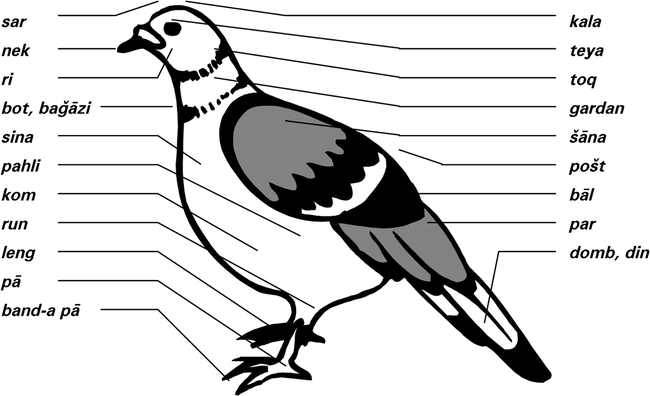
Commonly used bird physiology terms in Southern Luri.
Cognitive Distinctions Used to Differentiate Bird Types
As is the case in all societies, Southern Luri speakers classify living organisms at numerous levels; the Southern Luri taxonomy, which has six levels, is a typical system among the world's societies (see Berlin 1992:22). In SL, the life-form of
Two variations on a typical ethnobiological classification are found in SL. First, the variety taxon is poorly attested in the data gathered and, besides terms associated with bird sex and maturity, variety labels may not be distinguished from simple descriptors on a linguistic basis. Second, one could argue that a distinction of ‘subgenus’ is also relevant (e.g.,
Terms for bird species in Southern Luri.

As is the case in many taxonomies, the same labels are often used at several contiguous levels of the hierarchy. This is especially remarkable for the labels
As in any classification system, types are seen as unified based on a number of factors. In SL, speakers apply linguistically explicit as well as implicit but recurrent cognitive categories to distinguish bird types. Important factors are often found in the meaning of a bird's name; other significant factors are those that are referred to frequently in speakers’ descriptions of that bird. In the following section, I have listed and described cognitively significant distinctions that speakers have made in their description of bird life.
Linguistically Explicit Categories
Two discrete categories—domesticity and edibility—seem to be the most clearly defined and apply to all bird types.
Domesticity (domestic vs. wild): In the “domestic” category, the terms
Edibility: This parameter presents a three-way distinction. The first category is
Other Cognitive Categories Used in Distinguishing Types
In SL, factors that speakers have used to distinguish types from each other include the two distinct, comprehensive ones listed above, as well a number of factors for which names and descriptions of the birds highlight dimensions of contrast.
Categories found in names: The names of the birds themselves make reference to a number of factors that speakers use to highlight central characteristics of each folk species and to distinguish it from other folk species. These fall under the general categories of appearance, biological patterns and reference to an aspect of the wider culture. (Note that some names do not contain a discernible meaning, while others highlight two or three characteristic of a given bird type.) In Southern Luri bird names, there are 38 references to the appearance of bird types and 33 references to biological patterns in SL bird names (Table 2).
References to bird characteristics in Southern Luri bird names. (Total number of bird names recorded: 83; see Table 1).

The single reference to an aspect of the wider culture is that of
Categories found in speakers’ descriptions: Other facets of knowledge used in distinguishing bird types were evident in speakers’ descriptions of these birds. Items that have not been mentioned in conjunction with the birds’ names include: plumage patterns, flight patterns, migration (north/south as well as change of elevation over the course of the year), destruction of crops, scavenging garbage, attribution of good or bad omens, use as food, and role in cultural and personal stories, especially
Criteria that Distinguish Types at the Variety Level
The criteria of sex and maturity are sometimes used to distinguish bird types within a folk species.
Sex:
Maturity: Speakers use specialized terms to distinguish between three life stages or levels of maturity (m0). These stages are hatchling (m1), juvenile (m2), and adult (m3). The stage m1 includes organisms of both sexes that are still of a small size; m2 refers to organisms that have reached a mature size but are not yet sexually mature (as evidenced by egg-laying, for example); m3 indicates a sexually mature adult.
For most bird types, speakers use specialized terminology to differentiate only one life stage or level of maturity: the first maturity stage (m1), which is not eaten, is distinguished from later stages (see Figure 2). There is no distinction for sex among birds in the first stage of maturity. However, there are also birds (two types) for which speakers use specific terms to describe three life stages.
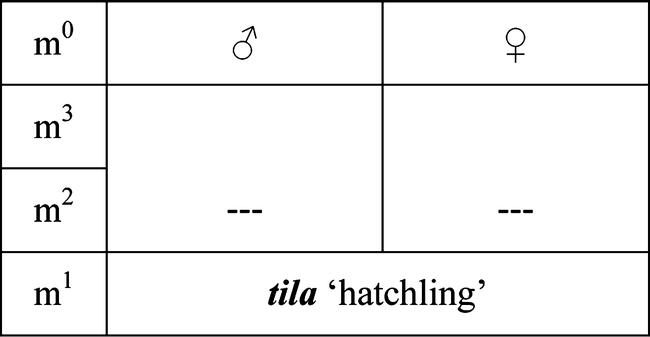
Life stages of most bird types.
For

Life stages of
For
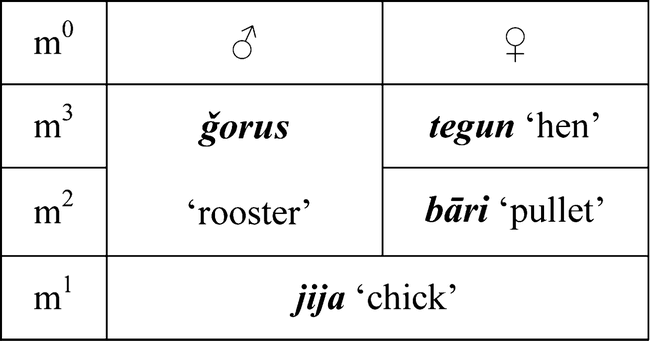
Life stages of
Why are terms for
Cognitive Distinctions and the Taxonomy
The cognitive distinctions that I have discussed in this chapter—domesticity, edibility, appearance, biological patterns, sex, maturity, and reference to aspects of the wider culture—all play into the elaborate taxonomy that is a part of the indigenous system of knowledge among speakers of SL. This taxonomy will be delineated in the following sections.
Taxonomy, Part 1: Intermediate Level Groups and Folk Genera
In the following section, I have arranged birds within a hierarchy1 of intermediate level groups (ILGs) and folk genera as classified by speakers of SL (the higher levels of this taxonomy are depicted graphically in Figure 5). Labels that apply to more than one level (refer to the same section above) are discussed at the highest level represented. Along with listing ILGs and folk genera, I have summarized and presented qualities that speakers have used to identify and distinguish each of the groups. For categories with more than a single folk species, a prototype is also given. (For a definition of ‘prototype’ as I use it, see Lyons 1995:6).
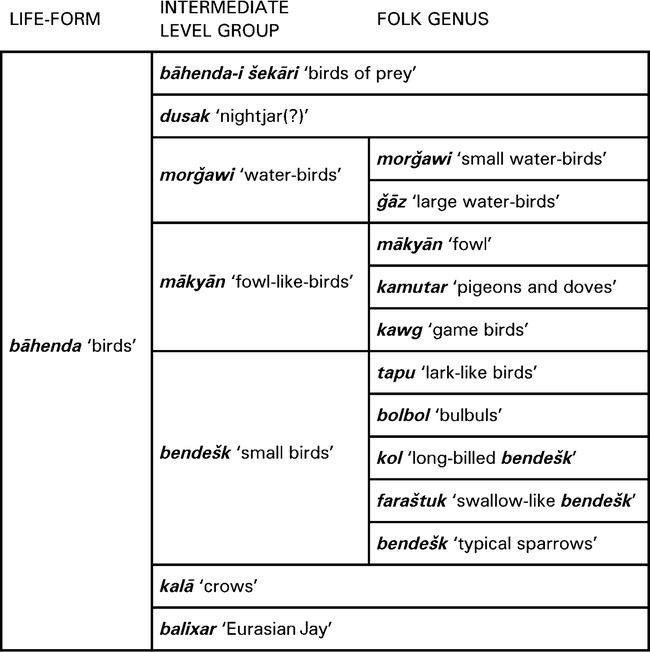
Intermediate level groups and folk genera in the Southern Luri bird taxonomy.
A. Intermediate Level Group: Bāhenda-i šekāri ‘birds of Prey’
Prototype:
B. Intermediate Level Group: Dusak ‘nightjars’
The curious ILG, with a single folk species
C. Intermediate Level Group: Morğawi ‘water Birds’
Prototype:
C1. Folk Genus: ğāz ‘large Water Birds’
Prototype:
C2. Folk Genus: Morğawi ‘small Water Birds’
Prototype:
D. Intermediate Level Group: Mākyān ‘fowl-like Birds’
Prototype:
D1. Folk Genus: Mākyān ‘fowl’
Prototype:
D2. Folk Genus: Kamutar ‘pigeons and Doves’
Prototype:
D3. Folk Genus: Kawg ‘game Birds’
Prototype:
E. Intermediate Level Group: Bendešk ‘small Birds’
Prototype:
E1. Folk Genus: Tapu ‘larks’
Prototype:
E2. Folk Genus: Bolbol ‘bulbuls’
Prototype:
E.3. Folk Genus: Kol ‘long-billed Bendešk’
Prototypes:
E4. Folk Genus: Faraštuk ‘swallows’
Prototype:
E5. Folk Genus: Bendešk ‘sparrows’
Prototype:
F. Intermediate Level Group: Kalā ‘crows’
Prototype:
G. Intermediate Level Group: Balixar ‘eurasian Jay’
The monospecific ILG
Additional Observations on the Taxonomy
In addition to the folk genera described above, there seems to be a loosely defined label, mentioned by a minority of speakers, given as
Another monospecific ILG has been recorded, but its validity is uncertain. Some speakers insist the term
Taxonomy, Part 2: Folk Species in Southern Luri
I have arranged all 64 folk bird species (for which there are 84 terms) according to the taxonomic levels outlined in the previous section. Information on each of the folk species in an ILG or folk genus is presented in Table 1 as follows:
Identification Number
Each bird name is numbered. In Appendix 2, I have arranged all bird names alphabetically in SL, Farsi, English and Latin (scientific nomenclature) and have indexed them by number.
Southern Luri Term
All Southern Luri terms for bird types are given in this column. When a Farsi term is also commonly used, I include this and refer to the Southern Luri term alongside that which it occurs. The writing system I use for SL is based on the system described in Anonby (2003a). Names whose pronunciation may be difficult for non-Southern Luri speakers to predict are also given in IPA (International Phonetic Alphabet). When a single bird type is identified by more than one synonymous label, the reader is referred to the most frequently used label, where other information on the bird type is given.
The reader should note that although some of the terms applied to birds are identical or similar to those used in Farsi, their application to bird types in SL is often different. For example, when the term ğāz is used in Farsi, it refers to geese. However, when it is used in SL (that is, specifically in the community where the research was conducted), it refers to Ardea cinerea (Grey Heron). In other cases, the range of a term is different. Take for example that of pāšalak, which in Farsi refers to several species of snipe (a type of sandpiper). In SL, however,
Meaning of Southern Luri Term
Whenever a Southern Luri term has a meaning of which speakers are aware, this is given. Single quotation marks are used to indicate a gloss (meaning).
Farsi Equivalent
Technical, Standard Farsi names are given, as well as regional names that speakers consider to be Farsi. The latter are given in quotation marks.
English Equivalent
Where technical English names are given, I have used capital letters. Where bird family names and nontechnical English names are given, capitals are not used.
Notes
In this column, I have included the Latin scientific name when identification of the species is probable or certain. For species whose identification is uncertain, I have included a description of the bird. This column also contains other information that speakers have given: appearance, including sexual dimorphism (where male and female have different physical characteristics); song; habits of food-gathering, nesting, and migration; instances and role of the bird in regional folklore; and other relevant information including similar terms in related language varieties. Quotation marks are used when the information is a direct translation of a speaker's description.
Conclusion and Reflection
This study is an investigation of Iranian ethnoscience; a synopsis of the way in which one community understands
This enquiry has revealed central aspects of the structure of knowledge of birds as encoded in the Southern Luri language spoken in Jawzār-Jawi, a community within the Mamasani ethnic group of Iran.
In the community under investigation, bird knowledge is most specialized among males who practice or have practiced a nomadic lifestyle. This knowledge is passed on through informal education.
The research presented in this paper has shown that bird knowledge is contained in a number of cognitive sets. The largest set is a four-level hierarchy with 84 terms for 64 types of birds at the folk-species level. A complete set of bird physiology terms is a further indicator of the richness of cognitive structure in the domain of birds. At the folk-species level, domesticity and edibility function as complete but less diversified sets. Below the folk species level, sex and maturity may be found as simple, whole sets. Other areas of bird knowledge, such as interaction of birds with human culture, are complex but less strictly organized in the Southern Luri language.
During the months in which I conducted research, all species that I myself observed were identified by speakers of SL, who then assigned these species a place in the taxonomy. In this sense, my experience confirms that the classification of birds found in the language spoken in Jawzār-Jawi is very much a complete taxonomy. And as to its representing a rich body of ornithological knowledge, I must admit that after all I have said in this article I cannot claim to have touched more than the surface of the significance of birds in many aspects of the culture. This is especially true of the role of birds in oral literature, a topic deserving further study.
Among the languages of temperate zone cultures, Southern Luri thus holds its own in the area of bird knowledge. In a seminal article, Berlin et al. (1966:237) stated that “there is a strong, positive correlation between cultural significance and degree of lexical differentiation.” Of course, cultural significance may be utilitarian, intellectual or both (Berlin 1992:3ff.). The results of this study suggest that the Southern Luri taxonomy reflects both perspectives. For example, the fact that more life stages are differentiated for common, large, edible birds than for other birds supports a utilitarian view of lexical differentiation. Conversely, the distinct naming of all crow species, none of which are considered edible, is one of many examples that an intellectualist perspective in ethnobiology also contributes to an understanding of the place of taxonomies within a culture. It is reasonable to suppose that this highly differentiated linguistic taxonomy has its origins in a time when birds played an even greater role in the cognitive world of the Southern Luri speakers (see Berlin 1992:260ff.). However, with the decline of pastoral nomadism and the rise of formal education in Farsi, much of the indigenous bird knowledge in SL is being shifted from an area of cultural common ground to one that is learned and retained out of interest by only some speakers: a professionalized domain that functions as understanding for understanding's sake.
A comparison of the Southern Luri bird taxonomy to that of classical Western science shows that the Southern Luri taxonomy differs in the arrangement of the labels it uses, as well as the way in which it uses these labels. A question that immediately comes to mind is: in which areas is each taxonomy more detailed? A simplistic answer is that the Western taxonomy is more detailed in areas such as the number of species labels; however, even for this seemingly straightforward issue, a number of concerns must be addressed in order to make a valid comparison. Of the approximately 500 bird species found in Iran, about half of them may occur in the Mamasani area as a whole. When compared to the Southern Luri taxonomy, which contains 84 labels for birds (and some of them synonyms), the Western system seems to be much more detailed. However, three factors account for this difference in number, only one of which is related to minuteness of detail. First, the world of the inhabitants of Jawzār-Jawi is geographically finite and, in fact, does not commonly extend beyond the home valley, adjacent high-elevation pastures, the nearby small city of Nurabad, and sometimes the large city of Shirāz, which is a long day's journey by public transport (including an all-terrain vehicle over unimproved roads for part of the way). Thus, a number of biomes that are within the Mamasani world as a whole (for example: small lakes, seasonal and permanent wetlands, cities, and dry plains) are beyond the world of the inhabitants of Jawzār-Jawi, and accordingly, the biomes of the bird species that inhabit them. Second, a high percentage (perhaps as high as half) of the birds found in the area are migrants from outside the region. Of these, many alight in the region only as vagrants or accidental species on their way to summer or winter residence. Third, and more to the point, there are in fact a number of cases where a single species in SL is clearly classified as several species in the Western taxonomy. This tendency is especially evident, for example, in the case of birds of prey and of small songbirds (see Table 1 for details). The Southern Luri taxonomy is more minute in other cases, however; consider the case of
A related topic of comparison between the Western scientific and the Southern Luri bird taxonomy is that of the use of labels, especially with regard to ambiguity. One significant feature of the Western scientific naming and classification system is its intolerance for synonyms; that is, ideally a single standardized name is used by a single academic population to label a single bird type. However, SL (and any other language variety that is not rigidified into the form of a technical jargon) allows more freedom in its labelling (see Berlin 1992:203ff.). One example is the use of any of four different words for ‘wagtail’. Of the terms
Elaborate bird taxonomies like that of Southern Luri exist in many other areas of Iran and elsewhere. This is one image in a far wider tapestry, an unexplored field in which our appreciation of the whole is still incomplete. But this very incompleteness in our knowledge of the world is the force that drives investigation forward; the force that is behind every society's categorization of the world, making sense of the world, coming to terms with the significant aspects of what we see in the world.
This calligraphic representation of a bird was produced by the author, who studied under Shokri, the master calligrapher in Shiraz, Iran. The body of the bird is formed using the Arabic text, bismillāh al-rahmān al-rahīm, a Qur'ānic invocation meaning, “in the name of God, the Compassionate, the Merciful.” Such invocations have been attested in Iran for hundreds of years and are found in written texts by Lurs as well as other ethnic groups. The traditional practice of including invocations in published works has become a legal requirement in today's Islamic Republic of Iran.

Footnotes
Acknowledgments
First and foremost, I thank my wife Christina for her patience, anthropological acuity and spirit of adventure. I would also like to thank the government of the Islamic Republic of Iran for granting visas and allowing Shiraz University to host us. In the field, Messrs. Hossein Ali-ye Mohammedi, Ahmad-e Mohammedi and Āmu Dādollāh spent much time with me and it was a privilege to learn from their expertise in the area of ornithology. I am, in fact, indebted to all members of the Luri community of Jawzār-Jawi for allowing my wife and me to live with them and for extending much excellent Iranian hospitality to us. Finally, I would like to thank Theodore Engel, Jeff Green and Enrique Salas-Vidal for their keen insights regarding the content and presentation of this article.
1 Oltrogge's (1977) article compares alternative methods of describing cognitive structure. In this study, I have chosen to represent the bird taxonomy hierarchically. Earlier sections of this study discuss covert categories (i.e., categories that are not themselves labeled in the language, but whose members are labeled) which in some cases are arranged hierarchically. As regards the taxonomy as a whole, I have found that covert distinctions support an existing overt linguistic hierarchy that is found at several levels (as I discussed earlier, and upon which I will elaborate in this section).
Lexicon of vocabulary associated with birds.

Index Of Bird Names In Southern Luri, Farsi, English, And Scientific Nomenclature (numbers Refer To Species Taxonomy List, Table 1)
