







Abstract
An ethnobotanical study was carried out in the Portuguese Serra do Açor, situated in the center region of Portugal amid the Serra da Estrela and the Serra da Lousa mountains, between January and June 2003. This work was based on 60 interviews with 30 inhabitants from 12 villages of this mountain chain who were acquainted with the uses of its vegetation. Information about 14 taxa with toxic, ichthyotoxic, insect-repellent, and bee-attractant uses was compiled, including their vernacular names, toxic principles, parts used, and preparations.
Introduction
The flora and vegetation of Portugal are well known, and there is much information about human use of plants. For example, Font Quer (1966) discusses medicinal uses of the plants of the Iberian Peninsula, including Portugal and Spain, and Carvalho (1949) and Feijao (1986) studied Portuguese medicinal, aromatic, and toxic plants. Estabrook (1994, 1998) focused on traditional uses of plants as green manures in the Serra da Estrela (Portugal). In the last few years many ethnobotanical studies have been carried out in Portugal: Alves Ribeiro et al. (2000) in the Tras os Montes region, Mesquita (2000) in the Serra da Malcata, Pinto Carvalho (2002) in the village of Moimenta da Raia (Tras os Montes), Rodrigues (2001, 2002) and Camejo-Rodrigues et al. (2003) in the Serra de Sao Mamede and on the medicinal plants in the Serra do Açor, and Novais et al. (2004) in the Serra da Arrabida. Worldwide, ichthyotoxic research has been conducted in Brazil (Pereira et al. 2002; Teixeira et al. 1984), Guyana (Moretti et al. 1982; Van Andel 2000), the Comoro Islands (Bourgois 1989), and Angola (Bossard 1993). There are also excellent reviews of ichthyotoxic uses of plants in Spain (Alvarez Arias 1998, 2000). Studies about insect-repellent plants have been made in Africa by many researchers (Abubakar and Aburahman 1998; Boeke et al. 2004; Chariandy et al. 1999; Palsson et al. 1999; Seyoum et al. 2002). This report is the first such work focused on the toxic, ichthyotoxic, and insect-repellent uses of plants of Portugal, including a discussion of their toxic principles.
Studied Territory and Methodology
The Serra do Açor is situated in the central region of Portugal between the Serra da Estrela and the Serra da Lousa. It includes the Mata da Margaraça Nature Park, one of the last areas in Portugal with relatively undisturbed vegetation (e.g., loureiros—Laurus nobilis L., medronheiros—Arbutus unedo L., folhados—Viburnum tinus L. spp. tinus, and some remains of Tertiary vegetation such as the azereiro—Prunus lusitanica L. subsp. lusitanica) (Paiva 1981). This region lies in the pre-Atlantic subhumid climate zone (Rodrigues 2002), with an annual precipitation of 2000–2500 mm at the summit. On the south side of the mountains the soils are highly eroded, while on the north side they are deeper and richer in organic material with forests of pine (Pinus pinaster Aiton) and chestnut (Castanea sativa Mill.) (Silveira 2001). The region's economy is based on agriculture (corn, potato, cereal, and olive production), exploitation of pine and chestnut trees, and livestock. Other activities are fishing, craft works, charcoal-making and apiculture. In the last two decades there has been an emigration of the young people to the cities, resulting in a loss of traditional activities and knowledge (Silveira 2001).
This study was carried out in 12 villages of the region (Figure 1); information was obtained through interviews with learned elders who had lived and worked their whole life in the countryside; 60 interviews with 30 different people (17 men and 13 women) were carried out. The informants were mostly rural workers (farmers and shepherds), as well as one beekeeper, two teachers, and three carpenters. The average age for informants in the 12 villages was between 60 and 84 years, with an overall average of 72 years.

Map of study area.
The first informants were selected with the help of Dra Silvia Neves (ICN) and Dr Jorge Paiva (University of Coimbra), who personally introduced the author to the local people of Pardieros and Relva Velha, villages around the Mata da Margaraça Nature Park. In the other villages (Barril do Alva, Benfeita, Cerdeira, Enxudro, Folques, Luadas, Monte Frio, Parrozelos, Pisao, and Sobral Magro), local people were asked about persons with “plant knowledge.” The interviews were carried out in the villages, fields, and woods of the region.
Each informant was interviewed by the author twice. The first interviews were informal, open-ended, and not structured, in order to let the people speak spontaneously and not feel pressured to give a particular response. Second interviews (structured and with specific questions) were carried out to confirm the identification of the plants, to resolve doubts, and to complete information. Informants were asked about vernacular names of plants, their toxic, ichthyotoxic, insect-repellent, and bee-attractant uses, parts of the plants used, and preparations. Some questions were asked in many different ways to the same people to validate the answers. Every answer was written down by the author and in some cases (with the informant's permission) the whole interview was recorded on a tape. Every plant was herborized by the author and a voucher herbarium specimen of each species was deposited in Argüello's herbarium. Plants were identified using the following literature: Coutinho (1939), Castroviejo et al. (2001), and Silveira (2001).
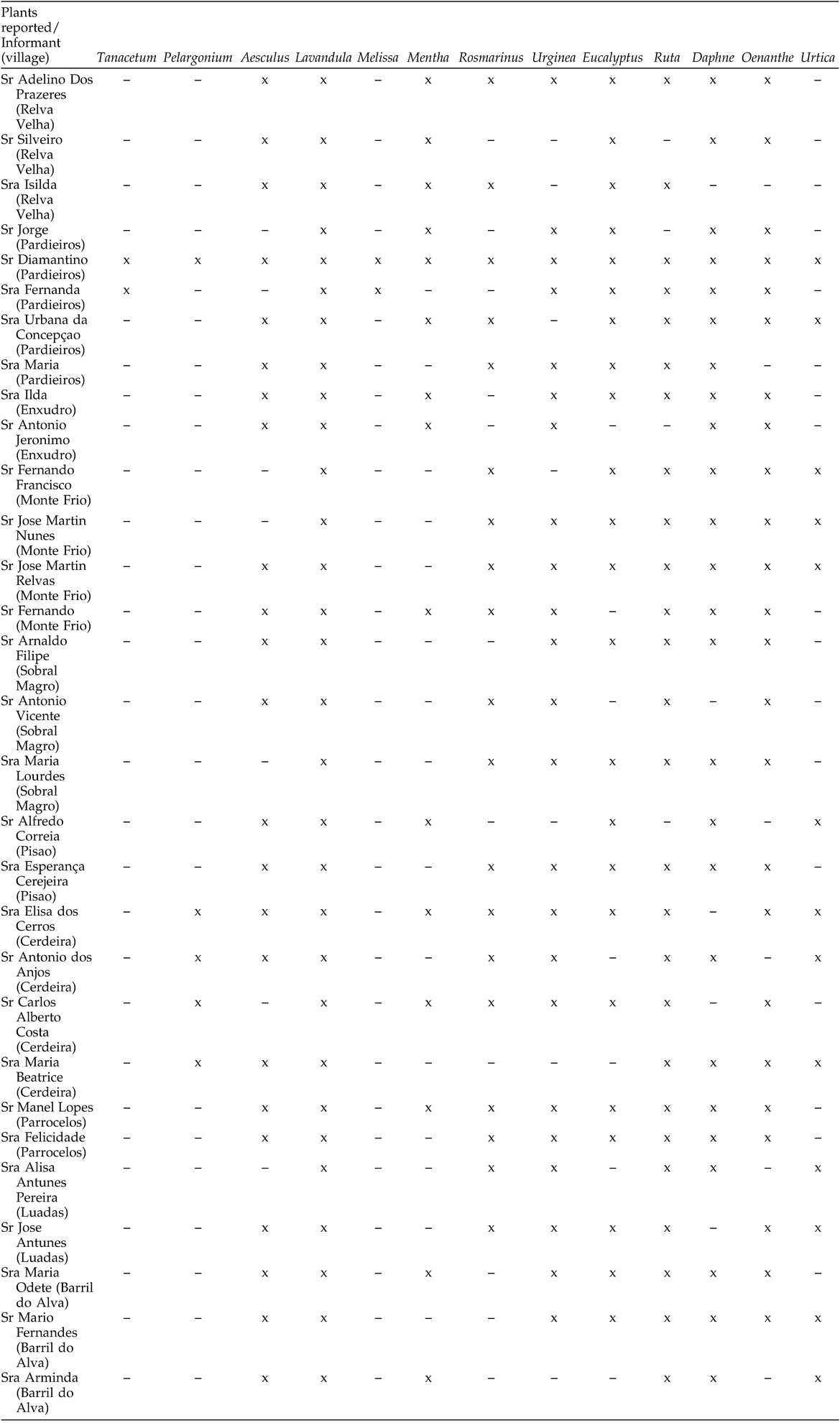
The complete information for each plant is given in Table 1, including the Portuguese vernacular name, the full scientific name, the accession number in Argüello's herbarium, the family, the used parts and preparations, and the type of use. Information about which plants were reported by each informant is included in Table 2.
Toxic and insecticidal plants used in the Serra do Açor (Portugal).

Plants reported by each informant; for species and uses, see plant uses in Table 1.
Results and Discussion
This research collected 14 taxa with different uses: 4 plants with toxic uses (including 2 ichthyotoxic), 7 insect repellent plants, and 3 plants used to attract bees.
Toxic and Ichthyotoxic Uses
The two toxic plants are Urginea maritima (L.) Baker (Liliaceae) and Ruta chalepensis L. (Rutaceae).
Urginea maritima, known as “cebola alvarra” or “cebola da rae,” is a typical Mediterranean plant that grows on dry hills near the sea. In this region we also find it cultivated in some vegetable gardens. Its bulb is used as a poison to kill mice. Mice have always been a problem in the countryside, eating stored food and attacking the crops. To repel and kill them, farmers poison a bit of corn (boiling it with the bulbs of Urginea maritima in an old pan used exclusively for this purpose) and leave it in places where the mice appear, so that they will eat the poisoned corn. Urginea maritima is also planted near fruit trees to protect them from the attack of mice and moles. The toxicity of these bulbs is well known, and extracts of the the bulb have been used in the past by the chemical industry to make rat poison (Carvalho 1949). Its toxic components are cardiac glucosides of the bufonelic group, a-esciraline and another glucosid-like esciriloside (Stary 1993). Death is due to heart attack, but it also attacks the nervous system.
As a medicinal plant in this region, a decoction of the bulb in oil is applied externally to treat pains (Rodrigues 2002). The same use is reported in the Serra da Arrabida, where it is also burned and its fumes inhaled as an antiasthmatic, antitussive, and antibronchitic (Novais et al. 2004).
Ruta chalepensis, known as “ruda,” is a cultivated plant with various uses in these villages. It is planted in the potato fields to repel mice and moles. The toxicity of this plant is due to its fucomarines (e.g., rutanine), cetones, and alkaloids, such as gravacrindondiol (Stary 1993). To this day it also has a folkloric use against witches and bad spirits; it is burned in houses and stables in a practice known as “defumadoiros,” or it is hung on doors to keep away bad spirits. This traditional ritual has also been reported in the Tras os Montes region (Pinto Carvalho 2002), and seems to be an ancient ritual that dates to medieval times in the Iberian Peninsula (Gomez Fernández 1999). In the Serra de Sao Mamede it is burned and used as an insect repellent (Rodrigues 2001).
The term “ichthyotoxic” refers to species used to kill or stun fish to make them easy to catch by hand. This traditional way of fishing is now illegal because of its lack of specificity—it kills different species of fish regardless of sex or age (Alvarez Arias 1998). Two species were mentioned as ichthyotoxic: Oenanthe crocata L. (Apiaceae) and Daphne gnidium L. (Thymeleaceae).
Oenanthe crocata, known as “embudo” or “budele,” is a very common plant in this region that grows near rivers and watercourses. It is well known to the inhabitants of these villages and people consider it to have been used since ancient times. The root of the plant is mashed and mixed with bread, cheese, or flour. The mixture is introduced into still water so it will stun or kill the fish that eat it. Then the fish, specifically trout, are easily caught by hand. Before eating a poisoned trout, its intestines (where the poison is accumulated) are thrown out. Some informants told us about the death of cats that have eaten the poisoned intestines. There are some other references to the use of Oenanthe crocata in Portugal; in the Tras os Montes region it is known as “canafreicha” and it is also use to fish (Pinto Carvalho 2002) and in Alentejo it is called “rabaça,” where it is known as a “very toxic and repulsive” plant, without any particular use (Lopes Borges 1996).
The toxic principles of Oenanthe crocata are well known: l-oenanthina, diol-diacetylenic (an isomeric of cicutoxine), l-oenanthenol and 14-desoxi-oenanthoxine (Jean-Blain 1973). The poison is analogous to picrotoxin. The poisoning of bovine livestock is not rare; a concentration of one gram of dry plant material per kilogram of animal weight is enough to kill a cow. The whole plant is toxic.
Daphne gnidium, known as “torvisco,” is used to poison eels or any fish in general. It is used the same way as the Oenanthe crocata (mashing the root mixing it with flour, bread or cheese and introducing it in the river). This use has also been reported in Tras os Montes (Pinto Carvalho 2002). The whole plant is poisonous, especially its fruits, due to a resin called mezerein (anhydrid of mezenic acid) with inflammatory and vesicant properties. It is extremely dangerous for livestock (30 g of the dry plant can kill a horse) (Jean-Blain 1973). Daphne gnidium also has a veterinary use in this region, as it is used by shepherds to treat diarrhea and to cure colds of sheep and goats. For this purpose a branch with leaves is plaited around the neck of the sick animal (Rodrigues 2002); as the plant is poisonous only when ingested, there is no reason to think that it works against diarrhea or colds, however. In the Serra de Sao Mamede it is put in the animals’ bed to repel and kill parasites (Rodrigues 2001).
Insect-repellent Uses
Urtica dioica L. (Urticaceae), called “urtiga,” grows near the houses, paths, and everywhere in the countryside where there are people or livestock. Farmers macerate the leaves in water and apply the mixture to field crops and use it as an insect repellent. Some people also plant it near their vegetable garden to keep out snails. This plant has many different uses in this region: an infusion of its leaves is used to treat colds and bladder infections, the whole plant boiled in water is used to wash hair or to make soup, and macerating the plant in water for one day and then drinking the water stops bone pains (Rodrigues 2002).
Rosmarinus officinalis L. (Lamiaceae), called “alecrim,” a very common and well known plant in this region. Its branches are dried and hung in closets to drive away insects and moths (also reported by Rodrigues 2001). In this region it has all kind of different uses: an infusion of its leaves is used to treat colds and headaches; a decoction of its branches and leaves was used in the past to wash hair and clothes (see also Rodrigues 2001; Novais 2002), the dried leaves are a spice to season rabbit (see also Novais 2002) and it is burned in “defumadoiros” to disinfect stables and yards, and against bad spirits (Rodrigues 2002).
Lavandula latifolia Medik. and Lavandula angustifolia Mill. (Lamiaceae), both called “alfazema,” are the most popular insect-repellent plants in this region. The flowers are dried and introduced into a small bag or simply hung in closets to repel insects and moths. It is also used to deodorize clothes and to perfume houses and people (Rodrigues 2002).
Aesculus hippocastanum L. (Hippocastanaceae), originally from Greece (Font Quer 1966) is cultivated in the Iberian Peninsula as an ornamental and known as “castanheiro das Indias.” Its fresh fruits are put in closets to drive away moths.
Eucalyptus globulus Labill subsp. globulus (Myrtaceae), called “eucalipto,” is an Australian tree introduced into the Iberian Peninsula in the nineteenth century (Font Quer 1966). It is cultivated extensively in Portugal and is a threat as an invasive plant. It has a recent and very common use in this region as an insect repellent. Its leaves are hung in yards to repel flies and burned in houses and stables to disinfect them, used in the same way as the Rosmarinus officinalis already mentioned. As a medicinal plant, an infusion of its leaves is drunk to treat mouth infections, teeth pains, rheumatism, and coughing (Rodrigues 2002).
Mentha suaveolens Ehrh. (Lamiaceae), called “montastre” or “mentastro,” is a kind of mint that grows in humid places (usually near nettles). It is used by shepherds, who put a small branch with leaves behind their ears to drive away mosquitoes. Beekeepers scrub its leaves on their hands before working with bees to keep from getting stung. Scrubbing also stops the itching from nettles. As a medicinal plant it is used to treat toothache, by smoking a cigarette made with a dry leaves of corn (Zea mays L.) filled with montastre leaves (Rodrigues 2002). An infusion of its leaves is drunk as a digestive (Mesquita 2000; Novais 2002) and fresh leaves are used as a condiment for fish soups (Rodrigues 2001).
Pelargonium graveolens Ait. (Geraniaceae) is an ornamental plant from South Africa introduced in the Mediterranean region in nineteenth century. It is planted in gardens and in flowerpots placed in window sills to repel insects. It is mostly used by inhabitants of the village of Cerdeira, where it was introduced as an ornamental plant by Sra Maria Beatrice, one of our informants. This species has not become naturalized and we have not found other Pelargonium species in the studied area.
Bee-attractant Uses
Beekeepers must attract the bees to their beehives, so they can live there producing wax and honey. For this purpose a mixture of “alfazema” (Lavandula latifolia, Lavandula angustifolia), “incenso” (Tanacetum vulgare), and “erva cidreira” (Melissa officinalis) leaves is made. The fresh leaves of the three species are boiled in water resulting in a dark and aromatic liquid that is rubbed on the walls of the beehive with a stick.
Conclusions
The results of this research show a considerable knowledge of toxic and repellent plant uses in this region that persists in the older generation (14 plants of 10 different families with toxic, ichthyotoxic, insect-repellent, or bee-attractant uses). Nowadays the use of insect-repellent plants is an accepted and common practice in this region for the control of insects in houses and stables. Toxic and bee-attractant plants are still used by the elders of the region. The use of plants in fishing is an old practice that is dying out but that was very common in the past (as many of the informants told us).
As the informants—selected for their knowledge of plants—averaged 72 years in age, we conclude that most of the ethnobotanical knowledge lies in the older generation. Despite the common uses that some of this plants have nowadays, the disappearance of this generation means the definite loss of the opportunity to compile ethnobotanical knowledge. This underlines the importance and urgency of conducting other ethnobotanical studies in a near future.
Footnotes
Acknowledgments
We wish to thank all the informants who have helped make this research project possible. We also wish to thank Dr Jorge Paiva and Dr Antonio Xavier Pereira Countinho from the University of Coimbra (Portugal), Dr Helios Sainz from the U.A.M. (Universidad Autónoma de Madrid), Dra Silvia Neves from the Mata da Margaraça Nature Park (ICN), Dr Paulo Ramalho, and Dr Manuel Pardo and Dr Ramón Morales (Real Jardín Botánico de Madrid).