Bima-sumba Group of Languages
Nage (central Flores) Ana Wa Ta'a Co
In a recent book on Nage ethno-ornithology, I described the Nage term as a reference to a ‘covert taxon’ (Forth 2004a:36) in view of the fact that
ana wa ta'a co
—the least equivocal way of designating birds in general, and a category inclusive of all locally known aviformes—is a lengthy, descriptive phrase. I would now regard this point as moot, and am more inclined to accept ‘bird’ as a named life-form in Nage. Meaning ‘animal (
ana wa
; see Forth 2004b) that flies (
ta'a co
)’, the Nage usage identifies birds by their characteristic form of locomotion. As some other creatures—most notably, insects—are also capable of flight, the category can be more exactly specified as
ana wa ta'a co zéta lizu
(‘animals that fly high in the sky’). As Nage remark, birds are further distinguished from flying insects by the fact that insects that fly also regularly move by ‘crawling’ (
laka
), and some by ‘jumping’ (
bedhi
). Birds can alternatively be described morphologically, as ‘animals with wings’ (Forth 2004a:36), but this is less common and moreover focuses on the feature essential to the characteristic form of locomotion.
Two other Nage usages referring to birds in a general sense are
ana peti
, a term that more specifically denotes small passerine birds and especially Estrildine finches, and
peti kolo
, a compound comprising the short form of
ana peti
and
kolo
, the name of certain smaller Columbiformes.3 However, these terms refer generally to birds only in particular contexts, where they are often better glossed as ‘bird of no particular kind’ or ‘any kind of bird’ (Forth 2004a:37-38). The restriction is demonstrated by direct questioning, which reveals that Nage do not normally consider eagles (
kua
), owls (
po
), or ducks (
bébe ae
), for example, as instances of
ana peti
or
peti kolo
, even though for Nage all are certainly ‘birds’, and all are recognized as instances of ‘animals that fly high in the sky’ (
ana wa ta'a co zéta lizu
).
Eastern Sumbanese Mahawurungu and Manggarai (western Flores) Kaka Lélap
These terms closely correspond to the Nage term for ‘bird’ in that both translate as ‘what flies’ or ‘flying thing’. Sumbanese
ma
- is a nominalizing particle, while
hawurungu
, like Manggarai
lélap
, means ‘to fly’. Since Verheijen glosses
kaka
as ‘animal’, the Manggarai expression might appear to correspond exactly to the Nage term. Yet however regularly it may be employed with the specific meaning of ‘animal’,
kaka
possesses the more general sense of ‘thing’, of which the meaning ‘living, animate thing’ is apparently derivative (Forth 2004b:60). A noteworthy feature of Manggarai
kaka
is its occurrence in numerous folk generic terms, not only for categories of birds but for other kinds of animals as well. Thus,
kaka ketoq
, denoting the Sunda pygmy woodpecker (Dendrocopos moluccensis), might be interpreted as ‘bird, or animal, that knocks, taps (on wood)’. Nevertheless, the term might equally, and perhaps more accurately, be construed as ‘tapping thing’, or ‘tapper’.4
Closely resembling Manggarai
kaka
in its range of applications is
kokaq
, a word from Rembong dialects spoken to the northeast of Manggarai, which Verheijen (1977) lists inter alia as ‘bird’, ‘animal’ (see
kokaq reman
, ‘wild animal’), and ‘object, thing’. Unlike
kaka
, however,
kokaq
is employed without modification in one Rembong dialect to refer to a particular category of fauna, and moreover a particular category of birds, the Estrildine finches.5 At the same time, the term occurs in four compounds labeling more specific bird categories (e.g.,
kokaq-but
, denoting a quail), and a further four designating kinds of mammals (e.g.,
kokaq-béwéq
, wild cat), a snake, and an insect. A very similar usage is suggested by bird terms from Tana Wolo, a district located just east of Manggarai and north of the Ngadha region (see Forth 2004a:xiv, Map 2), in regard to the lexeme
koka
, glossed by Verheijen as ‘Estrildine finches’. In Tana Wolo, six bird generics are labeled with compounds of
koka
, although these subsume quite different kinds from the Rembong
kokaq
compounds (namely, species of hawks of the genus Accipiter, the Large-billed Crow, Channel-billed Cuckoo, Savannah Nightjar, Sunda Pygmy Woodpecker, and wagtails). Rembong
kokaq
and Tana Wolo
koka
bear a palpable resemblance to names for the Helmeted Friarbird (Philemon buceroides) in other eastern Indonesian lauguages, including Nage, Ngadha, and eastern Sumbanese
koka
. Yet in view of their ornithologically very different referents, the Rembong and Tana Wolo terms are better understood as cognates of Manggarai
kaka
.6
The kinds of birds whose Manggarai names include
kaka
are as various as are the species associated with any of several comparable lexical sets comprising terms that incorporate
manu
and
kolo
(see Tables 2 and 4). Unlike these, however, and unlike Rembong and Tana Wolo
kokaq
and
koka
, Manggarai
kaka
is not identified with any more specific type of bird, nor does it unequivocally refer to birds in general, or some relatively large sub-set of these. Indeed, when used by itself,
kaka
is usually understood as ‘animal’ (Forth 2004b:59).
Both Manggarai
kaka lélap
and eastern Sumbanese
mahawurungu
(‘flying thing’) include bats as well as birds, as does the Nage term
ana wa ta'a co
. Because in all three cases the life-form is explicitly defined with reference to a kind of movement, the fact that it subsumes the Chiroptera as well as Aviformes is perfectly logical. By the same token, it would not be entirely accurate to say that the Nage, for example, classify bats as birds (that is, within a taxon equivalent to modern English ‘bird’ or scientific ‘Aves’), but only that they group them conceptually with birds.
Lio Ule Bene or Ule Age and Rembong Anak Reman
The evidence for a term labeling an ethnotaxon ‘bird’ in Lio is less straightforward than what is found in other Bima-Sumba languages. Some evidence suggests that Lio
ule
can be used as a general term for ‘animal’ (Forth 2004b:55-57). In all other Flores languages,
ule
and cognates denote a category of worms, maggots, and grubs—a particular sense also associated with the term in Lio.7 Entries in Arndt's Lio dictionary (1933) further suggest that, in some contexts,
ule
alone can mean ‘bird’. Thus Arndt glosses
ule léla dzére
as ‘the bird flies suspended, hovers’ (s.v.
dzére
, ‘to hover’;
léla
is ‘to fly’, cf. Manggarai
lélap
) and lists
haba ule
as ‘bird's nest’ (1933:132, s.v.
haba
, ‘(bird's) nest', cf.
haba manu
, ‘hen's nest'). Lio
ule
moreover occurs in compounds referring to at least six bird generics, including
ule mesi
, ‘heron’ (Stokhof 1983;
mesi
is ‘sea’) and
ule miu
, designating a bird that shrieks ‘miu’ (Arndt 1933). In these designations, of course,
ule
could just as well be interpreted as ‘animal’ instead of ‘bird’, in a way comparable to Manggarai
kaka
.
Ule
further appears in five compounds that apply to insects—as in
ule ae
, ‘dragonfly’ (
ae
, ‘water’), and
ule api
, ‘wasp with a red body’ (
>api
, ‘fire’). Yet with regard to the particular association of
ule
with birds, it is a point of interest that at least four of the five refer to relatively large flying insects.
The evidence for a Lio compound term denoting birds in general, and distinguishing these from other zoological life-forms, is equivocal. Two Lio phrases listed by Arndt that might possess this sense are
ule bene
and
ule age
. In one place, however, Arndt glosses
ule age
as ‘all kinds of creatures, worms, reptiles, birds’ (1933, s.v.
ule
), thus suggesting a more general zoological reference. Drawing on more recent research, the anthropologist Sugishima (personal communication 2000) describes
ule age
as a term specific to birds in Lio. But neither Takashi Sugishima nor Arndt provides a separate gloss for
age
, and it would seem that the term may only occur in combination with
ule
.8
In
ule bene
, the other Lio term possibly specifying ‘bird’,
bene
translates as ‘weeds, bush’ (Arndt 1933). Although Sugishima never recorded
ule bene
(personal communication 2000), nor had a Lio informant I questioned in 2005 heard of it, Arndt's gloss of the second component accords with Sugishima's exemplification
kuru bene
, ‘wild plants’. In Nage, too,
bene
can mean ‘wild, undomesticated’. Thus, if it is a regular Lio usage,
ule bene
may be understood as a reference to creatures inhabiting wild vegetation, and thus, as a synecdochal usage specifying wild birds.9 Indeed, especially among the usages included in Arndt's dictionary, there is some suggestion that, in spite of comparative evidence indicating an original meaning of ‘worm, grub’,
ule
alone, as a reference to wild (as opposed to domesticated) creatures, may have a special association with birds. Expressed another way, the suggestion is that that wild birds are the focus of a Lio category of ‘wild creatures’ designated by
ule
.
Since the second element of Lio
ule bene
means ‘weeds’ or ‘scrub’, the expression partly parallels
anak reman
, listed by Verheijen (1977, s.v.
anak
) as the term for ‘bird’ in the Rembong region of western Flores (see Forth 2004a:xiv, Map 2).
Reman
means ‘leaf (leaves), grass, weeds’, ‘undergrowth, scrub’, and ‘forest’ (Verheijen 1977), and like comparable terms in other eastern Indonesian languages denoting types of uncultivated vegetation (e.g., Nage
witu
, eastern Sumbanese
rumba
, and of course, Lio
bene
), the Rembong term serves to distinguish wild from domesticated creatures (Verheijen 1977).10
Anak
, on the other hand, is cognate with Nage
ana
(‘child, person, member’). Hence, Rembong
anak reman
further recalls the Nage term for animals in general (
ana wa
, analyzable as ‘children, people of the wind’) as well as a contextual Nage use of
ana
alone in reference, especially, to birds (Forth 2004a:56).11 As with Lio
ule bene
, therefore, in the Rembong term
anak reman
one encounters a usage suggesting the general sense of ‘wild animal’ but which evidently refers more specifically to (wild) birds.
Insofar as the Lio and Rembong usages appear to refer ambiguously to birds and a more inclusive category of animals, another comparison may be found in certain Oceanic languages, where terms cognate with Central Malayo-Polynesian
manu
(or
man
,
manut
, etc.; see the third subsection of ‘Ambon-Timor Group of Languages’ below) denote ‘bird (in general)’ but are further applied to other animals (Blust 1982: 247-48; see also Table 3; notes 5 and 6). In these Oceanic languages, however, the ‘bird’ term has apparently been extended to certain non-birds, including mammals and fish, whereas there is no evidence for the Lio and Rembong phrases having originally referred exclusively to avifauna.
Lamboya (western Sumbanese) Mango; Ende (central Flores) Nake; and Bimanese (eastern Sumbawa) Nasi
Wielenga (1917:33) compares western Sumbanese (Lamboya)
mango
to eastern Sumbanese
manginu
, a term referring to a variety of small passerine birds, especially munias and other Estrildine finches (Forth 2000:176-77); but he also lists the Lamboya term as the equivalent of eastern Sumbanese
mahawurungu
, as a general term for ‘bird’. From this one may infer that, insofar as
mango
does refer to birds in general, it represents an extension from a primary or original denotatum, which was a variety of small birds, or what have been called ‘dicky birds’ (Hunn 1991:139). A relevant comparison is the contextual use of Nage
ana peti
, another term whose most specific referent is Estrildine finches, but which contextually is similarly applied to a wider category of avifauna.
In the first comprehensive lexicon recorded for the Ende region of central Flores, van Suchtelen (1921:316, 340, 389) lists the apparently monolexemic
nake
as the term for ‘bird’ in both the Ja'o and Nga'o dialects of Endenese. In the same vein, he gives
sewo nake
as ‘bird's nest’ (1921:316). Drawing on information published in 1896, the ‘Holle Lists’ (Stokhof 1983:164) also record
nake
as Endenese for ‘bird’.12 This early evidence finds some support in a recent dictionary of the Ja'o dialect by Aoki and Nakagawa (1993), who translate
nake
as ‘kind of bird’, a sense they also list for
'ana nake
(
'ana
, ‘child’, denotes a small variety of something, as does its Nage cognate). These authors, however, further translate
nake
as ‘kind of parrot’ and ‘kind of hawk’, and with reference to the second gloss, they also record
nake jata
, ‘hawk’, and
nake toro
, ‘kind of bird of prey’ (the same definition given for
jata toro
).13 The only compound incorporating
nake
found in van Suchtelen's list is
nake buro
, translated as ‘swallow’ in the Ja'o dialect (1921: 340).14 Surprisingly, Verheijen (n.d.) lists none of the foregoing names in the terminologies he records for various Endenese dialects. On the other hand, he does record
nake teka
as the Endenese name for the Sunda Pygmy Woodpecker (Dendrocopos moluccensis), and
nake kowo
as the term for ‘swallow’ (Hirundo spp.) in the Riti dialect of eastern Keo (Verheijen n.d.:14, 15).15 Also referring to Keo, Tule (1996) lists
nake ‘ura
, ‘rain bird’, as the name of an unidentified kind of small bird.
None of these more recent data confirms the status of
nake
as a general term for ‘bird’; but nor does any contradict van Suchtelen's gloss. The fact that
nake
seems to occur incidentally in Endenese folk generics for quite various kinds of birds (parrots, diurnal raptors, woodpeckers, swallows) is not contrary to the general sense of ‘bird’, any more than is the occurrence of English ‘bird’ in the names of a similarly limited number of diverse aviformes (see e.g., blackbird, frigatebird, lyrebird, mockingbird, ovenbird). In regard to the derivation of the term as a possible life-form label, it may be relevant that in other central Flores languages (including Nage, Ngadha, and Lio, but not certainly in Endenese)
nake
is a word for ‘meat’ and, in some languages, especially ‘game’ or ‘wild meat’. According to Arndt (1961:346), Ngadha
nake
refers to ‘game’ both in the sense of ‘wild meat’ and ‘game animal’, while in both Ngadha and Lio,
nake
occurs in compounds denoting aquatic creatures.16 Quite possibly, then, Endenese
nake
has come to be applied to birds synecdochally, by virtue of their identification as sources of wild meat or kinds of game—and thus in a way hypothetically comparable to Lio
ule bene
and Rembong
anak reman
, whose analysis similarly suggests a more general reference to wild animals.
Detracting from this hypothesis is the circumstance that people of central Flores do not consider all birds edible. Nor are those named with
nake
in Endenese (for example, raptors and parrots) at all typical of those that they do. Nage, for example, explicitly prohibit raptors as food (Forth 2004a:104). What is more, even the limited information available allows us to glimpse an alternative interpretation of
nake
. For two Endenese dialects, Verheijen (n.d.:19) lists
ana ke kunu
and
ana ke jata
as names of two kinds of Estrildine finches.17 As already shown, if not the sole referent, these sorts of small birds are focal to similar terms in several eastern Indonesian languages (including Nage
ana peti
, eastern Sumbanese
manginu
, and Rembong and Tana Wolo
kokaq
and
koka
; see also Manggarai
cik
, ‘general name for almost all small birds’, Verheijen 1963; Komodo
kesiq
, ‘all small birds’, Verheijen 1982; Rembong
sik
,
kokaq sik
, ‘several kinds of small birds’, Verheijen 1977; Ngadha
siu
, Estrildine finches, Verheijen n.d.; Lio
si
,
ule si
, ‘kind of bird’, Arndt 1933; Sikanese
ti
, munias and various other small birds, Verheijen, n.d.). Although mostly focused on Estrildine finches, nearly all of these terms appear, in one way or another, to apply to a more inclusive category of small passerine birds, and, in the case of Nage
ana peti
, can even approximate ‘bird’ in a general sense. This comparative evidence, then, suggests that
nake
, ‘bird’, may not derive from a word meaning ‘meat’ or ‘game’, but may reflect a contraction of
ana ke
, or alternatively a short form of Aoki and Nakagawa's ‘
ana nake
, a term they equate with
nake
. Noteworthy here is the latter authors’ separate listing—under
kéé
, ‘small’—of
'ana kéé
as ‘kind of bird (very small)’ (1993:30). Whichever interpretation is correct, therefore,
nake
(or
ana nake
) may be understood as another term denoting a more limited category of birds that has come to acquire something of the sense of ‘bird’ in general.
Essentially the same analysis possibly applies to
nasi
, the general term for ‘bird’ in Bimanese. It is a reasonable surmise that the term reflects a compounding of Bimanese
ana
(‘child, person’, cf. Nage and Endenese
ana
) and a cognate of one or more of the series of names, listed just above, which are applied to small passerine birds in Flores languages (see especially
cik
,
siu
, and
si
). By the same token, Endenese
nake
,
ana ke
, and Aoki and Nakagawa's
'ana kéé
are obviously similar to
ke
, the term Fernandez (1996) gives for ‘bird’ in the Helong language, spoken on the island of Samau off the western tip of Timor. Not having access to other materials on Helong, I am unable to comment further on this name. It should be noted, however, that comparable Florenese terms like Manggarai
cik
, Sikanese
ti
, and so on, appear to be onomatopoeic in origin, and to that extent equivalent to English ‘chirp’, denoting the vocalization of a small passerine bird.
Palu'e Kolo
Although classified as a Bima-Sumba language (Wurm and Hattori 1981), the language of Palu'e, an island off the north coast of Flores, includes bird terms which in several respects are more reminiscent of bird terminologies from ‘Ambon-Timor’ languages spoken in more easterly parts of Flores. Consistent with this assessment is Vischer's statement, that Palu'e fauna includes ‘a large variety of birds collectively classified as
kolo
’ (1992:18), an obvious cognate of the general term for ‘bird’ in Atoni (Dawan), a language of western Timor (see Table 1). In view of its widespread occurrence in eastern Indonesian ethno-ornithological lexicons,
kolo
is further discussed in the following section.
Ambon-timor Group of Languages
Sikanese Kenaha Horong (‘flying Thing’) or Horong (the Nominal Form of Horo, ‘to Fly’)
Although Sikanese belongs to the ‘Ambon-Timor’ languages, the Sikanese terms, both of which refer to birds in general (Pareira and Lewis 1998:79; Lewis personal communication 2001), are obviously comparable to the Nage, Manggarai, and eastern Sumbanese usages by virtue of their naming of the life-form with reference to its characteristic mode of locomotion. A further similarity lies in the fact that the Sikanese category, like the terms from Sumba and more westerly parts of Flores, includes bats as well as true birds. Also worth noting is the evident relationship between Sikanese
horong
(from
horo
, ‘to fly’), and the synonymous eastern Sumbanese
hawurungu
.18 Since
ha
- is a fused prefix,
hawurungu
is evidently related to
wuru
, a probable onomatopoeia referring to the whirring or flapping sound of a bird's wings in flight (Forth 2000; Onvlee 1984). Despite the apparent similarity, a connection between either of the eastern Indonesian terms and
burung
(or
burong
), the term for ‘bird’ in Malay, Bahasa Indonesia, and several other Western-Malayo-Polynesian languages (see Table 3), is unlikely. According to Adelaar (2004: 50),
burung
derives from Proto-Malayo-Polynesian *
buR'w
, ‘to hunt’ (plus a fused suffix), an interpretation that in an interesting way recalls one interpretation of Endenese
nake
(‘bird’), as a word primarily meaning ‘game’—that is, the product of hunting.
Atoni (dawan) Kolo, Kédang Udang Olong
That
kolo
functions as a completely general term for ‘bird’ in the Atoni language of western Timor is indicated by both Fernandez (1996) and McWilliam (2002:308), who in a personal communication has noted how, in the contracted form
kol
, the term further appears in compounds referring not just to wild birds but also to the domestic fowl. Though often named simply as
manu
(see the following subsection), the fowl is more completely designated in Atoni as
kol manu
, while comparable binomials include
kol ka
, ‘cockatoo’, and
kol ton
, a kind of bird ‘that announces the onset of the rainy season’ (McWilliam, personal communication 2003). McWilliam further notes how Atoni
kolo
‘may also refer to the idea of flying or flight’, as suggested by
ot kolo
, ‘flying automobile’, or ‘aeroplane’.
In other eastern Indonesian languages,
kolo
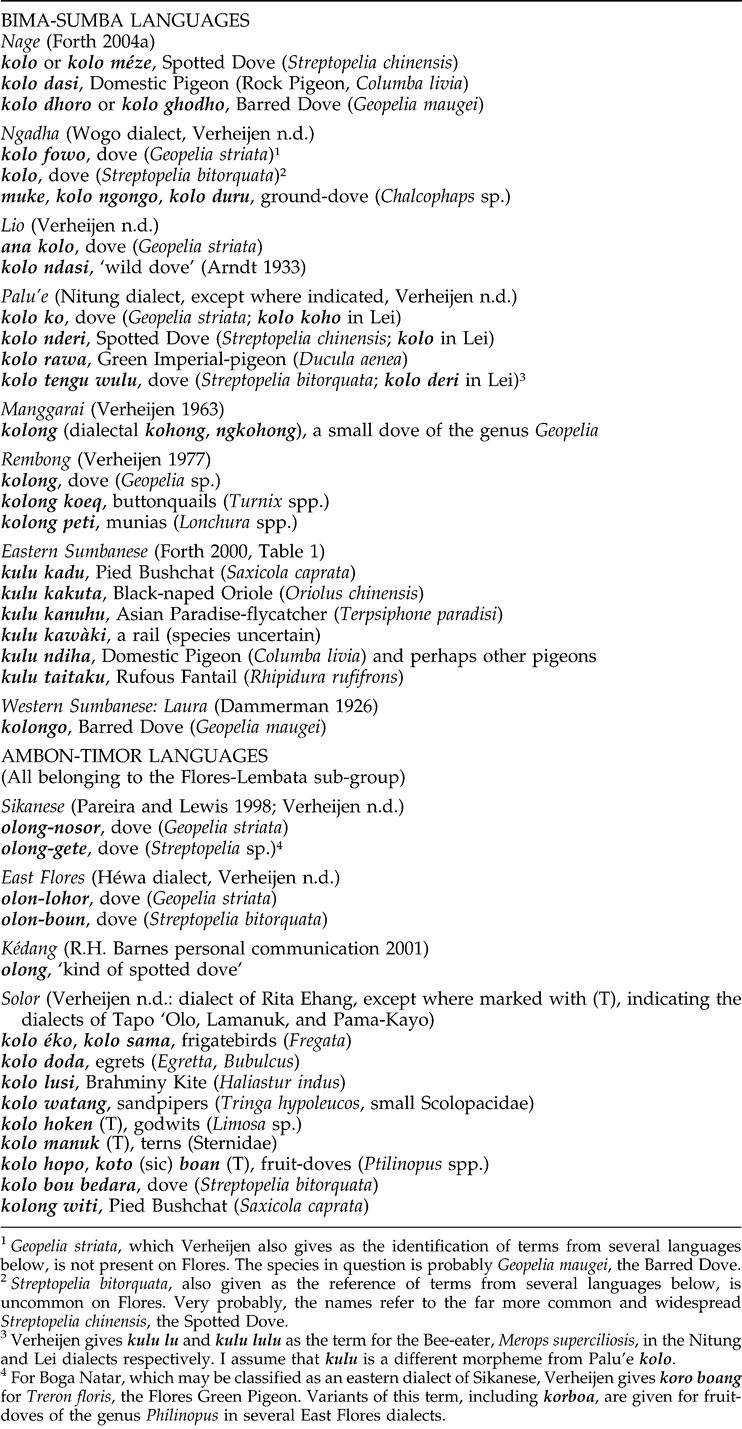
and variants mostly occur in compounds labeling two or more folk generics. Examples drawn from both Bima-Sumba and Ambon-Timor languages appear in Table 2. Among the Ambon-Timor languages, dialects spoken on Solor reveal as many as ten compounds of
kolo
. These are applied to such diverse categories as frigatebirds, egrets, sandpipers, terns, doves, the Brahminy Kite, and the Pied Bushchat (Verheijen n.d.)—a diversity that recalls Vischer's previously mentioned assessment of Palu'e
kolo
as a term ‘collectively’ classifying birds. In regard to the diversity found in Solor, it goes without saying that birds designated with compounds of
kolo
do not obviously constitute a single intermediate taxon. The Solorese and other compounds may be compared with the arbitrary occurrence of English ‘bird’ in names of such phylogenetically various kinds as ‘lyrebird’, ‘frigatebird’, and so on—a comparison suggested earlier with regard to Endenese
nake
. Nevertheless, one cannot simply infer from these numerous compounds that, by itself, Solorese
kolo
conveys the same general sense as does English ‘bird’, or functions as a completely general term for ‘bird’.
A cognate of
kolo
, namely
olong
, occurs in
udang olong
, reported as a general term for ‘bird’ in the non-Lamaholot language of Kédang, on the island of Lembata (R.H. Barnes personal communication 2001). Interestingly,
udang
alone also conveys this general sense, although the term has the more specific meaning of ‘pigeon’ (Barnes personal communication 2001). By itself,
olong
similarly denotes a ‘kind of spotted dove’ (cf. Nage
kolo
, Streptopelia chinensis; Manggarai
kolong
, Geopelia sp.). What one evidently encounters in Kédang, then, are names for doves and pigeons referring, at least in some contexts, to birds in general. In this, moreover, one glimpses a possible connection between the diverse referents of cognates of
kolo
encountered in various languages of Flores (though particularly ones belonging to the Bima-Sumba group, where the term almost always refers to pigeons and doves) and the Atoni use of
kolo
to designate the entire life-form category of ‘bird’.
Although the evidence does not reveal whether in Palu'e or Solorese—or indeed any of the Lamaholot languages of eastern Flores—unmodified
kolo
ever functions as a general term for ‘bird’, it is evidently on the basis of the widespread occurrence of cognates that Fernandez (1996) has reconstructed *
kolon
, ‘bird’, for the hypothetical proto-language he calls ‘Proto-Flores’. Actually, Fernandez's reconstruction would appear to relate to a grouping more inclusive than languages of Flores. One indication, of course, is the occurrence of
kolo
(‘bird’) in the Atoni language of Timor. Another is provided by six eastern Sumbanese compounds incorporating
kulu
, which, in a way recalling the Solorese usages, label such diverse bird categories as the small passerine Pied Bushchat, a rail, and a pigeon (see Table 2).19
Another possible indication of an association of
kolo
with a life-form category incorporating birds in general is the previously mentioned Nage compound
peti kolo
(
peti
, it will be recalled, is the short form of
ana peti
, which designates Estrildine finches and, more generally, small passerine birds). As demonstrated elsewhere (Forth 2004a), although
kolo
specifically denotes members of the Columbidae, the binary expression can in context refer to any kind of bird, or birds of no particular or definite kind. At the same time, when this usage is considered within the wider framework of Nage binary idioms, it becomes apparent that one is dealing with an instance of dual synecdoche. Indeed, it is not ruled out that the use of
kolo
as a general term for ‘bird’ in Atoni, and perhaps other languages as well, reflects an extension of meaning comparable to what is suggested by terms like western Sumbanese (Lamboya)
mango
and, according to one interpretation, Endenese
nake
. This possibility of course casts doubt on Fernandez's reconstruction of *
kolon
. Further calling into question this reconstruction is the circumstance that cognates of
kolo
refer exclusively to pigeons and doves not only in languages of the Bima-Sumba group, but also in Ambon-Timor languages of eastern Flores (see, for example, the several Sikanese compounds of
olong
or
olon
, all of which refer to Columbiformes). Thus, if Fernandez is correct, one would need to explain why a term originally denoting a life-form category has become restricted to precisely the same set of birds—specifically, members of the genera Geopelia and Streptopelia—in languages belonging to two different eastern Indonesian sub-groupings.
On the other hand, the occurrence of eastern Sumbanese
kulu
and Solorese
kolo
, both in a series of compounds with quite various ornithological referents, does appear to support Fernandez's interpretation. Also relevant is Rembong
kolong
, occurring in two compounds denoting respectively button-quails and munias (Lonchura; see Table 2). A solution may be found in the possibility that
kolo
,
kulu
, and other reflexes of hypothetical *
kolon
derive from a polysemous Central Malayo-Polynesian prototerm that could be used to refer to birds in general but had its focus in certain Columbiformes. As will be shown presently, a similar polysemy inheres in cognates of
manu
in certain eastern Indonesian languages, where the term refers to both the domestic fowl (Gallus gallus) and to birds in general.
Rotinese Manu-pui, Tetum Manu, Kédang Manuq, Nuaulu Manu (Manue, Man), Tanimbar Manut, Kei Man (Manut), Wetan Maana (Maan), Leti Manu, Moa Mana
Rotinese
manu-pui
comprises
manu
(‘domestic fowl’) and
pui
(or
puik
), a term that Jonker (1908:347) speculates may originally have referred to a particular kind of bird. He includes no separate listing for
pui
other than as a man's name (Jonker 1908:501), but an indication of its possible meaning is the probable cognate
fuik
, ‘wild’ (cf. Tetum
manu-fuik
, ‘wild bird’, Hull 2000). While Jonker's dictionary is based on the Termanu dialect of Rotinese, he further lists variants of
pui
as general terms for ‘bird’ in other dialects. Among these are Baä
mpuik
, Ti
mbuik
, and Dengka and Oe-nale
mbui
(Jonker 1908:756). Also noteworthy are several compounds comprising
mbui
in Dengka and Oe-nale, including
mbui meo
, a type of owl;
mbui-nggeo
, another kind of bird; and
mbui-uda-oe
, ‘rain bird’ (Malay
burung hujan
; Jonker 1908). There is, then, some suggestion that
mbui
, and perhaps other cognates of
pui
, function in a way comparable to
kolo
in Solorese. On the other hand, Jonker's entries
manu-bulu-lok
(s.v.
manu
), referring to a kind of small animal found in coastal sands, and
manu-puik
(s.v.
puik
), a sort of marine fish, reveal compounds of
manu
denoting creatures besides birds—a situation reminiscent of uses of
manu
in some Oceanic languages (see Table 3, also Blust 1982:247-248).
The evidence for Rotinese suggests that, in this language,
manu
alone refers specifically to the domestic fowl and acquires the sense of ‘bird (in general)’ only when compounded with
pui
. Although widely occurring in eastern Florenese compounds denoting ornithological folk generics (see Table 4, especially terms from East Flores and Sikanese), it is unclear whether
manu
by itself serves as a general term for ‘bird’ in languages of eastern Flores. That it may sometimes do so finds some suggestion in Kédang
manuq
, although in this language another term is available for ‘bird’. Similarly, E.D. Lewis (personal communication 2001) describes
manu
as a word ‘for birds generally’ in the Tana ‘Ai dialect of Sikanese, where the same term more specifically denotes the domestic fowl. At the same time, in his Sikanese dictionary Lewis lists only the last sense for
manu
(Pareira and Lewis 1998), giving
horong
(or
kenaha horong
) as the Sikanese term for ‘bird’.
By contrast, the evidence for cognates of
manu
denoting ‘bird (in general)’ is quite clear for Tetum as well as Tanimbar, Kei, Nuaulu, Wetan, Leti, and Moa, thus other Central Malayo-Polynesian languages included with languages of eastern Flores and Timor in Esser's ‘Ambon-Timor’ group.20 At the same time, regardless of the term used generally for ‘bird’, in most eastern Indonesian languages
manu
, or a related term, denotes the domestic fowl (see Table 3). While Nuaulu
manu
or
manue
refers to birds in general (Ellen 1993:121, 195), compounds incorporating the forms
manu
or
man
designate numerous folk generics, as do formally identical terms in eastern Flores languages and Tetum.
Manu
or
man
occur as a necessary or optional component of 14 Nuaulu compounds, which comprise about 30 percent of 54 Nuaulu bird names (Ellen 1993b; see Table 4). A comparable pattern is found in Tanimbar (Fordata), where the cognate
manut
(‘bird in general, more especially domestic fowl’, Drabbe 1932a) further occurs in at least five compounds denoting particular kinds of birds.21
What is most noteworthy about compounds of
manu
in Tetum, Nuaulu, and other languages of the Ambon-Timor group is the diversity of ornithological kinds they name (see Table 4). So various are they that it is difficult to envision their composing an intermediate folk taxon, or even a category defined by symbolic or utilitarian features. The same applies to compounds of
kolo
in some Ambon-Timor languages (e.g., Solorese) and to Endenese
nake
. At the same time, the evidence for compounds of
manu
reflecting the general sense of ‘bird’, even in languages like Sikanese where this meaning is not definitely attested, is considerably stronger than that for
kolo
(despite Fernandez's ‘Proto-Flores’ *
kolon
), or indeed for
nake
.
Further Discussion of Manu and Cognates
Although generally fewer than those occurring in Ambon-Timor languages, a complementary question is raised by the appearance of
manu
compounds in Bima-Sumba languages of western and central Flores, where unmodified
manu
definitely does not refer to birds in general, but only to the domestic fowl. Specifically, the issue is whether, in these binomial expressions,
manu
is to be construed as an element once meaning ‘bird (in general)’ or whether ‘domestic fowl’ is somehow the relevant sense.
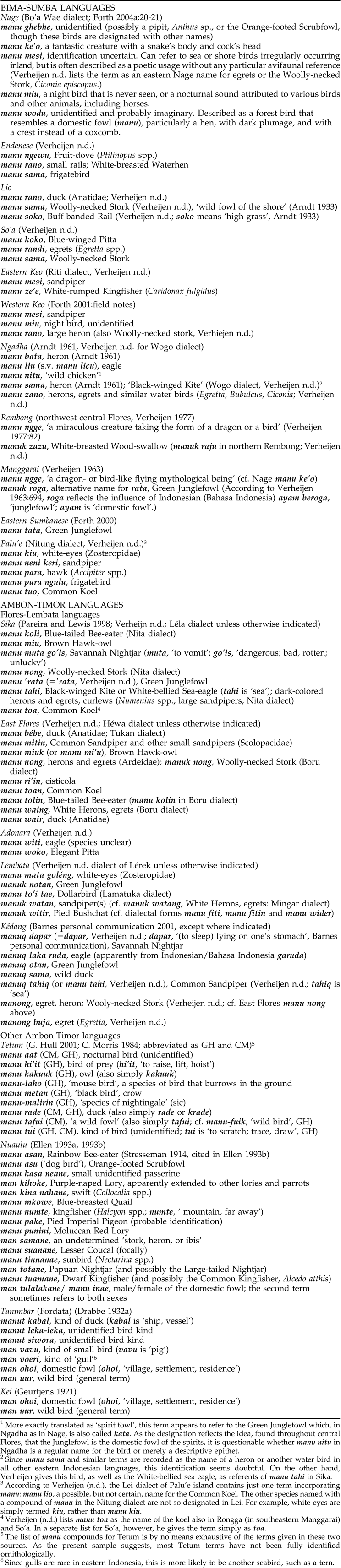
As discussed elsewhere (Forth 2004a:39), of five Nage compounds incorporating
manu
(see Table 4), at least three and probably four (
manu ke'o
,
manu mesi
,
manu miu
, and
manu wodu
) are to be understood as metaphorical usages and thus taxonomically unproductive. None of the representations to which these terms refer is associated with a particular ornithological kind. For example, Nage describe
manu ke'o
as a creature with the head of a cock (
manu
) and the body of a snake. Also, while the fifth compound,
manu ghebhe
, may refer to an empirical bird, the name is not widely known and the ornithological referent could not be identified.
I am therefore inclined to regard
manu
as it occurs in most if not all of the Nage compounds as meaning ‘domestic fowl’, but in a figurative sense.22 This interpretation cannot so readily be applied to compounds of
manu
in other languages of the Bima-Sumba group, if only because comparable ethnographic and linguistic information is not available. Nevertheless, the ornithological evidence suggests that these bird categories, or many of them, are similarly labeled with terms incorporating
manu
because, although they are not conceived taxonomically as kinds of domestic fowls, they in some way resemble domestic fowls. Birds that are morphologically similar to domestic fowls include rails, the waterhen, sandpipers, the Green Junglefowl (Gallus varius), and the Blue-winged Pitta. All are named with compounds of
manu
in one or more Bima-Sumba languages, including Endenese, Lionese, and the languages of So'a, eastern and western Keo, Ngadha, Manggarai, eastern Sumba, and Palu'e.23 The pitta, it should be noted, is a largely ground-dwelling bird whose shape closely resembles that of a young chicken. All these birds, moreover, are kinds that, like domestic fowls, are frequently encountered walking or running on the ground (or, in the case of rails, sometimes in water). Insofar as the term may designate a pipit (Anthus sp.), this characterization also applies to
manu ghebhe
, the one Nage
manu
compound that appears to designate an empirical bird. Alternatively,
manu ghebhe
could refer to the Orange-footed Scrubfowl (usually called
koko wodo
), a mostly ground-dwelling Megapode that closely resembles a chicken (Forth 2004a:20).
Also prominent among kinds named with compounds of
manu
, and partly coinciding with the series of ‘chicken-like’ birds, are several mostly large water birds or wading birds, including herons, egrets, storks, frigatebirds, and ducks. Other waders include the rails and sandpipers already accounted for on morphological grounds. In fact, the majority of the Bima-Sumba compounds (about 18 of 29, including kingfishers and wood-swallows) refer to birds associated with water, and mostly to coastal birds. Although they do not designate particular empirical kinds, the same applies to the Nage categories
manu mesi
, or ‘sea fowl’, and
manu ke'o
, a spiritually powerful creature inhabiting springs and other water sources (see also Rembong and Manggarai
manu ngge
).24
Especially in regard to coastal or riparian species physically dissimilar from domestic fowls, why birds associated with water might be named after chickens is difficult to say. Equally inexplicable is the application of compounds of
manu
to birds quite different from chickens and not typically found near water—like fruit-doves in Endenese and white-eyes in Palu'e (see Table 4). It is possible, then, that some of the Bima-Sumba compounds might yet reflect an earlier use of
manu
as a reference to birds in general. Indeed, given the proximity of some Bima-Sumba speakers (e.g., Nage, Endenese, Lionese, Palu'e) to speakers of eastern Flores languages in which
manu
is more widely employed, it would seem likely that
manu
compounds in the former partly reflect the Central Malayo-Polynesian pattern in which
manu
and cognates polysemously denote both ‘bird’ and ‘domestic fowl’. In this respect, it is noteworthy how
manu
compounds in eastern Flores (Flores-Lembata) languages refer to many of the same sorts of birds as do their Bima-Sumba counterparts (see Table 4), a classificatory overlap which furthermore reinforces the association of
manu
compounds with water birds and birds resembling chickens (such as the junglefowl and pitta). Named with compounds of
manu
in Sikanese, Kédang, and Nuaulu, nightjars (Caprimulgus spp.) also resemble fowls insofar as they roost and sleep on the ground or on very low perches. Bee-eaters, which are designated with
manu
compounds in Sikanese, East Flores, and Nuaulu, similarly nest in holes in the ground, and moreover are frequently found near water.
The tendency of cognates of
manu
to form compounds referring to ornithological folk generics is further attested in Indonesian languages belonging to the Western Malayo-Polynesian group. In Sundanese, for example, over forty such terms are recorded by Eringa (1984:491-492, s.v.
manuk
). Similarly, 25 compounds of
manuk
are listed for Madurese (Penninga and Hendriks n.d.:185-186). In both languages, the compounds specify birds of diverse kinds, while unmodified
manuk
denotes ‘bird (in general)’. As this should suggest, understanding eastern Indonesian (or Central-Malayo-Polynesian) applications of
manu
requires attention to cognates encountered in other parts of the Malayo-Polynesian-speaking world, and by the same token to hypothetical proto-terms reconstructed on the basis of these. Several linguists have recognized *
manuk
as a component of the prehistoric language named Proto-Malayo-Polynesian, which referred equally to ‘bird (in general)’ and ‘domestic fowl’ (see e.g. *
manuk
, ‘chicken, bird, fowl’, Zorc 1994:583). What is more, Bellwood, who cites Malcolm Ross as his source,25 lists *
manuk
as the term for ‘bird’ in Proto-Austronesian, the language ancestral to both the Malayo-Polynesian languages and the aboriginal Formosan languages of Taiwan, the place recognized by most historical linguists as the probable homeland of all Austronesian languages. That ‘domestic fowl’ does not occur as a further, more specific meaning of the prototerm at this more inclusive level is consistent with absence of evidence confirming the domestication of chickens on Taiwan in Proto-Austronesian times (Blust 2002:95; cf. Bellwood 1997:242).
Other students of Austronesian languages who have subscribed to an interpretation of *
manuk
as an ancient Austronesian word for ‘bird’ include Pawley (1969:7) and, more recently, Adelaar, who describes *
manuk
as ‘the common Austronesian etymon for “bird”’ (2004:50). By contrast, Blust (2002:94-95) has argued that the term did not form part of the Proto-Austronesian vocabulary at all, and has furthermore proposed a different prototerm (*
qayam
) for ‘bird’ at this level. Supporting Blust's reinterpretation is an apparent absence of reflexes of *
manuk
among Taiwanese languages. On the other hand, reflexes of *
manuk
denoting ‘bird (in general)’ do occur in all Malayo-Polynesian sub-groupings (see Table 3), thus in all sub-groupings of Austronesian languages apart from those spoken by aboriginal populations on Taiwan. Examples include Western Malayo-Polynesian languages such as Javanese, Sundanese, Madurese, Balinese, and the Sekajang and Penihing languages of Borneo, members of the Oceanic group (Hawai'ian, Samoan, Maori), and of course languages of the Central Malayo-Polynesian group. It is noteworthy, moreover, that in all the Western-Malayo-Polynesian and Oceanic languages just cited, reflexes of *
manuk
do not denote the domestic fowl, a category named with quite different terms (see Table 4). What is more, several Central Malayo-Polynesian languages (Wetan, Leti, Moa) that employ cognates of
manu
for ‘bird’ similarly use distinct terms for the domestic fowl, while among Western Malayo-Polynesian words for ‘chicken’ one finds apparent reflexes of *
qayam
, the term Blust (2002) proposes for ‘bird’ in Proto-Austronesian (see e.g., Malay
ayam
, Javanese
ajam
, Sundanese
hayam
, and Madurese
ajam
).
Yet equally widespread among Malayo-Polynesian languages are reflexes of *
manuk
that do not refer to birds in general but specifically to the domestic fowl. This pattern occurs in the Western Malayo-Polynesian group (see Table 3 in regard to Karo, Tagalog and Bontok in the Philippines, and many languages of Borneo) and, of course, among the Bima-Sumba group of Central Malayo-Polynesian. What is more, in many of these languages—including Karo, a number of languages spoken in the Sulawesi region (western Malayo-Polynesian), and also in Fijian (Oceanic; see Table 3; other examples are provided by Blust 2002:94)—the word for ‘bird’ is a reduplicated form of the word for domestic fowl (see e.g., Karo
manuk
, ‘chicken’;
manuk-manuk
, ‘bird’).
Largely on the basis of these reduplicative terms, Blust argues that Proto-Malayo-Polynesian *
manuk
referred only to the domestic bird, while ‘bird (in general)’ was labeled as *
manu-manuk
(2002:95). Not being a linguist, I shall not attempt a full evaluation of Blust's reinterpretation. It should be mentioned, however, that his argument seriously underestimates reflexes of unreduplicated *
manuk
denoting ‘bird’ as well as ‘domestic fowl’ among Central Malayo-Polynesian languages, particularly when he states that in this language group ‘reflexes of *
manuk
generally refer specifically to fowls’ (2002:94). Also noteworthy is the fact that in at least one Western-Malayo-Polynesian language where ‘bird’ is named with a reduplicative term, namely Muna (
manu-manu
), several folk generics are labeled with compounds of unreduplicated
manu
; thus
manu kaampo
denotes the ‘wild chicken’ (probably Gallus varius, the Green Junglefowl),
manu mbirita
a ‘kind of hawk’, and
manu meo
, an unidentified bird with an inauspicious cry (Van den Berg 1996; cf. Nage
manu meo
). Three other birds are named with Muna compounds incorporating
manu-manu
, thereby suggesting a contextual equivalence between the reduplicative form and unreduplicated
manu
in this language. Blust's interpretation also leaves unanswered the question of why the Proto-Austronesian term for ‘bird’, which he reconstructs as *
qayam
, came to be replaced in Proto-Malayo-Polynesian by a reduplication of a word for ‘domestic fowl’, a hypothetical change he simply characterizes as ‘unusual’ (Blust 2002:95). The interpretation further requires that *
manuk
(‘chicken’) was, equally unaccountably, replaced in a number of Western Malayo-Polynesian languages by cognates of Malay
ayam
(‘chicken’, see Table 3), and moreover, that these ‘chicken’ terms derive not from Proto-Austronesian *
qayam
, ‘bird’, as one might expect, but from a separate but identically reconstructed Proto-Malayo-Polynesian form (*
qayam
) meaning ‘domesticated animal’ (Blust 2002:90-91, cf. Adelaar 1994:13-14). Finally, it should be noted that *
manuk
(or *
manu
) has been accepted as the word for ‘bird’ in at least one proto-language subjacent to Proto-Malayo-Polynesian, namely Proto-Oceanic (Blust 2002:95; Grace 1969; Pawley 1969).
This leads naturally to the question of what happened to *
manuk
in languages belonging to the Central Malayo-Polynesian group, and how the eastern Indonesian evidence reviewed above may illuminate this problem. If *
manuk
referred specifically to the domestic fowl, as Blust argues, then its further occurrence as the word for ‘bird’ in Central Malayo-Polynesian languages, as well as in some Oceanic and Western-Malayo-Polynesian languages (see Table 3), would imply an independent extension of meaning, in more than one Malayo-Polynesian sub-grouping, to the entire life-form category. In some instances, this would further have involved a concomitant replacement of the term as the specific name of the domestic fowl. In eastern Indonesia, the extension could have occurred either at the level of Proto-Central-Malayo-Polynesian (the hypothetical ancestral language) or only in some subgrouping, such as Esser's ‘Ambon-Timor’ group. In the latter case, the limited occurrence of folk generics labeled with
manu
plus a modifier in Bima-Sumba languages (e.g., Lio
manu rano
, ‘duck’; see Table 4) might be seen as reflecting this extension in a very partial way. By contrast, if one assumes that the Central Malyo-Polynesian protoform of
manu
denoted ‘bird (in general)’, then the fact that unmodified
manu
does not designate the entire life-form taxon in Bima-Sumbanese languages could suggest a partial reversion, within the Central Malayo-Polynesian grouping, to Blust's Proto-Malayo-Polynesian *
manuk
, ‘chicken’.
On the other hand, if Proto-Malayo-Polynesian *
manuk
denoted ‘bird’ in addition to ‘chicken’, as per older interpretations, then one might assume a retention of these senses at the level of Proto-Central-Malayo-Polynesian. There would then have followed a restriction of reflexes to the exclusive sense of ‘domestic fowl’ specifically in the Bima-Sumba languages. The appearance of compounds incorporating
manu
plus a modifier for particular ornithological folk generics, particularly in languages of the Bima-Sumba group, might in that case reflect a metaphorical extension (or re-extension) of the chicken term to certain chicken-like birds, as suggested earlier. Alternatively, such compounds might be construed as remnant forms evidencing a former use of *
manuk
for ‘bird’ as well as ‘domestic fowl’ in ancestral languages (Proto-Malayo-Polynesian and Proto-Central-Malayo-Polynesian).
Evidently, Blust's interpretation provides more support for the evolutionary theories of Berlin (1992) and Brown (1984) insofar as it could imply that eastern Indonesian reflexes developed as a life-form term relatively recently, with the emergence of a particular sub-grouping of Central Malayo-Polynesian languages. More specifically, it does so in regard to Proto-Malayo-Polynesian *
manuk
(‘chicken’)—since for Proto-Austronesian Blust reconstructs a distinct ‘bird’ prototerm that was not retained as a life-form label in daughter languages. In contrast, the older interpretation of *
manuk
contradicts the evolutionary thesis, as it requires the existence of a term for the life-form ‘bird’ in the language ancestral to all Malayo-Polynesian languages, which as it were ‘devolved’ into an exclusive reference to a single folk generic. Evolutionary schema are, of course, especially challenged by those Central Malayo-Polynesian languages where ‘bird’ is labeled with a descriptive expression (e.g., Nage
ana wa ta'a co'o
) rather than a single lexeme, or where questions remain as to whether available terms unequivocally and comprehensively apply to all instances of the life-form taxon. What is more, since traditional subsistence economy and technology, the driving forces of taxonomic development in Berlin's view, are largely uniform throughout eastern Indonesia, one can hardly account for differences in this respect among Central Malayo-Polynesian speakers with reference to technological or material cultural differences.
At the same time, just because reflexes of *
manuk
(or Proto-Austronesian *
qayam
, according to Blust's interpretation) have ceased to refer to ‘bird (in general)’ in many modern Malayo-Polynesian languages, it does not follow that speakers have ceased to identify lexically a life-form category of avifauna. It is in this respect that the eastern Indonesian linguistic and ethnographic information becomes especially relevant. More particularly, the challenge to the evolutionary thesis is reduced if one accepts—as the present author is inclined to do—that any term consistently labeling a life-form, whatever its composition, is taxonomically equivalent to any other. The evidence of many modern Central Malayo-Polynesian languages suggests that *
manuk
, whatever its meaning in Proto-Malayo-Polynesian, denoted ‘bird (in general)’ in an immediately ancestral language (or Proto-Central-Malayo-Polynesian). At the same time, it seems quite certain that the Central Malayo-Polynesian prototerm referred polysemously to a particular folk generic, the domestic fowl. After the breakup of the ancestral language, reflexes in some daughter languages evidently became even more focused on the domestic bird, to the extent that a pre-existing life-form taxon was left without a sufficiently distinctive name, thus motivating speakers to develop other standard means for identifying the category of ‘bird (in general)’. Blust, of course, suggests a similar process, whereby a Proto-Austronesian term for ‘bird’ (*
qayam
in his interpretation) was not retained in this sense with the emergence of Proto-Malayo-Polynesian, so that ‘bird’ came to be designated with a reduplication of the name for a single species: *
manu-manuk
, from *
manuk
, ‘chicken’.
A development paralleling a hypothetical restriction of
manu
to the domestic fowl in some eastern Indonesian languages is discernible in the history of English, where Anglo-Saxon fugel (or fugol), ‘bird’ (cf. modern German Vogel, Dutch vogel), became restricted in modern English to the ‘fowl’, that is, the domestic bird more popularly known as the ‘chicken’. In the same process, as a reference to the entire life-form, ‘bird’ was derived from bridd, an Anglo-Saxon term denoting a young bird.26 As a reference to birds in general, the older use of ‘fowl’ barely survives in modern English, and does so mostly in compound terms designating particular kinds of wild birds—as in ‘guineafowl’ and ‘scrubfowl’—and the collective names ‘waterfowl’ and ‘wildfowl’. Although these usages might be ascribed to ‘fowl’ in a general, remnant sense of ‘bird’, it is interesting how they largely pertain to birds that in obvious respects resemble domestic fowls, in a way recalling many compounds of
manu
in eastern Indonesian languages. ‘Wildfowl’ applies chiefly to game birds, many of which, like pheasants, quails, and partridges, belong to the same ornithological family (Phasianidae) as domestic fowls. Not only are they therefore physically similar, but being hunted they are, like chickens, also eaten by Anglophones. Suggesting a rather more curious similarity to eastern Indonesian usages is modern English ‘waterfowl’, which, while also including game birds (principally, ducks and geese), recalls the occurrence of
manu
especially in eastern Indonesian compounds naming birds associated with water.









 ),
),