







Abstract
The Eastern Tukanoan of the Vaupés River region along the Colombian-Brazilian border have long used the palm Iriartea deltoidea as a durable building material. A recent study examining the linguistic roots of the local names of various palm species reveals that, in at least five languages of the Eastern Tukanoan, the contemporary name for Iriartea deltoidea suggests that it was also once a source of starch, a use not yet recorded for this species. Considering its demographic and structural characteristics, harvest of Iriartea deltoidea for starch would not be suitable for sedentary societies. We present a hypothesis that contemporary names for this palm are remnants of words from a time when the ancestors of the Eastern Tukanoan were hunter-gatherers and exploited this source of starch.
Introduction
Starch is an important source of staple food in many regions of the world, and it accounts for 20% to 50% or more of energy in those areas where the total carbohydrate intake in human diet is high (FAO 1997). In some tropical areas, the stems of palm trees (Palmae or Arecaceae) are important sources of starch (called palm sago), and at least 12 species of palms are known to produce this carbohydrate, four of them in the American tropics: Mauritia flexuosa L. f. (Heinen and Ruddle 1974), Manicaria saccifera Gaertn. (Wilbert 1976), Syagrus romanzoffiana (Cham.) Glassman, and Roystonea regia (Kunth) O. F. Cook. Of these, only Mauritia, used today by the Warao of the Orinoco delta, has any known relevant role (Gumilla 1791; Ruddle et al. 1978).
Palm starch is obtained in all cases by felling the tree, removing the outer woody layer of the stem, and exposing the interior pith. The pith is then chopped, sieved and kneaded while water is poured over it to remove the starch (Ruddle et al. 1978). Only well-developed palms that have not yet flowered are harvested for starch, as this substance is accumulated in the stem as a reserve for flowering (Tomlinson 1990). The labor-intensive process of felling large trees and splitting the stem open, as well as the destructive nature of the harvest, are probably the reasons why the most important palm starch sources (Metroxylon sagu and other species in Melanesia and southeast Asia, and Mauritia in the New World) are not species of heterogeneous, non-flooded forests. Instead, these are typically found in large stands of swampy areas unsuitable for agriculture, although they are sometimes planted on dry land (Ellen 2006). The other species play minor roles and are used only occasionally, or are often associated with hunter-gatherers (Puri 1997; Ruddle et al. 1978). However, palm starch is unknown today to some hunting-gathering peoples in the Neotropics, such as the Nukak of Colombia (Cabrera et al. 1999; Morcote et al. 1998) and the Yuquí of Bolivia (Allyn Stearman, personal communication 2005).
During recent field work among Eastern Tukanoan peoples of the Vaupés River region along the Colombian-Brazilian border, as a part of the Amerindian Palm Names Project, we recorded the names of the palm Iriartea deltoidea Ruiz & Pav. in several Eastern Tukanoan languages. Here we hypothesize that these names suggest the pre-agricultural use of this palm as a starch source.
The Eastern Tukanoan Names of Iriartea Deltoidea
The Eastern Tukanoans belong to a linguistic family comprising 13 to 15 languages (Fabre 2006; SIL International 2005), distributed along the Vaupés River and its tributaries in Brazil and Colombia. Eastern Tukanoan-speaking communities subsist mostly on fishing, hunting, and slash-and-burn agriculture, and they use many forest products, including approximately 20 species of palms (Bernal et al., unpublished data; Borrero Wanana and Pérez Correa 2004). One of these palms is Iriartea deltoidea, a species that is remarkable throughout its range (central and northern South America and eastern Mesoamerica) in three aspects: its extremely hard wood; the prominent and abrupt swelling of its stem near the middle (Figure 1a); and its tall cone of stilt roots (Figure 1b) (Henderson 1990; Henderson et al. 1995). Despite these outstanding characteristics, the name for this palm in at least five languages of the Eastern Tukanoan family (Piratapuyo, Siriano, Tukano, Tuyuka, and Wanano; Table 1) alludes to another, currently obscure feature: the presence of starch.
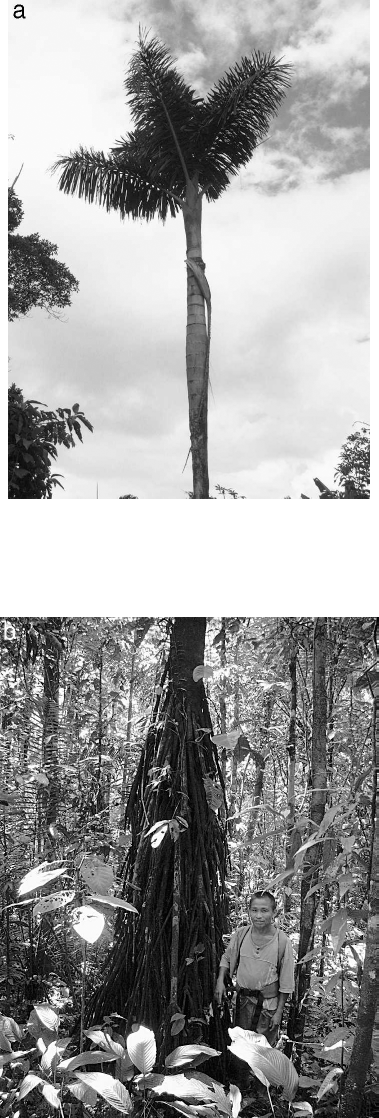
Iriartea deltoidea . a.) Habit. Note stem swelling; b.) Cone of stilt roots. Photographs by R. Bernal.
Names for Iriartea deltoidea in some Eastern Tukanoan languages.

The Tukano and Wanano names for Iriartea deltoidea,
// starch-big-palm // 1
The roots {
Thus, the Tukano and Wanano names for Iriartea deltoidea could be freely translated as “palm rich in starch,” but in languages of this same family it is shortened to “starch palm” (
Sedentism and Contemporary Use of Iriartea Deltoidea
Why should a palm that is used today primarily for its hard wood be named for starch? We have found no direct reference to the use of Iriartea deltoidea, either past or present, as a source of starch (Anderson 2004; Balick and Beck 1990; Borchsenius et al. 1998; Borrero Wanana and Pérez Correa 2004; Henderson 1990, 1995; Henderson et al. 1995; Kahn 1997; Koch-Grünberg, 1909-1910; Martius 1823-1850; Morcote et al. 1998; Ruddle et al. 1978), although the occurrence of starch in its stem would come as no surprise. Stem swelling in palms has been associated with an accumulation of reserve material for the onset of flowering (Beccari 1913; Tomlinson 1990), and the first inflorescences of Iriartea deltoidea do appear just above the swelling (Henderson 1990; Svenning and Balslev 1997). The swelling of Iriartea palms that are about to reach flowering age is probably rich in starch.
Despite the potential usefulness of Iriartea deltoidea as a starch source, there are good reasons why starch extraction from this species would be an activity more suited to hunter-gatherers rather than to sedentary people. First, the wood of Iriartea is extremely hard and it is therefore a very useful building material, easily converted into planks by splitting. Today it is one of the preferred materials for house floors throughout its range (Henderson 1990). Thus, cutting the palm primarily for starch would be not only a labor-intensive task, it would also be an expensive trade-off for building material for a sedentary people. Second, Iriartea has a slow growth, requiring about 55 years to reach the age when it produces the swelling and would be ready to be harvested for starch (Pinard 1993; Svenning and Balslev 1997). In addition, the optimal stage for starch harvesting is also the most sensitive (Pinard 1993). Felling pre-reproductive palms has a higher impact on Iriartea population structure than removing individuals of any other age, as they represent plants that have spent a long growing period but have not yet produced any fruits. Third, although Iriartea is a common palm, it does not form homogeneous stands in the lowlands, and recorded densities do not surpass 63–95 individuals per hectare in western Amazonia, less than one half of them with the appropriate size for starch harvest (Pinard 1993; Svenning and Balslev 1997). This density decreases toward the east (Henderson 1990) and is probably much lower in the Vaupés. Thus, starch extraction from Iriartea by a sedentary community would deplete the wild populations in just a few decades. Finally, the amount of starch obtained from a stem of Iriartea, probably approximately 40 kg (estimated from figures for Mauritia flexuosa; Ruddle et al. 1978) would make it uninteresting for people who have already acquired the cultivation of manioc (Manihot esculenta Crantz). Ruddle et al. (1978) have shown that the person-hours required to produce 1000 kcal are about 14% lower for manioc grown in swidden than for palm starch extracted from Metroxylon, and have documented the reduction of Metroxylon sago use in Thailand after the introduction of manioc. Considering that stems of Iriartea deltoidea are much harder than those of Metroxylon and about half as slender (except at the swelling), the difference in sago extraction efficiency between Iriartea and manioc must be even greater, and would therefore make the palm unattractive for people who are familiar with manioc.
Discussion
Starch extraction from Iriartea deltoidea among sedentary Eastern Tukanoan peoples growing manioc must have been only an occasional activity carried out during hunting expeditions or long journeys, or when manioc failed. It is unlikely that such occasional use would have independently given rise to the name for this palm alluding to starch in at least five languages of the family, particularly since any sedentary society would have already used this palm for its wood.
A more plausible explanation is that the name originates from a period when the Eastern Tukanoans were still hunter-gatherers. According to Reichel-Dolmatoff (1997), the Desana, another Eastern Tukanoan people, proudly recognize themselves as descendants from hunter-gatherers and harvesters of palm starch, a resource reported as important in the past in the Vaupés-Guainía area, and virtually forgotten today. Starch was obtained especially from Mauritia flexuosa, but other species were apparently used, although they were not identified by Reichel-Dolmatoff (1997). However, the linguistic evidence points to Iriartea deltoidea as a source, a hypothesis supported also by the fact that Iriartea and Mauritia grow in different habitats (Henderson et al. 1995), which would guarantee availability of the resource to the human groups throughout their ranges.
The past extraction of starch from the swollen stem of Iriartea would also explain the deep symbolic association of this palm with fertility among the Tukanoan people, as starch is usually compared to human sperm (Reichel-Dolmatoff 1996). This author cites the name of the palm in Tukano as
The antiquity of this association of Iriartea deltoidea with starch is supported by the apparently frozen nature of the name of Iriartea in Wanano, which would date back at least to the divergence time of 4500 years BP hypothesized by Swadesh (1959) for the Tukanoan languages. Because manioc was already present in the Colombian Amazon by at least 5000 BP (Piperno and Pearsall 1998), then the origins of Eastern Tukanoan names for Iriartea deltoidea probably date back to at least five millennia. The development of agriculture, particularly the cultivation of manioc, probably played a role in the abandonment of Iriartea as a starch source and led to the eventual loss of this use, leaving only the name as hidden evidence.
Footnotes
Acknowledgments
We thank Milciades Borrero for his friendship and valuable help; Luis Fernando Jaramillo and other personnel of CDA in Mitú for their logistic help and fruitful discussion; Adriana Alzate, María Noemí Uribe, Sister Clarisa (Javareté, Brazil), Graciliano Lima, Avelino González, and Gustavo Trinidad (Río Vaupés) for their company in the field and/or their information on their respective languages and palms; and Elsa Gómez-Imbert and Kris Stenzel, for discussion on Tukanoan linguistics; and Allyn Stearman, Gaspar Morcote, Kris Stenzel, and two anonymous reviewers for critically reading the manuscript and providing valuable ideas and references.
1
The writing of names varies according to the sources. For the sake of simplicity, our own data are here transcribed in approximate orthographic writing. The voiced palatal in a nasal syllable is transcribed as ñ or ny; the glottal fricative (non-phonemic) is omitted or transcribed as j or h; and the initial, semivocalic sound as w, v or b. In all cases there is no difference in sound between these symbols. Main stress is omitted or marked on the stressed vowel. See Gómez-Imbert (2000) for phonology of some Tukanoan languages, and Stenzel (2004) for Wanano.