







Abstract
This research explores continuity and change in foraging patterns over time by comparing data from ancient, historic, and contemporary time periods for the Makah Indians, a Pacific Northwest coast tribe. Zooarchaeological evidence from the late-prehistoric Ozette village middens is compared to quantitative data from a foraging harvest survey conducted with contemporary tribal members. The intervening historic-period foraging pattern is interpreted from ethnographic accounts. The data indicate both continuity and change. A comparison by resource type shows that 56% of faunal resources found in the Ozette middens continue to be used today, with the use of 87% of fish taxa and 84% of shellfish taxa continuing through the 500+ year period. Resources which are no longer used and resources which appear to be newly exploited are reviewed and explained in terms of historical ecology or methodological factors. Relative contribution to the diet by resource category (fish, shellfish, terrestrial mammals, marine mammals, birds, and commercial meats) is compared between circa 1500 and 1998. The data provide a perspective of greater time depth for contextualizing contemporary subsistence issues such as whaling, and help explain changes in productive practices since colonial contact as effects of long-term processes influenced by ecological and historical factors.
Introduction
The difference in foraging patterns between late pre-contact Native American societies and their contemporary tribal successors is often assumed to be very great. However, concrete data supporting or challenging this assumption is difficult to obtain because data generated by archaeologists studying the past and data generated by cultural anthropologists studying the present are often not easily comparable. In this article, I confront this issue for the Pacific Northwest coast by comparing contemporary data, derived from a harvest survey conducted in person with Makah tribal members in 1998, to the large body of pre-contact faunal data from the archaeological excavations at Ozette – a late-prehistoric Makah village. Despite structural differences in the data sets, occurrence analysis and relative contribution comparisons were possible. These methods enable us to consider explanations for change over time in Makah foraging practices, particularly change over the era of tremendous political, demographic, and cultural transitions that separate contemporary Makahs from their pre-colonial past.
The study of foraging patterns has been a pillar of both cultural ecology (Netting 1977; Steward 1955) and human evolutionary ecology (Winterhalder and Smith 1981). In these approaches to explaining the variety of human behavior, cultural patterns are tied quite closely to environmental conditions. In the research and results set out below, I borrow to some extent from both of these schools of thought, looking first to environmental conditions to explain foraging practices. The range of explanations include a very basic environmental possibilism, in which the extirpation of a species from the regional environment sufficiently explains its withdrawal from the local diet, and a more dynamic optimal foraging theory, in which the prey items most likely to be withdrawn from the local diet are those with the lowest ranked caloric returns. Through these processes and others, the shape of the cultural world maps on to that of the natural world.
With anthropogenic environmental change abounding during the study period, historical ecology provides some of the most satisfying explanations of change. In this case, I look beyond the kind of historical ecology employed by biologists to determine environmental reference conditions, trends, and the historic range of variability in an ecosystem (Sepez 2005; Egan and Howell 2001; Swetnam et al. 1999). Social scientists' applications of historical ecology take a diachronic approach to analyzing a dialectic between humans and the environment (Balée 1998; Crumley 1994). In the case examined here, the most overwhelming historical factor influencing the change between the pre-colonial and modern periods is the expansion of global economic interests and the American nation-state into the Northwest Coast. Almost all of the environmental change that has affected modern Makah foraging patterns is ultimately anthropogenic in origin. The natural world maps back to human societies.
Acknowledging what Crumley (1994:4) calls, “the historicity of environmental change,” historical ecology challenges us to look not at nature, but at landscapes, where landscapes are environments at a human scale, filtered through human ideas, and shaped by human actions. Given the maritime orientation of the Makah, I have elsewhere (Sepez 2001) suggested revising the terrestrial bias of landscape language with the term “ecoscape.” In the modern Makah ecoscape, foraging practices are sustained (or not) in a historically-particular nexus of ecological and social factors in which Makah individuals make contemporary choices.
Recently, the tribe received worldwide media attention for resuming subsistence whale hunting. Whales were once the most important single resource for Makahs, and their reputation as superior whale hunters was recognized up and down the coast. Makah hunters stopped whaling in the 1920s due to the depletion of whale stocks by Euroamerican commercial whaling operations along the West Coast. When the California gray whale recovered to healthy populations in the Eastern North Pacific and was removed from the endangered species list in 1994, the tribe began controversial preparations to resume whale hunting, culminating in the successful take of a single gray whale in May of 1999. No further whaling took place for eight years, while legal processes (litigation and regulatory procedures) proceeded. Although these processes have not yet concluded, in September 2007, Makah whale hunters killed another gray whale.
This background is important to situating Makahs in terms of the contemporary debate about aboriginal whaling and indigenous resource rights (Sepez 2002). The whaling revival formed an important motivation for the original research, which sought to examine the wider contemporary subsistence context that had often been overlooked (Sepez-Aradanas and Tweedie 1999). Whales are just one of many local wild resources important to Makahs. The comparison with the Ozette data provides additional context for contemporary subsistence by allowing a perspective of longer time depth. From this perspective, continuity and change – especially change across the massive sociopolitical and demographic upheaval between the pre-colonial and modern eras – can be seen as effects of long-term processes influenced by ecological and historical factors.
Methods
Study Site
The Makah Reservation comprises a portion of the tribe's traditional territory, located on the Olympic Peninsula in Washington State (Figure 1). Makahs are part of the Nootkan culture grouping, related most closely to the Nuu-chah-nulth bands of Vancouver Island, Canada. Despite the international border separating Makahs from their closest relatives, the linguistic, cultural, and genealogical ties are still quite strong. There are about 2,200 enrolled members of the tribe, about 1,300 of whom live on the reservation.
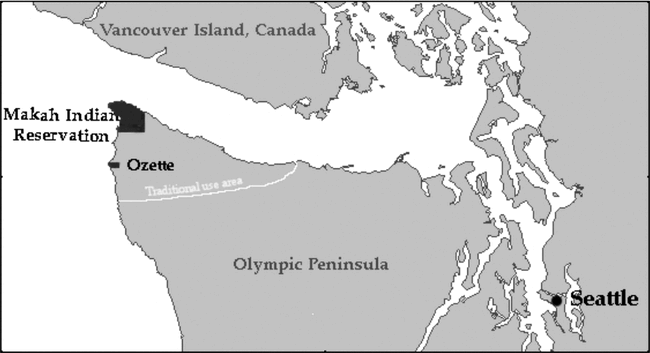
Location of the Makah Reservation and the Ozette village site.
The Makah are one of the Pacific Northwest coast tribes, notable for complex and sedentary hunting and gathering societies with intensely hierarchical social relations. They lived formerly in five permanent coastal villages – of which Ozette was one. The Makah village of Ozette was partially buried in a mudslide around 1500 AD and was the site of extensive excavations in the 1970's (Pascua 1991; Samuels 1994). The five villages have since become concentrated into a single settlement at Neah Bay. Makahs differed from their Salish neighbors by having a strong off-shore marine orientation within which marine mammals, such as whales and seals, and marine fishes, such as halibut, were more important than the salmon for which the Northwest coast is renowned.
Pre-Existing Data
Human occupation in the region goes back 9,000–11,000 years (Ames and Maschner 1999), with the deepest deposits at Ozette indicating approximately 2,000 years of continuous occupation. The main focus of the faunal analyses at the Ozette site were strata from the protohistoric era, dated at 440 ± 90 years B.P. (Huelsbeck 1994a). The data used to represent the foraging practices of the ancient (or pre-colonial) period consist of published analyses from this excavation including mammals and fish (Huelsbeck 1994a), shellfish (Wesson 1994), birds (DePuydt 1994), and whales (Huelsbeck 1994b).
The excavations at Ozette used shovel and trowel sorting, water washing, and water screening to collect abundant, well-preserved bones, shells, teeth and other materials which were examined by faunal archaeologists (Samuels 1994). Taxonomic identifications were made to the most precise level of taxon feasible (often the species level). Quantification included element frequency or number of identified specimens (NISP) and minimum number of individuals (MNI). MNI was calculated using the most common unique element identified from each taxon to represent the minimum number of individuals from which there were remains. Estimates of the edible yield were used to calculate relative contribution to the diet. Huelsbeck (1994b) uses live meat weight estimates multiplied by the average of the MNI and percent total bones.
Additional information is taken from James G. Swan's reports in the 1860's. Swan was a reservation school teacher and amateur anthropologist whose ethnography of Makahs (Swan 1870) contains information about subsistence practices he observed at that time. Swan is not particularly precise in the terminology he uses, nor is he comprehensive in his coverage. Many of the species for which his work serves as evidence of use are not discussed in the food chapters, but are mentioned by Swan in the discussion of other topics. Thus, a careful reading of Swan yields a general picture of early post-contact (or historic) foraging patterns.
Other ethnographic sources from the early historic period are available and are cited in the text where relevant. None are as comprehensive as Swan. Many of these were summarized in expert testimony (e.g., Thompson 1994; Renker 1993) given during litigation over treaty shellfishing rights (US v. Washington 873 F. Supp. 1422 [W.D. Wa., 1994]). Ethnographic and ethnohistoric sources have often been used very successfully to illuminate faunal archaeological evidence (e.g., Moss 1993), though these generally do not focus on systematic comparison between harvest survey data and comparable archaeological data for a full spectrum of marine and terrestrial animals.
Original Data Collected
Contemporary subsistence harvest data were derived from a survey conducted by the author and tribal research assistants in reservation households in the autumn of 1998, and described fully in Sepez (2001). The survey quantified harvesting for a one-year-period, from the fall of 1997 through the summer of 1998. The data were supplemented by ethnographic research on additional activities between 1997 and 1999. In the survey, subsistence is defined as local wild resource harvest for local consumption. This is a typical construal of the term in US law and wildlife management. In this sense, subsistence harvests, foods, and uses are contrasted with commercial harvests, foods, and markets.
Rather than focus solely on expert hunters, the focus was on the community as a whole, thus including non-harvesters, occasional harvesters, and others. To this end, the survey was conducted with a random sample of 15% of Makah Reservation households, following strict enumeration and random selection criteria. Participation refusal rates (including households with whom initial contact was never established and those with missed appointments) were less than 10%. The random sampling allows the survey results to stand in as representative of the practices of the tribe. The overall results showed similar patterns to those revealed in an unpublished household fishing survey conducted by the Makah Cultural and Research Center ten years earlier (Renker 2002).
The surveys were implemented using a harvest survey form similar to those employed by the Alaska Department of Fish and Game (Fall 1990). The author, along with a tribal research assistant, appeared at each survey household to administer the survey in person and record answers on the form. Respondents used retrospective recall to estimate the household's harvest for each type of resource in a category over a one-year period. Additional questions included estimates of resource amounts shared with other households, demographic and economic questions, opinion questions, and an open-ended opportunity for comment of the respondent's choice. The surveys took from 45 minutes to several hours to complete. Copies of the completed survey forms are archived at the Makah Cultural and Research Center.
Analytical Approaches
Although the differences between these data sets present a significant challenge, the similarities present a greater temptation. Each data set represents an attempt to characterize foraging patterns by species, while the two primary data sets – Ozette from the 1500's and the survey from 1998 – also attempt quantitative analyses. Preliminary comparisons were made using a basic occurrence analysis. This test simply examines and compares whether a particular taxon was present or absent in the Ozette data, the ethnographic data, and the modern survey data. Inferences about change over time may be drawn from the results.
The occurrence analysis is simplistic because quantity and other factors are not taken into account. Even if there is only one bone or only one household reporting contemporary harvest, that species is weighted equally with the staple foods as a component of the subsistence diet. This method also does not take into account many of the finer points of how the remains of any particular species might be represented in the middens at Ozette, or why the remains of a species that was in fact used by pre-contact Makahs may have been absent from the Ozette assemblage. Taphonomy, recovery, and processing issues are all concerns that affect the faunal data, as recall and veracity affect the survey data. These issues are examined further in the Discussion section in the context of specific resources.
Comparative quantitative analysis presented the biggest challenge because the survey data are quantified differently from the Ozette data. The survey represents just one year's use and is broken down into pounds per capita, where the Ozette data combines many years of accumulation for large extended-family longhouses. Additionally, different authors adopted varying analytical and presentation techniques for different portions of the Ozette assemblage and so there is a lack of uniformity between resource categories within this data set. To effect the quantitative comparison, the relative abundance of resources calculated for the Ozette data set (Huelsbeck 1994b) was compared to the relative abundance of resources calculated in the survey (Sepez 2001). An inference about the relative contribution of commercial meats to the modern diet was made by comparing the survey results to expected total consumption, using the formula: a − b = c, where a = expected total consumption of animal protein based on FDA estimates, b = total subsistence consumption extrapolated from survey results, and c = inferred commercial consumption.
Despite these challenges, the comparison of Makah foraging patterns through these data reveals some remarkable consistencies over time – remarkable given the other changes occurring in Makah society. The comparison also indicates the resource categories and particular species in which major changes in use patterns have been concentrated, allowing us to consider how these changes might be explained.
Results
Results of the 1998 harvest survey indicated significant resource use in each of the categories (fish, shellfish, marine mammals, terrestrial mammals, and birds), totaling 73 kilograms (162 pounds) annual per capita consumption (excluding fish and bird eggs 1 ) – or approximately 59–71% of all meat in the contemporary diet depending on estimation method (Sepez 2001). Although use was distributed differently among households – some families relied almost exclusively on locally harvested non-commercial items and others used them only sparingly – almost all households (99%) participated in local wild harvest activities in some manner (Sepez 2001). While there must be some variation in harvests year-to-year, respondents reported regarding the survey year as fairly typical.
Tables 1–4 compare the resources identified from the Ozette middens with those for which use was reported in the 1998 survey using the occurrence test. Each column presents a static representation of a particular time period; together they show change over time. Though simple, the occurrence comparison is a productive way to examine continuity and change between pre- and post-colonial times. Tables 1–4 reveal a significant amount of continuity in terms of the taxa harvested, despite the otherwise radical changes over this 500+ year period. This continuity is especially pronounced in the fish and shellfish categories, with 88% (14/16) and 84% (21/25) of Ozette resources still harvested, compared to 45% or less in the other categories. Combining all categories, 50 of 90 resource types used at Ozette are still in use today, for an overall continuity of 56% by this method. However, this measurement of continuity is sensitive to the way species have been aggregated to form categories. Such aggregations were necessary either because of the way remains were classified in the Ozette data, or the way that questions were presented in the 1998 survey. Some highly aggregated groups represent dozens of species, such as rockfish and “other small gastropods”. Other categories have a one-to-one relationship with the corresponding species level classification, such as razor clam (Siliqua patula Dixon). Despite this aggregation issue, the continuity of resource usage is clearly substantial.
Fish found in Ozette middens compared to those recorded in the 1998 survey.

Shellfish found in Ozette middens compared to those recorded in the 1998 survey.

Mammals found in Ozette middens compared to those recorded in the 1998 survey.

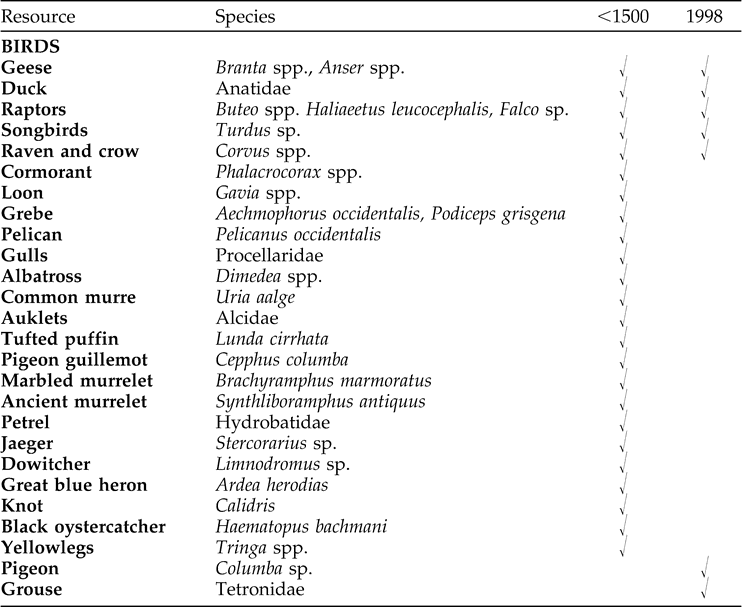
Birds found in Ozette middens compared to those recorded in the 1998 survey.
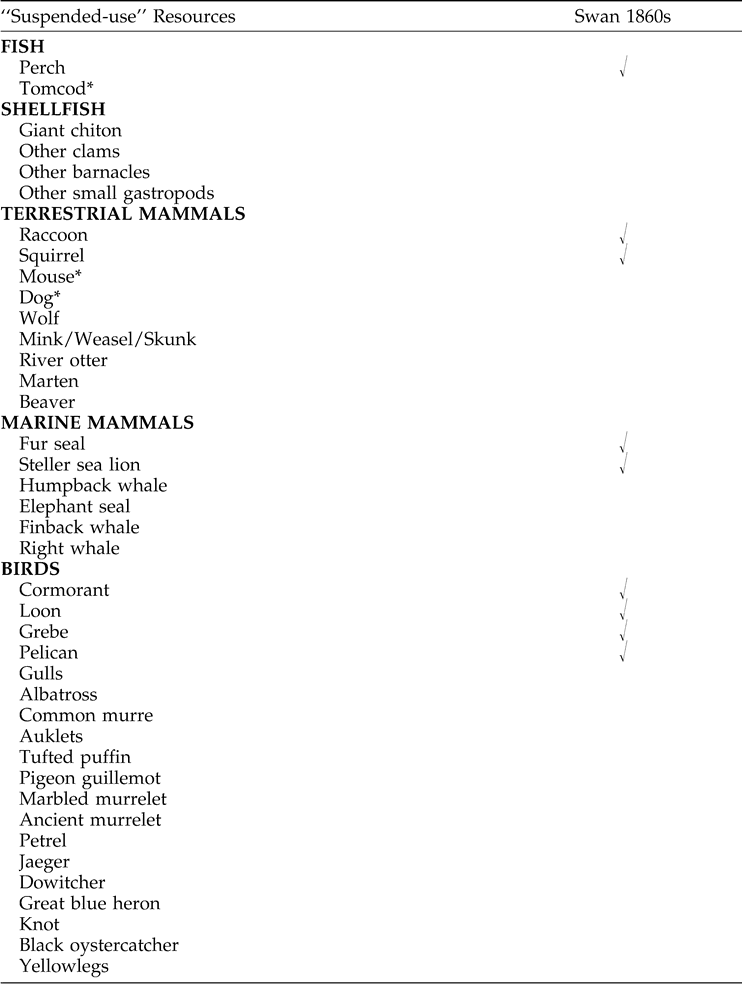
Suspended-Use Resources
Table 5 isolates the list of resources which were found at Ozette, but did not occur in the survey. The second column notes whether the resource was mentioned by Swan in his 1870 ethnography. For example, it has been suggested that seabirds were taken mostly for their feathers, but we know from Swan that in fact Makah people ate a variety of seabirds, including “pelicans, loons, cormorants, ducks of various kinds, grebes, and divers of various sorts. These, after being picked, and very superficially cleaned, are thrown promiscuously into a kettle, boiled and served up as a feast” (Swan 1870:25). He describes (1870:25) how these sea birds were hunted by spear after attracting them to a fire built on a special platform in a canoe. Nine of the suspended-use resources are mentioned by Swan, confirming that they were still in use at that time. Because Swan was not comprehensive or methodically rigorous in his approach, the absence of a mention by him cannot be taken as compelling evidence of non-use during that time period.
Resources found at Ozette but not recorded in the 1998 survey, compared to Swan (1870). *see qualifying discussion below.
Apparently New Resources
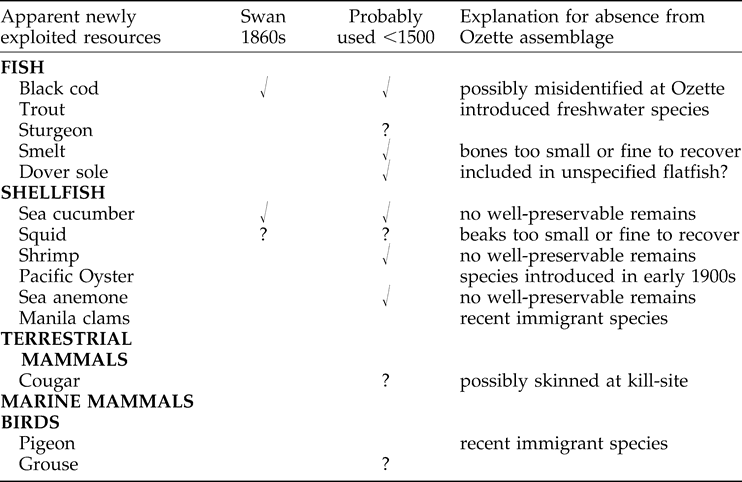
Table 6 displays those resources which appeared on the survey, but are not found at Ozette, and thus appear to be newly exploited. In fact, as with Table 5, a number of these do not actually belong on the list but are resources for which some aspect of the methodology misrepresents past or present practices. These are indicated in the column “Probably used <1500” with an explanation of the taphonomic, recovery, or processing issues that may have lead to their absence from the identified Ozette assemblage. They are examined in more detail in the Discussion section below
Resources recorded in the 1998 survey, but not found at Ozette.
Quantitative Comparison
Changes in the relative contribution of different resources categories over time can be seen in Figure 2, which compares quantitative data from the past and the present. The front row is based on the 1998 survey data. The back row is calculated by Huelsbeck (1994b) from Ozette data. The substantial decrease in marine mammal hunting due to commercial depletions is clearly evident, with resulting increases taking place in the fish, land mammals, and commercial meats. Neither row includes fish eggs or bird eggs.

Pre-1500 and 1998 foraging patterns compared.
Discussion
The level of continuity in Makah resource use over time stands as evidence against the assimilation assumption, which is the idea that overt signs of modernity in a tribal society – such as pickup trucks and satellite TV – are incompatible with traditional subsistence activities. An important factor promoting continued exploitation of traditional resources in this particular case is that Makahs have actually maintained a high level of control over their land and resources during the period under discussion. No doubt many Makah tribal members would argue with that characterization, being acutely aware of their history of struggle and loss, which parallels that of many western tribes. However, in comparison to many other indigenous groups around the world, their resource tenure has been relatively secure. They remain in the same place, on a portion of their former territory that includes four of the five traditional village sites, and they have legally-recognized rights to harvest fish and shellfish in a territory larger than the reservation, known from treaty language as their “usual and accustomed” area.
On the other hand, there is enough malleability in the possible interpretations of these data to support a number of different conclusions. There has been an unmistakable contraction of the diet breadth, particularly noticeable in the use of marine mammals (Etnier and Sepez in press) and bird species. Though many resources remain part of the subsistence array, those that are no longer harvested present an interesting explanatory challenge. Why are these particular resources abandoned and not others?
Suspended-Use Resources
I use the term “suspended-use” to convey the idea that these resources might be harvested again at some time in the future. This wording reflects the fact that Makah practices are enacted in political and ecological contexts that can and do change. The U.S. courts have established that Indian treaty rights to hunt and fish are not extinguished by laches, laches being a type of delay in asserting a claim and includes lack of use (Swim v. Berglund, 696 F. 2d. 712 [9th Cir. 1983]). In other words, the right remains a right, whether acted upon or not. Current non-use does not indicate preclusion of future use, either legally or culturally.
A perfect example of this is from a resource not on the suspended-use list. Gray whale use reported in the survey related to meat harvested from a whale taken incidental to local fisheries. The survey was completed several months before the resumption of whale hunting in 1999. During much of the past 75 years, gray whales would have been listed as a suspend-use resource. The last Makah whale hunt took place in 1926. However, the inference that this was the last Makah use of gray whale meat and blubber is incorrect. The real picture is more complicated than that. Evidence of limited continued use of beached whales in the intervening periods includes tribal members' reminiscences of eating whale meat during the Depression, and anecdotes from the 1980s of tribal members attempting to scavenge meat and blubber from beached whale carcasses that were being guarded by federal agents (Sepez 2001). It is likely there were decades during which no whale products were used, punctuated by intermittent opportunistic usage.
The list of suspended-use resources in Table 5 contains entries in every resource category, reflecting broad-based change in foraging practices. However, not every resource appearing on the list indicates dietary change. The list must first be culled of unintended artifacts of methodological processes. These include resources that left remains but were not actually part of the diet, and resources that were not sufficiently identified in the survey. Specifically, mouse, dog, and probably tomcod falsely indicate a change in usage and should be discounted from the suspended-use list for the following reasons.
In the survey, the local term “true cod” was considered to equate with the species Gadus macrocephalus Telesius, the Pacific cod, or grey cod. However, in hindsight, it appears that Microgadus proximus Girard, the Pacific tomcod, may also have been part of the local folk category called “true cod.” Both M. proximus and G. macrocephalus are gadids. The survey did not contain a separate category for M. proximus, (although there was a category for “other fish, unspecified”) and thus it appears in Table 5, probably incorrectly.
Mice are a prime example of the difficulty involved in meshing two disparate data sets. As pests, mice today are killed in traps, but this was not considered a subsistence harvest and so these mice were not included in the survey. We do not know whether the five mouse bones found at Ozette reflect some consumptive use, or if they were – as I suspect – just house pests (or rather, longhouse pests) as they are today.
Dogs have a similar, though more complicated story. Dogs occur in the Ozette fauna and they are still an important part of life for some Makah families. The ethnographic and archaeological evidence indicates that they were not a food source (Drucker 1951; Huelsbeck 1994a). However, there was in fact a consumptive use for dogs at Ozette. Dog hair was a key Makah textile material from which weavers made blankets that were well-known among other tribes in the region (Huelsbeck 1994a; Swan 1870). Makahs and Coast Salish peoples kept a special breed of dog just for their “wool” (Crockford 1997). I found no evidence for an equivalent non-lethal consumptive or commercial use in the contemporary society. Thus the appearance of Canis familiaris L. in Table 2 does not reflect a change in the foraging pattern.
The remaining resources on the suspended–use list range from weasels to whales. This diversity presents a challenge in explaining why these resources dropped out of subsistence usage while others stayed in. There is no obvious or general answer, as if all the very small items had been withdrawn, or only those which are present at a certain time of year. The suspended-use resources are both large and small, summer and winter, marine and terrestrial. In order to explain the changes, it is necessary to turn to a variety of considerations, including ecological, political and cultural factors. I will give examples of each.
Ecological explanations account for the discontinued use of species that are no longer found in the area. This is a manifestation of environmental possibilism, characterizable as: if they're not there, you can't catch them. Wolves are the most obvious of these. They have not been found on the Olympic Peninsula since 1920, when they were extirpated by early Euroamerican settlers through hunting, trapping, and poisoning (U.S. Fish and Wildlife Service 1999).
Many of the marine mammals are also explained primarily by ecological factors (Etnier and Sepez in press), particularly the finback whale and the right whale (also referred to as the fin whale and the North Pacific right whale). Both species remain endangered (Angliss and Lodge 2002), with few encouraging signs of population recovery. Fur seals also fall into this category, having populations that fluctuated significantly during the last century (Etnier 2002), and are currently designated as depleted under the Marine Mammal Protection Act (Angliss and Lodge 2002). But even during times of population recovery, fur seals never recolonized the near shore areas where Makahs formerly hunted them (Colson 1953; Etnier 2002; Sepez 2001; Swan 1870). In fact, it has been suggested that the near shore fur seals of Cape Flattery were a subspecies or even a separate species that is now extinct (Crockford et al. 2002). Swan (1883, analyzed in Crockford et al. 2002) provides detailed evidence that the Cape Flattery fur seal had different behavioral (non-migratory, birthing at sea) and physical (longer fur) characteristics than Northern fur seal as it is known today. Today, fur seals remain far off shore in their migration path, making them effectively absent from the harvest area, whether by species extinction or altered migration routes. Elephant seal populations have rebounded from near extinction (Caretta et al. 2004), but they were probably always infrequent visitors to this area, reflected in their scarce occurrence in the Ozette fauna.
However, these ecological changes are only the proximate cause of change in Makah subsistence. All of these extirpations were specific effects of Russian, European, and American over-harvesting of marine mammal populations for commercial trade purposes including the commodities of fur, oil, and meat. Of these enterprises, Makahs are known to have participated in pelagic fur seal hunting for commercial purposes, first as hired hunters and later as vessel owners. Absence (or local scarcity) of a species is a necessary part of the explanation for the change in Makah foraging patterns, but it is insufficient without reference to anthropogenic causes based on the history of the fur trade and the commercial whaling industry as manifested in Makah maritime hunting grounds.
While history and ecology explain a good deal of the changes, some changes in the foraging pattern are best understood in terms of contemporary political factors. For example, the bird species listed in Table 5 are all protected by the Migratory Bird Species Act, although many of them do not have depleted or even depressed populations (and some are not even migratory, although they are still covered by the Act). Certainly cormorants, gulls, murres, puffins, guillemots, and a number of shorebirds are common in the area today. Their absence from contemporary Makah foraging patterns is more likely a result of their political unavailability (i.e., by law) than their ecological unavailability. It is also possible that the survey data contain a reporting bias against protected species, but there was no ethnographic evidence to suggest this.
Humpback whales must also be understood in political context. The humpback whale population in the North Pacific has increased substantially in recent times (Caretta et al. 2004), but has not yet been delisted from the endangered species list. Now that they are more plentiful, individual Makahs talk about wanting to go humpback hunting; they are said to be easier to hunt and tastier than gray whales. However, the Tribe has said that it will not authorize a hunt for humpbacks until after the species is officially delisted. Such abstinence is more political than ecological.
But once again, it makes more sense to understand these political positions in their historical context. Protection measures for both birds and whales came about in a context of early 20th century concern over depletion of their populations. The protection measures represent further expansion of the American state and international regimes in the ecoscape through conservation mechanisms (Vaccaro 2005). Indigenous communities are often characterized by their asymmetric power relations with nation-states (Dyck 1985), and Makah responses to legal protections for both birds and whales are embedded in the history of that relationship. Thus the official representative body of the Tribe will not endorse pursuit of illegal prey, but individuals who discuss it, often younger men who spend a lot of time on the water fishing, are responding to resource availability in the ecosystem and situating themselves in positions of resistance to both local and national authorities.
Another type of explanation for suspended use involves optimal foraging theory, specifically resource ranking by post-encounter caloric return rate (Smith 1991). Low ranked resources, which include many of the small gastropods and small mammals, have been dropped from the diet due to cultural changes such as the availability of store foods. In the language of foraging theory (Kelly 1995), this indicates contraction of the diet breadth in response to increased abundance of higher ranked foods. Some of this may be driven by economics, i.e., that it is cheaper to buy similar replacement foods than to harvest them. However, some studies have shown that subsistence foods may still be taken even when the harvest costs outweigh the market price, indicating a non-market cultural value in the subsistence process (Dahl 1989; Johnson et al. 1997; Veltre and Veltre 1983). An important side note to this approach is that some presumably low-ranked species with a high cultural value (olive shells for example) are still taken today – but all of these are primarily for decorative uses. They are not eaten today and may have been primarily a decorative resource for Makahs in the past as well.
Of the resources in Table 5 that represent actual change, most can be explained by cultural and political responses to ecological and historical factors. Since these factors are not static, local foraging patterns can be expected to change again under the right conditions. For example, ESA delisting may occur for humpback whales sometime in the next decade. At that time, humpback whales are likely to return to active-use status. However, as the humpback population increase is observable to tribal members, individual Makah resource users may find it difficult to wait for the political process which necessarily lags behind the ecological process.
Apparently New Resources
Some resources included in Table 6 may not represent actual new resources in the diet due to taphonomic, recovery, or processing issues that may have lead to their absence from the identified Ozette assemblage. Specifically, sea cucumbers, sea anemones and shrimp leave no hard or readily preservable remains. While they were almost certainly in use at Ozette, they would not be detectable in the middens. Swan discusses sea cucumbers as “sea slugs” (1870:24) and ethnobiologist Erna Gunther records in her field notes from the 1930's that sea cucumbers and sea anemones were used by Makahs, although she indicates shrimp were not (Thompson 1994:8).
Though soft bodied, squid actually do leave behind chitinous beaks that are highly resistant to deterioration. Although there is evidence to suggest that they do not preserve as well as calcareous items in certain contexts (Emslie and McDaniel 2002), the generally excellent preservation in other more recent strata does not support this interpretation of their absence from the assemblage. A more likely explanation is that the recovery techniques used in the Ozette excavation were not capable of recovering such small items (Samuels 1991). Thompson (1994) concludes that ethnographic references to “cuttlefish” and “squid” (as in Swan 1870:23) refer to octopus, not squid, calling into question usage in the early historic period.
Smelt are also almost certainly erroneously listed, possibly because of their very small, fine bones. Despite their fragility, smelt bones can last in middens over centuries under the right conditions (Herb Maschner, Idaho State University, personal communication). Their absence at Ozette suggests they were either too small to be recovered with the techniques employed, or that they were consumed along with the fish as they are sometimes today (Sepez 2001). Herring rakes and dip nets found at Ozette indicate that similar fish were harvested in mass quantities, yet very few of these somewhat larger bones were recovered (Huelsbeck 1988).
Other resources appear in Table 6 as an artifact of classification. Specifically, Dover sole was almost certainly categorized with “unspecified flatfish” in the Ozette data set, while sablefish (black cod) bones could have been difficult to distinguish from other fish bones or were not identified correctly. Ethnographic evidence contradicts the explanation that sablefish are not represented in the Ozette fauna because Makahs could not or did not fish them in their very deep habitat. In fact, Makahs exploited both deep waters and offshore waters for halibut, and Swan specifically describes their harvest of
The other major category in Table 6 comprises resources that are newly exploited because they are new to the area. These resources are the complement to the resources that are no longer exploited because they are no longer there. The former include introduced species such as the freshwater rainbow trout, and the Pacific oyster (introduced from Japan in the early 1900s), and new colonists such as the Manila clam (accidentally introduced with Pacific oysters in Puget Sound in the 1930's and just recently appearing in Neah Bay) (Toba et. al 1992). If not for a single fragment of California sea lion bone that was identified at Ozette, this species would also fall in this category. Though currently common in the area, recent evidence suggests that their current prevalence in the local ecosystem is a new development. They may in fact have been aided in expanding their range by the niche left open with the near-shore extirpation of Cape Flattery fur seals (Etnier 2002).
Thus, on the list in Table 6, only a few of the resources represent formerly available resources that are newly exploited and even these are in doubt. Further research to identify more of the recovered bones from Ozette could help. This “few true new” phenomenon reflects the fact that most resources available in the past that were worth exploiting (by optimal foraging criteria) were exploited in some way. Swan wrote that “the principal subsistence of the Makahs is drawn from the ocean, and is formed of nearly all its products” (1870:19), and “there are but few of the animal products of the ocean but are considered edible” (1870:24). Based on the above reassessment of the data in Table 6, the only unexplained new resources are sturgeon, cougar and grouse.
The addition of cougar and grouse to the foraging pattern could be an indirect result of increased access to interior forestlands through roads and consequent increased land mammal hunting. In Swan's era, Makahs did not hunt inland very frequently and cougars are notoriously difficult to hunt. They may not have been eaten, but if used at all, used for their skins as they are today. If so, it is likely that they would have been skinned at the kill-site, with no bones transported to the middens. Conversely, grouse are notoriously easy to hunt, but there were probably not nearly as many of them in the past as there are today. Grouse populations have greatly increased with the expansion of edge habitat created by modern forestry practices.
The absence of sturgeon from the Ozette assemblage is more difficult to explain. If their distribution followed today's patterns, sturgeon would have been encountered by Makah fishermen on the outer coast when fishing in the near-shore areas, and possibly also in the Ozette River. Their distinctive skeletal parts would have been easy to distinguish in the Ozette fauna, so their absence may well indicate a lack of use. One hint at a possible cultural explanation is an aversion to sturgeon by Sahaptin-speaking Indians of the mid-Columbia River, as noted by Lewis and Clark (Hunn 1990). However, according to Hunn (1990) this aversion continues today among mid-Columbia Indians, whereas I have never heard such a sentiment from Makahs. In fact, sturgeon seems well-liked. A simpler explanation would be inpreservability of the remains. Occurring in the skin (a part of fishes consumed by Makahs [Swan 1870:23]), the bony plates of a sturgeon are distinctive, but because they are not very dense, there is a small possibility they may not have survived in identifiable condition.
Quantitative Comparison
The change in marine mammal harvests over the study time period (Figure 2), from 92% relative contribution to 0%, is the most dramatic. Substituted for marine mammals are fish (increase of 40%), commercial meats (increase of 29%), land mammals (increase of 15%) and shellfish (increase of 7%).
One difficulty, acknowledged by Huelsbeck (1994b), with inferring diet composition from the quantitative data at Ozette is that much of the Makah whale harvest was traded up and down the coast in the form of meat, blubber, oil, and artifacts made from bones. Thus the harvest does not accurately reflect the local subsistence diet because much of the harvest was essentially commercial.
Conversely, the 1998 data do not accurately represent the full contemporary harvest by Makah tribal members because the survey focused on subsistence resources only. Items harvested for commercial purposes – mostly fish and some shellfish – were excluded from the survey data collection. Subsistence was defined as local harvest for local consumption; items taken for home use from an otherwise commercial harvest were counted as subsistence items. In fact the relationship between commercial harvesting and subsistence practices was found to be an important one, with commercial harvests supporting subsistence use through shared trips and incidental harvest opportunities (Sepez 2001).
The distinction between commercial and subsistence resource harvesting, as it is commonly used in the Northwest and Alaska, can be important for modern resource management and for understanding economic and social dynamics of resource harvesting. The distinction can also be difficult to apply cleanly to real data, and the separation of the two types of harvests may not always be the most appropriate analytical approach. In this case, the different approaches were each appropriate for their original data sets, but those differences distort the relationships between resource harvest categories. One exaggerates the relative importance of marine mammals in the pre-1500 diet by counting harvests that are essentially commercial goods destined for artisanal trade networks. The other approach under-represents the relative importance of fish in the 1998 foraging pattern by discounting commercial harvests.
Noting that Swan described Makahs as active traders, Huelsbeck (1988) attempts to quantify the surplus production based on the Ozette data. He defines surplus as “quantities of food that exceed subsistence and social requirements and which can be exchanged for other kinds of food or manufactured goods” (1988:150). Applying several different methods, he finds a surplus that would have been “large enough to support extravagant consumption and the acquisition of other commodities” (1988:170). Commercial trade items represented in the <1500 bars of Figure 2 would most likely have been whale oil, seal oil, and dried fish.
The depictions in Figure 2 also do not account for the fact that not all resources taken were used for food. Some meat-yielding animals, such as sea otters and olive shells, are taken for non-food uses today, and the survey data attempt to correct for this. The archaeological data do not.
An additional interesting point suggested by Figure 2 concerns the contraction of bird diversity in the diet. When examined in terms of species utilized this contraction seemed quite prominent, with the list of birds no longer in use three times lengthier than those remaining. However, when placed in the context of overall contribution to the diet, that contraction appears far less consequential.
Methodological Issues
Two clear methodological issues emerge: the accuracy of the respective datasets in diet reconstruction, and the challenge of distinguishing between commercial and subsistence pursuits. Taphonomic, recovery, and processing issues with the Ozette faunal assemblage appear to account for between seven and nine of the 14 resources on the “Apparently New” list (Table 6), making that a significant factor. However, since reasonable assumptions can be made about these processes (sea cucumbers leave no hard shell remains, smelt bones were too small for the mesh size of the screens, etc.) the list generated by the presence / absence criteria of the occurrence analysis can be interpreted and corrected. Lacunae in the survey data due to inaccurate recall or other issues are more difficult to characterize without further survey or ethnographic work. The separability of commercial and subsistence pursuits is more of a challenge to correct and has a substantial effect on the shape of the relative importance of resource categories as seen in Figure 2, which should be interpreted with caution.
Also important methodologically is the grouping of resources in the data sets. Large, lumped groups, like rockfish, mask the species level diversity that is represented by such a category. The percent of taxa calculations are sensitive to the degree of lumping and splitting of resources in the analysis. However, since the resource categories were determined by the pre-existing data sets, there was little room to increase robustness.
Another issue to consider when interpreting these data is the manner in which this examination collapses dynamic diachronic subsistence systems into two (or three including Swan) static points. The Ozette data could be analyzed for change over time (such as from mussel dominance of shellfish to clam dominance, as shown in Wesson 1988), but the survey data cannot.
Conclusion
Subsistence hunting and fishing are integral parts of modern Makah life as detailed in Sepez (2001). Makahs are active in harvesting from the ecoscape for household consumption, sharing foods within their lineage groups and with others, and provisioning tribal ceremonial events with subsistence goods. These practices provide sustenance and nutrition to tribal members, sustain connections to place and tribal history, and help create and continue social relationships such as status, kinship, and tribal identity. Makahs place high economic and cultural values on their hunting, fishing, and shellfish collecting practices, which are integrated with an economy based on commercial resources harvesting (timber and fisheries) and inconsistent wage labor opportunities. The findings from the Ozette excavations provided a kind of validation of their subsistence and marine orientations for many contemporary Makahs.
The exploration contained in this paper attempts to combine two very different data sets, created by archaeologists on the one hand, and anthropologists on the other, with different goals in mind. Gleaning interesting and meaningful data about long-term foraging patterns is not as straightforward as it might seem. However, the limited successes of this exercise suggest that this type of analysis can contribute to understanding both continuity and change over the long term – or at least across the significant era of change from pre-colonial to contemporary societies.
In explaining the foraging changes presented by the data, two deficiencies of relying solely on environmental explanations that might be suggested by cultural ecology become apparent. First, some of the changes do not have an obvious environmental antecedent, but do have clear causes stemming from political strategies framed by the wider historical and human conditions. Second, many (if not, perhaps, all in this case) of the environmental changes that appear to explain cultural change through foraging practices, are anthropogenic in origin. While extirpation is a proximate cause for withdrawal from the diet, the extirpation of particular species is actually an effect of the wider historical phenomenon of colonization and global trade. While caloric return is a potent measure for understanding the optimal forager, the threshold for inclusion in the diet is altered in this case by the introduction of commercial foods, driven by the historical fact of colonization. Environmental explanations are often a necessary component of understanding foraging change, but they are often not sufficient. A broad historical ecology approach can provide a more sufficient range of elements that create the contexts in which humans act.
An important element of these results, one that should not get lost in the attempt to explain change, is the identification of continuity. The continuity evident in Makah subsistence foraging patterns from pre-colonial society to today calls into question the “assimilation assumption” that modern existence is inconsistent with a continuing relationship with the land (and, perhaps more importantly for Makahs, with the sea). Modern Makah foraging practices may not exploit the full range of resources used in the past, but they exploit an impressive range nonetheless. The continuity of foraging patterns also provides evidence that there are “few true new” exploited species, a principle which could be widely applicable insofar as hunting and gathering societies are known to make use of a great majority of useable resources in the local environment.
This particular data comparison also has an applied aspect. The comparison provides a longer-term perspective on the tribe's recent resumption of subsistence whaling, which has often been portrayed in isolation from its broader subsistence context. Several relevant things are demonstrated. First, the Ozette data set on its own demonstrates the factual authenticity of Makah claims to their whaling heritage. Second, the survey data set on its own demonstrates that Makahs are currently enmeshed in a diverse web of subsistence harvest interactions in the local ecoscape. The practice of whaling is situated in an extant pattern of harvest and sustenance from the local environment, rather than being a disconnected anomaly in an exclusively grocery-dependent culture. Finally, the data sets together demonstrate that foraging patterns change in response to ecological and historical factors. The abatement and revival of whale hunting, mirroring the dynamics of grey whale population trends, can be understood as routine cultural processes embedded in environment and history.
Footnotes
1
Fish eggs represent an additional 12 pounds per capita annually but bird egg harvest was insignificant (Sepez 2001). The available Ozette data does not characterize bird eggs and fish eggs would not leave survivable remains.
Acknowledgments
The author gratefully acknowledges the members of the Makah Tribe who participated in the 1998 subsistence survey; as well as tribal research assistants Brian Parker and Brenda Lovik; Wayne and Sadie Johnson; Janine Bowechop and the staff of the Makah Cultural and Research Center in Neah Bay; Jennifer Langdon-Pollock of the Pacific States Marine Fisheries Commission; the Alaska Fisheries Science Center; the University of Washington's Environmental Anthropology Program; the EPA's STAR Fellowship Program; Drs. Kristine Bovy, Douglas DeMaster, Mike Etnier, Ron Felthoven, Ben Fitzhugh, David Huelsbeck, Eugene Hunn, Robert Layton, Herb Maschner, Dimitra Papagianni, Eric Alden Smith, Joe Terry and Ismael Vaccaro. Thanks also to thoughtful comments from Greg Colfax, Gary Duker, James Lee, Hande Ozkan, Elizabeth Powers, Vikramaditya Thakur, Matthew Walsh, and several anonymous reviewers. The views expressed in this article are solely those of the author, and do not necessarily reflect the views of NOAA or the National Marine Fisheries Service.