







Abstract
Genetic and agronomic criteria are insufficient to explain the distinction made by farmers between a modern coconut hybrid and a natural coconut hybrid in southern India. Here we show that these modern and traditional coconut hybrids come from the same parental cultivars, and we analyze the attitude of farmers who name, characterize and treat the hybrids differently despite their biological similarity. From an anthropological perspective, this varietal assessment is not a free or isolated process. Indeed, farmer's evaluation of the new material is based on their traditional varieties, already known and used as a frame of reference. This comparison has less to do with the biological characteristics of the plant than with its qualities as a cultural entity within a human community. The large distribution scale of the modern coconut hybrids, their abundance, and the fact that their reproduction is technically assisted by scientists contrast with the rare, spontaneous appearances of the natural coconut hybrids in farmers' fields. By thus focusing our attention on human intervention, it is not only the planting materials that are being compared but also two crop creation processes and two social groups (farmers and scientists).
Introduction
In India, more than ten million people depend directly or indirectly on coconut growing and the coconut industry. Around 98% of coconut-based farms are small, with an area under two hectares (Ratnambal and Nair 1998). Aware of the economic, cultural and symbolic importance of the coconut palm, the International Coconut Genetic Resources Network (COGENT) launched several research projects designed to gather the views of farmers, not only about their traditional varieties, but also about the modern varieties created at research institutes (Batugal 2005). The project from which this study derives was launched in 1998, and is entitled “Enhancing income and employment in the coconut sector through conservation and use of special coconut ecotypes in India”.
The coconut palm belongs to the Arecaceae family (formerly Palmaceae) and is the sole species of the genus Cocos. There are two main types of coconut palms, the Talls and the Dwarfs. The Dwarfs make up less than 5% of the world coconut population, but they can be found all over the inter-tropical zone. Apart from their usually short height, most of the Dwarfs show a combination of common characteristics: autogamic preference (Talls are allogamic), small size of organs, precocity, and rapid emission of inflorescences. Because of the last two characteristics, the Dwarfs play an important role in genetic improvement programs. Most coconut hybrids released to farmers are crosses between Dwarf and Tall coconut varieties.
This study focused on two coconut hybrids that were named differently. The first, a natural coconut hybrid, is traditionally planted by farmers in southern India (Kerala). Natural coconut hybrids are spontaneous and rare. They occur in villages as the progeny of Dwarf coconut palms (Satyabalan 1956). The second is a modern coconut hybrid. Distributed by an Indian research institute, this modern coconut hybrid is produced with the technical assistance of scientists. Modern coconut hybrids are not rare: scientists can carry out controlled pollination at will. These two hybrids are classified, characterized and named differently by farmers, who conceptualize and treat them differently. Nevertheless, the modern coconut hybrid and the natural coconut hybrid were derived from the same biological parents. Where biologists do not see genetic difference between these two varieties, the farmers make a clear distinction: they accept one and reject the other. If these two varieties are genetically similar, why do the farmers name and characterize them differently? Why the different attitudes?
Following our surveys conducted in 1998 (Thampan 1999; Thampan 2000; Thampan and Pillai 1998), we first compare the characteristics attributed by farmers to the modern coconut hybrid and to the natural coconut hybrid in terms of fruiting time; number, size and quality of the fruits; variation and stability of yield; and resistance to pests, diseases, and drought. Then, the genetic origin and allelic composition of these hybrids are discussed and biological similarity is confirmed. Lastly, by taking the analysis of causes beyond the identity of the biological parents, the preferences of farmers and their attitudes towards modern coconut hybrids and natural coconut hybrids lead us to reposition them within two culturally differentiated communities, that of farmers and that of scientists. Thus taking advantage of the perspective offered by the anthropology of science (Latour 1989, 1990), the hypotheses we propose have less to do with the intrinsic qualities of the plant as a biological organism than its qualities as a “social fact” (Durkheim 1894) that referred to extrinsic qualities defined within and by human community.
Methods
Our study was carried out in eight
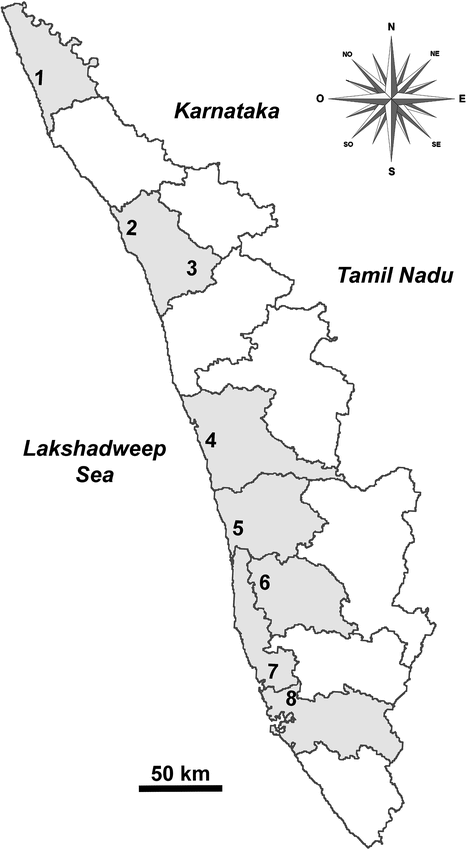
Map of Kerala with districts boundaries and the location of the eight surveyed
The interviews were based on a semi-structured questionnaire totaling 152 questions related to coconut cultivation. These questions focused on varieties, agronomic management, farming system, utilization of products, traditional knowledge and practices. The consultants introduced the topics, let the participants discuss between themselves with minimum intervention, and recorded the outputs in an extensive way. Each survey lasted between six and eight hours.
Molecular analyses were conducted on the coconut palms in order to characterize their genetic diversity. These analyses were carried out using the kit of 14 microsatellite markers developed by Cirad (the French Agricultural Research Centre for International Development) for the Cogent Network (Baudouin and Lebrun 2002).
Results
Coconut Cultivars in Southern India
In the State of Kerala, the most widespread cultivar is the West Coast Tall (WCT), a Tall coconut variety from the west coast of India. This cultivar is very much favored by farmers, occupying at least 95% of coconut groves. Seventy-five to 80% of farmers produced and selected their own seednuts from mother-palms in their own plantations. Two Dwarf cultivars are found in the villages, one being the Chowgat Orange Dwarf (COD). The COD is not a particularly hardy garden coconut palm. It is an ornamental and family plant, producing pleasantly sweet young nuts for drinking. Farmers attributed medicinal properties to its fruits. The other dwarf cultivar is the Chowgat Green Dwarf (CGD).
The modern hybrids as identified by farmers in 1998 mostly resulted from a cross between the Chowgat Orange Dwarf (COD) used as the female parent and the West Coast Tall (WCT) used as the male parent. This hybrid was produced at the Kidu farm by the Central Plantation Crop Research Institute, and distributed by researchers under the name of
Treated this way, the Dwarf coconut palm, which naturally is highly autogamous, is forced to cross-fertilize. Dwarf palms were used as female plants to receive WCT pollen. Pollen was harvested from different plantations and dusted onto the flowers of emasculated Dwarf palms. Given the procedure, the resulting hybrid appeared as a technical fact, though without losing its quality as a natural fact: it was a “man-made natural fact” (Latour 1990), i.e. a modern coconut hybrid. The
In southern India, knowledge of farmers regarding the sexual reproduction mechanisms of the coconut palm differs from that of scientists. From observations carried out in Asia, Africa and the Pacific, it can indeed be said that traditional farmers ignore the fact that a coconut inflorescence bears both female and male flowers. The knowledge of the farmers is empirical. In their plantations, they find that seednuts harvested from COD parents produced a progeny of the same type, but that the progeny is sometimes different. These palms, which were atypical and rare, were called
From an anthropological perspective, as farmers do not consider reproductive biology as defined by scientists, the atypical Dwarf coconut palm is not a hybrid! However, for the sake of convenience, and to help in the analysis of the problems that this situation gives rise to, the expression “natural coconut hybrid” is nonetheless used to distinguish it from the “modern coconut hybrid”. Although, both on stations and in villages, both types of hybrid were derived from the same biological parents (COD × WCT), farmers nonetheless judged the modern coconut hybrid and the natural coconut hybrid differently.
Assessment of the Modern Coconut Hybrid
In India, the first plantation with technically propagated coconut hybrids was planted at the beginning of the 1930's (Silas et al. 1991). However, it was not until the 1970's that the modern
Agronomic differences between the modern coconut hybrid and the natural coconut hybrid according to Indian farmers.

Almost all the farmers interviewed judged that the faults of the modern coconut hybrid far outweighed its qualities. They considered it maladapted to large-scale cultivation. On the other hand, the scientists argued that their modern variety was adapted to large-scale cultivation, was productive under good growing conditions and yielded larger fruits than the Tall variety. But farmers reported that plants produced on stations had trouble coping with poor soils and dry climate and that they were more susceptible to diseases and pests than their natural coconut hybrid. Farmers were also asked to rank their varietal preferences and to give yield estimations. As shown in table 2, the natural coconut hybrid was preferred to the Tall coconut, which was preferred over the modern coconut hybrid. There was no clear correlation between yield levels claimed by farmers and their varietal preferences. Indeed, production figures quoted by the farmers themselves indicated that the modern coconut hybrid outperformed WCT palms. Productivity was therefore not the only criterion considered by farmers when determining their order of preference. The modern coconut hybrid was also reported to reproduce on a more irregular basis and to be more susceptible to bunch abortion than the natural coconut hybrid. Farmers also reported that after an average of three to four years, and a decade at most, the productivity of the modern coconut hybrid declined. Moreover, the kernel of the fruit of the natural coconut hybrids was said to be better than that of the modern, be it for copra making or for home cooking.
Varietal preferences and yield estimations given by the farmers.

Before analyzing farmer preferences in greater detail, we investigate the nature and origin of the modern and natural coconut hybrids: the West Coast Tall, the Chowgat Orange Dwarf, the
West Coast Tall
This name is given to a cross-fertilizing Tall cultivar belonging to the Indo-Atlantic group. Compared to Tall coconut palms in Southeast Asia and the Pacific, this group is characterized by palms with a more slender, more flexuous stem, producing generally more elongated fruits containing a high proportion of fiber, and germinating later (Bourdeix 2005). The international Coconut Genetic Resources Database contains information on ex situ collections of coconut planting material (Lebrun et al. 1998a, 1998b). In that collection, two Indian accessions of the WCT cultivar are described. The older, IND069, was planted in 1965 at the Kasaragod Research Centre in Kerala. However, local researchers emphasize that the parents of accession IND069 were already found at the Kasaragod centre, which was created in 1916 from an existing coconut plantation (K. Muralidharan M.K. Nair, pers. comm..). Accession IND069 was then used in a series of controlled crosses during a period from 1972 to 1994. In total, 1186 progenies were planted at the CPCRI station at Kasaragod and at the Kidu seed farm (Karnataka), the main hybrid seednut production site. At least 50 WCT parents were used to produce the 200 WCT palms now used for pollen for hybrid production.
Seven WCT palms from the IND069 accession were analyzed using the kit of 14 microsatellite molecular markers developed by CIRAD (France) to study their genetic variability. That sample was characterized by a Nei's diversity index of 0.41 with a standard error of 0.09. Those values placed the WCT in a cohesive position relative to the Indo-Atlantic group, a group of moderate variability. Indeed, in the Indo-Atlantic group, 12 cultivars represented by 112 individuals were analyzed by the same kit. The Nei's indices ranged from 0.21 to 0.60, for an average group value of 0.40. In comparison, the “Asia” and “Melanesia” groups of Tall coconut palms had average Nei's index values of 0.54 and 0.59 respectively, higher than that of the Indo-Atlantic group.
Chowgat Orange Dwarf
The oldest known description of Dwarf coconut palms in India dates back to 1885 (Shortt 1885), but scientific research on the coconut palm did not begin until 1916. In the coconut palm, dwarfism is a syndrome combining numerous common characteristics: slow vertical growth, reduced organ size, preferential self-fertilization, early bearing and rapid bunch production. Because of these last characteristics, Dwarf palms play a major role in breeding programs. All the Dwarf cultivars inventoried originate from Asia or the Pacific, and were imported into the other regions 100 – 300 years ago.
Analyses were carried out with the microsatellite molecular marker kit developed by CIRAD (France) to characterize the COD. They revealed a virtually identical molecular profile for the following individuals: five Chowgat Orange Dwarf palms preserved at Kasaragod in India, five so-called Cameroon Red Dwarf palms preserved in Ivory Coast, seven Pemba Red Dwarf palms from Chambezi in Tanzania, and an orange-colored Dwarf palm from Mozambique. Those highly homozygous individuals had a Nei's diversity index of 0.02 (standard error 0.01).
Thirty-two Dwarf cultivars represented by 570 individuals were analyzed with the same kit. The Nei's index only exceeded 0.2 for eight of these Dwarf cultivars (L. Baudouin and P. Lebrun, pers. comm.). Because of its high degree of genetic homogeneity, the COD could be considered identical in the villages and at the Kasaragod research centre. In any case, it is genetically identical to the Cameroon Red Dwarf, which is highly autogamous, selfing at almost 95% under Ivorian conditions (Rognon 1976). In India, a study of the floral biology of the COD showed that the phase of female flower receptivity coincided with that of the pollen emission phase on the same inflorescence (Ratnambal et al. 2003). This is reflected in a high propensity for self–fertilization. Nevertheless, in India too, the COD would appear to produce at certain periods up to 20% of atypical plants arising from cross-fertilization, though no average value is quoted (Pramod et al. 2003).
Both farmers and researchers distinguished between Dwarf progenies by the color of the sprout, which, in the nursery, protrudes from the seednut. For Dwarf coconut palms, the genetic determinism of sprout color transmission relies on two independent genes (Bourdeix 1988). If the Orange Dwarf reproduces with another Orange Dwarf, the color of the sprout protruding from the seednut is reddish orange. West Coast Tall palms produce sprouts ranging from green to brown, and COD × WCT crosses give brown or greenish-brown sprouts, so they are recognizable by that criterion in the nursery.
Natural Coconut Hybrids and Modern Coconut Hybrids
Are the natural coconut hybrid and the modern coconut hybrid the same biological entity? To answer this question, we will show that the great majority of the seednuts with brown or greenish-brown sprouts gathered by farmers from COD palms are COD × WCT crosses. Factors suggesting that the male parents might be different will be analyzed and refuted at three levels: first, the existence of other cultivars in the villages, their spatial distribution and the effects of pollen competition will be taken in account; second, the consequences of selection on WCT and the possibility that the WCT populations might have evolved differently at research centers and in villages will be studied; last, the effect of male parent selection on the value of the hybrids will be quantified.
It is important to note that in the villages, the COD palms were surrounded by coconut palms belonging at least at 95% to the WCT cultivar (see above, cultivation area). Contribution to the pollen cloud by other varieties might be greater if those varieties were concentrated near villages where the COD palms were located. However, with the exception of the WCT, which was found everywhere, and the Chowgat Green Dwarf cultivar (CGD), existing in the villages, the other Tall palms and hybrids were generally planted in small plots in farmers' fields. The natural coconut hybrid might therefore have resulted from a cross between the COD and CGD.
Crosses between two Dwarf cultivars yields a Dwarf type palm: slender stem cylindrical at the base, very tightly arranged leaf scars, flowering two to three years after planting. On the other hand, Dwarf × Tall hybrids and Tall cultivars have a much broader stem opening out into a cone at the base, and have much less tightly arranged leaf scars. Dwarf × Tall hybrids generally flower between three and four years after planting, Tall cultivars after four years. The farmers unanimously agreed that the natural coconut hybrid was less precocious than the modern coconut hybrid. If the natural coconut hybrid were of the Dwarf × Dwarf type, however, it would start bearing much earlier than the modern Dwarf × Tall hybrid. Neither the farmers nor the researchers ever reported any resemblance between the natural coconut hybrids and any Dwarf variety. Therefore, the natural coconut hybrid does not result from a COD × CGD cross.
Pollen competition phenomena might favor crosses between the COD and cultivars other than the GCD (constituting under 5% of individuals). Such occurrences have sometimes been documented in coconut, but have remained limited in extent. Trials were conducted with the Malayan Yellow Dwarf cultivar (MYD). Some inflorescences were emasculated, and artificially pollinated with a mixture of pollen from several other varieties (Sangare 1981). The results of these studies identified that female MYD flowers were more receptive to Dwarf pollen than to Tall pollen, and exhibited higher rates of pollination with pollen from the same cultivar.
The fact that the natural coconut hybrid did not result from a cross between the two Dwarf varieties, COD and CGD, strongly suggests that there is no notable pollen competition effect in favor of CGD pollen. Consequently, the natural coconut hybrid resulted in the great majority of cases from a cross between the COD and the WCT, which accounted for 95% of the neighboring coconut palms.
The possibility that the modern coconut hybrid and natural coconut hybrid might be genetically different could be due to the heterogeneity of the WCT population, and particularly to the fact that the WCT palms used on stations were different from those of the farmers following selection by researchers. This could account for differences pronounced enough to alter the general combining ability of WCT palms and modify the characteristics of their hybrid progeny. For example, the WCT palms in the villages might be better adapted to local conditions than those used by researchers to produce the modern coconut hybrid, explaining the disagreement between the farmers' and researchers' assessments of the modern hybrid. However, such a hypothesis does not seem to be convincing. Indian researchers selected the WCT palms for their inherent phenotypic values (good yields). One point on which studies agree is that the productivity and adaptability of a Dwarf × Tall hybrid depends much more on the nature of the two parental cultivars than on the differences between individuals within those cultivars. For instance, in the Ivory Coast the cross between the Malayan Yellow Dwarf and the West African Tall (WAT) produces 97% more than its WAT parent (Bourdeix 1989). Selecting the best 20% of WAT parents based on hybrid progeny testing makes it possible to improve the value of the hybrid by 12%. However, if those WAT parents were chosen for their own value, and not the value of their hybrid progeny, the value of the hybrid would only be improved by 4%. Table 3 confirms similar results obtained with different types of hybrids. It therefore seems impossible that the low intensity selection effected by researchers could result in a strong decline in the performance of the modern coconut hybrid, as compared to results of spontaneous hybridizations in the villages.
Hybrid improvement: comparative efficiency of male parent selection based on inherent phenotypic value and progeny testing.

The favorable assessment by farmers of the productivity of the natural coconut hybrid, when compared to the modern coconut hybrid, was unanimous in the eight villages studied, including those located near the Kasaragod research centre. These results corroborate the fact that, despite the heterogeneity of the parents when considered individually within each WCT cultivar, no difference was found in the progenies. Neither did any evidence suggest local adaptation of the parents. Consequently, the differences in assessment between the natural coconut hybrid and the modern coconut hybrid were not linked to their genetic nature. The hybrid supplied to farmers by scientists was indeed true to a biological type, all the more so since the sprout color in the case of Dwarf × Tall hybrids made it possible to recognize with certainty the nature of the planting material being assessed. Thus, the modern coconut hybrid produced on research stations and the natural coconut hybrid reproducing spontaneously in the villages are the same cultivar. Having established that there is a marked difference in the cultural perception of these two hybrids, despite there being no distinguishable morphological or genetic difference between them, we turn now to a discussion of what social, cultural, and economic factors could be responsible for this apparent paradox.
Discussion
Preferences and Causes
Among the farmers, the natural coconut hybrid is preferred over the Tall coconut, which is preferred over the modern coconut hybrid. This situation is perplexing, considering that the modern hybrid is biologically indistinguishable from the natural hybrid. Consistent survey results across villages suggest that this paradox is not an artifact of methodological error. An assessment of these results by Indian farmers naturally encouraged them to compare the proposed materials with the varieties already traditionally known and grown; the results therefore focus on the perceived qualities of the modern hybrid relative to other traditionally known coconut palms – not on the biological characteristics of the hybrid itself. The survey invoked comparisons that led farmers to reveal, by contrast, certain characteristics of their traditional cultivars that served as a frame of reference.
This is contrast to the 1998 study, which focused more explicitly on the biological traits of the plant and its agronomic qualities. Consequently, an analysis of cultural processes as causes for farmers' preferences was neglected in this first evaluation. Farmers' appreciation of productivity was not guided by an experimental protocol. Whilst this value was not objective for the scientists, it was significant for the farmers. For the farmers, it was not simply two plants that were being compared, but also two human groups and two classification systems. These two plants live within two different human groups and exist through them.
As illustrated in table 4, we initially missed the importance for farmers of human intervention in the reproduction process of the modern coconut hybrid, and the cultural role of the scientists and assisted technical reproduction. We also neglected the sudden increase in abundance of a resource that was previously rare. However, it can be imagined that these characteristics enabled farmers to distinguish collectively, and without any confusion, between the modern coconut hybrid and the natural coconut hybrid. Indeed, the coconut varieties fitted into a preexisting system of opposition. Classification of the hybrids into two distinct categories left no ambiguity. Such classification rigor was at least necessary to enable farmers to choose without too much trouble one of the two terms existing in the local language to distinguish between the two coconut hybrids. Classification is not just a cognitive or linguistic phenomena; it is also determined by attitudes. As anthropology has already demonstrated in the field of kinship, where the system of terminology and the system of attitudes are “dynamically integrated” (Levi-Strauss 1974), the coconut classification system (as for kinship) is hand in hand with a system of attitudes, and that the behavior of the farmers to the modern coconut hybrid is not free of all commitment: attitude found the classification, and vice versa, so that the relationship between classification and attitude is dialectical (Table 5). After harvesting or buying a small number of seednuts of natural coconut hybrid, farmers plant them under good conditions and conscientiously maintain them, whilst modern coconut hybrids are planted and maintained without particular care.
Contrasted characteristics of the natural and modern coconut hybrid.

Attitudes of farmers regarding the modern and natural coconut hybrid.

One reason for the farmers' preference for the natural coconut hybrids could be the cost. For a smallholder, paying 25 rupees for the natural hybrid instead of 50 rupees for the modern hybrid makes a difference. But cost does not explain why the farmers point out a better agronomic performance for the natural hybrids. According to Santhakumar (1996):
Since coconut is grown in dry-land and because its cultivation has extended to even drier lands, such as hill slopes during last few decades, providing irrigation is not an easy task […] farmers also find it difficult to irrigate at the doses recommended by the scientists. Some others, who initially tried to irrigate coconut, have abandoned the practice. Farmers also believe that local varieties yield for a longer period of time and have higher timber value. This consideration, coupled with the insignificant yield difference between non-irrigated local and hybrid varieties, has led farmers to continue with the traditional varieties.
Our 1998 study includes villages located in dry land, but also in Kerala backwaters. Consequently, the contrasting attitudes of farmers regarding the natural coconut hybrid and modern coconut hybrid were not only revealed through the consideration of the intrinsic characteristics of the plant (productivity, ability to cope with poor soils, tolerance to diseases and pests, or uniformity of growing), but also through cultivation practices. Farmers generally plant natural hybrids on better soil and manage them with more care.
The different treatment afforded to modern and natural hybrids did not only appear as an effect resulting from farmer's classification (natural is better), but also as a cause (because the natural hybrid is cultivated on better soil, it produces better, confirming that natural is better). This different treatment was itself an attitude (tables 4 and 5) that strengthened the coherence of the classification by keeping active the opposition between the two communities and between the researchers' plant and the farmers' plant. The factor determining farmer preference would thus seem to be linked to the ways in which planting material is acquired, understood as a social fact, and defined within a community. Biological criteria were insufficient. Indeed, it was not merely two plants that were being compared, but two communities, and more specifically within each community, the possibility or not of placing humans and their technical intervention in a position of cause in the crop reproduction process (Cleveland and Soleri 2005).
The legitimacy of human's direct intervention, with instruments, on plant reproduction is not accepted everywhere: it is a social fact. This issue is highlighted by Haudricourt (1962). Haudricourt looked at a pastoral agricultural system in Southeast Asia by comparing sheep and yam, which defined direct positive action and indirect negative action, to analyze the relations that humans have with domesticated organisms, be they plants or animals. He focuses attention on human action, noting that such action (cause) could be direct or indirect with positive or negative effects, respectively, on the domesticated organisms.
Conclusions and Prospects
An analysis of causes shows that the ideologies of the two communities, scientists and farmers, are manifested in their treatment of plants: for the former it was easily conceivable for them to act directly on the plant, to intervene in its reproductive cycle, thereby placing humans and their actions in a causal role to achieve desired effects; which was not the case for the farmers of southern India. The factors involved in the assessment of the planting material are not only those pertaining to agricultural or utilitarian value, but also those pertaining to the processes through which the plant is created, the legitimacy of these processes, and their consequences. For the farmers, the rare occurrences of the natural coconut hybrid were in opposition to the abundance of the modern coconut hybrid, whose mass reproduction was technically controlled. From this perspective, the modern coconut hybrid appeared as a technical fact that the farmers, legitimately, would not confuse with a coconut palm on which they did not intervene and over the production of which they had no control.
A common understanding might be reached through changing the ways in which breeding programs are implemented, for example, by introducing a participatory approach. Acceptance of the modern coconut hybrid will be encouraged if the program takes place on the actual land of the community. If farmers want, scientists could help them to acquire knowledge about the reproductive methods of the coconut palm, and about the techniques associated with such knowledge. Indeed, emasculating a Dwarf coconut palm only takes two to three hours per year, is easy to do, and makes it possible to produce 60 to 80 hybrid seednuts per year. As already proposed in the Comoro Islands, farmers could carry out emasculation themselves (Bourdeix 2002). By eliminating sources of COD pollen in that way, the rate of hybrids harvested from the COD palms would no longer be 5 – 20% but rather 95 – 100%. That technique would no doubt enable farmers to achieve greater independence in acquiring seednuts (Pramod et al. 2003).
The situation depicted in this study appears paradoxical. Natural and modern hybrids are grown in the same villages by the same farmers. Scientists fortunately understood that these two hybrids are genetically similar, although farmers name, characterize and treat them differently. The genetic analyses in this study confirm that the hybrids are biologically similar. The anthropological survey of this study reveals that the attitudes of local farmers towards crop production processes must be considered in order to understand the agricultural preferences in a cultural context. It is likely that the situation identified here is not an isolated case. Comparable social facts probably occur in many participatory surveys and breeding programmes, in which farmers are asked to sort varieties by their preferences. A comparison of breeding program successes and failures, depending on whether or not the benefiting society corresponded to the direct positive action role, would also be of interest.
Footnotes
Acknowledgments
The authors wish to thank CPCRI (Central Plantation Crop Institute, Kasaragod) for its hospitality during a field trip, Dr. Hugh Harries for his information on the oldest description of the Dwarf coconut palm in India, and Drs. Doyle McKey, Jacques Lançon and Geo Coppens for comments on a previous version of the manuscript.