






Abstract
Pathways through college vary by sex in ways that may contribute to the contemporary male-female gap in college graduation that favors women. Although past research has documented sex differences in college pathways, little research has investigated the underlying causes of this variation. Using data from the National Education Longitudinal Study, this study empirically tests leading hypotheses for why men are more likely than women to progress through college discontinuously and part-time. This study finds that high school academic performance, which indicates preparation for college, accounts for part of the male-female gap in college pathways. Poorer academic performance at the beginning of college further increases the likelihood that men, relative to women, will disrupt their college experience.
The traditional image of college students as young people who graduate from high school, leave home, enroll full-time in college, and graduate in four years does not capture the diversity of postsecondary pathways in contemporary America. An increasing number of students attend college, but many young people follow disrupted pathways through college. For example, some take time off, transfer schools, simultaneously attend multiple colleges, or enroll part-time in an attempt to work or juggle other responsibilities during college. These college pathways represent “an additional layer of stratification in higher education” when they have negative consequences and are concentrated among particular subgroups (Goldrick-Rab, 2006, p.73). While socioeconomic status (SES) differences in pathways are well documented (Goldrick-Rab, 2006; Hearn, 1992), sex differences are less understood. Therefore, this study investigates sex differences in two consequential disrupted pathways through four-year colleges—discontinuous and part-time paths.
Since college pathways are associated with persistence to degree completion and numerous socioeconomic returns to degrees (Elman & O’Rand, 2004; Goldrick-Rab, 2006; Hearn, 1992), an examination of sex differences in college pathways contributes to the discussion surrounding a growing concern over the performance of men in higher education. Although young men were more likely than women to graduate from college in the 1970s, this pattern reversed, and women gained a clear advantage over men in persistence to college graduation by the 1980s (Buchman & DiPrete, 2006). At present, about one third of young women (ages 25–29) are college graduates compared to one quarter of men of the same ages. The growth in the male-female gap in college graduation is of concern since it will likely affect economic and demographic patterns such as labor market participation, marital formation, and childbearing (Buchman & DiPrete, 2006; Schwartz & Mare, 2005). Supplemental analyses show that sex differences in college pathways account for one quarter of the male-female gap in college graduation among National Education Longitudinal Study (NELS) respondents (decomposition calculations available upon request). Since pathways through college are a potentially important behavioral component of sex differences in persistence to graduation, understanding the reasons for sex differences in pathways through college may provide a window to the mechanisms behind the widening male-female gap in college graduation of concern to scholars, educators, and the general public. Disrupted college pathways also raise total college costs, reduce or delay the social returns to college attendance, and lower the economic returns, including wages, to college graduation (Elman & O’Rand, 2004; Goldrick-Rab, 2006; Hearn, 1992; King, 2003), and so an examination of sex differences in pathways through college may further illuminate processes leading to sex gaps in total college costs, likelihood of graduation, and returns to college degrees.
This article examines the determinants of male-female differences in discontinuous and part-time pathways through four-year colleges, since past research has documented significant sex differences in these patterns without identifying their underlying causes and since patterns may have changed since earlier studies (Goldrick-Rab, 2006; Hearn, 1992). Discontinuous and part-time pathways both increase the length of time students spend in school and disrupt persistence to an on-time, four-year college graduation, and so are referred to as disrupted pathways. A better understanding of the processes leading to various college pathways will enable policymakers and universities to design programs and counseling services that encourage students to follow pathways that increase persistence to graduation (King, 2003; Robinson, 2004) and potentially reduce the male-female gap in college graduation.
The Rise in Types of Pathways Through College
A rise in types of pathways through college in recent years was precipitated by growth in the higher education sector and by policy changes. Scholars estimate that more than half of all college students are “nontraditional,” which includes students over the age of 24, married students, single-parent students, first-generation students, and financially independent students (Baker & Velez, 1996). The number of nontraditional students may be even greater today. The rise in nontraditional students contributed to the development of new pathways.
As colleges and universities competed for the growing number of students, and nontraditional students in particular, a “higher education marketplace” developed where students can be considered consumers and colleges can be considered vendors (Goldrick-Rab, 2006). This higher education marketplace forced institutions to offer programs and develop policies that accommodated the needs of nontraditional students in order to compete for students (Goldrick-Rab, 2006). Many of these innovative programs enabled students to attend part-time, transfer credits, attend multiple institutions simultaneously, take online distance-learning courses, or take time off and later return to school (McCormick, 2003). Some of these pathways may have positive effects for segments of the diverse student body, for example by enabling students to balance family obligations and unexpected life circumstances with college enrollment or to transfer to schools that better fit their capabilities and potential. However, for other students, the effects of disrupted pathways may be primarily harmful when such pathways limit educational attainment or the returns to college degrees.
Disrupted college pathways are not rare. Approximately half of all students entering four-year colleges attend another college at some point, even if only to take a correspondence course; half attend part-time at some point; one third transfer; and up to one third of students take time off at some point after initially enrolling (Goldrick-Rab, 2006; King, 2003; McCormick, 2003; Robinson, 2004). These pathways vary by SES, and Hearn’s (1992) study found that students of lower SES were more likely than their more affluent counterparts to attend part-time. Goldrick-Rab’s (2006) and King’s (2003) more recent studies confirmed Hearn’s findings that students of higher SES follow more continuous pathways. More men than women take time off, while more women than men transfer institutions without interruption in attendance (Goldrick-Rab, 2006; Robinson, 2004), but the mechanisms underlying sex differences in disrupted pathways are not entirely clear.
College Pathways and Persistence
Since students who follow disrupted pathways are less likely to persist to college graduation (Goldrick-Rab, 2006; Hearn, 1992; King, 2003), an examination of pathways through college is usefully situated within theories of college student persistence. Tinto’s model of social integration and Bean’s model of student attrition have guided studies of college student persistence, typically at a single institution. Tinto (1997) argued that students who are more socially and academically integrated into the college community are more likely to persist through to degree completion since they have support and are invested in their programs; he further identified the importance of matches between individual ability and institutional academic and social characteristics. Bean (1983) argued that beliefs and attitudes, which are affected by student experiences with schools, shape persistence behavior. Bean also highlighted the importance of factors outside the institution, such as encouragement from family and friends, which facilitate persistence.
Although social integration during college plays a critical role in persistence models by mediating background characteristics and ultimately shaping persistence to degree completion, several additional college experiences, including behaviors and perceptions, shape students’ persistence directly and indirectly via levels of social integration (Berger & Milem, 1999). Pathways through college are important college behaviors that do so (Kuh, Cruce, Shoup, Kinzie, & Gonyea, 2008; Laird & Cruce, 2009; Lee, Mackie-Lewis, & Marks, 1993). For example, students who enroll part-time will have fewer interactions with faculty and other students, and students who take time off will unlikely spend time on the college campus during their enrollment breaks. Laird and Cruce found that part-time enrollment lowers social integration, Lee et al. uncovered that part-time enrollment lowers the likelihood of persistence to degree completion, and Kuh et al. found that transferring lowers the likelihood of persistence. Therefore, pathways contribute to persistence to graduation both directly and indirectly through social integration.
Persistence models identify several groupings of variables that explain persistence to degree completion, including background characteristics, high school academic performance, institutional characteristics, college experiences, and factors outside of the institution (Allen, 1999; Berger & Milem, 1999). The variables identified by persistence models account for college pathways and possibly observed sex differences in pathways (Goldrick-Rab, 2006; Hearn, 1992; King, 2003).
Both Tinto’s and Bean’s theories highlight the importance of precollege characteristics in shaping persistence during college (Allen, 1999; Cabrera, Castaneda, Nora, & Hengstler, 1992). Precollege characteristics can be divided into two groups—background characteristics and high school performance. Consequential background characteristics include race and ethnicity, sex, SES, educational goals, and encouragement from family and friends (Anderson, 1988; Berger & Milem, 1999; Cabrera, Nora, & Castaneda, 1993). Studies of college pathways identify the importance of these background characteristics as well, particularly highlighting the association between lower SES and more disruptive pathways (Goldrick-Rab, 2006; Hearn, 1992; King, 2003). Students from higher socioeconomic backgrounds may benefit from more highly educated parents and greater access to educational resources that facilitate continuous pathways.
High school academic performance indicates how prepared students are to handle the rigors of college, and students who are better prepared for college are more likely than lower performing high school students to persist through to graduation (Allen, 1999). Poor academic performance is a contributing cause of disrupted college pathways (Anderson, 1981; Hearn, 1992). Hearn argued that students with low high school academic achievement and preparation follow nontraditional pathways because they are not prepared for college. Such students may struggle with the amount and rigor of course work and consequently take time off or reduce their course load to part-time in order to lessen academic strain. Academic preparation is a possible underlying cause of disrupted pathways that might mediate male-female differences since boys perform more poorly academically than girls in high school (Goldrick-Rab, 2006).
In addition to precollege factors, institutional characteristics play a central role in models of student persistence (Anderson, 1988; Kuh et al., 2008). When student ability and effort match an institution’s academic and social characteristics, students do not face strain and they reinforce their commitment to earning a degree and to the institution they attend (Tinto, 1993). Furthermore, selective schools that provide greater resources and support can better facilitate continuous pathways and student persistence compared to less selective schools (Hearn, 1991). There are numerous measures of institutional characteristics and selectivity, including indices of selectivity, average Scholastic Aptitude Test (SAT) scores, per-pupil spending, sector, and student-faculty ratio (Hearn, 1991; Laird & Cruce 2009; Lee et al. 1993). Hearn found that women attend less selective schools than men do. Given men’s higher levels of institutional selectivity and the relationship between institutional characteristics and persistence behavior, institutional selectivity may suppress the magnitude of sex differences in college pathways.
Beyond social integration, models of college persistence consider the role of several additional college factors, including financial aid and college grades, that influence later college experiences (Allen, 1999; King, 2003; Kuh et al., 2008; Lee et al., 1993). Receipt of financial aid facilitates college persistence by alleviating monetary concerns and financial strain (Hearn, 1992; King, 2003). Although sex is not a central factor in decisions about financial aid packages, academic merit is (Heller, 2008), and so the higher high school academic performance of women compared to men could potentially shape pathways through college via financial aid.
College grades are positively associated with persistence, and persistence models suggest that the association results from an appropriate fit between student ability and effort and the academic characteristics of institutions (Allen, 1999; Anderson, 1988; Kuh et al., 2008; Lee et al., 1993). College grades also reflect students’ academic preparation for college. High college grades indicate that students are able to handle the academic rigor of college, while lower performing students may take time off or reduce their course loads in order to reduce academic strain. Goldrick-Rab (2006) suggested that low-income students who are likely to take time off may do so because they have “suffered academically or financially” in college (p. 73); the same may be true for men who perform poorly in college. Given than women earn higher grades than men in college, sex differences in college academic performance may contribute to differences in college pathways. There is likely a reciprocal relationship between college grades and pathways; however, in this study, I include early measures of college grades (during the first year) to test the hypothesis that poorly performing students are more likely than more highly performing students to follow disrupted pathways to reduce academic strain. Although some poorly performing college students may choose to take time off or enroll part-time to reduce academic strain, it is important to remember that some students may follow disrupted pathways involuntary, for example when students do not perform academically and are asked to leave by the institution (Goldrick-Rab, 2006).
Bean (1983) argued for the importance of factors external to the institution for persistence, and Anderson (1988) confirmed that involvement outside of school that detracts from a student’s ability to integrate into the college community and takes away from time devoted to studying, such as family obligations, limits persistence. Early family formation and working while enrolled may also limit a student’s ability to attend college continuously if students reduce hours or take time off in order to work a job or balance the demands of family and school. If women bear a disproportionate amount of family responsibilities, early family formation may suppress the extent of sex differences in pathways.
Overwhelmingly, past studies of college pathways acknowledge the need for additional research, especially in a multivariate framework (Bach et al., 2000; Hearn, 1992; McCormick, 2003). Previous studies have primarily highlighted SES differences in pathways and have focused on transfers rather than on other consequential pathways (Goldrick-Rab, 2006; King, 2003; McCormick, 2003). I expand the focus to the determinants of additional pathways, including discontinuous and part-time ones, and examine another key ascriptive characteristic—sex—along which patterns vary. Based on theories of college student persistence, I empirically test the following hypotheses:
Hypothesis 1: Men are more likely than women to follow disrupted pathways because their poorer high school performance leaves them less prepared for college.
Hypothesis 2: Men’s enrollment at more selective schools suppresses the magnitude of sex differences in pathways through college.
Hypothesis 3: The higher college academic performance of women, which reflects a good fit between student ability and effort and institutional academic characteristics, partly accounts for women’s more continuous college pathways relative to those of men.
Hypothesis 4: Women’s greater involvement outside of school in family roles suppresses the magnitude of male-female gaps in pathways through college.
Data and Method
These analyses use data from the NELS of 1988 conducted by the National Center for Education Statistics (NCES) of the U.S. Department of Education. NELS is a longitudinal study that first interviewed a nationally representative sample of more than 24,000 eighth graders in 1988 and followed more than 12,000 of the students for four follow-up interviews, the last of which took place eight years after high school graduation in 2000, to document their educational and labor market outcomes. The sample is restricted to those who entered four-year colleges by 1994 and reported their college pathways, resulting in 4,640 cases. Since students who enroll in four-year schools shortly after high school represent a more select group (Buchman & DiPrete, 2006), the analyses are replicated for the sample of students enrolled by 1996.
The NELS data are appropriate for studying sex differences in college pathways for several reasons. This longitudinal data set contains three waves of data collected prior to entry into higher education. Therefore, the data include substantial measures of early life course experiences and high school performance consequential to persistence behaviors during college that are less available in alternative data sets such as the Beginning Postsecondary Students Longitudinal Study (BPS). Although the BPS data contain more detail on the timing and types of college experiences, such as social integration, than the NELS data do, social integration should not be included in models of college pathways since prior research overwhelmingly finds that the direction of causality runs from pathways to social integration and persistence (Kuh et al., 2008; Laird & Cruce, 2009; Lee et al., 1993). 1 Furthermore, the NELS data contain indicators of financial aid and college academic performance, the key college experiences of interest in this study, at the beginning of college before most four-year entrants take time off or go part-time, thereby lessening concern about the temporal ordering of covariates and outcome measures in NELS. The Education Longitudinal Study of 2002, which follows students a decade after NELS, has not yet conducted waves of interviews beyond two years of on-time high school graduation so does not presently contain information to track students through the majority of their college years. Although the NELS data followed students in higher education during the 1990s, this time period represents the era when women gained a clear advantage in college graduation relative to men, and so the NELS data enable an examination of sex differences in persistence behavior during the time period in which women’s higher persistence rates relative to those of men became clearly established.
Dependent Variable
College pathways are measured with a categorical variable that includes a discontinuous pathway at some point (but never a part-time pathway), a part-time pathway at some point (but never a discontinuous pathway), multiple disruptive pathways (both discontinuous and part-time pathways at some point), and a full-time continuous pathway (never a part-time or discontinuous pathway). I distinguish between several types of pathways rather than using a dichotomous indicator for any disrupted pathway, since Hearn (1992) concluded that different types of pathways may not be closely associated with one another and may have differing underlying causes. By isolating students who follow only discontinuous or only part-time pathways at some point from students who do both, the analyses will not conflate the effects of independent variables on discontinuous pathways with associations with part-time pathways, and vice versa. By distinguishing students who follow multiple disrupted pathways, these analyses will be able to assess whether this more disruptive pathway results from differing processes than do pathways that involve only a single type of disrupted pathway at some point.
Part-time pathways
Prior research has not developed consistent measures of pathways (Robinson, 2004), and so in this study a part-time pathway indicates that a student attended less than full-time at some point after initially entering college. Since the survey question only asked whether a student attended less than full-time at some point (see Appendix A), there is ambiguity in students’ understandings of what “less than full-time” means. The data do not contain information on length of time as a part-time student or when sequentially students enrolled part-time. Therefore, the data do not allow for a distinction between students who enrolled part-time for one semester versus their entire college careers or for students who enrolled part-time during their freshman years versus senior years.
Discontinuous pathways
Similar to Goldrick-Rab’s (2006) study, a discontinuous pathway indicates having at least one interval, lasting six months or longer, of nonenrollment after initially entering higher education and before completing a bachelor’s degree (or before the last point of data collection in 2000 for students who had not yet completed their degrees). The construction of this variable used students’ self-reports of having taken off six months or more from school (see Appendix A). The data do not contain sufficient information to distinguish between students who took time off for one semester or several years or to identify when during their college careers students took these breaks.
Independent Variables
The analyses condition on background characteristics identified in persistence models, including race and ethnicity, SES, and encouragement from family and friends (Anderson, 1981; Berger & Milem, 1999; Cabrera et al., 1993). Composite SES is a standardized scale, ranging from –3 to 3, based on family income and mother’s and father’s education levels and occupations. Since Buchman and DiPrete (2006) found that the absence of a father more negatively affects the educational persistence and attainment of sons than of daughters, I include a dichotomous variable for living in an intact family (measured as living with both parents in the baseline year). Having at least one parent that expects a student to complete college measures parental encouragement, and having friends who plan to go to college measures peer encouragement.
The following covariates test the hypotheses in this study:
High school performance
Several measures of high school performance test Hypothesis 1, that men are more likely than women to follow disrupted college pathways due to lower high school performance that leaves them less prepared for college. Consistent with prior education research, I include high school grades, test scores, and high school curriculum (Goldrick-Rab, 2006; Hearn, 1992). Overall high school grade point average (GPA) on a 4.0 scale and combined verbal and math SAT scores serve as proxies for ability, academic achievement, and possibly effort, and persistence models predict that high grades and test scores identify students well prepared for college who should persist in higher education. A dichotomous variable indicating enrollment in college preparatory curriculum measures the extent that a student’s high school curriculum emphasized the skills and habits needed to succeed in college. Since Berger and Milem (1999) highlighted the association between behavior and persistence, these analyses also include a dichotomous variable for high school disciplinary problems, which identifies whether students got in trouble for breaking school rules or got suspended during their senior year. Students with high school disciplinary problems have not developed behavioral patterns consistent with the expectations of educators so may be ill prepared to operate within and progress through the college environment.
Financial aid
A dichotomous variable indicates that students were awarded financial aid when they applied for college. Extensive missing data prevent measuring the type or amount of financial aid.
Institutional characteristics
Theories of persistence identify the need for a good fit between student and institutional characteristics (Anderson, 1988; Kuh et al., 2008) and suggest that more selective schools with greater resources facilitate student persistence (Hearn, 1991). To test Hypothesis 2, that men’s attendance at more selective schools suppresses the magnitude of sex differences in pathways, institutional selectivity of the first institution attended is represented by a three-category variable, (1) highly selective, (2) selective, and (3) nonselective, as developed by the NCES; nonselective schools are the reference category. The measure of institutional selectivity in NELS is based on average combined SAT scores of incoming freshman (Alon & Tienda, 2005).
College academic performance
Persistence models suggest that high college grades indicate an appropriate fit between student ability and effort and the academic characteristics of institutions, which facilitates persistence (Allen, 1999; Anderson, 1988; Kuh et al., 2008; Lee et al., 1993). First-year college GPA on a 4.0 scale measures college grades and tests Hypothesis 3, that the higher college academic performance of women relative to that of men accounts for their more continuous pathways. Although there may be a reciprocal relationship between college grades and pathways, NELS data contain information on college grades at the very beginning of college. Such an early measure of college academic performance is likely prior to disrupted pathways since most students initially enter four-year schools at full-time status and since students, by definition, cannot take time off until after they have spent some time in college.
Involvement outside of school
Theories of persistence further suggest that factors external to institutions can limit persistence when they detract from time and effort invested in the college experience (Anderson, 1988; Bean, 1983). Early family formation and work measure involvement outside of school. This study includes two indicators of early family formation—being married or having a child within two years of high school graduation. A dichotomous indicator for working while enrolled during the first year of college is based on student reports that they worked and went to college in the same month. Although the effect of work on persistence likely varies based on the number of hours worked and whether the employment is on or off campus, the data do not contain information on these dimensions of student work.
Analytic Methods
Multinomial logistic regression analyzes the determinants of college pathways since this modeling strategy is designed to analyze discrete, categorical dependent variables. These analyses model the likelihood that a student will follow a full-time continuous pathway versus the three other options, including (a) a discontinuous pathway at some point (but never a part-time one), (b) a part-time pathway at some point (but never a discontinuous one), and (c) both discontinuous and part-time pathways at some point. The following equation summarizes the model:

where y is a dependent variable with J nominal outcomes whose categories are numbered 1 through J but are not assumed to be ordered. For these analyses, y represents college pathways. In this model, Pr(y i = m|x i ) represents the probability of observing outcome m given x. β m is a vector of coefficients for the effect of covariate x k on outcome m. I report the exponentiated coefficients, or odds ratios, for ease of interpretation. Odds ratios represent the odds of following a particular disrupted pathway instead of a full-time continuous pathway for a 1-unit change in an independent variable.
Model 1 includes only sex to measure the observed sex differences in college pathways. Subsequent models then add variables to the equation in blocks in temporal order and examine how the effect of sex changes across models. Any significant changes in size of the male coefficient across models based on t tests will identify which blocks of variables contribute to this changing effect. If the sex difference narrows when a variable is added, then the covariate is “explaining” some of the observed male-female differences in college pathways.
The second model adds background control variables including SES, race and ethnicity, and living in an intact family. This model represents the baseline model since it conditions on SES and so controls for the fact that fewer low-SES men go to college relative to low-SES women. The remaining models test the hypotheses of this study and account for significant predictors in persistence models. Model 3 includes measures of high school academic performance to test Hypothesis 1, that men follow more disruptive pathways than women do because they are less academically prepared for college. Model 4 accounts for being awarded financial aid at the time of college applications. Model 5 adds institutional selectivity to test Hypothesis 2, that the higher selectivity of institutions men attend suppresses the extent of male-female differences in pathways, and Model 6 includes first-year college GPA to test Hypothesis 3, that gaps in pathways result from women’s higher academic performance in college. The final model accounts for family formation and work to test Hypothesis 4, that women’s greater involvement outside of school with family roles suppresses the magnitude of male-female gaps in college pathways. Supplemental models test a series of interactions between sex and factors that might be expected to operate differently for men and women, including SES, high school grades, institutional selectivity, college grades, and early family formation (see the supplementary material in the online version of this journal).
I utilize multiple imputation by chained equations to impute the missing values in the data (Royston, 2004; Rubin, 1987). Multiple imputation uses values of other variables to predict missing values, and researchers are able to specify which explanatory variables to include in the imputation equations for each variable with missing values. 2 Five multiply-imputed data sets are created, analyses are run on each imputed data set, and then the average coefficients across the data sets are reported. Standard errors are adjusted to account for the degree of uncertainty in the imputation. Although fewer than 10% of cases have missing values for most independent variables, several measures of academic performance from transcripts available in the restricted data are missing larger percentages due to transcript availability. Almost 30% of students are missing values on their cumulative high school GPAs, and 14% are missing first-year college GPAs. Schafer and Olsen (1998) found that creating five multiply-imputed data sets is sufficient to produce efficient estimations when a variable is missing 30% of values. However, to ensure that imputing the values of transcript-based high school GPA does not change the substantive findings of this study, supplemental analyses used an alternative measure based on the average of student-reported high school grades in math, English, science, and social studies and also replicated the analyses on the subsample of students whose high school GPAs were available in the transcript data (see Supplementary Table S1 in the online version of this journal).
These analyses focus on sex differences in college pathways among college entrants. However, since fewer men than women go to college, male college students may be more select in their SES and academic backgrounds relative to female college students, and such differences could influence observed sex gaps in college outcomes (Jacob, 2002). It is impossible to control for this possible selection issue by including respondents who did not enter higher education in the analyses since such students lack observations on college variables, but scholars developed propensity score–adjusted regression that can account for possible effects of selection into college on college outcomes. Therefore, supplemental analyses use propensity score–adjusted regression to run models of college pathways that include propensity scores for the probability of enrollment as a covariate (Alon & Tienda, 2005; Stephan & Rosenbaum, 2006; Winship & Morgan, 1999). The propensity scores were calculated by predicting the likelihood of going to college for all NELS respondents, including those who did and did not enter higher education. Although all the students in the subsample included in these analyses did attend college, some would not have been predicted to do so based on their background characteristics. The propensity scores were then included as a covariate in models predicting college pathways. This adjustment models a random selection process into college by accounting for the college enrollment process (including men’s lower likelihood of college enrollment relative to women’s) and removes bias that results from observations that are not independent of the outcome variables. I note any differences in the discussion.
Results
Descriptive Results
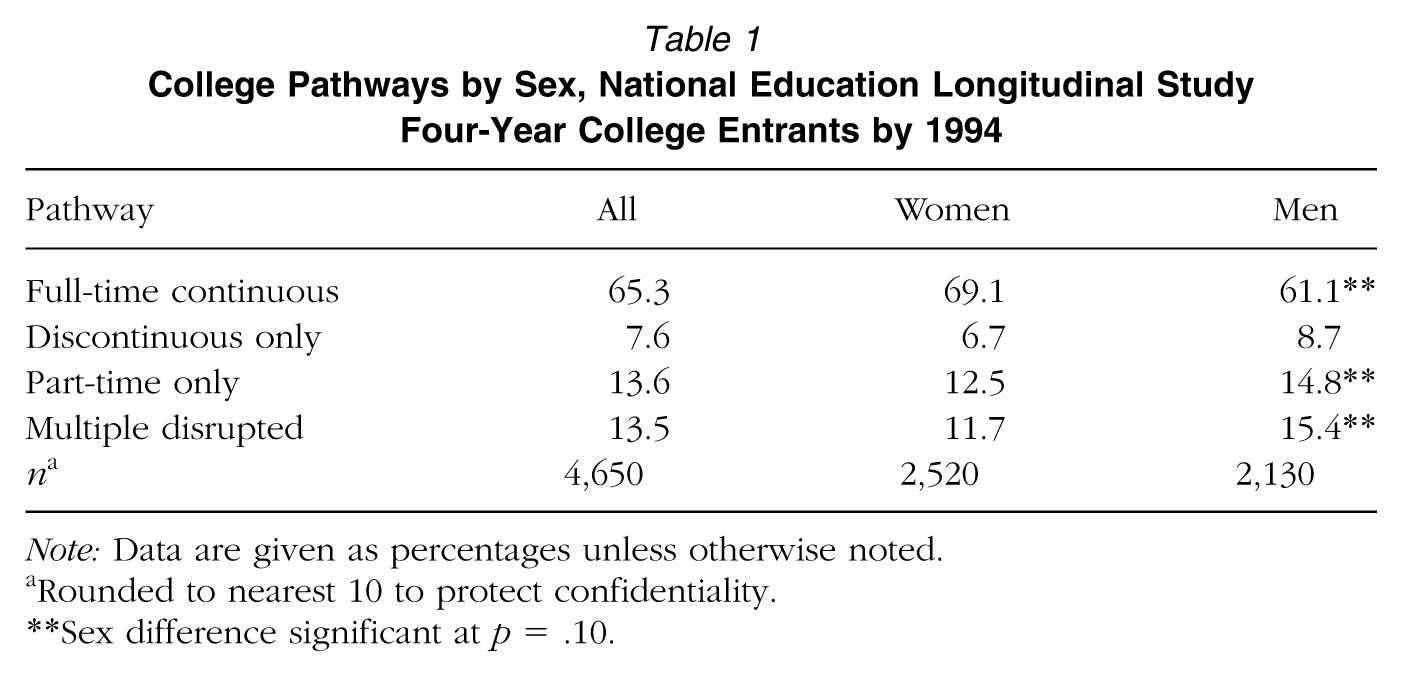
Table 1 reports sex differences in college pathways among students who entered four-year colleges by 1994. The majority of the sample (65%) followed a full-time continuous pathway. However, a significantly higher percentage of women than men did so (69% compared to 61%). A discontinuous pathway is rare, as 8.7% of men and 6.7% of women reported that they took time off at some point but never went part-time. A part-time pathway is more common than a discontinuous one, and almost 15% of men and 13% of women reportedly attended part-time at some point during college but never took time off. There are also significant sex differences in following multiple disrupted pathways, which includes a combination of discontinuous and part-time pathways in college. Over 15% of men reported going part-time and taking time off during college, while just under 12% of women did so.
College Pathways by Sex, National Education Longitudinal Study Four-Year College Entrants by 1994
Note: Data are given as percentages unless otherwise noted.
Rounded to nearest 10 to protect confidentiality.
Sex difference significant at p = .10.
These male-female gaps in college pathways are pervasive and are found regardless of race and ethnicity, SES, and high school academic performance. Figure 1 shows that the proportion of four-year college students following multiple disrupted pathways (discontinuous and part-time at some point) varies by race and ethnicity, such that Hispanic students have the highest rates of following this pathway. However, more men than women within each racial and ethnic group follow multiple disrupted pathways, except among Asian students. Figure 2 illustrates a negative relationship between high school academic performance and multiple disrupted pathways, since the proportion of students following this pathway decreases with rising high school GPA quartile. However, more men than women within each high school GPA quartile reportedly went part-time and took time off, showing sex differences in disrupted pathways among even the most highly performing high school students. Figure 3 further illustrates the pervasive sex differentials in college pathways, since more men than women within each SES quartile follow multiple disrupted pathways.
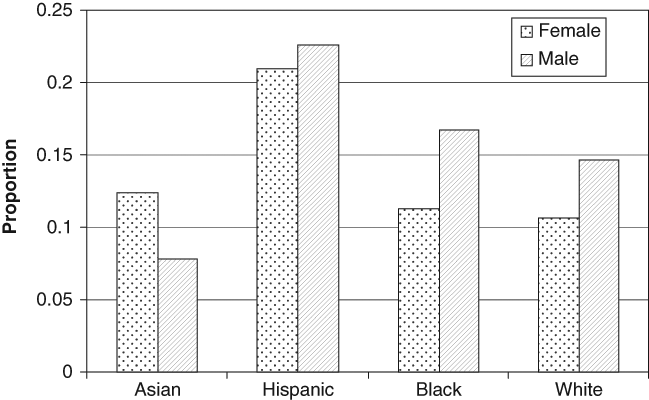
Proportion of students with multiple disrupted attendance by race.
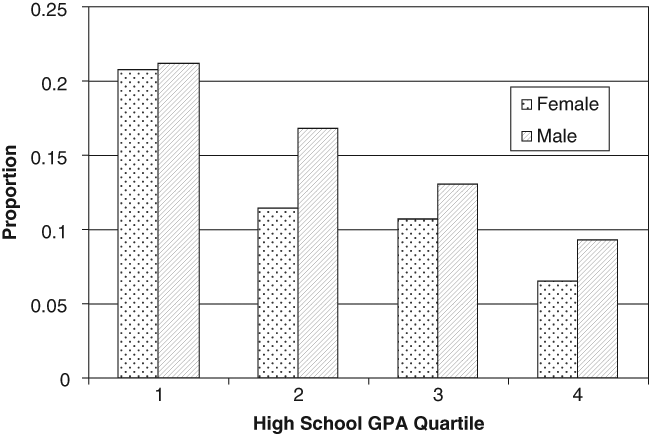
Proportion of students with multiple disrupted attendance by GPA.
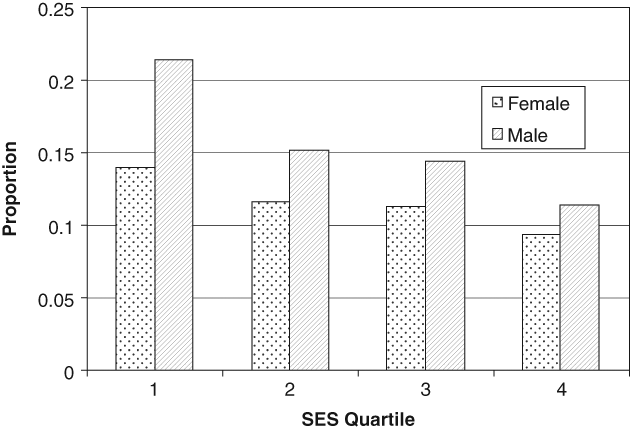
Proportion of students with multiple disrupted attendance by socioeconomic status (SES).
Table 2 reports the average values by sex of key independent variables, before imputing missing values, for the sample of students who entered four-year colleges by 1994. On average, men have slightly but significantly higher composite SES scores than women do, reflecting that fewer men than women enter higher education and so those who pursue postsecondary education draw from higher SES backgrounds. Since men are less likely than women to graduate from high school or enroll in postsecondary education, the men who do enter higher education are from more economically privileged families than those who do not. The support and resources these wealthier families provide may help their sons overcome the barriers to educational attainment facing men. A greater proportion of women than men go on to college, and so women in college draw from a wider range of SES backgrounds, including from low-SES backgrounds, than do men.
Frequency of Independent Variables by Sex, National Education Longitudinal Study Four-Year College Entrants by 1994
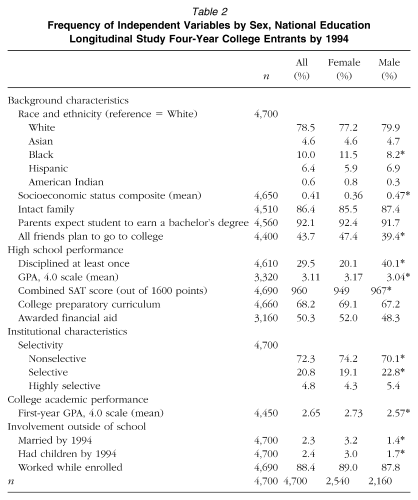
There are also significant sex differences in characteristics that are hypothesized to affect male-female differences in pathways, including high school academic performance. Women college entrants earned higher high school grades than comparable men, and the women in the sample had an average GPA of 3.17, while the men had an average GPA of 3.04. Men had higher average combined SAT scores than women did (967 compared to 949), which likely reflects men’s higher scores on the math portion of the SAT compared to those of women. There is a 20 percentage point male-female gap in high school disciplinary problems, as 40% of all men were disciplined at least once during senior year of high school compared to only 20% of women. These are underestimates of true sex differences in high school performance and behavior since men who attend college are more selective in terms of SES and ability than are women college entrants. However, to the extent that high school academic performance and behavior affect college pathways, these differences may account for portions of observed sex gaps.
There were no significant sex differences in financial aid awards. A smaller percentage of men attended nonselective schools relative to women, and so institutional selectivity may suppress the magnitude of male-female differences in pathways. Women earned higher first-year college GPAs than men did, potentially accounting for part of the sex difference in pathways. Although few students who went to four-year colleges married or had children early, more women than men did so. These sex differences in early family formation may suppress the magnitude of sex gaps in pathways.
The descriptive results show that the sex differentials in college pathways are pervasive and found across SES levels, quartiles of high school academic performance, and most racial groups, suggesting that deep underlying mechanisms contribute to these sex gaps. Furthermore, men and women vary on characteristics hypothesized to affect college pathways. Multivariate regression analyses will illuminate the mechanisms behind these sex differentials and show whether gaps remain net of the hypothesized underlying causes.
Multinomial Logistic Regression
Discontinuous pathway (never part-time)
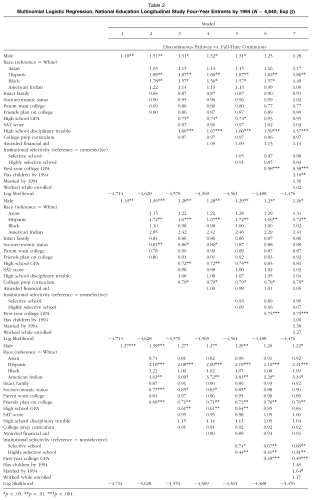
The first panel of Table 3 reports the multinomial logistic regression results for the odds of taking time off at some point versus following a full-time continuous pathway. The observed male-female gap in Model 1 shows that men are 49% more likely than women to follow a discontinuous path at some point versus a full-time continuous path. Net of background characteristics in Model 2, men are 51% more likely to report a discontinuous pathway. Model 2 represents the baseline model since it accounts for the higher average SES of male compared to female college students that results from sex differences in college enrollment.
Multinomial Logistic Regression, National Education Longitudinal Study Four-Year Entrants by 1994 (N = 4,640; Exp β)
p < .05. **p < .01. ***p < .001.
The inclusion of high school academic performance and behavior in Model 3 reduces the magnitude of the male-female gap in discontinuous compared to full-time continuous. Net of high school academic performance, men are 1.31 times as likely as women to follow discontinuous rather than full-time continuous pathways. This finding offers support for Hypothesis 1 that men are more likely than women to follow disruptive college pathways because their lower high school academic performance leaves them less prepared for college.
Financial aid awards and institutional selectivity do not affect the sex differential in discontinuous paths. Therefore, I do not find support for Hypothesis 2, that men’s enrollment at more selective schools suppresses the magnitude of sex differences in college pathways. In Model 6, college academic performance reduces the sex differential in discontinuous versus full-time continuous pathways and renders the sex gap nonsignificant. First-year college GPA affected the sex gap in the expected direction, thereby lending support to Hypothesis 3, that the higher college academic performance of women, which reflects a good fit between student ability and effort and institutional academic characteristics, partly accounts for women’s more continuous pathways relative to men’s. Students who earn better grades may be less likely to follow discontinuous paths because they are able to handle the rigors of college academics, so they fail less and receive more rewards at school because of their academic achievement. Some of the most poorly performing college students may take time off because they are put on academic probation or asked to leave by their schools.
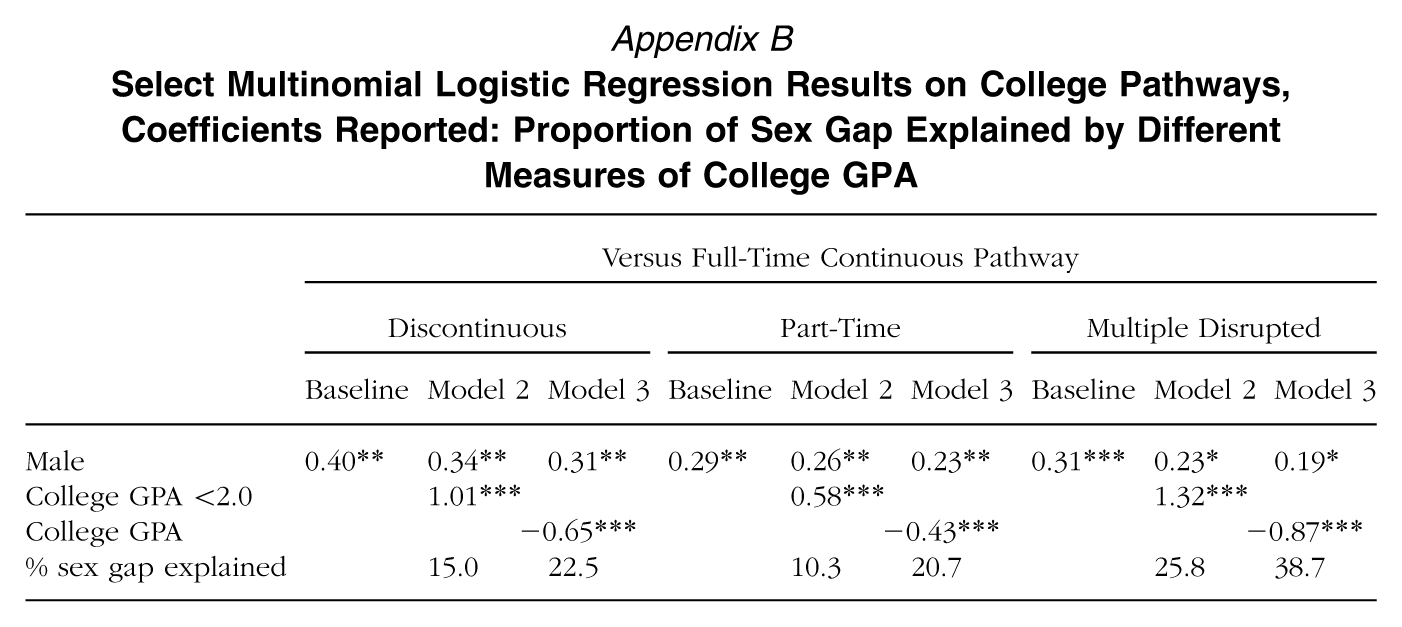
To test whether the sex gap in discontinuous pathways and the effect of college GPA on the this gap is primarily due to men involuntarily taking time off because of discplinary action for low scholarship, I ran supplemental multinomial logistic regression models including only sex and first-year college GPA as covariates. Separate models used two different measures of college GPA—a continuous measure of college GPA on a 4.0 scale and a dichotomous measure for having a GPA below 2.0. A college GPA below 2.0 puts students at risk of being placed on academic probation and possibly being asked to take time off by the institution. A 2.0 cutoff is appropriate since many schools place students on academic warning or probation after students earn below a 2.0 in a quarter or semester and suspend students if they do not raise their GPAs the following quarter. Therefore, it is possible that students with particularly low GPAs who took time off did so involuntarily because they were at least temporarily suspended by their institutions due to low scholarship. If the dichotomous measure of having a GPA under 2.0 explains the entire male-female gap in discontinuous pathways, these results would suggest that the sex differential in discontinuous pathways is driven by men being disproportionately likely to involuntarily take time off due to low scholarship. Appendix B reports the supplemental multinomial logistic regression results as well as the percentage of the male-female gap explained by each measure of college GPA. Having a college GPA below 2.0 explains 15% of the initial sex gap in discontinuous pathways. First-year college GPA (measured continuously), explains about 23% of the gap, showing that college academic performance overall and not just low scholarship affects sex differences. Furthermore, a significant sex gap remains net of college GPA below 2.0, showing that the male-female gap in discontinuous pathways remains above and beyond the effects of covariates that could be interpreted as men taking time off involuntarily due to low scholarship. The problems men face are broad, and disciplinary action for low scholarship only partly explains why they are more likely than women to follow discontinuous paths.
Although indicators of early family formation operate in the direction expected by Hypothesis 4, a significant sex gap does not reappear. Students who have children at young ages are more likely than others to follow discontinuous pathways, and so it appears that students who marry and bear children at young ages are more likely to temporarily forgo educational pursuits rather than balance the demands of school and family.
Part-time pathway (never discontinuous)
The second panel of Table 3 reports the multinomial logistic regression results for the odds of going part-time at some point versus following a full-time continuous pathway. The observed male-female gap in the first model shows that men are 33% more likely than women to have enrolled part-time at some point instead of full-time continuously. Model 2 shows that, net of background characteristics, men are even slightly more likely to follow a part-time pathway at some point.
High school performance partially accounts for the male-female gap in part-time pathways. Net of high school academic performance, the sex differential narrows, and men are only 28% more likely than women to enroll part-time at some point rather than full-time continuously. Over 20% of the male-female gap net of background characteristics in part-time pathways results from high school academic performance, further supporting Hypothesis 1, that men are more likely to follow disrupted pathways because they are less academically prepared for college.
Similar to the analyses for discontinuous pathways, financial aid awards and institutional selectivity do not significantly influence the male-female gap in part-time compared to full-time continuous pathways. However, first-year college GPA, net of high school performance and other background variables, further reduces the remaining sex differential in part-time pathways. Net of grades during the first year of college, men are 25% more likely than women to enroll part-time at some point. This effect of first-year college grades supports Hypothesis 3, that the higher college academic performance of women, which reflects a good fit between student ability and effort and institutional academic characteristics, partly accounts for women’s more full-time continuous pathways relative to men’s.
Early family formation does not affect the magnitude of the sex differential in part-time pathways. The competing demands on time that result from getting married or having children at young ages do not translate into a greater likelihood of going part-time at some point. The association between early family formation, particularly early childbearing, and discontinuous pathways, but the lack of association with part-time pathways, suggests that the students who marry and bear children at young ages are more likely to temporarily forgo educational pursuits rather than balance the demands of school and family. A significant male-female gap in part-time pathways remains net of all covariates in the model.
Multiple disrupted pathways
The final panel of Table 3 reports the multinomial logistic regression results for the odds of following multiple disrupted pathways (which includes discontinuous and part-time pathways at some point) versus full-time continuous paths. The observed male-female gap in Model 1 shows that men are 37% more likely than women to follow multiple disrupted versus full-time continuous pathways. Net of background characteristics, men are 39% more likely than women to follow multiple disrupted versus full-time continuous paths.
Similar to the determinants of discontinuous and part-time pathways, high school academic performance accounts for a portion of the male-female gap in multiple disrupted pathways, further supporting Hypothesis 1, that men are more likely than women to follow disrupted paths because they are less academically prepared for college. Net of high school academic performance, men are only 27% more likely than women to follow multiple disrupted instead of full-time continuous pathways. Financial aid awards are not associated with following multiple disrupted pathways or the sex gap in doing so. Although institutional selectivity increases the magnitude of the sex gap, as expected by Hypothesis 2, the change in the sex gap is not significant.
First-year college GPA further reduces the sex gap in multiple disrupted versus full-time paths and renders the sex differential nonsignificant. This finding further supports Hypothesis 3, that the higher college academic performance of women, which reflects a good fit between student ability and effort and institutional academic characteristics, contributes to women’s more full-time continuous pathways relative to men’s. The magnitude of the sex gap grows slightly and becomes significant again net of involvement outside of school. Therefore, women’s higher rates of early family formation suppress the extent of the sex gap in multiple disrupted pathways, lending modest support for Hypothesis 4. 3
A series of interactions between sex and various factors that might be expected to operate differently for men and women revealed a couple of interesting findings. The interaction between SES and being male was significant and positive for following a part-time pathway at some point. In other words, the benefit of higher SES on decreasing the likelihood of part-time pathways rather than full-time continuous pathways is not as strong for men as for women. Interactions between sex and high school GPA, attending a highly selective school, college GPA, and being married or having children within two years of high school graduation were not significant for any of the pathways.
Propensity Score–Adjusted Regression
These analyses focus on sex differences in college pathways. However, more women than men go to college, and so male college entrants are more select in terms of academic and social background compared to male nonentrants than are female college entrants compared to female nonentrants. Therefore, male-female differences in college enrollment may influence observed sex gaps in college outcomes such as pathways (Jacob, 2002). Supplemental propensity score–adjusted regression models included propensity scores for the probability of enrollment as a covariate. This adjustment models a random selection process into college by accounting for the college enrollment process and so factors out any possible effects of men being less likely than women to go to college. The propensity score–adjusted analyses show that controlling for the likelihood of enrolling in college does not change the magnitude of the male-female gaps in any of the pathways (results available upon request). Therefore, selection into college, and particularly men’s lower likelihood of enrollment relative to women’s, does not affect male-female gaps in college pathways.
Conclusion
The gap in college attendance and graduation between men and women was reversed in the 1980s and has continued to widen in recent years. In this article, based on longitudinal data from students who graduated from high school in 1992, I examine the gender difference in college pathways—whether men are more likely than women to take time off or go part-time rather than follow a full-time continuous pathway. The sex differentials in college pathways are significant and consequential since they contribute to the female advantage in college graduation. Sex differences in pathways through college are pervasive. Men are more likely to take time off and go part-time at some point than comparable women in all SES groups, all ability levels (indexed by high school GPA), and most racial groups (see Figures 1–3).
Sex differences appear to be of recent origin, since Hearn (1992) did not find male-female differences in part-time pathways among college students in the 1980s. The emergence of sex gaps may reflect an increase in the types and prevalence of disrupted college pathways in recent years. Some leading explanations for male-female differences in college pathways find little support here. Institutional selectivity does not affect the male-female gaps in the college pathways studied here, suggesting that sex differences in persistence behavior do not arise from differences in institutional characteristics such as resources and supports that might be more available at highly selective schools. This result is consistent with Conger and Long’s (in press) finding of similar sex gaps in college persistence across selectivity of institutions.
Furthermore, the results of this study provide only limited support for the hypothesis that factors outside of school that compete for students’ time—family obligations—shape the magnitude of sex differentials in college pathways. Women’s family responsibilities somewhat suppress the magnitude of the male-female gap in multiple disrupted pathways. Early family formation is associated with increased likelihoods of following discontinuous and multiple disrupted pathways but not part-time pathways, and so it appears that students are more likely to temporarily forgo educational pursuits rather than balance the demands of school and family. Although Anderson (1988) found that marriage had a significantly more negative impact on persistence through to college graduation for women compared to men in the 1970s, this relationship may have been attenuated in the past several decades as more opportunities developed for women to balance family and work roles (Goldin, 2006). It is important to note, however, that the small number of students who married or had children early limits the statistical power to detect any relationships between these variables and the outcomes.
The analyses identify high school academic preparation as a key variable that accounts for sex differences in college pathways, confirming Goldrick-Rab’s (2006) hypothesis that men follow more disrupted pathways than women do partly because men are less academically prepared for college. As is well known, academic preparation is a central factor in explaining persistence outcomes (Allen, 1999). However, this research extends our understanding of the scope of the influence of academic preparation by showing that it contributes to the production of sex inequality in college behavior—specifically pathways—that may ultimately limit persistence to graduation and various returns to college degrees.
Furthermore, first-year college GPA accounts for part of the sex gaps in pathways. The higher college academic performance of women, which reflects a good fit between student ability and effort and institutional academic characteristics, contributes to women’s more full-time continuous pathways relative to men’s. High college grades also reflect good academic preparation for college while in high school. Students who struggle academically early in their college careers may take time off or go part-time in order to reduce academic stress or pursue possible alternatives to college if their poor academic performance leads them to question their ability to succeed in college. Some of these students may involuntarily take time off if they are placed on academic probation by their schools, although this possible involuntary disruption does not explain the entire male-female gap in discontinuous pathways.
Since high school academic preparation and college academic performance are key determinants of the sex gap in college pathways, critics might argue that the greater male likelihood of following disrupted pathways is largely an issue of academic disadvantage early on rather than sex or college experiences. However, sex differences in disrupted college pathways abound for even the most highly performing high school students (Figure 2), and significant male-female gaps in some disrupted pathways remain net of high school and college academic performance, suggesting that the underlying reasons behind sex differences in persistence behavior are more complex.
What accounts for the unexplained male-female gaps in part-time and multiple disrupted pathways? The residual sex gaps may result from several unmeasured factors. Human capital theory would predict different persistent behaviors for men and women if the expected benefits of college completion varied by sex (Beattie, 2002; Becker, 1975). Scholars have documented higher returns to college degrees for women than for men (Altonji, 1993; Goldin, Katz, & Kuziemko, 2006), although Beattie found that women were less responsive to returns to school than were men in their schooling decisions. If higher returns to college degrees encourage women to be more committed to educational attainment, this underlying motivation and commitment may contribute to their full-time continuous pathways. Women’s higher grades in high school and college may partially reflect this motivation and commitment to educational attainment. Unmeasured indicators of goals or monetary concerns may also vary by sex and contribute to sex differences in pathways.
This study has several limitations. The data do not contain information on the length of time for which students took time off or went part-time or when during students’ college careers these disruptions occurred. If the underlying causes of disrupted pathways vary at the beginning and end of college, or if men and women differ on the sequencing of disrupted pathways, then these analyses would not capture the complexity of sex differences in disrupted pathways. Furthermore, although financial aid would be expected to affect disrupted pathways since students without sufficient financial aid might need to take time off or go part-time in order to work, this study found no association between financial aid awards and disrupted pathways. The data do not contain enough information to explore the effects of type or amount of financial aid, possibly biasing the results and underestimating the association between monetary concerns and disrupted pathways. More detailed measures of financial aid would likely reveal an association between financial aid and disrupted pathways. Furthermore, the lack of association between working while enrolled and disrupted pathways may reflect data limitations that do not permit the measurement of the consequential dimensions of work, including hours spent at work and whether employment was on or off campus. Therefore, this study likely fails to capture the true relationship between student work and disrupted pathways.
Despite these limitations, examining college pathways within the persistence framework usefully identifies factors associated with sex inequality in consequential disrupted college pathways and suggests several avenues for future research. This study follows Hearn’s (1992) foundational study of college pathways by measuring high school curriculum as enrollment in college preparatory curriculum. However, Adelman, Daniel, and Berkovits (2003) find variation in persistence by highest level of high school math course work, and so additional research that examines a broader range of measures of high school academic preparation will illuminate the process of how academic preparation affects sex gaps in disrupted pathways. Expanding the focus to additional pathways, such as transferring or simultaneously enrolling in multiple schools, would provide a more complete picture of the pathways that men and women follow through college. Furthermore, examining the prevalence and causes of disrupted pathways at two-year schools would help develop a more comprehensive understanding of college pathways since two-year colleges remain an important port of entry into higher education for low-income and minority students. Time series analyses that track changes in male-female gaps in pathways over time would illuminate trends in sex differences in consequential persistence behavior and could explore whether changes in college pathways over time contribute to changes in educational attainment across subgroups.
This study presented disrupted pathways as negative educational outcomes; however, it is important to keep in mind that some students might not have been able to pursue college at all had it not been for the option of taking time off or going part-time at some point in order to balance other needs. Consequently, the rise in disrupted pathways may have increased access to higher education for nontraditional students such as single parents, first-generation students, and financially independent students (Baker & Velez, 1996). Yet, the benefits of access to higher education are significantly reduced if the consequences of disrupted pathways are primarily negative and limit persistence to degree completion and so exclude students from reaping the main benefits of college—the economic and social returns to college graduation. Therefore, another important set of research questions relates to the consequences of disrupted pathways. Does the opportunity to follow disrupted pathways enable nontraditional students to balance the demands of school and other obligations and thus actually facilitate eventual educational attainment for some students? Do sex and social class differences in college pathways contribute to inequalities in educational outcomes such as persistence to degree completion and socioeconomic returns to college degrees? Incorporating college pathways as mediating variables into models of college student persistence would provide a helpful theoretical framework for studying such questions.
Academic performance and preparation are key aspects of full-time continuous pathways that contribute to college persistence, and so policies aimed toward raising persistence through to degree completion might fruitfully target adequate academic preparation in high school. The development of educational practices focused on creating more effective learning environments in high school that better engage struggling students might improve their academic preparation. Policies and programs at the college level could identify college students early on who struggle academically in order to provide them with additional supports that improve the fit between student ability and preparation and the academic demands of institutions. These policies would not target men specifically, but men would disproportionately benefit, thereby reducing male-female gaps in disrupted pathways and possibly graduation. Furthermore, schools could implement policies that require students who want to drop down to part-time status or take a semester off to first meet with academic counselors. Such meetings could provide an opportunity for students to discuss why they need to disrupt their college careers and to identify possible alternative solutions.
Although relatively small in magnitude, male-female gaps in college pathways are consequential since students who follow disrupted patterns spend more years in higher education, pay more in tuition over the long term, are less likely to graduate, and experience lower economic returns to their degrees.
Footnotes
Appendix
Select Multinomial Logistic Regression Results on College Pathways, Coefficients Reported: Proportion of Sex Gap Explained by Different Measures of College GPA
| Versus Full-Time Continuous Pathway | |||||||||
|---|---|---|---|---|---|---|---|---|---|
| Discontinuous | Part-Time | Multiple Disrupted | |||||||
| Baseline | Model 2 | Model 3 | Baseline | Model 2 | Model 3 | Baseline | Model 2 | Model 3 | |
| Male | 0.40** | 0.34** | 0.31** | 0.29** | 0.26** | 0.23** | 0.31*** | 0.23* | 0.19* |
| College GPA <2.0 | 1.01*** | 0.58*** | 1.32*** | ||||||
| College GPA | −0.65*** | −0.43*** | −0.87*** | ||||||
| % sex gap explained | 15.0 | 22.5 | 10.3 | 20.7 | 25.8 | 38.7 | |||
Acknowledgements
I thank Charles Hirschman and anonymous reviewers for helpful comments on earlier drafts of the manuscript.
This research was completed while I was a PhD candidate in the Department of Sociology at the University of Washington.
1
During the final wave of the National Education Longitudinal Study survey, respondents were asked to report their extracurricular involvement during college but were not asked to specify when they participated in the activities. Therefore, the data do contain sufficient information to determine when during their college careers students were socially integrated. In contrast, the data contain greater detail on the timing of academic performance by including college GPA during the first year and second year.
2
For example, missing values for high school GPA were imputed using a regression equation that included socioeconomic status, sex, high school curriculum, SAT scores, hours spent studying, and disciplinary problems in high school.
3
To test the sensitivity of the results to restricting the sample to four-year entrants by 1994, I replicated the analyses on students who entered four-year schools by 1996. The coefficients remain virtually unchanged, indicating the robustness of the findings to year of college entry