






Abstract
As suburbs racially change, they are increasingly a place where Latino students learn and Latino teachers teach. Latino-majority suburbs provide a strategic case to better understand how Latino and white educators make sense of race and place in the suburbs both when deciding where to teach and when engaging with Latino students and families. Drawing on interviews with 40 educators in a Latino-majority suburban school district in Texas, I demonstrate that narratives of choosing the district and narratives of Latino students and families varied by educator race and connection to place. Latino and white educators drew on their lived experiences as students, residents, and educators in the region to motivate their choice of district and inform distinct classroom practices.
Keywords
Introduction
Recruiting and retaining educators and providing a high-quality education to students of color are among the most significant challenges facing school districts in the United States and have been the focus of research for decades (Ingersoll et al., 2019; Ladson-Billings, 2006). Research on teacher labor markets has shown that educators often choose to teach in districts similar to those they grew up in in terms of urbanicity—a process that disadvantages urban districts and contributes to a predominantly white suburban teacher workforce (Boyd et al., 2005; Cannata, 2010; Reininger, 2012; Vernikoff et al., 2022). In addition, scholars have found that white educators often bring racialized stereotypes to the classroom (Lewis, 2003; Picower, 2009; Pollack, 2013) and that racial congruence, or the match between educators and students, is beneficial for students of color and can lead to increased purpose and satisfaction among educators (Bristol & Martin-Fernandez, 2019; Flores, 2017; Hart & Lindsay, 2024; Kohli & Pizarro, 2016). Taken together, this research suggests that both where educators choose to teach and how they engage with students and families have the potential to either reproduce or reduce educational inequality. In this article, I examine how these processes operate for Latino 1 and white educators in a Latino-majority suburban school district in a large metropolitan area of Texas.
As U.S. suburbs racially diversify, they are increasingly sites where Latino students learn and Latino teachers teach. As of 2020, 61% of Latinos in major metropolitan areas lived in the suburbs, and 41% of Latino educators taught in the suburbs (Frey, 2022; Taie & Lewis, 2022). As a result, racially diverse and diversifying suburbs have become an important focus of education research (Diamond et al., 2021; Lewis & Diamond, 2015; Tyler, 2016; Warikoo, 2022). Although some diversifying suburbs remain stably integrated, others experience racial turnover and become ethnic suburbs, or ethnoburbs, that are majority Asian, Latino, or Black. Ethnoburbs are suburban neighborhoods characterized by a concentration of co-ethnic populations and institutions, often including immigrant communities and ethnic businesses. Although similar to urban ethnic enclaves, ethnoburbs are located in the suburbs and are typically more socioeconomically diverse (Kye, 2023; Li, 2008). Arroyo, Texas (a pseudonym), a suburb of a large metropolitan area in Texas, and its school district, the Arroyo Independent School District (AISD), 2 provide a case of a racially changed Latino ethnoburb. AISD has a high concentration of Latino and immigrant students and a growing share of Latino educators. We know relatively little about this type of suburban school district or its teaching force, even though Latino-majority suburban school districts are increasingly common. These districts disrupt dominant narratives of suburban schools as majority white (Watson, 2012), generate demand for Spanish-speaking educators, and may buffer Latino students and parents from racialized stereotypes present in other suburban contexts (Lanari, 2023; Rodriguez, 2020; Tyler, 2016). As such, Latino-majority suburban school districts provide a strategic case for understanding how Latino and white educators make sense of race 3 and place in the suburbs, both when deciding where to teach and in everyday classroom practices.
Drawing on interviews with 40 educators, I find that educators’ narratives for why they chose to work in AISD and how they perceive students and families in Arroyo varied by educator race and their connection to place. Most Latino educators drew on their ties to Arroyo and their Latino identities to construct aligned narratives for choosing AISD, serving my community, and working with students and parents, relating to community. In contrast, white educators primarily described their district choice through narratives of job opportunity and shared more varied narratives of students and parents, ranging from emphasizing deficits to recognizing structural challenges. Latino and white educators who do not fit these broader patterns highlight the role that lived experiences in and connection to place play in shaping these processes. These findings offer insights into how educators draw on their racial and spatial identities when selecting school districts, point to staffing and professional-development reforms, and highlight the potential of homegrown Latino teachers to create affirming school spaces in Latino ethnoburbs.
Racial Mismatch and Racial Congruence
Teacher race and student racial composition shape where teachers choose to teach and how they perceive the students and families in their schools. Schools in the United States are racial institutions that reify whiteness through organizational practices (Ray, 2019) and interpersonal interactions among teachers, students, and parents (Lewis, 2003; Lewis & Diamond, 2015). Approximately 80% of public school teachers are white, whereas just 47% of public school students are white (Schaeffer, 2021).
This racial mismatch has consequences for both teachers and students. Research has found that white teachers “are more satisfied teaching in schools where the majority of students are white” rather than in schools where they experience racial mismatch (Renzulli et al., 2010, p. 43). In her study of race and schooling, Lewis (2003) found a deep hesitance among white teachers to name race outside of history class, preferring silence on race, rejecting its importance in school, and reacting with defensiveness when race was brought up. White educators’ hesitance to talk directly about race has been confirmed in a wide range of studies (see, e.g., Jupp et al., 2019; Pollock, 2004). Despite this race evasion, white educators adopt and articulate racialized stereotypes about and expectations of Black, Latino, and Asian students and their families, which leads to unequal academic expectations, disciplinary practices, and support and care (Lewis & Diamond, 2015; Ochoa, 2013; Pollack, 2013). These stereotypes reinforce deficit thinking. Deficit thinking, “the idea that students, particularly of low-SES [socioeconomic status] background and of color, fail in school because they and their families have internal defects, or deficits that thwart the learning process,” has a long history of pointing to genetics, cultural values, and family practices to blame students and families of color for their poor schooling outcomes rather than looking to “institutional structures and inequitable schooling arrangements” (Valencia & Black, 2002, p. 83). Research in racially diversifying suburbs has found that white educators hold deficit views of students and families of color and that these views are left unchecked when suburban districts respond to racial diversification by adopting colorblind approaches focused on instructional interventions rather than cultural responsiveness (Diem et al., 2016; Turner, 2020; Tyler, 2016; Welton et al., 2015).
Increasing the number of educators of color through hiring and retention efforts has long been understood as a way to contest deficit thinking and improve the schooling experiences of students of color. Educators of color have been found to serve as role models, hold high expectations, implement culturally relevant pedagogy, form caring relationships, and serve as agents of change who protect and advocate for students of color (Achinstein & Ogawa, 2011; Kohli & Pizarro, 2016; McKinney de Royston et al., 2021; Villegas & Irvine, 2010). Teacher–student racial congruence is often understood to operate through shared culture and lived experiences among teachers, students, and parents with similar racial and social backgrounds. This cultural synchronicity serves as a baseline from which educators of color can “use their insider knowledge about the language, culture, and life experiences of students of color to improve their academic outcomes and school experiences” (Villegas & Irvine, 2010, p. 185).
Although much of the research on teacher–student racial congruence has focused on Black educators (Hart & Lindsay, 2024; McKinney de Royston et al., 2021), the potential of racial congruence is evident in a small but growing body of research on Latino teachers (Bristol & Martin-Fernandez, 2019). Latino teachers are the fastest growing group of K–12 educators in the last 30 years, increasing from 69,000 in 1987–88 to 331,000 in 2017–18, and they make up the second largest group of K–12 educators nationally (Schaeffer, 2021). Latino teachers are concentrated in the South and West; 65% work in public schools where minority enrollment is at least 75%, and they work somewhat evenly in city and suburban schools, 43% and 41%, respectively (Taie & Lewis, 2022). There is ample evidence documenting deficit thinking towards the Latino community in U.S. schools (Lanari, 2023; Rodriguez, 2020; Tyler, 2016; Valencia & Black, 2002). Low expectations and stereotyping of Latino students and parents by middle-class white educators are institutionalized through practices of retention, academic tracking, surveillance, exclusionary discipline, and school push-out (Ochoa, 2013; Valdés, 1996; Valenzuela, 1999).
Research has found that Latino teachers take these negative schooling experiences and use them as motivation to teach, seeking to improve conditions for the next generation of Latino students and immigrant families (Flores, 2017; Irizarry & Donaldson, 2012; Ochoa, 2007; Weisman & Hansen, 2008). Given this goal, some Latino teachers illustrate a preference to work in their hometowns and communities, which are often cities, with Latino students and families with whom they can connect their own lived experiences and in schools where Latino educators are the majority and are united in their goal of serving Latino children and parents (Irizarry & Donaldson, 2012; Flores, 2011; Penn, 2021; Quiñones, 2018; Weisman & Hansen, 2008).
In the classroom, Latino teachers enact their roles in ways that reflect cultural synchronicity with Latino students and families and recognize their strengths. In her study of Latina teachers in California, Flores (2017, p. 65) found that once in the classroom, Latina teachers take on the role of “cultural guardians” for their Latino students and deploy “strategies in order to protect and help children they see as sharing their cultural roots.” These strategies include encouraging students to retain their home language, disrupting gendered expectations, supporting Spanish-speaking immigrant parents as they navigate the school, and sharing their own immigrant narratives with students in their classrooms. These strategies, informed by teachers’“working-class roots and immigrant backgrounds,” allowed them to build trusting, caring, and reciprocal relationships with students and families that Latino students and parents have long sought (Flores, 2017, p. 155; Valenzuela, 1999). The practice of Latino educators sharing their lived experiences with Latino students via autoethnography offers a pedagogic tool to counter deficit narratives, normalize migrant life, and name the knowledge, skills, and strengths within Latino immigrant families and communities (Jimenez, 2020).
This shared connection with Latino and immigrant students is not limited to Latino educators. Educators have been found to draw on other social identities—such as socioeconomic background and proximity to immigrants—to form a sense of shared connection with and responsibility for English learner (EL) students (Penn, 2021). This sense of shared connection shapes educators’ orientations toward and commitments to immigrant students, even in the absence of racial congruence. These dynamics are increasingly relevant in racially diverse suburban school districts that serve students not traditionally associated with suburbia. As suburbs become sites of immigrant settlement and racial change, educators’ understandings of and connections to place provide another facet of identity and lived experience to consider.
Place and the Urban–Suburban Divide
Places are not just physical locations; they are social contexts where people live their lives and develop a sense of place that shapes how they see, know, and understand the world (Cresswell, 2015). Accordingly, the places where educators grow up shape their perceptions and their spatial identities in consequential ways. Beyond individual experiences, imaginaries or narratives of place are also collective, and the positioning of places within broader spatial hierarchies—such as the urban–suburban divide—shapes shared understandings of those places and the schools within them (Mann & Dudek, 2024).
In the United States, suburbs were deliberately designed to expand single-family home ownership for white families. Because people of color were systematically excluded from the suburbs as they were built, suburban space became deeply intertwined with whiteness (Rothstein, 2017). White flight in response to school desegregation further reinforced this association, sharpening the urban–suburban divide along lines of race, school resources, student performance, and perceived safety (Rury, 2020). Together these processes produced racialized imaginaries of urban and suburban places and schools. Suburban schools are imagined as well resourced and safe, serving white, middle-class students outside city centers, whereas urban schools are imagined as under resourced and unsafe, serving Black, Latino, and low-income students in cities.
These imaginaries are powerful and consequential. Milner (2012) demonstrated that educators and school officials use the term urban to describe schools serving non-white, low-income students regardless of geographic location, including suburban and rural settings. Similarly, Turner (2020) found that as school districts racially diversify, urban imaginaries are invoked, generating fear that the district will become “like” urban districts and prompting efforts to retain white families. The urban–suburban divide thus functions not only as a spatial distinction but also as a racialized hierarchy that shapes perceptions, resources, and power relations, providing the “places for racism to take place” (Lipsitz, 2011, p. 5) in education policy and everyday interactions within neighborhoods and schools (Jenkins, 2021; Mann & Dudek, 2024). Through these processes, suburban schools are positioned as superior to urban ones.
The urban–suburban divide also shapes where educators choose to teach. Research has shown that educators’ lived experiences growing up in urban or suburban areas inform their employment decisions, with many selecting schools near their hometowns or in places similar in urbanicity (Boyd et al., 2005; Reininger, 2012). In a study of new teachers in New York State, Boyd et al. (2005, p. 127) found that 88% of teachers who grew up in urban areas began teaching in urban districts, while those from “suburban or rural hometowns strongly prefer to remain in those areas.” Interview-based research has highlighted the role of familiarity and comfort in these choices. Cannata (2010, p. 2914) found that prospective teachers often narrowed their job search to districts “that were ‘like’ those where they had previous experiences” in terms of race, class, and urbanicity. This preference for the familiar led many white candidates to avoid urban schools in favor of wealthier suburban districts. Hiring practices that prioritize local candidates and educators’ own pride of place further reinforce these patterns (Noonan & Bristol, 2020).
Educators’ lived experiences of place also shape the place-based knowledge and perceptions they bring into the classroom. Vernikoff et al. (2022) found that teachers who grew up in cities drew on their urban experiences as motivation to teach and used their place-based knowledge to support and connect with their students. Similarly, Alicea (2022) showed that teachers who had lived in South Central Los Angeles, where they taught, had deeper understandings of the community's geography and Black history than those who had not. In contrast, educators who grow up in the suburbs and teach in urban schools often rely on comparison rather than lived experience. Watson (2012, p. 987) found that white teacher candidates used their own suburban school experiences as the normative reference for interpreting urban schools, a process she terms “norming suburban.” Through this process, teachers framed urban schools, parents, and students as deficient relative to suburban norms, reproducing racialized and classed understandings of urban and suburban schools that reinforced existing spatial hierarchies.
As suburbs become increasingly racially and socioeconomically diverse, many suburban school districts no longer fit the traditional suburban imaginary of white and middle class. In Texas, for example, Latino-majority suburban school districts are increasingly common. In the 2021–22 school year, Latino students made up at least 50% of enrollment in 43% of large suburban districts (32 of 75). This diversification necessitates a reframing of suburban educational spaces to recognize heterogeneity and examine how parents and educators perceive and make decisions within racially changed suburbs (Diamond et al., 2021). Latino ethnoburbs are suburban communities with co-ethnic residential patterns, businesses, and Latino-majority schools. In these contexts, there is an opportunity to diversify the teaching workforce with local educators who bring distinct narratives about and lived experiences within the suburbs. At the same time, racial change may complicate the recruitment of white suburban teachers who perceive these districts as unfamiliar. Latino-majority suburban school districts therefore offer a strategic site for examining how educators’ racial and spatial identities shape the narratives they draw on when deciding where to teach and when engaging with students and families.
Framework: Cultural Toolkits and Narratives
In this article I draw on models of cultural sociology that reconceptualize culture as action (Swidler, 1986) to examine educators’ employment decisions and perceptions. From this perspective, culture is not understood as a set of values that cause outcomes but instead is conceptualized as cultural toolkits or stories, worldviews, habits, and skills that people draw on to construct strategies of action and inform decision making. Frames are the “lenses through which we ‘observe,’‘interpret’ and respond to social phenomenon” and are a part of individuals’“cultural toolkit for making sense of the world and for responding to different situations” (Warikoo, 2016, pp. 45 & 60). Narratives are stories constructed by individuals to make sense of “the past, present, and future” and to explain causal links between events (Harding & Hepburn, 2014, p. 58). Frames and narratives provide useful analytic tools to understand how individuals make sense of the world and how those perceptions shape their strategies of action.
Narrative frames have been used to understand how individuals choose, perceive, interact with, and navigate their neighborhoods. The narrative frames people hold are based on their lived experiences and comparison points. For example, residents of the same race and ethnicity in the same housing project can hold different narrative frames about their neighborhood based on their historical experiences in the neighborhood and the comparison points they use to assess it (Small, 2002; Tach, 2009). Narrative frames also vary by race, given the way lived experiences and institutional interactions are racialized. Bell (2020) found that Black and white residents in Cleveland drew on distinct frames—“police as a community amenity” versus “police as a public nuisance”—to discuss their neighborhood preferences, but nearly all respondents using a public nuisance frame were Black, reflecting different experiences with policing than white residents. Finally, narratives are not static. Rosen (2017, p. 275) showed that the narratives residents weave about why they moved to and how they navigated dangerous neighborhoods are “adapted to individual identities and experiences” and can change when violent events undermine them.
This conception of culture also has been used in education research to understand the perceptions and actions of both students and teachers. In her study of students at elite universities, Warikoo (2016) found that white and Asian students drew on different racial frames than Black or Latino students to make sense of race. Students brought race frames with them to elite colleges, which were shaped by “experiences in their families, neighborhoods, and primary and secondary schools” and developed new race frames or enhanced existing frames through new experiences in their university contexts (Warikoo, 2016, p. 60). In her study of charter school teachers, Golann (2018) analyzed how teachers’ cultural toolkits shaped not just their frames but also their practices. She found that when faced with a highly structured discipline system, teachers developed different strategies of action based on the alignment or misalignment of these disciplinary practices with their existing toolkits. Those who conformed to the system were able to implement it with ease and authority, while those who rejected school disciplinary practices often opted to move to school contexts where their cultural toolkits matched school expectations.
Narratives, frames, and toolkits—ways of understanding culture as action—have been used to examine how individuals choose, make sense of, and participate in their neighborhood and school contexts. Here I analyze how Latino and white educators narrate why they chose to work in the district (AISD) and how they carry out their work. This framework allows me to examine how narratives about place operate within the teacher labor market (employment decisions) and how narratives about students and families inform educators’ strategies of action in the classroom (classroom practices). Just as residents of the same neighborhood wove different narratives and held different frames based on their lived experiences and comparison points (Bell, 2020; Rosen, 2017; Small, 2002), educators working in the same district, at times the same school, tell different stories about the district and the students and families it serves, which, in turn, shape their everyday practices.
Data and Methods
This research adopts a qualitative case study approach focused on one Latino-majority suburban school district, AISD (Yin, 2018). This analysis centers in-depth interviews with 40 educators who chose to teach in the district. In-depth interviews were conducted from January to May 2022 and offer access to educators’ narratives about their decision to work in AISD, their perceptions of students and families, and their classroom practices.
The Arroyo Independent School District (AISD)
Arroyo, Texas, is a Latino-majority suburb in a large metropolitan area in Texas, and AISD is its school district. AISD has experienced dramatic racial change over the past 5 decades. In 1970, the district's student population was over 90% white; by 1990, it was 50% white and 40% Latino. By 2021–22, AISD served nearly 50,000 students: 80% of the students were Latino, 8% Black, and 5% white. The district also serves a high proportion of immigrant families—30% of the students are ELs—and 80% of the students are economically disadvantaged.
As the student population in Arroyo diversified and grew, the teaching workforce also changed. As shown in Table 1, the share of Latino teachers increased from 8% in 1990 to 18% in 2000, 20% in 2010, and 40% in 2021–22, the year of this study. This represents a 32 percentage point increase and a growth in the number of Latino teachers from approximately 170 to over 1,500. Although there has been progress in increasing the number of Latino teachers in AISD, it has not kept up with the increase in Latino students. In the 2021–22 school year, 80% of students were Latino, whereas 40% of teachers were Latino and 48% were white.
Demographic Composition of Teachers in the Arroyo Independent School District Across Time.
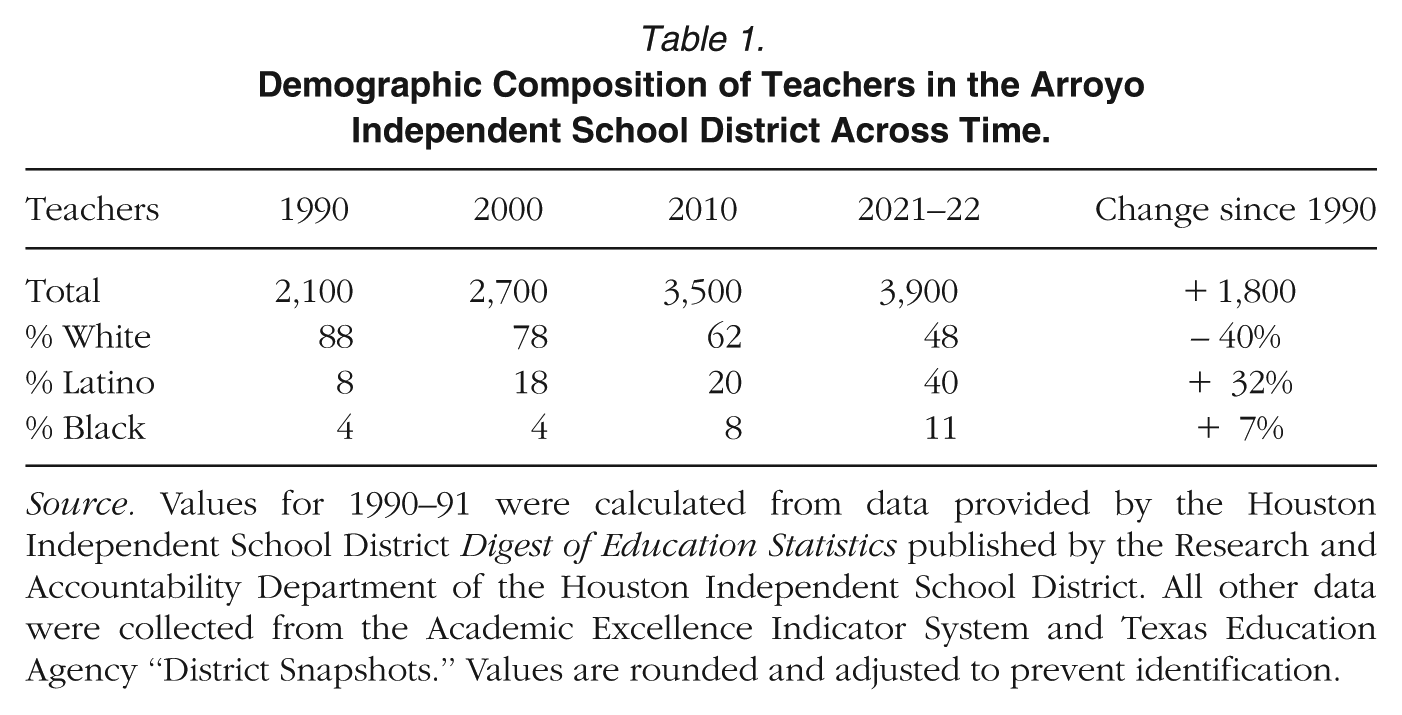
Source. Values for 1990–91 were calculated from data provided by the Houston Independent School District Digest of Education Statistics published by the Research and Accountability Department of the Houston Independent School District. All other data were collected from the Academic Excellence Indicator System and Texas Education Agency “District Snapshots.” Values are rounded and adjusted to prevent identification.
AISD’s size, student population, and teacher workforce set it apart from neighboring districts (Table 2). The central-city school district sits at the center of the metropolitan area and serves a student population that is roughly four times the size of AISD's student population. This district enrolls a higher proportion of Black students but has similar shares of ELs and economically disadvantaged students. Although smaller than the central-city district, AISD is larger than most neighboring suburban districts, which vary in size. With the exception of one neighboring district with comparable demographics, AISD's suburban neighbors enroll higher proportions of white students and lower proportions of ELs and economically disadvantaged students. Because employment decisions are made in context, school districts are perceived in relation to each other within the broader metropolitan area. AISD employs the largest number of Latino educators in the region after the central-city district, creating an opportunity to compare how Latino and white educators come to work in Arroyo and how they make sense of students and parents once there.
Comparing Demographics of Arroyo and Neighboring School Districts, 2021–22
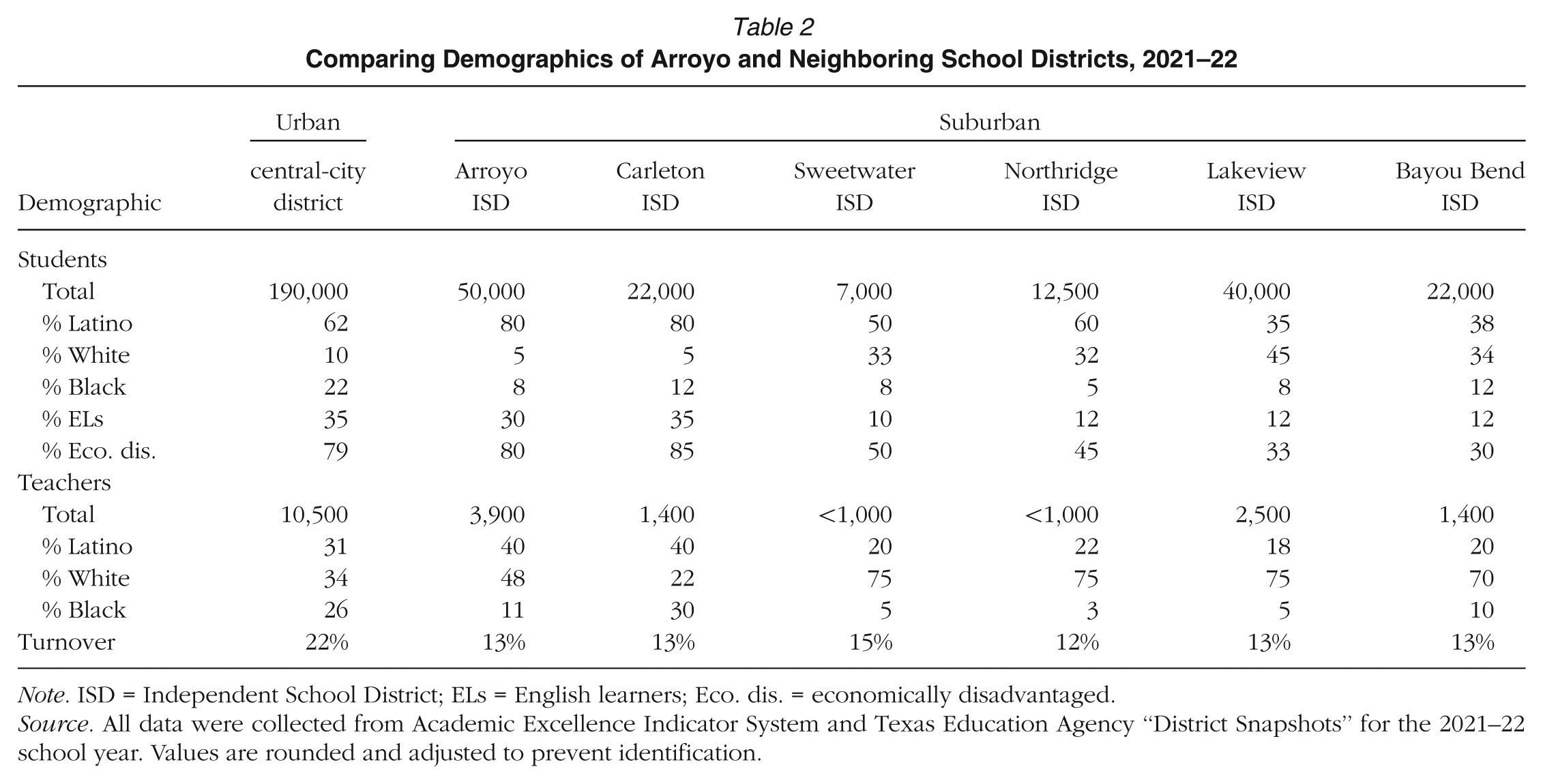
Note. ISD = Independent School District; ELs = English learners; Eco. dis. = economically disadvantaged. Source. All data were collected from Academic Excellence Indicator System and Texas Education Agency “District Snapshots” for the 2021–22 school year. Values are rounded and adjusted to prevent identification.
Recruitment and Sample
This study was conducted using a research–practice partnership model. I worked with the AISD research office to design the study and shape its initial focus (Arce-Trigatti et al., 2018). 4 Prior district research showed that students most frequently exited AISD during middle school, prompting district officials to seek a deeper understanding of the experiences of middle school students, families, and educators. As a result, the study centered on district middle schools. This emphasis allowed the study to examine educators’ narratives within a single school level rather than across elementary, middle, and high schools. It also highlighted educators who play an important role in supporting students and families during the academic transition from elementary school and the social transition into adolescence.
In collaboration with the AISD research office and district leadership, we identified four campuses reflecting geographic, demographic, and academic variation and invited school leaders to participate. Consistent with broader district patterns, these campuses served student populations that were at least 80% Latino and had a higher proportion of white teachers relative to the student population. In January 2022, I began visiting these campuses. At each school, I attended a staff meeting to introduce myself, describe the broader project, and invite educators to participate in interviews about their experiences working in the district.
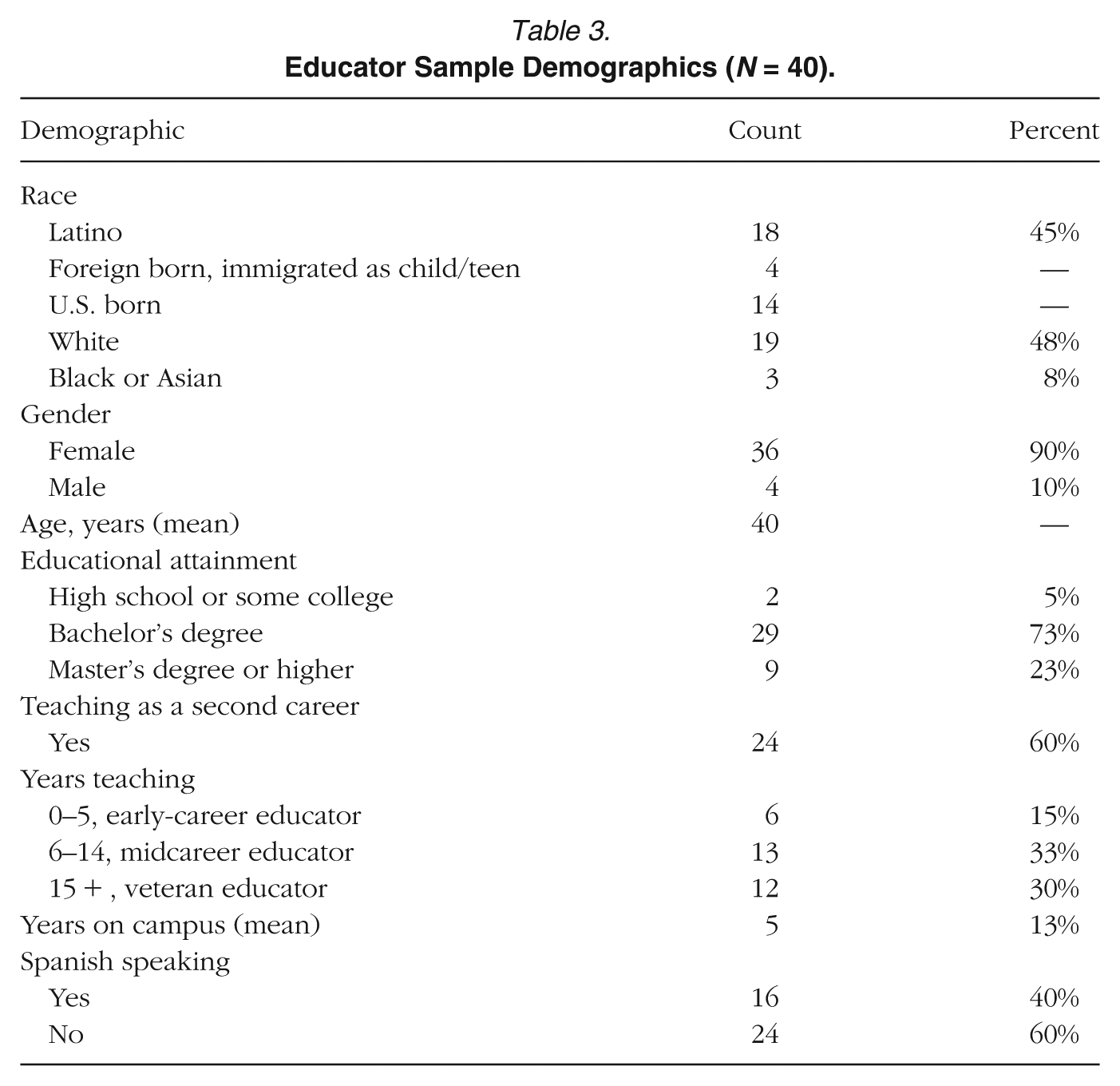
Forty educators participated in interviews, 10 on each campus. Participants varied by role, teaching experience, race, and language background (Table 3). I use the term educator because all participants were part of the school's educational mission. Most were full-time classroom teachers, whereas others held academic support, leadership, or community-facing roles. The sample was predominantly female (90%), and all classroom teachers held at least a bachelor's degree. Over half the participants entered teaching as a second career, and teaching experience ranged from early career to veteran educators. Eighteen participants self-identified as Latino (45%), 19 as white (48%), and three as Black or Asian (8%). Among Latino participants, four immigrated to the region as children or teens, whereas the remaining participants were born in the United States. Of the 18 Latino participants, 16 were bilingual, whereas no white educators in this sample reported speaking Spanish well enough to communicate with Spanish-speaking parents. As a result, this study does not allow for analysis of how race and language operate independently of one another or for a comparison with Spanish-speaking white educators.
Educator Sample Demographics (N = 40).
Data Collection
Educator interviews were conducted in person (25) or via Zoom (15) depending on participants’ preference and lasted, on average, 1 hour, ranging from 40 minutes to 2 hours. In-person interviews took place at focal schools in educators’ classrooms or other spaces provided by school officials, often during teachers’ prep periods or before or after school. Interviews followed a semi-structured format designed to balance an informal, conversational tone with consistent coverage of topics. Participants discussed their path to teaching; how they came to work in AISD and on their campus; their roles and typical workdays; their approaches to instruction, family communication, and student discipline; the joys and challenges of their job; the strengths and areas of growth on their campus; and their future plans. At the conclusion of each interview, I gathered demographic and household information, and each educator received a $25 gift card in thanks for sharing their time and expertise. Following interviews, I typed field notes about the interview setting, interactional dynamics, and prominent themes, which served as early case memos. All data were deidentified using pseudonyms, which participants had the opportunity to select.
Although educator interviews are the primary data source, I contextualized them through 40 hours of classroom observation, participation in family-facing school events, 70 parent interviews, and a districtwide survey of students and parents administered by AISD. Observations were used primarily to familiarize myself with each school context and understand how school days, campuses, and classrooms were organized. Although expanded and repeated observations could have provided deeper data on educators’ enactment of their roles, interview data align well with the narrative framework, which centers how teachers use and construct narratives to make sense of the world around them, their decisions, and their strategies of action.
Positionality
I am a U.S.-born, non-Latina white woman, and prior research has demonstrated that researcher identity—including race, gender, and professional status—shapes relationships with participants and the knowledge produced through qualitative research (Milner, 2007). My positionality as a graduate student and former middle school educator shaped how I entered the field, built rapport, and interpreted educators’ narratives. My prior experience teaching middle school was salient during recruitment and data collection; shared experience working with this age group facilitated rapport building and positioned me as familiar with school-based work. At the same time, I emphasized that I had not taught in AISD or in Texas and was eager to learn from their experiences. Interviews were designed around open-ended questions such as “How did you come to be an educator?” to decenter myself as the researcher and create space for participants to narrate their experiences in their own terms (Boveda & Annamma, 2023).
I shared a racial identity with some educators and not others. Although no interview question explicitly asked about race, apart from the final demographic form, discussions of school and district context often prompted conversations about race, class, and inequality. Latino educators spoke about their racial identity, immigrant histories, or experiences of discrimination, suggesting that racial mismatch did not, in and of itself, prevent discussion of these topics, although these accounts may have differed if I were Latina. Conversely, sharing a racial—and perceived middle-class—identity with white educators may have shaped how candidly they discussed their perceptions of Latino and low-income students and families. While I cannot fully disentangle the effects of my positionality from the data, I approached analysis by comparing educators’ accounts across interviews and identifying patterns as well as points of tension or inconsistency. To guard against unintended bias, I shared emerging findings and extended case write-ups with mentors and colleagues to solicit alternative interpretations of the same data, and I present educators’ voices through extended quotations so that readers can consider participants’ accounts alongside my interpretations (Milner, 2007).
Data Analysis
I analyzed interview data using an iterative and flexible coding approach, with support from an undergraduate research assistant (Deterding & Waters, 2021). We began with an index codebook of broad themes that aligned with interview topics and conceptual interests. We met weekly to review coding, refine definitions, and develop subcodes when patterns emerged or data did not fit an existing code. For example, within the index code “Choosing AISD,” we added the subcode “Compare to surrounding” to capture educators’ frequent comparison between AISD and neighboring districts in their choice narratives. We also recorded codes in a participant matrix to examine variation across campuses and educator characteristics.
In a second stage of analysis, I used the participant matrix and coded transcripts to focus on educators’ narratives of district choice and their perceptions of students and families. I re-listened to interviews and batch read transcripts, focusing on how educators explained their decisions, described their school contexts, and justified their practices. Through this process, it became clear that educators consistently drew on their lived experiences to frame their decisions and practices. To analyze these patterns systematically, I turned to Swidler’s (1986) conception of culture as action, which provided a framework for examining how educators mobilized narratives, frames, and cultural toolkits to make sense of their work and construct strategies of action. I then re-coded the data to identify recurring narratives that educators used to explain why they chose AISD and how they engaged with students and families. I also wrote thematic memos to consider variation within narrative categories and individual case memos to explore how educators drew on, combined, or resisted these narratives. This approach allowed me to identify patterns while recognizing nuance and variation across analytic categories and subgroups.
Narratives of choosing AISD and narratives of students and parents were not patterned by campus; in fact, educators with contrasting narratives often worked in the same school. However, narratives did vary systematically by educator race. Writing analytic memos alongside the matrix allowed me to examine high-level comparisons across Latino and white educators while also attending to variation within each group and identifying exceptions to broader trends. At several points in this article, I use proportions or percentages to describe how frequently particular narratives were used. These counts are not intended to imply homogeneity within groups or to produce population-level claims. Rather, they signal the relative frequency of narratives while preserving attention to internal variation. Throughout the findings, I pair these counts with extended, case-based discussion to illustrate the depth and variation within each narrative.
Findings
Narratives of Choosing AISD
When asked how they came to teach in the AISD, Latino and white educators provided different narratives for what drew them to the district. Over half the Latino educators in the sample (10 of 18) described choosing AISD as a way of serving my community, defined by their shared identity as Arroyo residents or as Latinos. In contrast, most white educators framed their district choice in terms of job opportunity (14 of 19) rather than identity, with a small group emphasizing the chance to teach students in need (5 of 19). Across narratives, educators contextualized AISD through comparisons with nearby districts and through their own experiences as students, residents, and educators in the region.
Serving My Community
The primary narrative used by Latino educators framed choosing AISD as a way of serving my community. Educators drew on their ties to Arroyo, their shared racial and linguistic identities, and their lived experiences as students in urban and suburban schools. As shown in Table 4, Latino educators in the sample had strong connections to Arroyo: 44% grew up in Arroyo, 61% lived in Arroyo at the time of our interview, and 75% of those with children enrolled them in AISD schools. Taken together, 83% (15 of 18) of Latino educators were alum, residents, or parents of AISD students.
Ties to Arroyo by Educator Race
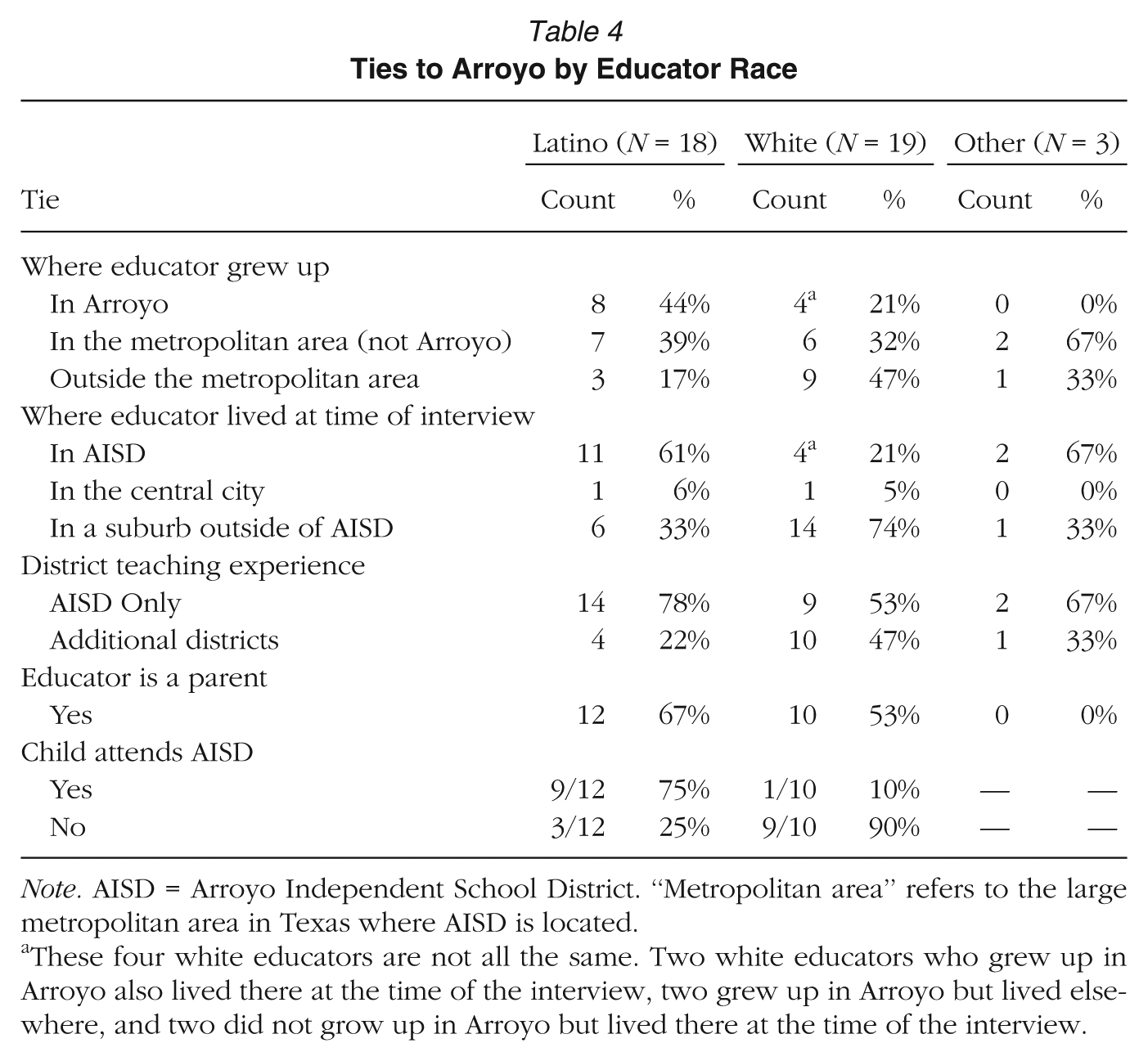
Note. AISD = Arroyo Independent School District. “Metropolitan area” refers to the large metropolitan area in Texas where AISD is located.
These four white educators are not all the same. Two white educators who grew up in Arroyo also lived there at the time of the interview, two grew up in Arroyo but lived elsewhere, and two did not grow up in Arroyo but lived there at the time of the interview.
Educators who grew up in Arroyo described their experience in AISD schools and their investment in the Latino community when describing their decision to teach in AISD. Ms. Herrera, a midcareer Latina educator, illustrates this narrative simply by saying: “I decided to teach in Arroyo because I wanted to give back to my community. I was raised in Arroyo and attended AISD schools.” Mr. Luis, a veteran Latino educator, similarly described returning to AISD as a form of reciprocity: “When I started teaching, I didn't even look at any other districts. I wanted to focus on Arroyo, which has done so much for me. It was a way of giving back.” Ms. Rodriguez, a midcareer Latina educator who grew up in and lives in Arroyo, echoed this in saying: “I was born and raised here. I love the community, and my passion is to help grow the community here.” When asked who this community was, Latino educators identified it as predominantly Hispanic or Latino.
For some alumni, programming provided by the school district facilitated this return. Ms. Rodriguez, for example, participated in a “2-year program” for high school students interested in teaching “where you get to get paired up with a teacher and she's your mentor.” This solidified her interest in teaching, and after graduating, she worked in the district as a tutor and aide as she worked toward her teaching degree. Mrs. Munoz, a midcareer Latina educator, began working for the district in high school as part of a co-op program offered by AISD and then became a teacher with district support: “The district had a teacher aide program to become a teacher . . . so that I could get financial help to become a teacher.” The first in her family to graduate from high school in the United States, she described this support as critical: “My parents didn't have very much information . . . so getting help from the district was needed at the time.”
For Latino educators who did not grow up in Arroyo, community was defined less by geography than by a shared Latino identity. As a child, Mr. Rivera, an early-career Latino educator, moved to the region from Puerto Rico, arriving first in Arroyo before moving to a nearby suburb. He applied to many districts when entering the teaching workforce during the COVID-19 pandemic but was excited to land in AISD: I knew that this was a high Hispanic population. And with my student teaching placement, I really enjoyed that, being bilingual [myself]. I get to use both of my languages, and I get to work at a school where none of the kids or the principal ever ask me how to pronounce my name—they just know [laughing].
His experience as an English learner (EL) shaped his goals for his students: “I came here knowing no English, and it was a struggle, but for me, the place where I was always successful was the art room. . . . art was safety, and now, I'm like, I want to give my students that.” Mr. Rivera's bilingual identity and experience learning English in U.S. schools informed his choice to work in a Latino-majority district and his desire to create spaces of safety for EL students.
Arroyo wasn't the only district where Latino educators could serve Latino students in Latino-majority schools; the central-city district is also majority Latino (62%). Yet, some Latino educators explicitly chose AISD over the central-city district as a place to serve Latino students because of their own negative schooling experiences in the city. Ms. Martinez, a midcareer Latina educator, immigrated from Mexico as a child and enrolled in the central-city district. She shared: “It was the most difficult experience in my life. I didn't speak the language, and I felt dumb. The teacher wasn't available at all.” This negative experience inspired her to teach: I remember clearly thinking as a little girl, I wish somebody would come talk to me and ask me, “Are you okay? Do you need help?” I would have said, “No, I'm not. Help me,” you know? But nobody did. And I'm like, I could be that person. I want to be the change.
With this goal in mind, she pursued a degree in bilingual education. After being assigned to AISD for her student teaching, she was amazed to see the difference across district lines: I felt safety in Arroyo, and that was a big thing that I never felt in [the central-city district]. I felt most of the teachers cared about their students, where in [the central-city district], it felt like, “You don't belong to me, and you will be gone next year, so I don't really need to put in any effort.”
Ms. Martinez chose to stay in AISD. She explained: “I would never go back to [the central-city district]. I love Arroyo. I felt very accepted, understood, heard, and safe. And I know I'm an adult, but I needed that growing up. And now I have that.” This contrast between the central-city district and AISD reflects broader discourses of safety and school quality across the urban–suburban divide but is grounded in Ms. Martinez's experiences of structural inequality as a student and educator.
For most Latino educators in the sample (14 of 18), AISD was the first and only district they had taught in; Ms. Nicolasa, a veteran Latina educator, returned to AISD after teaching in the central city because she felt more effective working with Latino students and families given her own cultural background. In the central-city district she taught at “a school that was basically African American” and didn't feel prepared to serve that student body: It was just another world. It is another system. It requires a lot of understanding of their culture, which I wasn't exposed to. Not that I couldn't do it, but I wasn't exposed enough to deal with those kinds of problems. Totally different than Hispanic problems.
Her own lack of exposure to Black culture and the Black community limited her effectiveness and ability to build trusting relationships with Black parents: It was like we're the enemies. What are you doing to my child? My child doesn't act up like that at home. It's you, you're discriminating because you're different, you know? So that took a lot of me, . . . and I started wanting to come back to Arroyo.
This experience of racial mismatch ultimately motivated Ms. Nicolasa to exit the central-city district. 5 Ms. Nicolasa moved from an urban to suburban district not in search of whiteness but in search of racial and cultural congruence. AISD, a suburban district that is 80% Latino, illustrates how ethnoburbs can create suburban districts where Latino educators seek racial match and professional belonging. At the same time, choosing AISD over the central-city district reinforces spatial hierarchies that position suburban school districts as safer and more supportive than urban ones.
Over half the Latino educators in the sample (10 of 18) employed a serving my community narrative to explain their choice of AISD. For this group, the racial composition of AISD—that is, the fact that it is a district that serves Latino and immigrant students—was a consideration discussed in choice narratives. These educators drew on their racial, linguistic, and place-based identities and framed Arroyo as a place where they could serve their community.
Job Opportunity and Students in Need
In contrast to Latino educators, most white educators did not draw on their own identities in their choice narratives and rarely named the race of students or families explicitly when discussing their decision to work in AISD. About three quarters of the white educators (14 of 19) employed a narrative of job opportunity to explain how they came to work in AISD, and one quarter (5 of 19) framed AISD as a place to serve students in need. Across both narratives, white educators constructed opportunity and need relationally.
Educators described choosing AISD because it offered professional opportunities that other local districts did not. Just over half the white educators (10 of 19) had worked in other school districts prior to moving to AISD, allowing them to draw explicit contrasts across district lines. The district's large size, with nearly 50,000 students and 4,000 teachers, was described as facilitating mobility and advancement. Ms. Canogra, a veteran white educator, grew up in Arroyo and attended AISD in the 1960s but lived in a neighboring suburb at the time of our interview. Despite her ties to the district, she did not employ a serving my community narrative when explaining her decision to leave a neighboring district and teach in Arroyo. Instead, she emphasized professional opportunity, explaining, “Arroyo is a really big school district, and so there are a lot of opportunities here for teachers and there's a lot of different positions.” Mr. Wozniak, a veteran white educator who came to the region later in life, described coming to AISD from a neighboring school district so that he could use his school leadership degree: “I came to Arroyo because I had exhausted opportunities at Lakeview ISD. They saw me as a high school teacher, and I was ready for a change. From my experience, the opportunities to move up and advance were not there.”
White educators also noted the benefits and resources that AISD provided to teachers. Ms. Walsh, a veteran white educator who had worked in multiple districts across the region, explained: What drew me originally to the district was salary. . . . What brought me back is they always had the curriculum together here. In Arroyo, we just have a plethora of resources. Whatever I need, I can pick up and go with it.
A high level of professional development and support was also a draw. Ms. Davies, a midcareer white educator, shared: “My mom had already been working here for a long time . . . so I knew that AISD offered really great new teacher support, which was different than Carleton ISD because I didn't have that [there].”
While Latino educators drew on their ties to Arroyo and the Latino community it served in their district choice narratives, white educators in the sample had fewer connections to Arroyo. Just under one third (6 of 19) of the white participants were AISD alums, residents, or parents of an AISD student, and most (14 of 19) lived in outlying suburbs and commuted into Arroyo (see Table 4 for details). For some, this separation was intentional. Ms. Lewis, a midcareer white educator, paused when I asked her about Arroyo and then responded: “Well, I teach here, but I don't live in Arroyo. I live in Westgate, which is very similar to where I grew up.” She continued: “I never wanted to work where I live, just because I kind of like the separation of I can go to the grocery store and not have to have a parent conference.” Whether intentional or not, this spatial distance limited many white educators’ familiarity with and ties to Arroyo and may help explain why white educators in this sample offered choice narratives focused on job opportunity rather than a sense of shared community with the students or the communities the district serves. 6
A smaller group of white educators (5 of 19) provided narratives that centered the student population in their choice of AISD and framed AISD as a place to serve students in need. These educators spoke of need in terms of socioeconomic status, district resources, and “demographics,” all of which were discussed relationally to other local districts.
Working in Arroyo allowed white educators living in the suburbs to work with students they perceived as having greater needs than those in the suburban communities where they lived. Mrs. Simmons, a midcareer white educator, shared: “So my three kids went to Lakeview ISD, LISD. I never really considered teaching in Lakeview because I wanted to teach in a district with more at-risk students.” She drew on her own socioeconomic background to motivate this choice: “I personally grew up very low socioeconomic[ally]. And so those are the kids that I was more interested in.” Given this goal, she purposefully narrowed her search: You can publicly look up the demographics of students—what I base mine on is the percentage of students who receive a free lunch—and Arroyo had that demographic. . . . Nothing against, like my kids go to LISD—we’re upper middle class, thank the Lord, but I just felt that my talents could be better used in a district that's not like that.
Mrs. Turner, a midcareer white educator who grew up in and attended Lakeview ISD, spoke of income alongside demographics when asked what drew her to AISD: The main reason was the diverse demographics. After substituting in LISD, I found myself looking at districts that had more diverse demographics or socioeconomic deficiencies. . . . I felt those kids needed me more, that I could do more good.
These white educators spoke of teaching students in need in AISD as aligning with their personal goals and maximizing their impact.
Working in AISD, a suburban district, also allowed some white educators to serve students they perceived as in need without entering the urban center. When asked why she chose to work in AISD, Mrs. Wilson, an early-career white educator and Arroyo resident, explained: The motivation here, in this district, is there are students that really need your help. I could go work in Northridge down the road, but most of those kids know how to work and behave—they don't need my help.
Importantly, Mrs. Wilson framed the need and demographics in Arroyo as manageable and familiar in contrast to the central city. She explained: I knew I didn't want to work in [the central-city district]. It scared me. I mean, it's hard teaching here with the dynamic we have here, the demographic we have going on. But if you go further into the urban areas, it gets even rougher. So it intimidated me. . . . It didn't intimidate me as much coming to Arroyo because I've lived here for so many years. I was used to the people here.
When asked to clarify the “demographic going on in AISD,” she confirmed, “mostly Hispanic.” Unlike Latino educators who exited and avoided the central-city district due to their own experiences of marginalization as students, Mrs. Wilson's avoidance was rooted in her perceptions of urban space and urban youth as intimidating and unfamiliar.
Latino and white educators provided distinct narratives for why they chose AISD. Latino educators, who had stronger ties to Arroyo, drew on their lived experiences and racial identities to frame their choice as a way to serve the Latino community. In contrast, white educators’ narratives centered on job opportunity, with some framing AISD as a place to serve students in need. Across both groups, educators understood AISD relationally—positioned between neighboring suburbs and the central-city district—as an in-between space within the urban–suburban divide. For white educators, this positioning shaped narratives of opportunity, safety, and student need. For Latino educators, it emerged through a desire to serve Latino students while avoiding districts associated with past marginalization. Although motivated by different logics, these choices reproduced spatial hierarchies that positioned suburban districts as preferable to urban ones.
Narratives of Working in AISD
Narrative Alignment Among Latino Educators
For Latino educators in this sample, narratives about students and parents were often closely aligned with their narratives for choosing AISD. They described students and parents as part of their community and drew on their cultural toolkits to relate to Latino students and parents. When relating to community, Latino educators offered narratives grounded in their own lived experiences of schooling, immigration, and family life to relate to and affirm the realities of students and families. These narratives informed how educators approached instruction, discipline, and family engagement.
Latino educators drew on experiences from their own lives to relate to their students and spoke of how those perspectives shaped their classroom practices. Mr. Luis, a Latino educator who grew up in Arroyo and attended AISD schools, reflected on how schooling shaped his trajectory: Coming from my background, my parents only went to third grade in Mexico, and my family always spoke Spanish at home, but teachers guided me through the bilingual program, and I started learning the language and doing well in academics.
As a bilingual science teacher, he had the opportunity provide similar support to his students who were “predominantly Hispanic” and “on the lower socioeconomic end.” His own childhood experience informed his efforts to expose his students to science through hands-on learning: A lot of the students that we serve here, their families work a lot. I see myself in them because when I was younger, my dad and my mom were always working. They didn't have time to take me to museums, the zoo, or NASA because they were so busy. I see that with a lot of my students, so I try to expose them to some of those learning situations here in class. I try to do labs, anything to make it hands-on or interactive.
Mrs. Delgado, an early-career Latina educator and AISD alum, similarly drew on her experiences as a student to guide her approach to discipline. Rather than relying on office referrals, she emphasized relationship building: I’m honestly not big on writing up kids. I probably could write up a kid every day, and I choose not to. I know all teachers are different, but I'm very big on talking to the kid. I'll be like, “Let’s go outside.” And they already know they're going to hear a speech from me. That's where I try to get more information, like, “All right, what's going on? Why do you have an attitude, or is there something you want to talk about?”
As a former “wild child” who “never liked school,” she used her own history to connect with students and normalize their struggles: “I do tell them, you know, ‘When I was your age, I was unmotivated.’ I let them know and give them my take.” These Latino educators leveraged their lived experiences to relate to their students. They didn't blame Latino parents for working long hours or describe Latino students as out of control and in need of an office referral; instead, they recognized familiar experiences and adapted their classroom practices accordingly.
Latino teachers who taught in bilingual classrooms often drew on their own experiences as bilingual students and adults to affirm their students’ linguistic identities. Ms. Martinez, the Latina educator who had a negative schooling experience as a student in the central-city district, shared her own experiences with students to encourage risk taking: “I tell them, ‘When I went to school, I did not even want to answer questions because of my accent. . . . I was embarrassed to say things wrong, but I shouldn't have been.’” These experiences informed her goal of creating a “safe environment where they can make mistakes and grow.” Although her instruction was primarily in English, Ms. Martinez consistently emphasized the value of Spanish: I always try to make them feel proud that they speak a different language and understand that it is a skill. . . . I'm like, I speak Spanish. My mom doesn't speak English, guys. I speak full Spanish to my mom. . . . I tell them, go home, practice with your parents and grandparents . . . [and] don't forget your Spanish because you will use it in the future.
By sharing her own experiences, Ms. Martinez normalized students’ struggles and affirmed the value of being bilingual (Jimenez, 2020).
Latino educators largely spoke of Latino parents as partners in their children's education who deserved proactive communication. Ms. Rodriguez, a bilingual Latina educator who grew up and lived in Arroyo, emphasized frequent outreach to families through the school communication app: “I message my parents this is happening, we have this event, we have tutorials. . . . If I was a parent, I would want to know what was going on. So I do that for my parents.” She believed keeping parents in the loop mattered and drew on her own identity and experiences growing up in a Latino immigrant family to describe why: I think that it makes them feel valued, and it makes them feel part of their child's learning. I mean, I'm Hispanic myself, and I know my parents—my mom was really involved. My mom actually does know English, but a lot of her friends don't, so my mom is their middleman where she helps them communicate. So I know the Hispanic community, and I know that they want to be involved.
Speaking Spanish facilitated this connection: “A lot of times, parents are afraid to call and ask how their child is doing because they don't think the teacher is going to know Spanish. Once they know that I speak Spanish, it opens up the gates.”
Many Latino educators in the sample were also parents in the district and drew on this shared positionality to relate to and support families (see Table 4). Mrs. Morales, a veteran Latina educator and an AISD alum, parent, and resident, described sharing information about community resources and opportunities based on what had benefited her own children. She understood her ability to relate to parents as a benefit: I do tell them my experiences. This is what I do with my kids, and this is what I did with my oldest. And I think they like to hear that, and they like to hear it from someone like them. You know, I am not somebody that comes from a rich family. I am somebody that came from somebody that worked as a custodian, that was a single parent, that had to raise children all on her own. And yet, here I am, putting my kids through college, giving them better opportunities so that they can be more than us.
This goal of offering her children more reflected messaging from her own mother, an immigrant from Mexico, and resonated with parents at her school. Mrs. Morales's use of “us” highlights the way she understands herself as part of the community—a point she reiterated when describing her decision to work in AISD: “I’ve talked to teachers here, and a good portion of them are in the same situation [as me]. This is my community. This is the community I serve.”
Although Ms. Rodriguez and Mrs. Morales spoke Spanish fluently—facilitating communication with families—shared language alone did not motivate their practices. Instead, they drew on their lived experiences in similar social positions as students and parents to understand families’ needs and inform their strategies of action. As Mrs. Morales explained, this shared positionality made her guidance resonate because it came from “someone like them.”
Latino educators’ narratives about choosing AISD aligned closely with their narratives about working with students and families. In relating to community, they drew on lived experiences in similar social positions to inform practices that affirmed students’ racial, cultural, and linguistic identities as assets.
Narrative Variability Among White Educators
Instead of relating to Latino students and parents, white educators offered more varied narratives about the students and families they served. Some narratives centered on emphasizing deficits and what students and families lacked, whereas others centered on recognizing structural challenges shaping families’ lives. This variation illustrates the persistence of deficit thinking and the possibility for narrative change through experience.
The narrative of emphasizing deficits focused on what educators perceived as missing or wrong with students, parents, and neighborhoods in AISD. Consistent with prior studies of white educators in diversifying suburbs, this narrative attributed in-school challenges to the values and parenting practices of low-income, non-white families (Tyler, 2016). Ms. Canogra, the veteran white educator and AISD alum who lives in a neighboring suburb, described her school community like this: I think, in this school in particular, it is extremely low income. Most of our parents are immigrants. Many of our parents and students are illegal,
7
and they don't associate with the school. They don't value education. You would think they would—and some of them do, I'm certainly not speaking for all of them. But I would say there's a big problem with apathy in this neighborhood. And there's a lot of challenges. Any time that you're dealing with lower-income students, I think there's a higher gang rate, there's higher drug issues.
Although she offered a caveat, Ms. Canogra drew on income, parental nativity, and documentation status to assert that Latino parents “don’t value education,” a persistent belief central to deficit thinking (Valencia & Black, 2002). This sense that parents weren't invested in their children's education was reinforced by her low level of engagement with families. Although annual meetings were required for students in her program, attendance was low, as she explained: “This year, I've maybe met with four parents, mostly by phone. If they don't participate, we'll just have the meeting and send home the paperwork.”
Educators drawing on deficit-based narratives also framed student behavior as a product of home life rather than school context. Ms. Walsh, the veteran white educator who came to Arroyo seeking opportunity and better pay, blamed challenges with discipline on changing demographics. She shared: “I’ve seen quite a few fights on campus, and I think a lot of that has to do with the area of town and the demographic we're dealing with. I think maybe they're emulating what they see at home.” When asked what this demographic was, she responded: “It’s predominantly low SES. I would think it's a high Hispanic population, a lot of single moms, so a lot of the kids don't have dads at home, or they have dads at home that shouldn't be at home.” Ms. Fern, a white educator in her first year in the classroom, shared a similar understanding. When she applied to AISD, she was aware of a language and race mismatch between herself and students: “My thing is I'm from Nebraska. I didn't take Spanish in high school, and this school is 94% Hispanic. And they knew. I told them in interviews I don't know any Spanish, none.” Once in the classroom, she relied on bilingual students to translate for their peers and shared that she was struggling to manage student behavior: “I’ve had students that have called me curse words in Spanish or attempted to hit me, and they barely got a consequence.” She described the cause of student behavior like this: I think it's just because we're in a lower socioeconomic status [area], more parents have anger issues that their kids learn and get. It's unfortunate that it happens in some districts more than others, and it's happening in this one.
When educators understood school challenges as originating from families, responsibility for change shifted away from schools and teachers. When I asked Mrs. Wilson what she thought could be done to improve students’ experience on campus, she pivoted to families: Parent participation, parent involvement. Parents have to be involved in their kids’ lives in order for them to be successful, because if the parent doesn't put that pressure on them [pause]. They don't always listen to me. You know, I can do my best, but if a kid doesn't have it within them to push themselves and the parents are not going to push him, I fear they get lost by the wayside.
Educators who drew on deficit-based narratives often attributed in-school challenges to the values, parenting practices, and family structures of low-income Latino families rather than to classroom or institutional conditions. This narrative shifted responsibility away from schools and teachers. If families were understood as the source of the problem, it limited what educators saw as their role in addressing those challenges.
However, not all white teachers engaged in these deficit-based narratives. A second narrative centered on recognizing structural challenges that shaped students’ and families’ lives—such as limited childcare, long work hours, precarious documentation status, and limited formal education—rather than attributing school challenges to family values or attitudes.
Mrs. Perkins, a veteran white educator and longtime resident of Arroyo, understood these structural challenges through her interactions with students and families rather than her own experiences growing up in the area in the 1970s. She spoke of how Arroyo had changed: It’s actually turned very urban. It's gotten so big now and we have a mix of kids, some very low socioeconomic kids. My high school was probably sixty percent Caucasian, thirty-nine percent Hispanic, and we had like one or two Black students. Now, it's one hundred percent Hispanic and Black. So it's just been a changeover from being a suburb.
Although she understood Arroyo and AISD as more urban than in the past, due to its increased size and share of low-income students of color (Milner, 2012), Mrs. Perkins wasn't upset about this change; it was simply a new reality. Growing up, in her words, “so middle class,” she found many of her students’ experiences eye-opening: I had a student my first year of teaching. He was absent every single Monday. I would ask him, “Why are you absent?” And he wouldn't tell me. Then finally he said, “I have to babysit my brother and sister. My mom works, and on Monday, there's no sitter.” That's real life. I mean, how are you going to fault him for that.
She similarly learned about parents’ long work hours through her interaction with students: “I ask, when does your mom get home? I'm going to call her. She gets home at 9:30. Wow.” She continued: “So it's just very different. . . . when I was growing up, PTA or Open House, we were there because my dad was off at three o'clock.” Although Mrs. Perkins could not relate to these experiences, she did not blame familial culture. In fact, she emphasized that parents valued education given the sacrifices they made to access it. She shared: I had a parent in a report card meeting one time. I told her that I was having real difficulty with her son, that he wasn't paying attention, and she said, “We are here illegally. But I want my kids to have this education. So he will not mess up in your room. He will not keep talking.” So I just think they've got a lot on the line. I mean, they've got a lot more at risk than the Caucasian families do, you know, like if they've got a job in some office.
These interactions expanded Mrs. Perkins’ awareness of the structural challenges families faced. As her understanding of these realities grew, Mrs. Perkins adapted her practices: “What I do now is I do a lot of emails. . . . In my emails, I put my schedule so we can set up a call or Zoom.” While her practices became more responsive to student and family needs, the inability to speak Spanish limited her ability to support all students: “In one class, I have 11 students all monolingual, and I don't speak Spanish, so I don't feel like I'm even doing my job.” From peer translation to using online tools, she was “making do” but felt more should be done by the school: “I complained to the people in the office, and I was told, ‘Do the best you can,’ which was really disappointing.”
Mr. Wozniak, the veteran white educator who has worked in multiple districts across the state, similarly emphasized structural factors shaping family engagement with special education: Our parents are largely supportive and really want their students to be successful, . . . [but] they have other stressors and concerns. Our parents frequently have multiple jobs. We have a number of parents who are immigrants and other parents who have incomplete educations. Because of these barriers that the parents face, sometimes I think it's hard for them to conceptualize the [special education] process.
These realities shaped how he enacted his role. He explained: “I am pushed to be an advocate for a parent because our parents often don't know the questions to ask yet. The things we're doing now will give them the foundation to push later.” He also explicitly resisted parent-blaming explanations of school discipline, arguing that student behavior reflected school practices: I’ve never been in a situation where I felt, oh my gosh, this campus is better or worse than others, or these kids are poorly behaved. . . . As educators, we tend to sometimes deflect blame and point to parents and families. But we really should focus on the fact that campus discipline is a reflection of your teachers and administrators.
White educators who used this narrative contextualized school challenges by recognizing structural challenges that shaped students’ and families’ lives rather than pointing to parental deficiency. This informed how educators enacted their roles and communicated with families.
White educators’ narratives were not static and could be reshaped through experience. Mrs. Sullivan, a midcareer white educator who grew up and lived in wealthy suburbs near Arroyo, explained that she had never considered working in AISD before taking a position there: “I’d never thought about Arroyo. When I was in high school, Arroyo wasn't considered a good district. . . . To be honest, we used to call it Pooroyo because they didn't have money, so teachers had to work really hard.” However, her experiences working in AISD challenged these assumptions. She was impressed with the ways AISD supported both teachers—“There are so many resources, so much professional development”—and families —“We have a lot of low-income kids, and there are programs to help those who need it.” Although not deeply familiar with the Arroyo community, interacting directly with parents on campus led her to see them as assets: What I've noticed is parents are really supportive. They really want their kids to succeed. So, when you call home or you text them or email them, you have parents that are like, “We’re going to fix this right now” because they put such a value on education. I mean, they see what it is and how important it is for their children.
Mrs. Sullivan illustrates that educators may hold narratives about local districts prior to entry, based on broader perceptions of place, but develop new understandings and narratives through lived experiences working in the district and engaging with families.
The Exceptions: The Role of Place and Lived Experience
Although most of the Latino educators spoke of serving and relating to the Arroyo community and most of the white educators described entering AISD for job opportunity while framing parents and students through deficit or structural lenses, there were notable exceptions. Two white educators who grew up in Arroyo drew on narratives of community similar to those of the Latino educators, while two Latino educators who grew up outside of Arroyo employed deficit-based narratives of students and families. These exceptions highlight the importance that lived experiences and connection to place play in shaping educators’ understandings of community and suggests that the patterns described above are best understood as a product of race and place rather than race alone.
Two young white educators who grew up in Arroyo, like many Latino educators, drew on serving my community narratives when describing their decision to teach in AISD and relating to community narratives when describing their relationships with students and parents. Ms. Vlachos, a midcareer white educator, became an educator through an alternate certificate program offered by AISD and described her choice of AISD as rooted in her own educational history: “I went through Arroyo myself K–12, so I definitely knew this was the district that I wanted to teach in, to give back.” Although initially unsure about teaching because of her own challenges in school, she found a meaningful role as a special education teacher, explaining: “I think this was a perfect fit for me. I struggled in school, and now I help those who also struggle.” Her family's immigration history also shaped how she connected with her students: In this district, we have a lot of bilingual children and second language learners who have family members from another country. And while I don't speak another language, I come from an immigrant family. My father's not from America, so I definitely relate to the children that way. They'll have concerns about legal matters—like papers—and I'll share with them, “Oh, I understand exactly what you're talking about.” I do talk about those things so they know that they have someone else that they can feel comfortable with.
Ms. Vlachos drew on her lived experiences as an AISD alum and the child of an immigrant to relate to her student and provide academic and interpersonal support. Ms. May, a midcareer white educator, similarly emphasized her ties to Arroyo and AISD when describing her decision to teach in the district: I’m really proud to work for AISD. I was born and raised in Arroyo, so that's why I work here. I actually went to the same schools my kids go to. . . . I'm working with kids that are just like me, and they go through the same struggles I did growing up.
Unlike the older white educators from Arroyo, such as Mrs. Perkins, who lived through significant demographic change, Ms. May described Arroyo as consistently diverse throughout her life: “I don't think it's changed too much. It's always been really diverse since I was a kid, mostly Hispanic, some white, some Black, and the socioeconomics are really broad.” She viewed this diversity positively, noting: “It’s really good to experience as many different people as you can because that's how you learn.” Together these white educators drew on their lived experiences as Arroyo residents and AISD alums to construct a place-based sense of community that motivated their choice of AISD and shaped how they related to students and families.
In contrast, the two Latino educators who, at times, drew on deficit-based narratives of students and families in Arroyo were from outside of Arroyo and did not describe themselves as part of the community. Mrs. Griffin, a midcareer Latina educator, had grown up, lived, and worked in a more affluent suburban district nearby before joining AISD. She described AISD as having “a different type of socioeconomic status” and recalled feeling “nervous” and excited about what she described as “the totally different culture” of Arroyo. Language posed a challenge when she started in the district: “One of the big things was the majority of my kids their parents only spoke Spanish, and I'm not the best at Spanish, so that was a struggle.” Student behavior was another challenge and one she believed originated from home: In my first year, I had a class that was very like—they didn't have a lot of structure at home, so at school, they were just crazy. But if you called parents about them, it was like, “Um, well, what did the other kid do?” . . . I feel like they wanted to be a good parent and wanted to have structure, yet their child would have a cell phone and nice shoes, and they didn't take those things away from them. So yeah, that was a difference because in the area I was in [before], the parents there were a little bit more involved.
Mrs. Anders, a veteran Latina educator who came to AISD from out of state, similarly framed student challenges as originating from home. When describing her concerns about low work completion, she shared: “I think a lot of it does stem from the parents. These kids are expected to do so much outside of school to take care of siblings and do household chores. . . . I feel like education has been put on the back burner.” Parent communication also was challenging: We’re just trying to constantly reach out [to parents], and hopefully after the tenth time they'll be receptive to say, “OK, I'll talk to you.” . . . A lot of times we get yelled at. It's our fault. We're not doing enough. . . . I think parents need to take more of an active role in their child's success. It's not just on us. We can only do so much.
This sense that families didn't prioritize education or actively support their child's success was not framed in racial terms. Instead, she focused on class when comparing parent involvement in Arroyo with other suburbs nearby, explaining: Socioeconomic-wise, it's a huge difference. . . . Families in Lakeview or Westgate are college educated, whereas here in Arroyo they're just living paycheck to paycheck, trying to put food on the table. It's a huge difference. Parents there are way more involved.
Both Latina educators compared the practices of parents in Arroyo to parents in neighboring suburbs, norming parenting practices in whiter and more affluent suburban spaces (Watson, 2012).
These cases highlight that shared racial identity does not ensure community alignment or asset-based understandings of students and families, just as racial mismatch does not preclude them. The educators’ narratives reflected their lived relationships to place—particularly whether they had grown up or been educated in Arroyo—alongside classed understandings of suburban space. These exceptions demonstrate how place-based lived experiences shape educators’ conceptions of community, alongside and in combination with race.
Discussion
As the suburbs diversify, they are increasingly a place where Latino students learn and Latino teachers teach. Latino-majority suburbs like Arroyo provide a strategic case to better understand how Latino and white educators make sense of race and place in the suburbs—both in deciding where to teach and in how they understand students and families. Drawing on interviews with 40 educators in Arroyo, this study shows that educators’ narratives about choosing AISD and about students and parents vary by educator race and connection to place. For many Latino educators, a sense of shared community motivated them to teach in a Latino-majority suburban district and informed their classroom and family engagement practices. In contrast, white teachers’ narratives were more variable and often reflected greater distance from Arroyo and the Latino community it serves. These patterns—and their exceptions—underscore the role of race, place, and lived experience in how educators select districts and make sense of them relationally, through comparisons with surrounding suburbs and the urban core. Together these findings point to several ways that race and connection to place shape educator labor markets and everyday school practices in Latino-majority suburbs.
First, I contribute to research on teacher labor markets by showing that educators’ employment decisions are shaped by their lived experiences and local geographies of race, opportunity, and socioeconomic context. Educators drew on their lived experiences as students, residents, and educators in the region when deciding where to work and constructed narratives of AISD in relation to neighboring suburban districts and the central-city district. For Latino educators, AISD provided a place to serve Latino students and families with whom they felt a sense of commonality and responsibility and, for some, an alternative to their own negative schooling experiences in the central-city district. For white educators commuting in from other suburbs, AISD was described as a space of professional opportunity and a place where they could serve students in need without the perceived risk of entering the central city. In this sense, AISD served as an in-between space for educators in the region: not as disadvantaged as the urban center and not as advantaged as surrounding suburbs. These findings extend and challenge prior research showing that educators sort into districts similar to those in which they grew up, and they highlight how teachers compare not just urban and suburban districts but also relationally construct suburban districts against one another (Cannata, 2010; Reininger, 2012).
Second, I illustrate that Latino-majority suburbs are places where racial congruence between Latino educators, students, and families can increasingly occur. Some Latino educators described long-standing ties to Arroyo and positive schooling experiences in AISD as central to their decision to teach there, whereas others were motivated by a desire to serve Latino students outside the urban district where they had experienced marginalization. Consistent with prior research on Latino teachers, these educators found purpose in working with students and families with whom they shared experiences related to immigration, language learning, and schooling, and they drew on this cultural synchronicity to inform their classroom and family engagement practices (Flores, 2017; Irizarry & Donaldson, 2012; Jimenez, 2020; Ochoa, 2007; Weisman & Hansen, 2008). The narratives of Latino educators in this study highlight how homegrown Latino educators draw on lived experiences to relate to, affirm, and connect with students and families in ways that disrupt deficit narratives and recognize the assets embedded in Latino communities. Importantly, this potential unfolds within broader patterns of school and residential segregation, raising questions about how racial congruence can be expanded without reinforcing segregation or limiting cross-racial exposure.
Latino-majority suburban school districts like Arroyo have the potential to increasingly match the Latino student population with a Latino teacher workforce. In AISD, more than 80% of graduates are Latino. However, these students must have the opportunity to pursue and complete their bachelor's degree to be eligible to teach, which requires resources and institutional support. District-supported pathways, such as Grow Your Own programs, have been shown to recruit community members into teaching (Gist et al., 2019) and were instrumental for several educators in this study. Without sustained efforts to cultivate an interest in teaching and bolster postsecondary education, Latino-majority suburban districts risk becoming dependent on recruiting educators from outlying suburbs who have fewer ties to the communities they serve (Boyd et al., 2005; Reininger, 2012). Although Grow Your Own programs can support teacher–student racial congruence and expand Latino educators’ access to the profession, recent legislation and executive orders in Texas and at the federal level have increasingly targeted K–12 initiatives explicitly focused on diversity, equity, and inclusion (Merod, 2025). In this policy context, the viability of these programs may hinge on framing them around workforce stability and fully staffed classrooms—goals that align with dominant policy narratives and state priorities. Such framing may allow these programs to persist even as they create important pathways for teacher workforce diversification.
Third, this work reiterates the persistent challenge of deficit thinking among educators and the need for proactive professional development, particularly for those unfamiliar with the communities in which they are teaching. Prior research on demographically changing suburbs and districts found that colorblind approaches to managing diversity often left deficit views of students and families of color intact (Turner, 2020; Welton et al., 2015). These findings suggest that deficit views still exist in Latino-majority suburban schools among both white and Latino educators. Although Latino-majority suburbs may offer some protection from discrimination in suburban schools, this potential is undermined when educators blame academic and behavioral challenges on Latino families. Clear district-level messaging and sustained professional development are needed to help educators identify and challenge deficit-based narratives, develop language for discussing race and structural inequality, and recognize assets within Latino and immigrant communities. Research highlights the promise of book studies, racial justice programs, equity audits, and other critical pedagogies grounded in community cultural wealth as tools for fostering an asset-oriented perspective among educators (Jimenez, 2020; Lac et al., 2020; Skrla et al., 2004; Villavicencio et al., 2022). Educators in this study cited strong professional development as a draw to AISD, suggesting that the district has the institutional capacity to support this work.
Despite the persistence of deficit thinking, the findings point to narrative change as a real possibility. Some white educators in this sample explicitly rejected deficit-based explanations, particularly those with long-standing ties to Arroyo or those who came to recognize structural challenges through their interactions with students and families. Even when barriers remained—such as language mismatch—educators who could name structural challenges resisted blaming families and worked to adapt their practices. These cases demonstrate that educators’ perceptions of students and families are not static and can be reshaped through new lived experiences and sustained engagement within school communities.
This study highlights that for Latino students increasingly learning in Latino-majority suburbs, why educators choose to teach in these communities and the narratives they construct about students and families are consequential. Educators bring their own narratives and perceptions of race, place, and schooling to their employment decisions and their classroom practices that have real implications for students’ experiences of school. As suburbs continue to racially change, the recruitment and retention of educators with shared community ties, alongside efforts to help all educators recognize deficit-based narratives and identify assets in Latino-majority communities, will shape how Latino students and families experience schooling in Latino ethnoburbs.
Footnotes
Acknowledgements
I thank Anna Rhodes and Ruth López-Turley for their consistent guidance and thoughtful feedback throughout this project, Juan Rubio and Melissa Carmona for their support in cleaning transcripts and analyzing educator data, and colleagues who supported the broader research-practice partnership that made this work possible. I am deeply grateful to the district and schools that opened their doors and to the educators who generously shared their experiences with me.

Funding
The author disclosed receipt of the following financial support for the research, authorship, and/or publication of this article: This research was supported by the Social Science Research Institute at Rice University, the Kinder Institute for Urban Research, and a dissertation research grant from the Russell Sage Foundation.
Declaration of Conflicting Interests
The authors declared no potential conflicts of interest with respect to the research, authorship, and/or publication of this article.
Notes
J