






Abstract
This study examined the development of achievement differences by gender from kindergarten through fifth grade using data from almost 12 million U.S. students across nine kindergarten cohorts. Prior to the COVID-19 pandemic, girls entered school ahead in both subjects, but their math advantage has diminished over time. Boys consistently surpassed girls in math skills during elementary school, while girls maintained a steady lead in reading. These findings challenge assumptions about an early schooling disadvantage for boys and highlight persistent, subject-specific gender gaps. We argue for targeted instructional strategies to support boys’ reading development and counteract stereotypes that may hinder girls’ math achievement.
Introduction
Much has been written in the last decade about the “educational crisis of boys” (Cain Miller, 2025a; Putnam & Reeves, 2025; Reeves, 2022a; Whitmire, 2011). Girls are now reported to have an advantage across a wide range of educational indicators, including behavioral skills, grades, test scores, and college enrollment (DiPrete & Buchmann, 2013; Reardon et al., 2019). Given these advantages, many have begun questioning whether schools are no longer well adapted to boys’ needs, particularly in the youngest grades (Heubeck et al., 2025; Sarrouf, 2024). Scholars argue that developmental differences between boys and girls combined with strict age-based kindergarten entry cutoffs lead to distinct structural disadvantages for boys in elementary school (Reeves, 2022a). Specifically, girls typically show higher rates of executive functioning, social awareness, and language skills at an earlier age (Cain Miller, 2025b; Zero to Three, 2021). While kindergarten and first grade used to be more focused on play and noncognitive skill development, these grade levels are increasingly focused on academics compared to prior decades (Bassok et al., 2016). The mismatch between academically oriented early elementary classrooms and boys’ slower noncognitive development is theorized to cause boys to fall behind academically once they enter school. One prominent scholar even recommended that all boys be held back 1 year so they can start school on a more even playing field (Reeves, 2022b).
Despite widespread concerns, there is surprisingly little evidence to support the idea that elementary schools are no longer well adapted to boys academically. The most recent nationally representative data on kindergarten test scores is the Early Childhood Longitudinal Survey, Kindergarten (ECLS-K) Cohort of 2010–2011. These data show a small advantage for girls in reading (.07 SD) and small advantage for boys in math (.08 SD) at school entry (Garcia, 2015). However, we have little recent data on the size of gender gaps in academic skills 1 at school entry and whether these gaps persist as students move through elementary school. Additionally, the timing of interruptions from the COVID-19 pandemic may have resulted in differential impacts on young boys and girls depending on their age at the pandemic onset. Therefore, it is necessary to account for the timing of the pandemic when unpacking gender differences for recent cohorts of students.
In this article, we examined the magnitude of gender gaps at school entry and how they widen or narrow across elementary school. We used data from nine recent kindergarten classes (students entering kindergarten in the 2016–2017 school year through those entering kindergarten in the 2024–2025 school year) and tracked these students through the end of fifth grade. Specifically, we calculated standardized mean differences 2 between boys’ and girls’ MAP Growth reading and math test scores from fall 2016 to spring 2025 using a nationally weighted 3 sample of 12 million students in approximately 22,000 schools. A central contribution of our study is the ability to examine how gaps change both during the school year and over summer break. If schools uniquely disadvantage boys, we would expect boys to fall further behind girls over the course of the school year as instruction accumulates.
Results
Girls Now Enter Kindergarten Ahead of Boys in Reading and Even With Boys in Math
We first examined the magnitude of gender gaps in math and reading at school entry for the kindergarten classes of 2016–2017 to 2024–2025. The purple bars in left panels of Figure 1 show the standardized mean differences in fall between boys and girls based on the year each cohort entered kindergarten. Before the COVID-19 pandemic, girls started kindergarten with an advantage over boys in both math and reading. However, girls’ initial advantage in math disappeared over the last 9 years. In math, the gap (favoring girls) was .08 SD in fall 2016, but it had shrunk to zero by fall 2024. In reading, girls’ advantage in fall of kindergarten decreased from .17 SD in fall 2016 to .12 SD in fall 2018 but remained steady since that point.
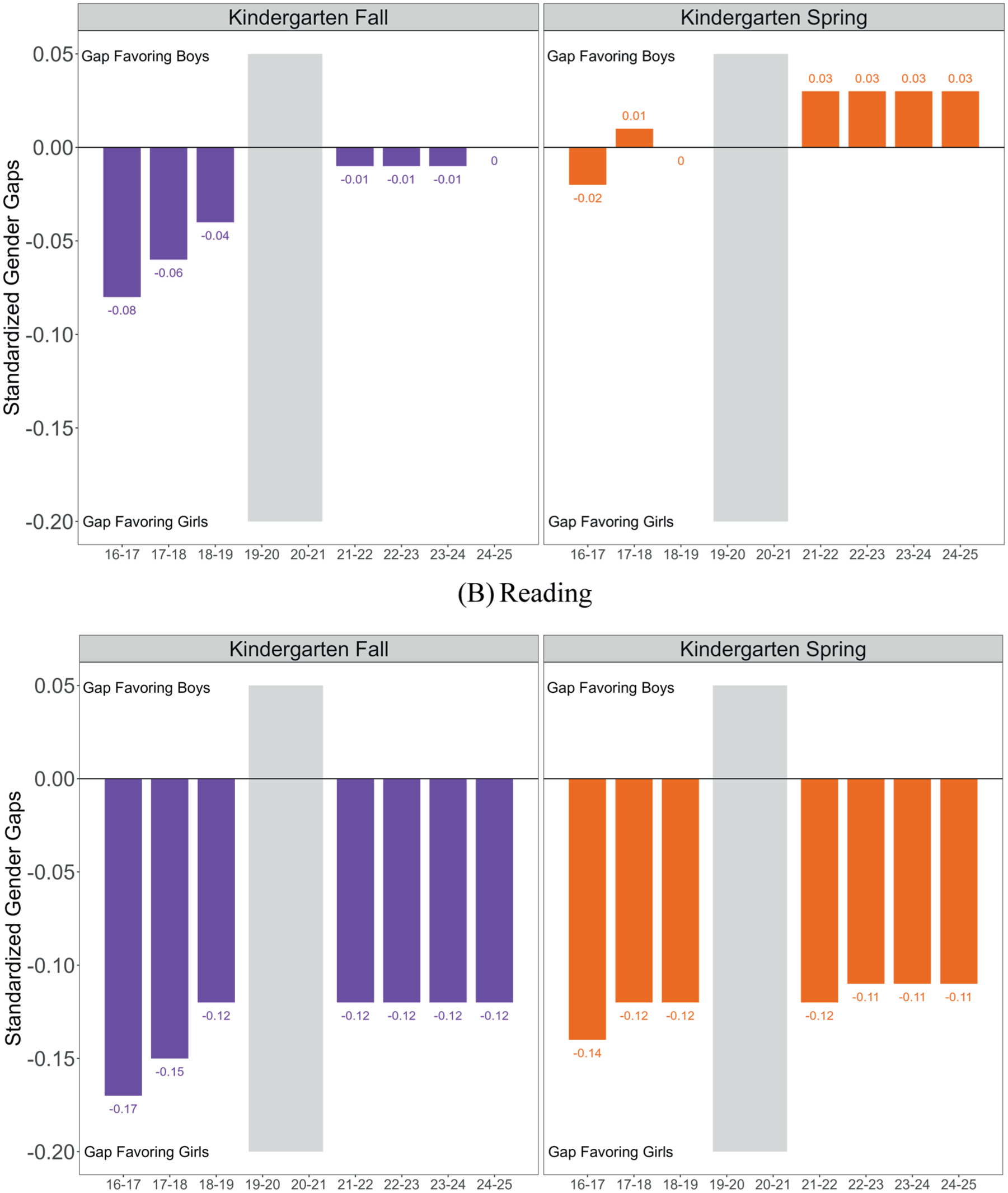
Gender gaps in kindergarten by the year students entered school. (a) Math. (b) Reading.
Boys Pull Even or Ahead in Math by the End of Kindergarten
We also explored whether gender gaps widened or narrowed over the course of the kindergarten year. The orange bars in the right panels of Figure 1 show the gender gap in the spring of the kindergarten year for the nine cohorts. In math, girls lost their initial advantage at school entry by the spring of kindergarten. That is to say, after just 9 months of formal schooling, boys had already pulled even with or ahead of girls in math. In reading, the gaps favoring girls were maintained or narrowed very slightly during the kindergarten year.
Boys Pull Further Ahead of Girls in Math by the End of Elementary School
Figure 2 displays boys’ (solid line) and girls’ (dashed line) average test scores from the fall of kindergarten to fifth-grade spring for each cohort over a 9-year span. In math, across all the years, boys went from roughly even with girls in the spring of kindergarten to being slightly ahead by spring of first grade (.08 SD on average). Across cohorts, this advantage widened as students progressed through the grades. By the end of elementary school, boys scored an average of .13 SD ahead of girls in math. Notably, these trends were consistent for students who entered school before and after the COVID-19 pandemic.
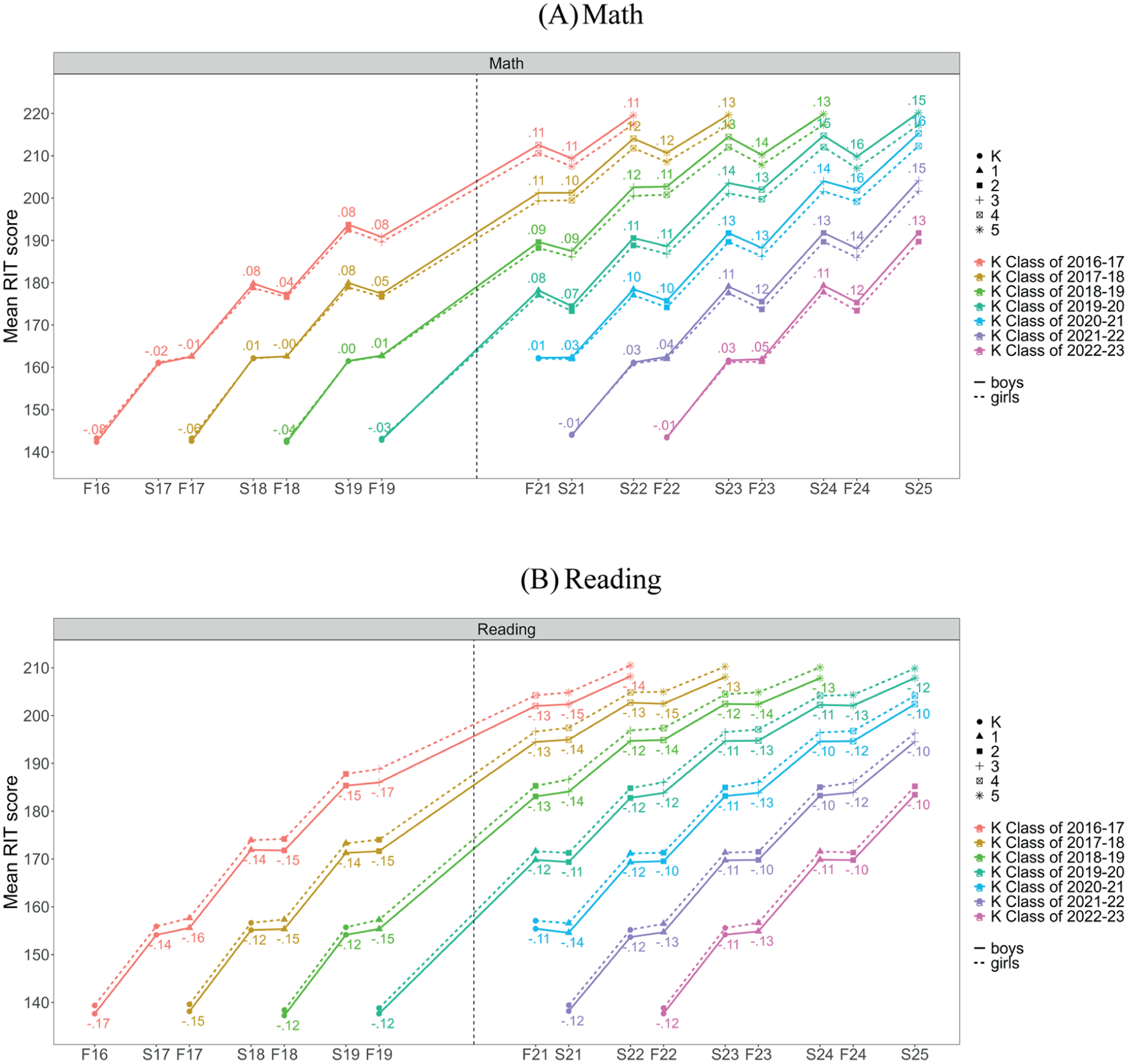
Gender gaps in math and reading in Grades K–5. (a) Math. (b) Reading.
In reading, girls displayed a consistent advantage from kindergarten to fifth grade. Girls started out between .12 SD and .17 SD ahead of boys at school entry and ended fifth grade with roughly the same sized advantage. In other words, girls’ advantage in elementary school reading was fully formed prior to school entry and was maintained (but not increased) by exposure to schooling.
Boys’ Advantage in Math Dates Back Over 20 Years
Our math findings are consistent with findings reported in prior national kindergarten cohorts based on other national samples (Cimpian et al., 2016). To examine the consistency of the math trends over time, we combined results from two cohorts from the ECLS-K (kindergarten classes of 1998–1999 and 2010–2011) and two cohorts from MAP Growth (kindergarten classes of 2016–2017 and 2021–2022). Figure 3 shows how the gender gap in math (reported in standard deviation units) grew from the spring of kindergarten to the spring of third grade for students who entered kindergarten over a 20-year span. The MAP Growth cohorts are displayed as dashed lines, while the ECLS-K cohorts are displayed as solid lines. In every cohort, boys’ advantage in math increased as they move through school. Boys’ overall test score advantage in math is smaller now than 20 years ago, but the fact that schools appear to advantage the development of boys’ math skills over girls’ math skills in elementary school is remarkably stable.
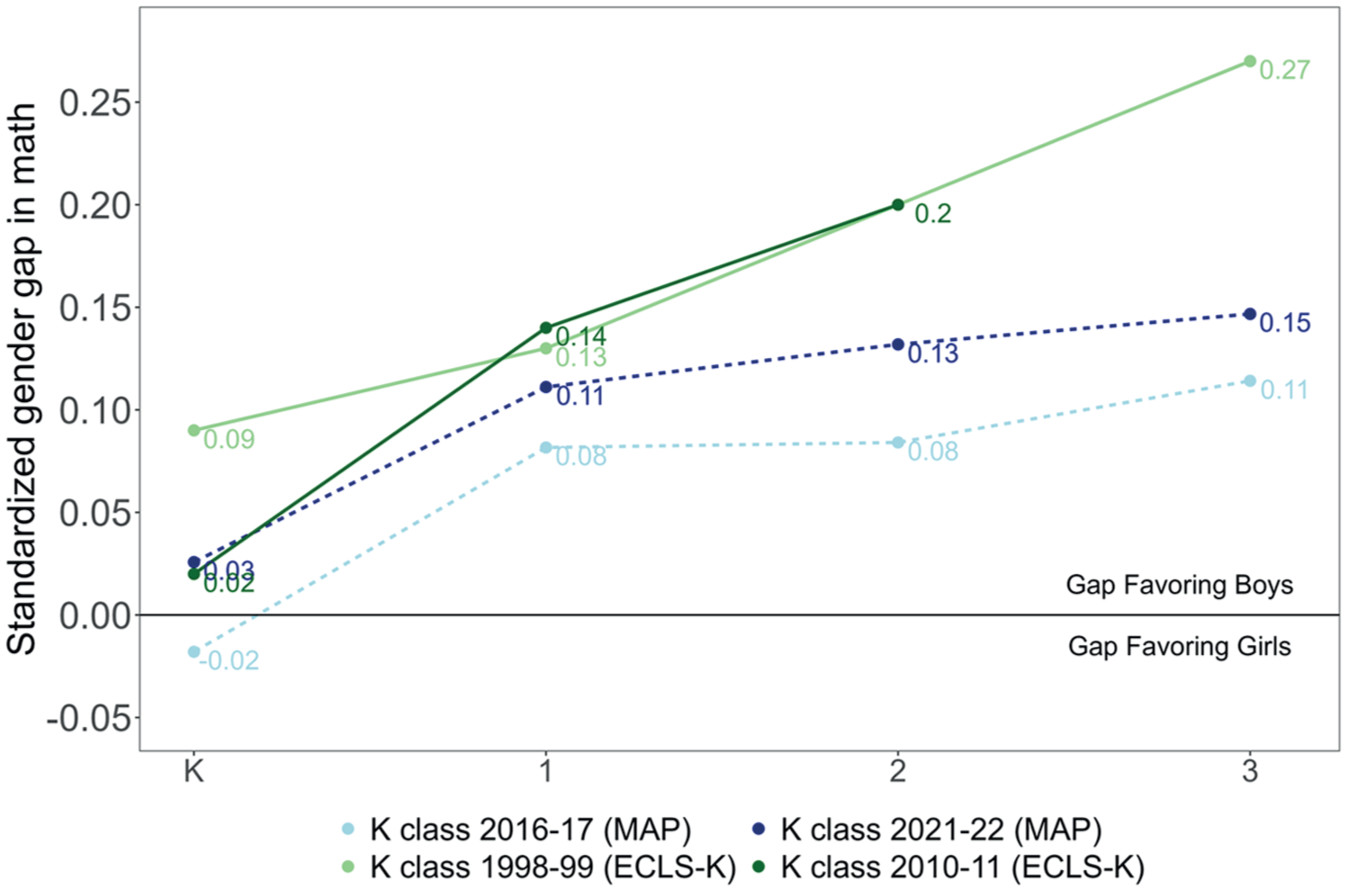
Standardized gender gaps in math from the Early Childhood Longitudinal Study, Kindergarten Classes (ECLS-K) and MAP Growth.
Discussion
Our analysis challenges the prevailing narrative that early elementary education is poorly suited to boys (Reeves, 2022a). While girls enter kindergarten with stronger reading skills and, historically, a slight advantage in math, boys quickly catch up and ultimately surpass girls in math achievement by the end of elementary school. These trends are remarkably stable and consistent with prior ECLS-K findings, even as early grade curricula have become more academically rigorous (Bassok et al., 2016) and U.S. schools weathered the COVID-19 pandemic. Notably, the primary difference we observe in the gender gap trends before and after COVID-19 is at school entry. Girls’ lead at school entry has shrunk in reading and swapped signs to favor boys in math following the pandemic. Girls falling behind boys in math during the pandemic has been a remarkably consistent pattern across multiple grade levels and data sources (Kuhfeld et al., 2025; Ma et al., 2025). More research is needed to understand the set of factors leading to girls’ recent math declines.
Importantly, these patterns reveal that schooling plays a markedly different role across subjects. In reading, gaps favoring girls are largely “fully baked” at school entry and remain stable through elementary school, suggesting that schools neither exacerbate nor close these disparities. In contrast, math gaps emerge and widen during the school years, with boys consistently gaining ground and ultimately surpassing girls.
Rather than framing the issue as a crisis for boys or girls, our findings suggest a more nuanced reality: Boys and girls face distinct challenges in school that require tailored support. Boys likely need more support and role models to do well in reading (Reeves, 2022a), while many girls face negative gender stereotypes and are perceived to have lower capacity (relative to equally performing boys) in math and science (Cimpian et al., 2016). Recognizing and addressing these differences is essential to creating learning environments that support all students equitably.
Supplemental Material
sj-docx-1-edr-10.3102_0013189X261461234 – Supplemental material for Gender Gaps in Early Grades: Questioning Whether Schools Disadvantage Young Boys
Supplemental material, sj-docx-1-edr-10.3102_0013189X261461234 for Gender Gaps in Early Grades: Questioning Whether Schools Disadvantage Young Boys by Megan Kuhfeld and Margaret Burchinal in Educational Researcher
Footnotes
Acknowledgements
We thank the editor and the reviewers for helpful suggestions that improved this article. We would also like to acknowledge feedback provided by Karyn Lewis and Jim Soland.

Funding
The authors received no financial support for the research, authorship, and/or publication of this article.
Declaration of Conflicting Interests
The authors declared no potential conflicts of interest with respect to the research, authorship, and/or publication of this article.
Supplemental Material
Supplemental material for this article is available online.
Notes
Author Biographies
References
Supplementary Material
Please find the following supplemental material available below.
For Open Access articles published under a Creative Commons License, all supplemental material carries the same license as the article it is associated with.
For non-Open Access articles published, all supplemental material carries a non-exclusive license, and permission requests for re-use of supplemental material or any part of supplemental material shall be sent directly to the copyright owner as specified in the copyright notice associated with the article.
