






Abstract
Extending findings from a 26-year longitudinal study of educational opportunity, we examine whether opportunities are related to the educational attainment and earnings of children from lower-income households (n = 226) as a function of when in a child’s development they occur. We compare the predictive power of opportunities accrued within three key developmental stages—early childhood, middle childhood, or adolescence—with the combined power of opportunities accrued across these stages. Our findings point to the value of educational opportunity in all three stages, particularly for educational attainment.
Dearing, Bustamante, Zachrisson, and Vandell (2024) documented large gaps in the number of educational opportunities that children from lower- versus higher-income households accumulate across childhood and adolescence. In turn, opportunity gaps predicted educational attainment and earnings in adulthood, with the strongest effects for children from low-income homes. Here, we extend these findings to children from low-income households by examining opportunities by age: early childhood, middle childhood, or adolescence.
While Dearing et al. (2024) highlighted the importance of repeated opportunities across childhood, developmental timing may matter. Theorists have long underscored the importance of stage-specific opportunities (Erikson, 1963) and, more recently, neuroscience has shown stage-specific distinctions in brain maturation and its response to the environment (e.g., Brown & Jernigan, 2012; Dahl et al., 2018; DelGiudice, 2017). Such maturational shifts may alter when educational opportunities matter most.
Scholars have, for example, argued that educational opportunities in early childhood have exceptional importance compared with other developmental stages because early childhood is a time during which the foundations of brain architecture are developed (e.g., Mustard, 2011), the brain displays exceptional malleability in response to environmental stimuli (e.g., Shonkoff, 2011), and children learn rudimentary academic skills that are essential building blocks for later academic skill growth (e.g., Heckman, 2011). Yet, theorists have also emphasized the importance of educational opportunities during middle childhood, when children’s reasoning and self-regulation skills rapidly improve (e.g., Sameroff & Haith, 1996) due to stage-specific changes in brain growth (e.g., white matter growth that improves efficiency and speed of neural connections; DelGuidise, 2017). Still other scholars have argued that educational opportunities in adolescence are of exceptional importance because maturation in cognitive, emotional, and motivational brain systems leads to uniquely strong effects of environmental conditions on motivation for achievement, creativity, and innovation (Dahl et al., 2018).
In this report, we examine low-income children’s educational attainment and earnings at age 26 as a function of when they occur, examining both (a) the unique predictive power of opportunities accrued within three developmental stages (i.e., early childhood, middle childhood, or adolescence) and (b) the additive predictive power of opportunities accrued across stages. To do so, we divided the 12 educational opportunity indicators studied in Dearing et al. (2024) according to developmental stage: early childhood, middle childhood, and adolescence.
We define early childhood as infancy, toddlerhood, and the preschool years (i.e., birth through age 4.5 years), middle childhood as the elementary school years (i.e., kindergarten through fifth grade), and adolescence as the secondary school years (i.e., middle school and high school). We chose these cut points for developmental and educational practice reasons. Developmentally, the end of early childhood and start of middle childhood is often marked by shifts in brain development (i.e., a shift from rapid neural growth to rapid pruning), cognitive reasoning, and self-regulation between the ages of 5–7 years (e.g., Sameroff & Haith, 1996). And, in education, this developmental transition from early to middle childhood corresponds with the start of elementary school. In turn, around ages 10–12, the onset of puberty generally signals the transition from middle childhood to early adolescence, which, for many children, also roughly coincides with their transition to secondary school (e.g., Dahl et al., 2018).
However, it is important to note that age cutoffs for stages vary in research and education policy, in part because they are somewhat arbitrary and influenced by sociohistorical and cultural factors (e.g., the ways we structure schooling). See, for example, variation in the definitions of early childhood education as birth to 5 (e.g., Arkansas Division of Child Care and Early Childhood Education, 2016; Massachusetts Department of Elementary and Secondary Education, 2025) versus birth to 8 (U.S. Department of Education, 2026). Moreover, development is often marked by continuity and change across stages, regardless of where cut points are placed. Yet, stages provide useful constructs for the purposes of labeling time frames and studying educational opportunities that are unique to certain ages.
Method
We use the 26-year longitudinal study analyzed by Dearing et al. (2024)—the NICHD Study of Early Child Care and Youth Development (SECCYD)—with an exclusive focus on 226 children born into low-income households. The sample is not nationally representative, but the SECCYD is unique in that children were from 10 U.S. locations and followed from birth, with repeated assessments of many child and family characteristics. This included frequent assessments (often via direct observation) of home, childcare, classroom, afterschool, and neighborhood settings from which Dearing et al. created the 12 dichotomous educational opportunity indicators we examine here. In addition, at age 26, participants self-reported educational attainment and earnings.
Broken down by developmental stage, the opportunities were as follows. For early childhood (i.e., 6 to 54 months of age), did children live in an enriching home environment, attend high-quality childcare/preschool, and/or live in a socioeconomically advantaged neighborhood? For middle childhood (i.e., kindergarten through 5th grade), did children live in an enriching home environment, have high-quality instruction in elementary school, participate in organized afterschool activities, live in a socioeconomically advantaged neighborhood, and/or experience upward family economic mobility? For adolescence (i.e., 6th through 12th grade), did children live in an enriching home environment, participate in organized afterschool activities, live in a socioeconomically advantaged neighborhood, and/or experience upward family economic mobility? See the supplementary materials for descriptions of measures.
Results
In the top half of Table 1, we present the distribution of the number of opportunities that low-income children accrued by stage (also see Table 1 note). In the bottom half of Table 1, we present covariate-adjusted multinomial logistic estimates for educational attainment at three levels—high school degree or lower (omitted group), some college or two-year degree, and four-year college degree or higher—and linear regression estimates for salary. For these models, the three stage-specific indicators of opportunities were estimated simultaneously, as individual predictors, each being a count of the number of opportunities experienced within that stage; coefficients for these predictors represent the unique association between each stage and the outcomes, holding constant opportunities in the other stages. We also computed a linear combination of these three predictors to estimate the change in the outcomes given a one-opportunity increase during each of the three stages, comparing children who experienced zero opportunities (27.5% of sample) with those who experienced one opportunity per stage (15.5% of the sample had one or more opportunities in each stage). Descriptions of these models and various sensitivity tests, presented in the supplement, indicated the findings were highly robust.
Opportunity Predictors of Educational Attainment and Earnings (n = 226).
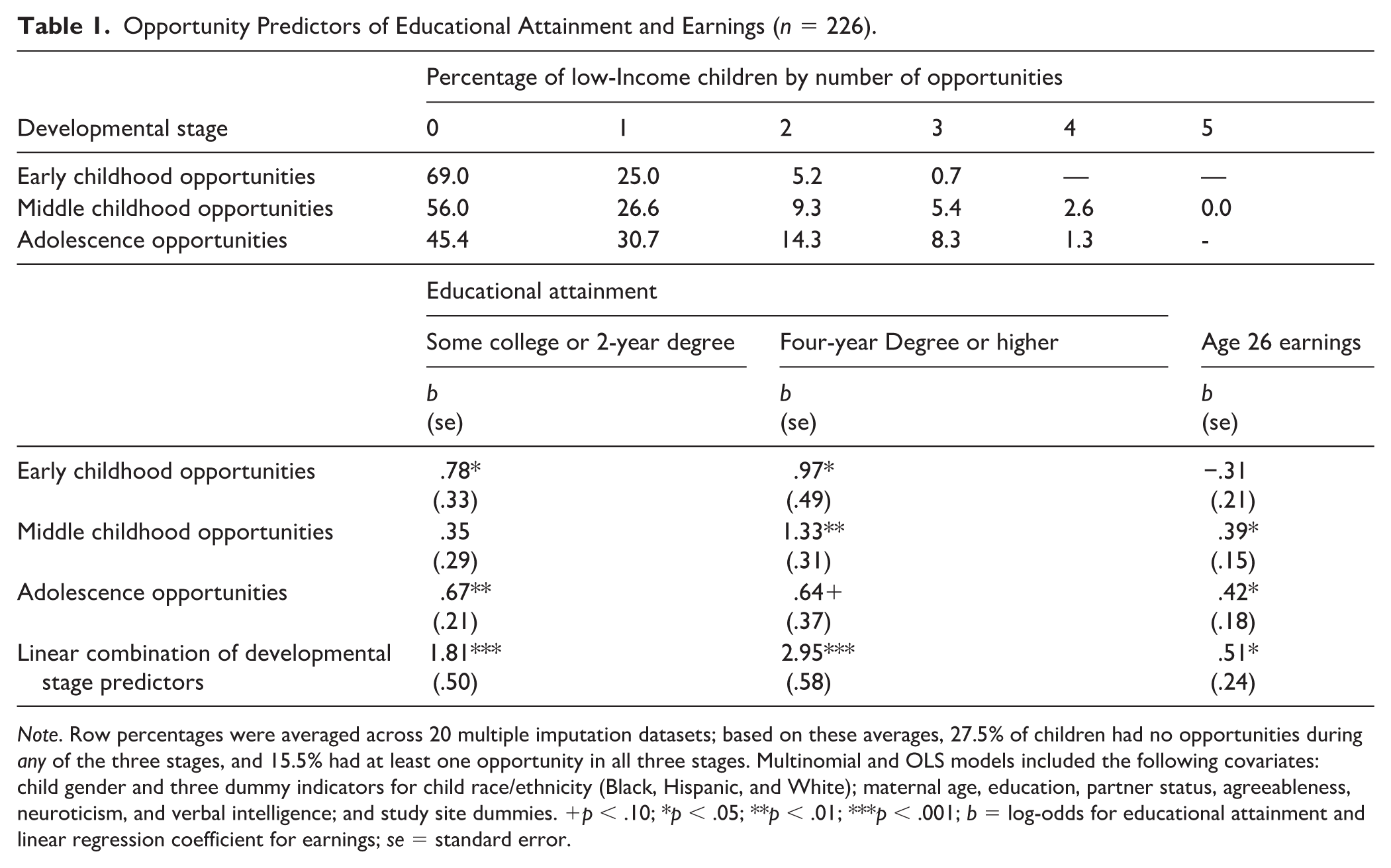
Note. Row percentages were averaged across 20 multiple imputation datasets; based on these averages, 27.5% of children had no opportunities during any of the three stages, and 15.5% had at least one opportunity in all three stages. Multinomial and OLS models included the following covariates: child gender and three dummy indicators for child race/ethnicity (Black, Hispanic, and White); maternal age, education, partner status, agreeableness, neuroticism, and verbal intelligence; and study site dummies. +p < .10; *p < .05; **p < .01; ***p < .001; b = log-odds for educational attainment and linear regression coefficient for earnings; se = standard error.
From the multinomial model, we plotted (top half of Figure 1) predicted probabilities of educational attainment for five groups of low-income children. The first group is children who experienced no opportunities during any of the three stages. The next three groups are children who experienced one opportunity during one (and only one) of the three stages, either early childhood or middle childhood or adolescence. The fifth group is children who experienced one opportunity in each of the three developmental stages. For descriptive purposes, we also display—in the bottom half of Figure 1—the proportion of children who experienced each of the 12 opportunities according to developmental stage and level of education attained.
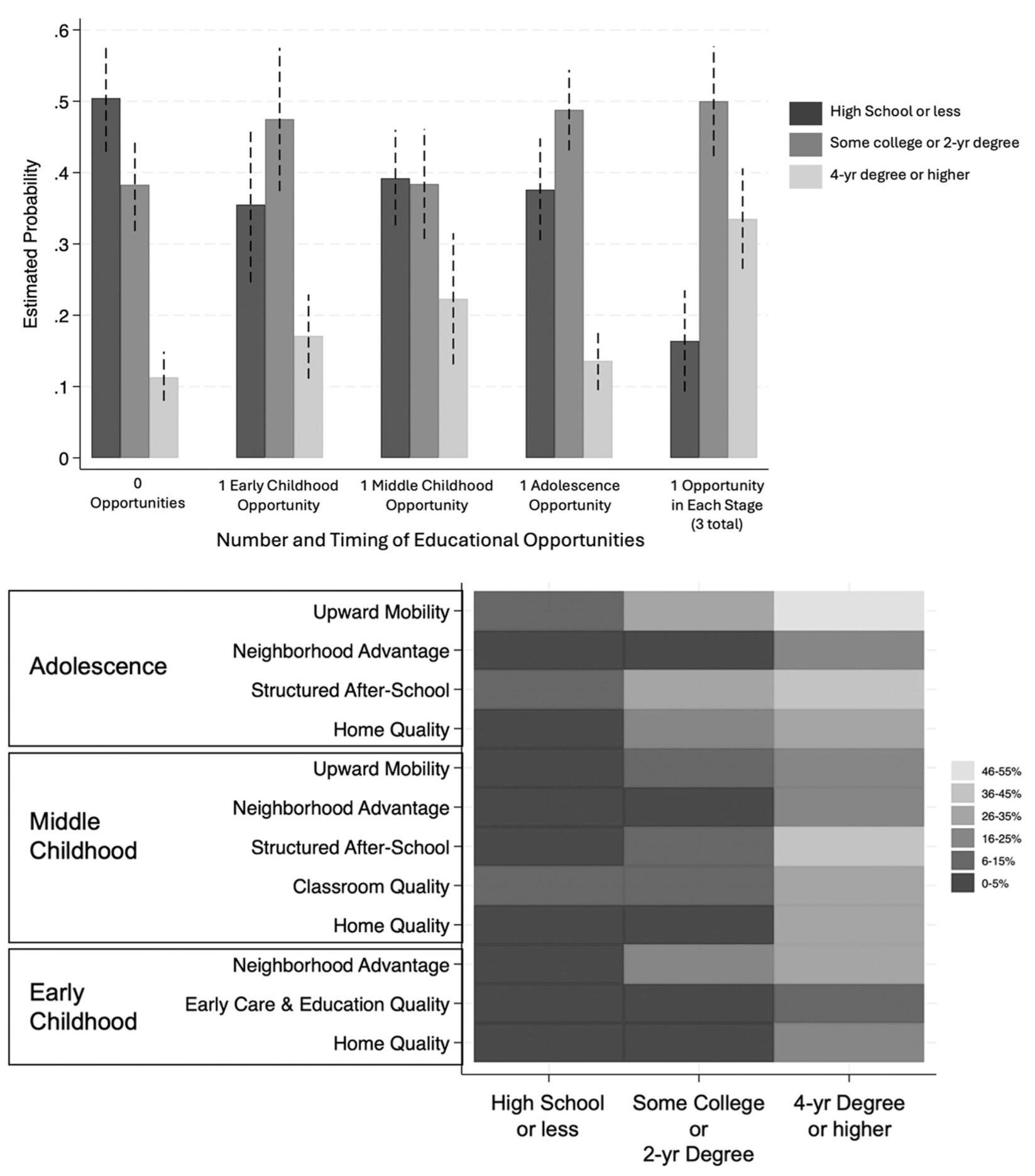
Opportunity and educational attainment for low-income children. The top half of the figure displays point estimates and 95% confidence intervals for five opportunity scenarios: (1) children who experienced no opportunities during any of the three developmental stages, (2) those who experienced one opportunity in early childhood, (3) those who experienced one opportunity in middle childhood, (4) those who experienced one opportunity in adolescence, and (5) those who experienced one opportunity in each of the three developmental stages (i.e., three total opportunities). The bottom half of the figure displays the proportion of children who experienced each of the 12 opportunities according to developmental stage and level of education attained.
Educational Attainment
Opportunities in each developmental stage demonstrated positive and statistically significant associations with gaining education beyond high school. Opportunities in early childhood and adolescence predicted increases in the probability of going beyond high school to gain some college education or a 2-year degree, and opportunities in both early and middle childhood predicted increases in the probability of completing a 4-year degree or more education. While less than 50% of low-income children who experienced none of the opportunities (in any stage) were likely to pursue education beyond high school, this percentage was greater than 60% for those with just one opportunity during at least one stage (top of Figure 1). Moreover, the linear combinations estimating the likelihood of education beyond high school for children who experienced one opportunity in each of the three stages were sizable; given one opportunity in each of the three stages, about 85% of children were likely to gain education beyond high school, with more than 33% earning at least a 4-year degree (top of Figure 1). It was also evident, descriptively (bottom of Figure 1), that children who attained at least a 4-year degree were the group most likely to experience opportunities in each of the three stages.
Annual Earnings
For age 26 earnings, middle childhood and adolescence opportunities were statistically significant predictors. Specifically, each additional opportunity during middle childhood was associated with an additional $3,984 in earnings, and each additional opportunity in adolescence was associated with $4,255 in earnings. The linear combination of opportunities across the three developmental stages indicated that one additional opportunity during each stage was associated with an increase in earnings of $5,104.
Conclusion
Extending evidence on the importance of educational opportunities for children from low-income backgrounds, we find that opportunities in early childhood, middle childhood, and adolescence were each uniquely predictive of educational attainment at age 26. In addition, opportunities in middle childhood and adolescence predicted earnings at age 26. These correlational findings are among the first to point to the importance of educational opportunities during each developmental stage for outcomes in adulthood. An important next step will be to examine whether our findings replicate with larger samples of children from low-income households. It will also be worthwhile to determine if educational opportunities, including those in early childhood, predict earnings at later times in adulthood, given evidence that income gains from higher education grow larger for individuals in their 30s and 40s (Kim et al., 2015).
Supplemental Material
sj-docx-1-edr-10.3102_0013189X261463238 – Supplemental material for Developmental Timing of Educational Opportunities for Children in Low-Income Households
Supplemental material, sj-docx-1-edr-10.3102_0013189X261463238 for Developmental Timing of Educational Opportunities for Children in Low-Income Households by Eric Dearing, Henrik Daae Zachrisson, Andres S. Bustamante and Deborah Lowe Vandell in Educational Researcher
Footnotes

Funding
The authors disclosed receipt of the following financial support for the research, authorship, and/or publication of this article: Eric Dearing and Henrik D. Zachrisson were funded by CREATE—Center for Research on Equality in Education, funded by the Research Council of Norway (No. 331640). Henrik D. Zachrisson was also supported by funding from the European Research Council Starting Grant ERC-CoG-2018 SEGOP (No. 101115949). A cooperative agreement (5 U10 HD027040) between the study investigators and the Eunice Kennedy Shriver National Institute of Child Health and Human Development supported the design and data collection of the Study of Early Child Care and Youth Development from birth through age 15 years. The age 26 study design and data collection were supported by a grant from the Charles Stewart Mott Foundation (G-2017-00786) to Deborah Lowe Vandell.
Declaration of Conflicting Interests
The authors declared no potential conflicts of interest with respect to the research, authorship, and/or publication of this article.
Supplemental Material
Supplemental material for this article is available online.
Author Biographies
References
Supplementary Material
Please find the following supplemental material available below.
For Open Access articles published under a Creative Commons License, all supplemental material carries the same license as the article it is associated with.
For non-Open Access articles published, all supplemental material carries a non-exclusive license, and permission requests for re-use of supplemental material or any part of supplemental material shall be sent directly to the copyright owner as specified in the copyright notice associated with the article.
