






Abstract
Studies of teacher residencies highlight their potential to increase the diversity and persistence of the workforce while addressing district staffing shortages. However, prior research is largely unable to directly attribute these promising trends to the programmatic elements of the residency model itself. Using a novel statewide survey and leveraging temporal variation in when predominantly undergraduate traditional teacher preparation programs across Tennessee reported becoming residencies, we estimate the causal impacts of adoption of the model on recruitment, employment, retention, and effectiveness. We generate skepticism that any improvements in diversity, employment, and retention stem from this transition; however, we find suggestive evidence that adoption may increase the instructional effectiveness and—somewhat surprisingly—the likelihood of migration across schools and districts of graduates.
However, past research collectively falls short of being able to directly attribute these promising outcomes to the model itself, due to both a focus on individual exemplary teacher residencies and a failure to account for other unobserved ways in which these potentially idiosyncratic programs and those who enroll in them may differ from traditional pathways to teaching. We extend this prior literature by leveraging a statewide sample of teacher preparation programs across Tennessee and plausibly isolating the impacts of model adoption on graduates from traditional, predominantly undergraduate programs that reportedly transitioned to teacher residencies during the previous decade. We fail to find corroboratory evidence of the large, positive effects on racial diversity and improved retention reported in previous studies of boutique teacher residencies. However, model adoption may boost graduates’ early-career instructional effectiveness (though this advantage appears to fade with additional years of experience) and alter their employment trajectories, increasing their migration across schools and districts. Our results are somewhat limited by an imperfect operationalization of treatment, a reliance on identifying variation from only 15 programs, and the inescapable omission of perhaps the most promising implementers (e.g., the earliest-transitioning programs and those always identifying as residencies). Nevertheless, they offer a clearer and credibly causal picture of the impacts of the programmatic elements of the teacher residency model, providing critical information for practitioners considering its adoption and policymakers encouraging its spread.
The Teacher Residency Model
Model Features
Over time, researchers and practitioners have developed consensus around the set of features characterizing the teacher residency model (Berry et al., 2008; Guha et al., 2016; National Center for Teacher Residencies, n.d.). Teacher residencies typically begin with the establishment of a partnership with a school district, allowing the two to collaboratively tailor their preparation experience to fit the specifics of the local context. Partner districts also help set programs’ priorities for recruitment, identifying the kinds of candidates that would address their most critical shortages and diversify their workforce. To attract these candidates, teacher residencies tend to provide a range of financial incentives, such as living stipends, loan forgiveness, or salary and benefits, sometimes in exchange for a multi-year commitment to teach in the partner district after graduation. As part of their context-specific preparation, residents learn to teach in an intensive, yearlong placement in the partner district under the mentorship of a highly qualified and trained teacher, all while taking classes designed to be highly integrated with their clinical experiences. Finally, after program completion, teacher residencies often offer early-career induction support to help facilitate graduates’ transition into the profession.
Notably, many of these features are not inherently unique to the residency model. Traditional programs have increasingly implemented some of them, and not every teacher residency consistently adopts them all, meaning that the model in practice may not be as “innovative” as advertised (Reagan et al., 2021). However, previous literature has shown that teacher residencies do provide at least a partially distinct pathway into teaching, finding average programmatic differences between teacher residencies and traditional programs in the length of their clinical placements, the financial incentives they provide to candidates, and the training and compensation they make available for mentors (Matsko et al., 2022; Silva et al., 2014; Terziev & Forde, 2021; Truwit et al., 2024).
These features of the residency model are geared toward improving graduate outcomes through the two distinct yet complementary pathways of “recruitment” and “preparation.” For instance, some model features are designed to influence the kinds of individuals who enter teaching. Strong partnerships, for instance, can help residencies stay abreast of district staffing shortages in particular grades and subjects and target their recruitment toward prospective teachers with interest in these high-needs areas. Meanwhile, financial incentives and supports can offset the costs of certification and thereby open the possibility of pursuing a teaching career to individuals who have been historically less likely to do so, thus potentially increasing diversity. Other features of the model are more aimed at influencing the quality of preparation that prospective teachers receive, which, in turn, may impact their employment, retention, and instructional effectiveness. The distinguishing characteristic of the teacher residency model is its intensive, yearlong clinical placement under the close supervision of an experienced and trained mentor teacher. Substantial prior evidence has linked longer clinical experiences and higher-quality mentoring with improved retention, increased feelings of preparedness, and, in some studies, greater instructional effectiveness (see Ronfeldt, 2021, for a review of this literature).
Teacher Residencies in Tennessee
Teacher residencies have become particularly popular in the state of Tennessee. Standalone providers like the Memphis and Nashville Teacher Residencies, which have operated in some cases as far back as 2009, have been recognized by the National Center for Teacher Residencies for the fidelity of their implementation of the model. In addition, many traditional, university-based programs have reported transitioning to the residency model either fully or in part over the course of the previous decade, though these later, previously traditional adopters tend to demonstrate less comprehensive adoption of its features (Truwit et al., 2024).
Several institutional isomorphic pressures (Reagan et al., 2021) appear to have likely contributed to the recent proliferation of the residency model across the state (Truwit et al., 2024). The earliest residency programs emerged in the context of Race to the Top under the Obama administration, which broadly established an air of accountability and innovation and, more specifically, ushered in the state’s public evaluation of teacher preparation programs, with annual report cards scoring the employment, instructional effectiveness, retention, and racial diversity of graduates. The perceived and publicized report card success of this vanguard of teacher residencies likely resulted in mimetic isomorphism, inspiring traditional programs to adopt (certain features of) the model in response (Truwit et al., 2024). More explicit forms of coercive isomorphism also may have facilitated the model’s spread; for instance, during our window of study, the state began to require that all programs establish at least one primary district partnership to provide a more context-specific preparation that better addresses local staffing needs, thereby laying the groundwork for several of the model’s features.
Literature Review
Prior studies have largely evaluated teacher residencies by comparing the characteristics and outcomes of their graduates to those of other early-career teachers, usually employed in the same districts. With respect to racial diversity and endorsement area, these studies have found inconsistent results around how graduates of teacher residencies compare with their peers. Studies of individual teacher residency programs estimate that graduating cohorts comprise a higher proportion of teachers of color than the rest of the novice workforce employed in the same districts (An & Koedel, 2021; Papay et al., 2012; Perlstein et al., 2014; Sloan & Blazevski, 2015). However, evaluations across multiple programs document either no differences in racial composition (Matsko et al., 2022; Silva et al., 2014; Terziev & Forde, 2021) or greater diversity among graduates of non-residencies (Wan et al., 2021). As for endorsement areas, the evidence is similarly mixed; some studies indicate that more residency graduates teach in high-need subject areas than their new teacher peers (Papay et al., 2012; Silva et al., 2014), but others reveal no differences (An & Koedel, 2021; Truwit et al., 2024; Wan et al., 2021).
Research exploring graduates’ employment and retention suggests greater promise from teacher residencies. Between 75% and 100% of teacher residency graduates find employment in partner and high-need districts (Papay et al., 2012; Roegman et al., 2017; Sloan & Blazevski, 2015; Wan et al., 2021). These graduates also appear to stay in the profession; after 3 or more years, they are more likely to have persisted in the same district than other new teachers (An & Koedel, 2021; Papay et al., 2012; Silva et al., 2015; Sloan et al., 2018; Wan et al., 2021).
Existing evidence of graduates’ instructional effectiveness is sparse, though it similarly paints residencies in a mostly positive light. Teacher residents in Kansas City demonstrated higher value-added to student math scores than other early-career teachers in the same district (An & Koedel, 2021), while those in Boston performed worse at first before eventually outperforming their peers after 4 to 5 years (Papay et al., 2012). In both areas, residents’ student achievement gains in English were comparable to other teachers. Research considering administrators’ ratings of instructional effectiveness is more favorable, finding higher scores among residents than other first-year teachers, though these results are especially limited to descriptive analyses of individual boutique programs (Perlstein et al., 2014; Solomon, 2009).
While the collective body of research on teacher residencies suggests the potential of the residency model to achieve its goals, it has two important limitations. First, the design of these studies does not allow researchers to confidently establish that the model itself is what drives any differences in graduate outcomes. Comparisons of the average outcomes of residents and non-residents are susceptible to differences across programs unrelated to the model (e.g., differences in coherence, course and/or faculty quality, entry requirements, cost and accessibility, geographic location) that could account for the trends described above. Second, most studies focus on single, often exemplary programs within a narrow setting or historical timeframe. Given evidence of variation in model implementation and a consistent pattern of less promising findings when studies examine multiple programs (Matsko et al., 2022; Terziev & Forde, 2021), any research on the outcomes of graduates from one small and possibly idiosyncratic program may fail to generalize. Relatedly, the distinctiveness of the model, as it continues to proliferate, appears to be declining (Truwit et al., 2024), potentially limiting the external validity of estimates from earlier studies of pioneering residencies as well as their utility to practitioners and policymakers now considering adoption and promotion of the model, respectively. 1
Our approach, by contrast, exploits within-program variation over time, intuitively comparing changes in outcomes of graduates of residencies from before to after the adoption of the model with contemporaneous changes among graduates of programs that never transitioned. This allows us to more convincingly disentangle the impacts of the model itself from any other institution and cohort characteristics that differ between residencies and non-residencies, though at the cost of limiting the generalizability of our estimates to the kinds of programs for which we observe any transition. With pressure mounting on teacher preparation programs to embrace innovative approaches (Darling-Hammond et al., 2012), the results of this study have the potential to illustrate whether and to what extent programs considering adopting the residency model—or, more specifically, its features—should expect improvements in the recruitment, employment, retention, and effectiveness of their graduates.
Methods
Data
During the 2019–2020 school year, we developed and administered a survey that asked program leaders, “To what degree do you consider your teacher preparation program to be a ‘residency’ program?” offering response options of “Fully,” “Partially,” and “Not at all.” In a follow-up, we asked those who selected at least “Partially” to identify the specific school year in which they began to consider their program a residency. We then posed a series of questions about specific program features and (similarly) the year in which these features were first implemented. We sent our survey to administrative contacts at all institutions that prepare teachers across the state and encouraged them to involve as many different colleagues as necessary to answer questions requiring historical institutional knowledge. Promising a $20 gift card incentive, we received responses from leadership in 72.9% of all programs that collectively produced 84.2% of all graduates over the past decade.
We use our first survey item to construct an annual treatment indicator flagging all years in which a program reported having at least partially adopted the residency model. 2 We then merge this indicator with three statewide longitudinal administrative datasets. The first contains information on the demographics of and certifications obtained by all graduates of teacher preparation programs in Tennessee from 2009–2010 to 2018–2019. From this file, we generate indicators for whether a graduate identifies as a teacher of color 3 or becomes certified in a high-need subject area (considered by the Tennessee Department of Education to include science, math, special education, foreign language, and English as a second or other language).
We then link graduates to personnel data, available for the universe of teachers in Tennessee public schools through 2020–2021, and evaluation data, only available until 2019–2020, which allow us to construct yearly measures of within-state employment, retention, and mobility. For employment, we create annual indicators flagging whether a graduate appeared as a teacher of record in the personnel dataset and/or received an evaluation measure (which proxies for serving as a teacher of record); across all years, we also combine these into an indicator for ever having found within-state public school employment as a teacher. For all years in which teachers are identified as employed, we draw on the school identifiers in both datasets to generate annual indicators for whether employment occurred in their program’s primary partner district 4 and for whether graduates failed to continue teaching in a Tennessee public school the subsequent year. Finally, conditional on their retention, we construct annual indicators for mobility that flag whether employed graduates failed to return in the following year to (at least one of) the same school(s) or district(s).
The evaluation data also provide two annual measures of employed teachers’ instructional effectiveness: observation ratings (ORs) and value-added measures (VAMs). ORs are available (at least in theory) for all teachers employed in the state from 2011–2012 to 2019–2020 5 ; as early-career teachers are typically observed multiple times each year, we construct annual overall scores by averaging across all 23 rubric items for each observed lesson and then over all lessons per school year. VAMs, which estimate the yearly impact of a particular teacher on student achievement through lagged growth models, 6 are available for only roughly a third of the employed teachers in our sample. This limited coverage stems primarily from the fact that VAMs only exist for teachers in tested subjects (i.e., third through eighth grade and certain core high school subjects). In addition, VAMs were not estimated for 2019–2020, due to the pandemic-induced termination of all assessments, and they are severely limited in coverage for 2015–2016, when technical difficulty surrounding the statewide transition to electronic administration resulted in the suspension of standardized testing for elementary and middle schools. (Unlike ORs, however, VAMs were estimated for teachers in the 2010–2011 school year—the first eligible year of employment for our earliest graduates.) As a result, while still a valuable measure, VAMs make for a noisier and perhaps less generalizable operationalization of instructional effectiveness. Following common practice, we explore impacts for math and English language arts (ELA) separately.
One complication is that the right-censored nature of this workforce data inherently provides earlier graduates with more opportunities to be observed teaching than their later peers. Since we assume that residency classification moves only in one direction, this allows for graduates of programs offering a traditional preparation experience in, for example, 2013–2014 with higher likelihoods of ever securing employment, more opportunities to leave the workforce or move schools, and greater instructional effectiveness stemming from accrued teaching experience than graduates—even of the same programs—prepared under the teacher residency model in 2018–2019. 7 We address this issue by restricting the focus of our preferred analytic specification to graduates’ employment, retention, mobility, and effectiveness only during the single year immediately following their graduation, which we can observe for all cohorts. In alternate specifications, we loosen this restriction and incorporate all available years of workforce observations to assess whether any first-year effects persist later into teachers’ careers, albeit with less capacity to cleanly interpret dynamic effects over time.
Sample
We preliminarily remove from our sample all completers of alternative (“early-entry” or “job-embedded”) certification programs. The focus of this study is on identifying the causal impacts of the programmatic transition from traditional preparation to a teacher residency model, the hallmark feature of which is a full-year, intensive clinical experience prior to serving as the teacher of record. Because this characteristic is irreconcilable with an alternative certification pathway (during which individuals are already serving as the teacher of record), we drop the 13.8% of individuals completing such programs.
Our final analytic sample contains 24,625 individuals who completed 66 unique survey-responding undergraduate and graduate teacher preparation programs between the 2009–2010 and 2018–2019 academic years. 8 The “All” column in Table 1 shows that these graduates of Tennessee programs are overwhelmingly White (90.7%) and that only about a fifth (18.3%) pursue certification in high-need subject areas. About 58.7% find employment in a Tennessee public school in their first year after program completion, 29.4% of whom are initially hired into their program’s partner district. After their first year of teaching, about 10.6% of employed graduates leave the profession, while 14.7% of those who do not leave move schools, mostly to new districts.
Summary Statistics of Analytic Sample by Program Classification
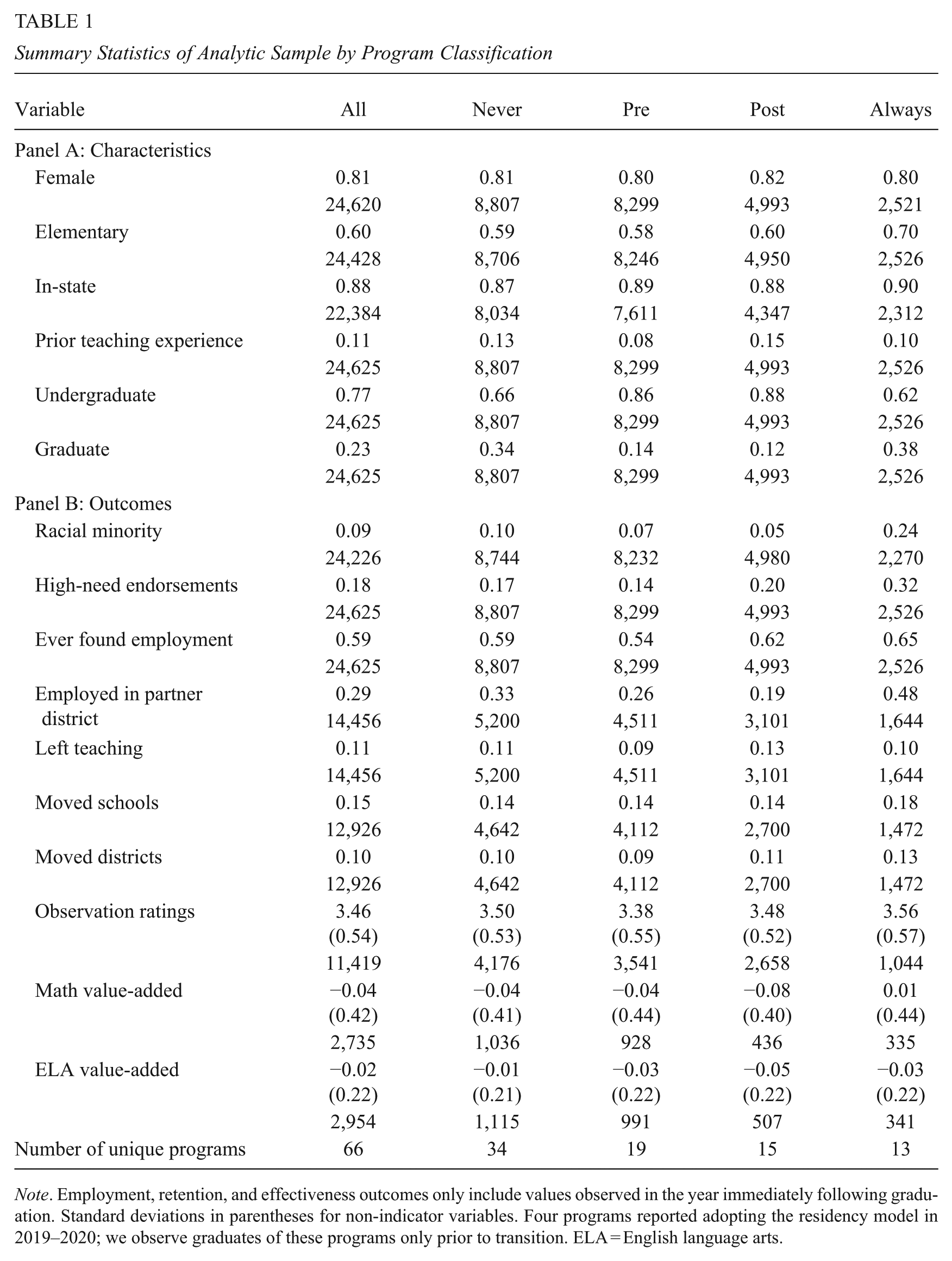
Note. Employment, retention, and effectiveness outcomes only include values observed in the year immediately following graduation. Standard deviations in parentheses for non-indicator variables. Four programs reported adopting the residency model in 2019–2020; we observe graduates of these programs only prior to transition. ELA = English language arts.
In Table A1, we assess the external validity of our sample by comparing the average characteristics and outcomes of graduates of programs that responded to our survey with those of non-responding programs (while still excluding job-embedded pathways). We find that our sample is disproportionately composed of undergraduate programs; however, across almost all other observable dimensions, graduates of responding programs appear comparable to those of non-responding programs, apart from having slightly less prior classroom teaching experience (unsurprising, given the underrepresentation of graduate pathways) and being more likely to move districts after their first year. While we cannot know for certain whether, which, and when non-responding programs would have identified as teacher residencies—and therefore cannot determine how their omission influences our estimates—the comparability of graduates of responding and non-responding programs, along with our high response rate, largely warrants the assumption that our sample satisfactorily represents all traditional programs across the state.
The remaining columns of Table 1 descriptively distinguish between programs that—during our window of study—reported consistently offering a traditional preparation, adopting the residency model (split into years before and after adoption), and operating exclusively as teacher residencies. Several noteworthy differences exist across these groups. Programs reporting a transition—which crucially provide the identifying variation in our analytic approach described below—further disproportionately serve undergraduates, whereas those that were always teacher residencies—which are inherently omitted from our models—were more likely to serve graduate students. Perhaps relatedly, graduates of these two groups differed, with cohorts among always-residency programs comprising higher proportions of teachers of color and teachers in high-need endorsement areas (as well as more elementary certified teachers). We also find that graduates of always-residencies tend to have the highest rates of employment (overall but also especially within partner districts), mobility, and instructional effectiveness. Taken together, these differences raise some concern that our estimates of the impacts of the model may not generalize to all residency programs and/or all teachers who complete them. Put another way, we are only able to isolate the effects of the transition from traditional preparation to teacher residency for the 15 (largely undergraduate) programs that shifted between 2011 and 2019, and the final column of Table 1 (“Always”) may indicate that these impacts could differ for programs that transitioned earlier and/or started as residencies ab initio. We return to this crucial point in greater detail in our discussion.
Analytic Strategy
Prior research has typically compared the characteristics and outcomes of graduates of teacher residencies with those of other programs to estimate differences in recruitment, employment, retention, and effectiveness among individuals entering the workforce in the same years and employed in the same school districts. However, such comparisons could be confounded by unobservable differences between programs—for example, in faculty or curricular quality—that, although not part of the residency model, are associated with which programs embrace it. In contrast, we employ difference-in-differences to leverage within-program variation in teacher residency classification over time. More specifically, we use two-way fixed effects for program and graduating year, thus accounting for any time-invariant unobservable differences across institutions as well as statewide changes in outcomes over time. This approach allows us to better isolate the impacts of model adoption by comparing changes in graduate outcomes from before to after their traditional programs transitioned to teacher residencies with contemporaneous changes among graduates of traditional programs that either never or had not yet adopted the model.
Estimation
Researchers have recently documented concerns about the bias and sensitivity of two-way fixed effects estimation when timing of treatment onset varies across units (Goodman-Bacon, 2021). These concerns are particularly warranted when treatment effects are likely dynamic (i.e., growing or declining over time relative to adoption) and/or heterogeneous (i.e., different across cohorts of adopters), both of which we find particularly credible here; impacts might increase over time as programs improve implementation, and they may also be larger among earlier and more eager adopters who perhaps integrate its features with greater fidelity. Consequently, we believe that the traditional approach to estimation presents substantial risk for identifying biased treatment effects, especially given substantial variation in timing of model adoption shown in Figure A1.
A variety of robust and efficient alternatives to traditional two-way fixed effects that better account for treatment effect heterogeneity have proliferated in the recent econometric literature (de Chaisemartin & D’Haultfoeuille, 2023; Roth et al., 2023; Wang et al., 2024). Here, we use the imputation-based approach proposed by Borusyak et al. (2024), which we prefer for three reasons: its robustness to the threat of anticipation effects, its use of only untreated observations for assessing the plausibility of the parallel trends assumption, and for its alignment with the structure of our data (Roth et al., 2023; Wang et al., 2024). 9 We explore the sensitivity of our results to other estimators—including traditional two-way fixed-effects and the group-time-based approach proposed by de Chaisemartin and D’Haultfoeuille (2023)—in a series of robustness checks discussed below, largely finding qualitatively consistent results and ultimately presenting the more conservative estimates obtained via our preferred estimator.
Generally speaking, the imputation-based estimator from Borusyak et al. (2024) uses period and unit fixed effects recovered from regressions involving only untreated (i.e., both never and not yet treated) observations to generate predicted counterfactual outcomes for each treated observation. An overall treatment effect is then constructed by taking the weighted average of the differences between these predicted and actual outcomes. Formally, this first step looks like

where outcome of interest Y for completer p of program s graduating in year t is regressed on unit- and time-specific fixed effects λ
s
and ß
t
, respectively, with the error term (ε
qpst
) clustered by program. Note that because most outcomes are binary (except for ORs and VAMs), these are linear probability models, meaning treatment effects are ultimately interpretable as percentage point changes in likelihoods. Then, for each treated observation, an effect is calculated as
Interpretation
Interpreting the estimates of our analyses as the plausible effects of model adoption requires two primary assumptions: (a) the existence during the pre-period of parallel trends in outcomes between graduates of programs adopting the model and those of programs who never or had not yet transitioned, and (b) the absence of any other unrelated programmatic or compositional changes that coincide with model adoption. For the former, as noted above, we examine our event studies for evidence of discrepant patterns prior to model adoption; for the latter, as an exploratory analysis upon which we elaborate below, we estimate changes upon transition to teacher residency in the composition of graduating cohorts across several characteristics available in administrative data. While these empirical investigations help corroborate the plausibility of a causal interpretation, they do not allow us to completely rule out the possibility of endogenous model adoption or the potential influence of contemporaneous, unrelated changes when programs become residencies.
Additionally, it is worth emphasizing that an analytic approach that employs period and unit fixed effects like ours relies on observing changes within programs. All identifying variation in these models comes from the 15 programs (22.7% of those in our sample) that reported becoming teacher residencies during the previous decade. (Changes in self-identification over time for all programs in our sample are shown in Figure A1.) Unlike in most prior studies, this means that programs that identified as teacher residencies across all observed years (N = 13) make no contribution to our estimates. These include both longer-standing programs that reported adopting the model prior to 2011 (N = 5) and more newly established pathways that began as teacher residencies and therefore never offered a traditional preparation (N = 8).
In many ways, we believe that this approach holds unique promise in uncovering the extent to which programmatic modifications made to the preparation undergone by teacher candidates can explain the increased diversity, employment, retention, and effectiveness among graduates of teacher residencies identified in prior literature, rather than other differences across programs unrelated to the residency model. In other ways, however, our analytic approach has several important limitations. Foremost among these is the fact that our estimates may only generalize to programs comparable to those that transitioned during our study window—namely, undergraduate institutions that initially offered a more traditional teacher preparation experience—and may not fully reflect the impacts of the teacher residency model at the graduate level and/or when implemented from day 1. Additionally, our reliance on only 15 programs to provide identifying variation often leads to imprecise estimates that constrain the utility of traditional levels of statistical significance; as such, we discuss results for which p < .1, classifying these as marginally statistically significant, and aim to support our interpretations with the face validity offered by both the dynamic patterns of effects displayed in our event studies and the robustness across sensitivity analyses. Finally, the validity of our results also hinges on the accuracy of our treatment variable—in the sense that programs not only truthfully identify whether they implement the teacher residency model but also, among those reporting a shift, precisely recollect the year in which implementation occurred. Our retrospective, self-report measure may permit error in each of these regards, raising concerns of attenuation bias driven by misreporting programs.
We seek to corroborate programs’ self-reported residency classification in two complementary ways. First, to clarify the specific changes implied by self-reported adoption of the model, we leverage the remainder of our survey, in which leaders responded to a series of questions about the presence and timing of adoption of programmatic features shown in prior literature to characterize the model (Berry et al., 2008; Guha et al., 2016; National Center for Teacher Residencies, n.d.). More specifically, we estimate our primary difference-in-differences specification using each of these seven features as an outcome; we display the effects of adoption of the model on the likelihood of reporting the presence of each in Panel A of Table 2.
Impacts of Reported Model Adoption on the Presence of Model Features
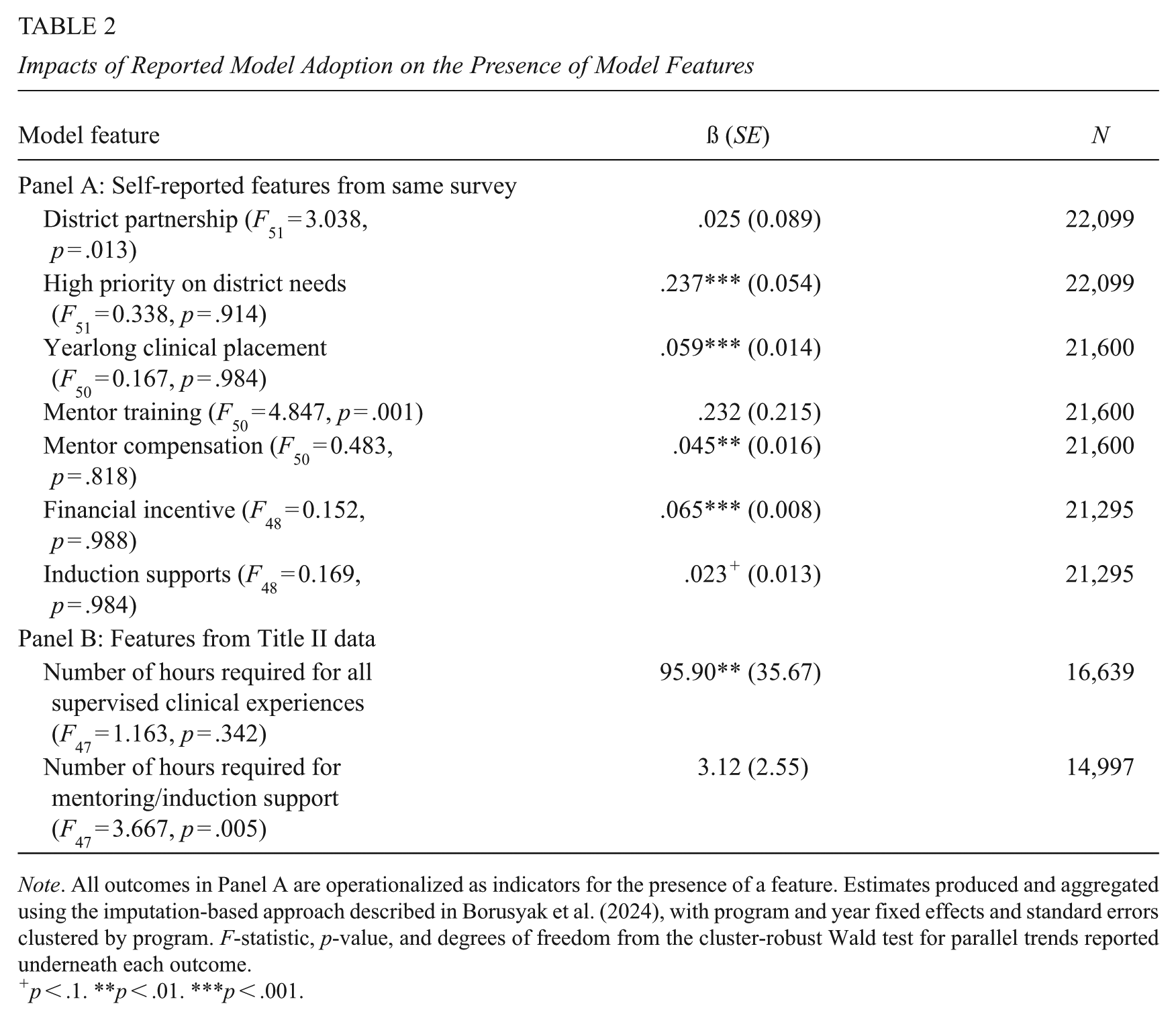
Note. All outcomes in Panel A are operationalized as indicators for the presence of a feature. Estimates produced and aggregated using the imputation-based approach described in Borusyak et al. (2024), with program and year fixed effects and standard errors clustered by program. F-statistic, p-value, and degrees of freedom from the cluster-robust Wald test for parallel trends reported underneath each outcome.
p < .1. **p < .01. ***p < .001.
Across all seven features, we uniformly observe self-reported average impacts that are theoretically aligned and directionally consistent with prior literature (Truwit et al., 2024). Most of these are statistically significant, though they are not always large in magnitude. For example, we find that transitioning to the residency model increases the likelihood with which programs report placing a high priority on district staffing needs during recruitment (by 23.7 percentage points [pp], p < .001), requiring a yearlong clinical placement (5.9 pp, p < .001), offering compensation for clinical mentors (4.5 pp, p = .005), and providing both financial incentives (6.5 pp, p < .001) and induction supports (2.3 pp, p = .080) for residents. No Wald tests indicate violation of parallel trends in the pre-period for any statistically significant outcomes, though at least one minor anticipation effect—in which programs begin to report placing a high priority on district needs 1 or 2 years before they report a transition to the residency model—is visible in the corresponding event studies of Figure 1. On the other hand, larger and earlier anticipation effects that do result in statistically significant Wald tests may be behind the absence of observed impacts on both the existence of a district partnership and the provision of training to mentors, suggesting programs often adopt these features in the years immediately prior to considering themselves residencies. That said, many of these features—and perhaps these two in particular—are far from exclusive to the residency model, so we do not find it surprising that traditional programs may have implemented them prior to a more comprehensive programmatic overhaul. 10
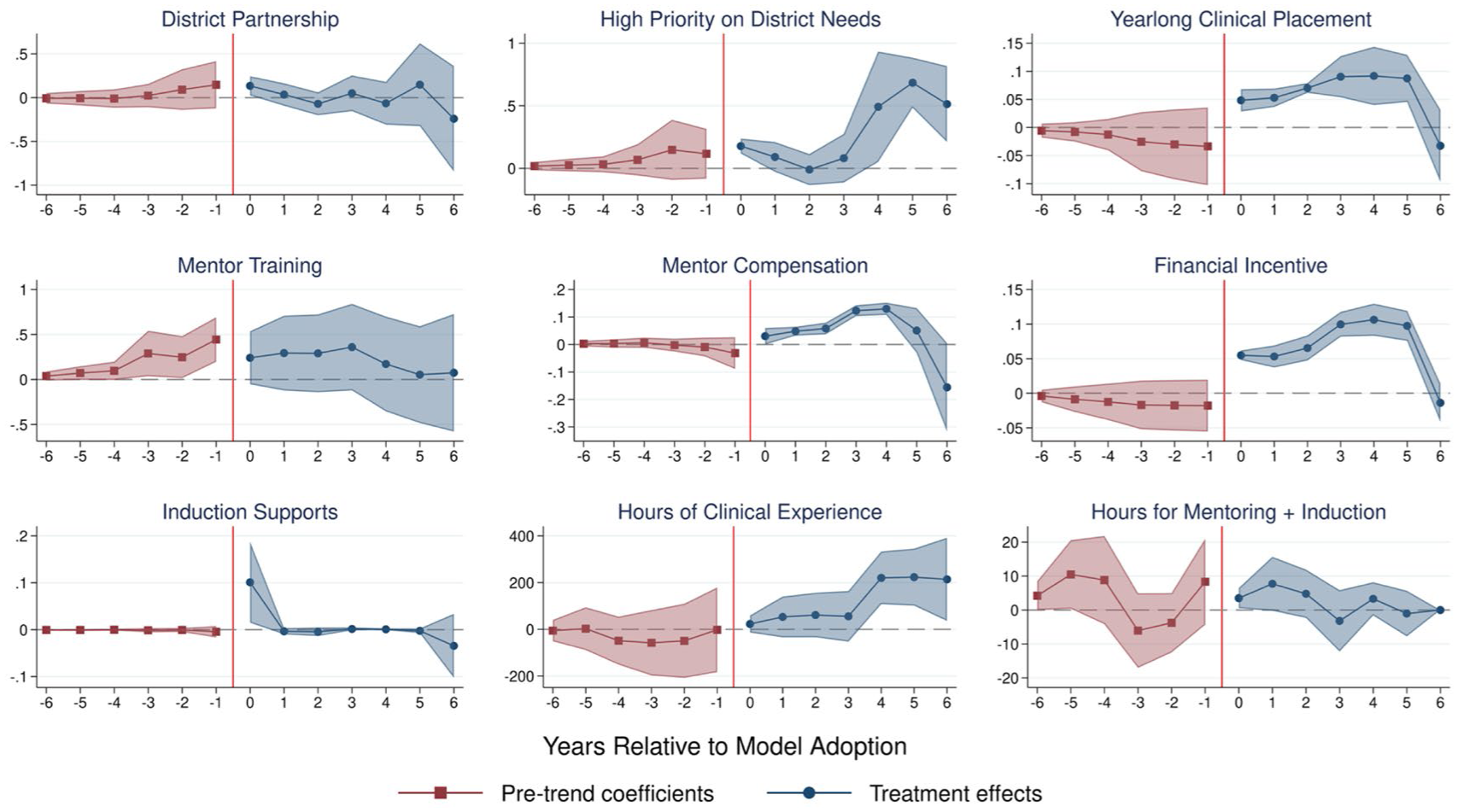
Dynamic effects of residency model adoption on the presence of model features.
These analyses, while reassuring, also rely on self-reported outcomes that were collected on the same survey and are therefore susceptible to similar threats of inaccuracy. Therefore, to further validate our treatment indicator, we integrate a pair of supplementary variables from the U.S. Department of Education Title II datasets: the number of hours of supervised clinical experiences required by each program both prior to and for student teaching (two values that we combine into one measure) and the number of clock hours of mentoring/induction support. While these metrics are also reported by program leaders themselves, they are done so annually rather than retrospectively and with some level of federal oversight; as a result, we believe that they are not subject to the same level of concern about the pernicious influence of, for example, a faulty memory and/or a lack of institutional knowledge stemming from staff turnover. 11 In Panel B of Table 2, we present additional corroboratory evidence for our treatment variable using this Title II data, finding that reported model adoption increases the length of total supervised clinical experiences by nearly 100 hours on average (p = .007); assuming 8-hour days, this is equal to an additional 2 and a half weeks’ worth of time in schools. 12 Our estimate of the impact on mentoring and induction support, though positive, is not statistically significant (while its Wald test is, indicating a similar potential violation of parallel trends).
Taken together, these analyses provide some reassurance that our operationalization of treatment does capture meaningful programmatic changes, including and especially a more intensive clinical experience. At the same time, the average estimated magnitude in the change of these features is more modest than what would occur under comprehensive implementation of the residency model, meaning that (some) programs may consider themselves to be teacher residencies even if they have not implemented all components of the model, a conclusion consistent with prior literature (Truwit et al., 2024). As an example, the shift in clinical experience from semester-long student teaching to a full-year residency would entail an increase of closer to 500 hours, suggesting that the average impact we identify is watered down by either residencies making smaller increases or non-residencies extending their own placements.
We take this to suggest that our estimates below may be best conceptualized as lower bounds for the impacts of the model. Further warranting this interpretation is the aforementioned concern of attenuation bias stemming from inaccurate reporting of the timing of a transition along with our decision to classify programs that reported “partially” considering themselves to be residencies as having adopted the model. While these factors may limit our capacity to identify the full extent of the effects of a well-implemented teacher residency, our analyses still have the potential to indicate where impacts are most evident while also illustrating a methodological step forward for future researchers similarly invested in understanding how programmatic changes to teacher preparation influence the outcomes of graduates.
Results
We present estimates of impacts of model adoption on recruitment, employment, retention, and instructional effectiveness. Table 3 contains estimates of aggregate effects across all programs and years of implementation, while Figure 2 displays the complementary event studies depicting dynamic effects for the (non-fixed) sets of programs observed at each point in time relative to adoption.
Average Impacts of Reported Model Adoption on Candidate Outcomes
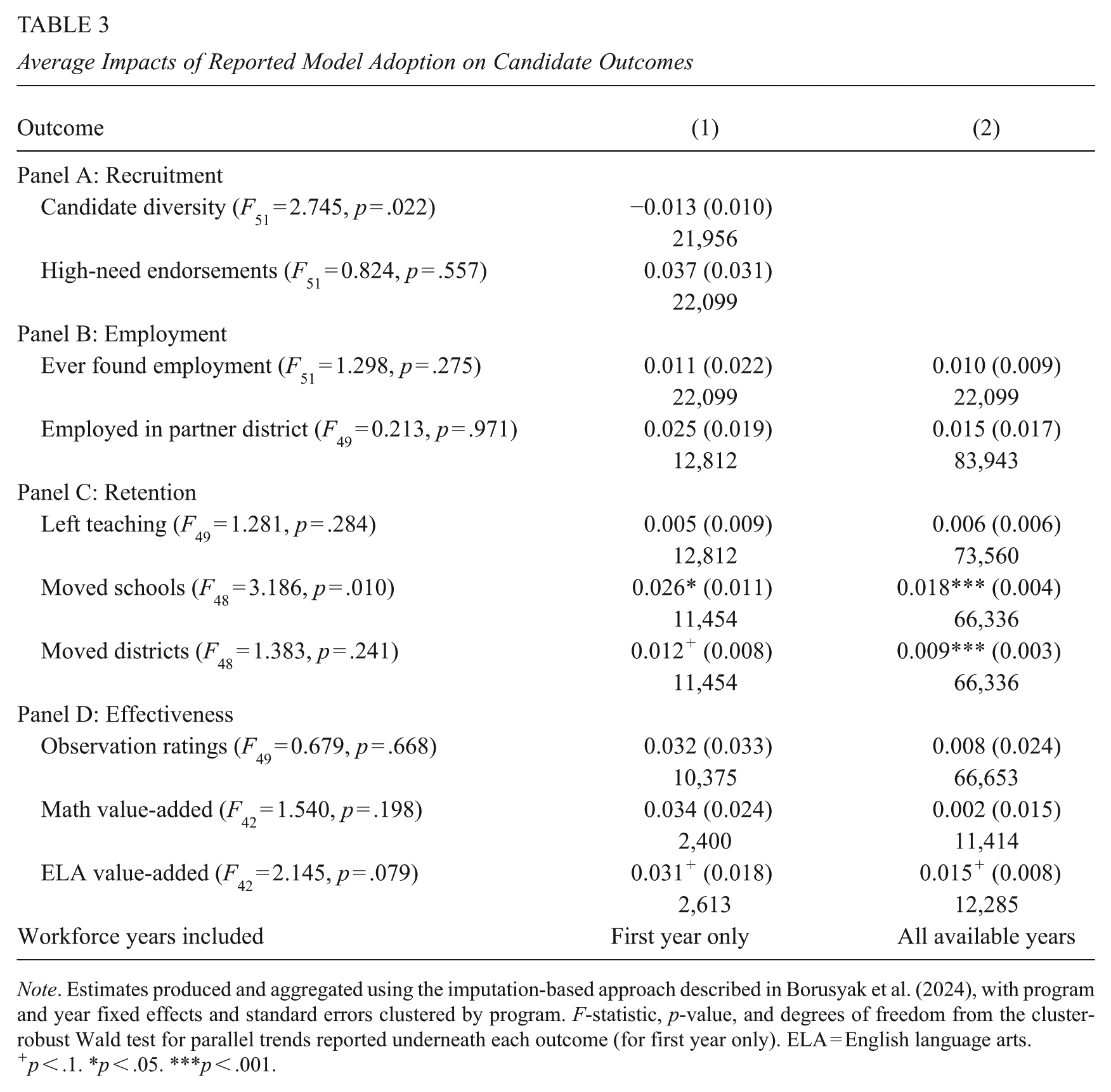
Note. Estimates produced and aggregated using the imputation-based approach described in Borusyak et al. (2024), with program and year fixed effects and standard errors clustered by program. F-statistic, p-value, and degrees of freedom from the cluster-robust Wald test for parallel trends reported underneath each outcome (for first year only). ELA = English language arts.
p < .1. *p < .05. ***p < .001.
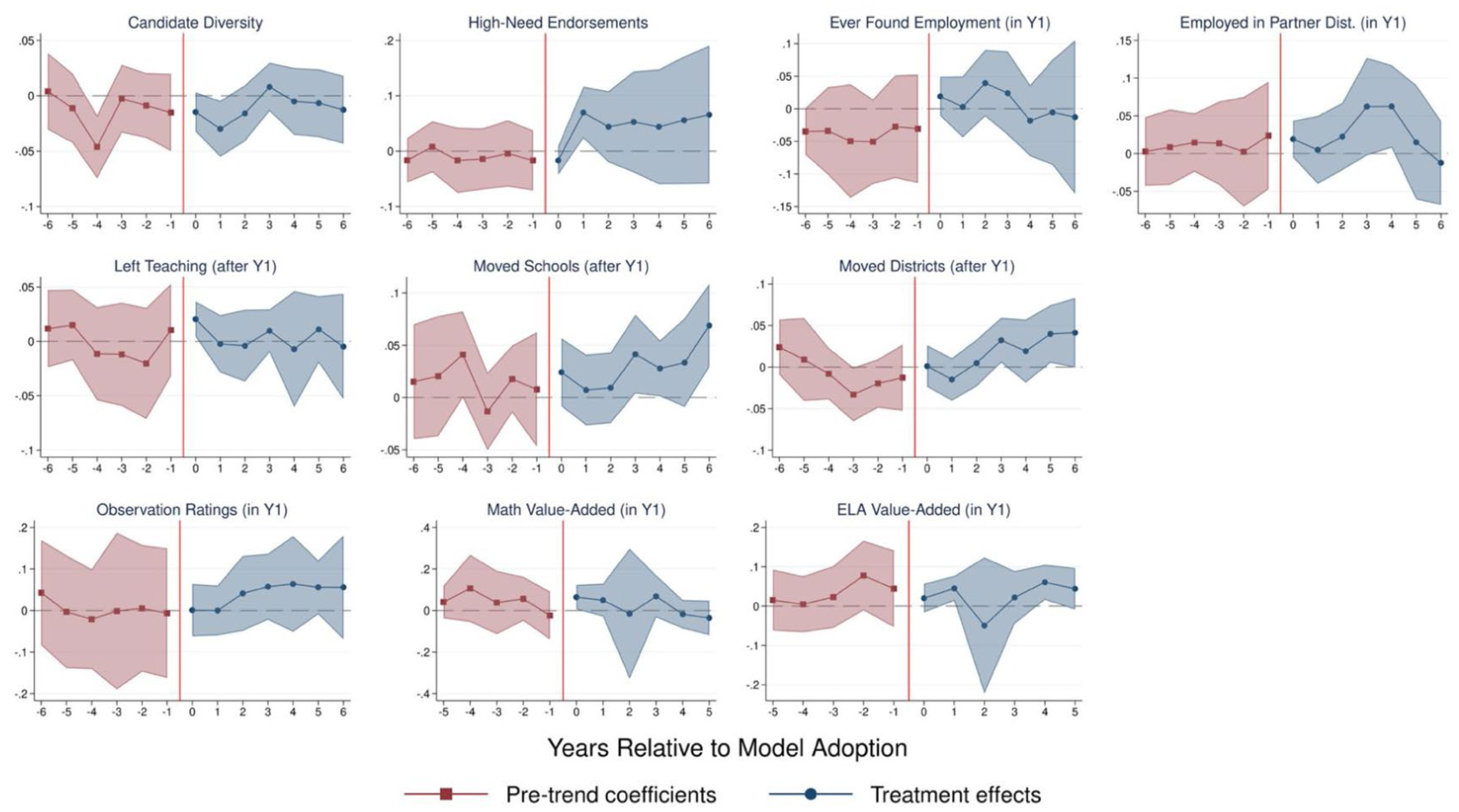
Dynamic effects of residency model adoption on graduate outcomes.
Primary Estimates
Beginning in Panel A of Table 3, we find only minimal evidence that adoption of the teacher residency model impacts programs’ recruitment practices. Both our aggregate estimate and the dynamic pattern of effects shown in our event studies imply that, relative both to their own rates in prior years and to any concurrent change among non-residencies, programs continued to graduate similar or slightly lower proportions of teachers of color after becoming teacher residencies. We find more mixed evidence of whether the transition to a residency influences the proportion of graduates certified in high-need subject areas. Taken at face value, model adoption increases the likelihood that a graduate receives a high-need endorsement across all years by 3.7 pp (p = .233), a 25.7% increase over pre-treatment years. While this effect is statistically significant only during the second year of model implementation, the pattern of dynamic effects visually demonstrated in Figure 2 appears to indicate a persistent increase of stable magnitude across all subsequent years. This slight delay aligns with the fact that these residencies’ earliest graduates—especially if undergraduates—would have likely decided on and taken prerequisite coursework for their subject area endorsements prior to this transition. Disaggregating this catchall into specific subject areas reveals that any positive impact is driven most by a clear and statistically significant increase in the proportion of special education endorsements (2.9 pp, 20.4% over a baseline of 14.2%, p = .019). We estimate precise null impacts for both math and science and an imprecise increase for foreign language/English as a second language.
In Table A2, we investigate additional impacts of model adoption on recruitment via several other graduating cohort characteristics. We find no effects on composition by gender, elementary endorsement, in-state residence, previous teaching experience, or prior academic achievement, implying—though not confirming—that the same kinds of students continue to enroll in these programs after model adoption. These results suggest that any subsequent impacts we uncover are driven more by changes in the preparation that graduates receive than by observable changes in recruitment and/or in graduates themselves.
In Panel B of Table 3, we show that adoption of the residency model does not statistically significantly impact the likelihood that graduates gain employment in a Tennessee public school, both immediately following graduation and in all available workforce years. The same is true for the likelihood of employed graduates working in their program’s partner district. The event study specification in Figure 2 provides some visual evidence of small but possibly short-lived increases in the overall and within-partner district employment rates of graduates after the transition to a residency model. However, any positive impacts on either outcome would be modest in absolute terms, ranging between one and three percentage points.
We present mixed results of impacts on graduates’ retention and mobility in Table 3 Panel C. Transitioning to the residency model does not appear to influence the rates at which graduates persist in the teaching profession either after their first year or over the course of their careers. However, we find some evidence that model adoption elevates the likelihood of school or district migration among employed, retained graduates after their first year of teaching, with increases of 2.6 pp (18.2%, p = .020) in the probability of switching schools and of 1.2 pp (13.3%, p = .097) for changing districts. Increased mobility is most evident several years post-transition and appears to be evenly split between movement within and across districts. In Table 3 Column 2, where we include all available workforce observations, we find that this increase in graduates’ likelihoods of moving schools and districts persists beyond the first year on the job, with impacts that are smaller in magnitude but more precisely estimated. That said, we note that the Wald test for school mobility indicates a violation of parallel trends in the pre-period at p = .01, casting some doubt as to the quality of the counterfactual provided by comparison programs and warranting some caution in concluding that any change in migration is attributable to the model.
In Panel D of Table 3, we find some weak evidence that transitioning to a teacher residency positively impacts graduates’ early-career instructional effectiveness. Across all three metrics, point estimates trend positive, indicating small increases in graduates’ ORs of about 0.03 points and in their VAMs of about 0.03 student-level standard deviations. However, only the estimates for ELA reach (marginal) statistical significance (p = .084 for the year immediately following program completion and p = .059 for all years). The event studies in Figure 2 complicate these aggregate estimates in divergent ways. On the one hand, we observe some indication of a delayed impact on ORs beginning in the third year of implementation and persisting beyond; on the other, there is again some concern about a possible violation of pre-trends driving the observed impact for ELA VAMs (with a marginally statistically significant pre-trend Wald test, p = .079). When examining impacts beyond the first year in the workforce, estimates in Table 3 Column 2 are substantially smaller, suggesting that any initial advantage in instructional quality for graduates of residencies mostly dissipates over time as graduates of non-residencies catch up over the course of their careers.
Robustness Checks
In Table A3, we first assess the sensitivity of our results to choice of estimator, finding mostly similar magnitudes and directions though sometimes different levels of statistical significance. Specifically, we compare our preferred estimator from Borusyak et al. (2024)—reproduced in Column 1—with another recent heterogeneity-robust alternative estimator for two-way fixed effects proposed by de Chaisemartin and D’Haultfoeuille (2023) as well as traditional two-way fixed effects estimation in Columns 2 and 3, respectively. For nearly all outcomes, estimates obtained following de Chaisemartin and D’Haultfoeuille (2023) are larger but less precise; when taken together, they tell a similar story for recruitment and employment but provide perhaps stronger evidence of impacts on mobility and instructional effectiveness. Meanwhile, when we generate classical two-way fixed effects estimates, we find that, as expected, estimates of effects that are later to emerge or grow over time (e.g., high-need endorsements, observation ratings) are slightly reduced, while those that diminish over time (e.g., employment, VAMs) are now marginally larger. For the most part, though, our takeaways are largely unchanged.
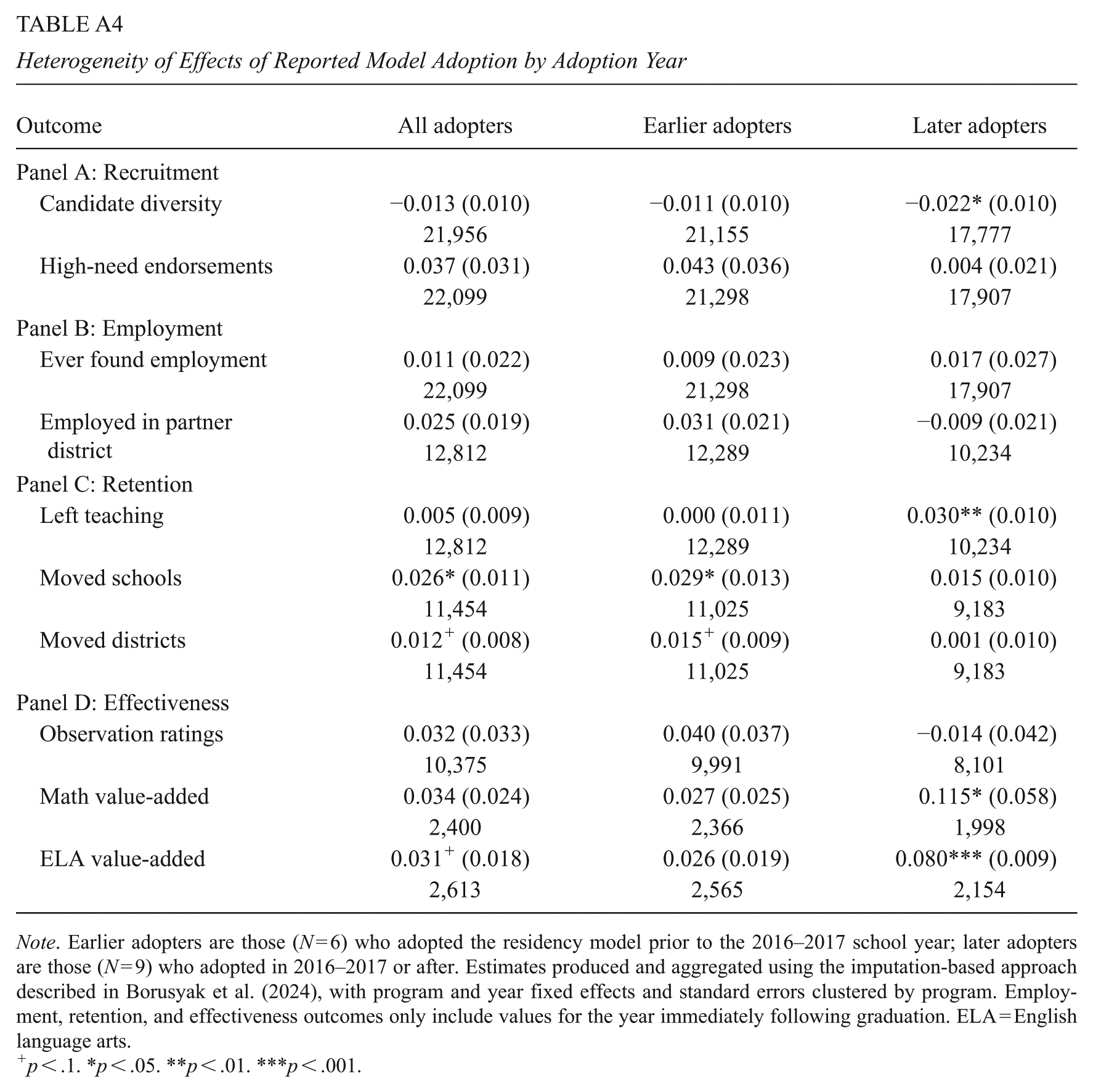
Collectively, the robustness of our estimates to the choice of estimator suggests that impacts for most outcomes may be relatively homogenous across both adopting cohorts and time relative to model adoption. Still, given prior evidence of more comprehensive implementation of the residency model among earlier adopters (Truwit et al., 2024), we more explicitly explore the extent of cohort heterogeneity masked by our aggregate treatment effects by separately estimating our preferred specification on earlier (up through 2015–2016, N = 9) and later-adopting (in 2016–2017 or after, N = 6) programs. We display the results of these analyses in the “Earlier adopters” and “Later adopters” columns of Table A4, with the “All Adopters” column again reproducing our preferred estimates for all 15 programs. In terms of recruitment, employment, and retention, we find a rosier picture of impacts for the six programs adopting the model in the 2013–2014 and 2014–2015 school years, though most continue to fall short of statistical significance. However, later-adopting programs appear to be more responsible for any increase in first-year VAMs.
Finally, in analyses not reported here, we also assess the sensitivity of our estimates to the inclusion of the additional graduate characteristics explored in Table A2—namely, gender, elementary endorsement, in-state residence, previous experience teaching in Tennessee public schools, and prior academic achievement. These characteristics are not needed as “controls,” given unconditional parallel pre-trends for most outcomes in our sparser specification and an absence of evidence that they are associated with model adoption, but we hypothesized that they might increase precision. However, we find that their inclusion does not meaningfully influence any of our estimates, reinforcing an interpretation of impacts appearing to be driven more by changes in programmatic features than by observable shifts in recruitment.
Discussion
The extant literature on teacher residencies highlights the promise of this nontraditional and innovative model of teacher preparation to attract and train racially diverse teachers that end up teaching in subject areas and classrooms that districts need most—and doing so both well and over longer careers (Guha et al., 2016). Our study aims to help clarify whether the improved outcomes documented in prior literature not only exist when examining a broader set of programs but also are attributable to the adoption of the residency model itself and not to other unobservable differences across institutions.
Effects of the Residency Model
Offering modest support for the promising results of previous studies, we find some evidence that the residency model may produce slightly more instructionally effective graduates. Effects only reach marginal statistical significance for teachers’ ELA value-added, but estimates—for VAMs in both subjects and for ORs—are all positive and roughly consistent in size with limited prior literature (An & Koedel, 2021). Moreover, the magnitude of these effects is comparable to the gains teachers typically accrue with additional experience. For example, estimates for first-year VAMs are about half the size of the amount of growth the average novice teacher demonstrates between their first and second years, making them substantively meaningful (Bell et al., 2023; Papay & Kraft, 2015). For ORs, this correspondence is much weaker; in raw magnitude, our estimate can be conceptualized as an average increase of about half a point on 1 of 15 indicators on the state rubric and is equivalent to only about a 10th of the typical growth demonstrated by teachers over their first year.
Given that the hallmark characteristic of the model is an intensive yearlong clinical placement, it may be that these effects correspond in part with the additional semester of classroom experience residents receive relative to a traditional preparation; such an interpretation is at least directionally consistent with the increase in the reported number of supervised clinical experience hours that we observe using Title II data. However, we caution that our study is not designed to assess this possibility directly, and prior research suggests that other features of the model like high-quality mentorship (Ronfeldt et al., 2020, 2025) may also influence graduates’ instructional effectiveness.
Effects on instructional effectiveness are largest when focusing on graduates’ first year of employment, indicating that the preparation that residents receive sets them up for an especially successful start. Impacts are diminished when estimated over all available workforce years—implying that teachers who graduate from non-residencies “catch up”—though, for ELA, they remain marginally statistically significant at about half the magnitude.
In similarly optimistic yet imprecise and modest results, we find that programs that transitioned to teacher residencies may produce a larger proportion of graduates certified in high-needs endorsement areas, with statistically significant impacts observed for special education certifications. Prior literature on this outcome was mixed; studies of individual residency programs have documented higher proportions of graduates teaching in high-need subject areas than other new teachers in the same districts (An & Koedel, 2021; Papay et al., 2012), but research on multiple programs across labor markets has failed to find the same pattern (Matsko et al., 2022; Terziev & Forde, 2021; Wan et al., 2021). Our result, which suggests the potential of the residency model to help address district staffing shortages through targeted candidate recruitment, may stem from the fact that an increase in the priority placed on district needs is the clearest impact of model adoption on the presence of specific features we observe among those programs that provide the identifying variation in our sample (see Table 2). These impacts were observed only for special education (and perhaps language) certifications but not for math and science, which could suggest that model adoption may have led programs to facilitate the completion of supplementary certifications rather than to shift graduates’ primary content preferences or differentially reallocate enrollment across subject areas.
Beyond these outcomes, we find less evidence that other promising impacts previously identified in the literature are attributable to the residency model itself. For employment, while estimates trend positive, we do not find any clear and convincing evidence that adoption of the residency model substantially increases the rate at which graduates obtain employment nor the likelihood of finding employment specifically in programs’ partner districts. This could suggest limits to the potential of the model to redistribute teachers to specific district settings as theorized and designed. However, it is worth acknowledging that Tennessee introduced a state requirement for all programs to form one or more district partnerships, raising concerns that programs may have adopted this feature—and experienced the associated employment effects—regardless of the preparation they offer aspiring teachers. We find some supporting evidence for this hypothesis in the clear anticipatory implementation of district partnerships among soon-to-be residencies and the absence of any observable increase in the reported presence of this feature after model adoption.
Programs that transitioned to teacher residencies also did not end up recruiting more teachers of color. This diverges from prior studies of single residency programs, which found greater racial diversity among graduates than among other early-career employees in the same districts (An & Koedel, 2021; Papay et al., 2012), although higher proportions of graduates of color were less common in examinations of the model at scale (Matsko et al., 2022; Terziev & Forde, 2021; Wan et al., 2021). One possible explanation for this discrepancy is that the increase in diversity estimated in previous studies cannot be interpreted as an impact of the model itself and may stem instead from other elements correlated with racial diversity (e.g., location, reputation, cost) that distinguish residencies from other programs that produce teachers hired into the same districts. Alternatively, it may be that adopting the model at an existing program offers less promise for increasing racial diversity than establishing a brand new program, due perhaps to challenges with recruitment earlier in the pipeline that have been both illustrated in states with predominantly White college-going populations (Bardelli et al., 2024) and acknowledged by teacher residencies (Terziev & Forde, 2021). The programs providing the identifying variation in our study involve mostly undergraduate pathways to teaching, where candidates often make decisions around institutional enrollment several years prior to program completion (e.g., as high school seniors). In such cases, programs may face difficulty in their efforts to influence the university-wide demographic composition of first-year students who comprise the pool of potential graduates, restricting any adjustments to recruitment practices to already disproportionately White student bodies; even if such efforts were successful, they would likely only emerge after several years of student matriculation.
Also in contrast with prior literature, we observe no relationship between adoption of the residency model and graduates’ retention, both after their first year on the job and over all observed years. Moreover, we found increases in the likelihoods that graduates move to a new school and district each year, a somewhat surprising result that aligns with descriptive trends documented in several previous studies (Roegman et al., 2017; Silva et al., 2014, 2015). On the one hand, increased mobility is not inherently problematic, especially if graduates of residencies are simply finding more success on the job market and can therefore more quickly find a more optimal fit. On the other hand, this trend is at least somewhat troubling given that the model was designed explicitly to help funnel graduates into specific districts.
In two exploratory follow-up analyses, we further investigate whether this increased mobility suggests that the residency model may fall short of delivering on its promise of helping partner districts fill difficult-to-staff classrooms. We first examine whether impacts on migration differ for graduates employed in partner districts compared to those hired into other districts. Compellingly, we find that adopting the model reduces the district mobility of graduates working in partner districts after both the first year (by 2.3 pp, p = .004) and in all available years (1.2 pp, p < .001); each of these estimates statistically significantly differs from the increases among those hired in other districts (p < .001 and p = .012 for the respective comparisons of subgroup-specific estimates). We observe a similar pattern for switching schools, albeit to a lesser extent.
We next look to see if model adoption impacts the kinds of relocations made by employed graduates after their first year. To do this, we draw on our same preferred specification but use as outcomes a set of difference scores in school-level characteristics (e.g., the difference between the percentage of students who are White in the schools to and from which a graduate moved). Note that these exploratory analyses should be interpreted with caution as they are underpowered—given their exclusive focus on the small set of employed graduates that move after their first year of teaching—and limited by poor coverage in school characteristics, which are available only through the 2017–2018 school year (resulting in the exclusion of all later-adopting programs). Still, they reveal no evidence that adoption of the residency model influences the kinds of moves that mobile, employed graduates make after their first year of teaching, with null impacts on student demographics, achievement, attendance, and staff turnover. At most, transitioning to the residency model shifts the post-first-year relocations of graduates to schools with relatively lower suspension rates.
While these two analyses are not designed to provide a conclusive explanation for this observed rise in graduate mobility, they do at least suggest that becoming a residency does not encourage graduates to move away from partner districts or to schools serving less marginalized students, mitigating apprehension that any positive impacts of the model fail to accrue in the settings that it was designed to serve. Additionally, they offer some evidence that an increasing proportion of graduates may find their way into their programs’ partner districts over time, suggesting perhaps that estimates of impacts on partner district employment may be more evident if measured further out. Future work should continue to investigate this trend to assess this possibility while also monitoring whether the patterns of migration resulting from model adoption are truly a cause for concern.
Considerations in Interpreting Effects
At a broad level, the impacts of teacher residencies could be driven by changes in who programs recruit or in the preparation they provide. We find that the characteristics of graduating cohorts remain similar on average from before to after any transition—with the possible exception of endorsement area—while adoption of the model leads to the greater reported presence of programmatic features like a yearlong clinical placement, mentor compensation, financial incentives, and induction supports. In addition, as noted above, most of the programs in our sample that reported adopting the residency model served undergraduates, many of whom may have made the decision to enroll at a particular institution several years prior to any programmatic transition. Together, this provides suggestive evidence that any observed effects are due to changes in preparation brought on by the adoption of the residency model and not changes in recruitment. That said, our analyses exploring changes in cohort composition are limited to a small set of observable characteristics and cannot rule out impacts on unobserved dimensions. Moreover, our exploration of how the transition to a residency alters programmatic features cannot directly link the adoption of specific components to improvements in outcomes. As such, future research should be explicitly designed to further parse apart the roles of recruitment and preparation in explaining the impacts of teacher residencies.
Additionally, we caution that our analyses hinge on a classification approach that asks programs to self-report whether they are residencies, which has implications for both the internal and external validity of our estimates. For the former, relying on program leaders to retrospectively identify their programs as (non-)residencies could limit the reliability of our classification. To address these concerns, we proactively encouraged program leaders to collaborate with other staff when responding to the survey to address informational gaps caused by administrative turnover. We believe that any inaccuracies in the reported timing of model adoption would be equally likely to result in misreports of earlier and later adoption years; moreover, any more systematic misreporting should manifest as consistent anticipatory or delayed effects, each of which we find some evidence for but neither of which we uniformly observe across analyses. As such, the largest concern stemming from our retrospective, self-reported treatment variable is the potential for attenuation bias constraining our power to identify statistically significant results.
With regard to external validity, we note again that the inclusion of program fixed effects means our estimates exclusively leverage the 15 programs that transitioned from non-residency to residency during our panel, which results in several limitations. Foremost, this means our study is often insufficiently powered to detect modest effects. Additionally, these 15 programs disproportionately comprised pathways to teaching for undergraduate students. Although their graduates were otherwise observably similar to those of non-residencies across the state, it remains possible that our estimates will not generalize well to, for instance, graduate pathways, particularly if that is where the model is more easily implemented and/or more efficacious. Perhaps of greatest concern is that the 13 programs we always observed as residencies do not play any role in estimating treatment effects. This includes not only the earliest self-reported adopters of the model but also the seven programs officially designated as teacher residencies via external stakeholders at the National Center for Teacher Residencies and the Tennessee Department of Education. Prior work has illustrated that these programs reported implementing the features of the model with greater fidelity than “unofficial” self-identified residencies; externally classified programs were much more likely to report requiring yearlong clinical placements, providing financial incentives, and offering training to mentors, though they did not report stronger district partnerships or more coherent curricular design (Truwit et al., 2024). If the programs that more comprehensively adopt the model’s features are also those that were most effective at, for example, increasing racial diversity or retention, then our results may fall short of capturing the extent to which the model influences these outcomes when implemented well.
This supposition is supported in part by descriptive statistics indicating that graduates of these “always” residencies consistently demonstrate the strongest workforce outcomes. We also document suggestively larger impacts on some outcomes (e.g., high-need certifications and ORs, though notably not VAMs) among programs transitioning to residencies earlier in our panel. Past research has also found that Tennessee’s earlier adopters of the model provided a more distinct preparation experience from traditional programs than later adopters, due both to a decline over time in the fidelity of model implementation and the rising proliferation of its features among non-residencies (Truwit et al., 2024). If we extend this trend to assume that impacts would be even more promising among the earliest adopters or those who had always implemented the model, then our analyses may undersell the potential for improved graduate outcomes.
For these reasons, we believe that our estimates are perhaps best interpreted as lower bounds for the impacts that programs could anticipate if they were to adopt the residency model in its totality. Still, limitations notwithstanding, we believe that our results are a substantial methodological step beyond prior studies that typically focus on no more than a handful of residencies (and often just one) and typically fail to control for the unrelated ways—both observed and unobserved—in which these programs differ from other preparers of new teachers. Specifically, we believe that our analytic approach better identifies the impacts of the residency model itself while clarifying the role of its programmatic features above and beyond any changes in recruitment—valuable information for traditional teacher preparation programs currently contemplating its adoption.
Policymakers continue to champion the residency model largely because of the promising initial evidence around its potential to increase teacher diversity, employment, and retention. Collectively, our results call into question whether the model itself is indeed responsible for these trends observed in prior studies of individual programs. At the same time, we provide some of the strongest evidence yet that model adoption may drive changes in graduates’ instructional effectiveness, as well as in their mobility and possibly their endorsement areas. These findings suggest to policymakers and leaders of traditional teacher preparation programs that transitioning to a residency may not be an effective strategy for diversifying their graduating cohorts or lengthening their teaching careers, but it may pay dividends in elevating early-career teaching quality.
Footnotes
Appendix
Heterogeneity of Effects of Reported Model Adoption by Adoption Year
| Outcome | All adopters | Earlier adopters | Later adopters |
|---|---|---|---|
| Panel A: Recruitment | |||
| Candidate diversity | −0.013 (0.010) | −0.011 (0.010) | −0.022* (0.010) |
| 21,956 | 21,155 | 17,777 | |
| High-need endorsements | 0.037 (0.031) | 0.043 (0.036) | 0.004 (0.021) |
| 22,099 | 21,298 | 17,907 | |
| Panel B: Employment | |||
| Ever found employment | 0.011 (0.022) | 0.009 (0.023) | 0.017 (0.027) |
| 22,099 | 21,298 | 17,907 | |
| Employed in partner district | 0.025 (0.019) | 0.031 (0.021) | −0.009 (0.021) |
| 12,812 | 12,289 | 10,234 | |
| Panel C: Retention | |||
| Left teaching | 0.005 (0.009) | 0.000 (0.011) | 0.030** (0.010) |
| 12,812 | 12,289 | 10,234 | |
| Moved schools | 0.026* (0.011) | 0.029* (0.013) | 0.015 (0.010) |
| 11,454 | 11,025 | 9,183 | |
| Moved districts | 0.012 + (0.008) | 0.015 + (0.009) | 0.001 (0.010) |
| 11,454 | 11,025 | 9,183 | |
| Panel D: Effectiveness | |||
| Observation ratings | 0.032 (0.033) | 0.040 (0.037) | −0.014 (0.042) |
| 10,375 | 9,991 | 8,101 | |
| Math value-added | 0.034 (0.024) | 0.027 (0.025) | 0.115* (0.058) |
| 2,400 | 2,366 | 1,998 | |
| ELA value-added | 0.031 + (0.018) | 0.026 (0.019) | 0.080*** (0.009) |
| 2,613 | 2,565 | 2,154 | |
Note. Earlier adopters are those (N = 6) who adopted the residency model prior to the 2016–2017 school year; later adopters are those (N = 9) who adopted in 2016–2017 or after. Estimates produced and aggregated using the imputation-based approach described in Borusyak et al. (2024), with program and year fixed effects and standard errors clustered by program. Employment, retention, and effectiveness outcomes only include values for the year immediately following graduation. ELA = English language arts.
p < .1. *p < .05. **p < .01. ***p < .001.
Acknowledgements
We are grateful to Emanuele Bardelli, Gina Lucchesi, Angelina Little, Kevin Schaaf, Julie Baker, Jack Powers, Randall Lahann, and Anissa Listak for their contributions to this work, as well as participants at the Association for Public Policy Analysis and Management (APPAM) and American Educational Research Association (AERA) annual conferences for their helpful comments. This project would not have been possible without the partnership, support, and data provided by the Tennessee Department of Education (TDOE) and partner educator preparation providers. Notwithstanding any TDOE data or involvement in the creation of this research product, the TDOE does not guarantee the accuracy of this work or endorse the findings. Any errors are the sole responsibility of the authors.
Declaration of Conflicting Interests
The authors declared no potential conflicts of interest with respect to the research, authorship, and/or publication of this article.
Funding
The authors disclosed receipt of the following financial support for the research, authorship, and/or publication of this article: Matthew Truwit received pre-doctoral support from the Institute of Education Sciences (IES), U.S. Department of Education (PR/Award R305B200011).

Notes
Authors
MATTHEW TRUWIT, PhD, is an assistant professor in the Department of Educational Leadership, Evaluation, and Organizational Development in the College of Education and Human Development at the University of Louisville. His research focuses on understanding, critically evaluating, and ultimately improving the ways in which educational policy enables and constrains teaching and learning.
MATTHEW RONFELDT, PhD, is a professor of educational studies at the University of Michigan School of Education. His research aims to improve teaching quality by focusing on preservice and in-service teacher education, teacher labor markets, the organizational contexts of schools, and the assessment of teaching and teacher preparation.