







Abstract
Background: We hypothesized that there no need to position the foot in plantarflexion after operative repair of an Achilles tendon rupture. Methods: In five fresh cadaver lower extremity specimens, the static tension in the Achilles tendon was measured as the ankle was sequentially dorsiflexed from 30, to 20, to 10, to 0 degrees of plantarflexion. The tendon was then transected and repaired using a modified Krakow locking loop suture technique. The tension in the tendon was again measured as the foot was sequentially dorsiflexed through the same range of motion: 30, to 20, to 10, to 0 degrees. The repair was then tensile tested to failure. Results: The intact Achilles tendons generated on average 10 N, 10 N, 15.8 N and 31.9.0 N of tension at 30, 20, 10, and 0 degrees of plantarflexion, respectively. After a modified Krakow locking loop repair, the tension across the repair site was 10 N, 11.46 N, 18.4 N, and 30.3 N at 30, 20, 10, and 0 degrees of plantarflexion. Thus, moving the ankle from 30 degrees to neutral placed an additional force of 21.9 N on the intact tendon and 20.3 N on the repaired tendon. The mean tensile strength of the modified Krakow repair was 598.6 N (range 167 1129 N). Conclusions: The tension in the repaired tendon at neutral position is only a small percentage (6.4%) of the strength of the tendon when operatively repaired by a modified Krakow locking loop suture technique. Clinical Relevance: Our results suggest that the ankle joint does not have to be positioned in plantarflexion after operative repair using the described technique.
Introduction
Achilles tendon ruptures are common injuries seen primarily in middle-aged male recreational athletes. 3 Traditionally, operative and nonoperative treatments have involved a period of cast immobilization with the foot in plantarflexion. This leads to delayed return of ankle motion and loss of dorsiflexion. 2,9,10
Although nonoperative treatment of Achilles tendon ruptures can give excellent results, 9 recent studies suggest that operative repair of the Achilles tendon may have advantages such as decreased ankle stiffness and calf atrophy, fewer tendocutaneous adhesions, and a lower risk of thrombophlebitis. 1,10,11,12,13 Furthermore, operatively repaired tendons have a lower risk of rerupture in physically active patients. 2,3,5,7,9,15
The current study was designed to determine the static tension generated across the Achilles tendon when the foot is plantarflexed and when the foot is in neutral position and to compare this difference to the ultimate strength of the tendon (gapping at the repair site) after being repaired using a modified Krakow locking loop repair. We hypothesized that the force generated during neutral foot positioning would be significantly less than the ultimate tensile strength of a Krakow locking loop repair, suggesting that plantarflexion casting may be unnecessary.
Materials and Methods
Five fresh cadaver lower extremities with full passive ankle motion were used for this study. There were three female and two male specimens with an average age of 79.6 (range 76 to 94) years. Each specimen was amputated above the supracondylar region of the femur. All of the soft tissues around the knee were removed except for the two heads of the gastrocnemius and their insertions into the posterior femur. Distally, the Achilles tendon was exposed from the myotendonous junction to the calcaneal insertion through a direct posterior approach. Each specimen was mounted on a customized hybrid circular external fixator with a hinged ankle component (Smith and Nephew Richards, Inc., Memphis, TN) (Figure 1).
Three 6-mm diameter half pins were used in the tibia, and a 1.8-mm diameter smooth wire was placed through the calcaneus to fix the specimen rigidly in the frame. Half pins were then placed into the first and fourth metatarsals off the hinged aspect of the frame to allow variation in ankle position. To avoid the use of a soft-tissue clamp, a Steinmann pin was placed through the distal femur parallel to the knee joint to serve as a traction site on the gastrocsoleus-Achilles tendon unit. The knee was essentially in full extension during all trials because of the upward pull of the testing machine.
The mounted specimen was then positioned on an MTS 858 Mini Bionix servohydraulic testing machine (MTS, Minneapolis, MN). Ankle position was determined by referencing off the intersection between the distal fibula and the glabarous skin line on the lateral aspect of the foot. Using this method, ankle position could be sequentially adjusted between 30, 20, 10, and 0 degrees of plantarflexion.
At the start of the experiment, each specimen was placed in 30 degrees of plantarflexion, and 10 N of tension was applied to the tendon. This preload was selected because it removed all slack from the tendon and placed it in tension. With 10 N applied and the foot in 30 degrees of plantarflexion, the ankle position was sequentially rotated in 10-degree increments to neutral with the force data being recorded at each position. This series was repeated four times for each specimen to ensure reproducibility and the mean values were calculated.
With the tendon still in the hybrid fixator, a simulated Achilles tendon rupture was created 4 cm from the calcaneal insertion by cutting the tendon transversely with a scalpel as described by Jaakkola et al. 6 The rupture was then repaired using a modified Krakow locking loop technique. 8 Each tendon was repaired using a #2 nonabsorbable polyester suture (Surgidac, US Surgical, Norwalk, CT, USA) with five locking loops proximally and five distally. Four suture strands crossed the repair site with all knots tied at the most proximal aspect of the repair (Figure 2). A running baseball stitch was made around the posterior aspect of the repair, using 4.0 monofilament polypropylene (Prolene, Ethicon Sutures, Johnson and Johnson, Piscataway, NJ, USA) to augment the repair.
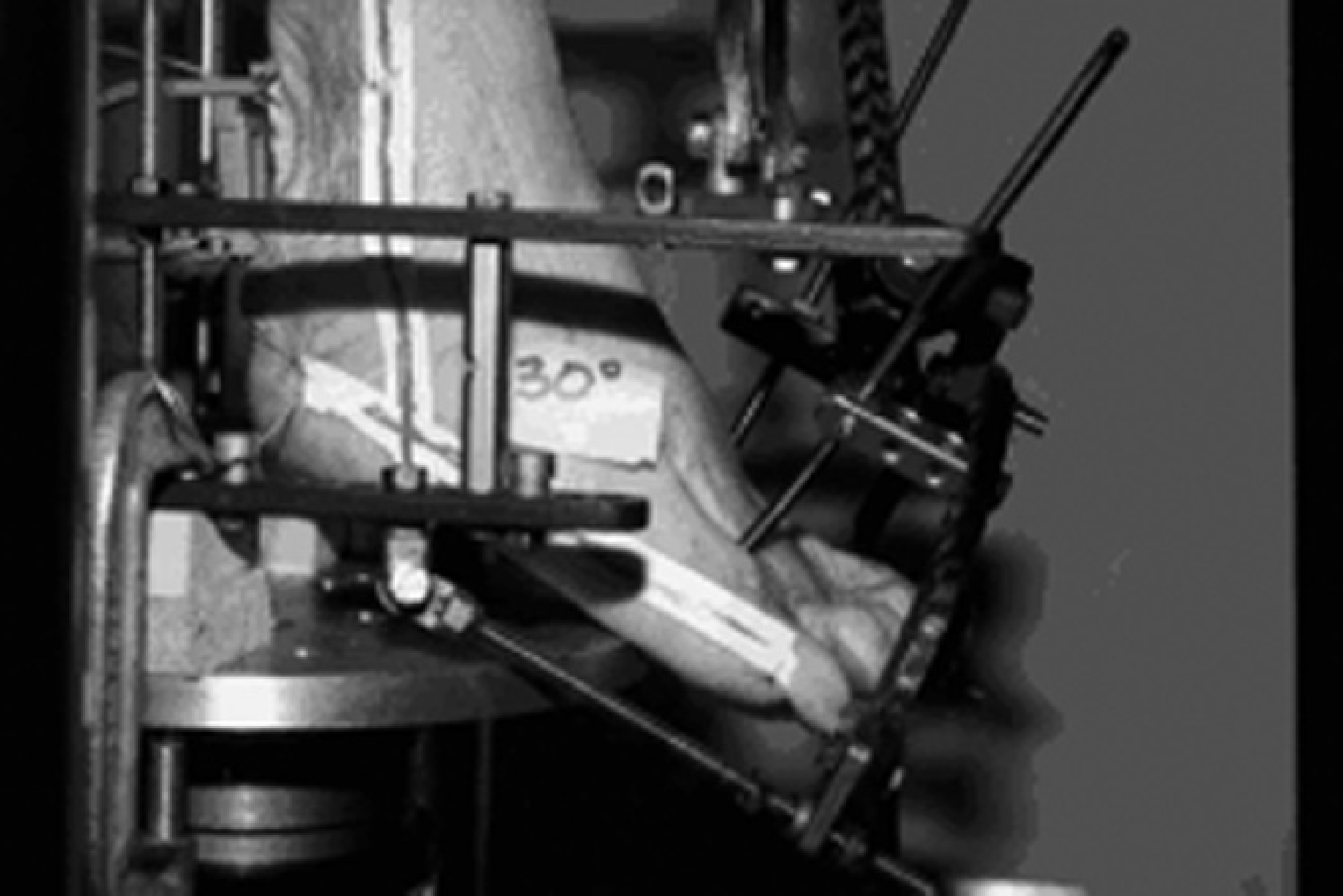
A typical specimen is shown mounted in the hybrid external fixator and set at 30 degrees of plantarflexion. The reference lines shown coincide with the fibula and the glabrous skin crease at the plantar aspect of the foot. The gastrocnemius origin is intact to allow loading through the femur. The foot is fixed in the lower portion of the frame, which is hinged to allow controlled ankle motion.
After repair, the foot while maintained in the hybrid fixator was remounted on the MTS machine and the ankle positioned in 30 degrees of plantarflexion. A preload of 10 N was again applied with the foot at 30 degrees. The ankle position was dorsiflexed sequentially to 20, 10, and 0 degrees of plantarflexion and the force data recorded at each position. This series was repeated four times for each specimen to ensure reproducibility, and the mean values were calculated.
The ultimate strength in tension of the modified Krakow locking loop repair was then determined by pulling the repair to failure at a rate of 0.1 cm/sec. Failure was defined as any visible gapping of 5 mm of the repair.
Results
On average, the intact tendons (n = 5) generated 10 N, 10.74 N, 15.8 N, and 31.9.0 N of force at 30, 20, 10, and 0 degrees ankle position, respectively. Following a modified Krakow locking loop repair the force across the repair site was 10 N, 11.46 N, 18.4 N, 30.3 N at 30, 20, 10, and 0 degrees ankle position (Table 1). A paired t-test was performed to test whether there were any statistically significant changes between the intact Achilles and each of the angles at 20, 10, and 0 degrees. None of the differences were statistically significant at p < 0.5. Since our sample size was small we carried out a Wilcoxon signed-rank test at 20, 10, and 0 degrees, and the p-values were 0.50, 0.81, and 1.0, respectively.
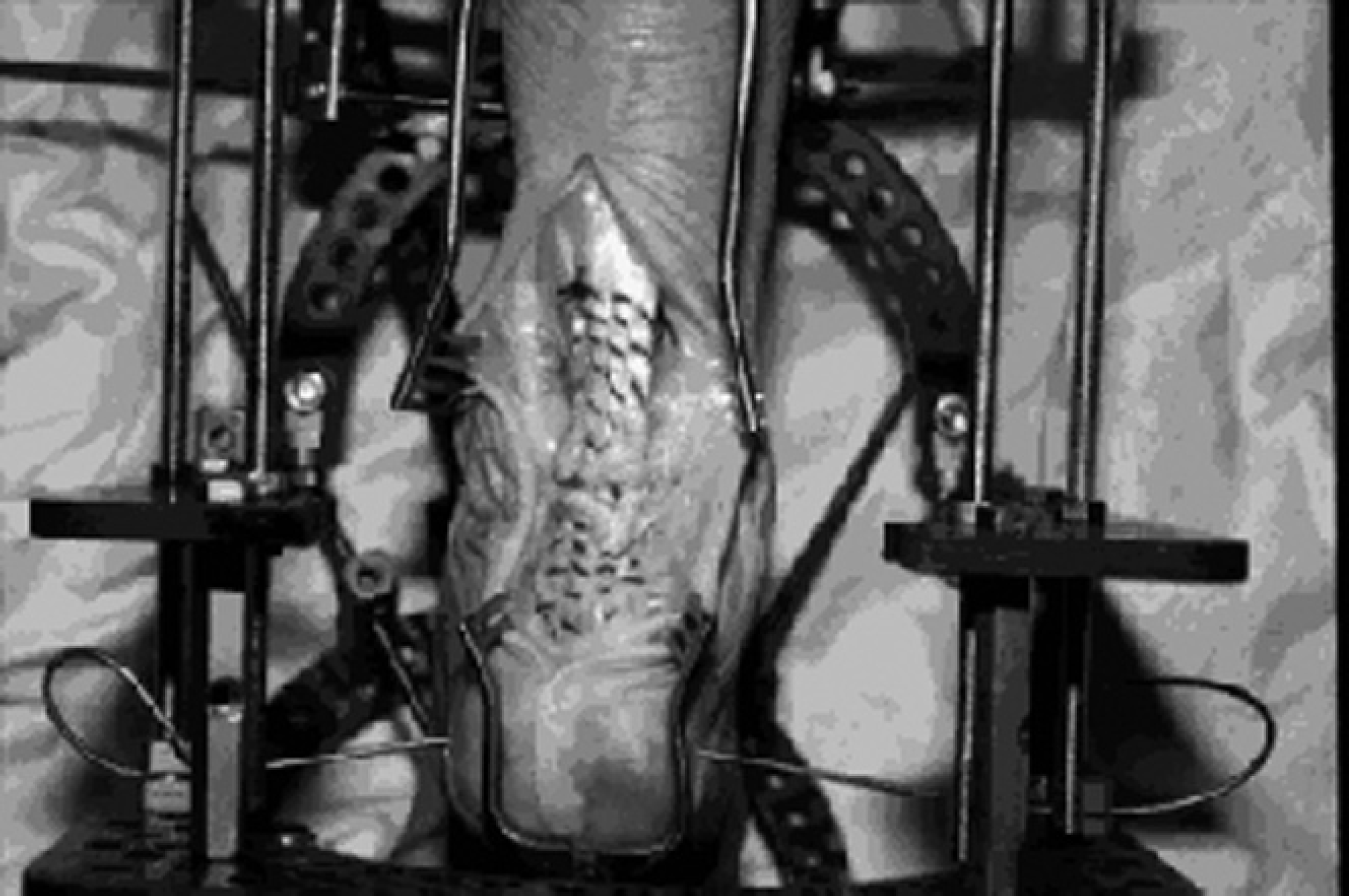
A specimen repaired using the modified Krakow locking loop technique. Equal numbers of sutures were used above and below the repair with the knots tied proximal to the Achilles transection.
The tension in the Achilles tendon for each intact and repaired specimen at 30, 20, 10, and 0 degrees of plantarflexion
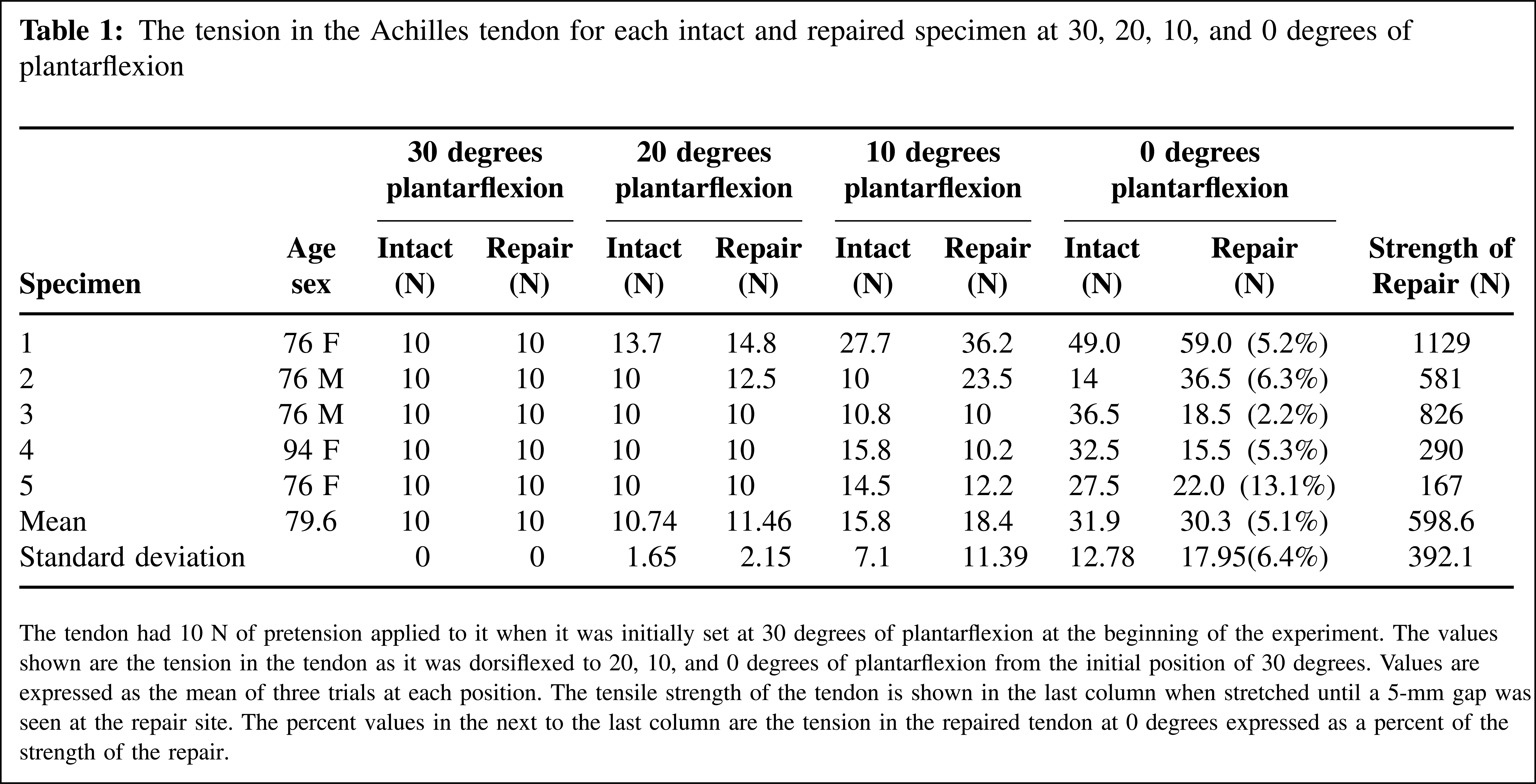
The tendon had 10 N of pretension applied to it when it was initially set at 30 degrees of plantarflexion at the beginning of the experiment. The values shown are the tension in the tendon as it was dorsiflexed to 20, 10, and 0 degrees of plantarflexion from the initial position of 30 degrees. Values are expressed as the mean of three trials at each position. The tensile strength of the tendon is shown in the last column when stretched until a 5-mm gap was seen at the repair site. The percent values in the next to the last column are the tension in the repaired tendon at 0 degrees expressed as a percent of the strength of the repair.
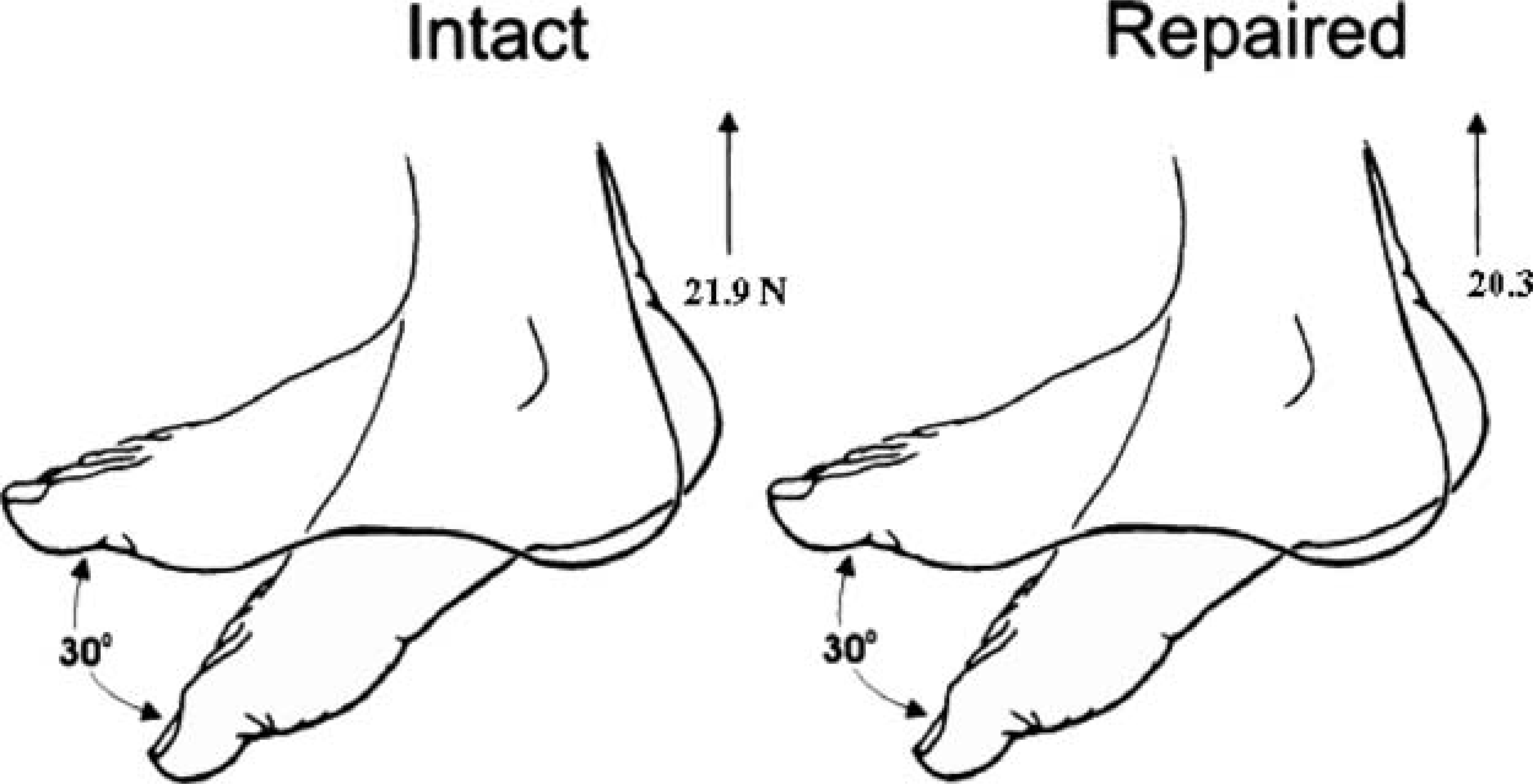
The difference in tension in the Achilles tendon after it is dorsiflexed from 30 degrees of plantarflexion to 0 degrees of plantarflexion. On the left is the difference for the intact specimen (21.9 N) and on the right is the difference for the specimen after it was repaired using the modified Krakow locking loop technique (20.3 N).
Further, our results indicate that moving the ankle from 30 degrees to neutral placed a mean additional force of 21.9 N for the intact Achilles tendon and 20.3 N after the repair (Figure 3).
All specimens were tensile tested to failure. Tensile strength was defined as the strength of the specimen to resist 5 mm of gapping at the repair site. There were no suture or knot failures. The mean tensile strength of the modified Krakow repair was 598.6 N (range 167 to 1129 N).
In calculating the tendon tension of the repaired specimen in the neutral position compared to the tensile strength of the suture repair we found that the average percent of the repair based on the overall strength of the repair was 6.4% with a 95% confidence interval (1.42%, 11.5%). This represents a small part of the actual strength of the suture repair. Even in the “worst” specimen, Specimen 5, the tension in the repair when the ankle was dorsiflexed to neutral was only 13.1% (22.0 of 167) of the strength of the repaired tendon.
Discussion
Our study examined the forces required for passive positioning of the foot after Achilles tendon repair using a modified Krakow locking loop repair. The main results to emerge from these experiments were 1) there was a minimal difference in tension across the repaired tendon as compared to the intact tendon when the ankle was dorsiflexed to the neutral position (Figure 3); 2) the tension in the repaired tendon at neutral position was on average only 6.4% of the strength of the tendon. Even in the “worst” case the tension in the tendon at neutral position was only 13.1% of the strength of the tendon. Thus, our results add credence to the immediate positioning of the ankle in neutral position, and the lack of need to position the foot in plantarflexion after operative repair.
In our experiment, we found some variability between tested specimens particularly in the strength of the tendon. We have found that this variability commonly occurs when using cadaver material and can be attributed to the vagaries of post-mortem collection. Two other studies looking at the strength of a traditional Krakow repair demonstrated average tensile strengths that were somewhat lower than ours (161 N 6 and 147 N 14 ). These studies used smaller gauge sutures (No. 1), had frequent knot failure at the repair site, and did not use a supplemental baseball stitch in their repairs. In choosing the modified Krakow locking loop repair, we tried to simulate our preferred repair by using No. 2 nonabsorbable polyester suture and supplementing this with a running baseball stitch around the posterior aspect of the repair. We also chose to modify the traditional Krakow technique as used in the other two studies to see if it would limit the number of knot failures at the repair site. Proximal knot tying seemed to accomplish this goal as none of our five specimens failed because of knot unraveling. Despite the differences in the two previous studies and ours, both studies suggested that locking loop repairs are strong enough to withstand immediate neutral ankle positioning with little risk of repair gapping.
As a cadaver biomechanical study, our conclusions are not without limitations. One considered drawback could be that we had five specimens. It took us a while to get these specimens, and if our result had been less clear then we would have hesitated at presenting data for five specimens. Since our sample size was small, we carried out a Wilcoxon signed-rank test at 20, 10, and 0 degrees. Further, in our model we applied 10 N of tension at 30 degrees of plantarflexion. We chose this force because it removed slack from the tendon, which was clear to see. Similar to other studies, 6,14 our model is one in which the tendon has been transected rather than ruptured. It is true that a transected tendon may hold suture better than a ruptured tendon where the ends are frequently fibrillated. However, this method is similar to other studies of repair strength in the literature and was adopted because it is easy to reproduce 14 This model obviously would not apply to musculotendinous junction tears or avulsion tears from the calcaneus.
Our study does not mean to imply that our modified Krakow locking loop repair can withstand the forces of early unprotected weightbearing. On the contrary, Finni et al. 4 demonstrated that walking places approximately 1430 N on the Achilles tendon during midstance which suggests that a modified Krakow locking loop repair could not withstand the forces of early unprotected weightbearing.