







Abstract
Background: Hallux valgus surgery is followed by a significant amount of postoperative pain. Local multi-drug injection can be an option for pain control, but few clinical studies exist. Methods: Between May 2008 and July 2009, 30 consecutive patients (60 feet) received simultaneous bilateral proximal osteotomies for the correction of hallux valgus deformities. Each patient received local infiltration of the test solution made with ropivacaine, morphine, ketorolac, and epinephrine on one foot and same amount of normal saline on the other foot. The test side and the control side were randomly selected and both the patient and the surgeon remained blinded until the end of the data collection. Results: The multi-drug injection resulted in significantly less pain at 4 hours after the operation through the night of the first postoperative day. The difference in visual analogue scale (VAS) between the two sides was most significant at 8 hours after the operation, and then gradually decreased through the first and second postoperative day. Mean satisfaction VAS was significantly higher on the injection side (8.2 ± 0.9) compared to the control side (6.2 ± 1.9, p < 0.0001). Conclusion: Local multi-drug injection was easy to perform and safe and effective in reducing pain and enhancing patient satisfaction after hallux valgus surgery.
Level of Evidence: I, Prospective, Randomized, Controlled Double Blind Study
Introduction
Hallux valgus surgery is usually accompanied by a significant amount of postoperative pain. 8,29 Adequate control of postoperative pain is important for patient satisfaction since pain and nausea due to narcotics are two major complaints after outpatient surgery. 29
Many authors agree on the necessity of multimodal approach for effective pain control while minimizing the side effects of analgesics after foot and ankle surgery. 4,6–8,16,17,20,24,29 Patient-controlled analgesia (PCA) is widely used for its safety and effectiveness. 5 However, PCA alone is not sufficient to achieve maximal pain control because it only acts on the central nervous system. Combining various nerve blocks has been proven to be effective in controlling postoperative pain. 7,8,16,24,29 Nerve blocks decrease the nocioceptive input and subsequent hyperexcitability of nerves, thereby diminishing postoperative pain. 7 However, there are several drawbacks which limit its use: increased time to place the blocks, technical difficulty or availability of a skilled anesthesiologist, and the associated motor blockade which can delay the functional recovery and rehabilitation. 21
Local infiltration with a multi-drug injection is another option for pain control. Due to its convenience, safety, and effectiveness, it has been widely used after total knee and hip arthroplasties. 3,9,11–13,19,30 Interestingly, however, few studies exist in the literature regarding the use of multi-drug injection after forefoot surgeries. Therefore, we designed a prospective, randomized, controlled, double-blind study to evaluate the effectiveness and safety of local multi-drug injection after hallux valgus surgery.
Materials and Methods
Between May 2008 and July 2009, 594 bunion surgeries were performed on 410 patients at the author's institution. Two hundred twenty-six patients had a unilateral procedure, while 184 patients underwent bilateral operations. Among the bilateral cases, 36 patients preferred simultaneous bilateral procedures, while 148 patients favored staged operations. Among the 36 patients who received simultaneous bilateral procedures, six declined to participate in this study. Therefore, 30 consecutive patients (60 feet) undergoing simultaneous bilateral proximal osteotomies for the correction of bilateral hallux valgus deformities were enrolled in this study. Mean age was 42.7 (range, 20 to 62) years and most of our patients were females (27 out of 30, 90%). Mean height, weight, and body mass index (BMI) was 161.5 ± 7.9 cm, 60.0 ± 6.9 kg, and 23.0 ± 1.9 kg/m 2 , respectively. Mean preoperative hallux valgus angle and intermetatarsal angle of the two sides were similar. Total tourniquet time was also similar between the two sides (Table 1).
All operations were performed on an in-patient basis due to the local standard as well as the use of spinal anesthesia, use of IV PCA, and performing simultaneous bilateral procedures. All patients were discharged from the hospital on the second postoperative day. Each patient received local infiltration of the test solution on one foot and same amount of normal saline on the other foot. Both the patient and the surgeon remained blinded regarding which side received the test solution until the end of the data collection. Only the circulating nurse who randomly selected a syringe containing either the test solution or normal saline for each side was aware of the randomization result. The study protocol was approved by the local ethics committee and all patients signed an informed consent.
Patients over the age of 20 with moderate to severe degree of bilateral hallux valgus deformities (i.e., hallux valgus angle greater than 30 degrees and intermetatarsal angle greater than 13 degrees) were eligible for inclusion. Exclusion criteria included diabetic or immunocompromised patients, patients with peripheral circulatory disorders, presence of associated lesions in the ipsilateral foot, or use of any analgesics within one week prior to the operation.
One experienced anesthesiologist performed spinal anesthesia (at level T10-11/T11-12 with 12.5 mg hyperbaric bupivacaine 5 mg/mL) in all patients. We conducted distal soft tissue procedure 14 combined with proximal chevron osteotomy 23 and Akin osteotomy 1 in all cases. Two 1.4-mm Kirschner's wires were used for fixation of the metatarsal osteotomies and two 1.2-mm Kirschner's wires were used for phalangeal fixation. In order to minimize the time interval between the injection of the test solution/saline in each sides, we temporarily covered the wound with wet saline gauze and an elastic bandage after the periosteal and capsular suture of one side, and then deflated the tourniquet. Surgery on the other side was done in the same manner. After periosteal suture of the second side, we re-inflated the tourniquet on the first side, and the surgeon injected the solution almost simultaneously in each side. Tourniquets were deflated 10 minutes later to minimize any possible systemic side effects and maximize the local concentration of the injection; this was taken as the starting time for the study evaluations.
The test solution was a mixture of 0.75% ropivacaine hydrochloride 30 mg (7.5 mg/ml, 4 ml), morphine hydrochloride 1 mg (10 mg/1 ml, 0.1 ml), ketorolac trimethamine 3 mg (30 mg/ml, 0.1 ml), and epinephrine 0.06 mg (1 mg/ml, 0.06 ml) mixed with normal saline 5 ml. The placebo was prepared with the same amount (9.26 ml) of normal saline. Five milliliters of the solution was injected over the periosteum, in the deep soft tissue and around the dorsal and plantar medial cutaneous nerves, and the remaining 4.26 ml was injected in the subcutaneous tissue around the wound after completion of the subcutaneous suture. Skin closure was done with continuous subcuticular sutures using Vicryl 4-0 and sterile strips (Steri-StripTM, 3M, St. Paul, MN) were applied. Surgical dressing was performed using a self-adherent wrap (CobanTM, 3M, St. Paul, MN). A postoperative rocker-bottomed shoe was applied and the patient was allowed to heel weightbear.
For pain control, all patients received intravenous PCA of fentanyl 1 mg and ketoprofen 240 mg. Oral administration of nonsteroidal anti-inflammatory drug (NSAID) was routinely administered three times a day, starting from 4 hours after the operation. Rescue analgesia was provided primarily with intravenous injection of diclofenac sodium 75 mg when requested by the patient. If diclofenac failed to relieve the pain within 60 minutes, then intramuscular injection of pethidine 50 mg was allowed.
Degree of pain on each side was evaluated separately using the visual analogue scale (VAS) at 2, 4, 6, and 8 hours after the release of tourniquet, and at 8 am, 2 pm, and 8 pm on the first postoperative day and at 8 am on the second postoperative day. When the patient requested rescue analgesia, VAS was evaluated before the injection. Patient satisfaction regarding the postoperative pain on each side was surveyed separately using very satisfied, satisfied, satisfied with reservation, and not satisfied scale. A satisfaction VAS system 2 was also utilized to give a numerical value and statistically compare the patient satisfaction. The scale ranged from 0 (worst, totally unsatisfied) to 10 (best, completely satisfied). Satisfaction was evaluated before discharge from the hospital, at noon of the second postoperative day. Data collection was done by a research assistant who was also blinded to which side received the test solution. Any side effects or discomfort was also monitored.
Clinical Data of the Two Sides

Statistical analysis
Statistical data were analyzed by using SPSS version 15.0 software (SPSS Inc., Chicago, IL). A statistician performed all the statistical analysis. To compare the numerical values of the two sides including VAS and satisfaction VAS, a two-sample t-test was performed.
Results
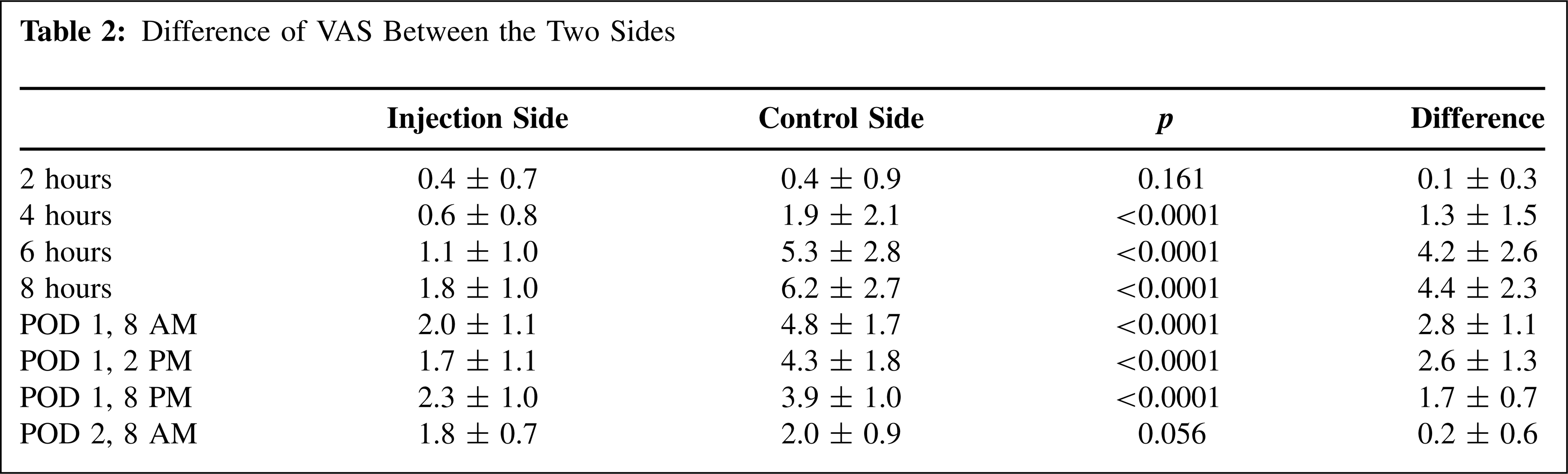
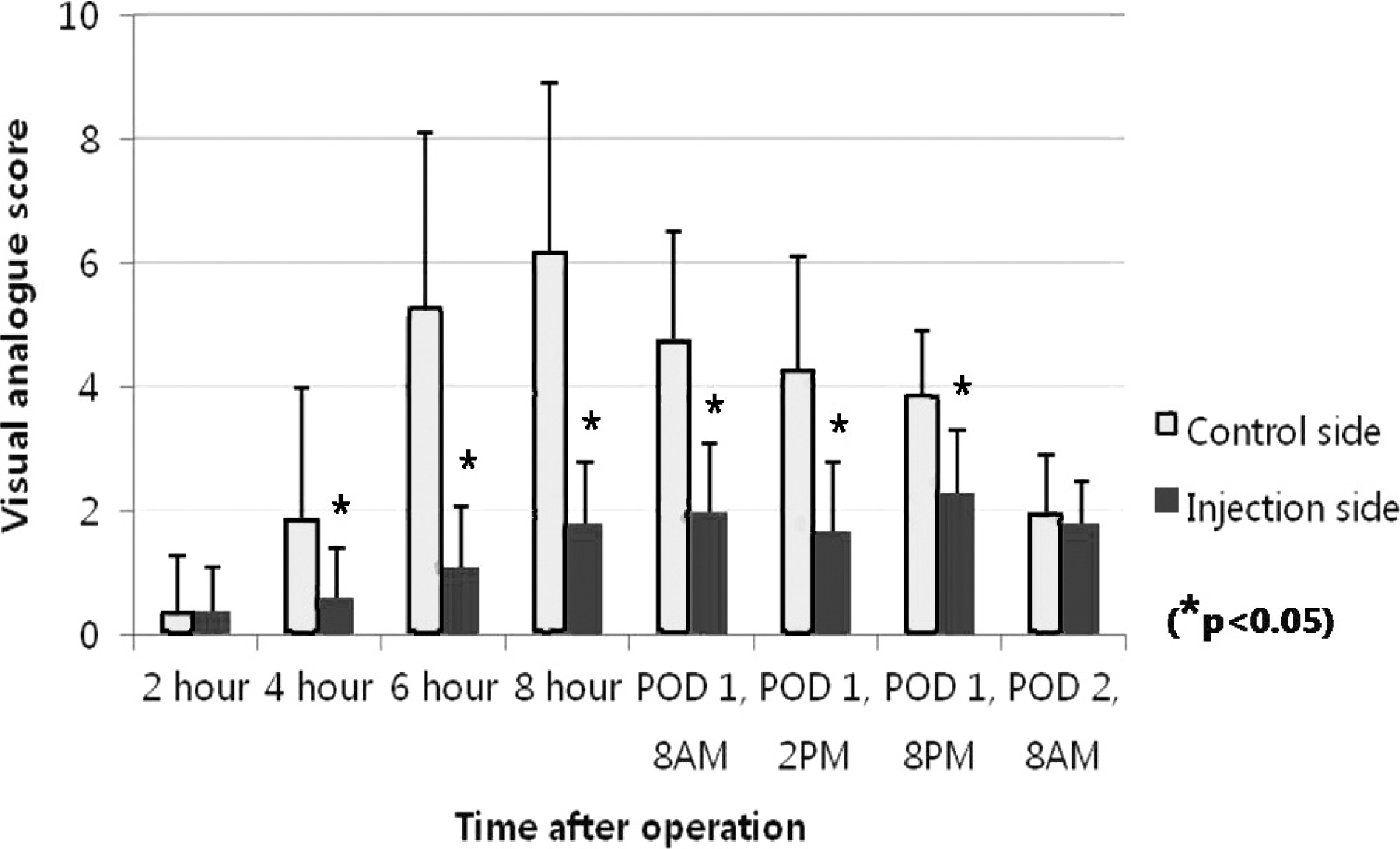
The multi-drug injection resulted in significantly less pain (VAS) at all evaluated periods except at 2 hours after the operation and at 8 AM on the second postoperative day (Figure 1, Table 2). The difference in VAS between the two sides was most severe at 8 hours after the operation, and then gradually reduced through the first and second postoperative day (Table 2). Four patients felt little difference in pain (VAS less than 1) between the two sides throughout the observation period.
Difference of VAS Between the Two Sides
Comparison of postoperative pain.
The multi-drug injection resulted in significantly less pain (VAS) at 4 hours after the operation (p < 0.0001) and the significant difference lasted until 8 PM of the first postoperative day (p < 0.0001) (Figure 1, Table 2). No difference was observed at 2 hours after the operation (p = 0.161) and at 8 AM in the second postoperative day (p = 0.056). The difference in VAS between the two sides was greatest at 8 hours after the operation (1.8 ± 1.0 versus 6.2 ± 2.7, p < 0.0001), and then gradually reduced through the first and second postoperative day (Table 2). Four patients felt little difference in pain (VAS less than 1) between the two sides throughout the observation period.
Rescue injection of diclofenac was administered in 25 patients (83.3%) during the night of surgery. Twenty-three of the 25 patients requested the rescue analgesics for the pain on the control side, while two patients complained of pain on both sides. Twelve patients required further injection of pethidine 50 mg to relieve pain on the night of the surgery.
Mean satisfaction VAS was significantly higher on the injection side (8.2 ± 0.9) compared to the control side (6.2 ± 1.9, p < 0.0001). Twenty-nine patients (96.7%) were satisfied or very satisfied and one patient was satisfied with reservation regarding the postoperative pain on the injection side. On the control side, 12 (40%) were satisfied or very satisfied, ten (33.3%) were satisfied with reservation, and eight (26.7%) were not satisfied.
Suture reactions or mild superficial erythema as a result of foreign body reaction to the suture material developed in two feet that received the multidrug injection and in one foot of the control side. All of them healed with conservative management. No other wound complication or deep infection occurred. No patient experienced any of systemic adverse effects on the central nervous system including nervousness, perioral tingling sensation or numbness, tinnitus, tremor, dizziness, blurred vision, seizure, drowsiness, and respiratory depression. No adverse cardiovascular events occurred including hypotension, bradycardia, arrhythmia, and cardiac arrest.
Discussion
Our initial questions included whether multidrug injection was safe and effective in reducing pain after hallux valgus surgeries and how long the analgesic effect last. Previous studies with similar regimens after total knee and hip arthroplasties demonstrated the efficacy of periarticular or deep soft tissue and subcutaneous multidrug injection in diminishing the postoperative pain and reducing narcotics use. 3,12,19,21,28,30 The duration of analgesic effect after local infiltration of long acting local anesthetics has been reported to range from 4 hours 3 to 3 days 19 after the operation depending on the regimen and the overall multimodal protocol of pain control.
Local infiltration of analgesics has been less popularly used in foot and ankle surgeries compared to total knee and hip arthroplasties. Dinley and Dickson 6 in 1976 reported the effect of intracapsular injection of bupivacaine after Keller's operation which was effective up to 12 hours after the operation. Porter and Davies 20 in 1985 performed a similar study in patients undergoing bilateral Keller's operation and found an analgesic effect up to 8 hours after the operation. Middleton et al. 17 injected intra-articular bupivacaine after arthroscopy of the ankle and reported significant pain reduction for 2 hours. Interestingly, all of these studies used 0.5% bupivacaine alone, resulting in an effective but short duration of pain control.
In 1994, McLeod et al. 16 also used 0.5% bupivacaine and found a longer duration of anesthetic effect with popliteal sciatic nerve block over subcutaneous infiltration. Since then, various nerve blocks have became the mainstream of adjuvant anesthetics in the field of foot and ankle surgery. However, ankle block in addition to general anesthesia did not reduce the need for rescue analgesia or improve pain ratings during the first 24 hours after hallux valgus surgeries. 29 An additional popliteal block was required to provide better pain relief in patients undergoing foot and ankle surgeries under general anesthesia and adjuvant ankle block. 24 Lateral popliteal nerve block after general anesthesia provided good postoperative pain control for 14 to 16.5 hours after foot and ankle surgeries, but at the same time, incomplete block was reported in 16%. 7,8 Furthermore, several disadvantages limit the use of nerve blocks: time for the procedure and for the onset of the sensory block, decreased operating room efficiency, technical difficulty and need for skilled anesthesiologist, and risk of intravenous or intra-arterial injection with possible systemic complications of local anesthetics.
This study presents, to the best of our knowledge, the first clinical report of multi-drug injection after foot and ankle surgery. Significant reduction of pain was observed at 4 hours after the operation and remained until the evening of the first postoperative day. The tendency for reduced pain continued until the morning of the second postoperative day (p = 0.056) (Table 2). No difference was found at 2 hours after the operation, which is probably due to the residual effect of the spinal anesthesia. High satisfaction results were obtained without any significant complications.
Prolonged analgesic effects can be explained by the synergistic effect of the four constituents of the block: ropivacaine, morphine, ketorolac, and epinephrine. Ropivacaine is a long acting local anesthetic, pharmokinetically similar to bupivacaine, but has a longer half life and is associated with less cardiovascular and neurotoxic side effects. 10,25 Together with morphine, ropivacaine blocks the afferent peripheral nociceptive input to the central nervous system. The advantage of adding morphine to the local infiltration can be explained by the presence of peripheral opioid receptors in the inflamed tissue, expressed within hours after surgical trauma. 27 Nonsteroidal anti-inflammatory drugs reduce the production of inflammatory mediators through inhibition of the eicosanoid pathway, and hence decrease peripheral sensitization and activation of nociceptors. 15 Furthermore, intra-articular or local infiltration of NSAID provides better pain relief compared to intravenous administration. 22 Epinephrine helps keep the drugs localized to the area of injection 26 and also reduces local bleeding. 18 However, special caution is required not to include too much epinephrine due to the risk of vascular compromise. Also, it might be safer not to add epinephrine in patients with peripheral vascular disorder or diabetes. No wound necrosis or gangrene occurred in this series. By exerting effects via differing mechanisms, local infiltration of multidrug injection leads to superior pain control with prolonged duration and reduced side effects. 19 In addition, administering the multi-drug injection before the physiologic response to surgical trauma reaches its peak results in a superior clinical response. 19
By restricting the investigation to bilateral cases undergoing the same surgical procedures, our study design controlled varied confounding factors. This is especially important when the dependent variables are subjective. The effect of the spinal anesthesia, additional analgesics, and patient's susceptibility to pain were equal on both sides. Therefore the difference in postoperative pain was due to the effect of the local multi-drug injection. On the other hand, comparing pain in bilateral cases could have exacerbated the difference of VAS since the degree of pain on one side might have been perceived relatively more or less seriously depending on the amount of pain on the other side. A relatively small number of cases is also a limitation of this study.
Since hallux valgus operations are often performed under local anesthesia, the beneficial effect of the multi-drug injection can be questionable. Further studies comparing the multi-drug injection with a lidocaine or other local anesthetic control group are required. However, indirect comparison with the literature shows a longer duration of pain control effect of the multi-drug injection over local anesthetic alone. While the effect of local infiltration of 0.5% bupivacaine lasted between 2 to 12 hours after the operation, 6,17,20 the effect of multi-drug injection lasted until the evening of the first postoperative day.
Conclusion
Local infiltration with a multi-drug mixture was easy and quick to perform, while also safe and effective in reducing pain and enhancing patient satisfaction after hallux valgus surgery.