






Abstract
Background: Osteochondral lesion of the talus (OCLT) is frequently described as an uncommon diagnosis; however, little is known of its incidence. In light of increased awareness combined with the continued evolution of radiologic and treatment modalities, more attention has been given to this diagnosis. Serving a young, athletic population with unique occupational requirements, we have perceived an increase in the diagnosis of OCLTs. The goal of this study was to determine the incidence of OCLTs in an active duty military population, as well as demographic risk factors for OCLTs. Methods: We performed a query of the Defense Medical Epidemiology Database (DMED) of the International Classification of Diseases, Ninth Revision, Clinical Modification (ICD-9-CM) code for OCLTs which in the Armed Forces Health Longitudinal Technology Application (AHLTA) system is uniquely assigned the code 732.5. An overall injury incidence was calculated, in addition to multivariate analysis to determine independent risk factors among the following demographic considerations: gender, race, rank, branch of military service, and age. Year of diagnosis was also considered. Results: The overall incidence rate for the 10-year period (1999 to 2008) was 27 OCLTs per 100,000 person-years. Significant demographic risk factors were female gender, white race, enlisted rank, service in the Army and Marines, and age greater than 20 years. Incidence rate was 16 per 100,000 in 2002, with steady annual increases resulting in an incidence rate of 56 per 100,000 person-years in 2008, corresponding to the years of active involvement in global combat operations. Conclusion: The incidence of OCLTs in the active duty military population was higher with female gender, white race, enlisted rank, increased age, and Army or Marine service.
Level of Evidence: IV, Retrospective Series
Introduction
Historically, many terms have been used to describe what are now universally referred to as osteochondral lesions of the talus (OCLTs), including osteochondritis dissecans, transchondral talus fracture, and osteochondral talus fracture. 2,10,11 Explanations of the etiology of OCLTs have varied widely and include acute or remote trauma; repetitive microtrauma; degenerative joint arthropathy; genetic predisposition; and osteonecrosis secondary to systemic metabolic disorders, abnormal vasculature, and even alcohol abuse. 3,4,7,8,12,16,17,20,21,28 OCLTs represent a difficult problem for the orthopaedic surgeon, and the true incidence of these injuries is unknown. Because of the poor reparative ability of articular cartilage, OCLTs can become irreversible and lead to chronic ankle joint pain and swelling, decreased activity level, and possibly osteoarthritis. 5,18,19,23,26
The incidence of OCLTs has not been well-established. These injuries may represent 0.09% of all fractures and 0.1% of all talus fractures. 12,15 Previous authors have reported OCLTs associated with ankle instability present in up to 6.5% of all ankle sprains, most commonly in patients between the second and fourth decades. 10 Increased incidence of OCLTs in association with lateral ankle instability has been well-documented in the literature. 22,24,27 Recently, the incidence of OCLTs in patients who underwent diagnostic arthroscopy prior to lateral ligamentous reconstruction for the treatment of chronic lateral instability has been shown to be greater than 20%. 6,9 Other authors have reported high incidences of OCLTs in association with ankle fractures as well. 1 No previous authors have been able to report overall population incidence rates.
The United States Armed Forces represent a diverse, physically active population of male and female service members with generally high occupational demands. They participate in organized physical fitness training programs and must meet the standards of their individual services' physical fitness tests as well as height and weight requirements semiannually. The active duty service population is a highly active patient population, and given their daily physical demands, may be at increased risk for development of intra-articular ankle disorders such as OCLTs. Little data exists in the literature on the prevalence or incidence of this disorder in a high-demand, physically active population. Our purpose for this study was to report the incidence rates and epidemiological variables related to OCLTs for U.S. Armed Forces service members.
Materials and Methods
The military maintains large medical databases, making it an ideal patient population for studying musculoskeletal disorders such as OCLTs. One such database, the Defense Medical Epidemiology Database (DMED) contains International Classification of Diseases, Ninth Revision, Clinical Modification (ICD-9-CM) coding information for every patient encounter worldwide involving active duty Army, Navy, Air Force, and Marine personnel at a military or civilian treatment facility. The DMED maintains the total number of active duty personnel along with personnel characteristics and military specific information. The DMED is frequently updated and is able to track military personnel as they move throughout the U.S. and the world. Data contained in this database is acquired via the Defense Manpower Data Center and by the military Electronic Health Record (EHR) systems. From 1999 to 2005 the treatment encounters were maintained within the Composite Health Care System II (CHCS II) which provided ICD-9-CM coding information to the DMED. In 2006, the military phased out CHCS II and converted to the Armed Forces Health Longitudinal Technology Application (AHLTA) system. These software programs provide ICD-9-CM codes for diagnoses. The diagnoses in the DMED are made by either a physician or a physician extender. Within these systems, the military has assigned a particular code to OCLTs of 732.5. Outside of the military, this code represents a diagnosis of juvenile osteochondrosis of the foot. While military treatment facilities frequently see and treat skeletally immature patients these encounters are not contained in DMED. Furthermore, when entering an ICD-9-CM code for a given patient encounter in AHTLA, this code is assigned a subheading of “New” or “Chronic,” depending on whether it is a first-time diagnosis or a prior diagnosis. This allows us to query only first-time diagnoses for a particular condition.
We determined the total number of first-time occurrences of OCLTs from 1999 to 2008 by conducting a query of the DMED using the ICD-9-CM code 732.5. Each query was further categorized by race, age, gender, rank, and branch of service. The race categories available in the database include white, black, and other. Mixed race individuals were classified according to self-report. The age categories were broken down into the following categories: less than 20 years, 20 to 24 years, 25 to 29 years, 30 to 34 years, 35 to 39 years, and 40 years and older. Rank was categorized as junior enlisted (pay grade E-1 to E-4), senior enlisted (pay grade E-5 to E-9), junior officer (pay grade O-1 to O-3) and senior officer (pay grade O-4 to O-10). The service categories used were Army, Navy, Air Force, and Marines. The DMED allows differentiation between inpatient and ambulatory encounters. Our queries were limited to ambulatory data only. Additionally we limited the data to “first occurrence” of the diagnosis. Incidence of OCLTs was acquired by 1 exposure year which was defined as 1 year that the service member served on active duty in the United States military.
Statistical methods
Statistical analysis was completed using Statistical Analysis System (SAS) version 9.2 to estimate the rate of OCLTs per 1,000 person years using ICD-9-CM code 732.5 from 1999 to 2008. A multivariate Poisson regression was used to calculate the incidence rate along with 95% confidence intervals for the diagnosis of OCLTs. The calculations were adjusted to control for race, gender, age, rank, and branch of military service. The referent category was selected on the basis of lowest incidence rate within the subset. Significant effects were noted for all five variables (p < 0.05). This study received institutional review board approval from the William Beaumont Army Medical Center Department of Clinical Investigation Protocol 02/10.
Results
From 1999 to 2008 there were 3,828 first-time diagnoses of OCLTs with a total population at risk of 14,071,570 person-years. During the 10-year period of this study an average of 382 OCLT diagnoses per year were made with an overall incidence of 27 diagnoses per 100,000 person-years (unadjusted). In other words, out of 100,000 military personnel seen annually by health care providers, 27 were identified with a first-time diagnosis of an OCLT.
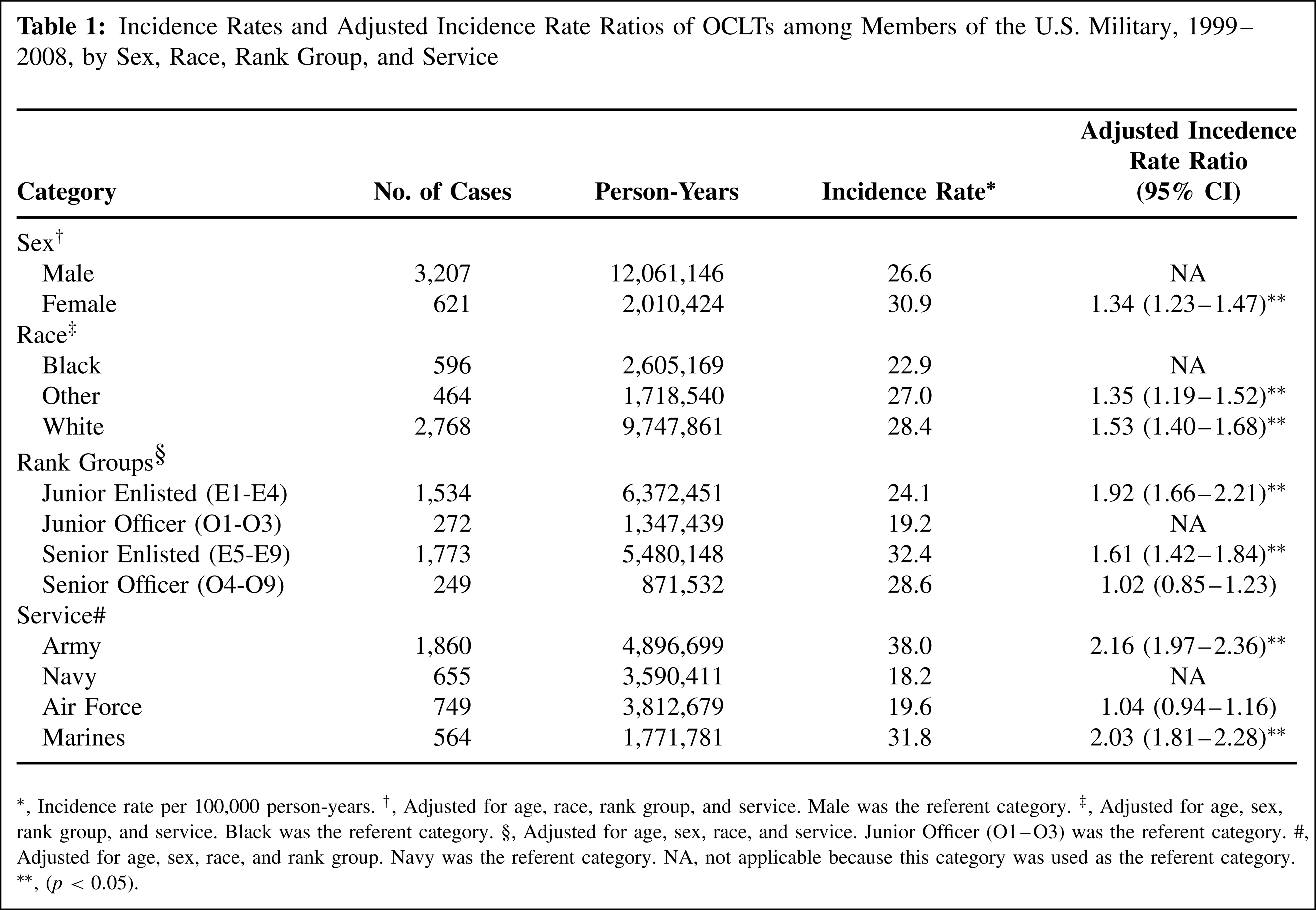
Significant main effects were identified for gender, race, rank, branch of military service, and age (p <0.05) (Table 1). Different incidence rates of OCLTs were identified between men and women. The incidence rate for women was 31 per 100,000 person-years and 27 for men. The adjusted incidence rate ratio was 1.34 (95% CI, 1.23 to 1.47; p <0.05) for women, with men as the reference category.
Black service members had a calculated incidence of 23 OCLTs per 100,000 person-years. White race had 28, with the combined “other” race demonstrating an incidence of 27 per 100,000 person-years. Using black service members as the referent category the adjusted incidence ratio was 1.53 (95% CI, 1.40 to 1.68; p <0.05) for white active duty service members.
Incidence Rates and Adjusted Incidence Rate Ratios of OCLTs among Members of the U.S. Military, 1999–2008, by Sex, Race, Rank Group, and Service
Incidence rate per 100,000 person-years.
Adjusted for age, race, rank group, and service. Male was the referent category.
Adjusted for age, sex, rank group, and service. Black was the referent category.
Adjusted for age, sex, race, and service. Junior Officer (O1-O3) was the referent category.
Adjusted for age, sex, race, and rank group. Navy was the referent category. NA, not applicable because this category was used as the referent category.
(p <0.05).
Military rank also had a significant effect on the rate of OCLTs. Junior officers had an incidence of 19 diagnoses per 100,000 person years and were the reference category for this subset of data. Senior officers had an incidence of 29 per 100,000 person years with an adjusted incidence rate ratio 1.02 (95% CI, 0.85 to 1.23). Junior enlisted personnel had an incidence of 24 per 100,000 person-years with an adjusted incidence rate ration of 1.92 (95% CI, 1.66 to 2.21; p <0.05). Senior enlisted military members had an incidence of 32 diagnoses of OCLTs per 100,000 person-years with an incidence rate ratio of 1.61 (95% CI, 1.42 to 1.84; p <0.05).
The branch of military service was an important risk factor for OCLTs. Active-duty Navy personnel had an incidence of 18 diagnoses per 100,000 person years and were used as the reference category for this subset. Air Force service was calculated with an incidence of 20 per 100,000 person years and with no significant effect appreciated when compared to Navy service (0.96; 95% CI, 0.86 to 1.07). Service in the Marines showed an incidence of 32 diagnoses per 100,000 with an adjusted incidence rate ratio of 1.95 (95% CI, 1.75 to 2.18; p <0.05). Active duty Army soldiers had an incidence of 38 diagnoses per 100,000 with an adjusted incidence rate ratio of 2.07 (95% CI, 1.90 to 2.26; p <0.05).
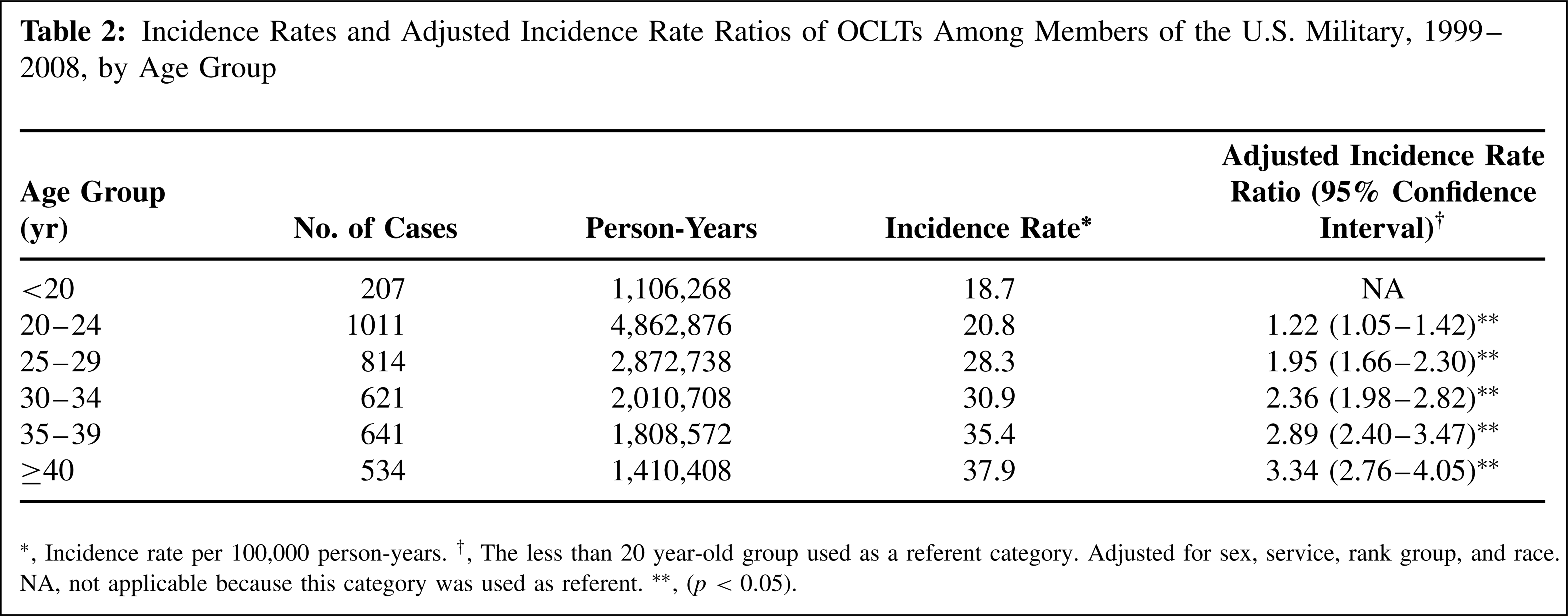
Age also had a significant impact on the incidence of OCLTs (Table 2). Using military personnel less than 20 years old as the reference category for this subset, an incidence of 19 diagnoses per 100,000 person-years was calculated adjusted for rank, gender, race, and branch of military service. For every age group older than the less than 20 years category, there was a consistent increase in the incidence of OCLTs as well as an increase in the adjusted incidence rate ratios of the diagnosis. The greatest incidence was found in the oldest age group (40 years or older) with 38 diagnoses per 100,000 person-years and an adjusted incidence rate ratio of 3.34 (95% CI, 2.76 to 4.05; p < 0.05). Significant effects were found in every age group older than the less than 20 years category (p <0.05).
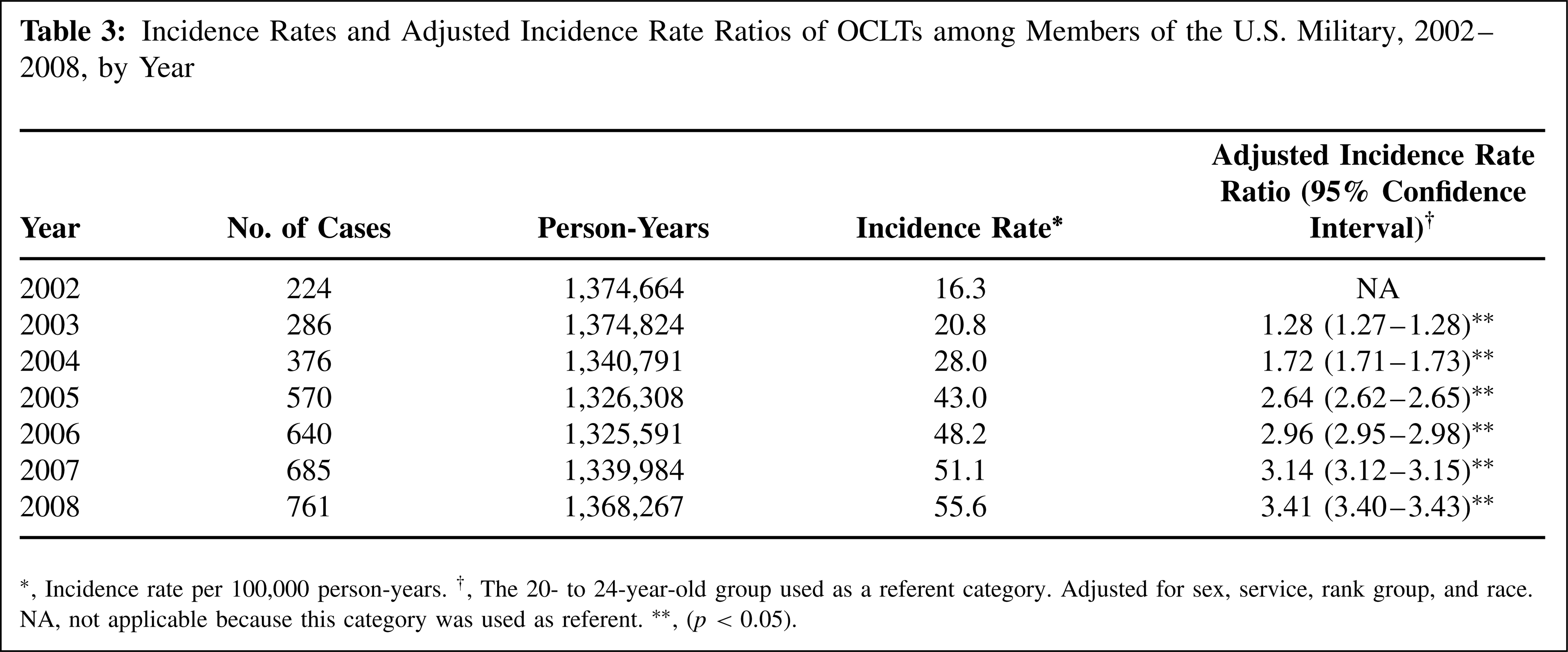
Significant effects were also identified with regard to years of the study (Table 3). Using 2002 as the reference year group, an incidence of 16 diagnoses per 100,000 person years was calculated. A continuous significant increase in the incidence rate of OCLTs was noted from 2002 to 2008 with a 2008 incidence rate of 56 per 100,000 person years and an unadjusted incidence rate ratio of 3.41 (95% CI, 3.39 to 3.43; p <0.05). These years correspond directly to years in which active duty military personnel were actively engaged in military conflict in the global war on terrorism.
Incidence Rates and Adjusted Incidence Rate Ratios of OCLTs Among Members of the U.S. Military, 1999–2008, by Age Group
Incidence rate per 100,000 person-years.
The less than 20 year-old group used as a referent category. Adjusted for sex, service, rank group, and race. NA, not applicable because this category was used as referent.
(p <0.05).
Discussion
In this large-scale database study spanning a 10-year timespan, we found the following factors were significant predictors of increased incidence of osteochondral lesions of the talus: female gender, white race, junior and senior enlisted military ranks, military service in the Army or Marines, and increasing age. These findings were in comparison to the following reference categories: male gender, black race, junior officer military rank, military service in the Navy, and age less than 20 years. These incidence rates of OCLTs were demonstrated in a unique population who were all active-duty U.S. military service members and represent the first study to our knowledge demonstrating such incidence rates of OCLTs in a large active population. Military personnel are exposed to rigorous physical and military training regimens which include strict physical fitness testing, height and weight requirements, and often overseas mission-related deployments in austere environments. Previous studies have suggested incidences of OCLTs representing 0.09% of all fractures and 0.1% of all talus fractures with an increased incidence noted with respect to acute ankle sprains, ankle fractures, and chronic lateral ankle instability. 12,15
Incidence Rates and Adjusted Incidence Rate Ratios of OCLTs among Members of the U.S. Military, 2002–2008, by Year
Incidence rate per 100,000 person-years.
The 20- to 24-year-old group used as a referent category. Adjusted for sex, service, rank group, and race, NA, not applicable because this catetgory was used as referent.
(p <0.05).
The overall unadjusted incidence of OCLTs in our population over this time-span was 27 diagnoses per 100,000 patient years. Practically speaking, for every 100,000 military personnel seen by health care providers across all specialties annually, 27 were identified with a first time diagnosis of an OCLT based on the current study. This data does not reflect the overall prevalence in our patient population but rather reflects only first time diagnoses of OCLTs annually. These results were collected based on data retrieved from a general database of all patient encounters seen in a large population and do not reflect encounters seen solely by orthopaedic surgery specialists. The overall prevalence is probably higher than this number. Based on this data, OCLTs are probably more common in this unique patient population than previous literature suggests for the general population. 12,15 However, we feel that these results might reflect the commonality of OCLTs in an active, athletic civilian population.
The current study found an overall increased risk in the development of OCLTs in women compared to men, with an adjusted incidence rate ratio of 1.34 (95% CI, 1.23 to 1.47) for women. This is the first study to highlight that OCLTs may be more common in females than previously thought. The reason for this finding is unclear; however, this may represent a natural tendency toward increased ligamentous laxity in females compared to males, as has been described with anterior cruciate ligament laxity. 13,14 The relationship between ligamentous instability and OCLTs has previously been well-documented by several authors. 6,9,22,24,27 While a complete epidemiological analysis of the incidence of ankle instability in all female military personnel or those female military personnel who are diagnosed with OCLTs is well beyond the scope of the current study, a recent epidemiological study by Waterman et al. found that in cadets at the United States Military Academy, the adjusted incidence rate ratio for ankle sprains in females was 1.83 compared to matched male cadets. 29 As well, a recent prospective randomized controlled trial by Frey et al. compared the incidence of lateral ankle instability in 957 high school volleyball players who wore prophylactic rigid, semi-rigid and non-rigid ankle braces compared to controls who did not wear braces. While the study did not find significant benefit from use of ankle bracing in athletes with a history of lateral ankle instability, it did note a significantly increased incidence of inversion ankle sprains in female athletes wearing non-rigid braces compared to males wearing the same type of brace, providing further evidence for increased ankle ligamentous laxity in females. 12 As female service members are expected to perform the same rigorous physical training as male service members, possible increased ligamentous laxity and resultant increased ankle instability may contribute to a higher incidence of OCLTs under such physical demands. We acknowledge that this assumption is purely speculative, and we are currently investigating through the previously described database whether such a correlation exists.
Our data also suggests a significantly increased incidence of OCLTs among those active duty service members who identify their race as white. The adjusted incidence ratio was 1.53 (95% CI, 1.40 to 1.68) for white active duty service members compared to black service members. This study is the first to our knowledge to address race as a specific risk factor for development of OCLTs. A previous study using the same Defense Medical Epidemiology Database from our institution found an increased incidence of plantar fasciitis in black service members compared to whites (incidence ratio, 1.12; 95% CI, 1.09 to 1.12). 25 The authors of that study addressed the idea that increased body weight and body mass index more common to blacks might have contributed to these findings. We would have expected similar findings with regard to OCLTs and were surprised to find this trend was not the case; therefore, we are hesitant to speculate on why differences exist between races with regard to incidence of OCLTs.
The results of the current study also demonstrated an increased adjusted incidence rate ratio of the diagnosis of OCLT with respect to service members in the following groups: junior and senior enlisted ranks. Junior and senior enlisted personnel had higher incidence rates of OCLTs compared to the reference category of junior officers. Furthermore, compared with service members in the Air Force and Navy, Army and Marine personnel also had an increased risk for development of OCLTs. A previous study published from our institution using the Defense Medical Epidemiology Database postulated that enlisted rank groups, particularly within the Army and Marine branches of service, may be subject to increased occupational and physical demands and that these variables may serve as proxies for occupational activity level. 25 The authors of the current study acknowledge that no means exist to tangibly prove that one rank group or one subset of military branches has higher activity levels and occupational demands than another, and therefore we do not assume that these variables should serve as proxies for activity level.
Interestingly, from 2002 to 2008 there was a steady and statistically significant annual increase in incidence rate ratios for OCLTs overall. These years correlate with the initiation and continuance of combat operations in Iraq and Afghanistan, and correspondingly we noted an increase in the incidence of OCLT diagnoses during this time frame. We acknowledge that more aggressive and early use of radiographic modalities such as magnetic resonance imaging as well as increased provider recognition of this diagnosis might have contributed to these findings from 2002 to 2008. However, the authors find it noteworthy that there was a steady and significant increase in the diagnoses of OCLTs during this time period in which military personnel were engaged in increasingly higher demand physical activities.
Increased age also increased the incidence of OCLTs in the current study. Compared to the reference group, less than 20 years, adjusted incidence rate ratio for service members 40 years and older was 3.34 (95% CI, 2.76 to 4.05). For all other groups (20 to 24 years, 25 to 29 years, 30 to 34 years, and 35 to 39 years) there was an increase in incidence rate ratio from one age group to the next. Previous authors have demonstrated increased incidence of OCLTs in patients in the second through fourth decades, but this is the first study to our knowledge to demonstrate a progressive increase in incidence with incremental increases in age throughout that same age range. 4 It is unclear exactly why increased age led to an increased incidence of OCLTs, but it is known that the biomechanical properties of articular cartilage degrade with increased age. For example, articular cartilage tensile stiffness, strength, fatigue resistance, and cell matrix turnover decrease with increased age. These findings lend further credence to repetitive microtrauma as a possible etiology of OCLTs. It is noteworthy that these findings are demonstrated even at ages as young as the third and fourth decades with regard to OCLTs.
The major strength of the current study is the large sample size of active duty service members captured in the military healthcare system and included in the DMED. Further, this is the first study of its kind to include such a unique population of highly functional patients such as active duty service members to best determine the incidence of OCLTs in such a population cohort. Weaknesses of the current study are inherent to any database study, and we acknowledge those shortcomings. First multiple physicians evaluated and coded the patient encounters, increasing the likelihood of inaccuracies in the diagnoses of OCLTs. Second, the data are based on patient-driven clinic visits, and individuals who have symptomatic OCLTs but do not seek medical care would not be encapsulated in the data. Such individuals would only make the incidence rates demonstrated in the current study even higher than we have reported. Third, the data collected from the DMED is subject to the dynamic cohort of military personnel that is depicted in this study. These patients may have characteristics that limit the reader's ability to generalize the data to their own patient populations and reduces the external validity of the current study. However, we feel that these results can be appropriately used to compare to other physically active patient populations whose activity demands are through sports or high demand occupational activities.
Finally, we recognize that the results of any database study depend on accurate input entered in order to determine accurate output obtained. With regard to ICD-9-CM codes, the authors acknowledge that other ICD-9-CM codes might be used to diagnose what are true OCLTs. In the current study, we used the first-time diagnostic ICD-9-CM code of 732.5 to encapsulate this diagnosis. In the military AHLTA system, this code is the same as for “juvenile osteochondrosis of the foot.” However, all patients queried in the current series were adult, active duty personnel. Therefore, there should be no interpreted overlap of cases of juvenile osteochondrosis of the foot. As well, we recognize that other codes such as 732.7 (osteochondritis dissecans) and 718.1 (intra-articular loose body) might also be used by providers to code for what might be actual OCLTs. This is an inherent weakness of any database study. There are certainly some OCLT diagnoses that were not captured in the current data secondary to this variability in coding, which might have led to higher incidences than those reported.
The authors of the current study feel that these results may prove valuable to civilian orthopaedic surgeons as they seek to identify at-risk cohorts within their own highly active patient populations. In conclusion, the results of the current study may be useful to identify at-risk groups within active populations in order to more effectively diagnose patients with OCLTs. We recommend further prospective studies to help better understand the effects of high activity levels and occupational demands on the development of OCLTs within a physically active population.