







Abstract
Background: Minimalist runners have been shown to have a different gait pattern with lower impact forces than habitually shod runners. Running in minimalist footwear has been promoted as a means of reducing or eliminating running injuries by returning to a more natural gait. Methods Ten experienced runners, age 21 to 57 (mean, 43) years, were identified with injuries within 1 year of transition from traditional to minimalist running footwear. Patients were interviewed to determine their running history, injury history, transition to minimalist footwear, and their new injury including its treatment and recovery. Results Ten patients who ran with traditional footwear ran an average of 25.9 (range, 6 to 45) miles/week for an average of 18.9 (range, 1 to 40) years presented with injuries 2.8 (range 1 to 10) months after switching to minimalist footwear. Their injuries included eight metatarsal stress fractures, a calcaneal stress fracture, and a plantar fascia rupture. All patients had a successful recovery and returned to their previous level of running. Conclusion Injuries including stress fractures and plantar fascia rupture have been observed in minimalist runners.
Level of Evidence: IV, Retrospective Case Series
INTRODUCTION
Long distance running has a high incidence of injuries. The first estimates of the incidence of endurance related running injuries appeared in the literature in the 1980s with reported rates ranging from 19% to 65%. 11,17,20 Because of the high rate of injuries, the athletic footwear industry has promoted specific shoe designs to help decrease the injury risk. Over the past 30 years, running shoes have developed a series of new adaptations including increased shock absorption, motion-control, and stabilizers as well as shoes to accommodate various arch types. Despite these advances, the incidence of running injuries has been relatively unchanged with reports ranging from 28% to 79% in the 2000s. 16,24,25 Minimalist running was recently popularized based on claims that it can reduce stress on the legs 7 and lower the incidence of running injuries. 4,5,10,18,22 The technique involves the use of footwear with minimal cushioning (Figure 1) in conjunction with a running style that mimics the running mechanics of a barefoot runner. Athletes that use traditional western-style running shoes have been termed “habitually shod” in the minimalist running parlance.
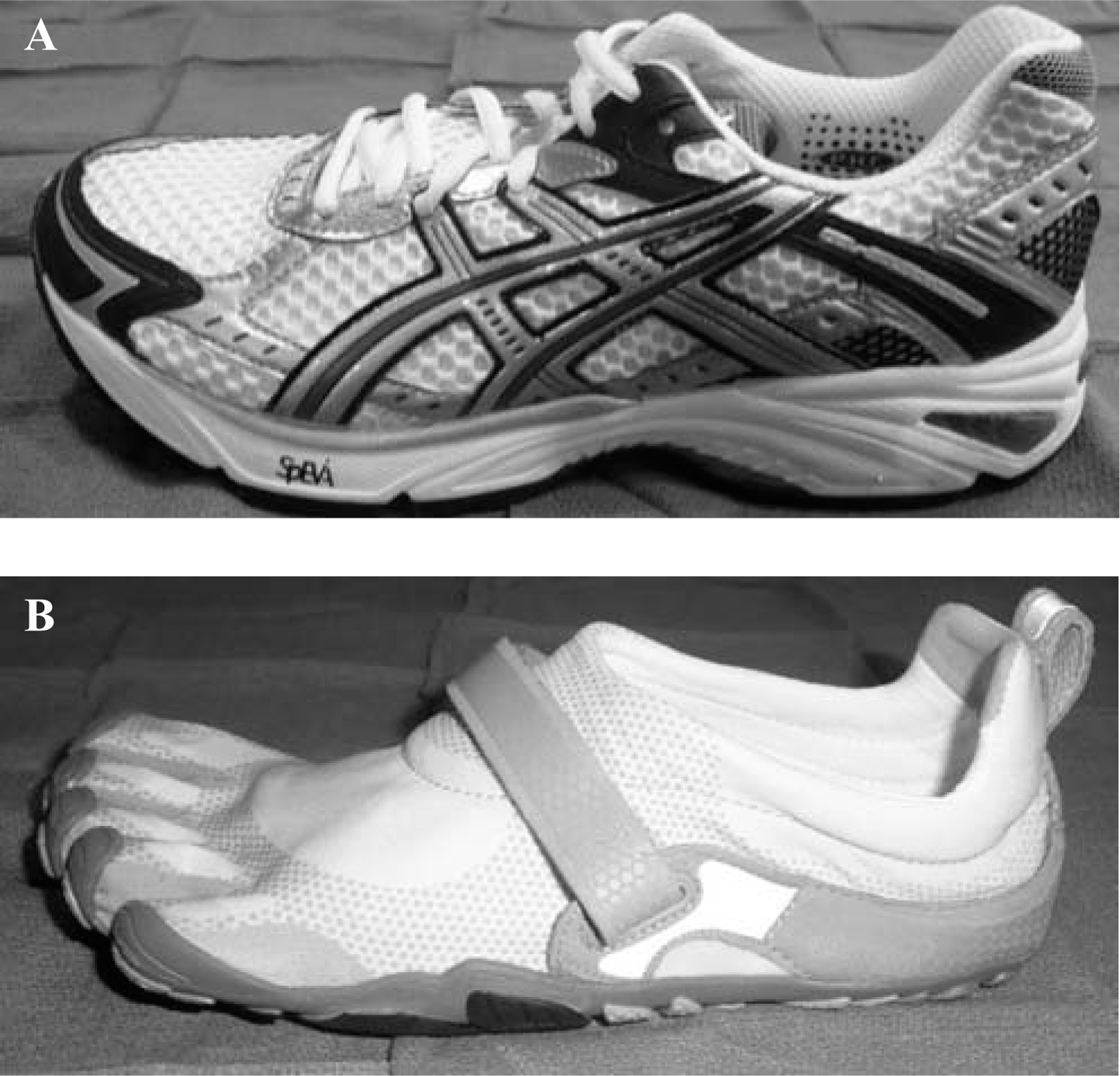
Comparison of plantar cushioning in (A) traditional and (B) minimalist running shoes.
Barefoot runners, a type of minimalist runner, typically land with a fore-foot or mid-foot strike that has less impact force than habitually shod runners that land with a heel-strike. The rationale behind barefoot running is that it allows runners to strengthen their foot and leg musculature and run with a more natural gait minimizing force transients 15 (Figure 2) which, in theory, reduces injury rates. Though the initial popularity of minimalist running may have arisen from barefoot running, it has been shown that both are similar in terms of changes in gait and impact forces. 23
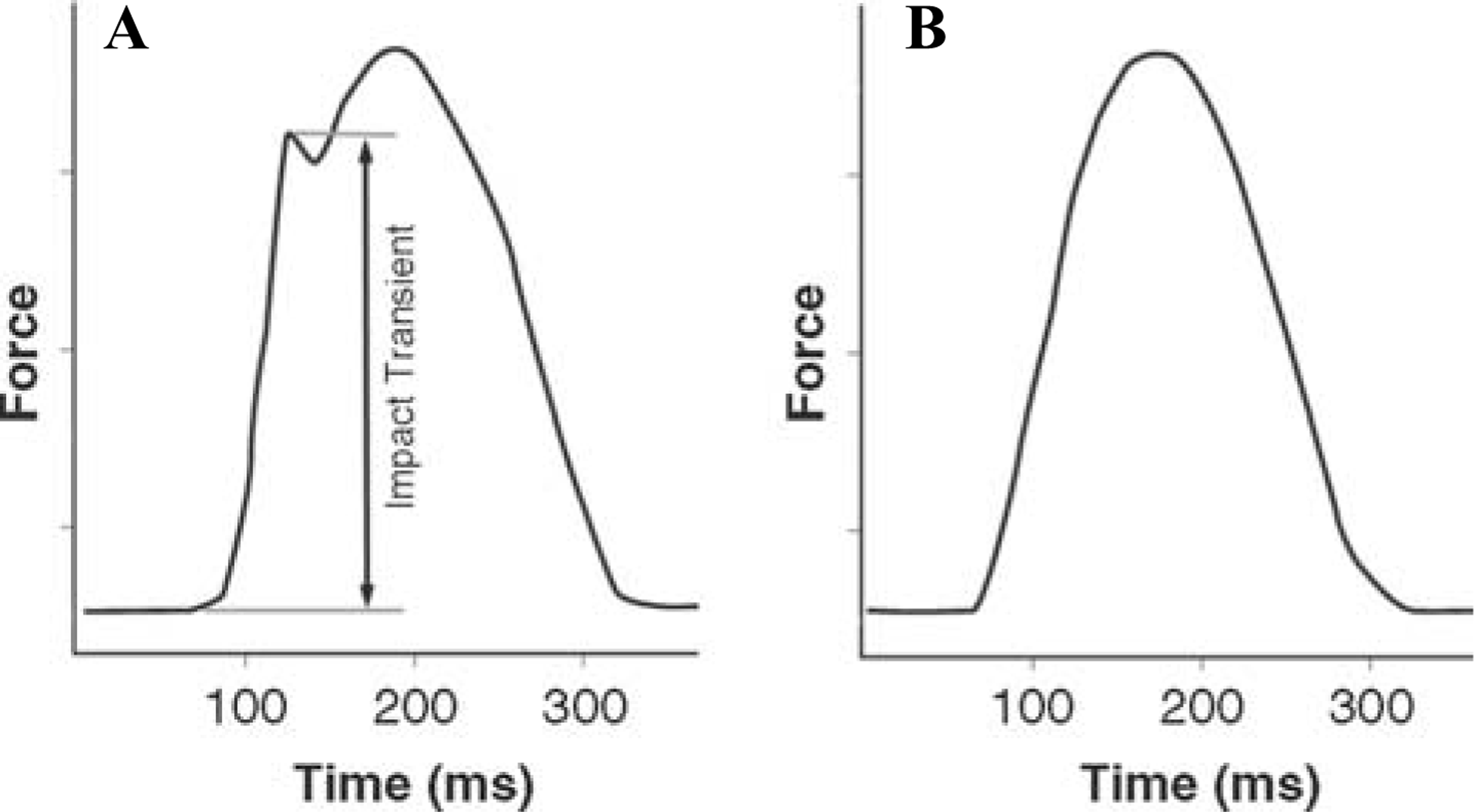
Force versus time curve for a foot strike of a runner. The initial force transient seen in habitually shod runners with a heel strike (A) is eliminated in barefoot runners who have a forefoot strike (B). The maximal force measured in both cases is nearly identical. Adapted from: Gehrmann, RM; Renard, RL: Current concepts review: Stress fractures of the foot. Foot Ankle Int. 27: 750–757, 2006. Used with permission.
The minimalist running movement has gained popularity over the past few years in part because of substantial media coverage, 10,19,22 despite limited scientific support for it. A recent book that appeared on the New York Times Bestseller List also extolled its virtues. 1,18 Leading shoe brands have capitalized on this movement. 2–4 The popularity of the minimalist running movement is evidenced by sales of minimalist running footwear. The most popular brand of minimalist running shoes sells for between $75 and $125 a pair. Sales revenues from this brand were $430,000 in 2006, and increased to $11 million by 2009. They are projected to reach $50 million in the next few years and to account for up to 25% of all running shoe sales. 5,6
Despite booming sales in minimalist footwear, there is no evidence that their use has decreased the incidence of injuries in runners. Since the introduction of these shoes, we have treated a series of experienced runners that have made the transition from traditional footwear to minimalist footwear and sustained an injury either during or shortly after their transition. All of the runners were uninjured in the year prior to their transition and all developed an injury within a year of the transition.
CASE SERIES
Starting in 2009 runners with injuries attributable to minimalist running began presenting to the senior author's clinic with complaints of pain. The runners were predominantly male (80%), and ranged in age from 21 to 57 years of age. All were experienced runners with an average of 18.9 (range, 1 to 40) years of running habitually shod prior to transitioning to a minimalist running style. Their average weekly distance ranged from 6 to 45 miles (Table 1).
Patient Data
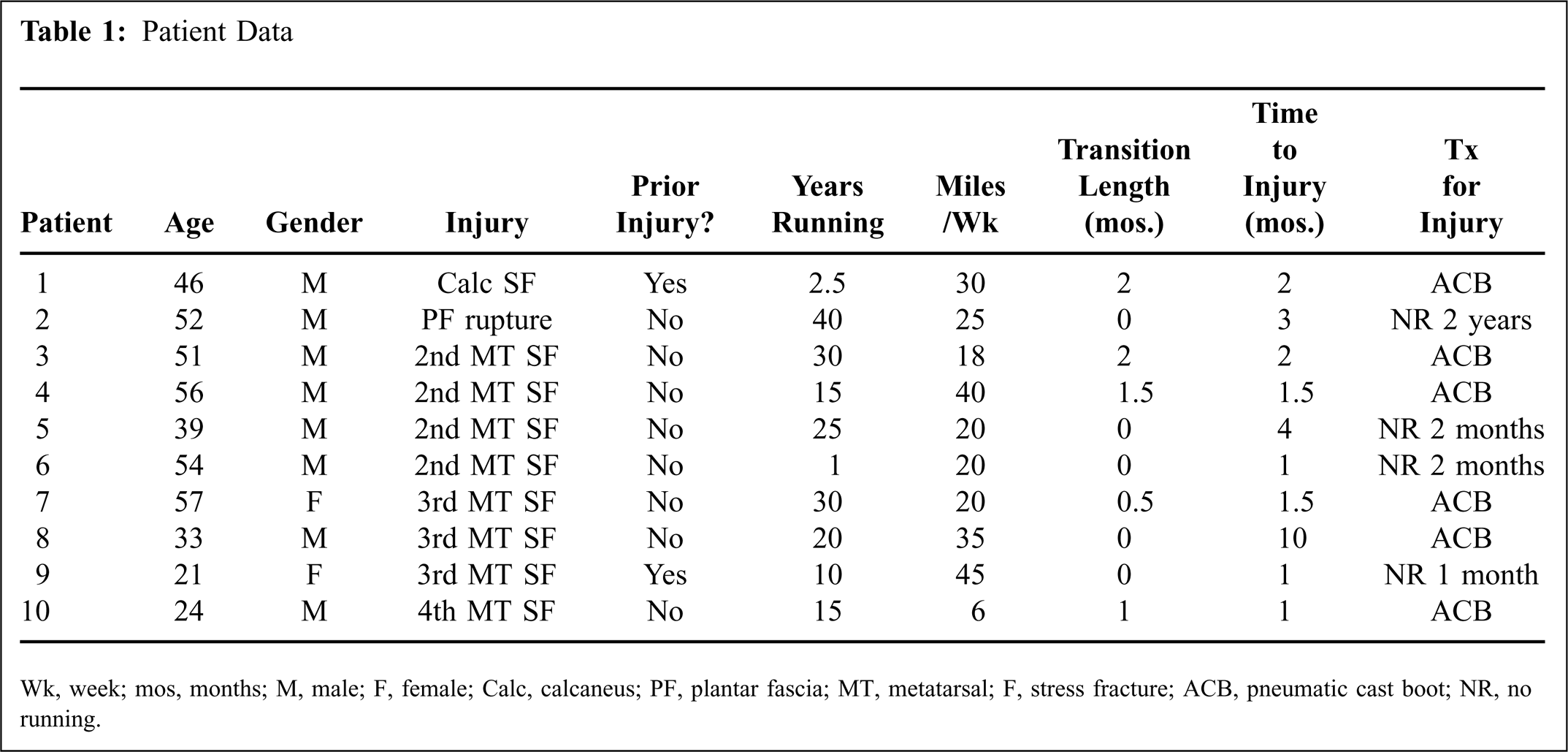
Wk, week; mos, months; M, male; F, female; Calc, calcaneus; PF, plantar fascia; MT, metatarsal; F, stress fracture; ACB, pneumatic cast boot; NR, no running.
The ten injuries sustained in the runners included nine stress fractures and a plantar fascia rupture. There were four second, three third, and one fourth metatarsal stress fractures (Table 1). A radiograph of a patient with a second metatarsal stress fracture and a magnetic resonance image of a patient with a third metatarsal stress fracture is shown in Figure 3. There was one calcaneal stress fracture (Figure 4).
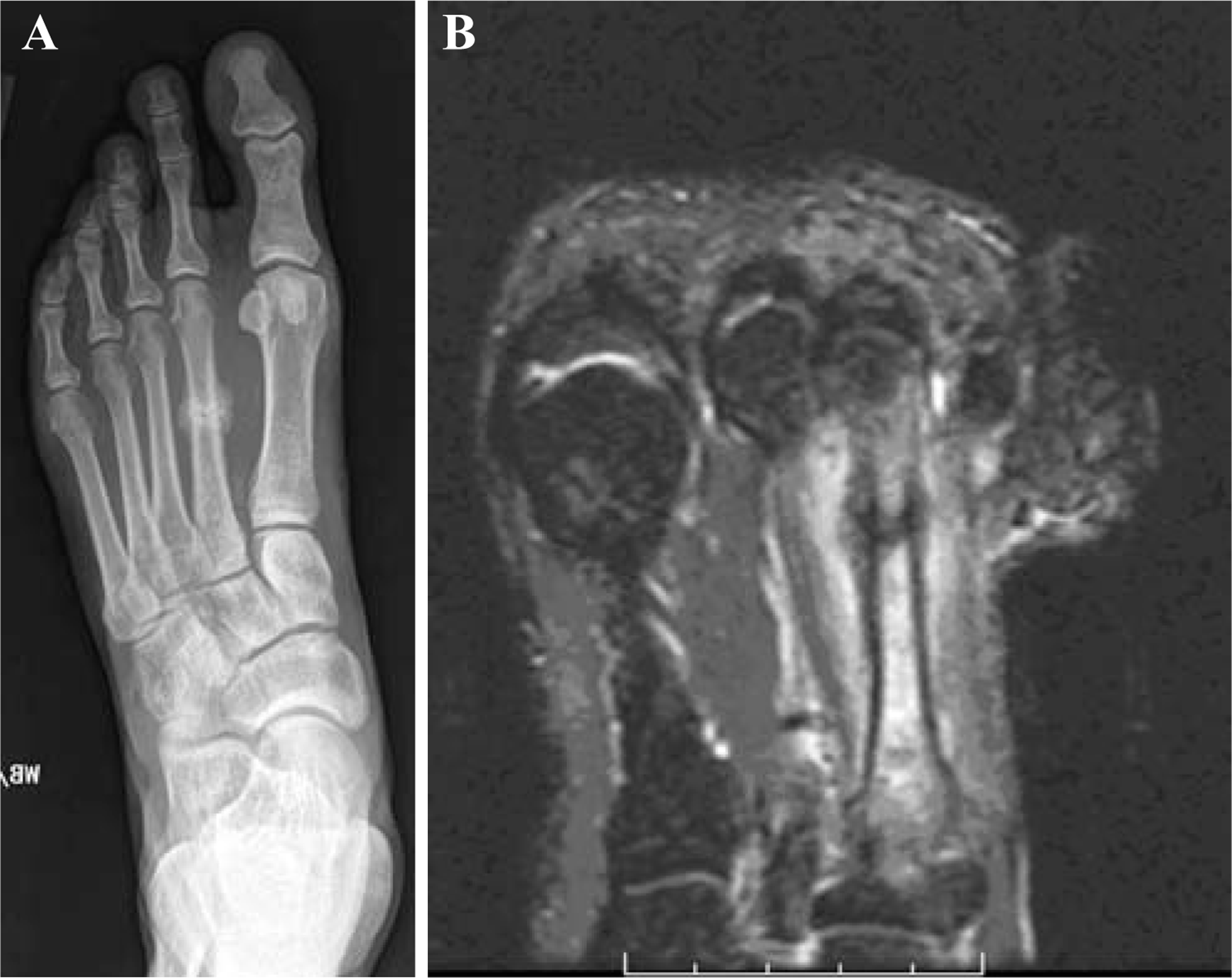
Metatarsal stress fractures associated with minimalist running.
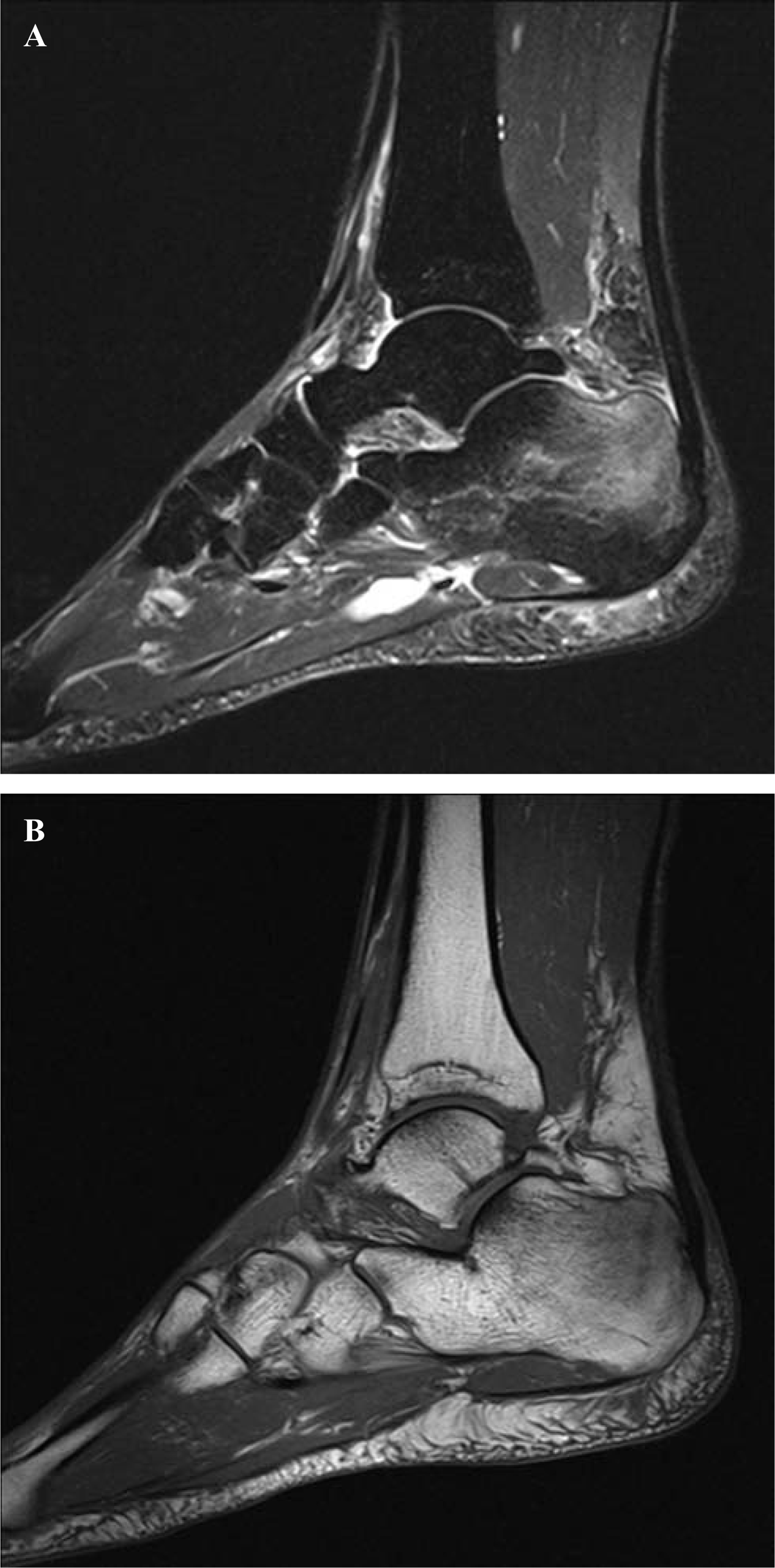
Calcaneal stress fracture in a minimalist runner.
All patients were uninjured for the year prior to initiation of minimalist running and none were known to have any metabolic or bone disorder. Two of the runners had sustained a stress fracture more than a year prior to their transition that had healed with nonoperative management. Specifically, the runner with a calcaneal stress fracture had sustained a fifth metatarsal stress fracture 3 years prior to his transition that healed with nonoperative management; he has been asymptomatic and running 30 miles per week since recovering from his injury. The second runner with a prior injury had a metatarsal stress fracture 5 years prior and was able to return to high school and collegiate cross-country without further stress fractures prior to her transition.
The runners varied in their transition length from traditional to minimalist footwear as well as in the length of time from their initial switch to their injury. The transition lengths ranged from an immediate switch for half of the runners (converted to minimalist technique completely without a transition period) to a gradual transition of 2 months. The majority of injuries occurred between 1 to 3 months from the transition, but one injury occurred as late as 10 months after the transition (Table 1). The runners noted an attempt to run on softer surfaces such as grass or a composite track at first; however, given the constraints of metropolitan living, they noted that they often ran on mixed surfaces that also included asphalt and concrete.
All of the runners in the series were treated nonoperatively with various lengths of immobilization, restricted weightbearing, and restricted activity. No additional workup was initiated in these patients due to an isolated athletic injury that healed appropriately in patients without any known metabolic bone disease. Recovery from injury was defined as the ability to return to running at their pre-injury level. Every runner has made a full recovery within a few months of injury. Two of the injured runners have resumed running in minimalist footwear after recovering from their injuries with no further injuries to date. The others have returned to traditional running shoes.
DISCUSSION
The frequency of injuries in runners is impressive with an incidence of lower extremity injuries ranging from 19.4% to 79.3%. 11,16,17,20,24–27 Runners have long sought ways to decrease the injury rate in this sport. Recently, minimalist running has become popular in part due to claims that it can decrease injury risk.
Compared to habitually shod runners who initiate weightbearing with a heel strike, minimalist runners initiate with a forefoot or midfoot strike. Studies have demonstrated that habitually shod runners have higher ground impact forces than the habitually barefoot runners. 12,15
Minimalist running has emerged in large part due to the research and publicity surrounding barefoot running; two recent articles in Nature have given insight into the differences between the running styles. 7,15 Because of the publicity surrounding the more “natural” barefoot running style, some habitually shod runners have altered their gait to mimic that of barefoot runners.
Minimalist running footwear has limited plantar cushioning. Because running barefoot risks direct trauma to the plantar surfaces of the feet, minimalist running and its associated footwear emerged to offer protection against this trauma. It has been claimed that minimalist footwear is effective in providing this protection while providing the same decreased impact forces and biomechanics seen in barefoot running. 23
Cushioned insoles and motion controlled shoes have not been shown to reduce injury frequency despite their marketing claims. 18,13,14,28 Similarly, despite marketing claims, minimalist footwear has not demonstrated decreased injuries. The purpose of this case series is to raise awareness that there are indeed injuries associated with it. Interestingly, the injuries we treated seem to have been induced in experienced runners during transition from a habitually shod to a minimalist technique.
The majority of the injuries in this series were metatarsal stress fractures. These injuries were present in patients that switched to minimalist footwear abruptly as well as in patients that followed the manufacturer's instructions on transitioning appropriately from traditional to minimalist footwear. These injuries, in previously uninjured runners, suggest greater cumulative microtrauma to the metatarsals than the runners experienced when habitually shod. Minimalist running with a forefoot or midfoot strike gait has been shown to decrease impact forces relative to a heel strike gait in traditional shoes, but many of our patients appear to be experiencing greater cumulative trauma to their metatarsals than when they were running with traditional shoes and a heel strike gait.
This contradiction can be explained either by the type of gait or by the type of footwear. In terms of gait, the impact force may still be lower in minimalist forefoot and midfoot strikers, but the force is in a different location: the metatarsals rather than in the heel. One other explanation is that the impact force may still be higher with the heel strike, but the impact force transmitted to the foot may be mitigated by the cushioned insole. Despite not being shown to decrease injuries, cushioned insoles have been shown to reduce tibial acceleration in running, 21 which may have the net effect of decreasing overall impact force on the leg. One additional explanation for the injuries may lie in the fact that many of the injuries occurred early, during or just after the patient's transition to minimalist footwear. It is possible that lower extremity connective tissues of indigenous barefoot runners are conditioned differently than in habitually shod runners. Habitually shod runners, with their alternatively conditioned foot and lower extremity musculature, have to adjust to the variations in minimalist running technique. One additional question raised by this potential explanation is whether or not there is an appropriate way to transition to safely condition the foot and lower extremity of habitually shod adults or if their tissues may never reach that of lifelong barefoot runners.
Our series also contains a patient with a calcaneal stress fracture. Athletes utilizing proper minimalist running technique would not have any heel strike; seemingly precluding them from developing a calcaneal stress fracture. Because large amounts of force are still being transmitted through the calcaneus to the triceps surae, injuries to the heel could occur. However, one would expect any observed heel injuries to be enthesopathies or Achilles tendinopathies. Calcaneal stress fractures most commonly arise from increased direct load to the heel. 9 The presence of a calcaneal stress fracture raises the question of whether the patient was utilizing minimalist running footwear with a heel strike gait pattern. Our patient with the calcaneal stress fracture either represents an atypical mechanism for generation of such an injury or, more likely, was running in minimalist running shoes with a heel strike gait pattern.
Despite the injuries that we present, there are a significant number of persons who have made the transition from traditional to minimalist footwear without injury. There are likely differences between the runners who have made the transition with and without injury. One potential difference between injured and uninjured minimalist runners could be their vertical leg compliance while they are habitually shod as compared to during and after the transition to minimalist running. Vertical leg compliance is the drop in the body's center of mass relative to the vertical force over the period of impact with the ground; thus, it is a measure of the body's connective tissues ability to function as natural shock absorbers. The vertical leg compliance is lower in runners who use a hindfoot strike as opposed to forefoot strike. This is explained by increased dorsiflexion of the ankle and decreased knee flexion in rearfoot strike runners at the time of impact. 15 Our injured minimalist runners may differ from their uninjured counterparts in the magnitude of change of their vertical leg compliance during their transition. We are currently looking into this as a possible mechanism of injury.
We have observed similar injuries in habitually shod runners in our clinic; however, given the low numbers involved in this report, we are unable to comment on the incidence of injuries in minimalist or habitually shod runners. Though we present a series of injuries associated with minimalist running, we do not know the incidence of these injuries because we do not know the number of persons running in minimalist footwear, nor do we know the percentage of patients in our area that presented to the senior author's practice. Minimalist running may actually decrease the frequency of running injuries as compared to traditionally shod runners. Further research is required to determine the ratio of experienced traditionally shod runners who become injured after converting to a minimalist running style relative to uninjured transitioners.
CONCLUSION
We present a series of injuries associated with minimalist running. Minimalist running is considered by some to decrease injury risk because of a more natural running style with decreased collision forces. Our goal was not to promote or demote the concept of minimalist running. We seek to raise awareness that lower extremity injuries do occur in runners adopting these practices.