






Abstract
Background:
Dementia and cognitive impairment were significantly associated with hearing loss. The impact of hearing loss on dementia and cognitive impairment is understudied, particularly for different effect on cognitive impairment according to types of hearing loss.
Objective:
The present study was conducted to elucidate the association between clinically diagnosed dementia and hearing loss with consideration of the type of hearing loss among an elderly population, and to explore the effects of different types of hearing loss on preclinical cognitive impairment.
Methods:
Data (n = 59,675) from the Korean National Health Insurance Service–Health Screening were used to calculate odds ratios (OR) for cognitive impairment according to type of hearing loss (conductive, sensorineural, mixed, and noise-induced hearing losses, and presbycusis). Cognitive impairment was assessed using the Korean Dementia Screening Questionnaire-Prescreening (KDSQ-P).
Results:
Cognitive impairment was significantly associated with conductive (OR: 1.45, 95% confidence interval (CI): 1.20–1.77), sensorineural (OR: 1.23, CI: 1.12–1.36), and noise-induced hearing loss (OR: 1.32, CI: 1.12–1.56), and presbycusis (OR: 1.53, CI: 1.25–1.87). Among participants scoring positive on the KDSQ-P (score≥4), the KDSQ-P score was significantly elevated in the mixed and noise-induced hearing loss groups.
Conclusion:
This study revealed a significant correlation between different types of hearing loss and cognitive impairment. Noise-induced hearing loss is especially important because it occurs earlier than other types of hearing loss and has large effects on cognitive impairment.
Keywords
INTRODUCTION
Dementia affects 50 million people worldwide, and this number is likely to increase to around 150 million by 2050 [1]. Recently, hearing loss has become an important topic in the context of cognitive impairment as numerous studies have revealed a higher prevalence of hearing loss in patients with dementia and/or cognitive impairment compared to healthy controls [2–5]. Among elderly populations, cognitive impairment might be exacerbated by hearing loss due to both neurostructural effects and decreased social interaction [6, 7].
In clinical practice, hearing loss is divided into four types: conductive, sensorineural, noise-induced, and age-related hearing loss (presbycusis). Conductive hearing loss results from deficits in transferring sound waves along the pathway from the external ear to the middle ear, or tympanic membrane. It can occur in mood disorders, cognitive impairment, and Alzheimer’s disease [8]. Sensorineural hearing loss occurs when sound cannot be carried to the brain from the inner ear because of damage to nerve pathways or to tiny hair cells in the inner ear known as stereocilia [9]. A previous study reported that those with sensorineural hearing loss showed neurocognitive deficits resulting in dysfunctional language communication, reading, writing, and self-direction [10]. Noise-induced hearing loss, which is a well-known occupational and environmental-related health hazard, is a kind of bilateral sensorineural hearing loss. Noise-induced hearing loss can be temporary, or permanent as a result of irreparable damage to the delicate hearing mechanisms of one or both ears. Typically, this type of hearing loss includes the frequency of human voices, thus it can interfere with conversation and understanding [11]. Presbycusis involves all conditions that lead to hearing loss in the elderly and is characterized by difficulty understanding speech and reduced hearing sensitivity [12]. Currently, very little is known about the unique associations between cognitive impairment and different types of hearing loss. It’s needed to demonstrate different effect on cognitive impairment according to type of hearing loss due to different etiology of hearing loss.
The present study was conducted to 1) elucidate the association between clinically diagnosed dementia and hearing loss with consideration of the type of hearing loss among an elderly population in the Republic of Korea, and 2) explore the effects of different types of hearing loss on preclinical cognitive impairment.
MATERIALS AND METHODS
Data and study participants
We used data from the National Health Insurance Service–Health Screening Cohort (NHIS-HealS, 2002–2015) collected by the National Health Insurance Service (NHIS) in South Korea. The NHIS program provides mandatory public health insurance which offers coverage of medical care services consisting of national health insurance, medical aid, and long-term care insurance to all individuals residing within the territory of Korea [13, 14]. The NHIS established the cohort to provide valuable nationally representative information for public health professionals and policy makers using data from health insurance and health examinations. The NHIS-HealS comprises 514,866 health screening participants who represent a random selection of 10% of approximately 5.1 million health screening participants in 2002 and 2003. It is a non-identifiable dataset including type of insurance and socioeconomic characteristics, medical and hospital use history, and health examination results from 2002 to 2015 [15].
Figure 1 demonstrates the selection flow of study participants and cohort profiles during follow-up periods. We selected two groups of study participants from the NHIS-HealS. First, to investigate the incidence of dementia, we excluded subjects who were diagnosed with dementia in 2002 (n = 165). We also excluded subjects who were diagnosed with dementia before being diagnosed with hearing loss during follow-up periods (n = 657) due to the impact of hearing loss on dementia. This resulted in a total of 514,044 participants (278,819 men and 235,225 women). Second, we used data from the 2nd National Screening Program for Transitional Ages (NSPTA) in the NHIS-HealS. The NSPTA targeted Korean citizens aged 40 (1st) and 66 (2nd), years that fall within key transition periods in one’s life [16]. Importantly, the 2nd NSPTA screened for cognitive dysfunction with the Korean Dementia Screening Questionnaire-Prescreening (KDSQ-P) [17]. We selected subjects who completed the 2nd NSPTA in the NHIS-HealS (n = 91,663) during follow-up periods. After excluding subjects who were not the target population of the 2nd NSPTA during follow-up periods (n = 391,190) and those among the target population in NHIS-HealS who did not participate in the 2nd NSPTA (n = 64,001), a total of 59,675 participants (29,555 men and 30,120 women) were included in analyses. Data was anonymized prior to release to authors from the NHIS. The Institute Review Board (IRB) of the Gil Medical Center, Gachon University approved this current study (IRB number: GCIRB2020–070).
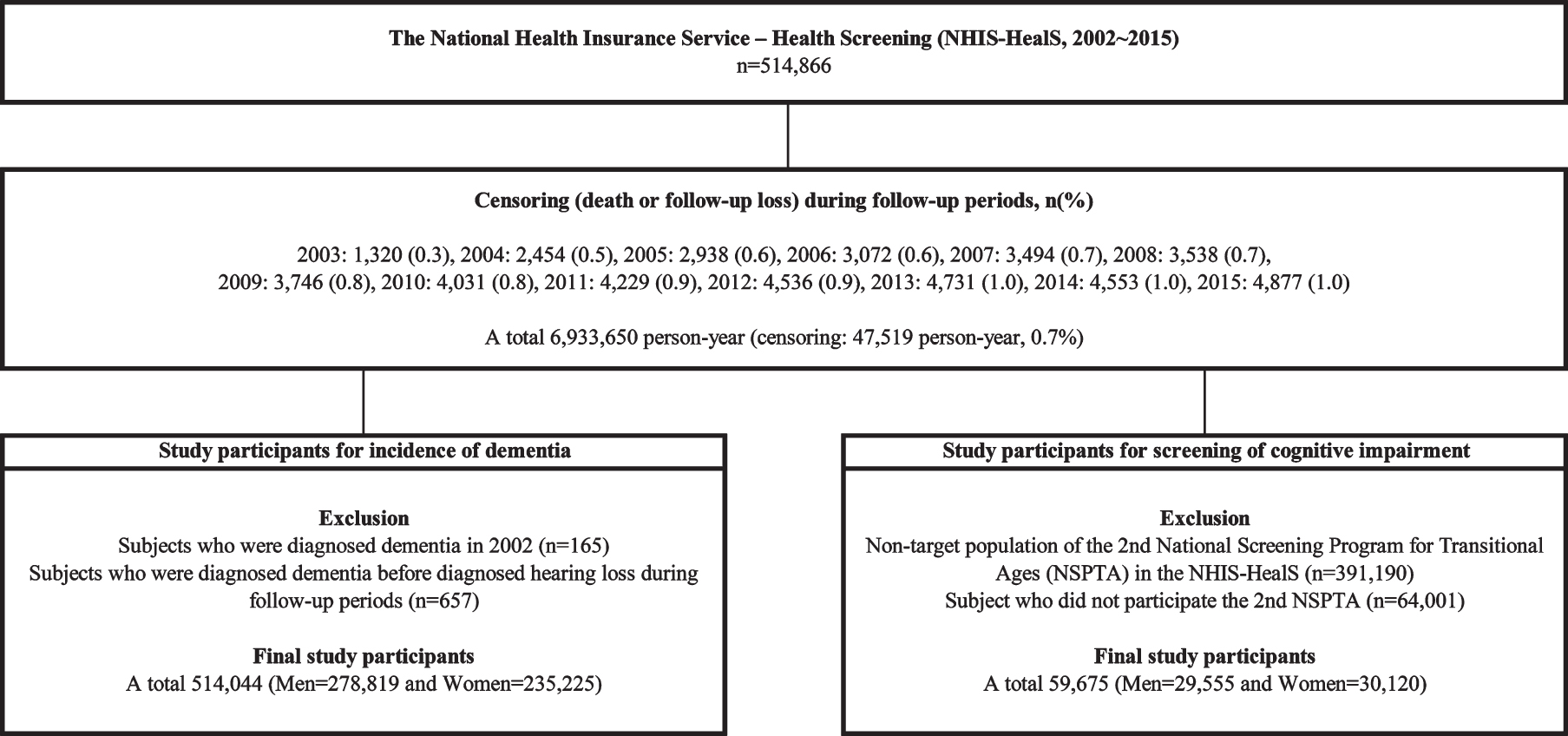
The flow diagram of study participants and the NHIS-HealS cohort profile
Dementia and cognitive impairment
Data regarding medical and hospital use history from the NHIS were based on the standardized protocol of the Korean Classification of Diseases and Causes of Death, 4th edition, which corresponds to the International Classification of Diseases, 10th revision (ICD-10) [18]. The dementia group was defined as participants who had ever visited a hospital facility with medical records that included the ICD-10 codes “F00 Dementia in Alzheimer’s disease” or “F01 Vascular dementia” during follow-up periods. Participants who had medical records with the ICD-10 codes “F02 Dementia in other diseases classified elsewhere” and “F03 Unspecified dementia” were excluded due to secondary dementia linked to rare diseases such as Pick’s disease, Creutzfeldt-Jakob disease, and Huntington’s disease.
Cognitive impairment was evaluated by the short form of KDSQ-P that includes five questions that assess memory impairment [17]. Response options of “never,” “sometimes,” and “frequently” are scored as 0, 1, and 2, respectively, and the cut-off for cognitive impairment is a sum score higher than 4 [19]. We defined cognitive impairment as scoring higher than 4 in the 2nd NSPTA during the follow-up period without dementia.
Hearing loss
The hearing loss group consisted of participants who had medical records that included the ICD-10 codes “H90 Conductive and sensorineural hearing loss” or “H91 Other hearing loss.” Type of hearing loss was classified based on the sub-code of ICD-10 or the clinical etiology of hearing loss. Conductive hearing loss was classified using the ICD-10 codes “H900 Conductive hearing loss, bilateral,” “H901 Conductive hearing loss, unilateral with unrestricted hearing on the contralateral side,” and “H902 Conductive hearing loss, unspecified.” Sensorineural hearing loss was classified using the ICD-10 codes “H903 Sensorineural hearing loss, bilateral,” “H904 Sensorineural hearing loss, unilateral with unrestricted hearing on the contralateral side,” and “H905 Sensorineural hearing loss, unspecified,” Mixed hearing loss was classified using the ICD-10 codes “H906 Mixed conductive and sensorineural hearing loss, bilateral,” “H907 Mixed conductive and sensorineural hearing loss, unilateral with unrestricted hearing on the contralateral side,” and “H908 Mixed conductive and sensorineural hearing loss, unspecified.” Presbycusis was indicated by the ICD-10 code “H911 Presbycusis.” Noise-induced hearing loss was indicated by the ICD-10 code “H833 Noise effects on inner ear (acoustic trauma and noise-induced hearing loss).” Congenital, unspecified, or idiopathic hearing loss such as “H910 Ototoxic hearing loss,” “H912 Sudden idiopathic hearing loss,” “H913 Deaf mutism, not elsewhere classified,” “H918, Other specified hearing loss,” or “H919 Hearing loss, unspecified” were categorized as other.
Other covariates
Socioeconomic status was classified into three age groups (41–50, 51–60, and more than 61 years old) and five household income groups (lowest, moderate–low, moderate, moderate–high, and highest) from the baseline characteristics of the initial cohort year. Health and behavioral characteristics were based on the 2nd NSPTA data from the NHIS-HealS during follow-up periods. To assess health status, we used questionnaires evaluating past history of chronic diseases such as hypertension, diabetes, dyslipidemia, cerebral vascular disease, cardiovascular disease, and body mass index (BMI). BMI was categorized into three groups based on the Asian standard as follows: underweight (< 18.5 kg/m2), normal weight (< 25 kg/m2), and overweight (≥25 kg/m2). Health behavioral status included smoking and drinking status. Smoking was categorized into three groups (never, past, and current). Current smokers were those who had smoked more than 100 cigarettes (five packs of cigarettes) during their lifetime and were smoking currently. Never smokers were those who had smoked fewer than 100 cigarettes (five packs of cigarettes) in their lifetime. Past smokers were those who had smoked in the past but did not smoke currently. Severe drinking was defined as having more than seven (in men) or five (in women) glasses of drinks containing alcohol more than twice per week.
Statistical analysis
A chi-squared test was conducted to describe differences in characteristics between groups with and without dementia or cognitive impairment. A Student’s t-test was also conducted to analyze the differences between age of diagnosis of hearing loss and KDSQ-P scores between the two groups. We estimated the age-standardized incidence ratio (SIR) and 95% confidence interval (CI) of dementia according to types of hearing loss using a reference group with all participants of the NHIS-HealS to demonstrate different effect of hearing loss on dementia according to type of hearing loss and dementia. The odds ratio (OR) and 95% CI were calculated by logistic regression analyses to demonstrate the association between hearing loss and cognitive impairment estimated by the KDSQ-P after adjusting for age, sex, household income, past history, and health behavioral status according to the type of hearing loss. All analyses were conducted using SAS, version 9.4 (SAS Institute, Cary, NC, USA).
RESULTS
Descriptive characteristics of all participants from the NHIS-HealS with or without dementia are shown in Table 1. Of a total of 514,044 survey participants (278,819 men and 235,225 women), 21,373 (4.2%) had dementia, specifically 7,933 (2.8%) men and 13,440 (5.7%) women. The highest rate of dementia was found among those older than 61 years of age. Among individuals with dementia, 4,153 (6.2%) participants had hearing loss.
Descriptive characteristics of study participants of the National Health Insurance Service – Health Screening according to presence of dementia
Figure 2 shows the age-SIR of dementia according to types of hearing loss and dementia. The all hearing loss group and conductive and sensorineural types of hearing loss had a statistically significant difference in rates of all dementia and dementia caused by Alzheimer’s disease compared to the non-hearing loss group.
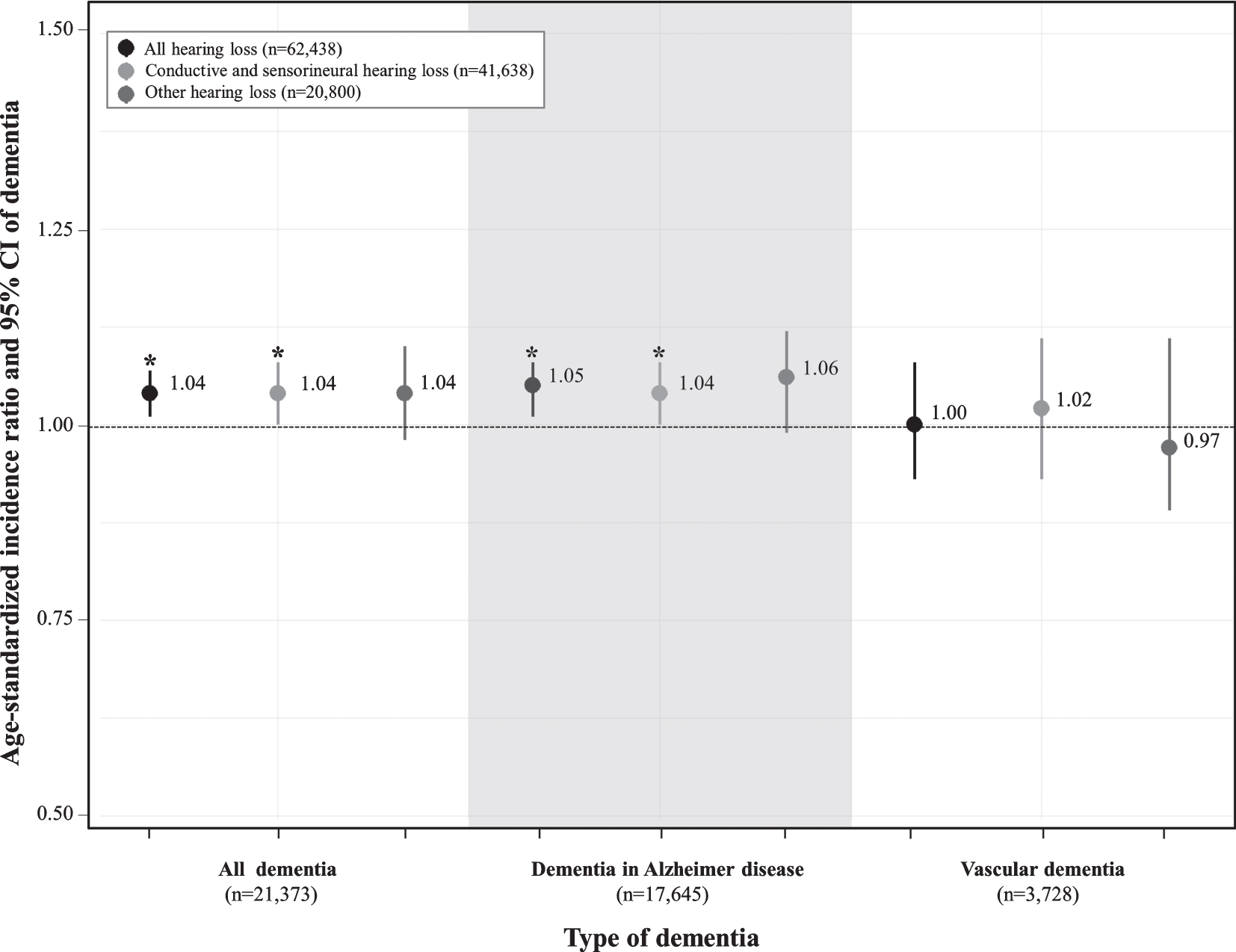
Age-standardized incidence ratio and 95% confidence interval of dementia according to types of hearing loss and dementia. * indicates a statistically significant difference compared to non-hearing loss group.
The baseline characteristics of participants in the 2nd NSPTA according to presence of cognitive impairment are presented in Table 2. Of the 59,675 respondents (29,555 men and 30,120 women), 9,886 (16.6%) had cognitive impairment, comprising 4,148 (14.0%) men and 5,738 (19.1%) women. Household income level was not significantly different between groups. The participants with the increased proportion of cognitive impairment were as follows: those without hypertension (17.0%), those with diabetes (18.4%), dyslipidemia (19.2%), cerebral vascular disease (27.0%), and cardiovascular disease (21.1%), those who were underweight (BMI < 18.5) (18.7%), never smokers (17.1%), and never or moderate drinkers of alcohol (16.8%). In the group with cognitive impairment, there was a significantly higher number of participants who had hearing loss (19.5%).
Baseline characteristics of study participants of the 2nd National Screening Program for Transition Ages according to presence of cognitive impairment
Table 3 presents the relationship between cognitive impairment and types of hearing loss using a logistic regression analysis after adjusting for confounding variables. Hearing loss was significantly associated with cognitive impairment, with an OR of 1.34, 95% CI: 1.26–1.43). Cognitive impairment was significantly associated with several types of hearing loss: conductive hearing loss (OR: 1.45, 95% CI: 1.20–1.77), sensorineural hearing loss (OR: 1.23, 95% CI: 1.12–1.36), presbycusis (OR: 1.53, 95% CI: 1.25–1.87), noise-induced hearing loss (OR: 1.32, 95% CI: 1.12–1.56), and other (OR: 1.34, 95% CI: 1.19–1.51). Conversely, the relationship between mixed hearing loss and cognitive impairment was increased but not statistically significant (OR: 1.16, 95% CI: 0.96–1.40).
Results from the logistic regression analyses for cognitive impairment according to type of hearing loss
All results were adjusted for age, sex, household income, past history, and health behavioral status according to the type of hearing loss.
Table 4 shows the scores on the KDSQ-P according to the type of hearing loss. Including all participants, those with mixed hearing loss and noise-induced hearing loss had KDSQ-P scores of 1.41 and 1.64, respectively. However, including only those that screened positive on the KDSQ-P (score≥4), the score was significantly higher (5.30 and 5.31, respectively).
Scores on the Korean Dementia Screening Questionnaire-Prescreening according to type of hearing loss
* indicates a statistically significant difference compared to all hearing loss group.
Figure 3 shows the average age of diagnosis according to the type of hearing loss. Across all types of hearing loss, the average age of diagnosis was 62.3 years old. Each type of hearing loss, except for mixed hearing loss, had a significantly different average age of diagnosis compared to the all hearing loss group. The average age of diagnosis of noise-induced hearing loss was the youngest at 56.5 years old.
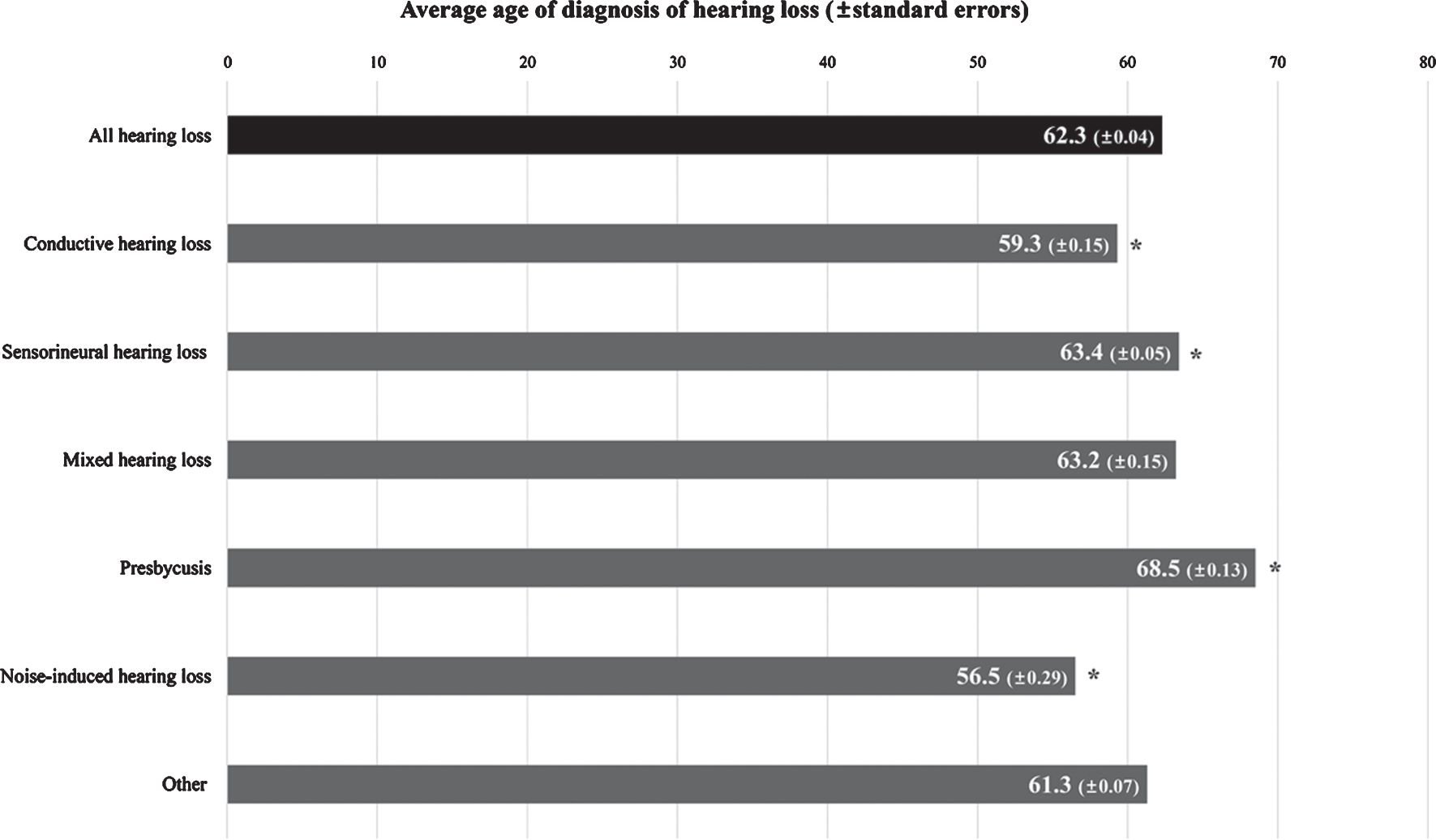
Average age of diagnosis of hearing loss according to type of hearing loss. * indicates a statistically significant difference compared to all hearing loss groups.
DISCUSSION
The current study suggests that significant associations exist between hearing loss and cognitive impairment among elderly Korean individuals. In addition, our results indicate different effects of hearing loss on dementia and cognitive impairment according to the type of hearing loss.
In recent years, there has been growing attention on possible mechanisms of hearing loss and cognitive impairment. Panza et al. suggested that hearing loss may excessively increase the brain’s cognitive load, and therefore cause changes and neurodegeneration in the brain both structurally and functionally [20]. Other studies have also suggested that hearing loss may accelerate brain damage. Lin et al. reported that hearing loss causes atrophy of the whole brain as well as regional volume reduction of the right temporal lobe, which is related to learning and remembering non-verbal information [21]. Hearing loss was also linked to dysfunction of the central auditory and auditory-limbic pathways and atrophy of the frontal lobe, which is related to cognitive skills such as emotional expression, problem-solving, and memory [22]. A study by Uchida et al. showed that hearing-impaired individuals had a significantly smaller volume of the hippocampus (an area related to short- and long-term memory) compared to healthy controls [23]. Another interesting hypothesis is that hearing loss is associated with social isolation [24], and long-term hearing loss may cause individuals to lose social skills which results in reduced cognitive stimulation [25].
There are different pathways leading to cognitive impairment based on the type of hearing loss. In the case of presbycusis, neuroimaging studies have described a plausible mechanism that accelerated lateral temporal lobe and brain atrophy and decreased cortical volumes in the auditory cortex are associated with cognitive impairment, occurring in approximately 30% of those with accelerated cognitive impairment [21, 27]. Conductive hearing loss is caused by impaired auditory function induced by an inability to locate sounds and detect weak signals in noise. Brain studies have shown that conductive hearing loss results in impaired spatial memory in the hippocampus and decreases in auditory cortex synapses and spike adaptation, which may develop into difficulties in cognition related to language acquisition [28, 29]. Unlike the other mechanisms presented above, sensorineural hearing loss is caused by problems with the nerve pathways in the ear or brain. A recent study reported that sensorineural hearing loss could induce abnormality in subregions of the thalamus and was significantly correlated with cognitive dysfunction after auditory deprivation [30]. Noise exposure is one of the most common causes of acquired bilateral sensorineural hearing loss resulting in noise-induced hearing loss in adults. The proposed mechanism underlying the association between cognitive dysfunction and noise-induced hearing loss is oxidative damage. Several studies have reported that increased oxidative stress produced by noise exposure can induce neuronal retrogression in the auditory nuclei and brain [31, 32]. Furthermore, noise-induced hearing loss caused by oxidative stress can decrease the level of hippocampal neurogenesis in brain regions that are critical for cognitive impairment [33].
Noise-induced hearing loss is thought to be the leading cause of conductive or sensorineural hearing loss contributing to presbycusis [34]. The field of occupational medicine has emphasized that noise-induced hearing loss is highly preventable. Most of the occupational noise-induced hearing loss is due to unprotected exposure to noise, and the impact of noise exposure is greatest in middle age [35]. This is consistent with our results, in which the average age of diagnosis is the youngest in noise-induced hearing loss compared with all other types of hearing loss. Furthermore, we found that the degradation of recognition was the highest in noise-induced hearing loss.
This study shows a significant correlation between noise-induced hearing loss and dementia. Recent studies have shown the brain change due to cognitive impairment and dementia using structural magnetic resonance imaging. Ledig et al. revealed that the reduced gray matter volume in the medial temporal lobe and increased ventricle volume in patients with Alzheimer’s disease compared to healthy controls. The longitudinal analysis also showed substantial hippocampal atrophy after a 24-month follow-up [36]. Cognitive impairment also has shown brain changes in frontal, temporal, and parietal lobes in white matter [37, 38] and splenium of the corpus callosum [39] using diffusion tensor imaging. A future study is warranted to investigate brain changes due to noise-induced hearing loss.
Recent studies have introduced the concept of brain plasticity. Brain plasticity refers to the ability of the brain to change flexibly, both functionally and structurally. Studies have shown that the brain is altered due not only to long-term environmental changes but also short-term training. For example, the area of the brain related to spatial function is significantly more developed in taxi drivers compared to bus drivers [40], and only six weeks of juggling training has been shown to change the regions of the brain related to visual and motor function [41]. With regard to brain plasticity, the current results suggest that hearing loss could increase the chance of structural changes in the brain that are linked to cognitive impairment. Further investigation of and experimentation on the effects of hearing loss on neurostructural plasticity is strongly recommended.
This study has a few limitations. Dementia was defined using the medical records of patients who had ever visited a hospital facility during follow-up periods. It is a clinically based approach but cannot conclusively confirm the presence or absence of the disease. However, medical records based on hospital visit information involving severe diseases such as dementia were considered reliable in a previous study that used a similar NHIS data structure [42]. Due to type of hearing loss is hard to separate perfectly in clinic, there was misclassification error in diagnosed type of hearing loss in current study. Furthermore, the NHIS-HealS did not assess the level of hearing loss and accurately measure noise exposure. We could not conduct all medical history for medication which could lead ototoxicity. Further research is needed to obtain more detailed information about noise exposure level and to consider possibility of hearing loss from medication. Finally, the study could not confirm an effect of early hearing loss on cognitive impairment due to inherent data structure. Further study is warranted to investigate this relationship.
In conclusion, this study demonstrates that hearing loss has a significant association with increased incidence of dementia and cognitive impairment. Different types of hearing loss have different proposed mechanisms related to dementia. Noise-induced hearing loss may play a key role in the development of dementia due to a typically earlier occurrence and thus a longer-term and larger effect on cognitive impairment compared with other types of hearing loss. These findings may help us to understand the effect of hearing loss on cognitive impairment and dementia. Further research should be undertaken to investigate the dose-response relationship between hearing loss and cognitive impairment and dementia.
