






Abstract
The power sector is experiencing comprehensive changes in its regulatory structure, sensing advancement and also prone to system security threats. To make the system more reliable the use of Ancillary Services (AS) become a must. The AS maintains the system security and reliability. With deregulation, the integration of Renewable Energy Sources (RES) in the power system has increased. To utilize RES at the maximum extent, the use of Energy Storage Systems (ESS) is required. ESS like Pumped Storage Plant (PSP) mainly adds great value to support renewable utilization. This paper proposes the simultaneous dispatch of energy and AS market such that the total procurement cost is minimized. The procurement of Operating Reserve (OR) as one of the principal AS is considered in the present work. The optimization problem is formulated and solved using Optimal Power Flow (OPF) technique. RES like Wind Power (WP) and Photo-Voltaic (PV), PSP as ESS with other conventional power generation units are considered to provide energy and AS. Four different cases considering various combinations of energy providers in the optimization problem have been studied and compared using modified IEEE-39 test bus system.
Keywords
Introduction
The electrical power industry around the world is meeting increasing demands for electricity in a competitive framework. Restructuring of power utilities are seen leading to deregulation of the power sector. The power industry has been a natural monopoly for a century. The monopoly had a vertically integrated structure comprising the generation, transmission and distribution services. Since the 1980’s the power industry is undergoing rapid change in its operating framework.
The framework has been serving the people well and maintained the system stability too. The change in the framework is allowing competition between the generating companies to establish a power market in the electrical industry. The competition will reduce cost of energy production and distribution, eliminate inefficiencies, reduce man work and will satisfy customer demands. The transition towards a competitive power market is commonly referred to as electricity supply industry restructuring or deregulation [18].
Today the complex regulatory environments ensure reliable electric power at fair prices [18]. The transmission system should be restructured in order to foster generation completion and fulfill customer choice [11].
Power system transmission open access TOA has changed the traditional concepts and approaches to provide electric service in many countries like the fully competitive markets of European Union (EU), UK, Scandinavia, USA, Canada, Chile, Argentina, Peru, Columbia, Australia, and New Zealand [17]. The impact of electricity restructuring has seen recent advancements in the Middle East nations [25] and also in the journey of Indian power sector towards deregulation [27]. Studies associated with transmission congestion and managing costs in the competitive electricity market has led to the formation of pool and bilateral models of electricity market [15].
Ancillary services were the provisions to ensure the reliability of the electric power service in the traditional power industry. With the concept of deregulation in the power industry responsibility for providing reliable power service has increased. Thus competition for procuring ancillary services has also risen resulting in the formation of a new market for obtaining these services. The responsibilities for providing ancillary services in competitive market, definitions have been discussed in [1–4, 21]. The technical and economic features of ancillary services in Australia, Belgium, California, France, Germany, Great Britain, Netherlands, New Zealand, PJM, Spain and Sweden have been presented in [43–44]. The estimation of costs for procuring various ancillary services required for the reliable operation of the power industry is studied in [10].
The competition of electricity sector usually trades in a centrally organized day-ahead market [17], parallel with the electricity market restructuring the increasing concerns for higher oil and fuel prices, global warming have promoted in exploiting the renewable energy sources (RES) worldwide. The integration of RES in the electricity market, possible solutions of integrating RES in electricity market, transmission network management in a regime of large scale renewable energy integration have been discussed in [7, 16, 39]. Technological and economic progress of the efficient and reliable renewable energy plants have contributed to large penetration of renewable energy in the power system, but there exist some constraints in operating the renewable energy plants. The risks incorporating PV and wind farms [36], the major challenges of wind and solar variability and the impact of wind and solar energy on the electricity market is discussed in [8, 12].
The characteristics of renewable energy sources being variable and uncertain and large integration of RES generation have created new challenges in the electricity market. To reduce the uncertainty of RES energy storage systems (ESS) play a vital role in large RES integration. The energy storage system is an additional system requirement recognized to provide security, reliability and flexibility to respond to various contingencies occurring in power system. The application of energy storage in power distribution network and the various energy storage methods for renewable energy sources have been presented in [26, 38]. The contribution of energy storages supporting large scale renewable generation in joint energy and ancillary service markets [32], combined operation of wind, solar photovoltaic, pumped storage, and energy storage systems in energy and reserve markets are seen in the recent years [23].
The structure of the paper follows by introducing pumped storage plant as energy storage in section 2, method used for procuring energy and reserve, problem formulation and pumped storage scheme in section 3, results and discussion of the cases studied in section 4 and conclusion in section 5.
Pumped storage plant as energy storage scheme
Pumped storage being the efficient and having capability of utilizing large scale renewable energy, the economics of operating an isolated power system with renewable integration joint operation of wind and pumped storage, and the operating strategy for wind-pumped storage hybrid power stations have been studied [19, 29, 37]. The bidding strategy of a pumped storage plant in a competitive electric market has been presented by Kanakasabapathy et al. [30]. India has huge potential for renewable energy generation and also has pumped storage hydro technology which can be utilized in the years to come [22]. The issues that may limit the ability of fully valued pumped storage hydro plants in today’s market and solutions for the problems have been discussed in [9].
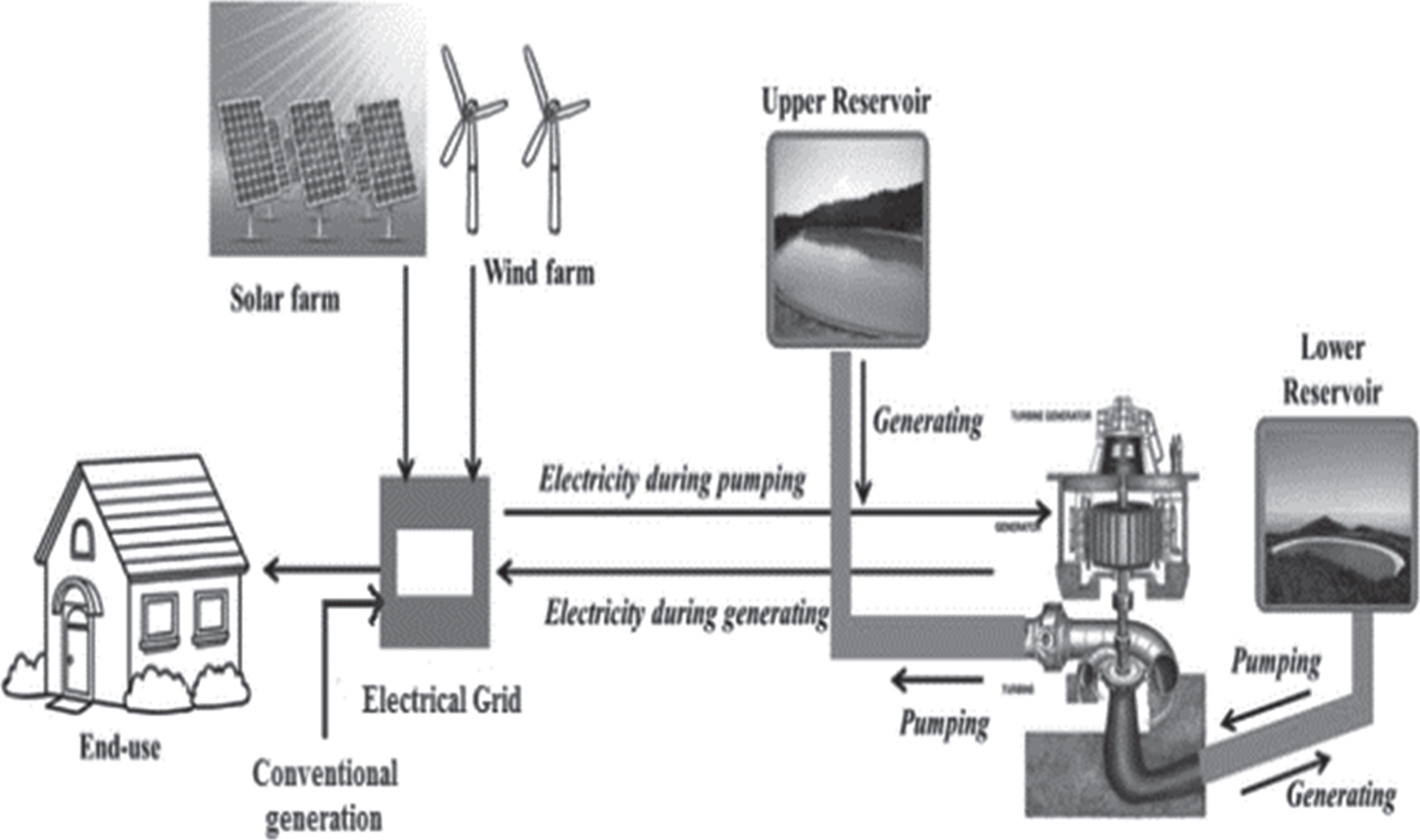
The pumped storage plant is similar to the design of conventional hydro power plant with some differences in operation. The main difference is that the pumped storage plant requires two reservoirs at upper and lower levels to store water. Water is pumped up and discharged using a pump-turbine arrangement. The reservoirs may be natural or artificially built having sufficient head difference, and they are connected through a penstock of minimum possible length through which the water can flow without any hindrance. Water can be stored in the upper reservoir when excess energy or cheaper energy is available and discharged during peak hours or when energy prices are high.
Figure 1 shows a hybrid pumped storage plant in which the energy is stored when energy prices are low or energy generated by the wind and solar farm is excess, the same is dispatched during peak hours or when electricity prices are high. Few advantages of pumped storage plant are discussed below: The pumped storage provides energy during the peak hours, where the energy prices are usually high. They are economically advantageous. But their net gain in energy is negative and it depends on the efficiencies of generator, turbine and pump. As discussed above the PSPs helps load levelling by utilizing the power from thermal, renewable during off peak hours to pump water from lower reservoir to upper and generate during peak hours. PSPs improve the system stability and ensure reliable operation of the system. PSPs can be started and connected to grid within 5 minutes which is the best suitable generation plant for peak hours. PSPs are environmental friendly, and are the most attractive scheme to store large amount of energy. Operation of Hybrid Pumped Storage Plant.
The story of electricity market under deregulation is similar to any contest or competition held in a reality show or game, where competitors compete and the judges decide the results based on winner policies or game rules. There has to be a platform on which these competitors compete such that the winner can be chosen as the best among the existing. In electric power systems, the introduction of competition to procure from the energy suppliers has forced the judge Independent System Operator (ISO) the system operator to analyze and make policies to ensure secure and reliable operation of power sector economically. The coordination of power system components and pooling in the competitive environment [13], solutions for electricity suppliers on financial risk management for electric energy contract evaluation [33], congestion management framework to provide access and prices to all users of transmission system where users bid for capacity and how the allocation of the Avail-able Transfer Capability (ATC) is done by the system operator [31], how to design an auction to procure ancillary services for power system, various design options for designing and implementing ancillary markets [5, 14] have been studied. Ma et al. [42] shows how to solve the energy and ancillary service products in the physical market using linear programming based approach. New methodologies to solve the linear programming problem for procuring energy and ancillary service in energy and reserve markets have been shown by Wu et al. [41]. OPF becomes the basic tool to solve the linear optimization problem [40]. A flexible reserve and energy dispatch approach when procuring energy and reserve simultaneously has been discussed in [24]. A survey of various OPF techniques used to solve linear programming problems is presented in [20]. The optimization problem is solved in MATPOWER [34] which is an open MATLAB power system simulation package, which helped in the work carried out.
Simultaneous dispatch
At the point when numerous products are included, the conventional merit ordered dispatch approach or its variations may not be stretched out effortlessly to yield powerful outcomes, particularly when network security constraints are an integral part of the optimization problem. In a general sense, the test is in dealing with fitting associations among the different products that may exist and be stipulated in the market rules. The LP-based joint dispatch strategy clears the energy and reserve offers simultaneously. In this approach, the common coupling of resource capacity with respect to energy and reserve, and different network security constraints are expressly presented. Express portrayal of these limitations in the dispatch procedure makes the market clearing costs more accurately reflect the marginal values of energy and reserve in the spot market. Enhanced market straightforwardness and proficiency might be accomplished because of the predictable arrangements amongst pricing and physical MW dispatch.
Problem formulation
The ISO is concerned to match the consumer demand with the power plant capability in the most economical way subject to reliability and security of the system. The objective is to meet the above considerations by procuring energy and reserve simultaneously at minimum cost. The objective function is written as
The procurement cost of energy from the i
th
unit is
The objective function, Equation (1) is subject to the physical constraints given in Equations (4)–(8). The physical constraints ensures operational security by setting the unit maximum and minimum points and also the total power supplied by the dispatchable and non dispatchable units equal to the total loaddemand.
The objective function, Equation (1) is also subjected to the following transmission network constraints.
(a) Power Flow Constraints
The power flow equation of the power network
(b) The inequality constraints The inequality constraint on real power generation P
gi
at PV buses The inequality constraint on reactive power generation Q
gi
at PV buses The inequality constraint on voltage magnitude V
i
at each PQ bus
(c)Transmission Limit Constraints
The branch flows are limited by MVA flow limit constraints
The integration of energy storage in conjunction with renewable energy has increased the use of renewable energy by maintaining a good quality of service reliability. The use of hybrid schemes (comprising of Wind, Solar and Pumped Storage) as an energy storage way in power production, showcases to overcome the problems of renewable energy storage and penetration to the grid in best manner. In the thesis, pumped storage scheme is applied with renewable units. PSPs are connected to buses where wind and PV are connected as well.
The main reason of integrating the PSPs was to utilize the excess renewable energy and to fulfil the peaks in load demand ensuring system stability and reliability by also acting as ancillary service provider during contingencies. Increase in penetration and dependence on renewable sources in power system has increased the ancillary services to play a vital role in maintaining system security and reliability.
Ancillary services, as discussed in section I are necessary to support renewable energy integration, particularly for wind and solar energy, as both wind and solar energies are greatly influenced by weather condition and their stochastic nature, which makes wind and solar energy be intermittent power source and unable to regulate the output power in response to the change in demand.
Calculation of available pumped storage potential
The pumped storage plant used in the problem is to overcome the problems of renewable energy thereby utilizing the maximum potential or RES and also acts as ancillary service provider in the day-ahead market. There should be a known value as capacity of pumped storage plant for fulfilling the demand in addition with other conventional and RES units. Therefore in the work carried out, it is considered that the upper reservoir is empty at the start of PSP operation. The energy generated by RES or any surplus power left after the energy and reserve dispatch will be allowed for the pumping action of PSP. The PSP will submit energy and reserve offers for the next hour based on its potential at that hour. The pumped storage potential in the problem is determined by the following equation:
The results after solving the objective function Equation (1) as OPF problem tested on modified IEEE 39 bus test system in the various cases have been studied. The cases studied are as follows: Case 1. Excluding RES integration in the market clearance. Case 2. Including only RES with conventional units. Case 3a. Combination of RES, pumped storage plants (dispatching 24×7) and conventional units. Case 3b. Combination of RES, pumped storage plants (dispatching only during peak hours) and conventional units.
The comparison of the best case in terms of cost of procuring the energy and ancillary service (ten minute spinning reserve) is showcased. The system specifications are presented before the simulated results.
Generating system
Technical characteristics of generation system
Technical characteristics of generation system
The total load demand of an electric power system is on peak during day time and evening when industrial loads, lighting loads are high. Hours 9 to 14 and 20, 21 are considered to be peak hour in the problem. Reserve requirement is generally equal to size of the largest generating unit or 5 to 10% of peak load in the system, but here we assume reserve requirement to be about 10% of the hourly energy demand. The energy demand and reserve requirement is shownin Fig. 2. Typical load pattern and reserve requirement.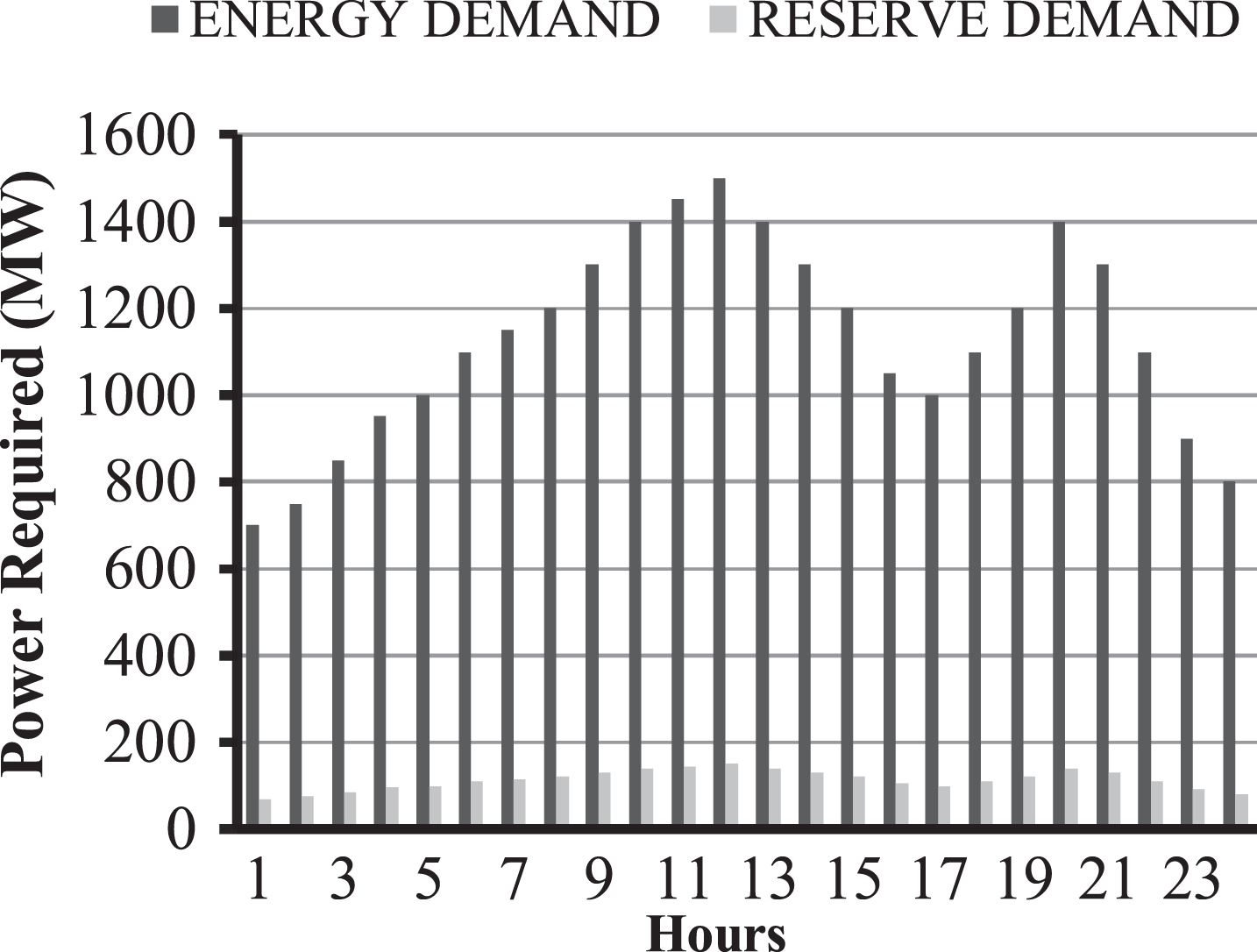
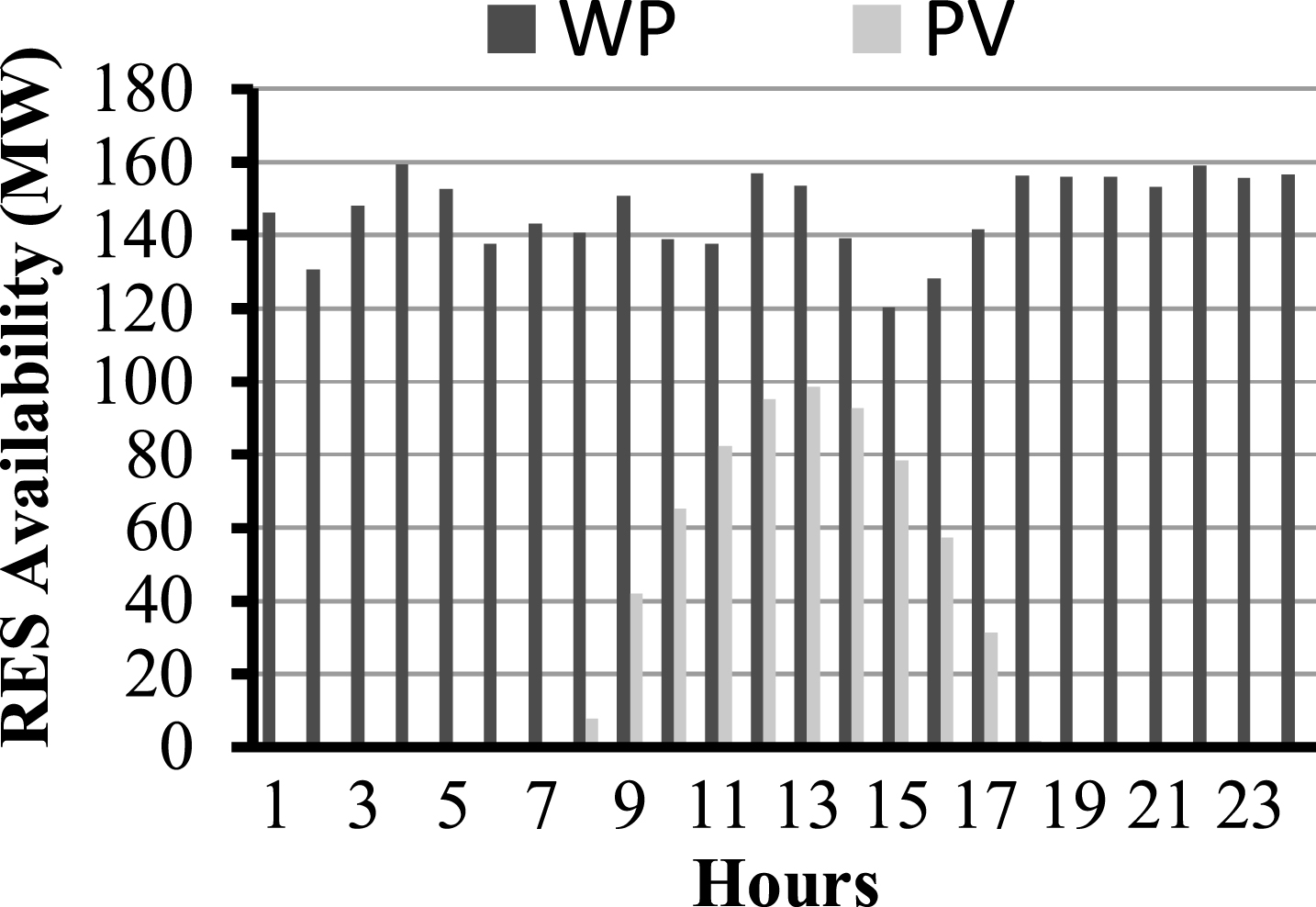
The RES potential (wind and PV) for a complete day is shown in Fig. 3. The load pattern and the RES potential are taken from [36].
RES potential availability.
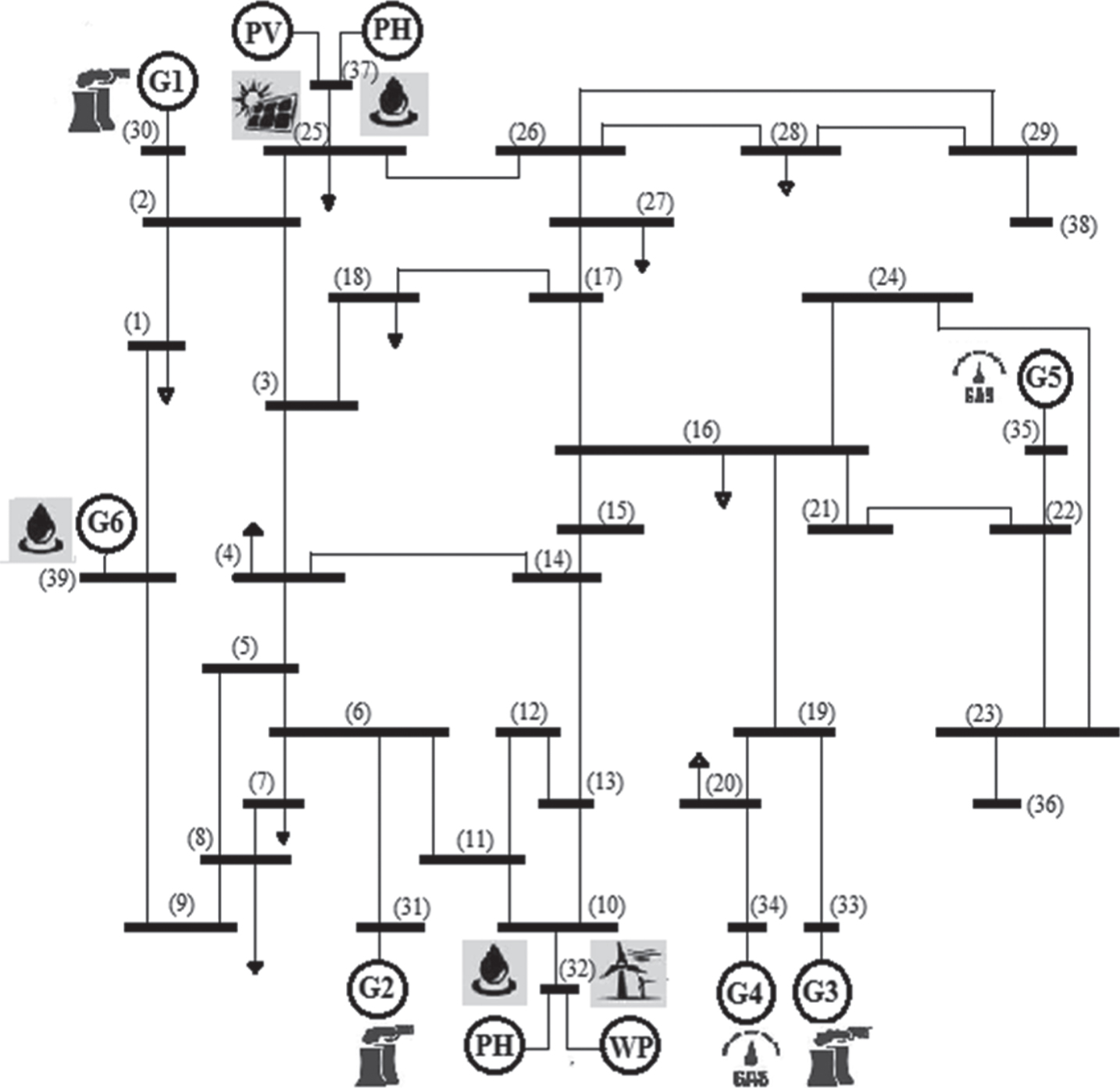
The problem is tested on modified IEEE 39 bus test system. Modifications made are such that nuclear generating units were decommitted and instead the system is integrated with RES, pumped storage units with other conventional generating units. The single line diagram of the modified IEEE 39 bus test system is shown in Fig. 4. The line data and associated capacities of the system considered for the simulation are given in Appendix 1.
Modified IEEE 39 bus test system.
The system have 10 generating units. Buses 30, 31 and 34 have thermal generating units G1, G2 and G4; buses 33 and 35 have gas generating units G3, G5 which are CCGT and OCGT respectively; a hydro unit G6 is located at bus 39; RES units WP, PV, i.e. the wind and PV are located at buses 32 and 37 respectively has a respective pumped storage plant WP-PSP, PV-PSP at buses 32 and 37. The total installed capacity of the system is 2000 MW without considering the renewable power plants and pumped storage plants. The renewable power plants can generate variable capacities ranging between 20 MW to 300 MW hourly.
The pumped storage plants have maximum capacity of storing 450 MW individually and the commitment by them is purely based on RES units and availability of water. The energy demand of the system ranges between 700 MW to 1500 MW as seen from Fig. 2. The loads in the system shares equal amount of total energy demand at that particular hour.
Case 1: Excluding RES integration in the market clearance
In this case the participation of renewable energy in energy and reserve market is neglected. The conventional units participate in the energy and reserve markets and the required energy and reserves at the particular hour is being procured at minimal cost. Based on the bid prices and network constraints the system operator procures the energy and reserve simultaneously. The energy and reserve dispatched by the conventional generating units for 24 hours and the total cost of procuring energy and reserve are shown in Table 2.
24- Hour dispatch cost of energy and reserve
24- Hour dispatch cost of energy and reserve
In this case the renewable energy based generating units (wind and PV) take part in the energy and reserve market along with the conventional generating units. The inclusion of Pumped storage plant is halted to study the effect of integrating it in the further cases. The energy and reserve dispatched by the conventional generating units and the renewable generating units for a period of 24 hours and the total cost of procuring energy and reserve are shown in Table 2.
Case 3a: RES + PSP (24 hour dispatch) + conventional
In this case the renewable energy based generating units, the conventional generating units and Renewable based Pumped storage plants take part in the energy and reserve market. It is assumed in this case that the pumped storage plant will have the ability to dispatch both energy and reserve for 24 hours, i.e. the reservoir of the pumped storage plant has enough potential to supply energy in the day. The energy stored in the PSP will be dispatched for the next hour of the market clearing process. Figure 5 shows the potential of pumped storage plant if dispatched 24 hours. The potential of the pumped storage plant has been calculated using Equation (14). The energy and reserve dispatched by generating units and the total procurement cost of energy and reserve for this case have been shown in Table 2.
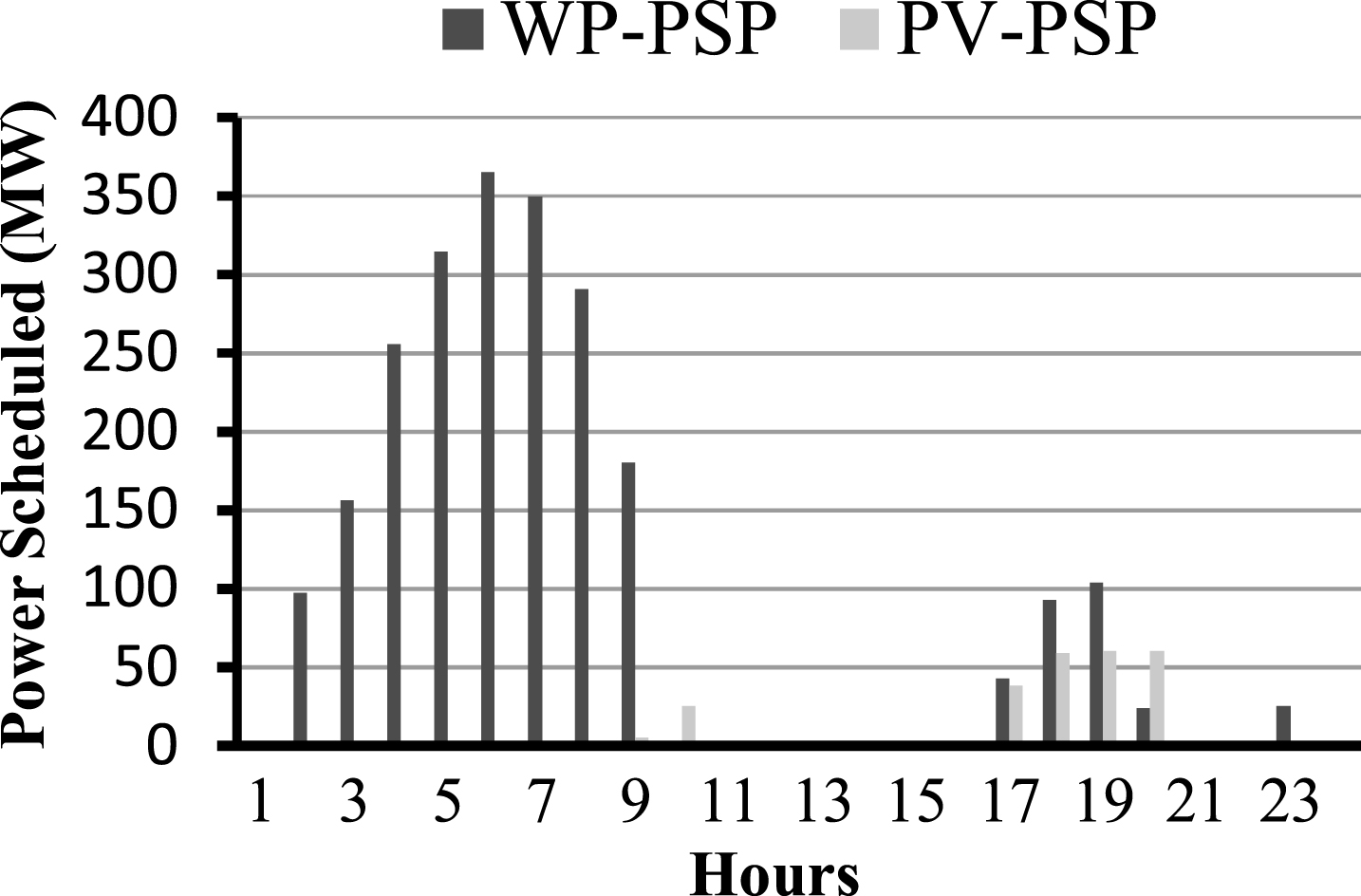
Potential of PSP for case 3a.
In this case the renewable energy based generating units, the conventional generating units and Renewable based Pumped storage plants take part in the energy and reserve market. It is assumed in this case that the pumped storage plant will dispatch only during peak hours, i.e. when the demand is high. Hours 9–14 and 20-21 are assumed to be as peak hour. The energy stored in the PSP will be dispatched for the next hour of the market clearing process. Figure 6 shows the potential of pumped storage plant if dispatched during peak hours. Potential of PSP for case 3b.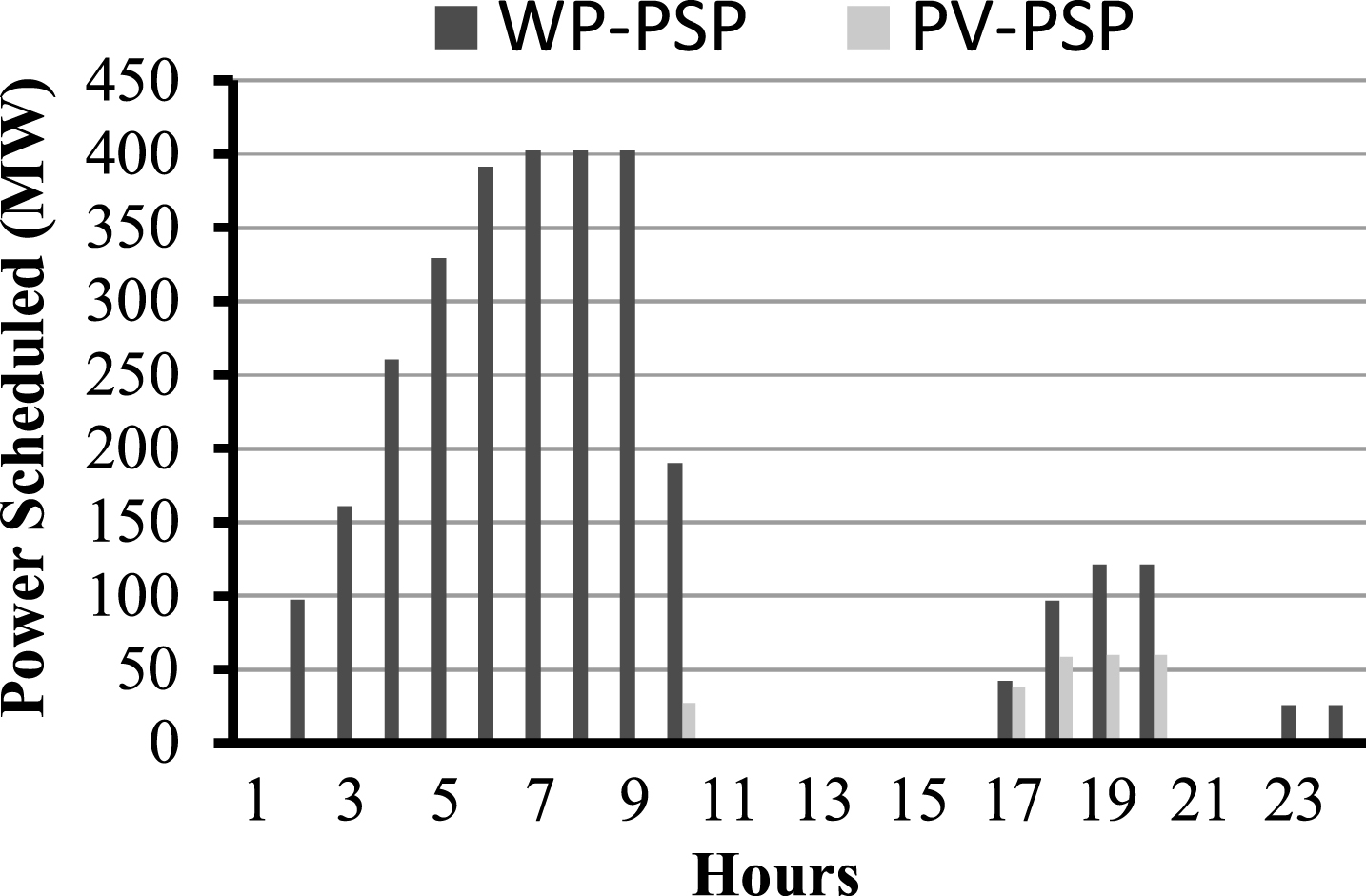
The potential of the pumped storage plant has been calculated using Equation (14). The energy and reserve dispatched by generating units and the total procurement cost of energy and reserve for this case have been shown in Table 2.
The overall energy procurement cost, reserve procurement cost and the total energy and reserve cost in a day for the various cases studied are tabulated in Table 2.
From the table we compare the best combination for energy and reserve dispatch based on the price of procuring energy and reserve from the electricity market. From the results obtained it is clear that the renewable integration reduces the cost of electricity, but to efficiently utilize RES potential Pumped storage plant have been used which helps in further reduction of electricity prices and also provides good provision of reserves to the power sector ensuring secure and reliable operation of the system.
The cases 3a and 3b is assumed such that water availability sustains as the operation of pumped storage plant depends on the availability of water. 24 hour dispatch of pumped hydro storage plant is practically not possible but to show the analysis of what could be the result if the case 3a operated resulted in cheaper reserve procurement compared to case 3b. Case 3b is more practical as we know the operation of pumped storage plant is generally during peak hours. The peak hour dispatch of the PSP acts as a good reserve provision and also to act as ancillary services other than reserves.
Conclusion
The objective to utilize renewable energy sources as energy and reserve provider to maximum extent is successfully accomplished. This is done by using renewable based pumped storage scheme by formulating a hybrid operation of wind, PV, pumped storage, hydro power, coal and gas generating units. The hybrid operation is performed to minimize the cost of procuring energy and reserve from the electricity market using simultaneous energy and reserve dispatch approach. The optimization problem is solved using optimal power flow technique and tested on modified IEEE 39 bus test system. Simultaneous energy and reserve dispatch is used because this approach is secure and economic compared to the other dispatching methods. Four cases have been studied: Excluding RES integration in the market clearance; Including RES with conventional units but not pumped storage plant; Combination of RES, pumped storage plants (dispatching 24*7) and conventional units; Combination of RES, pumped storage plants (dispatching only during peak hours) and conventional units.