






Abstract
In this paper we suggest a new approach to assessment of banking systemic risk contagion. Rather than the static analysis method, we introduce a dynamic analysis method to simulate the contagion of banking systemic risk. Banking systemic risk contagion is similar to the spread of infectious disease. In this paper, analysis is made on the process of banking systemic risk contagion by means of Matlab simulation based on network dynamic time-variant contagion kinetics model. The conclusion shows that high banking risk contagion rate, low risk immunization rate or low risk isolation protection rate all are the basic reasons for that the “risk contagion reproductive rate” reaches the threshold value to make banking systemic risk contagion uncontrollable, and it is suggested to ensure banking system safety by taking measures from the three aspects pointed out above and combining with prudential supervision policies.
Keywords
Introduction
Banking systemic risk refers to the possibility that risk infect other banks and even the whole banking system due to inter-bank relationship in the case of failure of one or more banks due to initial shock, so as to result in bank functional interruption and bring about massive loss to the real economy. Banking systemic risk consists of two important links: initial shock and risk contagion mechanism. In the case of failure of one or more banks, banking risk will infect other banks and even the whole banking system rapidly via direct and indirect relationships, so as to result in banking systemic risk. As the degree of financial liberalization and financial integration constantly deepen, the contact among financial institutions becomes closer. Banking industry is the core of the financial system, and banks combine together to form an inter-being and interrelated banking network via inter-bank lending and negotiable instruments. The business relationship between banks is increasingly close, which not only facilitates the business of banks, but also provides channels for the contagion of banking systemic risk. When some banks fall into crisis, they will spread the risk to the closely related banking network through the contagion channels, which will lead to the outbreak of banking systemic risk. Banking systemic risk is of high negative externality and will bring about enormous losses to the financial system and the real economy. If it becomes realizable to accurately assess degree of banking systemic risk contagion and predict the outbreak of banking systemic risk, it will be greatly helpful for the supervision authority to prevent and monitor banking systemic risk. The development complex network theory has greatly promoted the research of banking systemic risk contagion. Thus, this paper is intended to simulate banking systemic risk contagion from the aspects of banking risk contagion rate, banking risk immunization rate and banking risk isolation protection rate with dynamic time-variant contagion kinetics model based on banking network theory, which is of certain theoretical and practical significance to prevention and monitoring of banking systemic risk in China.
The research contribution of this paper is reflected in the following aspects: introducing the model of infectious diseases in the medical field into the banking network risk contagion mechanism to construct the systemic dynamic time-varying contagion kinetics model. The model not only can measure the contagion and diffusion of the banking systemic risk in the banking network and whole banking system but also can simulate how the banking systemic risk gradually accumulates and spreads until the outbreak. Rather than the static analysis method, we introduce a dynamic analysis method to simulate the contagion of banking systemic risk.
This paper is divided into six parts: the first part is the introduction, which explains the research contribution and structure of this paper; the second part is literature review, which summarizes and comments on the research results of banking systemic risk contagion of Chinese and foreign scholars so as to clarify the value of this research; the third part is the origin and principle of the model; the fourth part is to construct the network dynamic time-varying contagion kinetics model; the fifth part is the simulation process analysis; the last part is model inspiration and banking systemic risk contagion preventive countermeasures analysis.
Related work
Banking network is a complicated dynamic network. Banking network method lays stress on analyzing the relevance among banks. Thus, with this method, the correlation among banks can be clearly measured, and the “domino effect” of banking systemic risk contagion can be measured. More and more researchers focus on and apply the complicate network model on researching banking systemic risk. Many researchers have found that the structural characteristics of banking network have important effects on the process of banking systemic risk contagion. Particularly, the contagion and diffusion of banking systemic risk in the banking network have become a hot issue, and both Chinese and foreign scholars have made lots of researches.
Allen & Gale [5] innovatively analyzed banking systemic risk contagion mechanism with financial structure and found that liquidity shock is more liable to spread and diffuse in incompletely connected banking network structure, and completely connected banking network structure in comparison can restrain banking systemic risk from spreading among banks to a certain extent. Freixas et al. [17] studied banking systemic risk contagion from the aspect of interbank market and found that the probability of complete market structure of banking systemic risk is lower than that of incomplete market structure. Aleksiejuk & Holyst [4] studied the phenomenon that a single bank failure leads to failure of a large number of banks by infection channels with stochastic banking network model. Muller (2003) used complex network modeling and simulation methods to analysis banking systemic risk contagion of Swiss banks. The simulation results showed that: Swiss banking network had a relatively high aggregation coefficient and the banks are very closely linked. The ability of such banking network structure to withstand systemic risk was worse, banking risk could easily spread between these closely linked banks. Thurner et al. [33] introduced dynamic game model into banking network topological structure for analyzing inter-bank systemic risk contagion for the first time and found that banks could reduce their risk by choosing to conduct transaction with neighboring banks willing to share risk. Upper [35] measured the position of single bank in the banking network and the connection degree of banks with financial network analysis method. Nier et al. (2008) and Gai & Kapadia (2008) studied how an assumed shock influenced the elasticity of banking network structure by building banking system simulation network and found that the probability that banks influence each other mutually under external shocks was not obvious, but the high degree of relevance of banks decides that the banking system was vulnerable. Brock et al. [6] built a financial network risk model based on risk exposure matrix in which financial institutions correlate with each other and analyzed the contagion effect of financial system via simulating shocks. Cont & Moussa (2010) analyzed the contribution of every financial institution in Brazil to systemic risk in 2007 and 2008 with contagion index and the network structure risk and found that the contribution of heterogeneity to thefinancial network structure was large. The analysis results by Drehmann & Tarashev (2011) with generalized contribution approach (GCA) indicated that the position of a bank in the financial network decided its systemic importance, thereby indicating that banking network, relative to bank scale, played a decisive role in the banking systemic risk. Krause & Giansante [25] analyzed the contagion mechanism of financial system failure based on interbank lending network and found that the initial failure of bank scale was the principal factor of contagion, but the most critical factor was the prevalence of interbank lending network, so interbank financial associative structure must be taken into consideration for banking systemic risk supervision. Tabak et al. [32] took directional clustering coefficient as the indicator for measuring banking complicate network systemic risk and proved the negative correlation between directional clustering coefficient and domestic interest rate based on Brazilian interbank network data. Acemoglu & Ozdaglar [1] analyzed the correlation between financial network structure and the possibility of financial system failure, finding that interbank trade associations provided channels for banking risk contagion and made the financial system more vulnerable. Aldasoro et al. [3] measured banking systemic risk contagion mechanism with center measurement, input and output index measurement and Shapley value, and found that banking risk aversion played an important part in the process of banking systemic risk contagion, and liquidity hoarding would amplify financial losses due to correlative externalities.
To sum up, foreign scholars studied banking systemic risk from multiple aspects with banking network model and had made a lot of achievements. The first achievement was about the structure type of banking network influencing banking systemic risk contagion. Banking systemic risk contagion varied with the type of banking network structures. They covered complete market network, incomplete market network, regular network and stochastic network. The second achievement was study on banking network risk contagion from the perspective of interbank business connection (interbank borrowing system or interbank payment system). The third achievement was that the main channels of banking network structure being infected with banking systemic risk mainly included credit channel (direct channel) and information channel (indirect channel). Foreign scholars’ researches also have some disadvantages. Firstly, in real situation, banking network structure types are complicated. Besides complete market network, incomplete market network, regular network and stochastic network, the complicated banking network structures also are characterized by small-world, scale-free and double power law scale, which need in-depth study. Secondly, related foreign research literatures mostly consider credit risk caused by direct bilateral interbank risk exposure. In fact, there are several mechanisms of banking network risk contagion, and the speed and degree of banking systemic risk contagion vary with contagion conditions.
Wan Yangsong [36] from the angle of correlation between interbank market structure and function, built an interbank market structure model based on network theory, and innovatively proposed double power law banking network structure model; conducted deep analysis of interbank risk contagion process based on balance sheet connection in interbank market; built an interbank risk contagion quantitative analysis framework based on the combination of macro-structure (MS) with micro-agent (MA), and further studied interbank risk contagion mechanism and risk contagion immunization strategy based on MS-MA analysis framework. Huang Cong et al. [23] built a risk contagion model of China’s financial network, figured out the conditions for the stabilization of banking network, provided the existence and uniqueness of network steady state, described the structural features of China’s banking network from multiple dimensions, and conducted empirical analysis based on interbank payment and settlement data for the first time, finding that China’s interbank network was characterized by the coexistence of important nodes and local patches and network stabilization took on equilibrium under certain conditions and in certain scope. Mao Fengjun [28] reached the research conclusion with network analysis method that market concentration decided the network center position of systemic importance financial institutions and made such institutions “center nodes”, the degree of association among these center nodes gradually increased, any one going wrong would affect the whole financial network, and banking systemic risk gathered via internet channel. Jia Yandong [24] based on financial network model, measured the impact of single systemic importance financial institution to the whole financial system from the aspects of “direct contribution” and “indirect participation”, and measured the systemic risk of China’s financial institutions with “impact test” and Shapley value. Fan Xiaoyun et al. (2011) measured the systemic risk of China’s financial institutions with financial network model, and evaluated China’ssystemic importance financial institutions, finding that the degree of interbank association and the position of a bank in the financial network decided the degree of systemic importance of banks. Tong Mu and He Yi [34] simulated the risk evolution process of China’s high value payment system by means of mathematical modeling and analog simulation based on banking network model, finding that equilibrium liquidity rescue strategy could inhibit contagion of large value payment systemic risk to a certain extent relative to disequilibrium liquidity rescue strategy. Deng Jing et al. [9] regarded banks as nodes of interbank market network and analyzed the impact of interbank market network structure on banking systemic risk with financial network model. Their research results indicated that liquidity transfer and risk contagion held dominant position in bank association. Liquidity transfer held dominant position in the event that the liquidity in the banking system is adequate; risk contagion held dominant position in the event that the liquidity in the banking system is inadequate. Thus, it was supposed to strengthen interbank association in the case that the liquidity in the banking system was adequate and reduce interbank association in the case that the liquidity in the banking system was inadequate. Sui Cong et al. (2014) measured banking systemic risk with interbank default contagion model and analyzed banking systemic risk state in multiple interbank network structures by building scale-free network. Their analogue simulation results showed that network concentration degree was in direct proportion to risk contagion degree. Fan Hong [12] proposed a dynamic banking network system model with multiphase liquidation and macroeconomic trends and figured out a changing curve of systemic risk by simulating calculation, pointing out the problem of risk accumulation of banking network system. Feng Chao and Wang Yin (2015) based on a liquidation sequence obeying Markov decision process, built an interbank market network model and solved the optimal rescue strategy to liquidation sequence with neuro-dynamic programming method to reduce losses caused by banking systemic risk. Fang Yi and Zheng Ziwen [14] based on common asset holding network model, analyzed the contagion path indexes of banking systemic risk, having not only measured the contagion path of banking systemic risk from the dimension of time but also analyzed the creation mechanism of banking systemic risk from the space. Deng Chao and Chen Xuejun [8] analyzed the impact of banking systemic risk caused by liquidity shortage and selling off of assets due to credit loss on banking network system of different topological structures under different financial troubles and stresses, indicating that kernel-boundary interbank network system was more vulnerable to common shocks and contagion risk than scale-free network. Han Jingti and Cao Yu [21] analyzed the impact of superposition of multiple avoidance behaviors on banking systemic risk contagion with interbank network model, finding that the superposition of multiple avoidance behaviors had aggravated banking systemic risk contagion. If risk aversion was taken, heterogeneous network was superior to homogeneous network in respect of stability; otherwise, stochastic network of homogeneity was superior to heterogeneous network in respect of stability.
Review of related research results of Chinese scholars shows that Chinese scholars mainly focus on the mechanism of different banking network structures and network structural elements influencing banking systemic risk contagion, and correlation risk between bank credit market and bank balance sheet. For these researches, it is assumed that the systemic risk in the banking system have accumulated to the degree of outburst and the associated behaviors among bank nodes are static. These research results fail to explain how banking systemic risk accumulate gradually, spread and finally break out in the banking network from a dynamic angle.
The network theory and method focus on reproducing the statistical law of inter-bank interaction at the macro level, while the nodes in the network are too simple to describe individual banks, which cannot well reflect the influence of the local behavior changes of individual banks on the interaction law of inter-bank interaction at the micro level in the statistical sense. Over time the network of banking systems evolved. Bank main body behavior also changes with time, and at present the main researches are to analyze the characteristics of banking systemic risk contagion under static situation and lack of dynamic research. Therefore, the research of banking systemic risk contagion needs to be investigated the influence of time dynamics and bank status on bank systemic risk contagion under different contagion conditions and under different contagion influencing factors. Therefore, it is supposed to make up the limitations of static analysis method with dynamic analysis method, and this exactly reflects the value of applying network dynamic time-variant contagion kinetics model in this paper.
Origin and basic principle of model
Since risk contagion is similar to viral transmission, the Kermack & Mckendrick (1926) infectious disease model SIR was referred to and applied first. There are a lot of models for researching banking systemic risk, every analysis method has its advantages, but there is no model introducing time-lag contagion kinetics. Banking risk contagion is dynamic, and risk contagion is of time lag (from banks suffering from risk shock to banking systemic risk breaking out). Thus, we have to build a banking network risk contagion kinetics model considering time-lag effect. The contagion of banking systemic risk shares similarities with viral transmission, including propagation mechanism and trend of prediction. Virus has incubation period, and bank infected with risk also has incubation period and time lag. Thus, risk will not break out immediately. The study on the stability of time-lag model is critical and can facilitate analyzing and explaining banking systemic risk.
Mathematical method, analog simulation, and referring to kinetic model may be feasible for preventing banking risk contagion and banking systemic risk occurrence. According to the occurrence rule of banking risk network contagion, it is feasible to build rational models based on consideration of related factors, refer to mature infectious disease models in the academic world, and studies the existence and stability of equilibrium point and the stability of periodic solution of differential equation, so as to prove the durability and convergence of banking risk contagion, figures out the internal features and principle of contagion, and works out an optimal strategy of preventing and controlling banking systemic risk.
The mathematical model of infectious diseases was originated from the smallpox epidemic model (Daniel Bernoulli, 1760).
For purpose of the model, the objects consist of susceptible population and immune population. S(t) stands for susceptible population, q for infection rate, m (t) for fatality rate for other reasons, and p for fatality rate due to smallpox. The two differential equations mean the speed of change of the infected and rehabilitees respectively.
In 1911, Ross won Nobel Prize in medicine for the achievements in and application of themathematical model of infectious diseases and the differential equation model. In research development process, Kermark&McKendick(1926) proposed the classic virus infection model: “bin model”.
As to the symbols in the model, S stands for susceptible population; I for infected population; R for recovered population; β for infectious rate; γ for recovery rate. This model has been being modified and improved. Another classic model is SEIR model:
ɛ stands for the rate of conversion from population in incubation period into infected population, p, q ∈ [0, 1], p for the rate of descendants of population in incubation period entering the population in incubation period, and q for the rate of infected population entering the population in incubation period.
The threshold value of the model is basic reproduction rate R0, referring to new individuals infected by the infected individuals. If R0 < 1, the number of newly infected is less than 1, indicating the infectious disease will disappear gradually; if R0 > 1, the number of newly infected will increase constantly.
Build banking systemic risk contagion model based on network dynamic time-variant contagion kinetics model
Based on the assumption that the number of banks running well at the moment of t is x(t), the number of banks having infected with risk is y(t), z(t) means the number of banks immunized from risk contagion for self-help or help by others at the moment of t, λ means the number of healthy banks in the original state of the banking system, β means infectious rate, and all parameters are positive, a banking systemic risk contagion model can be worked out, as below:
Risks are of time lag in the contagion process among banks. Banks infected with risk contact with healthy banks (for business connection, interbank borrowing, bank run contagion, etc.). Healthy banks also are at risk (confidence shaking, financial strain, etc.). Healthy banks may turn into infected banks finally. We have introduced bank contagion time lag and built a new model on this basis.
d1 stands for the rate of uninfected banks turning into banks of other types (infected banks, immunized banks); d2 stands for the rate of infected banks turning into banks of other types (uninfected banks, immunized banks); d3 stands for the rate of immunized banks turning into banks of other types (uninfected banks, infected banks).
Substituting f (y, z) with μyz, μ means the rate of infected banks turning into immunized banks.
(1) Analysis of mathematical principle and equilibrium point of model
The first step is to prove the positive solution to Model (2) R is finally of uniform bound. Since the βx (t) y (t) is not negative, and based on the first equation of Model then:
The product of adding the first two equations of Model (2) is:
Wherein,
The product of adding the three equations of the model is:
(3) Wherein, d = min {d1, d2, d3}, then:
Based on the analysis above, all solutions to the model system finally are in a bounded positive invariant field.
Calculations show that the model system has one risk-free contagion equilibrium point P0 = (X0, 0, 0), wherein,
R0 and R1 stand for basic reproductive rate of banking risk contagion and productive rate of banking immunoreaction.
If and only if R0 = 1,
If and only if R1 > 1, P2 = (x*y*z*) exists, and
Based on the discussions above, it can be concluded that if R0 < 1,
(2) Analysis of stability of equilibrium point
(1) Analysis of principle of dynamic banking risk contagion
Whether banking risk will evolve into systemic risk is mainly related to the parameters of model, such as risk contagion rate β, isolation protection rate d1 of banks running well, isolation protection rate d2 of infected banks, removal rate γ of infected banks (being left bankrupted according to market rules), acquired immunization rate μ, and isolation protection rate d3 of infected banks.
According to Model (2), the increment of banks infected with risk at the moment of t is
If the indicators and parameters in initial state are: λ = 500 susceptible normal banks x (0) =0.90λ; risk-infected banks y (0) =0.05λ; immunized banks z (0) =0.05λ, risk infection rate β = 0.05, and immunization rate μ = 0.05, then the isolation protection rates of the three types of bank are d1 = 10, d2 = 5 and d3 = 1 respectively, of which the unit is %.
(2) Analog simulation of banking systemic risk in the case of risk infection rate changing
For simulating banking systemic risk contagion β, the values assigned to β from high to low are 0.5, 0.4, 0.3 and 0.2. This is to simulate the changing situation of x(t), y(t) and z(t) in the case t = 200, asbelow:
As shown in Fig. 2, in the case of high risk infection rate, the value of R1 reaches 2, much higher than the stable value of R1 = 1, where the number of healthy banks becomes less and less, the number of risk-infected banks continuously increases. As indicated by the imaginary line in the figure, the number of risk-infected banks takes on a trend of continuously spreading and increasing, which accelerates the outbreak of banking systemic risk.
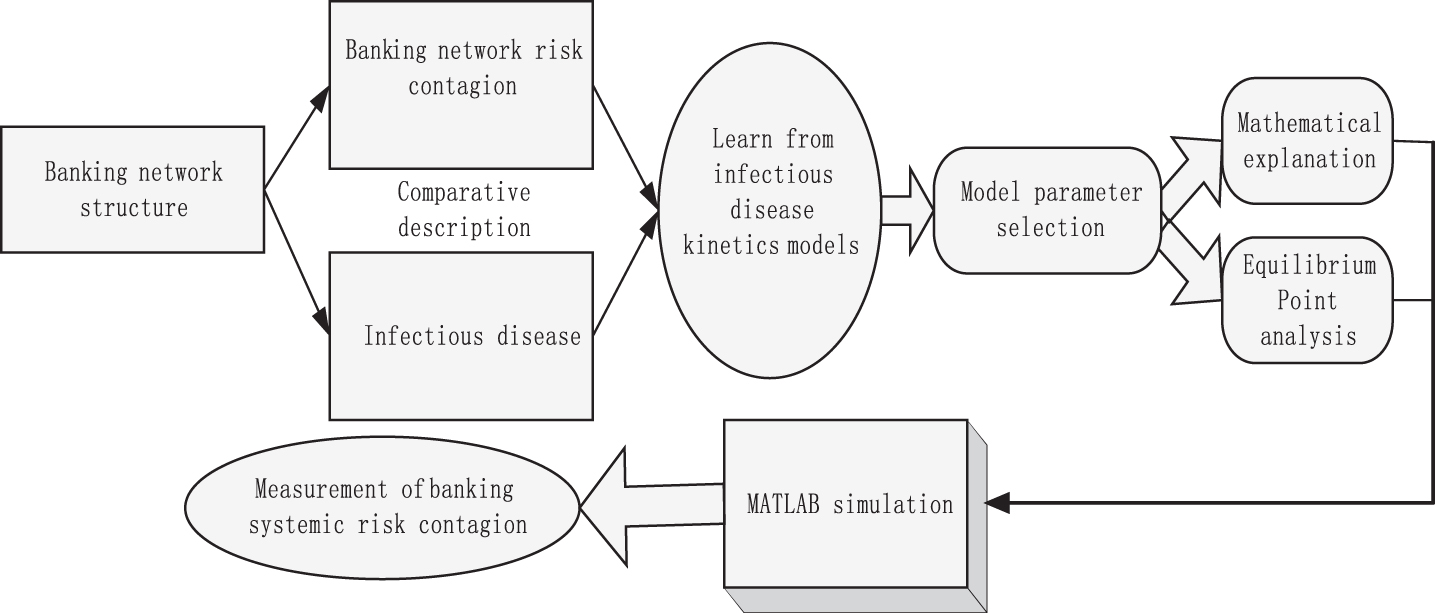
Design of measurement framework for banking systemic risk contagion.

State diagram of banking systemic risk in the case of infection rate β = 0.5.
As shown in Fig. 3, in the case that the risk infection rate decreases to β = 0.4, the growth rate of the number of risk-infected banks under the continuous shock of banking risk as the risk infection rate decreases is slightly lower than that in the case of β = 0.5. Since the value of R1 is still larger than 1 (equivalently the virus reproductive rate of the kinetic model of infectious diseases is larger than 1), the number of risk-infected banks Δy keeps increasing, and the diffusion trend of banking systemic risk cannot be suppressed.

State diagram of banking systemic risk in the case of infection rate β = 0.4.
Continue adjusting the virus infection rate until β = 0.3 with other parameters remained unchanged, and the simulation result is as below:
As shown in Fig. 4, in the case that the risk infection rate decreases to 0.3, the rate of deterioration of the whole banking system under continual impact of risk is slightly slower than that in the earlier stage of high infection, but it is not enough to turn the tide, because the value of R1 is still slightly larger than 1, the increment of risk-infected banks will continue to increase, and banking systemic risk will break out on a full scale finally as time goes on.

State diagram of banking systemic risk in the case of infection rate β = 0.3.
Based on the assumption that other parameters remain unchanged, and the banking risk infection rate decreases to β = 0.2, the simulation result is as below:
As shown in Fig. 5, in the case of β = 0.2, banking risk infection rate decreases drastically, and the number of risk-infected banks is convergent. According to the variation trend of y(t) in indicated by the imaginary line in the figure, the horizontal axis becomes the asymptotic line of y(t). This indicates that the number of risk-infected banks will gradually decrease and become convergent as time goes on. Analysis of the above figure shows that the banking system is stable on the whole if the risk infection rate is low enough, and there is no danger of banking systemic risk. The below is the verification process based on mathematical principle. Calculation shows that State diagram of banking systemic risk in the case of infection rate β = 0.2.
(3) Analog simulation of banking systemic risk in the case of risk immunization rate changing
Based on the assumption that other parameters remain unchanged, for simulating the representational state of banking systemic risk in the case that only banking risk immunization rate μ changes, the values assigned to μ are 0.5, 0.3 and 0.1. This is to simulate the changing situation of x(t), y(t) and z(t) in the case t = 200, as below:
As shown in Fig. 6, in the case that banking risk immunization rate is as high as 0.5, simulation shows that the number of banks infected with banking risk tends to 0 rapidly under external risk, indicating that in the condition of high risk immunization, banks’ risk resistance capacity is strong.
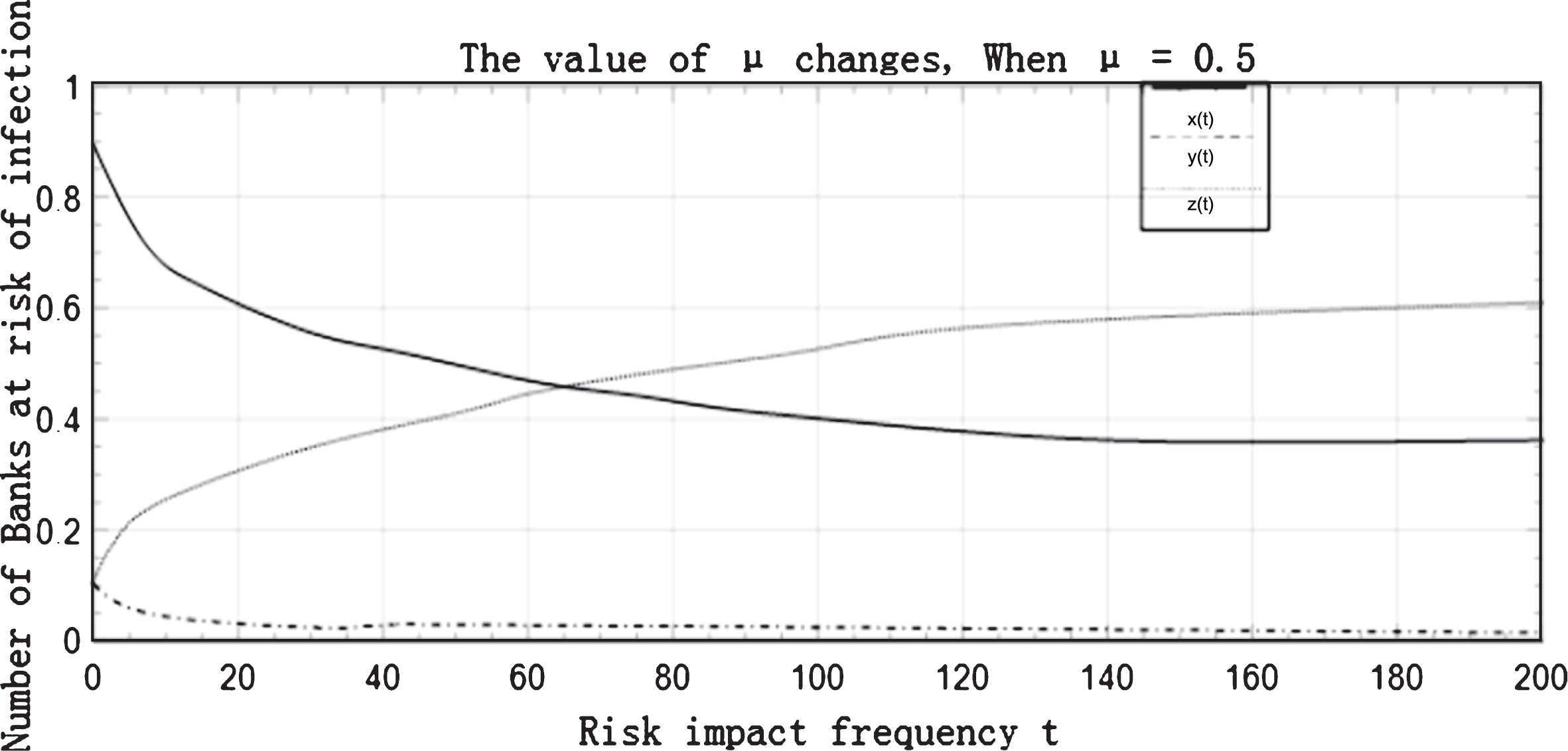
Banking systemic risk state in the case of risk immunization rate μ = 0.5.
In the event that the risk immunization rate decreases to μ = 0.3, the banking system will tend to be stable as long as the reproductive rate R1 of “risk-infected banks” is less than 1, where risk infection will disappear, and no systemic risk will occur.
If banking risk immunization rate decreases drastically to μ = 0.1 as shown in Fig. 8, the system becomes unstable for R1 > 1 and the reproductive rate of risk-infected banks is larger than 1, where the number of risk-infected banks gradually rises, and banking systemic risk will occur finally.

Banking systemic risk state in the case of risk immunization rate μ = 0.3.
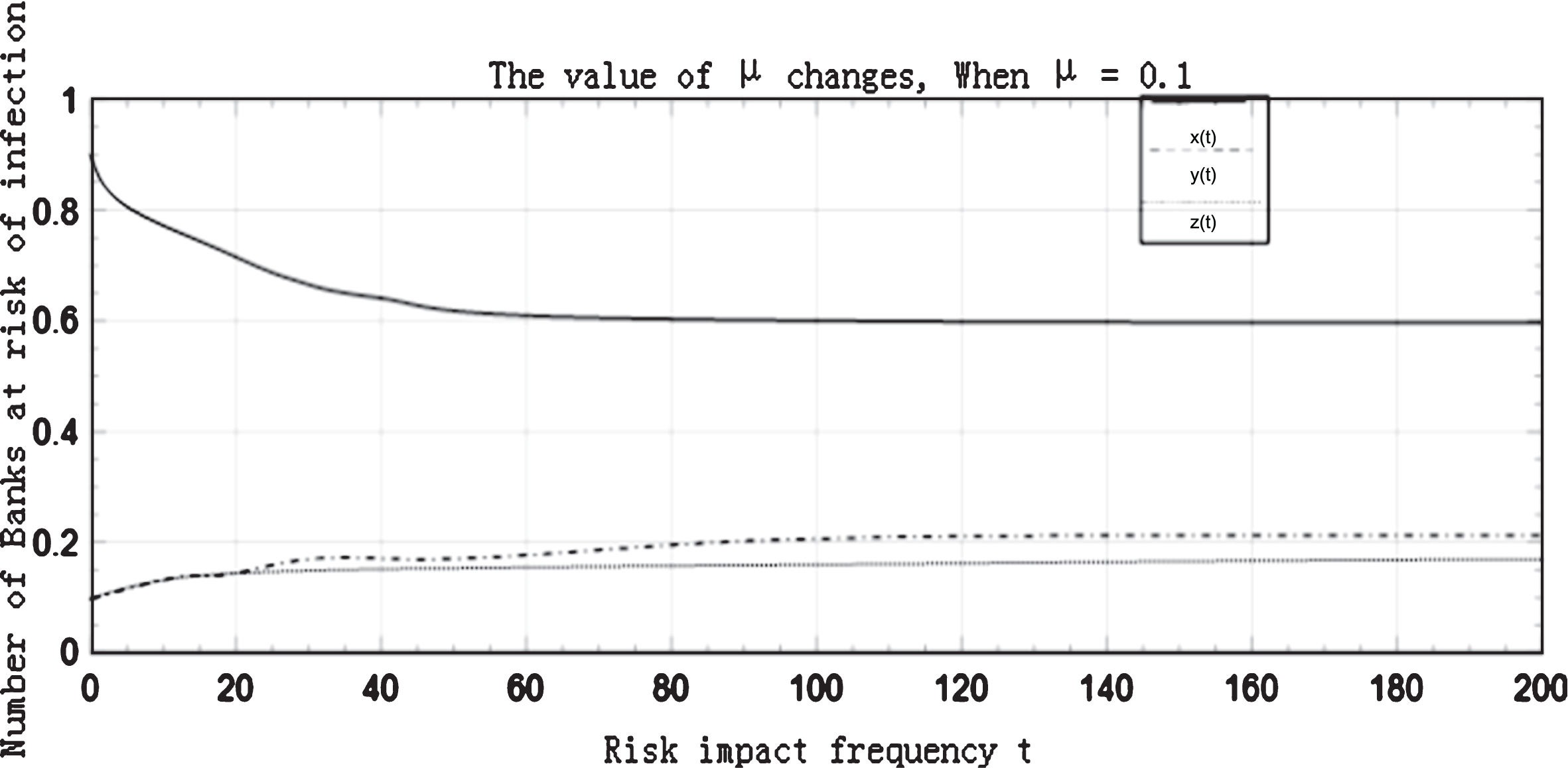
Banking systemic risk state in the case of risk immunization rate μ = 0.1.
(4) Analog simulation of banking systemic risk in the case of banking risk isolation protection rate changing
Based on the assumption that other parameters remain unchanged, for simulating the representational state of banking systemic risk in the case that only banking risk isolation protection rate d changes, the values assigned to d are 10, 5 and 1. This is to simulate the changing situation of x(t), y(t) and z(t) in the case t = 200, as below:
The analog simulation output diagram in the case of the bank isolation protection rate d1 = 10:
As shown in Fig. 9, if the government makes enough efforts to protect banking institutions in the event that the banking system stands a chance to suffer from risk so that the rescue isolation protection rate for susceptible banks d1 reaches 10, the government’s measures work well. In the figure, the imaginary line is gradually approaching the horizontal axis, indicating that the number of risk-infected banks takes on a decline trend until converges to zero, where the banking system tends to be stable.
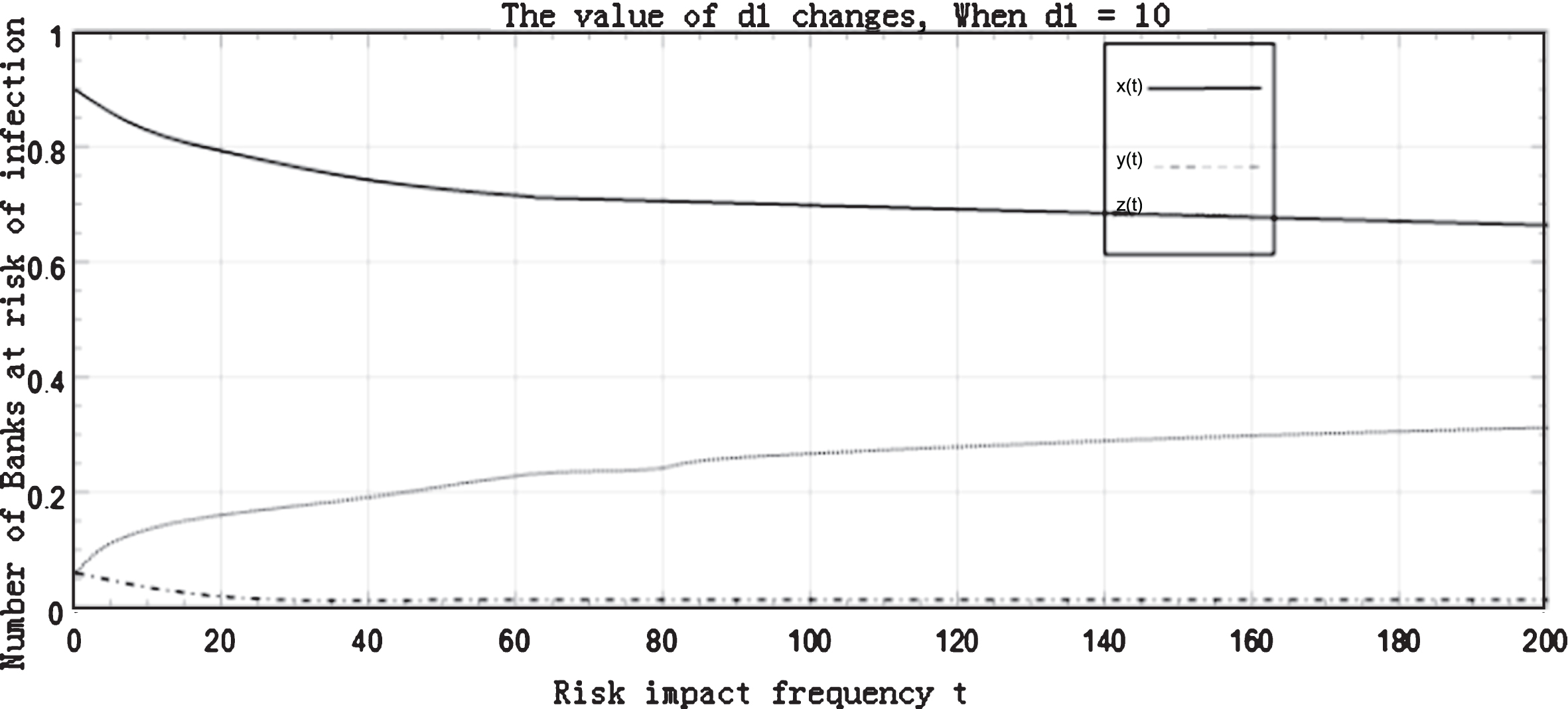
Banking systemic risk state in the case of banking isolation protection rate d1 = 10.
As the protection decreases to d1 = 5, the simulation result is as below:
As shown in Fig. 10, in the event that probable banking risk shock occurs, and the central bank or other competent bodies make less efforts for isolation rescue so that d1 = 5, banking systemic risk will be put under control finally, but the decrease rate of the number of risk-infected banks is slow (comparing with the case of d1 = 10). This is because the intervention of the government authorities is good for stabilizing the banking system and avoiding the occurrence of banking systemic risk.
Banking systemic risk state in the case of banking isolation protection rate d1 = 5.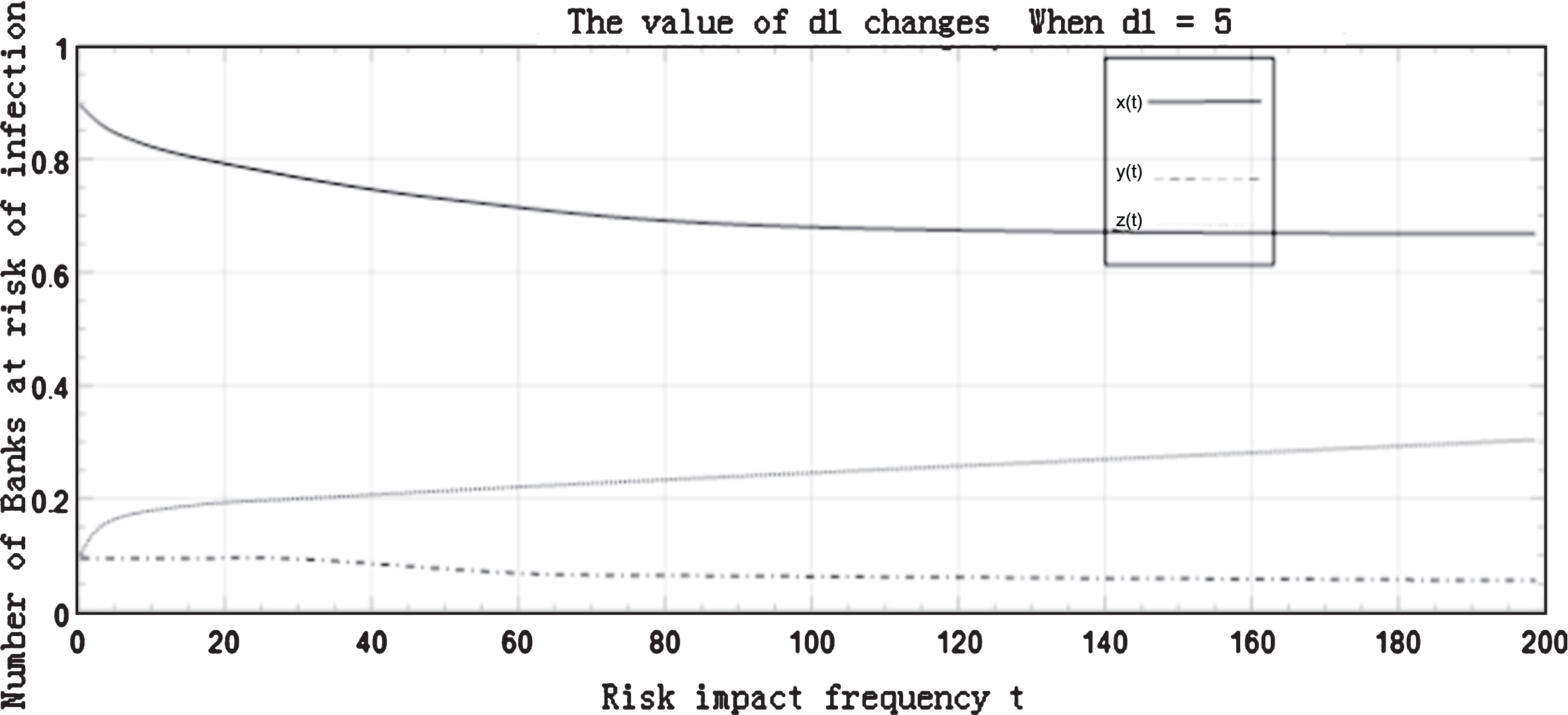
If the government authorities reduce efforts in rescue isolation to d1 = 1, the simulation result is:
As shown in Fig. 11, if the central bank or other financial institutions fail to make enough effort for isolation rescue of susceptible banks under banking risk shock, the number of risk-infected banks will keep rising, and the occurrence of banking systemic risk becomes unavoidable eventually.
Banking systemic risk state in the case of banking isolation protection rate d1 = 1.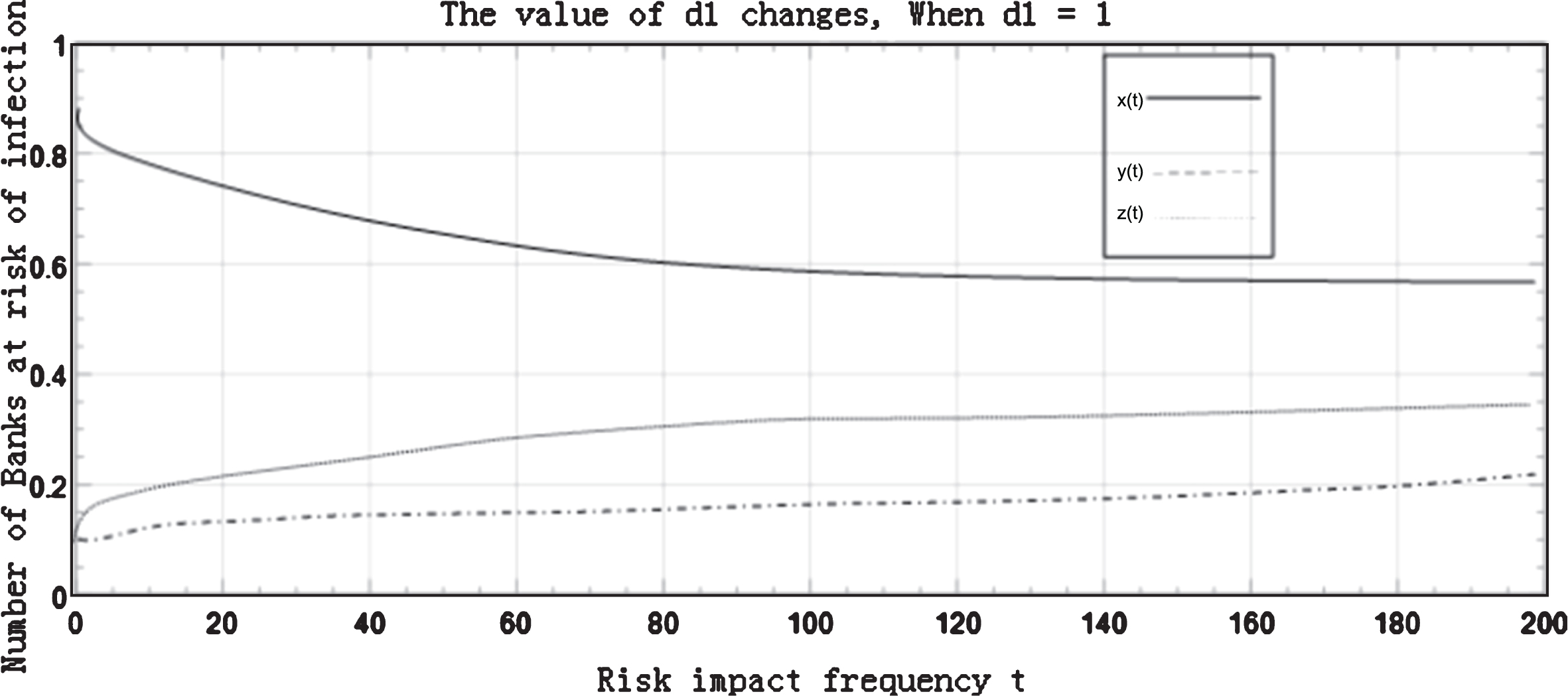
(5) Analysis of model simulation results
The below is analysis of simulation results of the representation state of banking systemic risk in the case that the banking risk infection rate β, banking risk immunization rate μ and banking risk isolation protection rate d change:
Firstly, the banking risk infection rate β has a significant impact on the formation of banking systemic risk. In the event that other factors remain unchanged while the cross-infection rate of banking risk is high, risk shock is liable to lead to banking systemic risk. Thus, an effective method of controlling banking systemic risk is to lower banking risk infection rate. As analyzed above, if the banking risk infection rate decreases from 0.5 to 0.2 (the risk infection rate decreases to a certain low level), banking systemic risk will disappear automatically.
Secondly, the banking risk immunization rate μ plays a decisive role in the process whether banking systemic risk occur or not. As shown in the simulation above, with other conditions remain unchanged, if the banking risk immunization rate is relatively high (μ = 0.5), banking systemic risk will not occur; if the banking risk immunization rate is low (μ = 0.1), banking systemic risk will occur finally as the number of risk-infected banks keeps increasing.
The last factor considered in the simulation is banking risk isolation protection rate d. Protection and isolation over all kinds of banks plays a decisive role in stabilizing the banking system. High value of d means great efforts made by the government authorities for rescue and protection of the banking system. As discussed above, if the rescue isolation protection rate is high enough (such as d = 10), the number of risk-infected banks will decrease rapidly, and banking systemic risk will disappear.
Whether banking risk will spread and develop into systemic crisis is similar to the spread of infectious diseases. The controllability of banking systemic risk contagion is mainly decided by whether the increment of risk-infected banks can be controlled, just like whether the basic reproductive rate of virus infection can be controlled. Measurements can be taken from the following aspects as discussed above to effectively control the contagion of banking systemic risk.
(1) Improve coordination mechanisms for macro and micro-prudential supervision
Prudential supervision tools permeate each other. Micro-prudential supervision should introduce a macro-prudential perspective, extract, optimize and improve risk measurement data at the level of bank transactions and customers to increase the stability of bank operations. Macro-prudential supervision means are the sublimation of micro-prudential supervision, but macro-prudential supervision means should be based on micro-prudential supervision means and start from the overall situation of the banking industry to establish a banking systemic risk early warning mechanism and improve the banking stress test system.
Prudential supervision tools complement each other. Financial supervision institution should not separate the micro prudential supervision tools from the macro prudential supervision tools, but further optimize the two types of supervision tools. In the design and optimization of micro-prudential supervision tools (capital adequacy ratio supervision, leverage ratio supervision, liquidity supervision, etc.), the introduction of macro-prudential supervision factors makes micro-prudential supervision tools gradually converge with macro-prudential supervision tools; macro-prudential supervision tools based on micro-prudential tools establish banking dynamic data information, strengthen the bank dynamic data collection, organizing standardization, so as to improve the dynamic data on the effectiveness of the macro-prudential supervision tools, further enrich and optimize the macro-prudential supervision tools, forming “micro-prudential supervision tools+macro-prudential supervision” the combination control of the banking systemic risk, maintain the stable operation of banking.
Prudential supervision mechanisms are integrated. Micro-prudential supervision adopts the bottom-up risk operation mechanism, aiming at the sound operation of a single bank. However, this operation mode cannot automatically achieve the sound operation of the entire banking industry. Macro-prudential supervision adopts the top-down risk operation mechanism, aiming at maintaining the sound operation of the banking industry and preventing the systemic risk of the banking industry. However, this operation mechanism cannot guarantee that a single bank does not have a crisis. Therefore, each operation mechanism has defects and requires the integration of the two operation mechanisms. The operation mechanism of micro-prudential supervision needs to introduce the perspective of macro-prudential supervision. The operational mechanism of macro-prudential supervision needs to be effectively supported by a sound operational mechanism of micro-prudential supervision.
(2) Reduce the probability of bank risk contagion
Set up the bank risk contagion barriers, establish the bank risk contagion firewall. Regulators should conscientiously fulfill their responsibilities of supervision over Banks, set boundaries for their business scope, optimize their network structure, and establish a modular network structure to isolate risk.
Limit the amount of inter-bank lending risk exposure and rationally allocate the proportion of inter-bank asset liability structure. In the process of operation, Banks should diversify their inter-bank trading positions, give priority to Banks with small trading scale of inter-bank assets and inter-bank liabilities as objects of inter-bank deposit and release, reduce the risk concentration of inter-bank business, and reduce the probability of risk contagion spread by the network system of Banks through the inter-bank lending market channels.
Accurately describe the network structure characteristics of different types of Banks. The systemic risk contagion of different types of banks is characterized by obvious heterogeneity. Regulators should formulate risk contagion prevention plans according to the network structure characteristics of different types of banks so as to reduce the probability of bank risk contagion and reduce the risk losses caused by bank risk contagion. For large-scale banks, thetwo-pillar supervision mechanism of “macro-prudential supervision + monetary policy” should be improved. For small-scale banks, micro-prudential supervision tools are used to strengthen the monitoring of micro-risk indicators in the operation process.
(3) Strengthen the bank’s ability to exempt itself from systemic risk
Improve banks’ own immunity. Banks risk immune mechanism in the process of operation, must be strict in discipline, in accordance with the principle of macro-prudential required by the central bank operations, maintain good liquidity, to maintain a higher capital adequacy ratio, increase their risk of immune system, which is to enhance the bank‘s own risk to resist force, so that can impact was likely in the external risk. Before the impact of external risk, banking institutions should improve their predictive power and be proactive in preparing for risk prevention. When encountering external risk, we should actively carry out self-rescue, avoid risk through multiple channels and improve risk immunity. The increased risk immunity of individual banks means that the stress of systemic risk of banks is reduced.
Increase supervision of systemically important banks. One is to identify systemically important banks as risk hubs in a timely manner, and to treat the capital adequacy ratio of risk generating banks and risk bearing banks differently. Second, regulators should limit the scale of systemically important banks to hold related assets and sell assets, and risk generating banks and risk bearing banks should hold differentiated asset structures so as to reduce the degree of correlation between banking networks. Third, the supervision authority should implement whole-process supervision in the links of “pre-restraint, in-process supervision and post-disposal”.
Restrict systemically important banking transactions and the scale of high-risk trading or derivative business in advance; improve the dimension of supervision standard, capital adequacy ratio and carpal bone supervision system; after the establishment of disposal mechanism to improve the post - disposal module.
(4) Increase effective and reasonable assistance to banks
Establish a joint rescue mechanism for creditor banks. The liquidity problem of individual banks is easy to induce a run crisis, which is usually the trigger for the outbreak of banking systemic risk. Joint rescue between creditor banks is not only conducive to reducing the probability that the debtor banks are infected by the risk of the banks, but also conducive to the creditor banks to share the risk losses. Creditor banks should reduce the financing leverage ratio, reduce the proportion of inter-bank assets in total assets, and reduce the concentration of inter-bank assets so as to reduce the probability of being infected by bank risk.
Strengthen the effective intervention of the government before or after the event. Government bailouts of banking institutions have had an immediate impact on the banking systemic risk contagion. However, the final result depends on the ratio of bank bailouts by the government. Too low a ratio of bank bailouts has no effect on the banking system at risk. Only when the government departments rescue the banks with a high enough segregation ratio can the risk in the banking system be quickly calmed and the banking systemic risk be prevented. With the timely intervention of the government, it is possible to achieve low cost and high efficiency. But when bank risk spreads to a certain extent, it may be costly to bail out a dangerous banking system. The problem is to consider the cost of the bailout. The higher the ratio of the bailout, the more conducive it will be to controlling the systemic risk of banks. However, the government has to pay a high price for this. Due to the problems of enterprise operation, the social consequences of banks may eventually be paid for by the state as a whole, which may have a bad demonstration effect.
Effectively perform lender of last resort duties. The central bank is the main body which plays the function of lender of last resort. First, the central bank should actively collect information to make objective and accurate evaluation and estimation of individual banks with operational difficulties so as to predict the degree of bank risk contagion. Second, the central bank should timely monitor the operation, liquidity and solvency of various banks and prevent the spread and contagion of bank risk from the source. Third, the central bank should analyze specific problems on a case-by-case basis and adopt targeted rescue measures according to the specific situations of different types of banks, instead of blindly injecting funds directly.
Conflict of interest statement
We declare that we have no financial and personal relationships with other people or organizations that can inappropriately influence our work, there is no professional or other personal interest of any nature or kind in any product, service and/or company that could be construed as influencing the position presented in, or the review of, the manuscript entitled.
Footnotes
Acknowledgment
This work was supported by National Social Science Foundation of China“Research on Dynamic Spillover Effect of RMB Exchange Rate Fluctuation on Stock Market under New Normal Situation” (No. 17BJY195).