






Abstract
This work conducts bibliometric research into publications during the period 1999 to early 2018. The aim of this study is to help gain a better understanding of the publications covering CSF and ERP implementations all over the world. The study includes the most cited articles, most cited authors and most influential institutions as well as the most prolific countries. A database of 301 articles from 86 different institutions and 48 countries has been documented and analyzed. The results indicate that this field is growing significantly over time and a small number of US institutions are currently the most productive in this field.
Introduction
The process of digitalization and globalization means that companies now have to make faster decisions in order to survive. Small and Medium-sized Enterprises (SMEs) have found in Enterprise Resource Planning Systems (ERP) a key tool to adapt to this dynamic scenario. ERP systems provide real-time information about the company, such as planning, production and customer response among others These systems are revolutionizing the organizations [1], and they are the main reference for decision making and to quickly adapt to market changes. However, it is not enough to implement an ERP within a company to accomplish the goals, if the company wants to survive or grow Many of the implementations have been classified as failures because they did not achieve predetermined corporate goals. There are several factors that can lead to success or failure [2], and these factors, known as Critical Success Factors (CSF), are defined as a necessary fact or element to achieve a particular goal. Therefore, CSFs are a crucial element to successfully implement ERPs, and thus it is crucial to ensure that they are identified and correctly dealt with.
Bibliometrics is defined by [3] as the discipline that studies bibliographic material quantitatively. There are many bibliometric studies in the literature mainly focused on analysis of specific Journals [22–25, 37–40] and [41] Much of this work also looks at research fields such as innovation [43], research disciplines [36] and management sciences [26]. Among them the reader can find a number of different approaches. For example [21], and [23] presented an analysis of influential countries based on number of studies cited. Several studies, such as [29] use thresholds to better identify the impact of each study, and they generally cover between over 100, 50, 20, 10, 5 and 1 citations [31]. Also relates the population of the countries and the number of citations to identify which are the most productive countries and [32] introduces de h-index, while [22, 23] and [33] introduce co-citation including document co-citation, author co-citation and institute co-citation. It is also worth highlighting that [22, 23] and [30] also use VOS Viewer software for graphical representation of the bibliometric results.
It is important to highlight that all of the above cited articles use the Web of Science as a core database to analyze bibliometric data.
Starting from their inception, ERP systems and their CSFs for successful implementation have produced a substantial number of published research papers ongoing studies [13]. The aim of this work is to synthesize the existing scientific bibliography into a bibliometric study, from a general perspective regarding leading institutions, authors, journals, countries and the most cited articles, all of which use indexes that help to provide a better understanding of the state of the art and also to highlight trends in the field of study. This study was motivated by a number of different factors. Firstly, the aim was to provide value in a field where there is not yet a large number of studies but which is in continuous growth due to business evolution and digitization. Secondly, this work aims to help researchers and authors to find the most influential actors, whether they be authors, countries or institutions, in the field that might help them to focus their research in a more effective way. Finally, it is necessary to identify which journals publish more on this type of article and their influence.
The authors believe that interest on this work will grow as the reader sees the evolution in the number of published articles within the last 18 years (Fig. 1), It is clear that interest and research in the field are growing. It is also hoped that the characterization of the CSF for ERP implementation publications provided in this article will serve as a basis for future, more extensive research, such as other articles or PhD research.
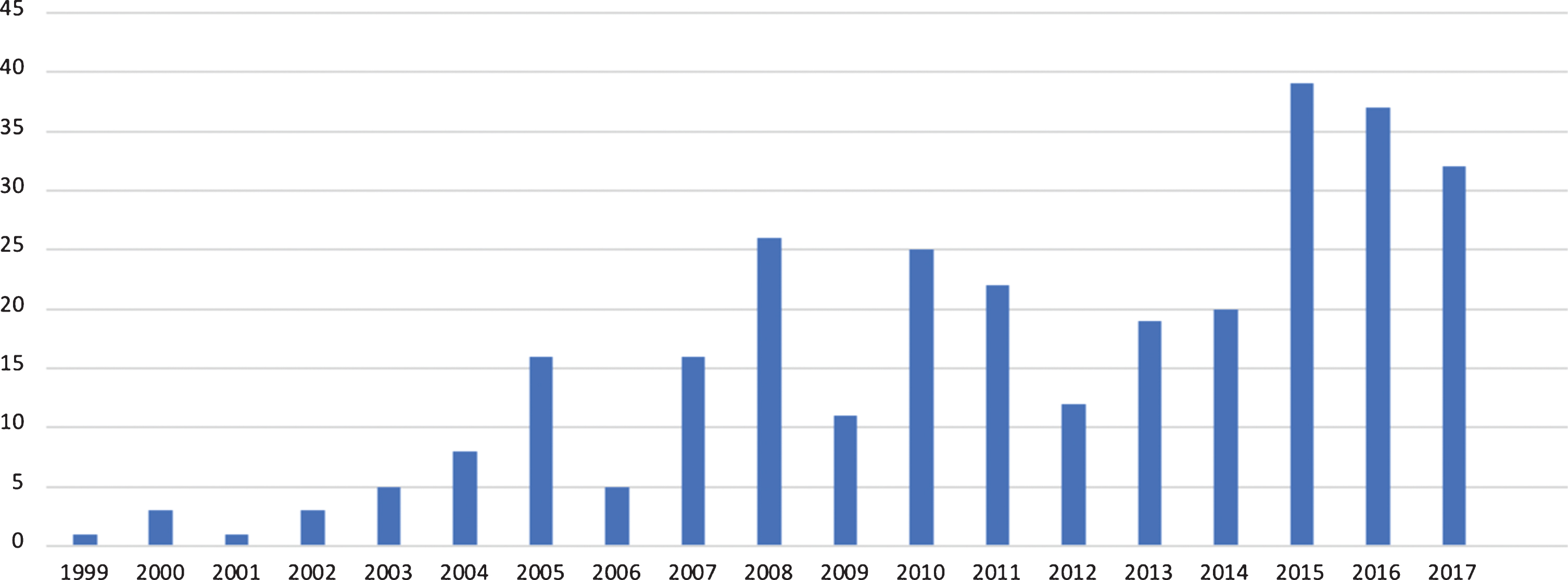
Number of studies published per year.
The main database in scientific research contributions is the Web of Science (WoS) which is the core of this work, however, WoS is a live database which is continuously growing and adding more publications, and for this reason only existing publications from between 1999 and January 2018 have been considered. This study provides an overview of the evolution of the studies published over this period, the 50 most cited papers, the most influential universities and authors, the journals publishing in this field and, finally, the most productive countries, considering both citations and publications. Prior to the results there is a section describing the methods used and following this, the conclusions are presented.
Studying and reviewing the literature on a specific topic gives an overview of research trends and its impact on the field [9, 17]. The current study considered all the publications over the years published on Web of Science (WoS), however only articles and reviews since 1999 have been found and only published studies during complete natural years have been considered. Although, there are other Academic databases, such as Google Scholar and Scopus, WoS is generally considered to be the best academic database on research contributions [20]. It contains more than 15,000 journals, over 90,000,000 records and covers up to 273 disciplines.
In bibliometric studies [19, 14] a wide variety of methods are used but the most common indicators are the number of citations and the amount of publications. In this study, those two indicators were considered together with the H-index, a new index introduced by Hirsch [4], which integrates publications and citations into one single index. Other indexes were also considered in order to define the impact of each article [18], the ratio (citations / articles), and for each institution the ratio (times cited / total studies). Moreover, as [5] stated, the number of articles above a citation threshold allows the researcher to identify influential articles, which is why different thresholds are considered in the results. Additionally, it is important to identify the quality of the institution [15] because this indicates the importance and impact of an article. For this reason, the reputed Academic Ranking of World Universities [5] and the QS World University Rankings [6] were consulted to identify the quality of the institution. Finally, a study on which journals [16] publish work on this topic was conducted to complete the picture regarding the state of the art.
When conducting the study some limitations were applied in order to narrow the results to the specific field of study. Therefore, a selection of keywords related to the topic was done. The keywords considered are: ERP, CSF, Enterprise Resource(s) Planning, Critical Success Factor(s) and Enterprise System(s). This generated 549 references not all of which were related to the main topic, consequently not all categories have been taken into account, only those within the field of study: computer science information systems, management, information science library science, operations research management science, computer science interdisciplinary applications, business, engineering industrial, computer science theory methods, engineering manufacturing, computer science artificial intelligence, engineering electrical electronic, economics, computer science software engineering, engineering multidisciplinary, business finance, computer science hardware architecture, telecommunications, social sciences interdisciplinary, computer science cybernetics, automation control systems, planning development, engineering mechanical and ergonomics reducing the amount of publications to 491 and then only the article (287 papers) and reviews (15) were taken, leaving a final total of 301 research works. The study used the material available on WoS in January 2018.
For a better result understanding, this article also includes a graphical analysis of the bibliographic material by using the VOS Viewer software [42]. This software draws maps based on the collected data from WoS based on citation and co-citation, coupling and co-authorship among others [22].
Results
In this section the most significant results of the bibliometric analysis are presented. Following the indicated keywords and related categories of study, 491 references were found including 287 articles, 17 book chapters, 199 proceedings papers, 15 reviews, 2 editorial materials and 1 book. These works have a total number of citations of 8999 with a ratio (cites / studies) of 18.33, the h-index is 44.
In order to narrow the results only the articles and reviews have been considered making a total of 301 references, since these options are the ones which can be considered as pure scientific contributions. Thus 8817 citations with a ratio (cites / studies) of 29.29 and a h-index of 44 were obtained.
Evolution of published studies
The first study found was published in 1999, and was the only one published that year. As can be seen in Fig. 1 the number of studies increased slowly up to a total of 24 in 2008 with the exception of 2006 where only 5 studies were published. After 4 years of decreasing number of publications, they increased again, until reaching their maximum during the years 2015 and 2016 with 35 publications followed by a minor decline in 2017. The gradual increase of publications it is due to two main factors, the first of which is the increase in researchers worldwide and the second and main reason is the digitalization of society. Increasingly, it is clear that companies need more up-to-date information to make decisions faster and to be able to adapt to the market changes, and it is here that ERP systems gain relevance as the scientific community gains awareness of how the world is evolving.
Analyzing the citations in Table 1. General citations per year, it can be seen that the most cited articles are not the ones published more recently. The year 2007 was the year with the most citations with 1464, other years with more than 1000 citations were 2003, 2005 and 2008. This is not related to the number of articles published which increase almost every year.
General citation per year
General citation per year
Abbreviations: ≥100 = Number of documents with equal or more than 100 citations; ≥50 = Number of documents with equal or more than 50 citations; ≥20 = Number of documents with equal or more than 20 citations; ≥10 = Number of documents with equal or more than 10 citations; ≥5 = Number of documents with equal or more than 10 citations; ≥1 = Number of documents with equal or more than 1 citations; TS = Total studies; TC = Total citations; PCT = Percentage.
It is important to know which were the most cited papers because this can define how influential they have been to others. Table 2 lists the most cited publications in descending order, it can be observed that the most cited article, Liang, Huigang; Saraf, Nilesh; Hu, Qing; et al. (2007), has 817 citations with an average of 74.27 citations per year. The second is Umble, EJ; Haft, RR; Umble, MM (2003) with 513 citations and average of 34.20 citations per year.
The 50 most cited articles
The 50 most cited articles
Abbreviations available in Table 1 except for R = Rank.
There are 20 publications with over 100 citations each, all but one of which is from the first decade of the century. Looking further to the rest of the list it can be also stated that, again, all of the publications are from the same decade but one, and it has to be mentioned that the least cited research work has a significant number with 42 citations.
Fig. 2 shows graphically, by using the VOS Viewer software, the map of citations between articles (A cites B and B cites A) with a minimum threshold of one hundred citations. This figure demonstrates in a straightforward way which are the most influential articles.
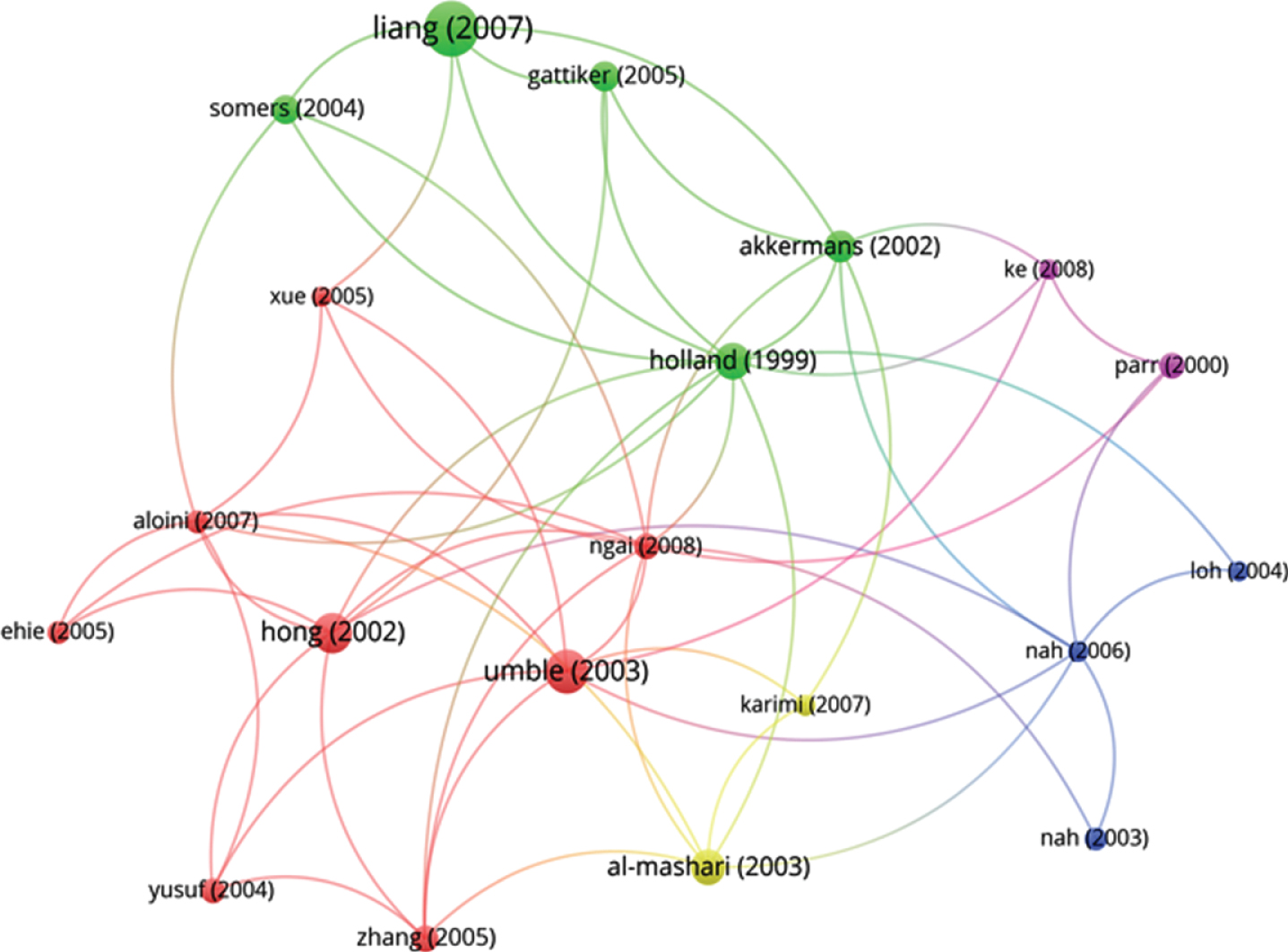
Citation between most influential articles.
Table 3 shows the 50 most productive institutions worldwide in this case the number of publications, times cited, h-index and the ratio (times cited / total studies) are considered together with the most relevant number of papers above the given thresholds 100, 50 and 20 and the current global ranking at both, Academic Ranking of World Universities (ARWU) and Quacquarelli Symonds QS World University Rankings [12]. This helps the reader to have an idea of the real influence of each university. The top influential Universities are Florida Atlantic University from United States, Wayne State University from United States, University of Manchester from United Kingdom, University of Nebraska Lincoln from United States and the City University of Hong Kong from China, all of them above 300 citations overall. Regarding production, the University of Pablo de Olavide from Spain is the first with 8 total papers and the highest h-index 6, which means they have 6 articles with at least 6 citations each. Following this are the University of Ljubljana from Slovenia with 7 studies and Ryerson University from Canada and national Central University from Taiwan with 6 papers each.
Most productive and influential institutions
Most productive and influential institutions
Abbreviations: Available in Table 1 and 2 except for: H = h-index; TC/TS = Citations per study; ARWU and QS = Ranking in the general ARWU and QS university rankings.
The universities from the United States are the most listed with 12 appearances followed by United Kingdom (which includes the works published under England, Scotland, Wales and Northern Ireland) with 7, Canada with 6, and Taiwan, Iran and China with 4 each. Even though the most listed institutions listed are from countries such as US, UK, Canada and Australia it can be stated that European and Asian Universities are increasing their work in this field. This is due to the rise of Asian universities which are committed to technology research and how to apply it to the business environment. However, most of the universities are from English speaking countries.
Looking at the ARWU, 6 institutions are in the top 100 but only 2 of them are in the top 50: University of Manchester in position 38 and University of Melbourne in position 39. There are 17 universities which are not even listed in the ranking. Regarding the QS ranking, only one, National University of Singapore, is in the top 20 and City University of Hong Kong, University of Manchester and University of Melbourne are in the top 50. Between the 50 and 100 positions there are 5 more universities. Therefore, it can be stated that only few of those considered to be the best universities worldwide are not publishing on this topic.
As with institutions, there are authors from around the world publishing about ERP and their CSFs for successful implementations. Table 4 presents the 50 most influential authors ordered by highest number of citations. As with the other sections, the h-index, the times cites, total studies and the ratio (cites / studies) appear to have been presented in order to get a better picture of their production and influence. Table 4 also includes the University/Institution where their last paper was submitted to the WoS and their country.
Most productive and influential authors
Most productive and influential authors
Abbreviations available in Table 1, 3 and 3.
As shown in Table 4, Americans are the most cited authors with 8 out of the top 10, Liang and Xue share first position as they co-authored the most cited paper with 930. The first non-American author is the Chinese Law with 214 citations followed by the Spaniard Salmeron with 196, who is the most productive author with 7 published papers. English-speaking authors from US and UK occupy 18 of the top 22 places in the list emphasizing the importance of Anglo-Saxon countries in this field of research. Also noteworthy are the Spanish authors who have 3 places in the top 20, and among the most productive with a published number of papers and the University with more top authors are Ryerson University from Canada and Universidad Pablo de Olavide from Spain with three each.
WoS presents work from all around the world and, since the topic is general and not related to any geo- graphical area, 48 countries are presented in Table 5. In this analysis the population in thousands [8] and the relationship between the total studies and citations to the inhabitants in millions to identify the productivity of each country have also been included. Furthermore, the same indexes as those used in the previous tables are used here as well. Note that the countries listed refer to the country where the author was working at the time of the publication.
Most productive and influential countries
Most productive and influential countries
Abbreviations available in Table 1, 2 and 3 except for: Pop = Population; TS/Pop = Studies per population; TC/Pop = Citations per Population.
As expected for the quality of their work, and al- ready stated by the reviewed literature [21], the importance of their institutions and its size the US is the number one in terms of works (77) and times cited (4083) with an h-index of 29. The UK follows with 34 studies and 1613 citation with an h-index of 16. In 6th position we can find Taiwan with similar amount of works with 31 but less citations (568) which translates into that there is no relation to having a large amount of publications and being influential. Before Taiwan, there are UK, Canada, China and South Korea.
Nonetheless, the most productive country per inhabitant is Canada followed by Taiwan in second and UK in third position. It is worth highlighting that 4 out of the first 7 countries are English speaking countries and they represent over 51% of all studies. Asian countries, like China, South Korea and Taiwan, compete for the lead with the English-speaking countries. It is surprising that India, with great Universities and a large population, does not appear in the leading positions and is only stays in 26th place. On the other hand, the rest of the results are fairly diverse which shows that business digitalization is a global concern with several countries from Middle East, Europe, South Africa and Namibia from Africa and Colombia from South America.
In this section an overview of the journals [11] publishing in this field is given. Table 6 shows the journals with the highest number of publications on this field. At the top of the list is Enterprise Information Systems with 15 articles published, followed by International Journal of Production Economics with 14 and Computers in Industry and Journal of Computer Information Systems with 12.
Most influential Journals
Most influential Journals
Abbreviations available in Table 1, 2 and 3.
On the other hand, the list varies when considering citations. In this case MIS Quarterly is first with 1143 citations followed by Information Management (965), European Journal of Operational Research (866), International Journal of Production Economics (864) and European Journal of Information Systems (473).
This study gives a general overview of the works published about ERP implementation and its CSFs on the WoS. The results show how the number of publications has increased over time from 1 in 1999 to more than 30 since 2015, and this has happened due to the continuous digitalization of the business world and the need for quality data in order to make faster decisions. The US leads the publications because they are home to the main universities but Asian countries follow closely. It is worth highlighting the importance of Taiwan in this field with its strong position and important number of publications and citations. In the following positions we see other English-speaking countries such as Australia, United Kingdom and Canada which leads the contributions per inhabitant. Not without cause, the most reputed institutions in this field belong to Taiwan, Spain, Canada, Slovenia and Hong Kong displacing American universities from the top. Developing countries do not appear in the leading positions but they are beginning to publish also in this field.
Regarding the journals, it is important to highlight that the most cited ones are not the most productive. The most cited article was published in MIS Quarterly which is one of the most important journals in the field. Moreover, the authors of that article, Liang and Xue, are also considered the most influential and their university, Florida Atlantic University, is also the first in institutions. Therefore, their article is considered the most important article with strongest impact on other research.
Observing the number of published studies and the citations generated, an objective view of the evolution that the research on this field has had during the last 18 years begins to emerge. It is worth noting that the work provides a general overview using a wide range of indicators including amount of publications, citations, h-index and several citation thresholds. This is due to the lack of an optimal standardized way of analyzing bibliometric results and, therefore, different research groups may be interested in different indicators considering different perspectives.
This article is intended to be the starting point for future research in the field of successful ERP implementations by delineating information sources.