







Abstract
In many cases, complex problems cannot be accurately described by precise numerical values. Fuzzy theory provides a suitable tool for solving these problems. However, if decision makers cannot reach an agreement on the method for defining linguistic variables based on fuzzy sets, TIVFNs (triangular interval-valued fuzzy numbers) can provide more accurate modeling. Therefore, solving fuzzy MCGDM (multiple criteria group decision-making) problem with an unknown expert weight and criterion weight in TIVFNs has become an important research direction. In this paper, TIVF-VIKOR (triangular interval-valued fuzzy VIKOR) method, which is suitable for the environment of TIVFNs, is proposed to solve the problem of fuzzy MCGDM. To achieve this goal, the TIVF-VIKOR method is innovatively adopted similarity and coefficient of variation are combined to calculate expert weight, and deviation maximization method based on divergence matrix is used to calculate criterion weight. VIKOR method is used to find the compromise solutions, which are converted into the form of binary connection number, and the optimal compromise solution is obtained after ranking. The proposed method is applied to the problem of machine fault detection, and the validity and feasibility of the method are illustrated. Compared with the TOPSIS∖ELECTRE method, the ranking results of the three methods are equivalent, and the fluctuation of the TIVF-VIKOR method is more distinct.
Keywords
Introduction
Multiple criteria group decision-making (MCGDM) problem is to invite decision makers (DMs) to evaluate alternative plans according to numerous criterions. MCGDM with imprecision, subjectivity or vagueness, among which evaluation ratings and criteria weights are displayed by linguistic terms and transferred into fuzzy numbers, belongs to fuzzy MCGDM [1–4]. The combination of fuzzy MCGDM and multi-field research has gradually penetrated into people’s lives. With the development of society, decision-making problems have become increasingly complex, and people’s decision-making ability has been enhanced but remain limited [5]. Therefore, how to make MCGDM in fuzzy number environment is becoming more and more concerned for researchers.
Due to the uncertainty of information and other factors, it is difficult for DMs to describe the complex reality with accurate values. Then Zadeh [6] first proposed the concept of fuzzy set (FS) in 1965 to express qualitative decision information. In 1986, Atanassov [7, 8] defined the intuitionistic fuzzy set (IFS) and mentioned membership degree and non-membership degree. Pythagorean fuzzy set (PFS) is an extended form of IFS, which was proposed by Yager [9] in 2013. It is defined that the sum of squares of membership degree and non-membership degree is less than or equal to 1. IFS and PFS have been frequently used to handle imprecise data and vague expression in practical MCGDM, however, it is difficult for them to describe complex information with uncertainty [10, 11]. And triangular interval-valued fuzzy numbers (TIVFNs) can express this kind of information very well. The upper and lower bounds of triangular fuzzy numbers (TFNs) combined with interval-valued numbers (IVNs) will consider more parameter information and express decision information more accurately. Subsequently, many researchers proposed to use TIVFNs to represent linguistic variables. Ren [12] adapt TIVFNs to solve the multi-criteria problem of groundwater resources management decision; Li [13] used TIVFNs to solve the problem of multi-objective planning and carried out feasibility analysis through examples; By using intuitionistic triangular fuzzy sets (TFS) and interval intuitionistic triangular plus fuzzy mixed aggregation operators, Robinson [14] sorted the alternatives and studies the multi-attribute decision making problem; Stanujkic [15] proposed an extended MULTIMOORA method suitable for TIVFNs to solve the design and selection decision of crushing circuit, then Stanujkic [16] extended the MOORA method by proposing the weighted average operator of de-fuzzing TIVFNs; Garg [17] proposed some operators based on TIVFNs, such as intuitionistic fuzzy ordered weighted average and intuitionistic fuzzy mixed average operators based on Frank norm algorithm, to solve fuzzy multi-criterion decision problems. TIVFNs is an effective tool to describe vague information. Researchers are increasingly concerned about the combination of TIVFNs and fuzzy multi-criteria decision making methods.
There are many specific methods for MCGDM. ELECTRE (Elimination and Choice Translating Reality), TOPSIS (Technique for Order Preference by Similarity to an Ideal Solution), VIKOR (Visekriterijumska Optimizacija I Kom-promisno Resenje) and so on are effective tools to solve such problems [18–20]. Benayoun [21] proposed ELECTRE method for the first time, but due to ambiguity and subjectivity, this method is not reasonable in the final ranking. Aiming at properly dealing with the uncertainty of the decision process, an interval extension of both ELECTRE TRI and TOPSIS is proposed by Micale [22]. For MCGDM problem, Ashtiani [23] transformed the linguistic variable into the form of TIVFNs and proposed the relevant TOPSIS method, but changed the TIVFNs into the form of IVNs in the process of calculation. The VIKOR method has more advantages than the other methods in selecting the compromise solution. The VIKOR method is characterized by a trade-off between the maximum group utility of the majority (aggregation of all criterions) and the minimum individual regret of the opponent (each criterion) [24–26]. The VIKOR method [27] was developed for multi-criteria optimization of complex systems (Opricovic, 1998). Wang [28] combined the original VIKOR model with a triangular fuzzy neutrosophic set to propose the triangular fuzzy neutrosophic VIKOR method, the calculation procedure of the method is given. Wu [29] proposed extend VIKOR method based on IVNs to solve the problem of green supplier selection. Based on the optimal weight vector of fuzzy measure represented by Shapley value, Rani [30] discussed VIKOR technology of relevant multi-criterion decision making problem in interval intuitionistic fuzzy environment. Wan [31] solved the MCGDM problem by combining the triangular fuzzy weighted average operator with VIKOR method. At present, there are few studies on the combination of TIVFNs and VIKOR method, and the existing VIKOR method cannot solve the problem in TIVFNs.
Previous studies have made significant progress, but some problems and challenges exist [32–37]. Firstly, the numerical representation of uncertain linguistic variable information. In literature [23], although the linguistic variables are converted to TIVFNs, it is simplified to be calculated in the form of IVNs. Secondly, the determination of weight information when expert weight and criterion weight are unknown. When the MCGDM problem is solved in literature [12], its criterion weight is given by experts directly based on experience. Thirdly, the improvement of the VIKOR method in different numerical cases. Literature [31] considers the case where the values are TFNs, but does not discuss the VIKOR method in the condition of TIVFNs. In view of the above situation, this paper proposes a VIKOR method in the context of TIVFNs to make fuzzy multi-criterion decision. Expert weights are obtained by the variation coefficient method based on similarity, and the criterion weights are calculated by combining a divergence matrix and maximum deviation method. VIKOR method is used to find the compromise solutions, which are converted into the form of binary connection number, and the descending order is performed to obtain the optimal compromise solution.
The remainder of this paper is organized as follows: Section 2 briefly reviews the basic concepts of this paper. Section 3 proposes a VIKOR method that is based on TIVFNs and details its steps. Section 4 gives an example and demonstrates the feasibility and effectiveness of the method. Section 5 presents the conclusions of this paper and future research directions.
Preliminaries
In this section, some basic concepts will be presented.
Triangular interval-valued fuzzy numbers (TIVFNs)
The interval-valued fuzzy set A [23] defined on (- ∞ , ∞) is expressed as:
Figure. 1 x′ of the interval-valued fuzzy set A. Therefore, the minimum membership value of x′ and maximum membership value of x′ are
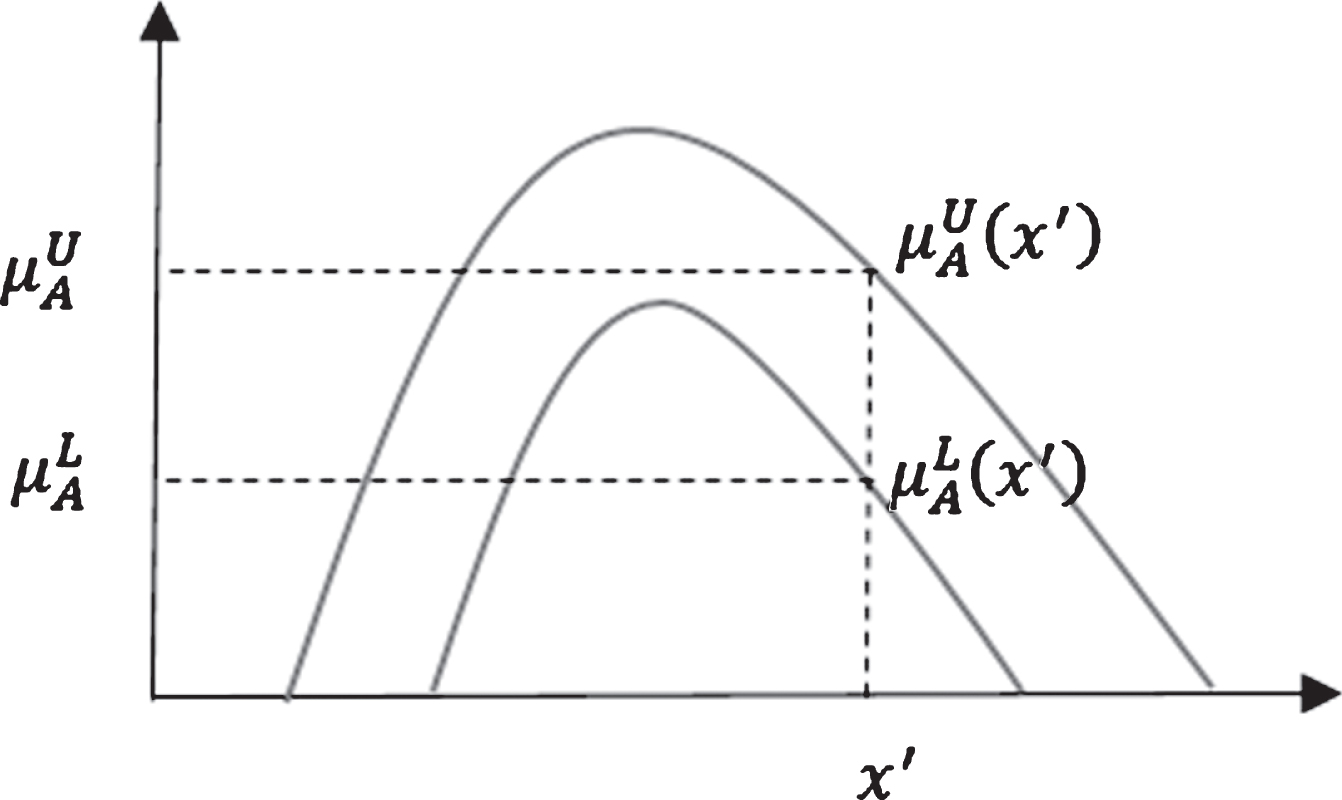
An interval-valued fuzzy set.
A triangular interval-valued fuzzy number [38] can be presented as
As shown in Fig. 2 is expressed in TIVFNs.
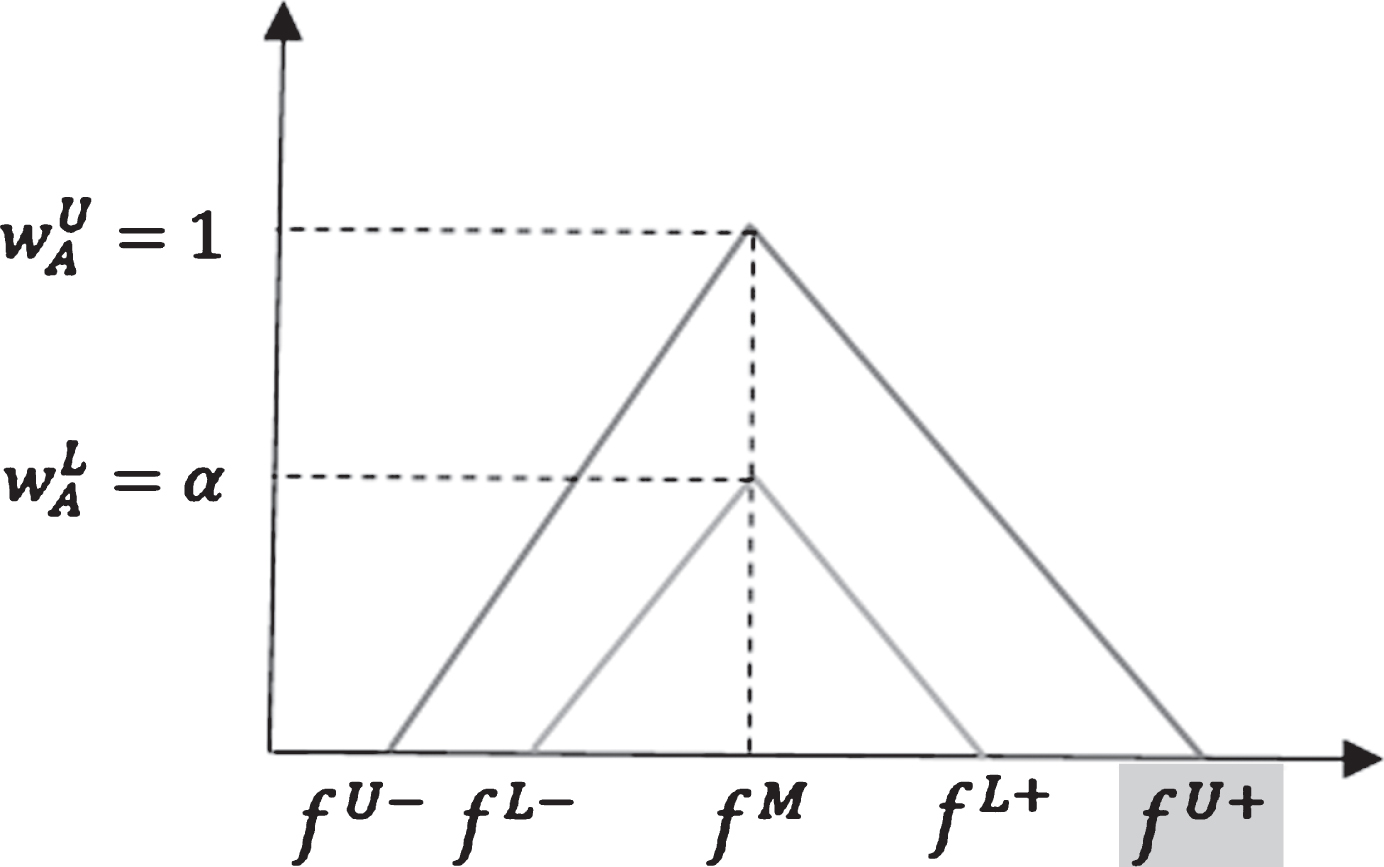
A triangular interval-valued fuzzy number.
The related relations in an interval-valued fuzzy number are shown in the lemmas as follows.
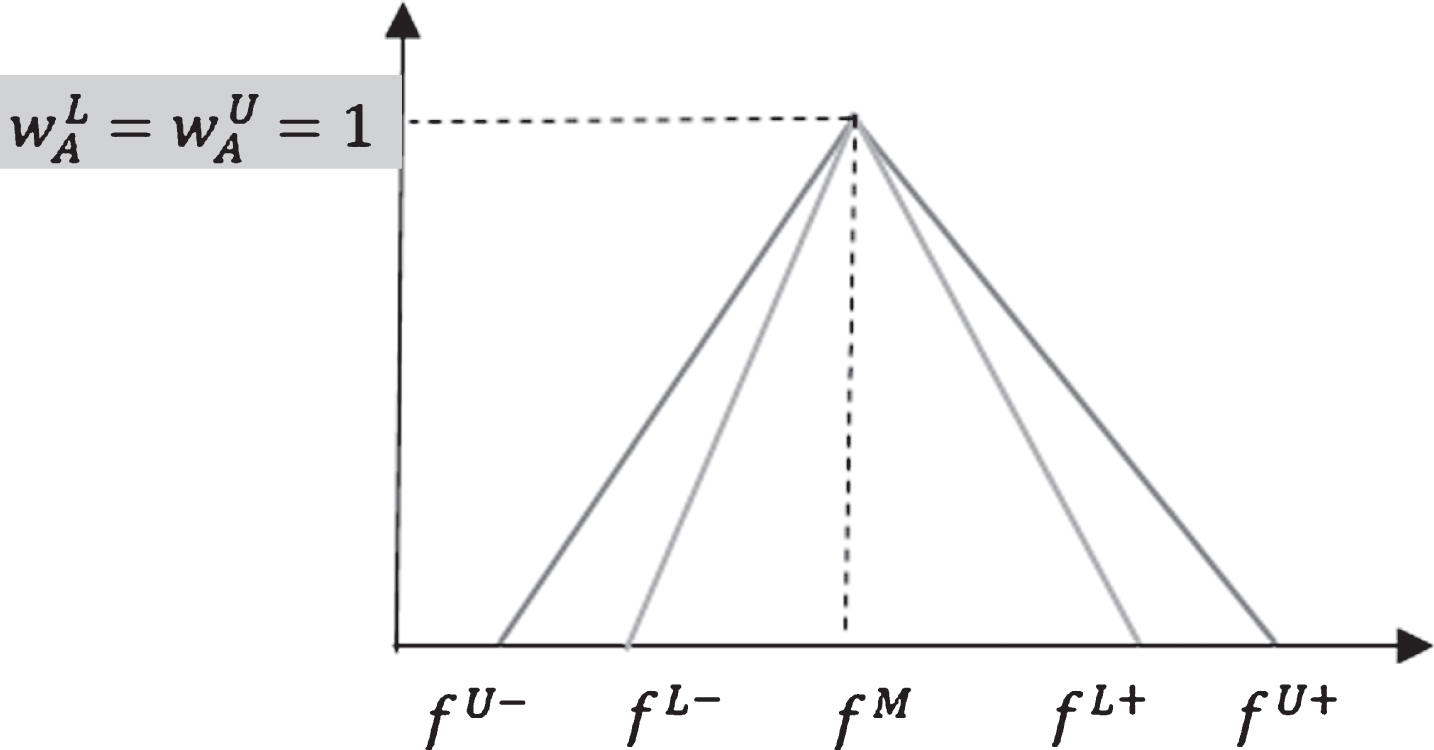
A general triangular interval-valued fuzzy number.
The VIKOR method has been developed as an MCGDM method to solve a discrete multicriteria problem with noncommensurable and conflicting criteria [39]. The method focuses on ranking and selecting from a set of alternatives, and determines compromise solution for a problem with conflicting criteria, which can help decision makers obtain a final decision [40].
For example, considering IVNs, let A ={ A1, A2, … A
n
} be the set of the alternative plan, let C ={ C1, C2, … C
m
} be the criteria of n alternatives, let
Where
Rank the alternatives by sorting in descending order by the value of Q i , then obtain the optimal compromise solution [41–43].
The obtained compromise solution can be accepted by the all decision makers because it provides a maximum group utility of the “majority” (represented by min S, Eq. (4)), and a minimum individual regret of the “opponent” (represented by min R, Eq. (5)). The VIKOR method is an effective tool in MCGDM.
The similarity measure [44] is a common method for evaluating the fuzzy comprehensive evaluation principle. Assuming a total of m rows, calculate the similarity of the jth index, where x i and y i are the two points of the jth row, and all values of row m are pare to calculate the similarity, the average similarity of the jth term is:
Additionally,
Consider the interval-valued number B = [b-, b+] as an example. Define the divergence matrix [45] value K = (k ij ) m*n as follows:
Assume two interval value points: A = [a-, a+] and B = [b-, b+]. For Eq. (8) to be qualified as a valid divergence measure for an interval-valued number, it must satisfy the axiom K (A, B) = K (B, A).
An association number is a structural function given by set pair analysis. The commonly used associative number includes binary associative number, ternary associative number and quaternion contact number [46, 47]. Association numbers with more than 3 elements are referred to as multivariate association numbers [48–50]. This paper primarily applies binary association number, whose general form is u = a + bi, (a > 0, b ∈ R, i ∈ [- 1, 1]), where the value of i is uncertain. Binary association number operation rules:
Let u1 = a1 + b1i and u2 = a2 + b2i be two binary connection numbers: u1 + u2 = (a1 + a2) + (b1 + b2) · i, i ∈ [- 1, 1] u1 · u2 = a1 · a2 + (a1 · b2 + a2 · b1 + b1 · b2) · i, i ∈ [- 1, 1] λ · u1 = λ · a1 + (λ · b1) · i, i ∈ [- 1, 1]
Transformation of common type attribute values to binary association numbers:
(1) Transformation between IVNs and binary connection number [51]
Let IVNs X = [x-, x+], and let
Equation (9) is the formula of the transformation from an IVNs to a binary connection number.
(2) Transformation of TFNs and binary relation number [52]
Let the TFNs Y = [y
L
, y
M
, y
U
], and let
Equation (10) is the formula of the transformation from TFNs to a binary connection number.
(3) Transformation between TIVFNs and a binary relation number
Let the t TIVFNs Z = [(zL-, zL+) ; z M ; (zU-, zU+)] and let
Equation (11) is the formula of the transformation from TIVFNs to a binary connection number.
In this section, we propose the Triangular Interval-Valued Fuzzy VIKOR (TIVF-VIKOR) Method to solve MCGDM problems.
The total framework of the TIVF-VIKOR method is shown in Fig. 4. The specific steps of the TIVF-VIKOR method are described in this section.
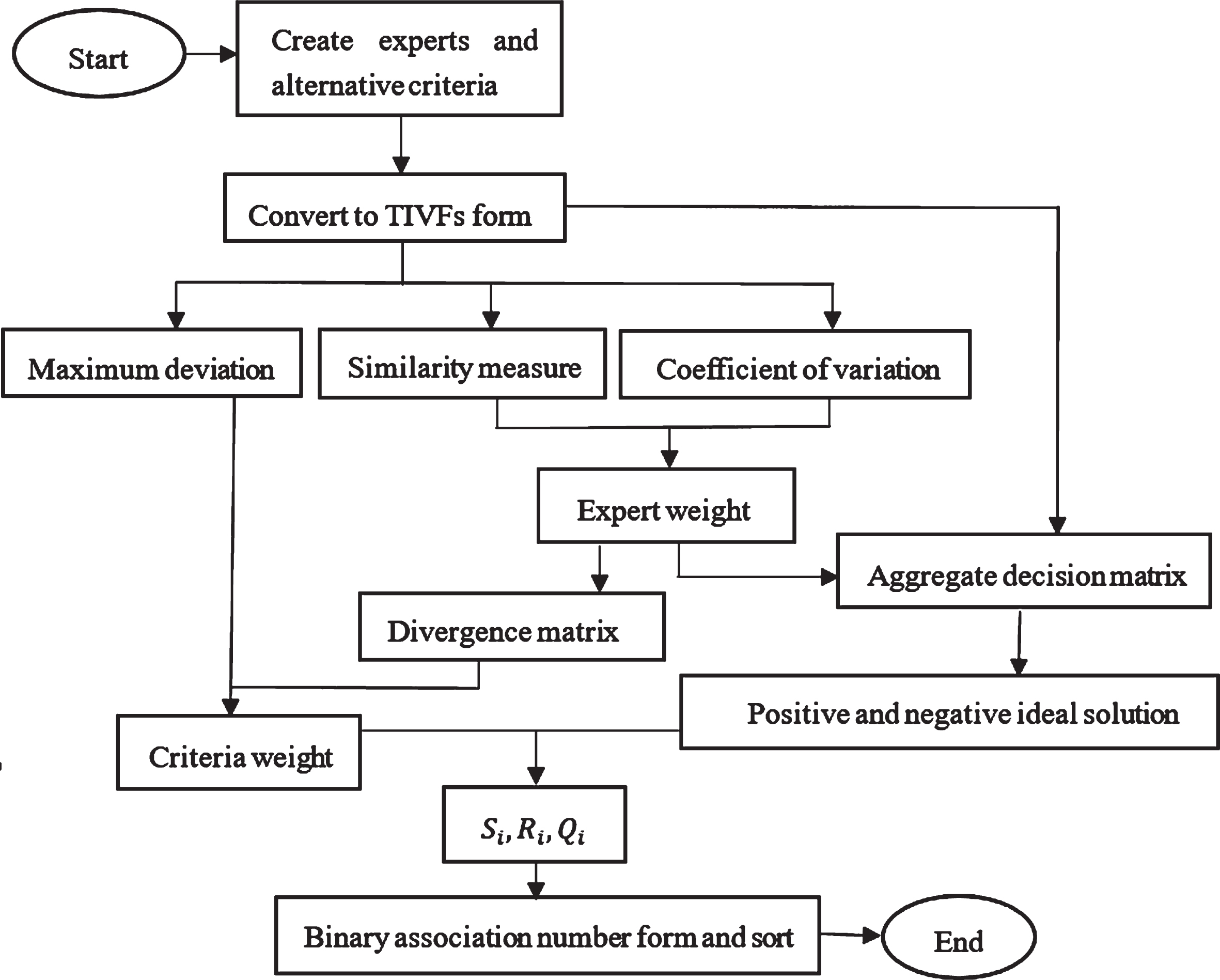
Framework of TIVF-VIKOR method.
In the decision-making problem, assume that an expert committee that is composed of t individuals E ={ E1, E2, E3, …, E t }. We need choose the most appropriate alternative from n alternatives A ={ A1, A2, A3, … A n } under the influence of m criterions C ={ C1, C2, C3, …, C m }.
In fuzzy MCGDM problems, the performance evaluation value and criterion weight are usually expressed by fuzzy numbers [37–40]. A fuzzy number is a convex fuzzy set that defines real numbers from a given interval, where each number has a member value between 0 and 1. This paper takes the standard value and the standard weight value as the linguistic variable. The concept of linguistic variables are very useful when addressing situations that are too complex or ill-defined to be properly described in traditional quantitative expressions [41–43]. These linguistic variables can be converted into TIVFNs as shown in Table 1 and Table 2.
Definitions of linguistic variables for the ratings
Definitions of linguistic variables for the ratings
Definitions of linguistic variables for the importance of each criterion
Due to the uncertainty of information, the lack of experience and the inaccuracy of human knowledge, decision experts cannot accurately estimate alternatives without considering various criterions [44]. Due to the ability of TIVFNs to address uncertainty, decision experts use TIVFNs to express their views. The detailed form of TIVFNs is f = [(fL-, fL+) ; f
M
; (fU-, fU+)]. This paper innovatively adopts the method of combining the similarity and coefficient of variation to obtain the weight of decision experts. The specific steps are detailed as follows: Convert the linguistic variables into the corresponding TIVFNs according to Table 1. The mean area method is used to calculate the mean value Calculate the average similarity of the jth index according to Equation (7). Calculate the similarity variance of the jth index. The formula of similarity variance is expressed as follows:
Additionally, Calculate the variation coefficient of the jth index. The calculation formula of the variation coefficient M
j
is expressed as:
Preform normalization to obtain the expert weight:
Considering the influence of different experts, the weight of decision experts and the importance of each criterion, we construct a weighted normalized fuzzy decision matrix [45–47].
The TIVFNs are f = [(fL-, fL+) ; f
M
; (fU-, fU+)]. Using the formula, the weighted normalized fuzzy decision matrix W
ij
can be expressed as follows:
According to the weighted divergence matrix, the maximum deviation method is used to determine the weight of the criteria. First, the values of the linguistic variables are converted to TIVFNs, and the weight of different criteria is obtained using the divergence measure calculation formula and combining with the deviation maximization. The specific steps are detailed as follows: Convert the linguistic variable into the corresponding TIVFNs according to Table 2. The TIVFNs are transformed into IVNs, and the weighted interval criterion matrix is obtained.
Convert TIVFNs (f = [(fL-, fL+) ; f
M
; (fU-, fU+)]) to an interval-valued number (b = (b-, b+)):
Use Equation (8) to convert the weighted interval criterion matrix to a divergence matrix. The maximum deviation method is employed to obtain the weight of a criterion.
For criteria C
j
,
The following deviation maximization model is constructed:
Construct Lagrange subfunction:
Solve the model to obtain:
After normalization, we obtain:
The positive ideal solution and negative ideal solution are expressed as:
The calculation formula of the maximum group utility S i is expressed as follows:
The calculation formula of the minimum individual regret R i is expressed as follows:
The calculation formula of the compromise measure Q i is expressed as follows:
Application
An illustrative example
In this section, we use an example to demonstrate the application of the VIKOR method in TIVFNs. This section provides an illustrative example of how to sort the sources of the machine fault in the industrial process, which is adapted from reference [21] to verify the feasibility of this method. Machines may break down in parts A1, A2, A3 and A4. The criterions and indicators to be considered are C1(the fault influence degree), C2(the search cost), C3(the human action ability), C4(the fault occurrence frequency) and C5(the fault repair time). The three experts (DM1∖DM2∖DM3) assess the importance of the criterions and the importance of alternatives based on each criteria. The goal is to determine the search order of the fault parts of the machine, find the first fault parts to be searched, and reduce the loss caused by the machine fault. Assuming that the weight of the experts and criterions are unknown, the data are expressed in the form of TIVFNs converted by linguistic variables. Each DM has proposed separate evaluation linguistic variables, which are used to evaluate the performance and importance according to the linguistic variables shown in Table 3 and Table 4, respectively.
Importance of criterion
Importance of criterion
Decision makers’ assessments based on each criterion
Weight of experts
Weight of criterion
Positive ideal solution and negative ideal solution of alternatives
Maximum group utility S i and minimum individual regret R i
Compromise measure Q i
Q i of binary association number form
The value range of i is [- 1, 1]. i = -0.2, i = 0.5 and i = 1 are randomly selected, the result of sorting is the same as that of A3 > A1 > A2 > A4. Therefore, A3 is the best compromise option for the alternatives, it is the fault source that should be first diagnosed.
As different DMs may have different decision-making attitudes, the selection of parameter values may also be different. In order to consider the influence of different parameter values on the decision results, sensitivity analysis will be carried out by setting different parameter i. According to the definition of binary connection number, parameter i can choose a number in [- 1, 1]. Different values of i correspond to different values of Q i , as shown in Table 11 and Fig. 5.
Different values of i correspond to different values of Q
i
Different values of i correspond to different values of Q i
As shown in Table 11 and Fig. 5, 11 numbers within the value range are selected and found: with the value of parameter i that affects the ranking order, the total ranking results are stable; and the optimal plan A3 remains unchanged. In summary, the TIVF-VIKOR method proposed in this paper is relatively insensitive to the parameter i.
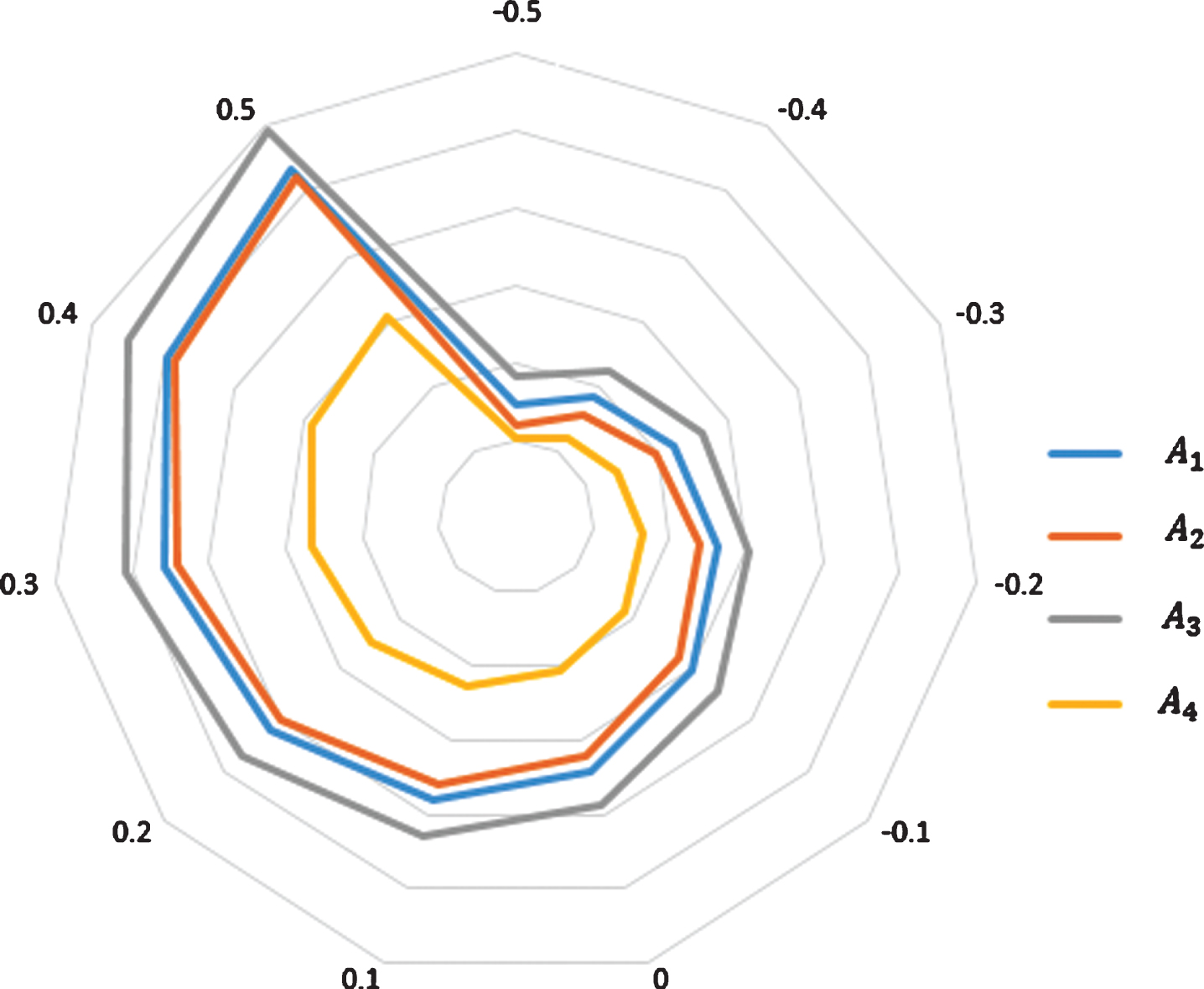
Different values of i correspond to different values of Q i .
Through sensitivity analysis, it can also be concluded that the ranking result of the proposed method is relatively stable when the parameter i changes. The method has excellent stability and is less affected by parameter change. In other words, the TIVF-VIKOR method proposed in this paper has strong robustness.
To verify the effectiveness of the proposed method, we compare this method with the literature [22] (ELECTRE method) and [24] (TOPSIS method) and obtain the same ranking result: A3 > A1 > A2 > A4. The decision method proposed in this paper is effective.
As shown in Fig. 6, the TIVF-VIKOR method substantially fluctuates when the ranking results of others method are equivalent. The method that we proposed by summarizing existing research results and effectively addressing TIVFNs information in decision-making problems, where the expert weight and criterion weight are unknown.
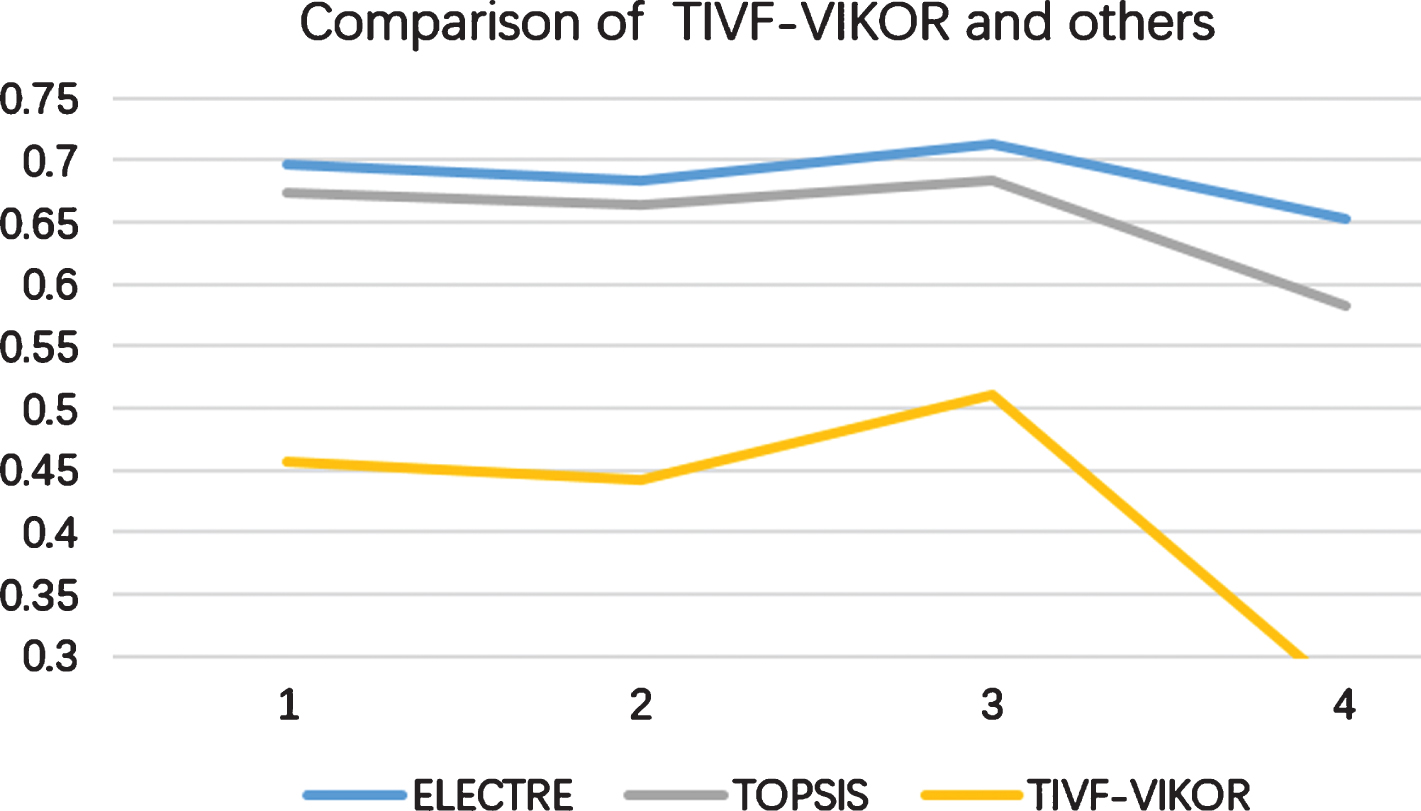
Comparison of TIVF-VIKOR and others method.
In some cases, it is difficult to convert many linguistic variables to precise values. TIVFNs are a suitable tool for solving this problem. The VIKOR method is an effective method that considers all criterions and yield the optimal compromise solution. In this paper, we primarily introduce the basic concepts of the TIVFNs, VIKOR method, similarity, divergence and binary connection number, and propose the VIKOR method in the environment of TIVFNs. The TIVF-VIKOR method is innovatively adopted similarity and coefficient of variation are combined to calculate expert weight, and deviation maximization method based on divergence matrix is used to calculate criterion weight. VIKOR method is used to find the compromise solutions, which are converted into the form of binary connection number, and the optimal compromise solution is obtained after ranking. An example of machine failure diagnosis is provided to verify the method. The validity and feasibility of the proposed method are shown by a sensitivity analysis and TOPSIS∖ELECTRE method comparative analysis. In the future research, the method can be extended to supplier selection, power equipment location and other research fields.
Footnotes
Acknowledgments
This project was supported by Key R & D project of Shandong Province, China (2019GGX101026).