






Abstract
Most of numerical methods for diffusion equations, refer to vertex unknowns directly or indirectly, and their accuracy is ultimately determined by the approximation to vertex unknowns. Based on the “twin-fitting” method, a simple and high accurate treatment for the vertex unknowns is developed and is applied to the nine-point scheme for diffusion problem. Numerical experiments show that the resulting nine-point scheme is high accurate for diffusion problems with discontinuous diffusion coefficients on distorted meshes.
Keywords
Introduction
Radiation hydrodynamics has been widely applied to energy, national defence and evolvement of celestial bodies, etc. When radiation hydrodynamics is simulated numerically, diffusion calculation usually couples with hydrodynamic calculation and naturally inherits large deformation meshes from the fluid flow simulation. The discontinuous diffusion coefficients are widely distributed over the computational domain, thus discretization of diffusion equations with discontinuous diffusion coefficients on distorted meshes becomes the main task of diffusion calculation.
If time discretization is not considered, the accuracy of discretizing diffusion equation is completely determined by that of numerical fluxes on cell edges. Many works are focused on constructing numerical fluxes and develop various methods. Based on the variational principle, there are related methods such as Kershaw scheme [1], Morel scheme [6] and Support-operator methods [8]. According to interpolation technique, related schemes include the difference scheme on polygonal meshes [5], linearity preserving schemes [7], 21-point scheme [11], Hermeline schemes [3], multi-point flux approximation methods [4] and the “twin-fitting” algorithms [9–10], etc. There are some algorithms [5, 13] relating to preserve the local maximum principle or solution positivity. These methods have made progress in improving their accuracy on distorted meshes, but most lose simplicity and some even increase the computational cost. For the discontinuous diffusion coefficients, most methods bring the low-order accuracy in the interface, but the “twin-fitting” algorithms [9–10] provide the global high-order accuracy.
The approximation to the normal component of fluxes on cell edges relates to the normal direction and the gradient of temperature, only the two cell-centered unknowns defined on the cells sharing an edge in general cannot give high accurate approximation on distorted meshes, and the vertex unknowns must be introduced in the construction of schemes such as scheme [2]. These schemes employ a linear combination of the neighboring cell-centered unknowns to calculate the vertex unknowns, and their accuracy is ultimately determined by the approximation for the vertex unknowns, which has been confirmed by many numerical results and will be further validated in this paper.
There are many works dedicated to improving the accuracy of approximation for the vertex unknowns. The simplest way is to use the arithmetic average weights [2], and another simple way is to make the weights direct proportion to the diffusion coefficients and inverse proportion to the distance between the vertex and its neighboring cell centers. The two methods are often used in practical computation due to their simplicity and fairly good accuracy on smooth meshes, but they lead to poor accuracy on distorted meshes. Recently, there are two kinds of treatments with fairly good accuracy, Taylor method [12] and linearity preserving methods [7]. The method [12] uses Taylor expansion and the requirement of second-order approximation to the vertex unknowns to calculate the weights. The methods [7] apply the linearity preserving criterion to obtain the weights. Numerical results show that the schemes using the methods [7, 12] can attain good accuracy on distorted meshes, but the accuracy lessens rapidly when the mesh is gradually distorted. Based on the “twin-fitting” method, a treatment for the vertex unknowns [10] is established, adopts different linear functions to approximate the temperature on sub-cells sharing a vertex, and shows the same numerical effect as the methods [7, 12].
A new treatment for the vertex unknowns is developed in this paper by preserving the continuity of temperature validly and by using the “twin-fitting” method. The difference between the new treatment and the treatment [10] lies in the choice of sub-cells sharing a vertex such that the new treatment is simple and high accurate.
The rest of the paper is organized as follows. In section 2, the scheme [2] is rederived by the “twin-fitting” method. In section 3, a new treatment for the vertex unknowns on general quadrilateral meshes is given. Numerical experiments in section 4 will demonstrate that the resulting nine-point scheme with the new treatment is simpler and higher accurate than the one with the methods [2, 10], and some conclusions are given in the last section.
The finite volume scheme
Consider the diffusion problem as follows,
where K ⩾ k0 = const > 0, R, u0, α, β, ψ are given functions, Ω a bounded polygonal domain with its boundary denoted by ∂Ω and
Assume Ω is partitioned into a number of nonoverlapping polygonal cells, i.e. the intersection of any two intersected cells is either a common edge or a common vertex. Let
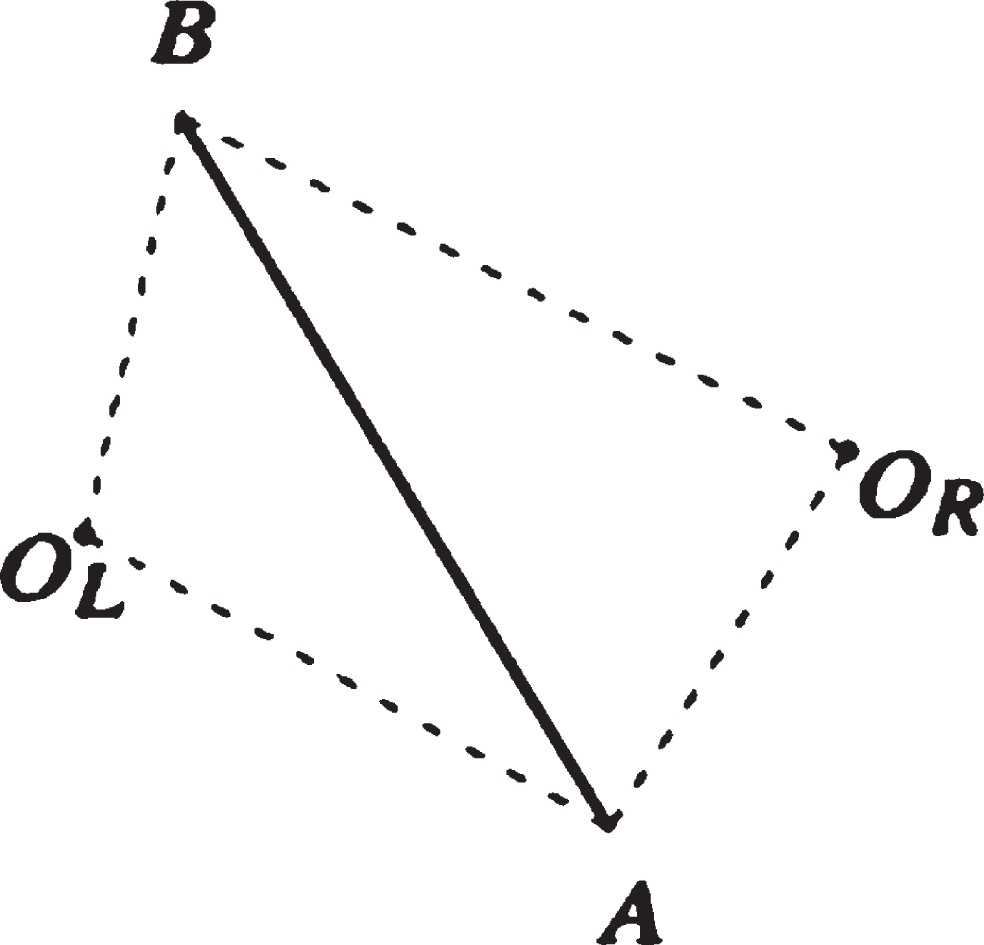
The local mesh of edge AB.
On the left cell to integrate the diffusion equation in (1), and set
If u
L
is defined as the unknown on cell center, then the key of discretizing (2) is to approximate ∫
γ
F ·
Two polynomials are employed to approximate the temperature on the two sides of γ for the reason that the gradient of temperature is discontinuous in the case of discontinuous diffusion coefficients, which is the motivation of the “twin-fitting” method. Concretely, p
L
(x, y) and p
R
(x, y) are composed by area coordinate basis functions on ΔO
L
AB and ΔO
R
BA respectively and satisfy the given values u
L
, u
A
, u
B
and uR, u
A
, u
B
, then are determined by the constraint
where
If γ is on Dirichlet boundary, then
If the time discretization adopts the implicit scheme, then the Equation (2) can be discretized as follows
In this section, a new treatment for the vertex unknowns on quadrilateral meshes is established and can be extended to polygonal mesh.
Consider the vertex shared by four cells, see Fig. 2, assume u0 be the vertex unknown on point O (0, 0), it is treated as a linear combination of its surrounding four cell-centered unknowns u i (1 ⩽ i ⩽ 4) respectively defined on the cell-centers O i (s i , r i ).
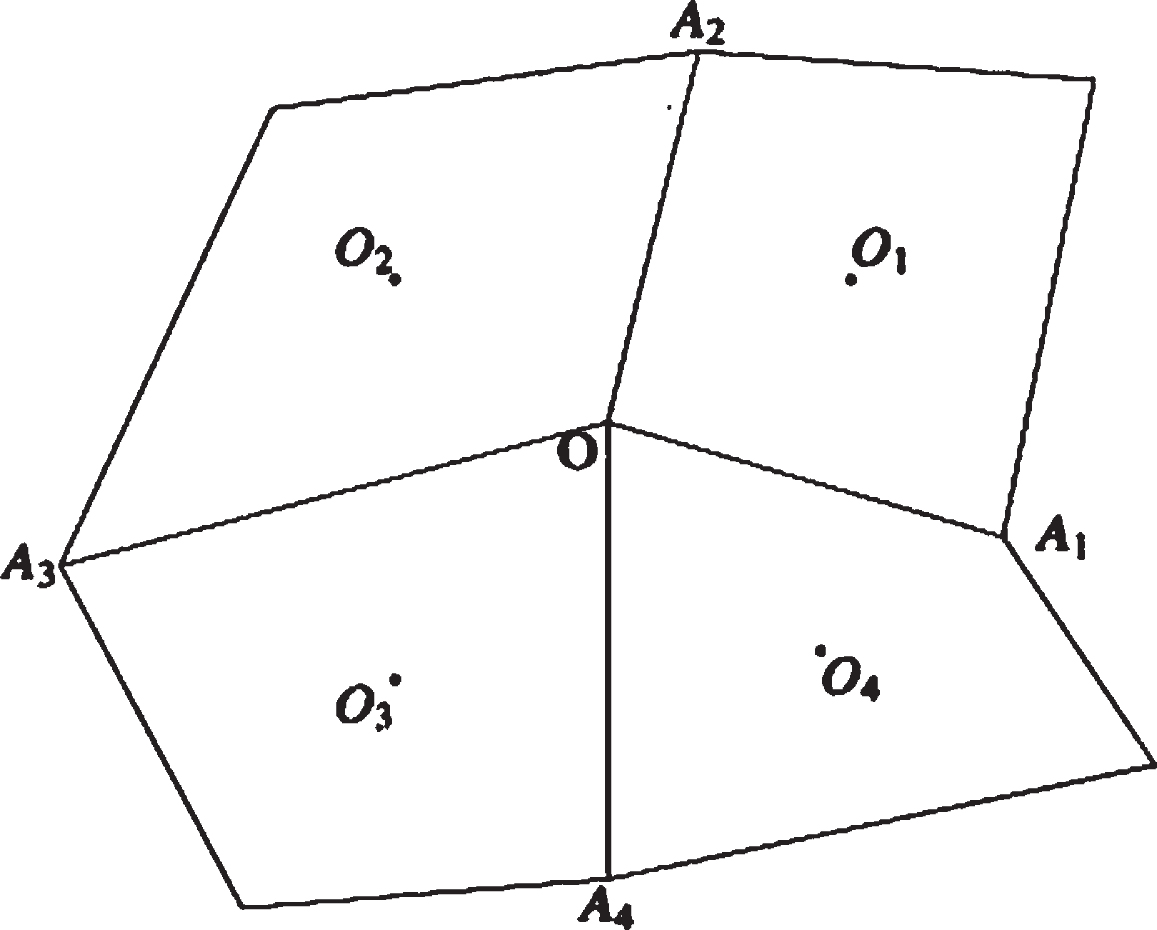
The local mesh of the vertex.
In order to calculate the vertex unknown, the diffusion coefficients around the vertex are seen as the discontinuous ones when the temperature varies sharply, and four linear functions p
k
(x, y) (k = 1, 2, 3, 4) are employed to approximate the temperature on the sub-cells ΔOOk-1O
k
. These functions can be determined by the given temperature values on local stencils and by adopting a minimum problem to preserve the normal component continuities of fluxes on
This minimum problem is in fact equal to solve the following formula
Thus, the vertex unknown u0 can be expressed as a linear combination of u
i
(1 ⩽ i ⩽ 4) as follows,
NPS-tritwin denotes scheme (4) with the new treatment, NPS-tritwinv1 scheme (4) with the weights given in [10], and NPS scheme (4) with the arithmetic average weights [2]. Numerical experiments are used to test their performance on distorted meshes of domain Ω = [01] × [0, 1] including smooth, random and Kershaw meshes, see Fig. 3. The discrete L2 error Eh and its order of convergence q are used to analyze the results, where h denotes number of cells along x-axis same as that along y-axis and is 12 in Fig. 3.
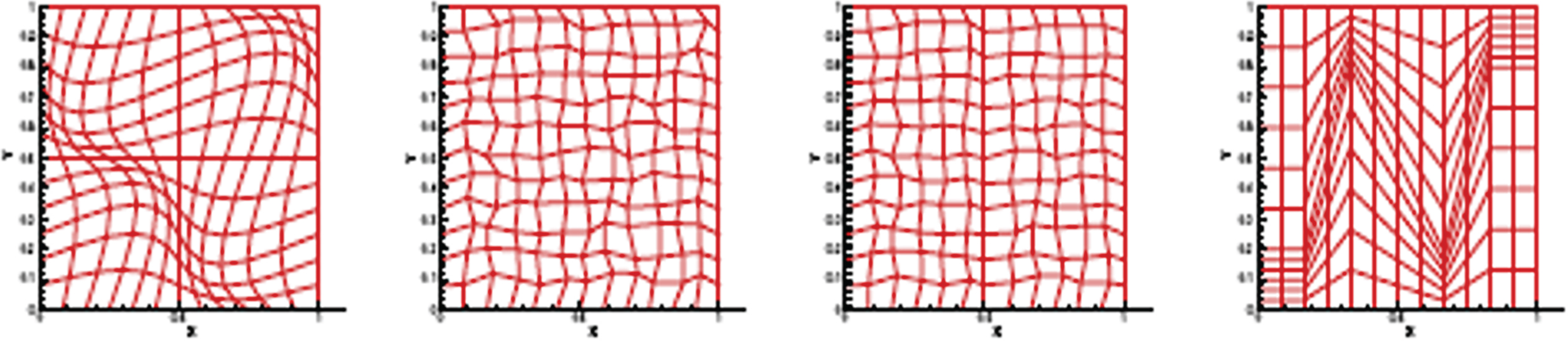
Meshes(smooth, random(ex.1), random(ex.2), Kershaw).
Example 1 is to test problem (1) with K = 1 and u (x, y, t) = sin πx sin πy on meshes of Fig. 3.
Example 2 is to test problem (1) with
on meshes of Fig. 3.
Example 3 is to test the problem in example 1 on meshes of Fig. 4.
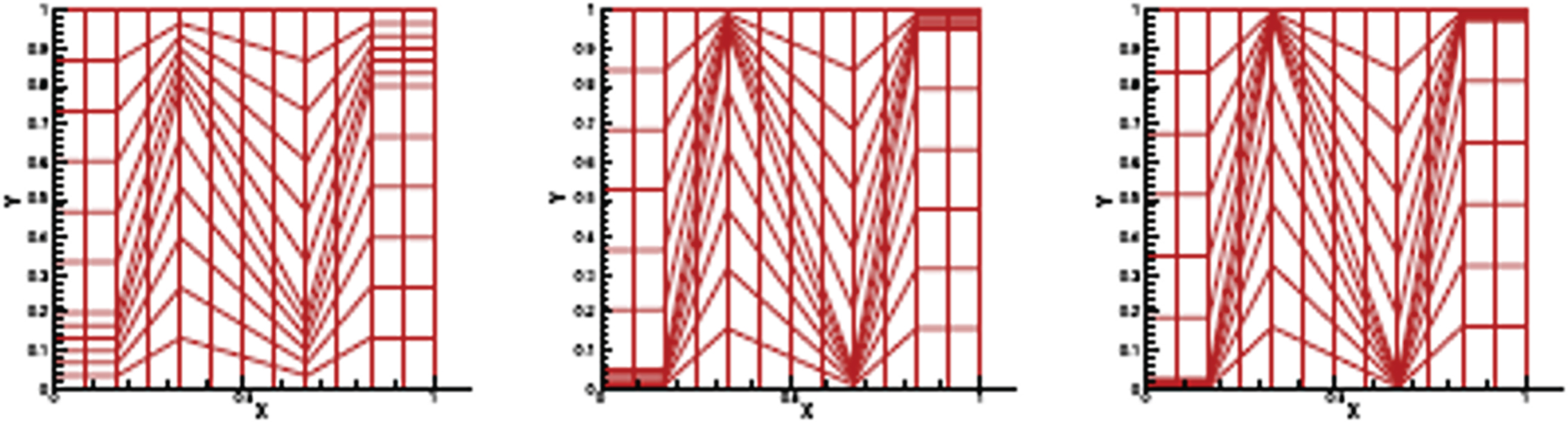
Kershaw meshes with gradual distortion.
Example 4 is to test the problem in example 2 on meshes of Fig. 4.
Table 1 is the result of example 1, and Table 2 the result of example 2. From the two tables, it is shown that the three methods are almost 2nd convergent on smooth meshes, and NPS-tritwinv1 and NPS-tritwin are at least 2nd convergent on random meshes, but NPS has lower order of convergence and even has no convergence. On Kershaw meshes, NPS cannot attain 1st order of convergence, while NPS-tritwinv1 and NPS-tritwin can attain at least 1.5 order of convergence.
The result of ex. 1
The result of ex. 2
In Figs. 5 and 6, ln(r) measures the distortion of mesh and q-l2 is the order of convergence. From the two figures, it is shown that, when Kershaw meshes are gradually skewed, the convergent order of NPS-tritwin is at least 1.4, that of NPS-tritwinv1 is at least 1.2, and that of NPS lessens rapidly and even attains 0.
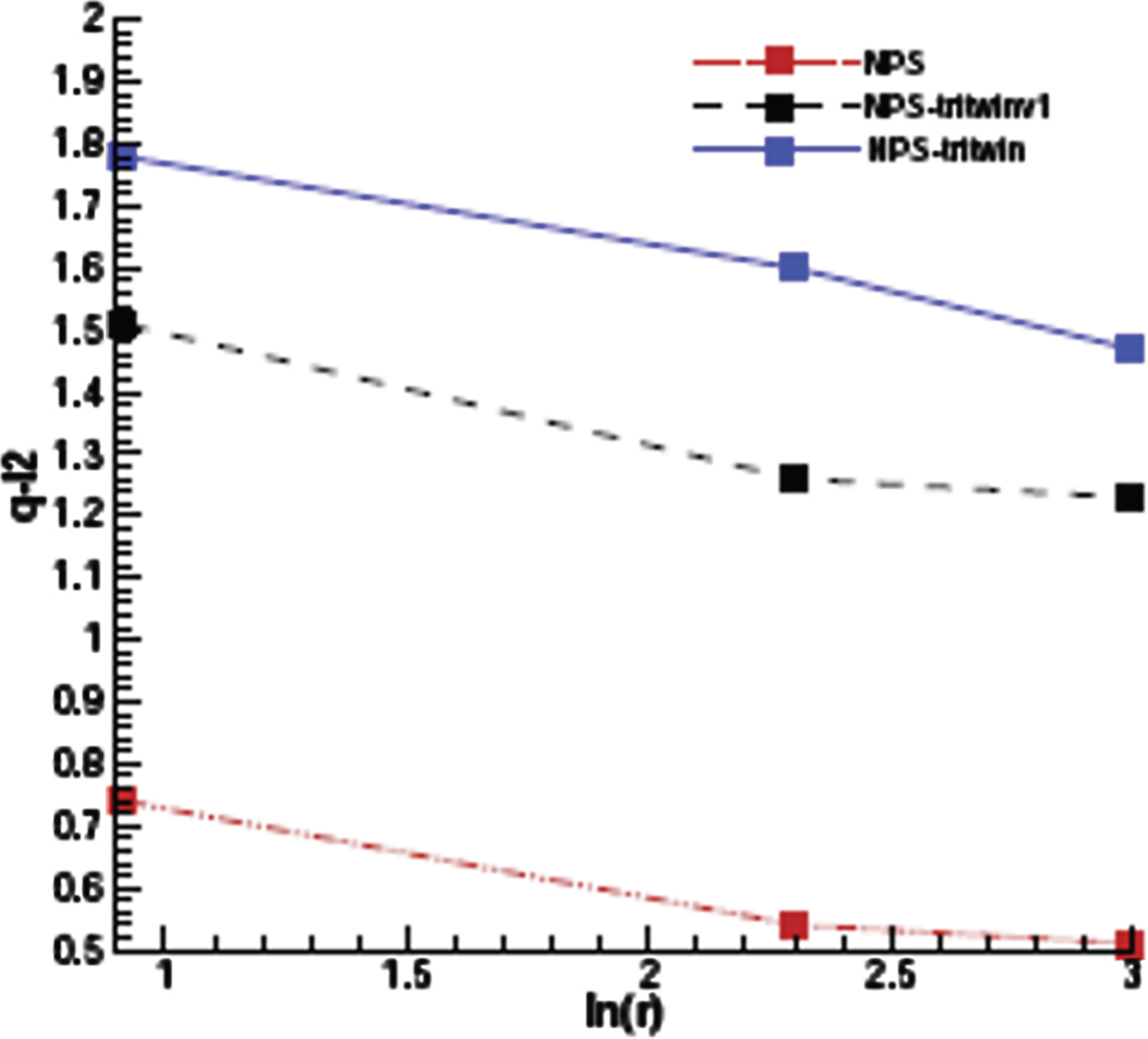
Convergent order of ex. 3.
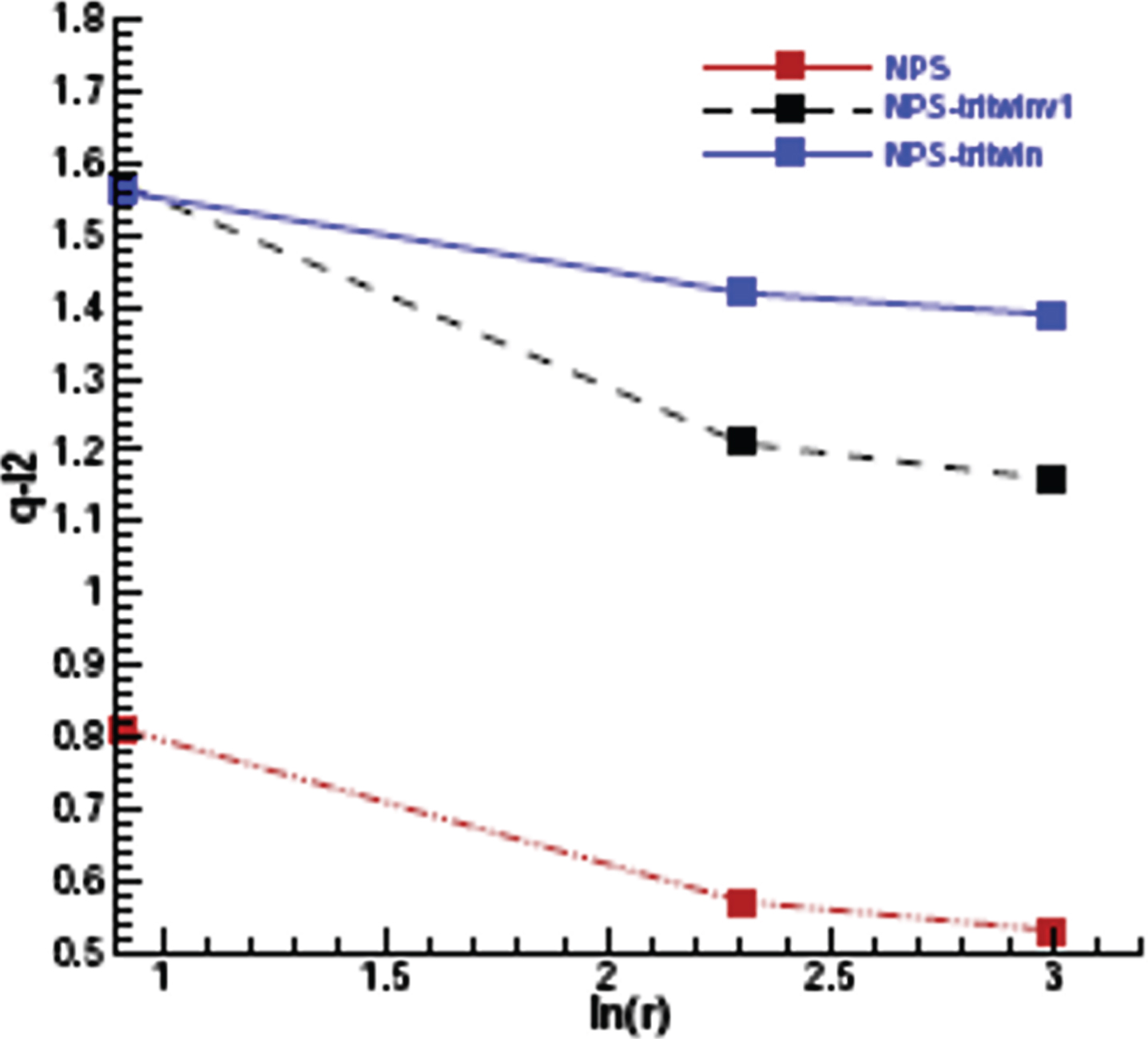
Convergent order of ex. 4.
Thus it is obvious that the new treatment is superior to other treatments.
A simple and high accurate treatment for the vertex unknowns is established on general quadrilateral meshes by the “twin-fitting” method. Numerical experiments show that this treatment is superior to other treatments due to simplicity and high accuracy, and can adapt well to diffusion problems with discontinuous diffusion coefficients on distorted meshes.