






Abstract
BACKGROUND:
Never Events represent a serious problem with a high burden on healthcare providers’ facilities. Despite introducing various safety checklists and precautions, many Never Events are reported yearly.
OBJECTIVE:
This survey aims to assess awareness and compliance with the safety standards and obtain recommendations from the National Health Service (NHS) staff on preventative measures.
METHODS:
An online survey of 45 questions has been conducted directed at NHS staff involved in invasive procedures. The questions were designed to assess the level of awareness, training and education delivered to the staff on patient safety. Moreover, we designed a set of focused questions to assess compliance with the National Safety Standards for Invasive Procedures (NatSSIPs) guidance. Open questions were added to encourage the staff to give practical recommendations on tackling and preventing these incidents. Invitations were sent through social media, and the survey was kept live from 20/11/2021 to 23/04/2022.
RESULTS:
Out of 700 invitations sent, 75 completed the survey (10.7%). 96% and 94.67% were familiar with the terms Never Events and near-miss, respectively. However, 52% and 36.49% were aware of National and Local Safety Standards for Invasive procedures (NatSSIPs-LocSSIPs), respectively. 28 (37.33%) had training on preventing medical errors. 48 (64%) believe that training on safety checklists should be delivered during undergraduate education. Fourteen (18.67%) had experiences when the checklists failed to prevent medical errors. 53 (70.67%) have seen the operating list or the consent forms containing abbreviations. Thirty-three (44%) have a failed counting reconciliation algorithm. NHS staff emphasised the importance of multi-level checks, utilisation of specific checklists, patient involvement in the safety checks, adequate staffing, avoidance of staff change in the middle of a procedure and change of list order, and investment in training and education on patient safety.
CONCLUSION:
This survey showed a low awareness of some of the principal patient safety aspects and poor compliance with NatSSIPs recommendations. Checklists fail on some occasions to prevent medical errors. Process redesign creating a safe environment, and enhancing a safety culture could be the key. The study presented the recommendations of the staff on preventative measures.
Introduction
Medical Errors represent a public health problem with a high burden on the healthcare provider’s facilities. The impact of medical errors was initially highlighted by the landmark report “To Err is Human”, released by the Institute of Medicine [1] in 1999. Further studies estimated medical errors as the third most common cause of death [2]. Multiple definitions have been outlined by several authorities to describe patient safety incidents [3]. Never Events (NEs) are an important category of avoidable medical errors; they are defined as serious clinical incidents that should have never happened if guidelines and safety measures were implemented and followed correctly [4].
There have been continuous global efforts aiming at reducing avoidable medical errors through implementing various safety checklists and several site-marking initiatives [5,6]. These initiatives were followed by the introduction of The World Health Organization’s “WHO” safety checklist [7], which initially succeeded in limiting the medical errors related to invasive procedures since implemented in 2009 [8].
In 2015, the NatSSIPs were introduced in the UK to provide guidance for the safe care of patients undergoing invasive procedures and encourage NHS-funded organisations to develop their LocSSIPs to monitor and maintain safety [9].
Despite all these efforts, Never Events continued to occur across the different surgical specialities during the last decade, with the annual reports from NHS showing sustained numbers of repeatedly occurring never events within the NHS [10–13]. This raises concerns about the reliability of the current safety measures in place, the level of awareness, and the education of healthcare staff on patient safety issues.
Many of the invasive procedures take place in the operative theatre with proper safety checks. However, in modern practice, many invasive procedures are performed outside operative theatre/room settings, like insertion of central lines and chest drains in the emergency departments or ICU, endoscopic procedures, cardiac catheterisation and interventional radiological procedures. In many hospitals, these clinical settings do not adopt the same safety checks as in the theatre settings or do not have safety checks at all. This carries a great potential for medical errors and NEs [9–12].
Learning about patient safety issues involves formal and informal methods of learning. Formal learning pathways are usually planned activities with predetermined educational objectives, including mandatory training modules, workshops [14] and educational courses [15–17]. While informal learning includes learning from mistakes, it is a kind of unplanned subconscious learning and includes learning from incident reports, Morbidity and Mortality meetings, medical claims, and root cause analysis of incidents [18,19].
The study aims to:
Assess the level of awareness of healthcare professionals about avoidable medical errors relevant to invasive procedures. Assess the current level of education on preventative measures for avoidable medical errors. Obtain insight into the personal experience of healthcare workers with these avoidable medical errors. Invite healthcare workers to give their practical recommendations to improve the safety of invasive procedures and avoid these incidents.
We have conducted an online survey through SurveyMonkey directed to the NHS staff in England and Wales (the areas covered by NHS England where NatSSIP was circulated and put into action in 2015). The survey included 45 questions designed to assess the level of awareness among staff on avoidable medical errors relevant to invasive procedures. Additionally, we explored the level of training and education delivered to staff on patient safety. Moreover, we designed a set of focused questions to assess compliance with the NatSSIPs guidance. Open questions were added to encourage the staff to give practical recommendations on tackling and preventing these incidents in real life.
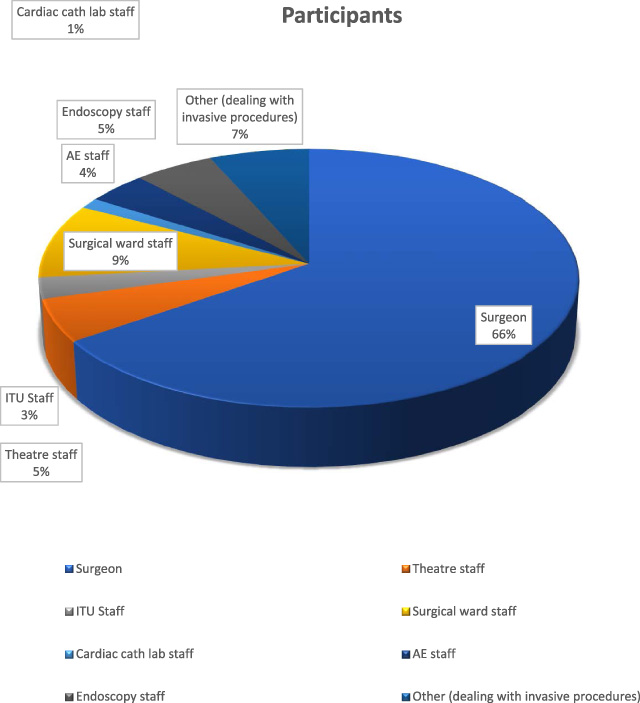
Participants departments and designations.
The survey was designed by the research group who have previous research experience in patient safety and NEs. Additionally, the focussed questions were designed based on the NatSSIPs. The initial draft of the questions was designed by the first author and went through multiple cycles of review by the research team. The final questionnaire has been piloted through the invitation of 10 complete responses representing the targeted audience and included qualified surgeons, surgeons in training, nursing staff, and medical doctors, all involved in invasive procedures in and outside theatre settings.
The survey went live from 20/11/2021 to 23/04/2022. Participants were selected by two authors, IO and AH, with an experience in patient safety and NEs. The survey was directed to those staff involved with invasive procedures performed in theatre or outside theatre settings. The targeted audience was chosen among the members and followers of the pages of the relevant royal colleges and professional associations in England and Wales. The individual profiles were reviewed by the research team to verify the suitability of the participants taking into consideration the position, speciality, location and setting of practice. In some situations, direct chats with the proposed participants took place to verify their suitability and the relevance of the survey to their work and experience. We included different specialities; general, vascular, and orthopaedic surgery, interventional cardiology, intervention radiology, Accident and Emergency (AE), gynaecology and endoscopy staff. A total of 700 invitations were sent through social media platforms, including Twitter, Facebook and LinkedIn.
A quantitative analysis has been performed, and the responses have been expressed in figures and percentages. Open questions and free text inputs were qualitatively analysed and presented in the form of logical themes.
Results
Out of seven hundred invitations sent, 160 (22.86%) responded to the survey and 75 completed the survey till the end (10.7%). The designations of the participants are shown in Fig. 1. Sixty per cent of the participants work both in and outside the theatre; Fig. 2 shows the setting of the participants’ practice.
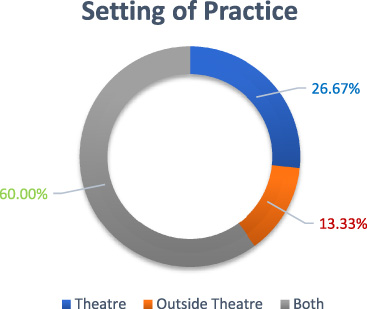
Setting of practice.
Level of awareness
The first set (Table 1) included seven questions that assessed the level of awareness of the NHS staff on medical errors. The majority were familiar with the terms NEs and near-miss, 96% and 94.67%, respectively. However, 72% only agreed with the term NE. 18 (24%) did not agree; some considered the term NE implying blame and guilt rather than learning, while others believe we can never eliminate errors. Regarding their awareness of the different safety standards, 68%, 52%, and 36.49% of the respondents were aware of any national or international safety standards for invasive procedures, NatSSIPs, and LocSSIPs, respectively.
Table 2 shows the responses to 6 questions that covered the education and training on patient safety issues. Twenty-eight (37.33%) only had training on preventing medical errors relevant to invasive procedures; the majority (10) were delivered in the form of courses. Moreover, 36% only received orientation/education on local safety standards for invasive procedures in their current jobs.
Education and training
When asked when they first learned about the WHO checklist, the majority said through the nursing or medical school curriculum and postgraduate studies. Forty-eight (64%) believe that training on safety checklists should be delivered early during the undergraduate education stage. Four of the respondents highlighted the importance of repeated cycles of teaching and continuous education on checklists and safety precautions. Moreover, 48.44% think the training on the use of safety checklists should be through Objective Structured Clinical Examination (OSCE) stations as part of the qualification/graduation exams. In comparison, 20.31% prefer presentations and videos, and the same percentage prefer online modules. Eleven participants believe training on checklists should be multimodal and include a combination of teaching methods.
Table 3 included three questions to explore the experience of NHS staff with medical errors and the patient safety culture. Fourteen (18.67%) had experiences when the checklists failed to prevent medical errors. They attributed this failure to the team’s poor engagement, routine safety checks mindlessly, a new team, fatigue, and the use of generic checklists not specific to the intended procedures. Although 18.67% had experienced hostility from team members when they requested their involvement with the safety checks, the majority still felt able to express safety concerns at any stage during the procedures.
Experience of NHS staff with medical errors and the patient safety culture
Table 4 includes 22 questions to assess compliance with the NatSSIPs within the NHS practice. There was good compliance with the pre-procedure safety team brief and senior involvement in safety checks. 85.33% always have a pre-procedure safety team brief, and 94.67% of the surgeons/seniors in our theatre contribute to the checklist. However, 41.33% and 26.67% of the respondents always and sometimes perform a debriefing after unscheduled or emergency procedures, respectively. 20% rarely do a debriefing after emergency procedures, while 4% have never heard of the term debriefing before.
Focussed questions on compliance with NatSSIP guidance
Recommendations by NHS staff
In lengthy procedures, when staff changes during a procedure cannot be avoided, 45 (60%) discuss this at the team brief. When the procedural team changes during a procedure, 38 (50.67%) do not do a second handover, while 21 (28.00%) have never experienced this situation.
When different teams perform separate, sequential procedures on the same patient, 22 (29.33%) do not perform another ‘time out’ before each new procedure, and 34 (45.33%) have never been in this situation. 53 (70.67%) said they had seen the operating list or the consent form containing abbreviations.
When asked about precautions to prevent retained items, 33 (44.00%) had a failed counting reconciliation process/algorithm. However, 32 (42.67%) did not know what this meant. When asked about the visual marker worn by the patient in case of intentionally retained items post-procedure, 11 (14.67%) said they do not use it, and 39 (52.00%) said they have not heard of that.
Within the group that deals with procedures involving implants or prostheses, 25 (50%) do not name a team member responsible for ordering and checking the correct implant, and 22 (44%) do not have an implant room in the theatre. In the group that uses guidewires, 15 (42.86%) said the guidewires are not included in the counting process, and 8 (22.86%) do not check the integrity of the guidewires after removal.
Table 5 included seven open questions to elicit recommendations from the NHS staff to enhance the safety process. Most of the responses were centred around the multi-level checks with the involvement of more than one staff member, effective utilisation of checklists specific for the intended purpose, clear site marking, verification of the three identifiers, active engagement of the whole team, patient involvement in the safety checks, quality counting process in a quite ambient, adequate staffing, avoidance of staff change in the middle of a procedure and list order, and investment in training and education on patient safety.
This study reports the finding of an NHS staff survey covering different patient safety areas, including: staff awareness and experience, training and education on patient safety, and compliance with the National safety standards in England and Wales, in addition to the recommendations of the NHS staff on the practical measures to prevent medical errors and NEs related to invasive procedures.
The survey showed that 96% and 94.67% of the staff are aware of the terms NE and near-miss. Another survey included 34 theatre nurses showed that only 15% of respondents were familiar with the term NE in relation to surgery [20].
However, 76% only of our respondents agree with the term NE. Some believe that the term NE implies guilt and blame rather than learning from mistakes, while others think we can never eliminate errors. Providing a blame-free culture is quite important to encourage transparency and to learn from errors and is an essential step to avoiding under-reporting of errors. A recent systematic review and meta-analysis [21], which studied 12 different hospital survey on patient safety culture (HSOPS) dimensions, showed that of the 12 HSOPS dimensions, six scored under 50% of positivity, with “non-punitive response to errors” the lowest one. They concluded that the culture of culpability is the main weakness across studies. The same results have been reproduced in a more recent survey, with the lowest percentage of positive responses being “non-punitive response to error” (18%) [22]. Within the NHS, the financial sanctions have been removed since 2018 to guarantee protection to the healthcare workers, provide a blame-free atmosphere and encourage reporting of incidents [23].
The level of awareness of the safety standard was much lower than the awareness of the errors and terms used. Interestingly, 36.49% only were aware of any local policies or LocSSIPs in their area of work. That puts an exclamation mark on the strategy adopted to spread awareness among the NHS staff after seven years after the release of NatSSIPs with this low level of awareness [9].
There has been a noticeable trend for developing educational programs in patient safety directed to healthcare professionals at different stages of their careers, starting from medical and nursing schools [24]. However, there is a significant variation in the amount of time allocated, setting and modalities of teaching and assessment methods. Moreover, there is no obvious systematic, standardised approach to learning about patient safety [25].
Our study showed that only 37.33% and 36% of our participants received training on the prevention of medical errors relevant to invasive procedures and education regarding any local safety standards for invasive procedures in their current job, respectively. A recent survey [26] of American and Canadian urology residents (RES) and program directors (PD) showed that 79% of the urology trainees and 42% of the program directors received training on patient safety. Both groups preferred an online patient safety curriculum (RES = 69%; PD = 68%). Although 20.31% of our participants prefer online modules, the majority, 48.44%, prefer to receive patient safety education in the form of OSCE stations as part of qualification/graduation exams. The remaining favoured other modalities, including videos, lectures, and presentations.
Moreover, a few highlighted the importance of the multimodalities approach, and others pointed to the utilisation of Work-Based Assessment (WBA) as a tool for training on patient safety. The majority, 64% of our respondents, recommended introducing education on patient safety as part of undergraduate medical education. Early exposure to patient safety enroots the patient safety culture. However, it can be challenging because patient safety practice is quite complex, requiring a broad range of skills, behaviours and clinical knowledge. These skill sets could be beyond the level of an undergraduate student [25]. Careful designs of the learning modules in parallel with the clinical knowledge should be exercised with an increasing level of complexity as the students progress higher through their educational pathway.
Despite the established effectiveness of safety checklists in reducing adverse incidents [27], 18.67% of the respondents had experienced specific incidents when the checklist failed to prevent medical errors. They attributed the failure to a host of factors, including lack of engagement of the whole team, fatigue, emergency situations, new staff members, safety checks becoming routine and done mindlessly, and the use of generic checklists not specified to the procedures intended. In this respect, it is worth highlighting the emphasis of the NatSSIPSs on designing LocSSIPs tailored to the local practice and specific to the intended situation [9].
This survey showed that 18.67% experienced hostility from team members when they requested their involvement with the safety checks. However, the majority still feel able to express safety concerns. A survey that included 393 cancer nurses from different European countries showed that nurses in the Netherlands and the United Kingdom scored higher on “communication openness”, the “frequency of events reported”, and “non-punitive response to errors” than nurses from Estonia or Germany [28].
The next set of questions (Table 4) is meant to assess the awareness and compliance of NHS staff with NatSSIPs guidance. The questions targeted a range of challenging clinical and patient safety situations that have been clearly covered and appropriately addressed by NatSSIPs published in 2015. The results show an acceptable level of awareness and compliance with the basic concepts and checks, including the pre-procedure safety brief, the seniors’ engagements with the safety checks, and the presence of seniors during briefing and Time Out. However, we could notice a clear pattern of responses; as the situation gets more complicated and/or less frequently encountered, the levels of awareness and compliance decline. This was noticed in situations like the team change in the middle of lengthy procedures and when multiple teams performed sequential procedures on the same patient.
Abbreviations in the consent forms and theatre lists are well-recognised potential risks for medical errors and compromise patient safety [29]. A recent audit conducted in level-one trauma centres in the UK showed that in its first cycle, there were abbreviations in 54% of the consent forms, which declined to 22% in the re-audit cycle [29]. Our survey showed that 70.67% of the respondents had seen abbreviations in their theatre lists or consent forms.
Retained foreign objects post-procedure are pretty common, with an estimated 901 incidents reported from 2012 to 2020. These included 152 retained guidewires [10]. NatSSIPs recommend that LocSSIPs should include a clear failed reconciliation process, and in case of intentionally retained items for later removal, a visual marker worn by the patient should be used to indicate the consequent incomplete reconciliation and the intended date of its removal [9]. We included a few focused questions about the safety precautions relevant to these incidents. The results showed that 13.33% do not have a failed counting reconciliation process/algorithm, and more than 40% do not know what this term means. Moreover, 14.67% do not use visual markers, and more than half of the participants have not heard of this at all.
When asked about guidewires, 20% use guidewires outside the theatre and 34.29% use them inside and outside theatre settings. 42.86% do not include guidewires in the counting process, and 22.86% do not check their integrity after removal.
Wrong implants or prostheses are not uncommon within different specialities within the NHS, with approximately 425 incidents reported between 2012 and 2020 [10]. NatSSIPs detailed, comprehensive guidance on the precautionary measures to prevent wrong implants. When we asked direct questions about these measures outlined in NatSSIPs, the results showed limited awareness and compliance among the staff. Only 40% have implant room in the theatre, and 34% name a team member responsible for ordering and checking the correct implant. More than 20% rarely or never remove the unused prosthesis from the theatre after choosing the correct one. All of these carry potential risks for wrong implant insertion.
These findings clearly explain the persistence of NEs despite the theoretically proposed precautions which remain in books and papers. The practice on the ground, as shown in this survey, presents evidence of a low level of awareness and poor compliance with the safety precautions.
The survey conducted in 2018 (3 years after the release of NatSSIPs) showed that only 67% of institutions that responded had developed LocSSIPs. A recent report published by the Healthcare Safety Investigation Branch showed that the introduction of NatSSIPs did not lead to the standardisation of the safety precautions as intended. Moreover, the development of individualised LocSSIPs allowed variation in approaches across the NHS [30].
Study strengths and limitations
The study has some limitations, including the small sample size. However, the response rate was comparable with other similar surveys [26]. This could potentially compromise the generalisability of the results. However, looking at the participants’ positions, specialities, and setting of practice – Figs 1 and 2, this survey would be potentially representative of NHS staff performing a wide range of clinical activities involved with invasive procedures. We hope our work triggers more efforts supported by official bodies to explore our findings further on a larger scale.
Moreover, this survey included a wide range of questions to examine the situation on the ground from different angles and covered various domains. Additionally, the survey included healthcare professionals from different specialities working in and outside theatre settings.
Conclusions
This survey showed a low level of awareness of some of the principal patient safety aspects, including available national and local safety standards, and poor compliance with NatSSIPs recommendations, especially in challenging situations that carry potential patient safety risks. Additionally, the survey showed limited training and education on patient safety. The checklists fail on some occasions to prevent medical errors. Process redesign creating a safe environment, and enhancing the safety culture could be the key.
Although some of the NHS staff might have negative experiences when they ask for senior engagement with safety checks, the majority feel they can express their concerns and speak up. The study presented practical recommendations from the staff to prevent the various NEs and avoidable medical errors related to invasive procedures.
Footnotes
Author contributions
IO: Conceptualisation, design of the survey, investigation, formal analysis, writing – original draft, discussion of the results, writing – review and editing. AH, TZ and RSing: investigation, formal analysis, submission. RSp: writing – review and editing, supervision. All authors helped with all stages of the study and have seen the final manuscript and approved it.
Conflict of interest
The authors have no conflicts of interest to declare.
Ethics approval
Not applicable.
Informed consent
Agreement on participation and completion of the questionnaire have been considered implied consent for this kind of survey.
Funding
This research did not receive any specific grant from funding agencies in the public, commercial, or not-for-profit sectors.