





Abstract
Diabetes prevention programs have been developed in the different countries and it is therefore necessary to gain a better understanding of factors affecting the effectiveness of these programs for each society. Accordingly, the purpose of this study was to evaluate the effect of the National Diabetes Control and Prevention Program (NDCPP) on the biochemical and anthropometric indices among a sample of Iranian patients with type 2 diabetes mellitus (T2DM). A total of 384 patients with T2DM from the primary health care system of Tehran and Tabriz cities during January to June 2020, were included in the study. A two-part questionnaire consisting of items related to socio-economic and demographic characteristics was used and biochemical and anthropometric indices were measured at the beginning and the end of the 3-month intervention period. There was a significant difference in fasting blood sugar (FBS), hemoglobin glycosides (HbA1 C), systolic blood pressure (SBP) and weight before and after the NDCPP (P < 0.001). Also, there was significant improvement in carbohydrate (P = 0.015) and protein intake (P = 0.027) after the NDCPP compared to before the study. No significant difference was observed in waist circumference (WC) (P = 0.689), body mass index (P = 0.784), diastolic blood pressure (P = 0.647), and other dietary nutrient intake before and after the NDCPP. Repeated measure ANOVA revealed a significant decrease in FBS (Time effect P = 0.019) and weight (Time effect P = 0.006) after the NDCPP. Also, residing in different cities had a significant effect on FBS (time×city effect P < 0.001), HbA1 C (time×city effect P < 0.001), and SBP (time×city effect P = 0.037) after the NDCPP. The NDCPP resulted in weight loss, improved HbA1 C, and FBS. These findings suggested that NDCPP had a positive effect on controlling T2DM among Iranian population and can be considered as a way to prevent complications of T2DM.
Introduction
Diabetes mellitus (DM) has emerged as one of the major global health challenges of the 21st century [1]. Based on the World Health Organization (WHO), in 2019, about 1.5 million people died because of diabetes. It is predicted 463 million people suffering diabetes in the worldwide and can reach to 700 million people by 2045 [2]. According to Esteghamati et al. [3], more than 4.5 million adult people with DM are living in Iran and, it is expected to increase to 9.2 million by 2030 [4]. The prevention of T2DM is a major public health challenge and a national priority, due to its cardiovascular, retinal, and disabling consequences. Based on reports, T2DM can be prevented or delayed in adults at risk by the lifestyle programs promoting modest weight loss, healthy eating, and physical activity [5]. Intensive lifestyle interventions can avoid the incidence of T2DM in the elderly with prediabetes [6].
National Diabetes Control and Prevention Program (NDCPP) is the common program intervention for diabetes [7]. The diabetes prevention program (DPP) is a long-term follow-up to examine the effectiveness of the interventions on the health of T2DM patients. Population-based screening programs have been introduced for screening diabetes in some countries [8].
There are numerous studies showing that lifestyle changes can avoid the consequences of T2DM in high-risk populations. The long-term nutrition education program improves anthropometric, dietary, and metabolic parameters in patients with T2DM in Brazil [10]. Recently, the 1-year Tianjin DPP led to weight loss in women with gestational diabetes [11]. Moreover, Oba et al. [12] revealed that the three- month DPP could decrease SBP in patients with T2DM Thailand compared to before the intervention. There is little information about the effectiveness of DPP for the Iranian patients with T2DM. Alirezaei Shahraki et al. [13] reported NDCPP decreased FBS and HbA1 C among diabetic elderly patients in Isfahan, Iran. However, there is no study reporting anthropometric indices, blood pressure and dietary intake in the Iranian patients with T2DM older than 30 years old. Therefore, the aim of this study was to evaluate the effect of NDCPP on the biochemical and anthropometric indices among a sample of Iranian patients with T2DM.
Materials and methods
The Iranian NDCPP is progress, aimed to reduce the economic costs, disabilities, premature diabetes related mortality and its complications. The program is implemented through the continuous follow-up and care in all health centers under the auspices of medical universities in the country with the required staff of the first level, general practitioner (family physician), health care expert and Nutritionist [14].
Ethical considerations
The study was approved by the Ethics Committee of Tabriz University of Medical Sciences (IR.TBZMED.REC.1397.1026) in order to investigate effectiveness of the NDCPP for both Tehran and Tabriz.
Participants
The study participants included all patients with newly diagnosed T2DM older than 30 years who were enrolled in the NDCPP during January to June 2020. Tabriz and Tehran were divided into 10 and 22 municipal districts, respectively. Two health centers were randomly selected from each district. The health centers enrolled in this research were selected from all of the identified districts using simple randomization tables. A total of 384 people with T2DM from 64 health centers were selected using convenience sampling. The implementation of NPPCD included only Iranian T2DM population older than 30 years old. The study inclusion criteria were as follows: 1) individuals with T2DM older than 30 years old without pregnancy, 2) enthusiasm to file a diabetes record, 3) no history of other comorbidities e.g., hypertension, 4) not receiving medications for controlling hypertension, hyperlipidemia and hyperglycemia, 5) ability to communicate with the researcher. The study exclusion criteria were specified as follows: 1) reluctance to continue care, and 2) not participating in training sessions. The sample size was determined using Krejcie and Morgan [15] as given below:
s = X2NP (1 –P) / d2(N –1) + X2P (1 –P).
s = needed sample size.
X2 = the table value of chi-square for 1 degree of freedom at the desired confidence level (3.841).
N = the population size.
P = the population proportion (supposed to be.50 meanwhile this would supply the maximal sample size).
d = the degree of accuracy expressed as a proportion (0.05).
By considering the 95%confidence, tolerable error 5%, minimum sample size in both cities was 384. However, Tehran as the capital city has a much larger population compared to Tabriz. Based on their population, 314 and 70 participants were dedicated to Tehran and Tabriz, respectively, and they were randomly selected from 10 municipal districts of Tabriz and 22 municipal districts of Tehran. Sampling process is presented in Fig. 1. We had a total of 9 sample (about 2 %) drops that were replaced (four were expelled for immigration and five for not attending classes). Alternatives were selected from the same center.
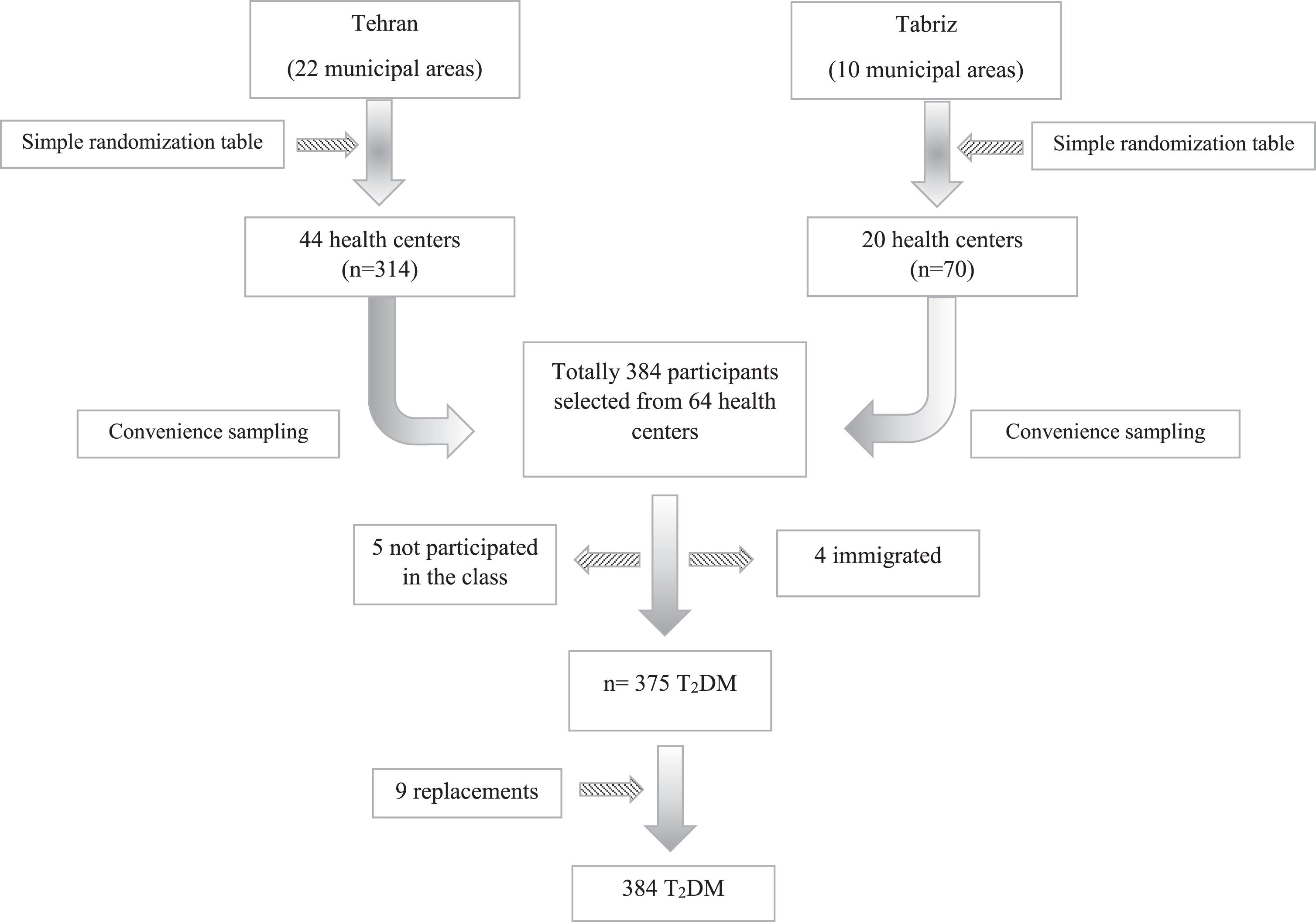
Flowchart of the study.
A two-part questionnaire consisting of 1) the demographic and socio-economic information items and 2) the measurement of biochemical and anthropometric indices of FBS and glycosylated hemoglobin (HbA1c), body weight (BW), height, body mass index (BMI) and waist circumference (WC), systolic and diastolic blood pressure, as well as the 24-hour food record were used at the beginning and the end of the three-month intervention [16]. In the first stage, after selecting the participants and before entering the program, the diagnosis of T2DM was confirmed by the physician according to the patient’s laboratory test and the high FBS level and HbA1c>6.5. Demographic and socio-economic characteristics included age, sex, education level of the patient and his / her spouse, occupation of the patient and his/her spouse, marital status, monthly income, housing ownership status, housing area and number of rooms [17].
Procedure
Individual counseling was performed by a physician, health care expert, and nutritionist. In the group training, symptoms of diabetes (signs of hypo and hyperglycemia), types of diabetes, complications of diabetes, importance of medication were trained by team doctors. Nutrition training to modify eating habits and regulate blood sugar based on diet, food pyramid, reducing fat and simple carbohydrate intake, enhancing the consumption of fruits and vegetables and the role of physical activity in controlling blood sugar was performed by a nutritionist. Lecture, question and answer and PowerPoint slides were used to convey the educational content. Each training session lasted 60 minutes. Three months after entering the participants into the program, the questionnaire was completed again and the results of the biochemical and anthropometric measurements were recorded in the questionnaire.
Outcomes
Anthropometric indices were measured prior and after the 3-month intervention. The BW was measured to the nearest 0.1 kg using a portable digital scale, with participants wearing minimal clothing. Height was measured while the participants was barefoot, by a measuring tape to the nearest 0.1 cm. BMI was obtained by dividing BW (kg) in height squared (m2) [18]. The WC in the area between the iliac crest and the last rib or dagger appendage was measured using a tape measure [19]. Dietary intake was evaluated by 3 non-consecutive day food records (two-week days and one weekend) in the beginning and the end of the study. Before the intervention, all participants were instructed on how to use a food scale and how to record their food intakes; however, about illiterate and low-literate people who could not complete three -day food records of the questionnaire, the Nutritionist in each health center completed this form by face-to-face interview. Nutritionist software (Ver. 4; First data bank Inc., Hearst Corp., San Bruno, CA) was used to analyze macronutrient and energy intake of participants. Nutrient intake was determined using revised edition of the Iranian food composition table [20]. The FBS and HbA1c [21] were determined before and after three -month intervention using their medical report. Blood systolic and diastolic pressures were taken using digital sphygmomanometers.
Statistical analysis
The data were analyzed by the paired t-test, the repeated measures analysis of variance (RMANOVA) and ANOVA using SPSS 22.0 for Windows (SPSS, Inc., Chicago, IL, USA). P < 0.05 was considered as significant differences in all statistical analyses.
Results
The socio-economic features of the study participants are presented in Table 1. According to the results, 229(59.6%) and 155(40.4%) of participants were women and men, respectively. The most of participants (47.4%) were the 61–75 age group, 40.7%were the 46–60 age group, 9.2%were the 30–45 age group, and only 11(2.9%) of them were older than 75 years old. The majority of participants had an elementary-level education. Most of participants were married (83.1%), 54.7%had their own house, and the most frequent (60%) home area was 76–100 m2 among participants.
The socio-economic characteristics of the
The socio-economic characteristics of the
Income without work: do not working currently but having income from their properties; Free: not paying for the home. Million Toman was equal to about 77 dollars in 2020.
The effect of the NDCPP on the participants’ biochemical and anthropometric indices is presented in Table 2. There was significant difference in FBS before (178.30±4.98 mg/dl) and after (151.88±3.09 mg/dl) the NDCPP in Tabriz and Tehran (175.72±2.34 vs. 135.80±1.67 mg/dl) (P < 0.001). A significant difference was observed in HbA1 C before (7.84±0.13%) and after (7.27±0.11%) NDCPP in Tabriz and Tehran (7.58±0.80 v.s. 6.82±0.66%) (P < 0.001). There was a significant difference in SBP only for Tehran and Tabriz before (126.44±0.85 mmHg) and after (119.41±0.68 mmHg) the NDCPP (P < 0.001). Significant difference was detected in BW for Tabriz and Tehran before (77.33±0.75 Kg) and after (76.00±0.74 Kg) the NDCPP (P < 0.001). No significant difference observed in WC (P = 0.698), BMI (P = 0. 748) and diastolic blood pressure (P = 0.647). No significant difference was also observed among the study participants with respect to sex (data not shown).
The effect of diabetes prevention program on patients biochemical and anthropometric indices of studied subjects based on cities: Tabriz (n = 70) and Tehran (n = 314)
DPP: Diabetes prevention program; FBS: Fasting blood sugar; HbA1C: Glycated hemoglobin; BMI: Body mass index. The DPP had no significant effect on anthropometric index of patients based on their gender, so not mentioned separately in the table. *: Significant difference before and after DPP (p < 0.001) by paired t-test.
Moreover, as shown in Table 3, NDCCP had no effect on daily dietary energy intake (P = 0.215), percentage of energy derived from carbohydrate (P = 0.077), and fat (P = 0.141) before and after the study (P > 0.05). However, a significant difference was detected in carbohydrate intake in gram (P = 0.015), dietary protein in gram (P = 0.009), and percent of energy derived from protein (P = 0.027) before and after the NDCPP in Tabriz and Tehran (P < 0.05). In addition, sugar intake decreased in both cities after the NDCPP (P < 0.001).
The effect of diabetes prevention program on dietary energy and macro-nutrient intake in studied subjects (n = 384) based on gender and cities
*: Significant difference before and after DPP (p < 0.05) by paired t-test.
Repeated measures ANOVA revealed a significant decrease in FBS (Time effect P = 0.019) and BW (Time effect P = 0.006) after the NDCPP. Also, residing in different cities had a significant effect on FBS (time×city effect P < 0.001), HbA1 C (time×city effect P < 0.001), and SBP (time×city effect P = 0.037) after the NDCPP. RMANOVA was done by adjusting for sex, educational and occupational levels, district, floor area, and total expenditure and these socio-economic variables had no significant effect on anthropometric and biochemical indices of the participants (Table 4).
Mean (±SD) of biochemical and anthropometric indices of studied subjects based on their city and gender before and after DPP
*Adjusted for educational and occupational level, district, floor area, and total expenditure. †Significant difference before and after DDP (p < 0.05) by RMANOVA. ‡Significant difference before and after DDP (p < 0.001) by RMANOVA.
T2DM have an important economic effect on people, families, health systems in countries with poor resources [22]. Given the rapidly escalating financial and societal costs associated with diabetes care in developing countries, critical interventions and programs are needed to prevent T2DM and its complications [23].
In the current study, FBS improved after the NDCPP. Previous programs such as Finnish diabetes prevention [24], American DPP [25] also revealed that lifestyle intervention decreased risk of developing T2DM by more than 60 percent. Gillies et al. [26] found that non-pharmacological interventions can decrease the risk of T2DM in patients with impaired glucose tolerance. Effectiveness of the DPP is higher in developed countries, but the prevention of T2DM in developing countries is critical [27]. A cross-sectional pre- and post-test design on 100 elderly patients with recently diagnosis of T2DM in Isfahan, Iran revealed that program for the prevention and control was useful for FBS [13]. However, there is no study reporting anthropometric indices, blood pressure and dietary intakes in Iranian patients with T2DM older than 30 years old. Therefore, this study designed to examine the outcome of the NDCPP not only on FBS and HbA1 C, but also on the above- mentioned factors.
The effect of non-pharmacological interventions on decreasing HbA1 C, adiposity and blood pressure are important for control and prevention of T2DM [28]. An improvement reported on FBS and HbA1 C in self-management program in patients with T2DM [16]. Our results are similar to previous studies suggesting that socioeconomic position, education level and occupational status had no significant effect on anthropometric and glucose tolerance in individuals at high risk for T2DM in a year follow-up lifestyle intervention [29].
According to our results, significant difference was observed in BW for people residing in Tabriz and Tehran before and after the NDCPP. No significant difference was seen in WC, BMI and diastolic blood pressure. However, in most of the reports, a significant difference was reported after 12 months of follow-up [30–32]. This difference might be attributed to the limitations of the current study on the short duration of follow-up (3 months). NDCPP had no effect on daily dietary energy intake and dietary percentage of carbohydrate intake before and after the NDCPP in Tabriz and Tehran. Despite there was no significant effect on dietary percentage of carbohydrate before and after the study in Tabriz and Tehran, but overall significant difference was observed in grams of dietary carbohydrate intake before and after the NDCPP. There was a significant difference in percentage of protein as well as the grams of protein intake before and after the NDCPP in Tabriz and Tehran. Significant weight loss despite the reduction in energy intake might be attributed to the low accuracy of the three-day food record and an increase in energy expenditure.
Long-term nutrition education by Pimentel et al. in T2DM Brazilians revealed a reduction in BW, BMI, FBS and HbA1 C with no effect on carbohydrate, protein and energy intake [10] and our result on dietary intake was in agreement with this report. However, no significant change was seen in BMI and WC following the implementation of NDCPP in the Iranian patients with T2DM. Absetz et al. [30] reported DPP had positive effect on BMI, WC, and diastolic blood pressure in males, but not in females. Dunkley et al. [33] reported BW, blood glucose, and blood pressure decreased by DPP at the 12-month follow-up. In a 3-year follow up program by Lindstrom et al. [24], FBS decreased after one year and BW and BMI diminished after three years. In a six months’ follow up in Chicago, USA, Ruggiero et al. [34] reported that the intensive care program leads to improvement in BW/BMI, WC and body fat. Greece lifestyle intervention program by Makrilakis et al., showed an acceptable result on BW and BMI, FBS and systolic pressure with no effect on WC among T2DM population [35] and our results were consistent with this finding. Telephone-based service also improved FBS, BW and BMI in patients with T2DM [36].
Based on our findings, HbA1 C was improved after the NDCPP. Educational interventions are important to decrease HbA1 C levels among adults with T2DM in developing countries [37]. The application of the Lawrence Latino diabetes prevention project significantly decreased BW and HbA1 C [38]. Improvement in BW and blood pressure in 3 years’ diabetes prevention program was seen in American Indian and Alaska native societies [39]. In a six months’ community-based physical activity and nutrition behavior intervention program by Tran et al. [40], BW decreased and SBP improved and our results were consistent with this finding. Hu et al. in a one-year intervention on primary prevention of T2DM among elderly individuals found that BW, WC and HbA1 C decreased in prediabetes population of rural China [31]. Also, Limaye et al. reported that application of a virtual assistance-based lifestyle modification leads to a significant decrease on BW, WC, systolic and diastolic blood pressure in young patients with T2DM [32].
Our findings indicated that, SBP improved after the NDCPP. A similar effect was reported on weight loss with DPP [41]. It was reported that lifestyle intervention could also improve blood pressure [41]. During the 10-year follow-up by diabetes prevention program coordinating center in USA, systolic and diastolic blood pressure in the lifestyle group was lower than in the other groups. However, these differences were not sustained by the end of follow-up [41]. Nevertheless, our result was in agreement with this finding and NDCPP only decreased SBP at the end of research. In research by Rautio et al, the lower systolic and diastolic blood pressure was observed between women with higher education level and there was interaction among age, education level, BW, BMI and WC. Also, retired or not employed people had higher BMI and WC and interaction observed among age, occupational status, BW, WC and SBP in women [29]. Blood pressure and WC significantly decreased by Finnish national diabetes prevention program [42].
The results of repeated measure ANOVA demonstrated that only the reductions in FBS and BW due to NDCPP remained significant after adjusting for socioeconomic status. Also, NDCPP showed different impacts on FBS, HbA1 C and SBP in participants residing in different cities. It seems that differences might have related to the cultural and economic differences besides sample size between two cities. Among Chinese population, lower level of education (less than senior high school), non-manual work and unemployment were related with FBS > 8.5 mmol/l, which indicated association among socio-economic status (income, education and occupation) and T2DM [43]. Zhang et al. showed an association between low income, high FBS and T2DM. No relationship reported between education level and FBS or T2DM in Tianjin, China [43]. Also, better HbA1 C status reported in educated and the most controlled blood pressure was seen among Chinese patients with higher income levels [44].
It should be note that, there is complex interaction between adverse effects of low income and health. Low-income patients have difficulties accessing to healthcare and education, proper housing, social support and healthy nutrition [45]. It was reported by Brunner et al, that low-income-related stress increased blood cortisol levels which could inhibit insulin uptake [46]. Public health and health care officials concerned with decreasing incidence of the T2DM and helping its management by the public policy decisions that amend low-income conditions and advise means by which low-income rates can be lowered [47]. Also, Vijayaraghavan et al. [48] reported that diabetic adults living in families with low incomes, self-efficacy scores decreased by increasing housing instability.
On the best of our knowledge, limited researches have been done on effects of the NPPCD on biochemical and anthropometric indices in Iranian patients with T2DM and current findings suggested that NDCPP had positive effect on FBS, HbA1 C and SBP and subsequently controlling T2DM among Iranian population. The main limitations of our study were small sample size and short duration of study which might affect the results. However, these findings can use as primary evidence for improving the NDCPP. Also, we were not able to determine physical activity of the T2DM population which can affect the findings. Further researches with a more sample size including T2DM population from rural, urban and suburban areas and extended intervention time are recommended to evaluate effectiveness of the NDCPP in improving diabetes risk factors.
Footnotes
Acknowledgments
The authors would like to thank all patients with T2DM enrolled in this study, the Research Vice Chancellor of Tabriz University of Medical Sciences and Nutrition Research Center, Tabriz University of Medical Sciences, Tabriz, Iran for their financial support. This research was conducted as a part of the PhD thesis of the first author (Grant Number: 61717).
Funding
Tabriz University of Medical Sciences.
Conflict of interest
Authors declare there is no conflict of interest.