






Abstract
BACKGROUND:
Impaired upper limb function in stroke survivors is characterized by muscle weakness, increased muscle tone, contracture, or impaired motor control.
OBJECTIVE:
We aimed to evaluate the effectiveness of Kinesio-taping application for functional recovery on the affected arm and forearm during rehabilitation.
METHODS:
Forty-one patients eligible for this study were randomly assigned to either the Kinesio-taping group (n = 21), receiving Kinesio-taping intervention and conventional therapy, or control group (n = 20), receiving sham Kinesio-taping intervention and conventional therapy. The whole intervention lasted for 3 weeks. Fugl-Meyer assessment of the upper extremity, Barthel Index, the Stroke Impact Scale, and modified Ashworth scale were measured at 3 time points: baseline, post-treatment (3rd week), and follow-up (6th week).
RESULTS:
In the Kinesio-taping group, there were significant differences in the upper extremity (p = 0.003), wrist (p = 0.000) and hand (p = 0.000) parts of the Fugl-Meyer assessment of the upper extremity between the three assessment times. On the other hand, the Barthel Index showed significant differences in both groups after therapy.
CONCLUSION:
Combining conventional rehabilitation with Kinesio-taping intervention may improve functional motor performance of both the proximal and distal parts of the affected upper extremity in stroke survivors, with potential benefits for activity of daily living.
Introduction
Upper limb weakness after stroke is one of the most common neurological deficits (Hatem et al., 2016). More than 80% of acute stroke survivors live with upper limb hemiplegia, and more than 40% of patients with chronic stroke have motor impairment in the affected upper extremity (Cramer et al., 1997; Jorgensen et al., 1999). Although more than 70% of these patients could perform some activities that require good dexterity six months after the stroke, the prognosis of upper limb function in stroke survivors with severe hemiplegia is poor (Kwakkel et al., 2003; van Kuijk et al., 2009). The clinical characteristics of impaired motor performance of the affected upper extremity in stroke survivors include muscle weakness, increased muscle tone, contracture, and impaired motor control related to neurological deficits after the insults (Hatem et al., 2016; Raghavan, 2015). Therefore, multiple approaches for the neurological deficits have been used to improve functional performance and quality of life (QoL) (Hatem et al., 2016; Sommerfeld et al., 2004; Welmer et al., 2010).
Stroke rehabilitation programs for upper extremity impairment include motor rehabilitation, electrical brain stimulation, hemisphere sub-specialisation, and multisensory interaction (Johansson, 2011). In patients with subacute stroke, therapeutic exercises, constraint-induced movement therapy, mirror therapy, mental practice, neuromuscular electrical stimulation, and botulinum toxin are also recommended (Hatem et al., 2016). On the other hand, Jaraczewska & Long (2006) stated that Kinesio-taping (KT) combined with other interventions may facilitate muscle function, provide joint support and proprioception feedback, and reduce pain in their previous reports. KT would help improve upper extremity function and activities of daily living for stroke survivors as well (Jaraczewska & Long, 2006; Kim & Kim, 2015). A randomized control trial in 2019 and a meta-analysis in 2020 also revealed beneficial effects on improving upper limb and activity of daily living (ADL) function in patient with chronic stroke (Deng et al., 2021; Santos et al., 2019). Moreover, our preliminary study showed that KT on the affected forearm could provide positive effects to improve motor performance by providing sensory feedback and reducing the spasticity on the distal part of the affected upper extremity in stroke patients receiving conventional rehabilitation programs (H.-C. Hsieh et al., 2021; Y.-C. Huang et al., 2019). However, the above results only showed significant improvement in motor recovery and performance of the distal part of the affected upper extremity after KT application. In this study, we used KT application including both the arm and the forearm of the affected upper extremity. We considered that it could provide more motor recovery and functional performance not only the distal part but also the proximal part of the affected upper extremity in strokesurvivors.
The aim of this study was to explore the clinical advantages of employing KT to enhance the recovery of motor performance in the affected upper limbs and daily activities among individuals who have experienced a stroke resulting in hemiplegia.
Materials and methods
This was a randomized controlled parallel-group study with participants being masked. The study was conducted at a tertiary referral hospital in southern Taiwan. The recruitment and follow-up period spanned from November 1st, 2019, to February 26th, 2021, concluding upon reaching our targeted number of patients. In our previous pilot studies (H.-C. Hsieh et al., 2021; Y.-C. Huang et al., 2019), we enrolled 31 and 35 patients, respectively. Therefore, we aimed to recruit a minimum of 40 patients for the current study, accounting for potential dropouts.
The inclusion criteria were as follows: (1) stroke survivors in subacute or chronic stroke and hemiplegia (duration is 2–12 months after stroke). (2) Able to perform hand grasping by the affected upper limb. (3) Able to perform at least minimal fingers extension and minimal wrist extension (ability of extension at least 10° at the metacarpophalangeal and interphalangeal joints and 20° at the wrist). The exclusion criteria were as follows: (1) age < 18 years or > 80 years old; (2) previous history of upper extremity tendon or neuromuscular injury; (3) any other systemic neuromuscular disease; and (4) cognitive or speech disorders impeding their communication ability.
Randomization was conducted using block randomization in a 1 : 1 ratio. A computer-generated randomization list, featuring the values 0 and 1, was employed, where 0 represented the KT group, and 1 indicated the control group. This randomization list was securely sealed in an envelope. Before unsealing the envelope, an impartial researcher created a random allocation sequence for the participants. Subsequently, the researcher matched the randomization list with the allocation sequence. All the included patients were then divided into two groups: the KT group and the control group. In the KT group, the taping on the affected forearm was applied from the upper one-third on the dorsal side and the tape was split into five equal bars to the distal interphalangeal joint of each finger (Fig. 1A). 3M paper tape was used to surround the fingertips without tension to maintain adhesion on the finger joints. Subsequently, to facilitate the wrist and finger extensors, the tape was applied with 20%–30% tension over the muscle belly and 50% tension over tendon areas, including 10% neutral tension. Finally, one inch at the distal end of the tape was used as the second anchor, and it was applied without any stretch. The taping on the affected arm was applied from the origin of the triceps muscles to the insertion of the triceps (Fig. 1B). To facilitate elbow extension, the tape was applied with 20%–30% tension over the muscle belly, including 10% neutral tension. In the control group, the participants received sham KT only applied over the dorsal forearm above one inch from the wrist to the proximal interphalangeal joints at all five fingers without tension (Fig. 1C).
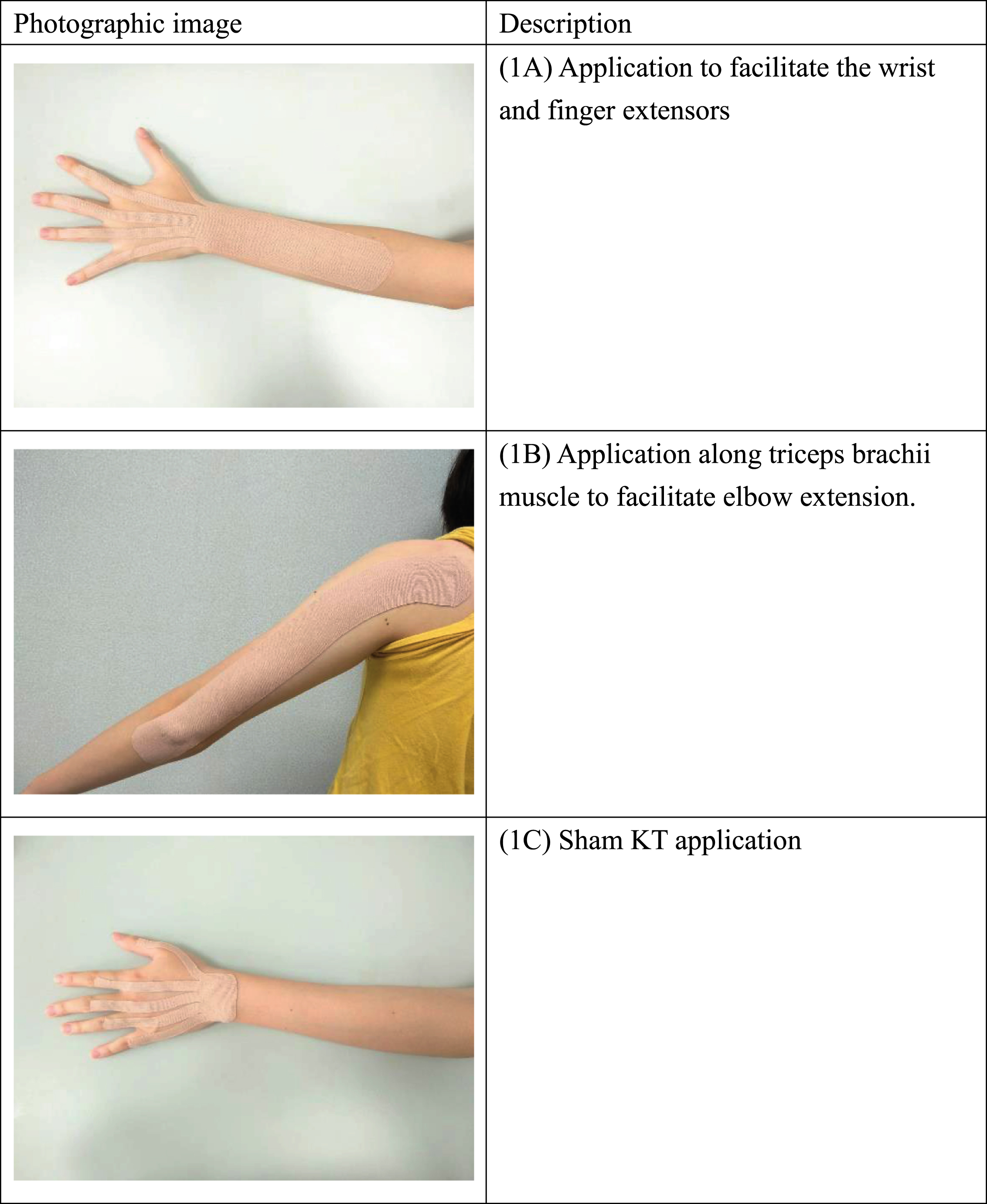
Image of application of Kinesio taping (KT) and sham taping (ST) for hemiplegic upper limb (1A) KT application on the affected forearm; (1B) KT application on the affected arm; (1 C) sham taping.
In the KT group, the patients received KT for five days per week, for three weeks. A 30-minute hand functional training was also provided once daily during the intervention. In the control group, the patients received sham KT for five days a week, for three weeks and a 30-minute hand functional training once daily. Additionally, conventional rehabilitation therapy, including one hour of occupational therapy and one hour of physical therapy, was performed five days per week for three weeks.
The primary outcome of our study was Fugl-Meyer assessment of the upper extremity (FMA-UE). The secondary outcomes were modified Ashworth Scale (MAS), modified Barthel Index (BI), and Stroke Impact Scale (SIS). Physical examinations for each patient included spasticity of the affected upper extremity, as measured by MAS. FMA-UE was used to evaluate upper extremity function. The BI was used to assess ADL, and the SIS was used to evaluate the QoL. All patients in this study were evaluated at the following time points: before intervention (baseline), immediately after three-week intervention (3rd week), and three-week post-intervention (6th week) as follow-up assessments.
This study followed the principles of the Declaration of Helsinki. The protocol of this study was approved by the Institutional Review Board (IRB) of Kaohsiung Chang Gung Memorial Hospital (IRB number: 201802320A3C502). All participants signed the written informed consent form for approval.
Fugl-Meyer assessment of the upper extremity (FMA-UE)
The FMA-UE is a stroke-specific impairment index consisting of five domains and a total of 155 items. Each item is scored on a 3-point scale: 0 (cannot perform), 1 (performs partially), and 2 (performs fully), resulting in a maximum total score of 226. The five domains assessed are motor function, sensation, balance, joint range of motion, and joint pain. The test-retest reliability for motor function, as measured by the intraclass correlation coefficient, is high at 0.972. For the other domains, the correlation coefficients range from 0.828 to 0.883, indicating good reliability overall. Additionally, the FMA-UE demonstrates good concurrent validity, showing strong associations with measures such as the Modified Ashworth Scale (MAS), grip strength, and Jebson-Taylor Hand Function Test (Kim et al., 2012).
Modified Rankin Scale (MRS)
The MRS is a 7-point scale, ranging from 0 (indicating no symptoms) to 6 (representing death), designed to assess the level of disability or dependency in patients regarding their mobility and daily activities (Lees et al., 2012). Inter-rater reliability for the MRS is moderate, with a kappa coefficient of 0.56, while test-retest reliability is strong, with kappa statistics ranging from 0.81 to 0.95. Additionally, its construct validity has been confirmed by several studies (Banks & Marotta, 2007).
Barthel Index (BI)
The BI is utilized to assess disability or dependency in activities of daily living among stroke survivors (Leung et al., 2007). The internal consistency of the Chinese version of the BI is excellent (Cronbach’s alpha = 0.93), with good reliability (kappa statistics ranging from 0.63 to 1.00) (Leung et al., 2007). Scores on the BI range from 0 to 100, with higher scores indicating lesser dependence in activities of daily living.
Stroke Impact Scale (SIS)
The SIS is a comprehensive assessment tool designed to evaluate the impact of stroke on various dimensions of a patient’s life. It encompasses multiple domains, such as physical function, mobility, hand function, activities of daily living, communication, emotion, memory, and participation in social roles and activities. With 59 items, each scored on a 5-point scale ranging from 1 (indicating inability or extreme difficulty) to 5 (indicating no difficulty), the SIS provides a detailed assessment of stroke-related impairments and limitations. The scale demonstrates good internal consistency, with Cronbach’s alpha coefficients ranging from 0.83 to 0.90, making it suitable for measuring changes over time. Test-retest reliability, as indicated by intraclass correlation coefficients, ranged from 0.70 to 0.92 across SIS domains, except for the emotion domain (0.57). Measures of disability, particularly in mobility and activities of daily living (ADL/IADL), exhibited excellent coherence with established measures, showing correlation coefficients between 0.82 and 0.84. Correlations for domains assessing memory and communication were more modest, generally ranging from 0.44 to 0.58. The participation domain displayed a moderate correlation with the SF-36 social function domain (0.70), while correlations with SF-36 emotional and physical role functions were lower at 0.28 and 0.45, respectively. Correlations between SIS domains and patients’ global ratings of recovery were good (0.53 to 0.63), with weaker correlations observed for memory, communication, and emotion (0.21 to 0.39) (Duncan et al., 1999).
Statistical analysis
Statistical analyses were performed using SPSS software version 21.0 (IBM Corp., Armonk, NY, USA). Fisher exact tests were used to analyse the categorical variables including sex and hemiparetic side. Mann-Whitney U tests were used to compare the between-group differences in numerical variables including age, height, weight, onset duration since the stroke, FMA-UE, MAS, and SIS. The Friedman test was used for within-group comparisons of the aforementioned parameters between the three assessment times. For missing data, an intention-to-treat analysis with a multiple imputation technique was used (Jakobsen et al., 2017; Rubin, 1987). Manual Bonferroni Correction was applied, which changed the significance level from 0.05 to 0.017. Finally, the effect size was assessed using Cohen’s d test.
Results
After the initial evaluation, forty-one participants were eligible for randomization. The flow diagram is shown in Fig. 2. Twenty-one participants (10 men and 11 women; median age, 54 years; median duration since stroke onset, 108 days) were allocated to the KT group and 20 participants (10 males and 10 females; median age, 61.2 years; median duration since stroke onset, 99.5 days) were allocated to the control group. There were missing values in FMA-UE, SIS, MAS and were replaced with multiple imputations as mentioned above.
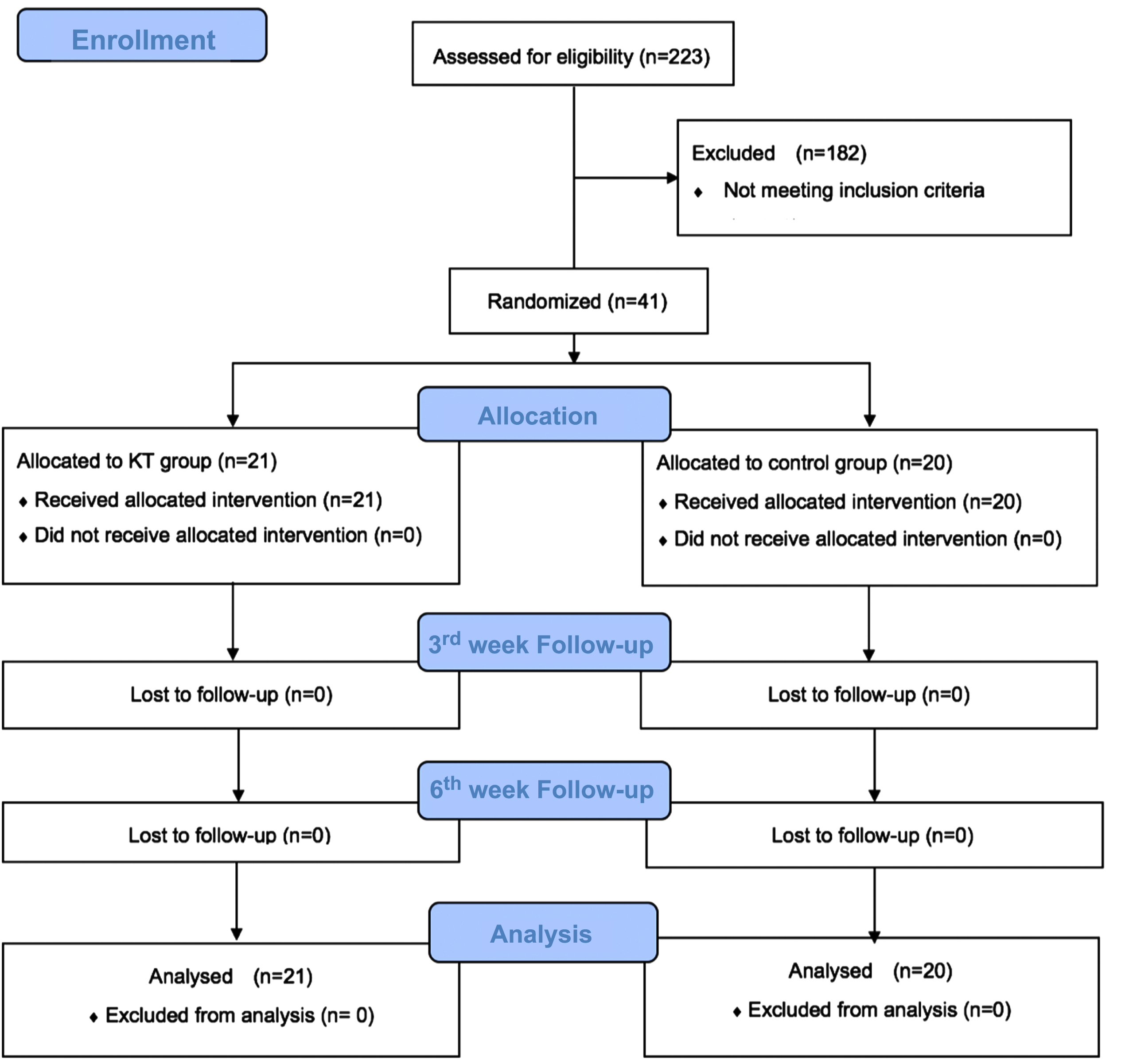
Flow diagram of the study.
Table 1 shows the clinical characteristics of all patients with stroke in the two groups. There were no significant differences in the general characteristics including age, sex, height, weight, hemiplegic side, onset duration of stroke, MAS, SIS, BI, and FMA-UE between the KT and control groups at baseline. The within-group comparisons of functional outcomes in patients with stroke are shown in Table 2. In the KT group, there were significant differences in the upper extremity, wrist, and hand parts of FMA-UE (p = 0.003,<0.001,<0.001), and BI (p < 0.001) between the three assessment times. The Cohen’s d value for FMA-UE is 0.751, which is considered a large effect size. No significant findings were found in the SIS between the three assessment times. In the control group, there were no significant findings in the FMA-UE, and SIS among the three assessment times. There was a significant difference in BI at the three assessment time points. There were no significant findings regarding MAS in either group. Additionally, no adverse events were reported in both groups.
Clinical characteristics of stroke patients in the control and KT groups
IQR = interquartile range. *P < 0.05
Within-group comparisons of functional outcome in KT / control groups
IQR = interquartile range; FMA-UE = Fugl-Meyer Assessment-Upper extremity; MAS = modified Ashworth Scale. P: within-group comparisons of the results between three assessing times. *P < 0.017.
The objective of this study was to examine the clinical advantages of applying KT to enhance the recovery of motor performance on not only the distal but also the proximal part of the affected upper limbs and daily activities among stroke survivors. In this randomized control study, we found that stroke survivors in the KT group had significant improvements in upper extremity part regarding FMA-UE compared to the findings in the control group, which reinforces the benefits of applying KT to the proximal extremity. Furthermore, since our results were near the threshold for a large effect, indicating that the difference in changes was not only statistically significant but also practically significant. Significant improvements were also found in the wrist and hand parts of FMA-UE after KT intervention. All these results highlight the potential of KT application in improving motor function in stroke survivors with hemiplegia.
In stroke survivors with hemiplegia, it has been widely reported that conventional hand rehabilitation could have positive effects on motor performance in the affected upper limb (Winstein et al., 2016). Our previous study found that KT application combined with conventional rehabilitation or constraint-induced movement therapy on the forearm may be contributed to better motor performance and reduce spasticity in the upper extremity (H.-C. Hsieh et al., 2021; Y. C. Huang et al., 2019). In this study, we used KT not only on the affected forearm but also on the affected arm (the triceps muscle) to provide sensory input and motor facilitation during task training for the affected upper extremity. According to the results of our study, the functional performance of both the arm and forearm on the affected upper extremity got significant improvement after KT intervention. This result is similar to those of our previous studies (H. C. Hsieh et al., 2021; Y. C. Huang et al., 2019) as well as another recent study (Lerma Castano et al., 2020). However, the spasticity in this study was not reduced in either group, which is different from our previous results (Y. C. Huang et al., 2019). This result may be explained by the fact that the spasticity in the affected upper extremity of the participants in this study is relatively lower than that observed in previous studies. Hence, KT did not demonstrate an effect in reducing spasticity in this study. The improvement in upper limb function can be linked to the mechanical support, proprioceptive feedback, and neuromuscular facilitation provided by KT, rather than a reduction in spasticity or a direct improvement in strength (Jaraczewska & Long, 2006).
Previous researchers reported that increasing the ability for ADL and reducing post-stroke depression play the major roles for improving health-related quality of life in patients after stroke (Li et al., 2023). In this study, the conventional rehabilitation with additional KT applied on the arm and forearm could significantly provide more improvements in the motor function and in basic ADL in stroke survivors. However, we did not find the improvements presented in the QoL. For evaluating the changes of the QoL after intervention, we use stroke impact scale, including strength, hand function, basic ADL/instrumental ADL, mobility, communication, emotion, memory and thinking, and participation. The scale involves both motor and non-motor domains to assess the life quality, which is a more complicated indicator of general health condition, in patients with stroke. Therefore, we considered multidisciplinary rehabilitation not only to focus on facilitating motor performance, but also to further provide psychological therapy and mental support would be more beneficial to improve life quality in stroke survivors.
This study is not without limitations. First, there was a lack of long-term follow-up to reveal longer positive benefits of functional outcomes on the proximal and distal upper extremity, as upper motor neuron lesions typically require months to manifest significant changes. Therefore, further studies to evaluate the effectiveness of KT with a longer follow-up period are warranted. Second, this study had a limited sample size, comprising a total of 41 enrolled patients. Third, we did not record the usage of muscle relaxant agent or adjust for this confounder in the statistical model. Although we did not enroll subjects with moderate to severe spasticity, our results could be confounded. Further studies with more rigorous research designs are needed.
Conclusions
KT application on both arm and forearm combined with conventional rehabilitation could provide better arm function on not only the distal but also the proximal part of the hemiplegic upper extremity in stroke survivors at the subacute and chronic stage. Furthermore, applying KT may also have a potential effect in enhancing the activity of daily livings.
Footnotes
Acknowledgments
The authors would like to express their sincere gratitude for the assistance provided by Chia-Chun Jou with the data analysis. Also, this research would not have been possible without the cooperation and participation of the study participants. The authors acknowledge the financial support received from the Ministry of Science and Technology Grants (NMRPG8J0221) and the Chang-Gung Medical Research Project (CMRP number: CMRPG8M0431). The authors thank everyone who contributed to the realization of this work.
Conflict of interest
The authors declare that they have no relevant material or financial conflicts of interest that relate to the research described in this paper.
Funding
This study was supported by research grants from Ministry of Science and Technology Grants (NMRPG8J0221) and the Chang-Gung Medical Research Project (CMRP number: CMRPG8M0431).