







Abstract
BACKGROUND:
Work tasks in pineapple plantations in Malaysia are characterised by non-ergonomic work postures, repetitive tasks, awkward posture and manual handling of work tools that contribute to the reporting of musculoskeletal symptoms (MSS). There have been very limited studies performed among pineapple plantation workers focusing on ergonomic intervention programs to specifically reduce MSS.
OBJECTIVE:
The aim of this study was to assess the effects of work improvement module using a Kiken Yochi participatory approach intervention in reducing MSS among male migrant pineapple farm plantation workers in Pontian, Johor.
METHODOLOGY:
In this interventional study, a total of 68 male migrant workers from two plantation farms were invited to become a participant in this study. In total, 45 participants that consisted of 27 workers for the intervention group and 18 workers for the control group were recruited. The background of workers and MSS were assessed using questionnaires. Ergonomic and postural risks were evaluated and the work tasks with the highest risk were used as a basis for the development of the Kiken Yochi training module. MSS education and training intervention that provided information on proper lifting techniques and education on body mechanics and ergonomics to reduce MSS were implemented to both groups of workers. Kiken Yochi Training was given to the intervention group only. MSS were reassessed after 2 months of the follow-up period. Data was entered into statistical software and were analysed according to objectives.
RESULTS:
In terms of the postural risk assessment, almost two-third of the participants (68.5%) had working postures categorized as high risk for MSS. Ergonomic risk assessment identified cultivation, manual weeding and harvesting of pineapples as the work tasks contributing the highest health risks to workers. The most commonly reported MSS between both groups of workers were at the knees, lower back and shoulder area. Upon completion of the delivery of intervention module to both groups of workers, the MSS prevalence reported (after 2 months) were significantly lower for the ankles and feet area within the intervention group.
CONCLUSION:
This study suggested that development and implementation of programs using effective participatory approach training methods are able to prevent selected musculoskeletal problems for this occupation. To enhance the effects of such trainings, modifications of work tools in this occupation are desirable.
Introduction
Musculoskeletal diseases (MSDs) are very prevalent in the agricultural sector. MSDs can cost the farming industry loss of productivity [1] and causes problems in many forms to the workers and employers such as disability and lost work time. MSDs related to the back area have been the most commonly reported MSDs among agricultural workers. In one recent study, more than half (55%) of the natural rubber processing workers in a plantation in Portugal reported to experience low back pain while in contrast, only one-fifth of the workers reported experiencing carpal tunnel syndrome (19%) [2]. The study linked ergonomic problems arising from awkward work posture and highly repetitive work to the reported symptoms. The extent of MSD problem in developing countries such as Malaysia is reported on a larger scale. In one study among pineapple plantation workers, it was revealed the body parts most affected by MSDs were the lower back (64.8%) followed by the ankles and feet (53.7%) and the knees (52.8%) [3]. Malaysia is one of the countries that consider agriculture as a vital sector to the economy; therefore work-related MSD problem in the agricultural settings needs to be assessed and adequately controlled.
Since MSDs cause many absences, heavy economic losses, and reductions in productivity [4], intervention approach in the workplace training has been employed to reduce the size of this problem. In literature, interventions to reduce MSDs such as Participatory-Action Oriented Training (PAOT), Work Improvements in Small Enterprises (WISE), Work Improvement in Neighbourhood Development (WIND) and Ergonomics Checkpoints in Agriculture has been created specifically for the agricultural and small-medium enterprises setting. There have been several reports of interventions involving participatory approaches in reducing MSDs and participatory ergonomic approach interventions are one of the known avenues [5].
Kiken Yochi Training is an example of such approach used to create a safe workplace [6]. Kiken Yochi originated from Japan and is a Japanese term for hazard prediction. It has been introduced since the year 1974 [7]. The purpose of Kiken Yochi Training is to enhance the ability of first-line employees to anticipate potential hazards in their workplace, in order to discover hazards that they could cause themselves and to ultimately ensure workers work in accordance with safety operating procedures. Kiken Yochi Training is a four-step approach that consists of a several key activities such as discussion, evaluation, planning and implementation [8]. This approach uses illustrations to represent work task or workplace and through a discussion, workers learn to anticipate potential hazards in the work procedure and workplace in order to minimise the risks to safety and health. Kiken Yochi has been frequently used in the manufacturing or processing industries and several well-known corporations such as Tokuyama Corporation that produces chemical products, Zeon Corporation that produces petroleum-based products, NGK Spark Plug Corporation that produces spark plugs and Hitachi Chemical Corporation which manufactures chemicals has reported the use of Kiken Yochi at the workplace.
Malaysia has become one of the few countries to produce export-based pineapple or Ananas comosus in Latin for consumption worldwide [9]. This clearly indicates that the pineapple production industry in Malaysia is steadily expanding in tandem with increasing market demand. Despite the increased market demand, workers continue to operate work tasks using manual and traditional tools from the stages of pineapple growing to the harvesting of pineapple fruits [3]. All of the work tasks in pineapple plantations are characterised by non-ergonomic work postures, movements and repetitive tasks that have been linked to reports of MSD at various parts of the body [10]. Since pineapples grow low on the ground, workers needs to assume awkward postures such as stooping or constant bending to perform work-related tasks. Taking into account the various risk factors which pineapple plantation workers are exposed to, it is not surprising that the reported Musculoskeletal Symptoms (MSS) experienced by the workers is high [3, 10]. Nevertheless, there have been very limited studies performed among pineapple plantation workers focusing on ergonomic intervention programs to specifically reduce MSS. Therefore, taking the participatory approach of the Kiken Yochi training method into consideration, it is hypothesised that MSS among pineapple plantation workers who are exposed to ergonomic risk factors can be reduced.
The aim of this paper is to assess the effects of a work improvement module using Kiken Yochi Training approach to reduce MSS among male migrant pineapple farm plantation workers in Pontian District, Johor. To the best of our knowledge, this study will be the first study reported in Malaysia using Kiken Yochi Training method among an agricultural population and its effectiveness in reducing musculoskeletal risks would contribute a basis to a more extensive application of the participatory approach in other agricultural settings in Malaysia or in other neighbouring countries in Asia.
Materials and methods
Ethics approval
The University Ethics Committee Involving Human Subjects of the Universiti Putra Malaysia approved the protocol of this study. All ethical consideration as specified in the protocol of this study was adhered to.
Study setting
This study took place in Johor, a state in the southern province of peninsular Malaysia. Johor is the main state to produce pineapple in Malaysia and has been producing pineapples since 1921. Malaysia, in particular the state of Johor has been known as one of the major pineapple growing countries in the world has been cultivating the crop on peat soil, which is often characterised as a soft and uneven base of land.
Study design
An intervention study was conducted using a questionnaire-based face-to-face interview method, direct observations of the daily work tasks and a video-based analysis of the working postures. In this study, the working postures of participants were recorded while they were performing work tasks at the pineapple plantation. The purpose of video recording was to observe and assess the hazard specifically the ergonomic risk factors faced by the workers during their work activities. The video recording was also used for video-based analysis of their working postures. Finally, training interventions were then given to participants and the results were followed-up after a period of 2 months.
Study population
The management of two pineapple plantations in Johor were solicited to take part in this study. The selection of these pineapple plantations were based on homogeneous characteristics of the workplace on the aspect of (1) the total size of the plantation, (2) the total number of workers and (3) work process which includes manual handling. The inclusion criteria for the workers to be included in this research were those who (1) have been working for one year as pineapple workers, (2) between the ages of 18 to 55 years old and (3) working 8 hours per day at the pineapple plantation. The workers who had any history of injury related to musculoskeletal system (e.g. fracture, rheumatoid), have any chronic disease or have a part-time job were excluded from this research. Participants for this study were migrant workers for no other reason simply being that all the pineapple plantation workers were of Indonesian origin. To facilitate their understanding in all communication, the fieldwork of this study was conducted in the Malay language.
Sample size
In order to determine the sample size required for this study, the prevalence of MSD among palm oil harvesters in a study located at the southern part of peninsular Malaysia was used as a reference [11]. The prevalence of the total reported MSD was 94% and after considering a 30% attrition rate, a total of 8 persons were added into each group (26 persons per group) to compensate the probability of dropouts. Therefore, the total estimated number of participants required was 68 workers with 34 workers for each of the intervention group and the control group.
\enlargethispage 2pt
Sampling procedure
The name list of the pineapple plantation workers were obtained from the management of each of the invited plantation. From the name list, a cluster sampling method was used for the selection of participants. All workers at the pineapple plantations who meet the inclusion criteria were selected to participate in this study using simple random selection method.
Data collection
The flow chart of the data collection procedure is presented in Fig. 1. In brief, this study is made up of three separate phases. In this first phase of study, the answering session for the Standardized Nordic Questionnaire (SNQ) [12] and postural risk assessment using Rapid Upper Limb Assessment (RULA) [13] were conducted. Upon completion of the questionnaire-based interview, the working postures of 54 participants were video-recorded for the purposes of Hazard Identification, Risk Assessment and Risk Control (HIRARC) [14] and RULA. The outcome of this exercise was the identification of work tasks categorised as high risk from the analysis performed in the HIRARC and RULA results. These work tasks were then incorporated into the development of training modules for the next phase of this study.
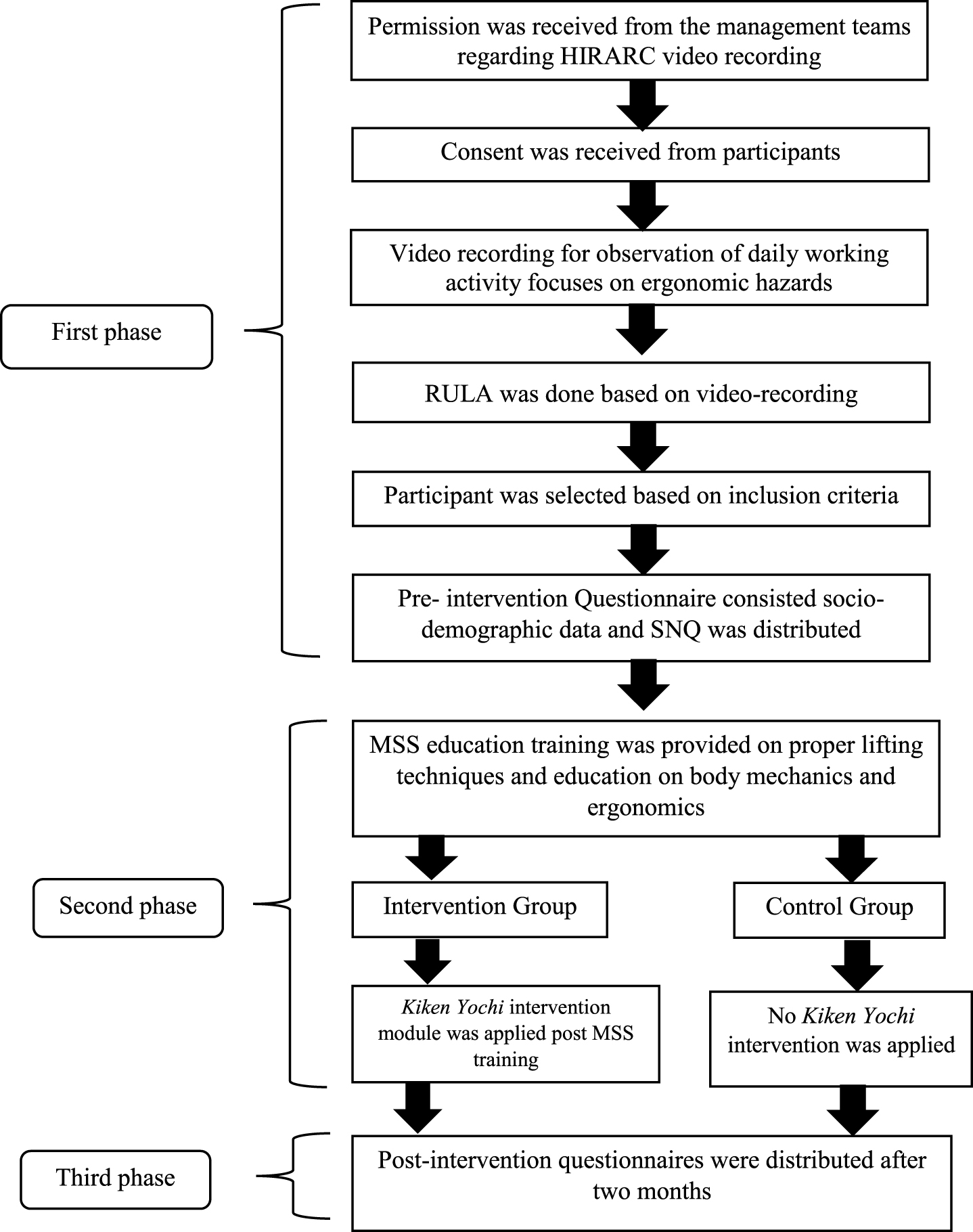
Flow chart of data collection procedure.
In the second phase of this study, training interventions was given to the study participants in the intervention and control groups in a series of separate sessions. The trainings were conducted for approximately 20 minutes per session in a group of six participants. For both groups, MSS education and training was provided on risk factors of MSS, incorrect working postures followed by an acceptable or correct work postures, stretching exercises suggested for different periods of time such as in the morning, before work and during resting time, proper lifting techniques and information on body mechanics to reduce MSS.
In addition to the MSS education and training, the intervention group were given the Kiken Yochi Training after 7 days of the initial training session. Each participant in the intervention group was asked to identify ergonomic hazards using printed illustrations of awkward posture related to their work. Illustrations were developed using the risk assessment information collected during the first phase of data collection. Next, participants were required to state the countermeasures for the correct postures and actions that could be practiced in order to eliminate the hazard. When the countermeasures are identified, the finger-point-and-call method was then performed. The best actions and postures selected by participants were based on their discussion.
For the third phase of this study, post-intervention interview-based questionnaires were administered to all participants in the intervention and control groups after a 2 months interval period. The post-intervention questionnaires were used to assess MSS in the 2 months after the implementation of the intervention.
All collected data were entered into statistical software and were analysed according to the objectives of this study. Descriptive statistics were used to summarize the socio-demographic data, lifestyle, occupational information and the distribution of MSS and RULA scores of various body regions of the participants. McNemar statistical test were performed in order to determine the differences in the MSS distribution pre and post intervention.
Results
A total of 54 participants had consented to participate in this study. The number of participants in the intervention group was 30 while the control group consisted of 24 participants. At the end of the intervention, there were only 27 participants who remained in the intervention group while the control group had only 18 participants left. The flow process of the participation in this study is as shown in Fig. 2.
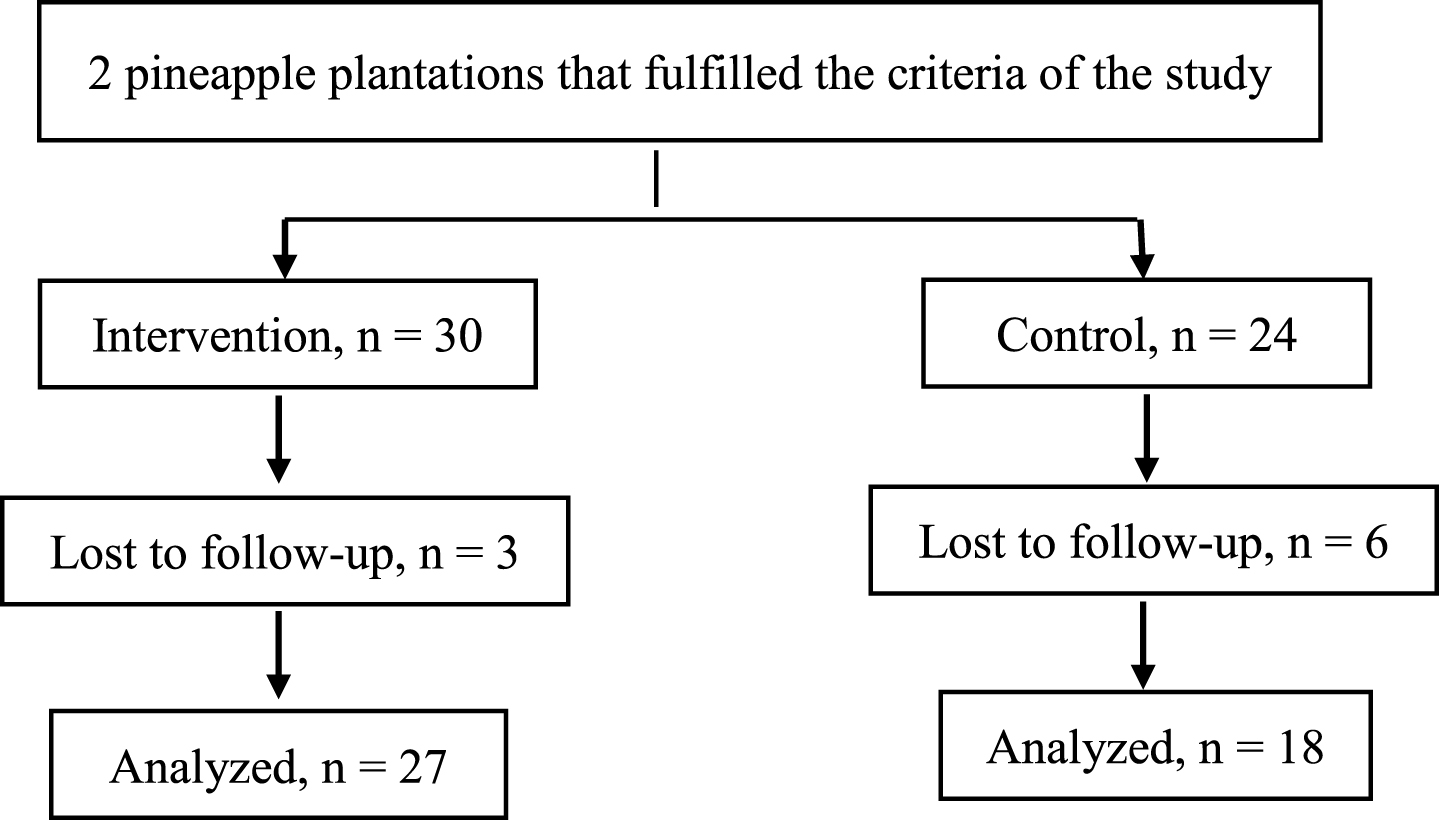
Flow process of the intervention and control administration.
The socio-demographic characteristics, lifestyle and occupational information are summarized in Table 1. The mean (standard deviation) age of the study participants was 33.69 (9.86) years old. Approximately 70% of the participants had normal body mass index (BMI). In term of smoking, more than half of participants (55.6%) were smokers. Most of the participants (74.1%) had attained a secondary level of education. In terms of work tasks, about 24.1% (n = 13) of the workers were involved in the activity of cultivation while 22.2% (n = 12) of the workers performed harvesting tasks daily. Most of the study participants have had working experience of four to ten years (44.4% , n = 24) or three years and less 42.6% (n = 23).
Socio-demographic characteristics of pineapple plantation workers (n = 54) across categories of control and intervention group
n = 54 participants, χ2 = chi square test, *significant at p < 0.05, BMI = body mass index.
In terms of the postural risk assessment, almost two-third of the participants (68.5%) had working postures categorized as high risk for MSS (RULA score of 7). Approximately 30% of the participants had working postures categorized as medium risk for MSS (RULA score of 5 to 6) while only one worker (2%) had a low risk working postures (RULA score of 4). None of the workers had a RULA score lower than 3, which indicates a working posture with negligible risk for MSS. The work task with the highest risk was cultivation and harvesting because one-fifth of the workers who performed these tasks scored the highest MSS risk. This was followed by the task of manual weeding. None of the workers involved in the task of fertilizer application had working postures categorized as high risk for MSS. The details of the RULA scores are presented in Table 2.
Distribution of Rapid Upper Limb Assessment (RULA) results for pineapple plantation workers within the control and intervention groups across work tasks performed in pineapple plantation farm
*RULA Score of 4: Working postures with low risk for MSS RULA Score of 5-6: Working postures with medium risk for MSS RULA Score of 7: Working postures with high risk for MSS.
The results for the HIRARC were obtained from the semi-quantitative analysis of the likelihood and severity matrices [14] and will only be narratively explained (data not provided). Similar to the RULA outcome, cultivation, manual weeding and harvesting were the three work tasks categorized as high risk from the HIRARC (a risk rating level of 15). In the risk matrix, the rating of the likelihood scale for the three work tasks was 5, which indicate the highest likelihood of the hazard or event being realized. While in terms of the severity scale, the rating of 3 that was equivalent to serious was considered. In the matrix, the rating of 3 represents non-fatal injury with the possibility of permanent disability.
Kiken Yochi training module was developed based on the hazards arising from the work tasks of cultivating, manual weeding and harvesting and was successfully given to the workers in the intervention group. Tables 3 and 4 compared the distribution of MSS reported in pre- and post-intervention in nine different body regions for both groups. Within the intervention group, the past 12 months prevalence of MSS at the ankles/feet were significantly different at the end of the 2 months follow-up period. In terms of the control group, there was no significant difference for the prevalence of MSS in any of the body region.
Comparison of MSS prevalence (for the past 7 days) at pre- and post-intervention (2 months period) time point in nine body regions as reported by pineapple plantation workers
Comparison of MSS prevalence (for the past 12 months) at pre- and post-intervention (2 months period) time point in nine body regions as reported by pineapple plantation workers
* p is significant when <0.05.
This study implemented Kiken Yochi training intervention to reduce MSS among male pineapple plantation workers. Within the best of our knowledge, this is the first study conducted in Malaysia incorporating Kiken Yochi training methods that have been specifically tailored to the pineapple plantation sector to reduce MSS. The basis of Kiken Yochi Training is that it will help workers to recognize and identify the types of accidents that may arise from risk factors at the workplace or in the course of a work task and determine the danger points and action plans. Kiken Yochi Training results in increasing the awareness of workers towards danger and motivation to practice in teams and share information regarding hazards [15]. Consequently, these cause a reduction in human errors and at the same time improve safety performance [16].
This study found that MSS mostly affects the lower back and knees area. Musculoskeletal pain at the lower back area is common and affects workers in many types of occupation related to manual work [17, 18]. The symptoms of musculoskeletal problems as reported in literature includes pain, swelling in the joints, stiffness, numbness, tingling, clumsiness, loss of coordination, loss of strength, skin discoloration and difficulty moving in activities either at work or during leisure time [19]. This study was based on self-reported symptoms collected using SNQ to identify the prevalence of MSS without the diagnosis of a physician. The results in this study is parallel with the study reported earlier among pineapple workers where the most affected body parts were the lower back (64.8%), the ankles and feet (53.7%) and the knees (52.8%) [3]. This previous study that took place in one of the largest pineapple plantation in Johor reported that the work tasks in the pineapple sector involved demands such as lifting loads weighing more than 30 kg, awkward body postures and repetitive movements. Specific to the tasks in the pineapple plantations, postural problems are most common. Prolonged bending, heavy lifting, stooping and squatting cannot be avoided and were found in most of the work tasks in the pineapple plantation as reported in the previous [3] and in this present study. Such risk factors can also be found in other types of manual occupations and even housework in rural households [18, 20].
Based on the HIRARC outcome, cultivation, manual weeding and harvesting were the three work tasks categorized as high risk (i.e. a risk rating level of 15 or more) in the pineapple plantations. According to the Department of Occupational Safety and Health (DOSH) Malaysia, a high risk outcome requires immediate action to control the hazard as detailed in the hierarchy of control [14]. These results were similar with the outcome of the ergonomic risk assessment in the present study where the results of RULA identified similar work tasks as being high risk. Improvements in the method to perform the three work tasks were identified and compiled to develop the Kiken Yochi Training module and to ensure that the improvements tally with the risk factors of MSS, inputs from physiotherapist and occupational medicine doctors were obtained for each of the suggested improvements.
This study was able to show that significant reduction of MSS prevalence was reported for the ankles and feet at the end of the 2-month follow-up period. This results can be supported by the fact that the given Kiken Yochi Training was focused on the lower back and the lower extremities such as the knees, ankles and feet for the reason being that these body parts were mostly affected in the tasks of cultivating, harvesting and manual weeding. Details of these tasks obtained from the observational part of this study and the HIRARC exercise is as follows; 1) For cultivation, workers plant young trees in a ready-made hole in the ground. It was observed that the workers had to constantly bend their trunk at an angle of more than 90° for an average duration of 6 hours. The workers reported musculoskeletal discomfort at the knees and feet. 2) In the task of harvesting, pineapple fruits are collected by the workers and placed in a knapsack basket carried on their back that weighs up to more than 50 kg. The movement of workers while carrying heavy load is made difficult due to the uneven peat soil. From the HIRARC exercise, workers reported musculoskeletal pain at the low back area and at the knees. 3) In the task of manual weeding, workers are required to remove weeds by hand. Workers will alternate between standing and bending of the trunk at an angle of more than 90° for the whole duration of 6 hours. Similarly, workers reported musculoskeletal pain at the low back area in addition to the pain at the knees and feet.
The workers reported no other reduction in the prevalence of symptoms although it was initially hypothesised that a broad reduction of MSS at various parts of the body region was expected at the end of the 2 months period. Several reasons can be considered to help explain the results. Firstly, during the training, workers were taught to perform work using the correct work postures, but the intervention given does not reduce the high physical demands required to perform any of the work tasks in the pineapple plantations. Secondly, from the post-intervention questionnaire, it was found that several of the workers did not agree to change their work posture and reduce the weight of pineapples in the knapsacks (for harvesters) because this will slow the speed of working and reduce their productivity. This finding was also parallel with the study done among oil palm plantation (OPP) harvesters at South Peninsular of Malaysia found participants did not agree on proposing changes of behaviour in order to reduce ergonomic risk factors of MSDs such as awkward postural and excessive manual handling [11].
Thirdly, Kiken Yochi should be practiced and applied daily and not only performed for the duration of a training session. In Japanese companies, Kiken Yochi is performed every morning before work. The activity of performing Kiken Yochi during all working hours is called Kiken Yochi Katsudou. Also, supervision and involvement of managers is necessary in order to ensure Kiken Yochi Training is successfully implemented. In this study, supervisors and managers were not involved as participants in the training sessions to avoid intrusion of their schedule.
Lastly, this study found that pineapple workers depend solely on traditional methods in completing their gruelling tasks daily. It is difficult for educational program to gain effect in preventing work-associated low back injury [22] as such it is suggested that manual tools be swapped with improved tools in the prioritizing of control methods before such participatory approaches are implemented. As an example, the study done among tealeaf plucking workers in India studied the effects of using an improved tea plucking basket which was ergonomically designed that fits the back curvature of the workers [23]. The result showed the significant reduction of energy expenditure and MSDs as reported by the participants in the study.
Limitation and strength of the study
There were several limitations in this study that needs to be considered. The finding was limited to male workers since all of the workers at the selected pineapple farm plantations were coincidently males. There is also plantations in Malaysia where women are among those who are employed to work in the plantation fields. As such, the results cannot be generalised to both genders. Furthermore, the pineapple plantations involved in this study fully employed migrant labour workers as their main manpower. The length of employments for migrant workers in this study is averaged at 5 years unlike other plantations that employed local workers in which these workers have more than 10 years history of tenure [3]. As such, the severity of the MSS is expected to border on high as compared to what is reported in this study. The findings of this study is also limited to the fact that the authors could not ascertain whether the participants in this study fully applied the Kiken Yochi Training in their daily work or there were unreported lapses. As such, it might be possible that the benefits of the Kiken Yochi Training will be more pronounced if there was a method to ensure workers perform the participatory approach daily. Lastly, recall bias were also a potential limiting factor in this study. The method for interview-based questionnaires has inherent drawback such as difficulties to recall health symptoms. The strength of this study includes that this is the first study in Malaysia conducted using Kiken Yochi Training methods in reducing MSS among agricultural workers. Kiken Yochi Training has been often implemented in manufacturing industry but no studies in Malaysia have reported its effectiveness even in any industrial settings.
Conclusions
This study suggested that development and implementation of training programs using effective participatory approach methods that can be practiced daily are able to prevent selected musculoskeletal problems for this occupation. For this specific agricultural sector, improvements of working tools are desired before the effects of ergonomic training methods can be more pronounced. Adopting newly innovative modifications on existing tools coupled with suitable ergonomic training methods such as Kiken Yochi can help ensure the safety and health of workers and help increase the productivity of the Malaysian agricultural sector.
Conflict of interest
None to report.
Footnotes
Acknowledgments
Special thanks are owed to all participants and the management of the pineapple plantation farms included in this study. This study was financially supported by the Pak Rashid Foundation Grant Fund with project number 6300182. The authors would like to thank the sponsors for the scholarship support. Appreciation is also due to Dr. Saari Mohd Yatim and Puan Suhana Hani binti Bastani from the Rehabilitation Centre, Hospital Serdang, Malaysia for the input given on the development of the ergonomicintervention.