







Abstract
BACKGROUND:
Wooden Steel Chairs (WSCs) and Stackable Arm Chairs (SACs) are widely used in tertiary institutions of learning in low income countries. No local studies seem to have investigated the postural risk associated with the concerned chair type.
OBJECTIVE:
This study aimed to evaluate the postural risk associated with WSCs and SACs. It also determined the anatomical distribution of musculoskeletal complaints among users of the chair types.
METHODS:
Purposive sampling was used to select 100 desktop computer users (23.25±1.6 years) of which 50% consistently used a computer laboratory with WSCs and the other half used one with SACs. The Rapid Upper Limb Assessment (RULA) method was used to evaluate the sitting posture of users of both chair types. Musculoskeletal complaints were investigated using the Nordic musculoskeletal questionnaire.
RESULTS:
Analyses showed significantly higher (p < 0.05) mean RULA scores for the right side of the body for users of WSCs (6.08±0.85) compared to users of SACs (5.26±1.23). Statistically significant differences (p < 0.05) were found on the prevalence of lower back pain between users of WSCs and SACs. Among all study participants, 72% reported musculoskeletal pain at one or more body parts in the previous 12 months. Self-reported complaints pertained to the neck (24%), lower back (19%), shoulders (16%), elbow (8%), upper back (8%) and wrist (4%).
CONCLUSION:
WSCs seem to pose a higher postural risk for lower back pain than SACs. Ergonomics interventions and exercise training programmes may be useful to address the poor working posture and musculoskeletal complaints.
Keywords
Introduction
Previous studies indicate that there is lack of coverage of many sectors by existing occupational health and safety services in low- and middle-income countries [1–3]. In such countries, ergonomics is currently a negated field which lacks relevant legal instruments and expertise [2, 4]. This may imply that there is lack of adequate monitoring of ergonomic hazards in low- and middle-income countries. An effective monitoring system would require evidence from scientific research pertaining to priority ergonomic issues of local context that require surveillance, correction and regulation.
Musculoskeletal disorders (MSDs) have been described as injuries that affect tissues such as muscles, bones, tendons, cartilage, and ligaments [5]. Pain, numbness and fatigue of concomitant and non-concomitant nature have been reported as symptoms of MSDS [6]. Studies report that several factors contribute to MSDs. For example, long time sitting [7] and improper sitting [8] contribute to lower back pain. Desktop computers are nearly always used in seated rather than standing position. Adolescents regularly use computers in prolonged sitting positions when typing assignments, accessing online social networks and playing computer games [9]. In Zimbabwe’s tertiary institutions of learning, sitting devices such as Wooden Steel Chairs (WSCs) and Stackable Arm Chairs (SACs) are widely used. However, no study in this country appear to have investigated the postural risk associated with the use of these chair types.
The Rapid Upper Limb Assessment (RULA) is a useful method for the assessment of sedentary tasks [10] such as the sitting posture when using WSCs and SACs. It is a validated and reliable method which was developed to identify unsafe upper limb working postures requiring correction [11–13]. The objectives of present study were to (i) evaluate the postural risk associated with WSCs and SACs using the RULA method and (ii) determine the anatomical distribution and severity of musculoskeletal complaints among users of the chair types using the Nordic musculoskeletal questionnaire [14]. Findings from the study are useful for implementing ergonomics interventions.
Methods
Study setting and participants
A cross-sectional survey was conducted between February and May, 2017. The study was carried out in computer laboratories that had been designated for specified academic programmes at a local university. There are numerous approaches to determining the required sample size and these include: (i) imitating a sample size of similar studies, (ii) use of published tables, and (iii) applying specific formulas [15]. Several postural risk assessment studies that similarly used the RULA method had sample sizes which comprised about 15–100 participants [12, 16–20]. Of these studies, where two sub-groups were used and compared, each sub-group was about 50% of the sample size [12, 18–20]. In the present study, postural risk assessment was performed on 100 desktop computer users. Two laboratories using either wooden (Agriculture students, n = 50, drawn from a total of 67) or stackable (Environmental Science, Natural Resources and Geography students, n = 50, drawn from a total of 113) chairs were identified. Participants were purposively selected. The study conditions were more or less the same in both laboratories except for the chair type. In both laboratories: (1) desktop computers were used, (2) students’ routine computer usage activities were internet searching, typing, accessing online social networks, and playing computer games, (3) participants were full time students with at least a year in the university, (4) participants spent at least six hours per week using a computer and (5) none of the participants had prior known postural training on the ergonomics of sitting. The study was carried out in a real life learning environment (computer laboratory).
Participants with self-reported pre-university enrolment health problems were excluded in this study since their clinical manifestations also entail pain related body complaints. The health problems of concern included musculoskeletal complaints, neurological conditions (e. g. spina bifida) and other medical conditions (e. g. arthritis and pregnancy). This study received ethics approval from the institutional review board of the author’s university (Ref. 011/2017) and was carried out in conformity to the Helsinki ethics guidelines [21]. In particular, all participants were informed about the purposes and procedures of the study and gave verbal and written consent. Names of the participants were not captured in this study in order to protect their anonymity. The photographs were taken by trained research assistants and each signed confidentiality forms.
Data collection
The RULA method was utilised to measure the possible postural deficits with regard to sitting for the 50 students using WSCs and 50 using SACs. It uses postures codes which range between 0 and 4 where 1 is a safe posture, for example neck flexion (0–10°). Four (4) is considered an extremely unsafe position, for instance it applies in scenarios when the neck is bent in extension. The postures codes were assigned on the upper and lower arms, wrist, neck and trunk taking into account the angles at the joints, weight and duration. The cumulative RULA scores were calculated using the procedure elaborated in previous literature [10–13]. Photographs of the study participants were taken and analysed using the RULA method [10]. Postural scoring for each photograph was carried out two independent trained raters (FN and PD). Approximately 10–15 minutes were taken to rate each participant. On average, the level of agreement between the raters ranged from 86% to 92%, with regards to all RULA items. When discussing the scores to reach a consensus, photographs were by raters as a reference point.
According to the RULA method [10–13] posture A comprised scores for the (i) upper arm, (ii) lower arm and (iii) wrist. These scores were combined using Table A, as per the RULA method. Posture B comprised scores for the (i) neck, (ii) trunk and (iii) legs, combined by using Table B. Then, the scores for the muscle use and force load were added to the posture A to get score C and to posture B to get score D. Table C (as per the RULA method) was applied to combine the scores C and D, in order to obtain the grand RULA score. According to McAtamney and Corlett [10] the grand RULA scores of: (i) 1-2 denote a negligible risk, (ii) 3-4 represent a low risk, (iii) 5-6 depict a medium level of risk and (iv) risk scores above 6 represent a high risk. In addition, each risk level denotes the category of the action level [10]. The negligible risk level requires action level 1, which means the posture is considered to be acceptable and no changes are required. The low risk category corresponds to action level 2, which denotes a need for further investigation and implementation of changes. The medium risk category represents action level 3, which shows that further investigation and changes are needed soon. Lastly, action level 4 is for high risk, and denote that investigations and changes are required immediately.
Qualitative data on the prevalence and severity of self-reported musculoskeletal disorders was gathered by interviewing (PN interviewed whilst FN recorded the responses) participants using a modified Nordic musculoskeletal questionnaire. To measure the prevalence, study participants were asked whether they had experience musculoskeletal pain, numbness or discomfort in various body regions during the past 12 months. The severity was determined by asking whether the self-reported pain prevented them from carrying out normal activities during the same period. The questionnaires were administered in English, which is the official language for learning in Zimbabwe’s primary, secondary and tertiary institutions of learning. Past studies have shown that Nordic musculoskeletal questionnaire is a valid and reliable data collection instrument [6, 14]. It took about 10–15 minutes to administer each questionnaire. In the present study this questionnaire was piloted on 20 respondents and rephrasing of a few technical anatomical terms was made to improve on clarity. The kappa values ranged from 0.83 to 0.96, which indicates a satisfactory reliability measure. The first section of the questionnaire gathered data on participants’ demographic characteristics such as age, sex and height. The second part collected information on the nature of body complaints experienced by each category of chair users.
Measurements were conducted on the students’ sitting postures in relation to the mouse, keyboard and monitor of the desktop computers. The measurements taken were: (i) the distance between the desk edge and the g-h letters of the keyboard letters, (ii) the position of the keyboard in front of the user, (iii) the distance between the Video Display Unit (VDU) screen’s midpoint and the users’ eyes, and (iv) the distance of the mouse’s middle point from the desk’s edge.
Statistical analysis
The Statistical Package for Social Sciences (SPSS) version 20.0 was used for data analysis with p < 0.05 considered to be significant. Normality testing for the grand RULA scores was performed using the Shapiro-Wilk test. A Chi-square test (χ2 – test) was performed to compare (i) the type of musculoskeletal complaints in relation to the chair type used and (ii) difference in prevalence of MSDs between study participants with grand RULA score of 1–4 (negligible and low risk) and ≥5 (moderate and high risk). The demographic data of participants was analysed using descriptive statistics.
Results
Demographic data
The majority of participants (97%) were right-handed. The ages of users WSC ranged from 19 to 29 years (23.06±1.8 years) with a mean weight of 65.76±5.3 kg and mean height of 164±11 cm. Ages of SACs users ranged from 20 to 26 years (23.44±1.4 years) with a mean weight of 66.46±7.3 kg and a mean height 1.63±12 cm. Overall, the means of age, weight and height of all study participants were 23.25±1.6 years, 66.11±6.3 kg, and 163±23 cm, respectively. There were no significant differences (p > 0.05) in age, height and weight of users of WSCs and SACs. Similarly, male participants were not significantly different (p > 0.05) from females in relation to the same demographic characteristics (age, height and weight).
Postural assessments
The postural scores of 100 students were analysed using the Rapid Upper Limb assessment (RULA) method, the results are shown in Table 1. The mean grand RULA scores were above 2, which means that when seated on the chair types no participant had a safe (negligible) posture score. The grand scores ranged between low and very high risk, which indicates that changes are required for the chairs. With regard to the right and left side of the body, the mean grand scores of users of WSCs were higher than those of users of SACs. The difference in the grand scores was significant for the right side (p < 0. 05) but non-significant for the left side (p > 0.05) of the body. The highest mean grand score (6.08±0.85) pertained to the sitting posture of users of WSCs. According to the applicable RULA action levels (action level 3 and 4), such a score denotes a moderate to high risk for developing MSDs. This means that there is an urgent need to implement changes to safeguard the musculoskeletal health of the chair users.
Details of RULA scores
Details of RULA scores
*Significant (p < 0.05); NS: not significant (p > 0.05); Score C: posture score A (upper arm, lower arm and wrist) + muscle score + force score; Score D: posture score B (Trunk, Leg and neck) + muscle score + force score; WSC: users of wooden steel chairs; SAC: users of stackable arm chairs.
Score C, which mainly comprises scores for the upper arm, lower arm and wrist, was significantly higher (p < 0.05) for users of WSCs in comparison to users of SACs. A similar trend was observed with regards to Score D, which denotes postural scores for the neck, back and legs. This basically means that the sitting posture used by users of WSCs poses a higher postural risk for the development of musculoskeletal pain at neck, trunk and legs than of users of SACs.
The data collected using direct observation and photography shows that when using desktop computers, users of WSCs and SACs adopted unsafe working postures in relation to the keyboard, mouse and monitor. A desktop computer user poorly seated on a WSC is shown in the first picture in Fig. 1. First, the lower arms are unsupported and unsafely at a static angle far above 100 degrees from the neutral position. Second, although the WSCs had back supports, they were rarely utilised. Third, the desk edge is 10 cm from the g-h keyboard letters which is too close and promotes neck flexion (>20°). In addition, there are repetitive finger movements in both hands when typing as the typing task requires depression of keyboard’s keys. Some students were observed to perform keying functions with shoulders slightly forward slumped whilst some had abducted shoulders.
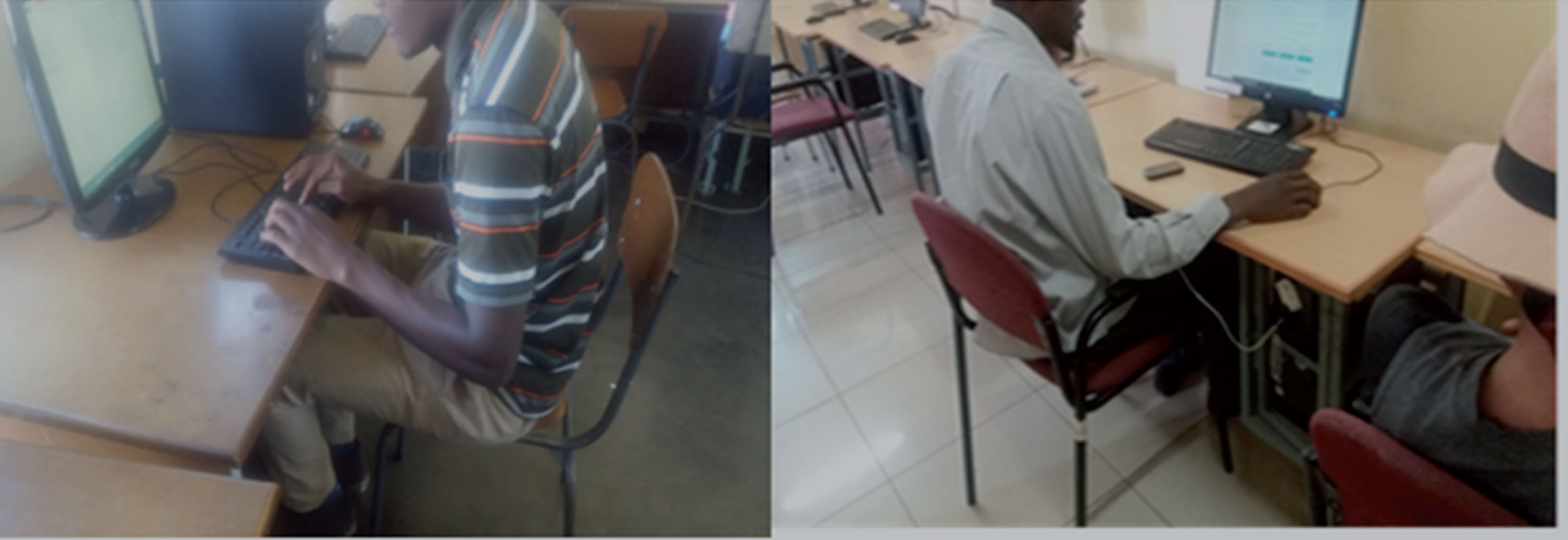
Desktop computer user on a WSC (upper arms unsupported) and on a SAC (upper arms supported).
The video display unit (VDU) is slightly twisted to the right as shown in the second picture of Fig. 1 and the distance between the VDU screen’s midpoint and the eyes is 59 cm. This generates an unsafe viewing posture with a poor angle of 10–20 degrees below the user’s horizontal line and a lateral neck bend of 0–20 degrees. Although the right hand’s wrist was slightly bent and twisted, on the positive the lower arm is correctly balanced on the chair arm rests and the distance of the mouse’s middle point from the desk’s edge was 16 cm and satisfactory.
Musculoskeletal complaints affecting one or more body parts were reported by 72% of the study participants as shown in Table 2. The predominantly reported body complaints were pain at the neck, lower back and shoulders. The prevalence of other body complaints other than the neck, lower back and shoulders was relatively low (at most 8%). The prevalence rate of musculoskeletal complaints among users of WSCs was consistently higher than that of users of SACs. In addition, users of WSCs had a significantly higher risk (p < 0.05) for the development of lower back pain than users of SACs. The WSCs lacked arm rests and padded backs rests, which may explain the observed common adoption of the unsafe postures.
Self-reported musculoskeletal complaints per body region
Self-reported musculoskeletal complaints per body region
*Denotes a statistically significant association (p < 0.05) and NS denotes a not significant association (p > 0.05); numbers in parentheses for WSCs and SACs columns are % of users who reported to have pain at the concerned body part; WSC: Wooden steel chair; SACs: Stackable arm chair; N/A: Not applicable.
Table 2 also shows the proportion of participants reporting severe musculoskeletal complaints. In this study, the term severe pain referred to participants prevented from carrying out normal activities due to pain during the last 12 months. Of the users of WSCs, 12% experienced severe pain in more than one body part. In comparison, the prevalence rate of such severe pain was more or less similar among users of SACs.
The association between the grand RULA scores and the prevalence of self-reported musculoskeletal complaints is shown in Table 3. For all body regions, the complaints were higher among study participants with grand scores ≥5 (moderate or high risk scores) compared to those with scores less than or equal to four (negligible or low risk scores). The χ2 – test showed a statistically significant association between the grand RULA scores and the prevalence of lower back pain (χ2 = 4.12; p < 0.05). However, the χ2 – test did not show significant differences (p > 0.05) with regards to the prevalence of other body part complaints among participants with moderate or high scores compared to those with negligible or low risk scores.
Association between musculoskeletal pain and grand RULA score (100 participants; df = 1)
*Denotes a statistically significant association (p < 0.05) and NS denotes a not significant association (p > 0.05). Figures below the grand RULA score represent the number of study participants with or without musculoskeletal pain at the concerned body part. Grand RULA score 1–4 denote negligible to low risk for musculoskeletal pain while ≥5 denote a moderate to above medium risk level [10].
Postural assessments
The purpose of the present study was to evaluate the postural risk posed by WSCs and SACs using the RULA method. Results showed that none of the participants had safe had a safe sitting posture. Both studied chairs (WSCs and SACs) lacked adjustable supports for the hand, back and seat. They could not be flexibly adopted in height, width, and tilt to meet the different height and other unique physical features of their intended users. Adjustable chairs coupled with appropriate training on their use have been associated with reduced risk for developing MSDs [22].
In addition, results of this study showed elevated RULA scores for users of WSCs compared to users of SACs. According to the RULA method, this means that the sitting posture for users of WSCs chairs poses a greater risk for the development of occupational musculoskeletal disorders than of SAC users. Postural deficits that require correction were observed. For example, forward trunk flexion (20–45°), was commonly practised as WSC users often rest their lower arms on the working table since this chair type has no arm rests. Such trunk flexion may account for the elevated prevalence of back pain observed in the present study and previous literature [8, 23]. Redesigning of the WSCs must prioritise incorporation of appropriate arm rests. Previous studies recommend the use of chairs that have a backrest, armrest and adjustable height to (i) reduce muscle activity of trunk, neck and shoulder and (i) to reduce the pressure between the vertebral discs [23, 24].
In the present study, RULA scores were higher for the right side of the body compared to the left. Such higher scores could be due to: (i) most repetitive mouse operations were performed using the right hand, (ii) most learners sat with bodily force slightly exerted on the right side, with right shoulder slightly raised, (iii) when in a slightly at rest position, some participants rest left hand on lap and either did typing or mouse operations with right hand across midline, and (iv) some students worked with unsupported lower arms in a prolonged sitting position. Repetitive hand movements [16], raised shoulders [25], unsupported arms [17], are risk factors for musculoskeletal disorders. The lack of arm rests in WSCs may explain the observed sustained elevation of the upper arms and shoulder abduction.
Figure 1 showed that although the WSCs had back supports, they were rarely utilised. Their wooden, unpadded, and slightly cow horn curved back support material was described as uncomfortable by the chair users. But the non- usage of back supports and sustained forward trunk bending may strain the muscles and ligaments that surrounds the spinal cord. This may contribute to development of back pain. The seat for the WSC had varying slight negative gradient that promoted sustained minor elevation of the users’ thighs. On the contrary, users of SACs were able to adopt a much safer sitting posture than of WSC. The chair’s arm rests and the fairly comfortable back rests offered their users an opportunity to sit in a relaxed position which may allow recuperation of the muscles.
Musculoskeletal complaints
The second objective of this study was to determine the anatomical distribution of musculoskeletal complaints among users of WSCs and SACs. Kaliniene et al. [23] also reported a higher prevalence of complaints pertaining to the shoulders (50.5%), elbow (20.3%), wrist/hand (26.6), upper back (44.8) and lower back (56.1%) among computer users. However, the authors did not examine postural role of the chair type used. The prevalence of neck, lower back and shoulder in users of WSCs and SACs, provides a tip of an iceberg concerning an underappreciated burden of MSDs in tertiary institutions of learning of low-income countries. Considering that the participants are a younger population (mean age: 23.25±1.6 years), the findings portray an urgent need to implement intervention measures, such as such as exercise training. A recent study of office workers [7] demonstrated that an exercise training program could reduce musculoskeletal pain at the neck, shoulders and the lower back. The concerned training program comprised specific exercises designed to remove the main cause of pain (muscle stiffness and weakness) by stretching and strengthening the muscles, thus reducing pain.
The present study demonstrated that the prevalence of self-reported lower back pain differed significantly (p < 0.05) between users of WSCs and of SACs. The lack of ergonomically back rests in WSCs may explain the high prevalence of lower back pain among their users as mentioned earlier on. Consistent with the present study, Gandavadi et al. [18] found elevated RULA risk scores for students using Conventional Seats (CS) compared to those using Bombach Saddle Seat (BSS), due to the resultant poor sitting position that fostered tilting of the posterior pelvic. Poor posture scores such as reported in the present study may pose a greater risk for the onset of musculoskeletal disorders, such as lower back pain [18]. Moreover, prolonged sitting has been reported to be a risk factor for lower back pain [7, 17]. In a study of hospital nurses Nourollahi et al. [26] showed that the prolonged use of poor trunk postures significantly (p < 0.05) contributed to the onset of lower back pain. The current study showed that the prevalence rate of wrist pain was 6% for users of WSCs and 2% for users of SACs. In Denmark, Jensen [27] observed that the duration of use of a computer predicted hand-wrist complaints, although not for neck complaints. To prevent hand-writs complaints, the authors recommended that reducing usage of a computer to not more than three-fourths of one’s work time. The same recommendation may usefully benefit the present study’s participants.
Strengths and limitations of the study
The present study has some strength. First, it was undertaken in a developing country, which helps to fulfil the lack of research on the chair types used in the tertiary institutions of learning. Second, it used a validated method (RULA) to assess the sitting postures, which enhances the reliability and validity of the study’s findings. Third, the study was conducted in real life academic learning environments so as to generate sound interventions for the prevailing scenarios. A major shortcoming of the current investigation relates to use of a cross-sectional study design. Such studies have difficulties in demonstrating causality [28]. In addition, the present study identified the proportion of participants reporting severe musculoskeletal pain but did not measure the levels the pain. Further studies may perhaps need to use questionnaires such as the Cornell Musculoskeletal Discomfort Questionnaire Connel, which are extremely useful with regards to precisely measuring the pain levels at the various body parts [29]. The single-centre design may also limit the application of the present study’s findings to other unstudied tertiary institutions of learning. Furthermore, increasing the sample size could contribute to clearer results [30]. The present study might not consist of the best possible representative sample of users of WSCs and SACs due to the use of purposeful sampling. As such participants needed to fulfil predefined inclusion criteria and were non-randomly selected, which means our study is not immune to sampling bias. In addition, although the sub-groups of the study sample are equal, as in other similar postural risk assessment studies [16–20], they are disproportionate to the size of the populations from which they were selected. Use of specific formulas to calculate the required sample sizes could have strengthened the methodological rigor of our study.
Conclusion
The present study showed that WSCs posed a higher postural risk for the development of musculoskeletal disorders than SACs. In addition, musculoskeletal complaints were more prevalent among users of WSCs than SACs. Therefore, WSCs require further redesign improvements. Some improvements reported in past studies include: i) fitting them with arm rests, ii) padded back supports or iii) gradually phased out in favour of SACs or other ergonomically designed chair types. We also found a statistically significant (p < 0.05) higher prevalence of lower back pain among users of WSCs compared to users of SACs. Such a prevalence is suggestive of usage of unsafe sitting postures. Training students on options for minimising forward trunk bending such as drawing the closer to the working table, may be useful in lowering lower back pain among users of WSCs. Also, exercise training programs may be needed to reduce of the pain.
Conflict of interest
The authors declare that no competing interest exists.