







Abstract
BACKGROUND:
Sitting is a common and familiar position used daily as a platform for many motor activities in the workplace, at school, or at home.
OBJECTIVE:
To investigate how difference in the chair design and selected sitting manipulations contribute to reach distance in sitting.
METHODS:
Ten healthy subjects were required to reach forward as far as possible while sitting in an adjustable chair with 0°, 10° forward or 10° backward inclination of the seat, with and without footrest and leg support, with legs crossed, and when holding the edge of the seat with the contralateral arm.
RESULTS:
In comparison to sitting with feet on the footrest, the maximal reaching distance decreased significantly when sitting on either forward or backward inclined seat (p < 0.05) and it increased when the subjects held the edge of the seat while seated with footrest and the posterior leg support (p < 0.05). There was no major effect of crossing the legs or the use of anterior leg support on the maximal reach distance.
CONCLUSIONS:
Modification of the chair design could increase or decrease reaching distance in sitting. The outcome of the study provides a background for future investigations of the effect of sitting positions on reaching distance in the workplace, at home, or at school.
Introduction
Reaching for objects while sitting at a desk, store check-out stations, chemical process control stations, vehicles, working on conveyor belts, etc., involve maintenance of posture. Efficient control of posture emerges from an interaction of the individual with the task and the environment [1].
Many chairs that are used in everyday life, in the workplace, at school, or at home have limitations as to how far one can reach in the sitting position. Moreover, chairs with the flat sitting surface (regular chairs) are commonly used in schools [2], by sewing machine operators [3], and as dinner chairs in the home environment. Modifying chairs can help users adapt better to the working environment which consecutively will prevent musculoskeletal disorders and enhance productivity [4]. Furthermore, the use of different forms of support in aiding work sitting posture could be beneficial in reducing musculoskeletal disorders resulting from work related activities [5]. For example, a slight seat modification to mitigate body loading might be beneficial to reduce discomfort in the lumbar region [6].
Balance control in sitting involves the ability not only to maintain the seated posture without falling over but also to balance the body mass over the base of support while performing a variety of self-initiated actions. In addition, proper balance control is needed while maintaining body stability for fine manual manipulation of objects or equipment, and for performance of highly visually demanding tasks.
Reaching to targets beyond arm’s length, such as reaching for tools or a book, when answering the telephone or picking up an object, is a common action which perturbs balance. Reaching movements involve complex interactions between the arm and the upper body, taking into consideration the dimensions of the base of support which is provided by the pelvis and thighs on the seat and the feet on the floor [7]. The ability to perform reaching tasks while seated is fundamental to an individual’s professional and leisure activity, independence, and quality of life.
Workplace intervention focused on adjusting the equipment, work design and organization, is critical in helping workers function better while avoiding musculoskeletal disorders [8–10] and musculoskeletal pain [11]. While modifying the work or leisure places, the chair and the work surface are the most frequently adjusted elements of the environment [12–14].
Different chair designs and sitting manipulations have been used to provide body support needed in carrying out working and leisure activities. Thus, the wedge has been used in sitting to induce seat inclination forward or backward [15]. It was found that the use of a 10 degree padded inclined seat had a significant effect on back shape [16]. Sitting on a chair with a 10 degree forward slope was effective in maintaining a neutral alignment of the spine [17]. Moreover, the ability to control displacement of arms and trunk during reaching was improved while sitting in chairs with tilted seat as compared to a standard chair configuration [18]. However, the literature on the effect of an inclined seat on reaching distance from the sitting position is limited.
Another way in which balance control in sitting could be enhanced involves using body positions that utilize the effects of a closed kinetic chain (CKC). For example, lower legs CKC is utilized when sitting with the feet on the ground or crossing the legs while sitting with the feet off the ground. Sitting in a position involving lower leg CKC (that is associated with the stiffening of muscles in the lower extremities) differs from sitting with feet off the ground and not crossed as the terminal ending of the limb is free or fixed [19, 20]. However, not much has been studied on how reaching is affected by stiffening of lower extremity muscles that could be achieved using CKC. Using closed kinetic chain for the upper limb can also enhance sitting balance control. For example, better body stability could be achieved while sitting with the hands holding the edge of the seat (upper limb closed kinetic chain) as compared to sitting with both hands by the side (upper limb open kinetic chain). While it was demonstrated that CKC exercise appears to be more effective in improving the dynamic balance ability than open kinetic chain exercise [21], no studies of the role of closed kinetic chain in sitting balance control associated with reaching were conducted.
It was shown that providing anterior or posterior supports to the lower legs could help to optimize postural control in sitting by reducing the muscular load in tasks involving arm manipulations [22, 23]. In addition, using anterior and posterior supports to the lower legs while sitting was associated with improved activity in biceps femoris and rectus femoris muscles which resulted in better body stabilization [24].
This study was aimed to investigate how difference in the seat design and selected sitting manipulations could influence maximal forward reach. We hypothesized that reaching distance will be affected by the different sitting manipulations or seat features. Particularly, sitting with the lower limbs support or contralateral hand support will allow reaching greater distance as compared to reaching from a traditional seated position with feet on the ground.
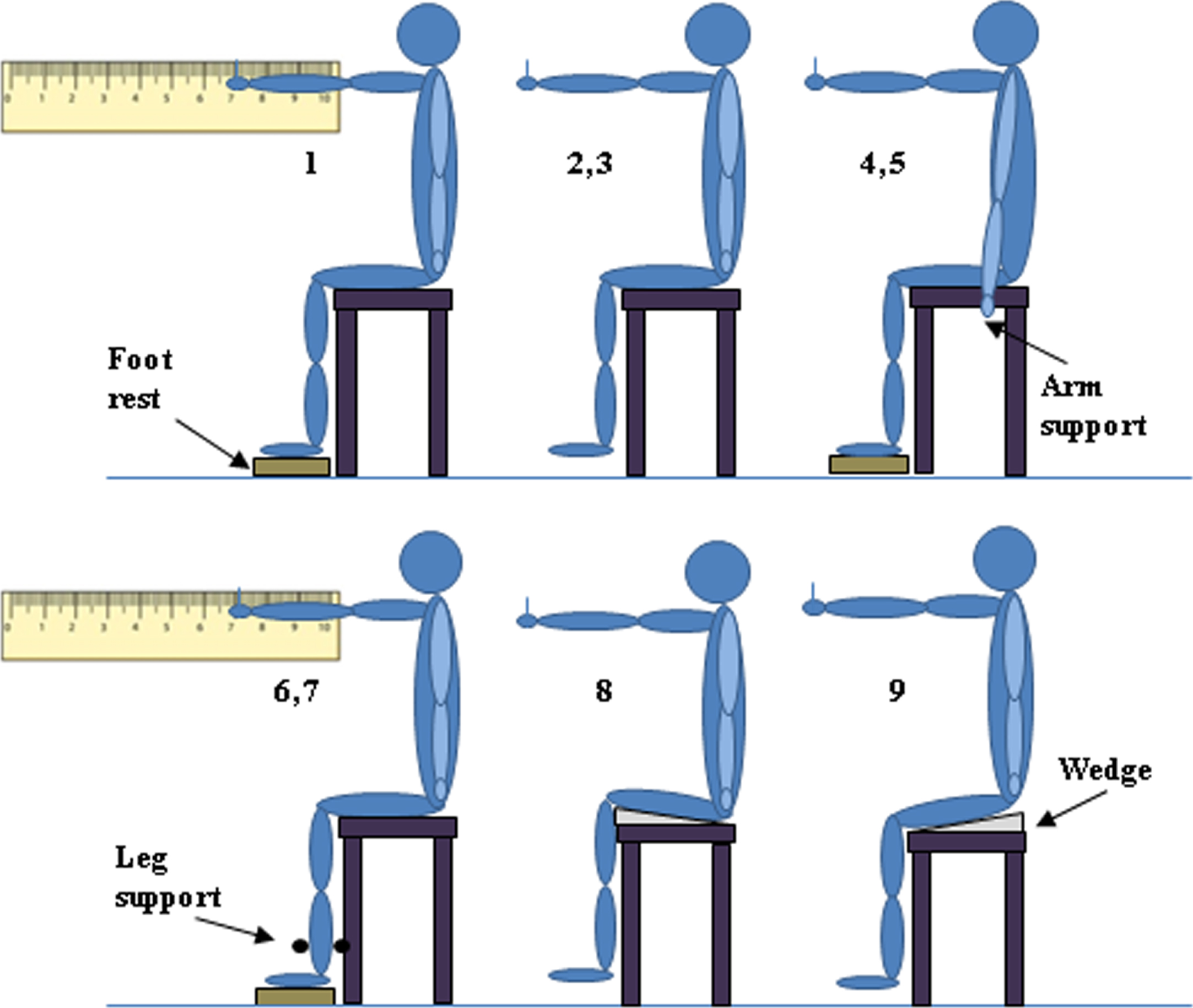
Experimental setup. The subjects were required to reach forward while sitting.
Participants
Ten healthy subjects (4 males, 6 females) with the average age 26±7 years, height 1.63±0.17 m and weight 62.77±20 kg participated in the study. Nine of them were right-hand dominant and one was left-hand dominant. The study was approved by the University of Illinois at Chicago Institutional Review Board and all the subjects provided a written informed consent.
Instrumentation
A wooden chair with a height of 81 cm and a sitting base of 41 by 41 cm, was used in the experiments. This chair allowed manipulating sitting positions by using adjustable parts attached to the chair. Thus, two parts of the plywood connected by a hinge were placed on the seat of the chair and used to create 10° forward and backward inclination of the seat. A height adjustable and detachable footrest was used to study the effect of footrest. Two height adjustable removable side bars were used to study the effect of the anterior and posterior leg supports on reaching distance (Fig. 1).
To ensure safety of participants during the experiments, the subjects were provided with a harness loosely attached to the ceiling. A ruler positioned horizontally at the shoulder level was used to measure the reaching distance.
Experimental procedure
Subjects were required to sit on the chair with no back support, with the sacrum at 1 cm from the posterior edge of the seat, and their back straight and head forward. They reached forward using their dominant hand as far as they could while the other arm was placed by the side (except in the CKC for the upper limb condition). Functional reach distance was measured using a ruler attached to the wall on the dominant side of the participants at the height of the acromion. Subjects were required to lift the arm forward at approximately 90° and to make a fist around a pencil held vertically upwards (Fig. 1). The position of the pencil along the ruler was recorded as point 1. The subjects were then asked to lean forward as much as they could while remaining seated. The location of the pencil was recorded again as position 2. Each task was repeated 3 times and the mean reach distance was obtained. Reaching was defined as the difference between position 1 and position 2 over 3 trials [25]. All reaches were performed with full vision.
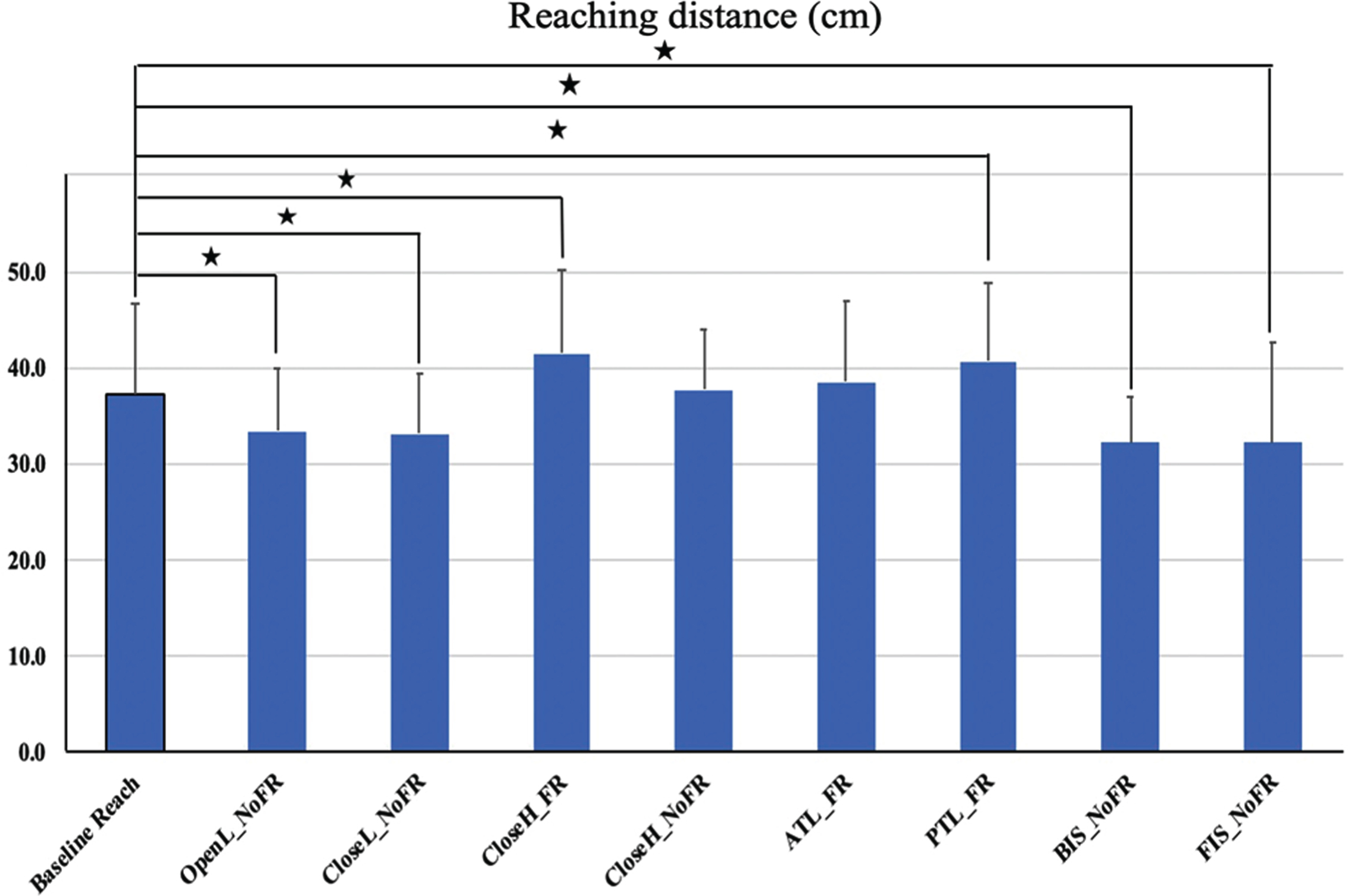
Mean and standard deviation of maximum reach distances measured while sitting in different experimental conditions. Abbreviations: OpenL–Open kinetic chain sitting for the lower limbs; CloseL –Closed kinetic chain sitting for the lower limbs; CLoseH - Closed kinetic chain sitting for the upper limbs; FR –foot rest; NoFR –No foot rest; ATL –anterior leg support; PTL –Posterior leg support; BIS –backward inclined seat; FIS –forward inclined seat. (*) shows statistical significance, (p < 0.05).
Nine experimental conditions were implemented, and the order of conditions was randomized across the subjects. Thus, the subjects were required to reach forward while sitting with the legs on the footrest (just as in a normal everyday sitting with the legs on the ground) and the other hand by the side: referred to as baseline reach (BR). To study the effect of body’s closed/open kinetic chain on reaching distance, the subjects were required to reach forward while 1) sitting with no footrest and legs either hanging (open kinetic chain, OpenL_NoFR) or with their legs crossed at the level of the distal 1/3 of the leg (closed kinetic chain, CloseL_NoFR) and 2) while sitting and reaching concurrently with holding the edge of the seat with the other hand, and the legs on the footrest (closed kinetic chain, CloseH_FR) or the legs hanging (open chain, OpenH_NoFR). To study the effect of leg support, a wooden bar was placed across the distal one third of the legs anteriorly (ATL_FR) and across the distal one third of the legs posteriorly (PTL_FR) [24]; the footrest was available in both the conditions. Finally, to study the effect of seat inclination on reaching distance, subjects sat on either a backward inclined seat (BIS_NoFR) or forward inclined seat (FIS_NoFR) [15]. The verticality of the trunk while sitting was checked by the experimenter.
Repeated measures one-way ANOVA was employed to compare difference between the reach distances measured in different sitting conditions. SPSS software (IBM, USA) was used. Statistical significance was set at p < 0.05.
Results
Mean reach distances measured while sitting in different experimental conditions are shown in Fig. 2. When sitting in the baseline condition (feet on foot-rest) the maximum reach distance was 37.2±9.5 cm. When the subjects were sitting in other experimental conditions, the maximal reach distance decreased or increased, and the effect of condition was statistically significant (F (1,9) = 270.06, p < 0.05).
Reaching while sitting with the lower limbs in the open or closed kinetic chain condition resulted in decrease of the maximum reaching distance to 33.5±6.6 cm and 33.2±6.2 cm respectively (p < 0.05). Thus, sitting in the open kinetic chain condition for the lower limb (OpenL), brought about a decrease of 3.7 cm in reaching distance and reaching while sitting in the closed kinetic chain condition resulted in a 4.0 cm decrease as compared to reaching from the baseline condition (p < 0.05).
While sitting and holding the edge of the seat with the contralateral hand and the legs on the footrest (upper limb closed kinetic chain), the reaching distance increased to 41.5±8.6 cm, 4.3 cm more than the reaching distance from baseline condition and it was the largest among all experimental conditions. The difference between the baseline condition and CLoseH_FR condition was statistically significant (p < 0.05). While sitting with no footrest and holding the edge of the seat (CloseL_NoFR), the reaching distance was 37.8±6.1 cm and it did not significantly differ from the baseline sitting condition (p > 0.05).
While sitting with an anterior leg support, the reaching distance was 38.6±8.3 cm, however, this distance was not statistically significant from the reaching distance measured in the baseline conditions (p > 0.05). While sitting in conditions with the posterior leg support, subjects were able to reach 40.7±8.0 cm and the reach distance was statistically significant from the reach distance achieved in the baseline conditions (p < 0.05).
When the subjects were positioned on the forward and backward inclined seat, the reach distance decreased to 32.2±4.8 cm and 32.2±10.5 cm respectively. The difference between the baseline reach and reach while sitting on either forward inclined or backward inclined seat was statistically significant (p < 0.05). The difference in reach distance between the two seat inclined conditions was not significant (p > 0.05).
Discussion
The maximum reaching distance was increased or decreased depending on the effect of each of the selected sitting conditions. Thus, our hypothesis that reaching distance will be affected by the different sitting manipulations or seat features was supported.
Effect of kinetic chain
Performing the reaching task without the use of footrest, with no leg support or upper limb support (an open kinetic chain sitting) brought about a 3.7 cm decrease in reaching distance as compared to sitting with footrest. This can be related to the fact that lower limbs were not able to key to the ground or footrest for needed physical and psychological support to reach farther. Performing reaching task while the legs were in closed kinetic chain and no footrest brought about the same (4.0 cm) reduction in the reaching distance. This decline in maximal reach can be related to the fact that increased muscle tension impairs balance [26]. Thus, it could be suggested that subjects were caught between a need to reach further and a need to maintain balance. From the principle of priority setting, one would tend to aim at maintaining balance to avoid a fall rather than reaching farther.
Furthermore, the results of this study showed that participants can reach farther with the support of the contralateral arm. Based on that outcome we suggest that using arm support can help to increase the body’s stability in the sagittal plane thus allowing reaching farther. Holding the seat while reaching could also be associated with the increased ability of the subjects to obtain additional somatosensory information about the position of the body during reaching. The possibility of this to happen is supported by the literature. Thus, healthy individuals were found to improve the stability of standing when applying light finger touch contact to a stationary surface [27, 28]. Moreover, touch and pressure cues from any part of the body in contact with a stable external surface have been found to enhance body orientation [29].
Role of leg supports
The use of anterior leg support together with footrest, brought about a 1.4 cm increase in reaching distance as compared to the baseline reach distance of 37.2±9.5 cm. Similarly, the posterior leg support enabled subjects to reach 3.5 cm farther than in the baseline reach condition. These results can be attributed to the fact that leg supports have been found to optimize sitting postural control by reducing the muscular load in tasks involving arm manipulations [22]. It was also reported that anterior or posterior supports to the lower legs while sitting are associated with enhanced activity in biceps femoris and rectus femoris muscles, respectively [24] that help in the stabilization of the body. The impact of the foot rest is also important; as previously described in the literature, subjects could reach further when their feet were in contact with the ground than when they were not [30]. Similarly, during forward reaching movements when the thigh and foot support permitted larger forward excursions of the center of mass (COM), healthy subjects were able to reach farther [31].
Effect of inclined seat
The stability of the trunk on an unstable surface depends on one’s ability to align the projection of the COM with the center of rotation of the support surface; added to this, the central nervous system (CNS) also has to control inertial forces generated by trunk movements [32]. Trunk stability relies on correct perception of body attitude and on the development of adequate muscular responses. Body attitude is constantly modified on the basis of information provided by the visual and vestibular systems and through information derived from somatosensory receptors [33]; as it is modified, further muscular responses are needed to maintain stability and balance. Sitting on a backward inclined seat packs the pelvis, thereby ensuring more stability of the body. However, there is a tradeoff –increased stability results in reduction of the reaching distance. Quite the opposite, sitting on a forward inclined seat diminishes body stability when the subject reaches forward. This results in reduced reaching distance which could be attributed to the fact that the subject develops a protective response in order to avoid slipping off the seat. As such, it is likely that fear of falling due to the increased instability of the body in such a position could influence sitting functional reach performance [34].
There are some limitations that we want to mention. This exploratory study involved a relatively small sample of young subjects sitting on a stationary chair and performing reaching while holding a light object, there was no backrest to support the lumbar spine, and reaching was only performed in the forward direction. Moreover, we did not study the long-term effect of sitting in the suggested conditions on the trunk, upper and lower limbs musculature. Future studies involving lateral reach, reaches performed when holding a heavy object, manipulating a dial or steering wheel or other control elements would be needed to uncover the effect of modified sitting postures on maximal reaching distance.
Conclusion
The results of the study showed that chair design and selected sitting manipulations affect the maximal reaching distance in sitting. They also suggest the importance of considering the way we reach for objects in order not only to optimize task performance but to place less strain on the body. The outcome of the study provides preliminary data for future investigations of the effect of sitting positions on reaching distance.
Conflict of interest
The authors report no conflict of interest.