






Abstract
BACKGROUND:
The intensive care unit (ICU) is a complex, dynamic, high stress and time-sensitive place. While a variety of rules and regulations provided to reduce medication errors in recent years, many studies have emphasized that medication errors still happen.
OBJECTIVE:
The purpose of this investigation is to predict, reveal and assess medication errors among surgical intensive care unit (SICU) nurses.
METHODS:
This study was performed in one of the public hospitals in Shiraz, namely Shahid Faghihi hospital. The human error assessment and reduction technique (HEART) method was adopted to measure and assess medication errors in the ICU.
RESULTS:
Findings indicate that ICU nurses perform 27 main tasks and 125 sub-tasks. The results also showed that setting and using DC shock task has the highest human error probability value, and assessment of patients by a nutritionist has the lowest human error probability value.
CONCLUSION:
Medical errors are key challenges in the ICU. Therefore, alternative solutions to mitigate medication errors and enhance patient safety in the ICU are necessary. Although the technique can be used in healthcare; there is a need to localize the coefficients and definitions to achieve more accurate results and take appropriate controls. Employing experienced people and providing conditions that reduce the possibility of errors in nurses, increasing the number of staff, and developing specialized and simulated training were identified as the most important control strategies to reduce errors in nurses.
Introduction
Human error in the industry is one of the biggest occupational safety and health problems in the world.
Studies show that many major disasters in recent years have been caused by humans. There are many examples here to be made, such as the pesticide plant explosion in Bhopal, India (1984), Hillsborough football stadium (1989), the Chernobyl disaster (1986), Three Mile Island (1979), and the space shuttle disaster Challenger (1986). Human error also causes accidents in medical centers, which are known as medical errors [1, 2].
Healthcare is a broad and complex industry with diverse domains and services [3, 4]. As we know, the healthcare treatment processes rely incredibly on human contribution [4]. Therefore, human error can affect healthcare system reliability and patient safety [3].
Medical errors have been increased dramatically in the healthcare industry. They are a leading cause of mortality and major problems in both industrialized and underdeveloped countries [5, 6]. According to the report, a large number of people (from 44,000 to 98,000) die in hospitals every year due to preventable medical errors [7]. Base on another report, they are responsible for 210 to 440 thousand deaths and more than one million injuries [8]. Also, medical errors pose a heavy financial burden on the government and the private sector [9, 10]. The rate of general error in Iran, like other Middle Eastern countries, is higher than in developed countries. However, accurate statistics on medical error rates are not available in Iran, although Jolaee et al. reported 19.5% of medical error rates in nursing [11]. According to another study in Iran, in every 100 to 150 people admitted in hospital, one person dies [12]. Also, as shown by various studies, nurses are the common cause of the error (from 40% to 44.2% errors) in Iranian hospitals [13–15].
One of the most important units in which medical errors present additional challenges is the intensive care unit (ICU) [16]. ICU is a complex, dynamic, high stress and time-sensitive place in the hospital due to vulnerable and unstable patients requiring rapid and complicated medical decision-making [17]. Receive more medication intravenously, and infusion of most medications, patient with a little physiological reserve and the sedated patient can increase risk of medication errors in the ICU [17, 18]. However, adverse events and serious errors are life-threatening and may pose acute risks to patient life in the ICU [19]. Therefore, medical errors are key challenges, as the prevalence of medical errors and adverse events in the ICU are higher than in other units. Accordingly, it is crucial to introduce practical and effective measures to reduce and prevent medical errors [16–18].
Different systems around the world have been designed and implemented based on the specific situation of each country, including challenges, healthcare delivery structure, safety culture, and health policies, which are divided into two types of mandatory and voluntary reporting [11]. In the United States, the National Medication Errors Reporting Program (MERP) for monitoring medication errors has been established [4]. Furthermore, Australia, New Zealand, and Malaysia have introduced similar MERP systems. In addition, quality improvement and safety projects such as Central Line Associated Bacteraemia (CLAB) in ICUs project, Safer Systems Saving Lives (SSSL) Project, NSW Clinical Excellence Commission (CEC), and the Performance Indicators and Medication Safety (PIMS) Project have been implemented [19]. In Iranian hospitals, voluntary reporting forms (anonymous) are used to record medical errors, and Root Cause Analysis (RCA) method is often used to investigate the causes and roots of errors [11, 20].
While a variety of rules and regulations provided to reduce medication errors in recent years, many studies have emphasized that medication errors still happen. Therefore, alternative solutions to mitigate medical errors and enhance patient safety in the ICU are necessary. In this context, this paper aims at adopting the human error assessment and reduction technique (HEART) method to predict, reveal and assess medication errors in the ICU and to eliminate or mitigate errors associated with ICU operations.
Literature review
Human errors are one of the significant challenges for the healthcare industry. They directly affect human life, patient satisfaction, and loss of trust in the healthcare industry [16]. Therefore, investigation of the human contribution to medication errors has considerably become one of the most substantial concerns in the healthcare industry.
With this insight, there are numerous research papers about medication errors in the literature. For instance, Chen et al. found that the drug error-monitoring system significantly reduced errors [4]. Another study was performed to characterize ICU adverse events, their root causes, and their recommended actions. Also, Corwin et al. stated after examining the root causes of the error, solutions including standardization of the care process, implementation of a training program as a team, and simulation were recommended [17].
Numerous studies have also been conducted on human errors in the healthcare system. Scott et al. carried out statistical report analysis in order to establish relationships between the frequency and nature of specific error types and patient and Emergency Department (ED) characteristics [21]. Another study conducted for reducing medication errors in the process of drug prescription has been presented by Vélez-Díaz-Pallarés et al. In the paper, the authors used Healthcare Failure Mode and Effect Analysis (HFMEA) method [22].
There are also a couple of novel studies upon the impact of errors on healthcare professionals, nurses’ medication errors and the related factors, application of Human Reliability Analysis (HRA) in healthcare. These studies are predominantly retrospective and analyze data about past patient harms. Few studies used hazard analysis techniques, for example, HFMEA, to analysis healthcare processes [3, 16].
Moreover, the relative contributions of interruptions, multitasking, fatigue, and working memory capacity in task errors by emergency physicians were studied by Westbrook et al. [23]. In another study conducted on the precise determination of the cause-and-effect relationship of medical errors by using structural equation modeling [24].
Kaur et al. and Leape’s findings show that two-thirds of medical errors are usually preventable [16, 25]. In order to minimize medical errors in the healthcare industry, it is essential to seek creative solutions and a proactive system to reduce human error. So, human error prediction is a critical task to enhance safety. Human reliability assessment methods are tools that calculate the probability of human error for a given action [3].
Although numerous HRA methods have been introduced and applied to different fields, the human reliability assessment techniques in healthcare are considerably limited, and the most critical control strategies to reduce errors such as correcting nurses’ work shifts, providing practical and continuous training, and reducing additional tasks were suggested [26–30].
For instance, Fam et al. used the CREAM method to assess the nurses’ errors in the cardiology section [31]. In another study, Deeter et al. applied the CREAM technique for analyzing the errors recorded in a hospital [32]. The results of their studies showed that the CREAM method is much more efficient than traditional methods such as RCA. Castiglia et al. applied HEART technique to evaluate the exposure of radiology medical workers to radiation during brachytherapy; they proposed safety equipment and the development of safety protocols as control solutions [33].
In the light of the above literature review, it is clear that the studies, particularly upon human error prediction in the ICU are very scarce. Therefore, this study is expected to remedy about the gap and contribute a substantial impact on the healthcare industry in particular ICU.
Materials and methods
This study applies a human error assessment approach under HEART methodology to predict, reveal and assess medication errors in the ICU. A brief theoretical background of HEART methodology is explained in the next section.
HEART generic categories
HEART generic categories
Human error data scarcity is one of the greatest problems for predicting the HEP value in the healthcare industry. To deal with this limitation, the empirical equation such as HEART appears to be reasonable and sensible.
The HEART technique, introduced by William in (1988), is one of the best practical tools to compare human error probability values during reliability analysis. Fundamentally, the technique is based on generic task (GT) and error producing condition (EPC) parameters which allow defining the generic error probability (GEP) value and performance shaping factors (PSF) of humans in the related task, respectively. The HEART methodology has eight generic tasks associated with eight GEP values to determine the probability of human error. Furthermore, the technique has thirty-eight different EPCs.
The fundamental steps of the HEART methodology are briefly described as follows [34–36]. Step 1: Identifying the task and related steps. In this step, task and related steps are identified by utilizing Task Analysis Techniques (TAT) such as Hierarchical Task Analysis (HTA). Step 2: Determining relevant generic task types. In this step, relevant generic task type is determined based on the nine qualitative descriptions of actions (A to M). The qualitative descriptions of actions are provided in Table 1. Step 3: Selecting GEP value. In this stage, quantitative GEP value is determined per generic task. Table 1 shows the GEP value in the line of the generic task type. Step 4: Defining the relevant EPC. In this stage, relevant EPC is determined in accordance with the thirty-eight possible statements. Step 5: Determining assesses the proportion of affect (APOA) for each EPC. In this stage, the proportion of the effect for each EPC is determined based on its importance by using Equation 1.
In order to weight the importance of each EPC, a smart solution such as Analytic Hierarchy Process (AHP) technique can be utilized instead of traditional APOA. Step 6: Calculating HEP value. This step provides to find the HEP value for each step by using Equations 2 and 3.
It should be noted that each task may be consist of several sub-task. Therefore, the final HEP value of the task can be calculated in accordance with the equations in Table 2.
AHP, introduced by Saaty in 1980, is an appropriate multi-criteria decision-making (MCDM) tool to solve complex decision problems. The technique is a popular, flexible, and easy to apply weighting method [37]. The method aims to provide relative importance of criteria according to the hierarchical structure. It relies on experts’ judgment and a pair-wise comparison matrix. The AHP method basically is comprised of three main steps; Constructing criteria pair-wise comparison matrix In order to provide pair-wise comparison matrix, the following Equation (4) is used.
The pair-wise comparison matrix is completed in accordance with Saaty’s 1–9 linguistic relative importance scale in Table 3. Calculating relative importance of criteria. The relative weight (w) of each criterion is calculated with Equation (5).
Proving consistency rate. The consistency rate can be calculated with the following Equations.
In this section, the AHP-HEART approach is applied in order to conduct human reliability assessment in the Surgical Intensive Care Unit (SICU). Human error record and its data availability are problems in hospitals. Moreover, data scarcity is one of the greatest challenges for evaluating the human reliability of healthcare staff in the healthcare industry. To this end, a list of 11 public hospitals of Shiraz city was obtained and their error recording systems were investigated by research team including three OHS university professors with at least 5 years of practical experience in OHSMSs and five nurses with at least 10 years of experience.
Calculating the HEP of a task from the HEPs of its sub-tasks
Calculating the HEP of a task from the HEPs of its sub-tasks
Due to a better error recording system and data availability, Shahid Faghihi hospital, one of the public hospitals in Shiraz, was selected. Then, a comprehensive list of the recorded and self-reported errors by nurses in each war was provided. Finally, surgical intensive care unit (SICU) based on the number of errors was selected. Fifteen nurses with necessary in-depth and wide knowledge, at least 5 years of experience, on SICU war constituted the expert profile. All subjects voluntarily participated in the study after receiving information about the study objectives. They also signed informed consent forms before the commencement of the study. The study was approved by the ethic committee of Shiraz University of Medical Sciences (Reference number IR.SUMS.REC.1394.S141). The study was performed in accordance with the Declaration of Helsinki of 2013 [38].
Saaty’s pair-wise comparison scale
In accordance with the above nurses’ tasks classification, a head nurse determined nine generic task types as depicted in Table 1. The head nurse then determined all error producing conditions (EPC) for each task.
In the next step, the weights of error producing conditions for each task were determined. To this end, the analytic hierarchy process (AHP) method was used, and a pair-wise comparison matrix was constructed in accordance with Equation (4). After that, the importance weight of each EPC was provided using Equation (5).
It is noticeable to mention that the paired comparison was conducted by nurses in the SICU ward regarding each task and using geometric mean; the nurses paired comparison was then merged together. AHP method software (Expert Choice version 11) was used to calculate the final weight of the EPC [37, 39]. The total effect of EPC on each task was calculated in accordance with Equation 1. Finally, the probability of human error was estimated in accordance with Equations 2 and 3.
Results
The error record documents investigation revealed that frequent errors occurred in the SICU were recording process paitents’ information and giving oral and injected drugs to the patient, respectively. The five top-ranking tasks were based on the number of the recorded errors, as shown in Table 4.
The ranking of each duty
The ranking of each duty
Indeed, 27 tasks were determined for each nurse in the SICU ward.
Table 5 shows the results of the HEART technique analysis of the twenty-seven tasks for the ICU nurses. It represents that twenty-one of EPCs specified in the HEART technique had significant effects on the HEP scores.
Results of the HEART techinique
According to the HEART results, the maximum rate of error was related to the task of setting and using DC shock with 1.69 score, and the minimum error was related to the paitents’ assessment by anutritinist with a score of 0.0023 (Table 5).
As there were plenty of calculation results related to technique of HEART for all tasks, only the calculation results related to the task of injection of blood and blood products are provided here.
Based on the mentioned definition, this task was categorizes in group D by the head nurse and had GEP = 0.09 (Table 1).
The important EPCs having a maximum effect on the task were selected by the head nurse (Table 6).
HEART results for blood transfusion and blood product
EPC pair-wise comparison for each task was completed by each nurse. Pair-wise comparisons were merged using geometric mean and then entered in Expert Choice software version 11 (Fig. 2), then weight of factors (EPCs) was calculated as PoA. The PoA results for each EPCs are presented in Table 6.
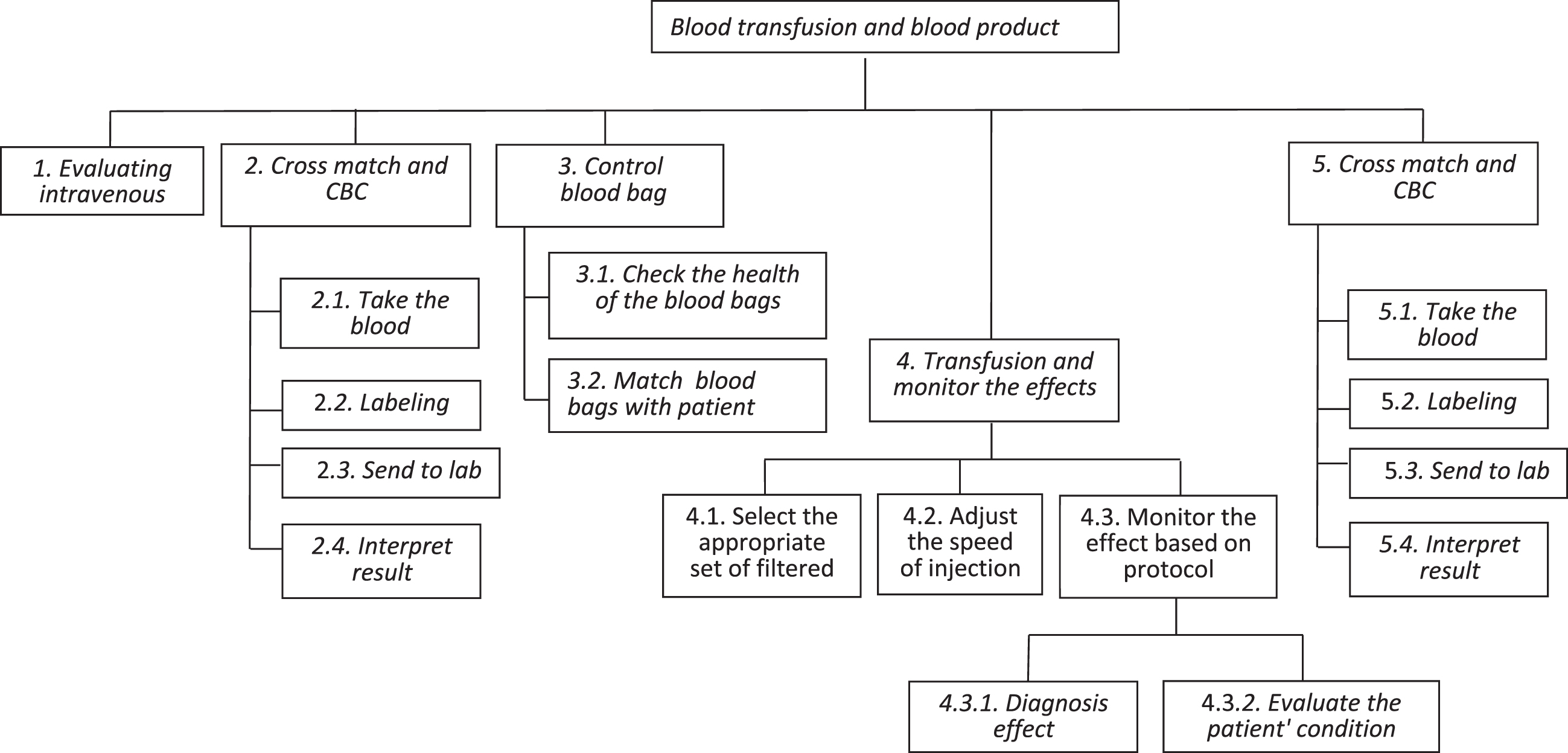
Hierarchal task analysis of injecting blood and blood product.
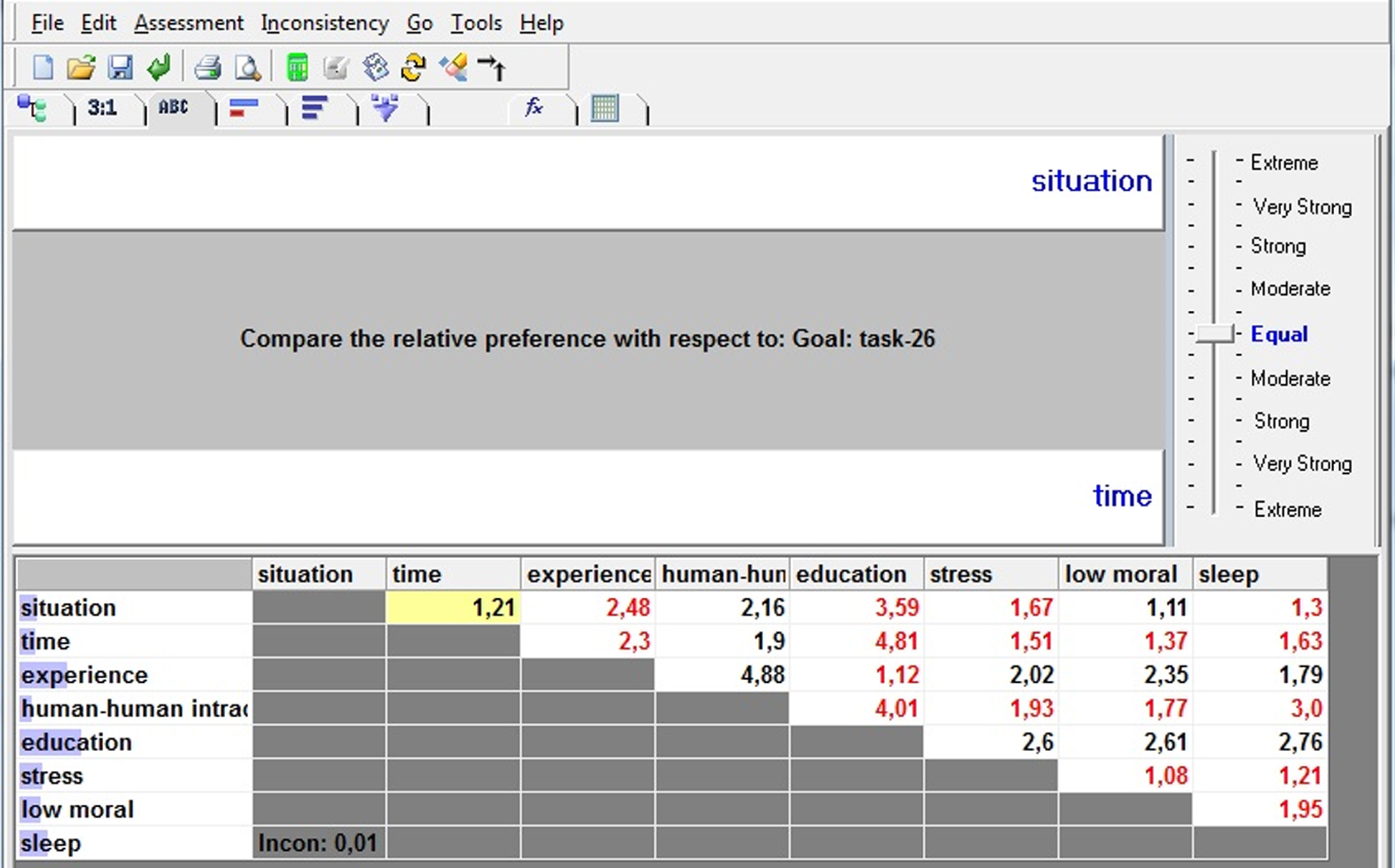
Pair-wise comparisons matrix of blood injection and blood products.
It should be mentioned that the consistency index of the comparison pair-wise matrix of all tasks was less than 0. 1.
The ICU provision is a risky environment due to the high prevalence of adverse events. Therefore, patient safety improvement is a high-priority issue in the ICU. HRA methods aim to estimate human error probability in order to prevent adverse events. In recent years, many HRA methods have been developed to provide human error probability estimation. The current study utilized the HEART method in order to estimate human error probability.
HEART method is the most applicable human reliability assessment technique widely used in the chemical, nuclear, marine, and medical fields. The HEART method is considered one of the first-generation methods. Another strength of the HEART technique that enables us to select suitable factors for different duties and situations is the variety of factors defined in the HEART structure.
We found and evaluated twenty-seven main tasks of the SICU nurses. The SICU nurses’ main tasks evaluated in this study include: setting and using DC shock, record patient information, airway suction, intubation, endotracheal tube care, urinary and fecal care, venous injection, electrocardiography, nasogastric tube, preparation of the room, patient education, maintain electrical neutrality, consciousness level assessment, blood transfusion and blood product, oxygen administration, blood gas analysis, and instillation.
We calculated and ranked the HEP of the main tasks. Based on the obtained HEP of main tasks, the tasks with high HEP to be taken into account to improve patient safety were found to be setting and using DC shock, code management, cardiopulmonary resuscitation, intubation, airway suction, oral drug administration, endotracheal tube care, and venous/ muscular injection. These tasks had the highest HEP values, which cause reduce human reliability. Therefore, the occurrence of human error is more possible in these tasks. The most important causes of human errors in mentioned tasks could be due to insufficient time, lack of nurses, carelessness and distraction of nurses, low nurse to patient ratio, little work experience, quality of staff’s education and training, and the work condition [4, 41].
The results of HEART show that, in total, for the tasks assigned to groups C and D, “unfamiliarity with the situation which is potentially important”, “A shortage of time available for error detection and correction “and “Operator inexperience” are the most important factors affecting performance nurses were identified. For tasks assigned to groups E and G, “high workload”, “A shortage of time” and “low-quality education” were identified as the most influential factors in their performance.
For example, for the task of transfusing blood and blood products which are classified in group D, the three important factors mentioned for this group (EPC 1, 2, and 15), with percentages of 21.4, 15.8, and 13, respectively, had the most significant impact on staff performance in evaluating the results of blood task. The EPC 1 and 15 are dependent on the experience of the staff. As a result, using experienced people can be the most effective way to reduce errors in blood and blood products.
“A shortage of time available for error detection and correction” is the second factor influencing the performance of this process. In case of incorrect injection lead to rapid and acute reaction (hemolytic immune reaction due to blood incompatibility). A series of tests are performed to reduce the risk of a hemolytic immune reaction during the process of transfusing blood and blood products is called cross-matching.
“An impoverished quality of information conveyed by procedures and person-person interaction” is another factor affecting the performance of the task. Corrective measures, including reviewing and visiting the patient’s bracelets separately, the use of braces of different colors were suggested. Furthermore, “A mismatch between the educational achievement level of an individual and the task requirements” is a factor influencing performance due to a shortage of specialist nurses.
In some cases, the results of AHP and the HEART technique results were inconsistent in prioritizing the EPC in all tasks. According to the nurses’ view, some factors, including sleeping cycle deficiency, calm distraction, and over-increase of physical demand, are important and influential on the functional ability of the staff, while based on the results of HEART, the least effective value due to small coefficient was allocated to them. In addition, similar results were found related to the inconsistency between HEART and the experts’ viewpoints in Chadwick et al. in the task of recording abnormal results of the patients’ blood as well as other studies in this field [34, 42].
However, the HEART technique is used as a successful method that has been validated in many industries and has also been introduced and used in various studies as a method that can be used in the field of healthcare. But the results of studies show that factors affecting performance should be localized for different areas.
Limitations
Given the cross-sectional nature of this study and data collection by self-report, the findings should be interpreted cautiously. As another limitation in the current study, there was no accurate system for recording medical errors in the hospital. In addition, the participants might not have answered the questions honestly because of being afraid of losing their jobs. Moreover, this study was performed among surgical intensive care unit (SICU) nurses in Shiraz. Therefore, the results might not be generalizable to other hospital nurses and working groups.
Conclusions
This study presents the application of the HEART technique among ICU nurses to assess the possibility of error in their various tasks and to investigate the factors affecting their performance. Although the HEART technique was first developed in the nuclear industry and has since been used in many industries, the use of such techniques in healthcare systems has been expanding in recent years. For the study, 17 ICU nurses and a head nurse, all with more than 5 years of experience, participated.
The EPCs selected by the head nurse in this study are the ones that had the greatest impact on their performance in the relevant task. In order to calculate the weight of each EPC, pairwise comparisons were performed by all nurses separately for each task and then using the geometric mean method, pairwise comparisons of nurses were combined with each other, and weighting was performed using the AHP method. In other studies, different methods such as GRS, FUZZY, etc., have been used instead of AHP to examine the opinion of experts and weight the factors. For future studies, it is suggested to examine and compare the differences between these methods in calculations and results.
Although the HEART technique is very fast and easy and as a result, it can be understood by all non-specialists and is therefore widely spread in various industries, but it is recommended to localize the EPC coefficients in different tasks to achieve more effective results. In addition, it is necessary to clarify the boundaries between the tasks and use applicable definitions in the healthcare system.
The overall results of the study show that we can classify the duties of nurses into two groups (C and D) and (E and G). Given that for the tasks of group one, “lack of experience” and “lack of time to identify and correct” were identified as the most important factors affecting performance, it was suggested to employ experienced people and provide conditions that reduce the chance of error in nurses. And for the tasks of the second group, increasing the number of personnel to increase the time available to perform tasks and reduce fatigue of employees and provide specialized training periodically and simulation was proposed. Also, based on the results of each task, control strategies were proposed for each task.
Footnotes
Acknowledgments
This study was supported by grant number 94-7509.
Conflict of interest
The authors declare no conflict of interest.