







Abstract
Objective
To evaluate the cost of preventing recurrent upper respiratory tract infections (URTIs) with a non- specific immunostimulating agent (OM-85) in at-risk children.
Methods
A cost consequence analysis was conducted considering three different perspectives: Community, National Health Service and patient. A pre-existing decisional model was used to compare prophylaxis with OM-85 and no prophylaxis. The clinical data was based on the weighted average of the results of nine randomized placebo-controlled trials identified by a Cochrane literature review. Clinical events considered in the model were natural resolution of the infection, onset of complications (acute otitis media, sinusitis, others) and their evolution. Direct and indirect costs incurred by patient, NHS and Community were structured in accordance with the most authoritative guidelines and implemented with current Italian prices and tariffs. Sensibility analyses were performed to evaluate the model robustness.
Results
The immunostimulating agent OM-85 achieved savings for 40.30 euro/patient in the perspective of the National Health Service and for 182.99 euro/patient in the community's perspective. Sensitivity analyses confirmed the robustness of base scenario results.
Conclusions
Non-specific immunotherapy with OM-85 reduces the incidence of URTIs in at-risk children together with savings for the community and NHS.
Introduction
Upper respiratory tract infections (URTIs) have a primarily viral aetiology and include cold, influenza, laryngitis, pharyngitis, sinusitis and tonsillitis (1). Occasionally these infections can be followed by bacterial complications such as otitis media, sinusitis and pneumonia (acute respiratory tract infections, ARTIs) (1).
Recurrent URTIs are common in children less than 1 year of age, due primarily to the immaturity of their immune system and the presence of environmental factors that increase the risk of exposure to pathogens (2). There is currently no consensus concerning the meaning of the term “recurrence” (3). Certain authors have attempted to provide one on the basis of clinical presentation; for example, the presence of three episodes of otitis media within 6 months or the presence of two episodes of sinusitis and/or recurrent pneumonia within 6 months or four episodes of rhinopharyngitis within a 6-month period (4). However, this kind of classification seems to be somewhat contrived, especially in children (3). Theoretically, clinical and epidemiological observations associate the term “recurrence” with cases characterised by the presence of three or more episodes of URTI in the same winter (5, 6).
In Italy, several preventive therapies, developed to reduce the incidence of URTIs, are currently available, including the administration of vaccines and immunostimulants (3, 7–9). One of the most extensively studied immunostimulants is OM-85, a bacterial lysate of eight bacteria including the main respiratory pathogens (Haemophilus influenzae, Diplococcus pneumoniae, Klebsiella pneumoniae and K. ozaenae, Staphylococcus aureus, Streptococcus pyogenes, S. viridans and Moraxella catarrhalis) (10). This agent is administered as it is able to stimulate local immune response by activating the lymphoid tissue of the mucous membranes, macrophages and phagocytes (10). It also stimulates cytotoxic activity and the production of salivary and bronchoalveolar IgA as well as serum IgA and IgG (10).
The results of a recent Cochrane review showed that, compared to placebo, the immunostimulant OM-85 significantly reduces (p<0. 0001) the proportion of subjects with ARTI (-35. 9%) (11).
As the choice of a treatment strategy should also be based on an analysis of the associated costs (drug acquisition, hospitalisations, diagnostic work-up, medical visits, etc.), it was deemed appropriate to assess whether, compared to the absence of prophylaxis, the administration of the immunostimulant OM-85 represents a treatment option leading to a more efficient allocation of resources in the management of upper respiratory tract infections in children at risk of recurrence.
Materials and Methods
Analysis technique
As the aim of this economic evaluation is to assess treatment costs associated with two different treatment strategies, the Cost-Consequence Analysis (CCA) is the most appropriate technique (12). This method estimates the economic impact of costs (e. g. direct medical, direct non-medical and indirect costs) and effects (e. g. number of respiratory tract infections) of a given treatment option.
Analysis perspective
As the economic outcome of a treatment option could be influenced by the different perspectives adopted, it was deemed appropriate to conduct this assessment taking into account the costs (direct medical, direct non-medical and indirect costs) generated by each of the two treatment options compared for three different points of view: the Community, the National Health Service (NHS) and the patient (13).
Study design
The CCA was conducted using a previously-published decision-tree model simulating the comparison between two treatment strategies: no prophylaxis and prophylaxis with the immunostimulant OM-85 (10). The structure of the original model was kept unchanged, whereas, when available, clinical data and resource consumption associated with the pathways identified by the model were revised. Consumption was determined taking into account prices and fees applied in 2015. The time horizon for the analysis was 6 months, which was appropriate for assessing the effectiveness and economic consequences generated by the decision to use one of the two treatment options considered.
Model
Figure 1 shows the structure of the simulation model that, by reflecting the current clinical practice as closely as possible, attempted to reproduce the clinical pathway of children at risk of recurrent upper respiratory tract infections. Subjects enter at the root of the tree and, depending on the administration or absence of prophylactic treatment, they follow, from left to right, one of two possible paths, that differ in their probabilities of occurrence, as the sequence of clinical events was assumed as being the same for both options. Upper respiratory tract infections can have a normal course (URTIs) or complications (ARTIs). In the latter case, the model envisaged the presence of three possible types of ARTI: i) acute otitis media, ii) acute sinusitis, and iii) other (tonsillitis and bronchitis). The treatment of an episode of acute otitis media or acute sinusitis involves the administration of a maximum of three lines of antibiotic therapy and possible hospitalisation. Just one line of antibiotic therapy is envisaged for the complications constituting the “other” items (tonsillitis and bronchitis).

Structure of the simulation model. IS = immunostimulant; URTI = upper respiratory tract infection; ARTI = acute respiratory tract infection; AOM = acute otitis media; AB = antibiotic; Resp = response; Hosp. = hospitalisation.
The model was completed with appropriate probability values in order to define the probabilistic nodes and with accurate cost estimates to complete the comparison, as described in the paragraphs below.
Probability of events
In the absence of prophylaxis, the probability that within the 6-month period a subject may experience at least one acute respiratory tract infection is 31% (10). As the results of a recent Cochrane literature review showed that, compared to placebo, the administration of the immunostimulant OM-85 reduces this likelihood by 35.9% (11), in this model a probability of 19.9% that a subject under prophylaxis may contract an ARTI in the 6-month period was assumed (calculated as a 35. 9% reduction in the probability of occurrence of an ARTI in the absence of prophylaxis [31%]). The probability that an upper respiratory tract infection is not acute (URTI) is 69% in the absence of prophylaxis and 80. 1% in the presence of prophylaxis (OM-85).
Acute respiratory tract infection may present in 69. 4% of cases as acute otitis media, in 17. 7% as acute sinusitis and in 12.9% as “other” conditions (tonsillitis and bronchitis) (10).
Eighty five percent of episodes of acute otitis media and 80% of episodes of acute sinusitis are resolved by administering only the first line of antibiotic therapy (10). Subjects who do not respond to the first line treatment are administered a second line of antibiotic therapy, whose efficacy -identical for both acute otitis media and acute sinusitis - was entered into the model as 70% (10). Finally, if the second line of antibiotics also fails, the possibility of giving a third line of antibiotics (35% of cases with acute otitis media and 50% of cases with acute sinusitis) or of hospitalisation (65% of cases with acute otitis media and 50% of cases with acute sinusitis) is also considered, according to the patient's clinical conditions.
Mean number of upper respiratory tract infections
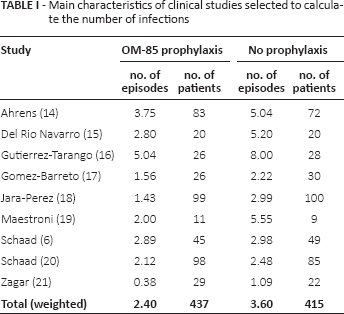
Compared to the original model, the mean number of upper respiratory tract infections was revised according to the findings of the Cochrane review (11). The authors evaluated nine clinical trials that compared the administration of the immunostimulant OM-85 to no prophylaxis (6, 14–21). A total of 852 patients were evaluated, of whom 437 were treated with the immunostimulant and 415 with placebo. By weighting the results of the individual trials in relation to the number of enrolled patients, over the 6-month period a mean of 2. 4 episodes in the presence of prophylaxis with OM-85 and of 3.6 episodes in the absence of prophylaxis were estimated (-1. 20 [95% CI from -1. 75 to -0. 66]) (Tab. I).
Main characteristics of clinical studies selected to calculate the number of infections
Resource consumption and unit costs
Table II shows, for each consumption item considered, the corresponding unit cost and classification according to the perspective adopted (patient, NHS and Community).
Unit costs (2015 €)

Prophylaxis with the immunostimulant OM-85 involves the administration of one 3.5 mg capsule per day for the first 10 consecutive days of the month, for 3 months. The cost of prophylaxis, incurred by the patient, corresponds with the retail price of a pack of 30 3.5 mg capsules, equal to €20.40 (Broncho Munal®®).
In case of an ARTI, at least one paediatric primary care visit is recommended; another visit is provided in case the first and second-line antibiotic therapy fail (10). A paediatrician will see 75. 3% of subjects with an URTI (10). The cost of a paediatric visit was valued using as a proxy the NHS reimbursement tariff for a general practitioner visit, equal to €20.66 (22).
Drug consumption associated with an URTI involves the administration of paracetamol (100% of subjects) and the use of nasal decongestants and saline solutions (65% of subjects) (10). Paracetamol cost was valued at €3.50 (equal to a 30 ml pack of Tachipirina drops), and that of nasal decongestants and saline solutions at €10. 21. The latter amount was calculated as simple mean of the retail prices for a pack of fluo-cinolone acetonide plus clonazoline (€7. 50), xylometazoline (€8. 35), isotonic seawater (€13. 30) and sulphurous water (€11. 70).
The first-line antibiotic therapy for an ARTI is amoxicillin (10). For the treatment of otitis media, consumption of two packs of amoxicillin (each containing 12 soluble and chewable 1000 mg tablets) was assumed and valued at a unit retail price of €3.27, to which the patient copayment of €2.00 per pack was added. Only one pack of amoxicillin (€3.27 + €2.00 copaid by the patient) was considered for the treatment of acute sinusitis. For “other” acute infections, a mean was calculated between the cost for the treatment of bronchitis with expectorants and the cost for the treatment of tonsillitis with amoxicillin. For the expectorants a cost of €9.55 was entered, obtained as the mean cost of Fluimucil® (200 ml 600 mg/15 ml syrup; €9.90) and Vicks Tosse Fluidificante® (200 mg/15 ml syrup 180 ml; €9. 20). Only one pack of amoxicillin (€3.27 + the patient copayment of €2.00) was entered for tonsillitis treatment.
In case of failure of first-line treatment for acute otitis media and sinusitis, it was assumed that a second-line of antibiotics (amoxicillin/clavulanic acid or cefuroxime) is given (10). A mean cost of €21.30 (drug cost plus patient copayment) was taken into account assuming that 50% of patients were treated with amoxicillin/clavulanic acid and the remaining 50% with cefuroxime (10). As for amoxicillin/clavulanic acid, two packs with a unit cost of €7. 90 (pack of 12 x 1000 mg tablets) plus €2. 00 patient copayment per pack were considered; for cefuroxime it was assumed that three packs with a unit cost of €5.60 (pack of 6 x 500 mg coated tablets) plus €2. 00 patient copayment per pack are administered to the patient (10).
If the patient does not respond to the second line antibiotic therapy, a referral to an ENT specialist is required to assess the severity of the clinical situation and decide whether to prescribe a third-line of antibiotics or to hospitalise the patient. Given the absence of a specific reference tariff, the specialist visit was valued using as a proxy the NHS reimbursement tariff for a general practitioner visit (€20. 66) (22); moreover, the model also considered a patient copayment of €23.00 (10).
Hospitalisation, which was assumed to occur in 65% of acute otitis media and in 50% of acute sinusitis not responding to second-line antibiotic therapy, was valued at the amount reimbursed by the NHS for the DRG 070 (otitis media and upper respiratory tract infections, for patients < 18 years of age), equal to €662.00 (22). If third-line antibiotics were prescribed (in 35% of cases of acute otitis media and 50% of cases of acute sinusitis not responding to second-line antibiotic therapy), the pharmacological options are ceftriaxone (5 packs each containing one 1 g vial) or clindamycin (two packs each containing 5 x 600 mg vials) for the treatment of otitis media or clindamycin (two packs each containing 5 x 600 mg vials) or cefixime (one pack containing 100 mg/5 ml powder for oral suspension) for the treatment of acute sinusitis. Drug mean costs entered into the model (otitis media: €38. 19; acute sinusitis: €26.83) correspond to the mean retail price of these products plus the patient copayment of €2.00 per pack.
Consistent with literature data, it was assumed that 34.2% of respiratory tract infections (acute or otherwise) generate a loss of productivity by a family caregiver, equal to an average of 3. 5 working days (10). This parameter was valued at a gross hourly wage of €13.09, according to the Italian Annual Report 2013 (most recent data available) (23).
Finally, Table III provides a simplified description of the calculation method used to determine the mean cost of one episode of acute otitis media from the NHS perspective.
Mean cost of an episode of acute otitis media (NHS perspective) *

See section “Resource consumption and unit costs.” ENT = ear, nose, throat.
Sensitivity analysis
The purpose of sensitivity analysis is to assess the degree of uncertainty that could characterise the comparison results (24). Uncertainty usually has three possible origins: i) structural, ii) data sources and iii) accuracy of the estimates.
In the case of structural uncertainty a new scenario was assumed, in which prophylactic therapy (administration of OM-85) would only be effective in reducing the number of episodes per patient in the 6-month period, without any clinical effect on the proportion of subjects that could have an ARTI in the 6-month period. Therefore, consistent with this assumption, patients receiving prophylaxis were assigned the same probabilities (31%) of having an episode of ARTI as patients not receiving prophylaxis.
For the second type of uncertainty, concerning the choice of data sources, the analysis of the base case was repeated varying the difference, between the two treatment options, in the mean number of episodes of respiratory tract infections in relation to the upper and lower limits of the confidence interval (-1.20; 95% CI from -1.75 to -0. 66) (11).
In the third case, i. e. to estimate the uncertainty concerning the accuracy of the estimates used in the model, a threshold analysis was conducted on the probability that a subject receiving prophylaxis could have an acute respiratory tract infection and on the number of days of absence from work due to a respiratory tract infection.
Sensitivity analysis was performed for the Community and NHS perspectives only.
Results
Mean cost of treatment
Separately for the three perspectives adopted, Table IV shows the results of the comparison between the two treatment pathways in terms of expected mean cost for patients with and without prophylaxis.
Results of the Cost-Consequence Analysis (CCA): mean cost per patient

In the Community perspective, the subject receiving prophylaxis (immunostimulant OM-85) determines the lowest mean cost. The difference, equal to €182.99, corresponds to a reduction of about one third of the costs (-31.4%) incurred by the Community. The cost of €20.40 associated with the prophylactic administration of the immunostimulant OM-85 is more than outweighed by the lower consumption of healthcare resources (hospitalisations, drugs, etc.) and non-healthcare resources (patient copayments, days of absence from work, etc.).
Also from the NHS perspective the management of a patient who has received prophylaxis with the immunostim-ulant OM-85 leads to lower treatment costs in comparison with a subject not receiving prophylaxis (Tab. IV), with a difference of €40. 30 (-43. 0%).
Finally, taking into account in the model the costs incurred only by the patient, the prophylaxis with the immunostim-ulant OM-85, compared to no prophylaxis, would lead to a mean increase in the costs of treatment of €7. 73 (€45. 11 vs.€37. 38) (Tab. IV).
Sensitivity analysis
Table V shows the results of the analysis performed on structural uncertainty (equal probability of ARTI = 31%) and uncertainty associated with the sources of data (variations in the number of acute respiratory tract infections). In all simulations, both from the perspectives of the Community and the NHS, the treatment pathway based on the immunostimulant OM-85 has always the lower mean cost per patient.
Sensitivity analysis

ARTI = acute respiratory tract infection; NHS = National Health Service.
The first comparison of the threshold analysis, performed from the Community perspective, showed that, with any value associated to the probability that a patient receiving prophylaxis may have an episode of ARTI, treatment with the immunostimulant OM-85 is always cost-saving (Fig. 2). Conversely, the same analysis, conducted from the NHS perspective, showed that prophylaxis with the immunostimulant OM-85 remains the option with the lower cost of treatment up to a 69.5% probability that a patient receiving prophylaxis may have an episode of ARTI (about 3.5 times the value of 19.9% assumed for the base case) (Fig. 3). Finally, the last comparison of the threshold analysis, conducted from the community perspective, shows that prophylactic treatment is always cost-saving, even in the extreme case in which no days of absence from work due to a respiratory tract infection are considered (Fig. 4).

Threshold analysis: probability of acute respiratory tract infection (ARTI): Community perspective. IS = immunostimulant.

Threshold analysis: probability of acute respiratory tract infection (ARTI): NHS perspective. IS = immunostimulant.

Threshold analysis: days of absence from work (Community perspective). IS = immunostimulant.
Discussion
Cost-saving is an increasingly important factor when a treatment strategy is set down. It is therefore essential to appropriately identify the associated costs, not only in terms of drug acquisition but also of costs due to hospitalisations, medical visits, possible concomitant therapies and days of absence from work, etc.
The aim of this analysis was to assess the economic impact of prophylaxis in children at risk of recurrent respiratory tract infections, from three different perspectives: the Community, the NHS, and the patient.
According to the results estimated by this decision model, compared to the strategy “no prophylaxis”, the administration of the immunostimulant OM-85 would allow savings for the Community in the treatment of a child at risk of recurrent URTI (€399.46 vs. €582.45). Prophylaxis also appears to be advantageous from the NHS perspective, with a 43.0% cost reduction for each patient treated (€53.51 vs. €93. 81). This difference (-€40. 30) would also be adequate to cover the cost of the immunostimulant, which currently is paid by the patient (out-of-pocket).
Finally, as the immunostimulant acquisition cost is not reimbursed by the Italian NHS, it was deemed appropriate to analyse the economic impact of prophylaxis on patients (patient perspective). Patients would have an increase in the monthly cost of treatment of approximately one euro (€1.29); a negligible amount when compared to the clinical benefits (reduction in the number of respiratory tract infection episodes) and the better quality of life for patients and their families (e. g. reduction in hospital days, days of absence from work, etc.).
According to our estimates, the reduction in the number of acute respiratory tract infections would also lead to a more than 50% reduction in the use of antibiotic therapy for these patients. In addition to the obvious economic benefit, this aspect could also help to manage properly antibiotic therapy, especially in the light of the alarming situation outlined in the recent WHO report on the increase in antimicrobial resistance (25).
This economic analysis involved the adoption of choices/ assumptions that deserve discussion. In the comparison between the two scenarios - with and without prophylaxis - on the basis of the findings reported in literature (11), it was assumed that the administration of the immunostimulant has a clinical effect not only on the mean number of respiratory tract infections, but also on the proportion of subjects who could have an episode of ARTI. To eliminate the effects of this assumption on results, a sensitivity analysis was conducted taking into account a scenario in which the immunostimulant has a clinical effect on the mean number of respiratory tract infections episodes alone. Even in this case, the therapeutic option constituted by prophylaxis is characterised by lower treatment costs.
In addition, with the aim of estimating the impact on results of the variability associated with the mean number of episodes of respiratory tract infections (11), a sensitivity analysis was conducted by varying the mean number of these episodes in relation to the confidence interval. In all simulations, considering the perspectives of both the Community and the NHS, prophylaxis with OM-85 always generates a lower mean cost of treatment.
Lastly, the probabilities that a respiratory tract infection is not acute (ARTI) and that each episode is associated with a loss of productivity represent two further parameters that could potentially affect the final result. To assess this impact, a thorough threshold analysis was conducted. This showed that, even in an extreme case (no acute infection or no loss of productivity), OM-85 prophylaxis always remains the cost-saving treatment option.
It is noteworthy that recent clinical studies seem to have successfully expanded the clinical use of the immunostimulant OM-85 in terms of its preventive effect for both recurrent exacerbations in adult patients with chronic bronchitis or moderate chronic obstructive pulmonary disease (COPD) and for respiratory tract infections in HIV-infected patients (27). In the former study (26), patients with chronic bronchitis or moderate COPD treated with the immunostimulant OM-85 showed a significant reduction in the number of exacerbations (-29%; p = 0. 03) compared to patients treated with placebo. In addition to showing a significant reduction in the number of respiratory tract infections, the latter study (27) - an observational study conducted on patients with HIV - also reported a significant reduction in the use of, and costs associated with, antibiotic therapy. These findings are consistent with our analysis results, as these authors conclude that the use of the immunostimulant OM-85 may contribute to at least controlling the resistance “phenomenon”, in the absence of an actual reduction.
Conclusion
Therefore, by considering the dual effect generated by the reduction in the number of episodes of upper respiratory tract infections and in the associated treatment costs, the adoption of the prophylaxis strategy with the immunostimulant OM-85 in the treatment of children at risk of recurrent respiratory tract infections seems to be a treatment option that could optimise (efficient allocation) the resources available to society and lead to savings in the costs incurred by the Italian NHS.
Footnotes
Financial support: This research was made possible by an educational grant from Abiogen Pharma S. p. A.
Conflict of interest: The author declares that he has no conflicts of interest in the research.