






Abstract
Purpose
ABG II - cemented anatomic stems share their geometry and instrumentation with the uncemented version and provide a promising concept. This study compares a consecutive series of cemented ABG IIs to a pool of all other implants used during the same observation period at the institution of the authors.
Methods
This retrospective study is based on data from our regional hip arthroplasty register. The results of 141 cases with ABG II prosthesis were compared to those of 2,315 cases that were operated during the same period of time and reported in the regional arthroplasty registry. Survival was calculated using the Kaplan Meier method.
Results
The patients with cemented ABG II had a significantly worse preoperative WOMAC sum score and WOMAC domains, and similar ameliorated results as the control group at 1-year follow-up. The 5-year revision rate of the ABG II compares well to the 5-year revision rate of the controls in this study.
Conclusions
Revision rate and health related, quality of life, of cases with cemented ABG prosthesis are similar to those of a register based control group.
Keywords
Introduction
The uncemented ABG II prosthesis (Anatomic Benoist Girard II stem, Stryker, Kalamazoo MI) is frequently used in Europe. It was the second most commonly used cementless stem from 1992 to 2008 in the Swedish hip register (1) and was evaluated in several publications as well as in registries.
The cemented ABG II stem, however, was used in Sweden in only 65 cases (1), is less studied and is not mentioned in other registries (2, 3). It has a satin surface finish and both the cemented and uncemented implants share the same instrumentation and geometry (Fig. 1) with a slightly reduced volume for the cemented stem to allow for the cement mantle. Thus, the choice for a cemented or un-cemented fixation can be made preoperatively. A polyethylene centraliser can be mounted at the tip of the cemented version that guides the tip of the stem in the centre of the femoral canal.
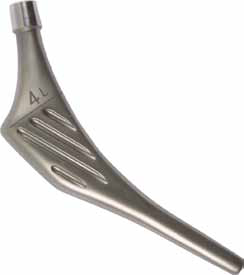
ABG II stem cemented.
The aim of this study was to compare a consecutive series of cemented ABG II stems to a pool of stems implanted at the same institution during the same time period based on registry data and thus provide an estimate of the cemented ABG II clinical results and survival.
Material and Methods
We conducted a retrospective study on the cemented ABG II stem which was approved by the regional ethics committee (UN3763). The study was based on the data of our regional hip arthroplasty register and was completed with patient data of revision cases. Revision information was collected until March 2014.
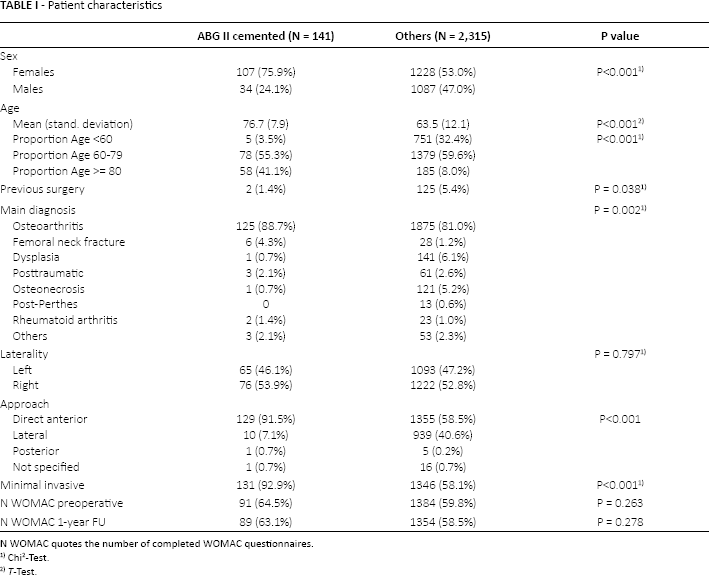
We included 141 consecutive patients who were operated in our department, and who were registered in our regional arthroplasty register. Of those patients 107 were female (76%) and 34 were male. Five of them were younger than 60 years (4%), 78 were 60 to 79 years old (55%) and 58 were at least 80 years old (41%). Two patients had undergone previous surgery of the operated hip. Sixty-five were operated on their left hip (46%), the others on their right. The direct anterior approach (4-5-6) was used in 129 cases (92%), while a lateral approach was chosen in 10 cases (7%) and a posterior approach was chosen in 1 case (for more patient characteristics see Table I). The direct anterior approach was performed in a minimally invasive technique with special instruments in the Smith-Peterson interval.
Patient characteristics
N WOMAC quotes the number of completed WOMAC questionnaires.
Chi2-Test.
T-Test.
Implantation was performed using a modern cementing technique with jet lavage, vacuum mixing, a cement stopper, and a centraliser. Two different gentamycin-loaded bone cements were used (Palamed® G by Heraeus and Refobacin® Bone Cement R by Biomet). The stem has 6 sizes, with a stem length varying between 100 mm and 135 mm, and a distal diameter from 8.3 to 11.5 mm. Offset can be controlled only by different neck length. Only 28 mm and 32 mm heads were used, predominantly ceramic heads.
In 103 cases (73%) we obtained a completed WOMAC (Western Ontario and McMaster Universities Arthritis Index) questionnaire immediately before the operation (on the preoperative day in almost all cases), and in 94 cases (67%) postoperatively after 1 year. Ninety-one (65%) preoperative WOMAC questionnaires were completed sufficiently enough to perform further analyses, in comparison to 89 (63%) postoperatively. Reasons not to complete the WOMAC were advanced age, inability to read, and patients who had migrated from other countries and did not understand the language.
The main diagnoses was primary osteoarthritis (125), followed by femoral neck fracture (6), post-traumatic (3), rheumatoid arthritis (2), osteonecrosis (1), and dysplasia (1). The rest had other diagnoses (category “others” in registry).
The results were compared to those of 2,315 cases which were operated during the same period of time, in the same institution, and were also included in the regional arthroplasty registry. Ninety-two patients were younger than 40 (4.0%), 659 were between 40 and 59 years old (28.5%), 1379 were between 60 and 79 (59.6%), and 185 were at least 80 years old (8.0%).
Thus the proportions of octogenarians were not equal for the groups. In the ABG group 40% were from that age group while in the control group only 10% were octogenarians.
The regional arthroplasty register (https://www.iet.at) is connected to the health information system of all public hospitals in the region. Thus, every operation, primary total hip arthroplasty (THA), and revision, is coded for reimbursement by the public health system, and automatically included in the register. The register is also linked to the authorities and collects information on the death of patients.
Survival was calculated using the Kaplan Meier method and the significance of differences of the median (WOMAC) was calculated with the Mann Whitney test.
Results
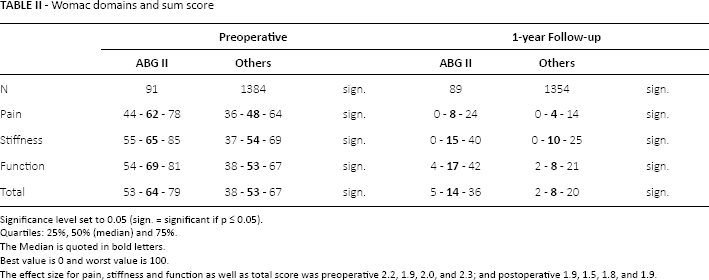
The patients who received cemented ABG IIs had a significantly worse preoperative WOMAC sum score and WOMAC domains in comparison to the controls (Tab. II). At 1-year follow-up results were almost equal.
Womac domains and sum score
Significance level set to 0.05 (sign. = significant if p ≤ 0.05).
Quartiles: 25%, 50% (median) and 75%.
The Median is quoted in bold letters.
Best value is 0 and worst value is 100.
The effect size for pain, stiffness and function as well as total score was preoperative 2.2, 1.9, 2.0, and 2.3; and postoperative 1.9, 1.5, 1.8, and 1.9.
For survival statistics, a total of 2,454 observations with a total of 98 failures were available. Total analysis time at risk is 146,229 observation months, ranging from 0 to 95.8 months per individual. Mean time at risk per subject was 59.5 months, and median time at risk 59.9 months.
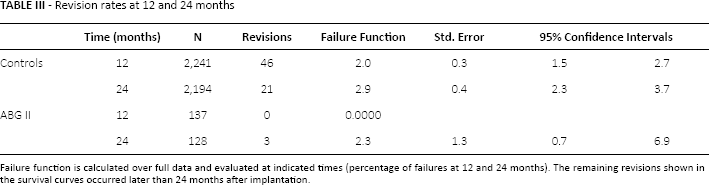
Five cemented ABG II were revised (3.5%) whilst 93 stems in the control group were revised (4.0%). Survival for 12 and 24 months is quoted in Table III, and survival curves are shown in Figure 2.
Revision rates at 12 and 24 months
Failure function is calculated over full data and evaluated at indicated times (percentage of failures at 12 and 24 months). The remaining revisions shown in the survival curves occurred later than 24 months after implantation.
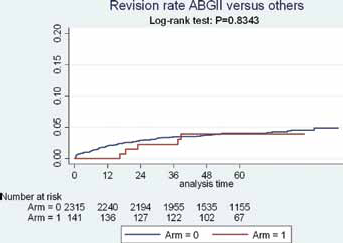
Survival of controls (Arm 0 = Other) and cemented ABG II (Arm 1 = ABG II). Survival time is quoted in months.
Aseptic loosening started with radiolucencies between stem and cement in Gruen zone 1 and 7 (Fig. 3).
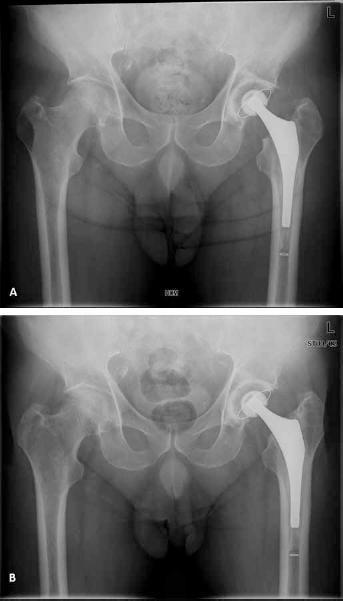
Male patient, 67 years-of-age at time of implantation. The decision to use a cemented stem was made intraoperatively because of poor bone quality. Stem exchange 22 months later because of aseptic loosening (migration, bone scan, radiolucencies Gruen zone 1 and 7). The stem could be pulled out without effort. Distal cement had to be removed by help of an ultrasonic cement removal system.
Discussion
Preoperative and postoperative WOMAC scores of ABG II patients were worse than those of controls, reflecting patient selection (Tab. I). Young and active patients received cementless prostheses, while those with bad bone stock received a cemented prosthesis. Elderly people, and especially octogenarians, experience more pain, restriction of motion, and loss of function. More than 40% of ABG II patients were older than 80 but only 8% of the controls.
The revision risk for cemented ABG II was 2.3% (0.7%- 6.9%) after 2 years in comparison to 2.9% (2.3%-3.7%) of the controls. Several factors may contribute to this finding, although analysing them in detail would have been beyond the scope of this study. It is well known, from the Swedish arthroplasty register for example, that revision rates decrease with increasing age. The cemented ABG II was implanted in a much higher proportion of octogenarians. There are no restrictions by the social security system concerning revisions in people older than 80 years. Elderly people experiencing pain, however, are more hesitant to undergo a revision. In addition, the benefit-risk ratio of a revision may get worse with additional co-morbidities of octogenarians, thus influencing the individual decision to undergo surgery.
A centraliser was used in all ABG II patients. According to Bell CA et al (7) the use of a centraliser is not justified, since it does not result in better alignment. However, this comparative study was not known at the time of implantation. As the distal centraliser of the cemented ABG II prosthesis adds an additional 27 mm to the length of the stem, and accordingly, to the distal cement plug, its use is no longer recommended.
Pérez MA et al (8) studied damage accumulation in the cement mantle and debonding of the bone-cement interface in Exeter, Charnley, and ABG II cemented stems, and also to the Elite Plus stem in a previous study (9). They showed that the cement deterioration and bone-cement interface debonding is different for each implant and depends on the stem geometry. The highest deterioration (cement and bone cement-interface) was observed with the ABG II stem. These findings may influence long-term survival, but supposedly will not cause revision in the first years of observation. On the other hand, a study from our group showed that the direct anterior approach with a curved insertion of the stem into the canal had no negative influence on the thickness of the cement mantle (10).
As far as the authors know, this is the first paper on short-term survival of the ABG II cemented stem. The short-term outcome compares well to the pooled results of all other stems used at the same department.
Footnotes
Financial support: The study was partially funded by Stryker Corp., although it was conducted as an independent academic study.
Conflict of interest: The Department of Orthopaedics receives research support from Stryker Corp. M. Nogler is a consultant and presentation speaker for Stryker Corp.