Editorial
 Available accessEditorialFirst published January, 2015pp. 1-1

Select search scope: search across all journals or within the current journal


 Available accessEditorialFirst published January, 2015pp. 1-1Available accessReview articleFirst published January, 2015pp. 2-6
Implant modularity has recently come under increasing scrutiny due to concerns regarding wear, corrosion and potential adverse reactions to metal debris. This review outlines the evolution and development of the femoral stem trunnion and relates this to contemporary issues now encountered.
Despite different manufacturers producing what appear to be similar trunnion designs, there is still a lack of standardisation, with small but significant design variations. Wear and corrosion is certainly not a new phenomenon, but recent changes in design and the use of larger metal head sizes has potentially made the problem more prevalent. These issues along with steps to avoid these problems are discussed.
Available accessReview articleFirst published January, 2015pp. 7-14Corrosion of the head-neck junction of the femoral component in total hip arthroplasty has been associated with symptomatic adverse local tissue reactions, trunion fracture and elevated serum metal ions. An analysis of risk factors and treatment strategies for corrosion at this interface is lacking in the literature. We therefore performed a systematic review of AAOS proceedings, MEDLINE and EMBASE databases, and included our own case series. A total of 24 articles representing 776 cases of head-neck corrosion met inclusion criteria. The combination of large femoral head sizes and small taper dimensions comprised the majority of published corrosion cases. Revision to ceramic head and ceramic/polyethylene liner was the most commonly utilised treatment. Coating precipitation, mixed alloy coupling and head-neck modulus mismatch collectively appear to contribute to the corrosive process.
Available accessReview articleFirst published January, 2015pp. 15-23Advanced hip imaging and surgical findings have demonstrated that a common cause of greater trochanteric pain syndrome (GTPS) is gluteal tendon tears. Conservative measures are initially employed to treat GTPS and manage gluteal tears, though patients frequently undergo multiple courses of non-operative treatment with only temporary pain relief. Therefore, a number of surgical treatment options for recalcitrant GTPS associated with gluteal tears have been reported. These have included open trans-osseous or bone anchored suture techniques, endoscopic methods and the use of tendon augmentation for repair reinforcement. This review describes the anatomy, pathophysiology and clinical presentation of gluteal tendon tears. Surgical techniques and patient reported outcomes are presented. This review demonstrates that surgical repair can result in improved patient outcomes, irrespective of tear aetiology, and suggests that the patient with “trochanteric bursitis” should be carefully assessed as newer surgical techniques show promise for a condition that historically has been managed conservatively.
Available accessResearch articleFirst published January, 2015pp. 24-27Hip abductor insufficiency is often associated with lateral hip pain, movement disorder and Trendelenburg gait. The aims of this study are to predict if preoperative radiological findings correlate with postoperative outcomes and if pre and postoperative radiological findings correlate with postoperative function.
Patients with clinical and MRI evidence of hip abductor tears that had failed to nonoperative treatment underwent surgical repair. Pre and postoperative MRI analysis was carried out by an experienced musculo-skeletal radiologist. Clinical analysis consisted of Harris Hip Score, a measure of patient satisfaction, pre and postoperative walking aids and Trendelenburg test.
This study shows no real improvement in the MRI appearances of the tendons after surgery. Preoperative MRI absence of gluteus minimus was 100% predictive of a poor outcome, whilst thickening of the posterior gluteus medius was 83% predictive of a poor outcome. Postoperative MRI absence of posterior gluteus medius was 75% predictive of a poor outcome. Thickening of anterior gluteus medius and posterior gluteus medius were 71% and 83% predictive of a poor outcome respectively. Absence of posterior gluteus medius correlated with poor outcome in 75% of cases.
The MRI appearance of the tendon does not normalise after surgery and there is limited correlation between the MRI appearances pre and postoperatively with the postoperative outcome.
Available accessResearch articleFirst published January, 2015pp. 28-33This study describes specific complications noticed during the first unselected cases operated by anterior approach for THA in our hospital and specific adjustments that were applied on the procedure to prevent these complications. We retrospectively analysed the differences between 202 patients who were operated by a standardised approach and 248 patients who were operated after adjustments were implemented with the procedure. Injury to the lateral femoral cutaneous nerve (LFCN), fractures of the greater trochanter and dislocation were specific complications that were noticed with the initial technique.
Prevalence of injury to the LFCN decreased from 7.9% to 0.8% (p<0.001), fractures of the greater trochanter decreased from 5.4% to 0.8% (p = 0.004) and the incidence of dislocation decreased from 4.5% to 1.6% (p = 0.074).
Available accessResearch articleFirst published January, 2015pp. 34-38Dual mobility implant designs minimise the risk of dislocation without sacrificing range of motion. Between 1st September 2008 and 31st July 2011, 5 institutions examined early clinical outcomes of a new dual mobility bearing hip system implanted in 485 primary THAs in 452 patients. Patient demographics were 46% female, a mean age of 67 years and a mean BMI of 30. Complications at a minimum of 2 years after surgery included 1 femur fracture, 1 DVT and 4 unrelated deaths. There were no dislocations. For functional outcomes, Harris Hip Scores increased from 41 to 86 (p<0.001), while VAS pain scores decreased from 5.9 to 0.7 (p<0.001). Minimal complications, excellent early clinical outcomes and the absence of early dislocations demonstrate the improved stability of this dual mobility implant system.
Available accessResearch articleFirst published January, 2015pp. 39-43Highly cross-linked polyethylene (XLPE) has improved wear properties. This study reports the results of a small series of patients treated over 10 years ago with a metal-on-XLPE hip resurfacing.
A total of 21 hips in 20 patients received a hip resurfacing with a cobalt-chromium metal femoral head and metal-backed acetabular cup lined with a XLPE insert and were retrospectively studied. Kaplan-Meier Survivorship was calculated.
Five patients who had initial extreme cystic disease in the femoral head failed due to femoral loosening. Survivorship was 95.2% at 5 years and 81.0% at 10 years.
We found that XLPE wear was not implicated in these failures, which were primarily attributed to poor bone quality of the femoral head, early bone preparation, cementing technique and excessive head reaming to near the neck diameter, necessitated for the implantation of a thick two-part socket.
Available accessResearch articleFirst published January, 2015pp. 44-49For the revision of failed acetabular components impaction bone grafting (IBG) with a cemented cup is a well known technique. Claims have been made that this is a biological reconstruction technique, restoring the bone stock loss and thereby facilitating future revisions. However, there are no scientific data proving this claim.
In this study, we present the clinical and radiographic outcome of 11 consecutive acetabular re-revisions in 10 patients with again IBG and a cemented polyethylene cup observed in a previously reported cohort of 62 acetabular IBG revisions. All data were prospectively collected. Kaplan-Meier survivorship analysis was performed.
The mean follow-up after re-revision was 10 years (5-15) and 28 years (26-30) after the primary revision. No patients were lost to follow-up. The mean HHS improved from 37 (12-49) points to 71 (40-95) points at final follow-up. Survival with further cup revision for any reason as endpoint was 91% (95% confidence interval (CI) 51 to 99) at 10 years. When excluding one early cup re-revision for malpositioning 3 weeks postoperative, survivorship with further cup revision for aseptic loosening as endpoint was 100% (95% CI 37-100) at 10 years. Survival with further cup re-operation for any reason as endpoint was 82% (95% one-sided CI 45-95). In all surviving re-revisions trabecular incorporation was observed without radiolucent lines.
This study shows that, due to restoring the bone stock, even successive acetabular reconstructions using IBG and a cemented cup are possible with satisfying 10 years survivorship.
Available accessResearch articleFirst published January, 2015pp. 50-55Polyethylene wear has been a major cause of revision of cementless total hip replacements. Highly cross-linked polyethylene has been developed to increase mechanical resistance to wear. However, cross-linking from irradiation of the polyethylene generates free radicals and these can oxidise
To measure wear of vitamin E infused highly cross-linked polyethylene and compare wear between 2 different head sizes.
In a prospective randomised study between 32 mm and 36 mm Biolox® delta heads in 50 hips we analysed the
Mean (95% CI) wear for the total material was 0.041 mm (0.015-0.066) in the vertical direction and 0.177 mm (0.155-0.200) in the total 3D direction. After the anticipated period of bedding-in we found no statistically significant differences in wear from three months to 2 years in vertical and total 3D directions. Although statistical significant differences between 32 mm and 36 mm heads were found in the total 3D direction we cannot conclude that there are significant clinical important differences in wear comparing these head sizes.
This study shows promising early results with very low wear, even for 36 mm heads, but long term follow-up is necessary to evaluate if this polyethylene will provide low wear and good mechanical properties in the long-term.
Available accessResearch articleFirst published January, 2015pp. 56-60ABG II - cemented anatomic stems share their geometry and instrumentation with the uncemented version and provide a promising concept. This study compares a consecutive series of cemented ABG IIs to a pool of all other implants used during the same observation period at the institution of the authors.
This retrospective study is based on data from our regional hip arthroplasty register. The results of 141 cases with ABG II prosthesis were compared to those of 2,315 cases that were operated during the same period of time and reported in the regional arthroplasty registry. Survival was calculated using the Kaplan Meier method.
The patients with cemented ABG II had a significantly worse preoperative WOMAC sum score and WOMAC domains, and similar ameliorated results as the control group at 1-year follow-up. The 5-year revision rate of the ABG II compares well to the 5-year revision rate of the controls in this study.
Revision rate and health related, quality of life, of cases with cemented ABG prosthesis are similar to those of a register based control group.
Available accessResearch articleFirst published January, 2015pp. 61-66Cementation of a polyethylene liner into the well-fixed shell is a convenient option for revision total hip arthroplasty. We retrospectively reviewed 45 patients who had liner cementation to investigate the risk factors which gave rise to major complications and reoperation. Patients were observed for a minimum of 7 years (range 7.8-14 years). Relevant risk factors (age, BMI, surgical approach, previous cup size and position, types of coated surface) were assessed with Cox regression analysis. The mean Harris Hip Score was improved from 62.5 (range 57-68) preoperatively to 87.1 (range 70-97). A total of 7 hips (15.5%) had acetabular component loosening that was treated with reoperation. Prevalence of acetabular component loosening was statistically significantly higher in hydroxyapatite-coated group (5 of 13) than in the Ti-coated group (2 of 32, p = 0.015). All recurrent dislocations occurred in patients treated with a posterior approach. Diameter of the previous metal shell of below 54 mm showed a lower 10-year survival rate than those greater than 54 mm in diameter. PE liner cementation in stable metal cup is a useful alternative option for carefully selected patients. Pre-existing HA-coated cups as well as small sized cups were indicative of poor outcomes.
Available accessResearch articleFirst published January, 2015pp. 67-71Creating bi-laminar cement mantles as part of revision hip arthroplasty is well-documented but there is a lack of data concerning the effect of cement brand on the procedure. The aim of this study was to compare the shear strength of bi-laminar cement mantles using various combinations of two leading bone cement brands.
Bi-laminar cement mantles were created using Simplex P with Tobramycin, and Palacos R+G: Simplex-Simplex (SS); Simplex-Palacos (SP); Palacos-Simplex (PS); and Palacos-Palacos (PP). Additionally, specimens were produced by rasping (R) the surface of the original mantle, or leaving it unrasped (U), leading to a total of eight groups (n = 10). Specimens were loaded in shear, at 0.1 mm/min, until failure, and the maximum shear strength calculated.
The highest mean shear strength was found in the PSU and PSR groups (23.69 and 23.89 MPa respectively), and the lowest in the PPU group (14.70 MPa), which was significantly lower than all but two groups. Unrasped groups generally demonstrated greater standard error than rasped groups.
In a further comparison to assess the effect of the new cement mantle brand, irrespective of the brand of the original mantle, Simplex significantly increased the shear strength compared to Palacos with equivalent preparation.
It is recommended that the original mantle is rasped prior to injection of new cement, and that Simplex P with Tobramycin be used in preference to Palacos R+G irrespective of the existing cement type. Further research is needed to investigate more cement brands, and understand the underlying mechanisms relating to cement-in-cement procedures.
Available accessResearch articleFirst published January, 2015pp. 72-75Avascular necrosis (AVN) of the hip may have extensive involvement of the proximal femur which may affect boney ingrowth into cementless femoral stems. From 1994 to 2004, 182 total hip arthroplasties (in 144 patients, 117 AVN hips and 65 non-AVN hips) were performed using hydroxyapatite coated femoral stems. All patients were followed up prospectively. Mean age was 51 years and mean follow-up 14.7 years (range 9.7-19.1 years). Four stems were revised because of aseptic loosening, 3 in AVN group and 1 in non-AVN group. The overall mechanical failure rate was 2.2%, the mechanical failure rate in AVN and non-AVN group was 2.6% and 1.5% respectively (p = 1). The 19.1 year survival using revision for aseptic loosening as an endpoint for AVN and non-AVN patients were 97.1% and 96.2% respectively (p = 0.654). Stable boney ingrowth was present in 99.5% hips. This study represents 1 of the largest series reporting the long-term follow-up of the use of cementless femoral stems in treating AVN of the hip. We report excellent long-term survival of cementless total hip arthroplasty used in managing AVN of the hip and is comparable to that seen in non-AVN total hip arthroplasty.
Available accessResearch articleFirst published January, 2015pp. 76-81Increased evidence indicating ghrelin's direct influence on bone has been reported, but previous studies did not investigate its relationship with osteonecrosis of the femoral head (ONFH)
Patients with non-traumatic ONFH (including steroid-induced, alcohol-induced, and idiopathic ONFH) and healthy controls were recruited for the study. We evaluated levels of plasma ghrelin and vWF. Other potentially relevant indicators, von Willebrand Factor cleaving protease (vWF-cp), plasminogen activator inhibitor 1 (PAI-1), tissue plasminogen activator (tPA), leptin, C-reactive protein (CRP), and lipid parameters were also assayed. Correlation coefficients and logistic regression models were used to assess the associations.
Patients with non-traumatic ONFH had significantly lower ghrelin levels, higher vWF, PAI-1, CRP levels than those in healthy controls. Ghrelin level was negatively correlated with vWF after adjustment for other variables. Logistic regression model revealed that non-traumatic ONFH was independently associated with plasma ghrelin and vWF.
This study indicates that plasma ghrelin, vWF and PAI-1 levels were changed in patients with non-traumatic ONFH. Ghrelin in combination with vWF may prove to be involved in the pathogenesis of non-traumatic ONFH.
 Open accessResearch articleFirst published January, 2015pp. 82-90
Patients undergoing total hip arthroplasty are increasingly younger and have a higher demand concerning hip range of motion. To date, there is no clear consensus as to the amplitude of the “normal hip” in everyday life. It is also unknown if the physical examination is an accurate test for setting the values of true hip motion. The purpose of this study was: 1) to precisely determine the necessary hip joint mobility for everyday tasks in young active subjects to be used in computer simulations of prosthetic models in order to evaluate impingement and instability during their practice; 2) to assess the accuracy of passive hip range of motion measurements during clinical examination. A total of 4 healthy volunteers underwent Magnetic Resonance Imaging and 2 motion capture experiments. During experiment 1, routine activities were recorded and applied to prosthetic hip 3D models including nine cup configurations. During experiment 2, a clinical examination was performed, while the motion of the subjects was simultaneously captured. Important hip flexion (mean range 95°-107°) was measured during daily activities that could expose the prosthetic hip to impingement and instability. The error made by the clinicians during physical examination varied in the range of ±10°, except for flexion and abduction where the error was higher. This study provides useful information for the surgical planning to help restore hip mobility and stability, when dealing with young active patients. The physical examination seems to be a precise method for determining passive hip motion, if care is taken to stabilise the pelvis during hip flexion and abduction.
Available accessResearch articleFirst published January, 2015pp. 91-97The Harris Hip Score (HHS) is one of the most widely used health related quality of life (HRQOL) measures for the assessment of hip pathology: in spite of this, a validation study, and an official Italian version have not been provided yet. The aim of this study was to create an Italian valid and reliable version of the HHS.
The score was translated and modified in Italian; then 103 patients with different hip pathologies were evaluated using this HHS version and also with the WOMAC and the SF-12 questionnaires. Content, construct and criterion validities were tested, such as interobserver reliability, test-retest reliability and internal consistency.
Cross-cultural adaptation was easy, and only minor adaptation was required in the translation process. Construct and criterion validity of the HHS Italian Version were confirmed by satisfactory values of Spearman's Rho for correlation between specific domains of HHS and Womac and SF12 scores. Interobserver and test-retest reliabilities obtained values of 0.996 and 0.975 respectively; Cronbach's alpha for internal consistency was 0.816.
Statistical and clinical analysis showed that HHS is highly valid and reliable in this new Italian version.
Available accessCase reportFirst published January, 2015pp. 98-100We report the case of a young female patient who received a total hip replacement due to pain in her left hip joint, misdiagnosed as degenerative arthritis. A clear cell chondrosarcoma (CCCS) in the femoral head had initially not been detected. Seven years later, a periprosthetic recurrence of CCCS close to the former femoral osteotomy occurred. Although a sample of the periprosthetic tumour had been taken for histologic analysis, the recurrence of CCCS remained misdiagnosed for almost 2 years until this rare histopathologic morphology was examined in a specialised multidisciplinary tumour centre. Finally, revision surgery with wide tumour resection margins had to be performed requiring the removal of the total hip replacement and its reconstruction using a modular megaimplant (proximal femoral replacement). Relevant facts of the CCCS as a rare entity regarding histology, treatment and differential diagnoses are discussed.
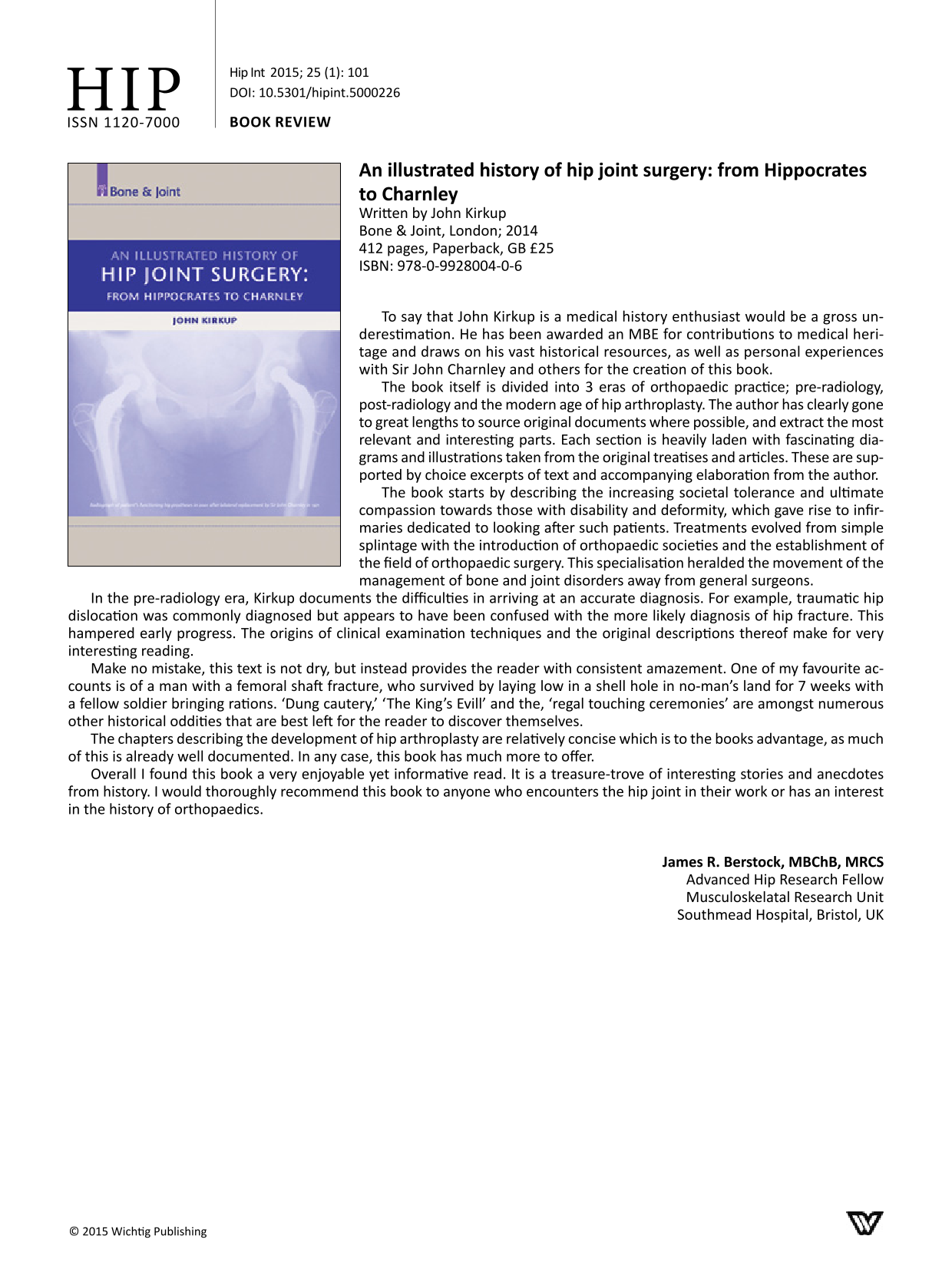
Available accessBook reviewFirst published January, 2015pp. 101-101