






Abstract
Purpose
We aimed to assess the early outcome following revision arthroplasty for failed metal-on-metal (MoM) total hip replacements (THR) due to adverse reaction to metal debris (ARMD).
Methods
We reviewed 106 consecutive revision arthroplasties. Case notes and radiological investigations were reviewed to assess the complications. Oxford Hip Score (OHS) and Euroqol (EQ-5D-3L) scores were used to assess the functional outcome and improvement of quality of life.
Results
At a mean follow-up of 20 months (12-48 months), the mean OHS was 28.7. Pain improved in 61% patients. A majority of patients were in level 2 for all the EQ-5D-3L dimensions. The overall complication rate was 16%. Survivorship free from further revision for any cause was 94.3% at 48 months. There was no correlation between pre-revision blood metal ions and the final outcome.
Conclusions
Revision surgery for failed MoM hip replacement due to ARMD is associated with a relatively higher rate of complications and risk of chronic pain. There is poor correlation between serum metal ions and development of ARMD and outcome following revision surgery.
Keywords
Introduction
Metal-on-metal hip (MoM) arthroplasties were introduced with theoretical advantages of low wear, increased range of movement, lower dislocation rates, and a more normal gait pattern (1). However, it has been recognised now that MoM hips, especially in certain designs e.g. ASR (Depuy Medical), these articulations may lead to early failure as a result of reaction to metal debris. This has been variously described as adverse reaction to metal debris (ARMD), pseudotumour (2) and acute lymphocytic vasculitis associated lesions (ALVAL) (3, 4). This issue is higher in MoM total hip replacements (MoM THR). Based on data from the National Joint registry of England and Wales, Smith et al (5) found significantly poor survival rates of stemmed MoM THRs as compared to other bearings. Higher revision rates of MoM arthroplasties has also been shown in several other studies (6–14). Due to concerns about MoM articulations, the United Kingdom Medicine and Healthcare products Regulatory Agency (MHRA) issued regular follow-up guidelines for these patients (15). These include regular follow-up, metal ion levels check and metal artefact reduction sequence magnetic resonance imaging (MARS MRI) (16) when appropriate. In a symptomatic hip with raised metal ions and abnormal imaging revision surgery is warranted.
There is currently limited literature about the outcome of revision arthroplasty for ARMD. Grammatopolous et al (17) described poor outcomes of hip resurfacings revised for pseudotumours as compared to others causes. In a small study of 13 patients, Rajpura et al (18) found good outcomes in 12 patients. However, 1 patient had extensive soft tissue destruction and was left with a pseudoarthrosis. Wyles et al (19) found high rate of infection following revision of failed MoM hip arthroplasties and stressed the importance of monitoring results of these revision surgeries. Munro et al (20) also found high complication rates in patients undergoing revision of large head metal on metal total hip arthroplasty. The results of all these studies are limited due to the small number of patients, mixture of resurfacings and stemmed total hip replacement cases and various aetiologies responsible for failure of primary procedures. We therefore performed this study looking at the outcome of revision Arthroplasty for failed stemmed MoM total hip replacements due to ARMD.
The primary aim of this study was to assess the functional outcome and quality of life of patients following revision arthroplasty for failed MoM THR. The secondary aims were to analyse complications following revision surgery, analyse the relationship between pre-operative metal ions and postoperative pain improvement and to assess post revision survivorship.
Patients and Methods
We reviewed the outcome of a single surgeon series of revision arthroplasties for failed MoM THRs. The primary surgery for these patients had been performed by a variety of consultants. These patients were identified through a dedicated surveillance programme for MoM hip replacements at our hospital. This surveillance followed the guidelines published by the MHRA in June 2012 (15).
Inclusion criteria
Consecutive patients who underwent revision arthroplasty for failed MoM hip replacements and gave their informed consent to be included in the study.
Exclusion criteria
Follow-up less than 12 months;
Failure of primary MoM hip arthroplasty due to causes other than ARMD;
Metal-on-metal resurfacings.
A complete pre-operative work up was performed including inflammatory markers, blood cobalt (Co) and chromium (Cr) levels, radiographs and MARS MRI scans. Ultrasound guided hip aspiration was performed pre-operatively in cases where a suspicion of infection existed.
Criteria for revision
The revision criteria for MoM hip replacements at our institution is in accordance with MHRA guidelines (15). Revision arthroplasty is offered to a symptomatic patient who has evidence of ARMD on MARS MRI and/or increasing blood metal ions (Co and Cr) levels above 7 ppb, on serial tests. Findings on MRI scans are given more significance than ion levels.
Operative procedure and follow-up
A posterior approach was used for all revision surgery. The hip was aspirated before opening the capsule. A thorough soft tissue debridement and removal of necrotic tissue was performed. Synovial fluid and tissue samples were sent for culture, biochemistry and histopathology examinations. Medical photography images were taken and saved on the hospital database. The acetabular component was removed using a self-centering curved osteotome. A new uncemented hemispherical shell was used in the revision of resurfacing cups. If the original acetabular shell was modular and well fixed the metal liner was replaced with a new poly liner and the original shell was retained. The femoral stem was assessed intraoperatively and was revised only if there was significant taper damage, it was loose or in cases of significant proximal femoral osteolysis. The revision bearings were a mixture of ceramic on highly cross-linked polyethylene and ceramic on ceramic bearings. Full weight-bearing mobilisation was allowed postoperatively.
Following discharge from the hospital, patients were seen at 2 weeks for a wound check and then at 3 months, 6 months and then annually. Oxford Hip Score (OHS) and Eq-5D-3L questionnaire were recorded as well as a visual analogue scale (VAS), where patients self-score their health from 0-100 (worst health to best health respectively). Patient-reported improvement in pain was also recorded.
Data collection
We reviewed medical records; blood tests, microbiology results, histology reports and radiological investigations of these patients. Perioperative complications in the form of infection, fracture, dislocation, haematoma formation and re-revisions were reviewed. The findings were recorded on a Microsoft Excel sheet.
Statistical analysis
Statistical analysis was performed using SPSS 22.0 software (SPSS Inc.). Pearson chi-square test was performed to compare the outcome between male and female patients. We used Spearman's correlation; scatter plots and linear regression to analyse the correlation between pre-operative serum Co and Cr levels. Kruskal-Wallis test was used to analyse the effect of pre-operative metal ions on postoperative pain improvement. A Kaplan-Meier curve was generated to analyse post revision survivorship. Further revision from any cause was used as an end-point to generate the survival analysis.
Results
Over a period of 5 years (2009 to 2014), the senior author performed 140 revision arthroplasties for failed MoM hip replacements. After application of exclusion criteria (Fig. 1), 106 arthroplasties in 100 patients were deemed suitable for this study (62 women, 38 men, mean age, 65.23 years, range 25-85 years). Bilateral surgeries were performed in 4 female and 2 male patients. The left side was operated in 45 patients and right side in 49 patients. The mean time from primary surgery to revision was 4 years (1-8 years) and the mean follow-up from revision surgery was 20 months (12-48 months).
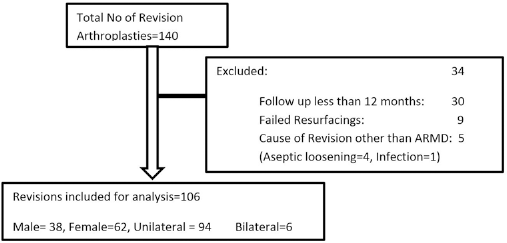
Flow chart presenting patients included in the study. ARMD = adverse reaction to metal debris.
Pre-revision blood metal ions
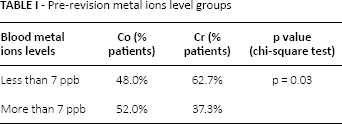
The mean pre-operative blood cobalt levels were 22.83 ppb and the mean blood chromium levels were 14.42 ppb. This difference was statistically significant (1-sample t-test, p = 0.001). There was however, a strong positive correlation between pre-revision blood cobalt and chromium levels.
The metal ion levels were further divided to 2 groups; below 7 ppb and ≥7 ppb. Table I illustrates the values in study patients. Overall, more patients had Co levels >7 ppb as compared to Cr levels (p = 0.03, chi-square test).
Pre-revision metal ions level groups
Implants revised
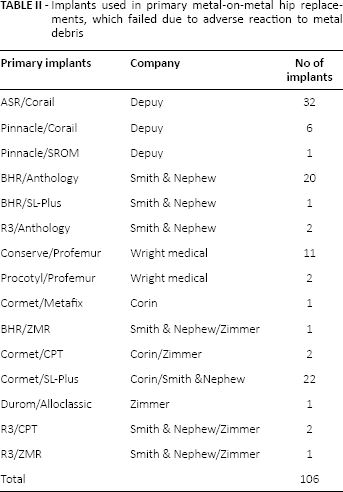
Several implants had been used in primary MoM hip replacements that failed due to adverse reaction to metal debris. These are shown in Table II.
Implants used in primary metal-on-metal hip replacements, which failed due to adverse reaction to metal debris
Components revised
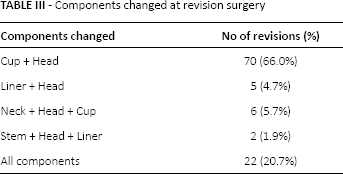
The majority of patients required only bearings exchange whereas in 20% cases all components were extracted and revised. Table III presents the components exchanged at the time of revision surgery.
Components changed at revision surgery
Comparison of ASR/Corail versus other implants
The mean pre-revision blood Co levels in ASR group were 28.4 ppb as compared to 21.4 ppb in other implants (p = 0.12, Mann-Whitney U-test). Similarly, the blood Cr levels were 17.1 ppb and 13.9 ppb (p = 0.057, Mann-Whitney U-test) in ASR and other implants respectively. There was no difference in post revision clinical outcome between ASR/Corail and other implants. (Oxford Hip Score, p = 0.3, MWU test, VAS, p = 0.7)
Complications
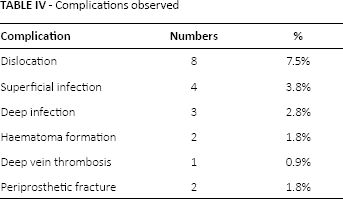
The overall complication rate was 16%. 6 patients had further revisions due to either infection (n = 2), recurrent dislocations (n = 3) or periprosthetic fracture (n = 1). There was no statistically significant difference in complications between those patients who had only bearings exchanged versus those where all components were extracted and revised (Pearson chi-square test, p = 0.7). There was no statistically significant difference in complication rates between ASR/Corail group and other implants group (p = 0.2, chi-square test). Table IV presents the complications observed in our series.
Complications observed
Patient-reported improvement in pain and mobility
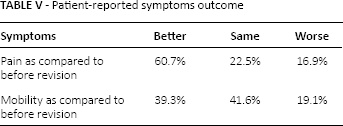
At mean follow-up of 20 months following the revision arthroplasty, 61% of patients expressed improvement in their pain as compared to pre-revision symptoms. However, only 39% patients expressed improvement in their mobility. Table V presents patient reported pain and mobility outcome. There was no statistically significant difference observed between primary implants and the final outcome in the form of improvement of pain (chi-square test, p = 0.13I).
Patient-reported symptoms outcome
Oxford Hip Score and Eq-5D-3L
The mean Oxford Hip Score (OHS) was 28 (SD = 12) and the mean VAS on Eq-5D-3L was 58 (SD = 24). Figure 2 presents the results of the 5 elements of EQ-5D score. Most of the patients were at level 2.
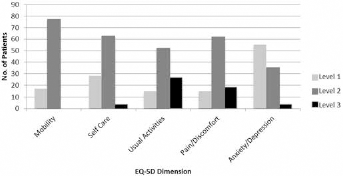
Eq-5D results at mean 20 months follow-up.
There was no difference between male and female patients regarding post revision pain improvement (p = 0.814, Spearman's rho test). Similarly, there was no correlation between pre-operative blood Co levels and post revision pain improvement (p = 0.295, Man Whitney U-test) or pre-operative serum Cr levels and post revision pain improvement (p = 0.254, Man Whitney U-test).
Survival rate of revision arthroplasty
The cumulative survival free from further revision from any cause was 94.3% at 48 months.
Discussion
Most of the outcome studies reporting results of revision arthroplasties for failed MOM hips included both resurfacings and large head stemmed MoM THRs (18, 19, 21). Our study included patients only with stemmed large head MoM hip replacements, which failed due to adverse reaction to metal debris (ARMD).
It is reported in the literature that the metal debris released from trunnion as a result of trunniosis may be biologically more active and can lead to severe tissue destruction (22–24). Revision surgery in case of failed stemmed MoM hip replacement may therefore involve more significant soft tissue destruction and osteolysis.
The poor outcome of revision arthroplasty for failed MoM resurfacings due to ARMD has been documented in the literature. In a study by Grammatopoulos et al (17), the mean OHS of patients who underwent revision surgery for pseudotumours was 20.9 which was significantly worse as compared to OHS (40.2) of those requiring revision due to fracture or revision due to other causes (OHS = 37.8). In our cohort, the mean OHS was 28 (SD = 12). This compares to a mean OHS of 34 following revision hip arthroplasty for any cause in a study by Field et al (25).
We found no correlation between pre-operative serum metal ions and the final outcome following the revision surgery. This is in agreement with the literature that serum metal ions are poor indicators of failure rate of metal on metal hips and tissue damage (26).
Revision surgery for failed metal on metal hips is associated with a high rate of complications (Tab. VI). In a study by Munro et al (20), major complications occurred in 38% patients undergoing revision of failed large head stemmed MoM hips. In our study, the overall rate of complications was 16%, which included both minor (e.g. superficial wound infection) and major complications (e.g. dislocation). Wyles et al (19) reported results of 37 patients following revision of MoM total hip replacements which included 8 patients requiring revision due to ARMD. 2 (25%) of these 8 patients developed periprosthetic infection and required further revision surgery. In our series, the rate of deep infection requiring further surgery was 2.8%.
Complications of revision arthroplasty for failed metal-on-metal hips
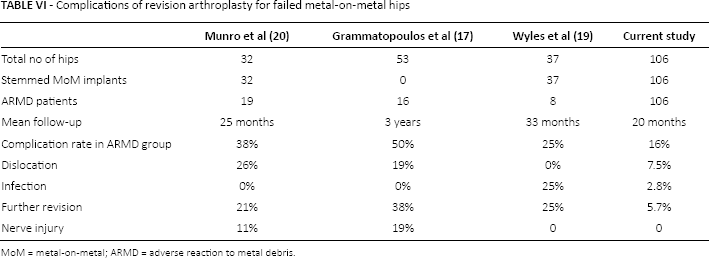
MoM = metal-on-metal; ARMD = adverse reaction to metal debris.
Overall, 61% patients reported improvement in pain following revision surgery and 39% patients reported improvement in mobility. This shows the complexity of this procedure and the risk of on-going pain and poor mobility in spite of revision surgery.
Although, the ASR/Corail group showed higher levels of pre-revision metal ions, the overall post revision outcome and rate of complications were similar in all groups. This is because all these patients had revision surgeries due to significant adverse reaction to metal debris and at that stage, all MoM implants show similar behaviour.
Our study has some limitations. Firstly, it is a retrospective study. Secondly, we did not have pre-revision OHS or EQ-5D scores to compare with the post revision scores. However, revision surgeries were only performed in those patients who were symptomatic and had evidence of significant periarticular damage on MARS MRI scans. Thirdly, the follow up is relatively short. However, this large study provides good insight into early outcome and complications following revision surgery for failed MoM THRs.
To our knowledge, this is the largest study on outcome of revision surgery for failed stemmed MoM THRs due to ARMD. Our overall complications are less as compared to other similar studies. This may be due to our regular surveillance of all MoM implants and a proactive approach in dealing with the patients showing significant ARMD on MARS MRI scan.
Conclusion
The revision arthroplasty for ARMD is associated with relatively higher rate of complications. Both patients and surgeons need to be aware of the potential for on-going pain following these operations. A closed surveillance of all MoM implants is necessary with clinical, biochemical and radiological investigations to plan revision surgery before extensive soft tissue and bony damage occurs. Blood metal ions alone do not represent the whole picture and have poor correlation with the development of adverse reaction to metal debris and outcome following the revision surgery.
Footnotes
Financial support: None.
Conflict of interest: None.