






Abstract
Background
Concerns arise over the early complications encountered during the learning curve for the direct anterior approach for total hip arthroplasty.
The purpose of this study is to examine the learning experience of a single surgeon in adapting this approach.
Methods
The 1st 500 primary total hip arthroplasties are reviewed. The patients were evaluated out to 3 months. Rates of major complications, reoperations, periprosthetic fractures, heterotopic ossification, leg length discrepancies and lateral femoral cutaneous nerve deficits were identified for each of 100 patients.
Results
The major complication rate decreased from 5% to 2% throughout the series. Reoperation rates fluctuated from 2% in the 1st 100 cases to 3% in the 4th 100 cases to 1% in the 5th 100 cases. The periprosthetic fracture rate decreased from 9% to 2%.
Conclusions
The incidence of heterotopic ossification declines throughout the series and is attributed to changes in irrigation technique and quantity. The incidence of major complications decreases with increasing experience. The most dramatic improvements occur after the 1st group of 100 cases.
Keywords
Introduction
Total hip arthroplasty has demonstrated unequivocal success over the past 30 years (1, 2). In the past decade, emphasis has been placed on providing rapid functional recovery through minimally invasive surgical techniques (3-4-5-6-7-8-9). Options for surgical exposure to the hip include the minimally invasive posterior approach, anterolateral, the 2-incision approach as well as the direct anterior approach. The 2-incision approach was popularised in the 1st half of the last decade (3). The technical requisites of the operation and subsequent early complications have limited its universal acceptance (9-10-11).
The direct anterior approach to the hip as described by Heuter (12) as well as Smith-Petersen (13) is a well-accepted approach for arthroplasty of the hip. The approach provides for an intranervous exposure to the hip with no disruption of the abductor musculature. Judet and Judet (14) combined the direct anterior approach with the use of a fracture table for total hip arthroplasty while Matta et al (15) popularised the use of a fracture table to augment a less invasive approach.
Few papers have addressed the perioperative complications experienced in the learning curve for the direct anterior approach using a fracture table. The purpose of this study is to evaluate the learning experience of a single surgeon in adapting the direct anterior surgical approach for total hip arthroplasty over the 1st 500 cases.
Materials and methods
A retrospective evaluation of 500 consecutive total hip arthroplasties (THAs) (442 patients) was performed on patients undergoing primary THA through a direct anterior approach using a fracture table. The procedures were performed from June 2006 to August 2011. The direct anterior approach was the primary approach throughout this period. During this time period 5 primary THAs were performed by the surgeon through the posterior approach. 3 of these were performed due to excessive size of the patient in which the surgeon did not feel he had the technical capabilities to perform the surgery through an anterior approach. 2 hips were congenital dysplasia, requiring a straight stem which the surgeon felt could not be positioned well through a direct anterior approach.
Institutional Review Board approval for the study had been obtained. Collection of the cases in this series includes the surgeon's 1st direct anterior procedure.
The direct anterior approach was performed as described by Matta et al (15). A fracture table was used in all cases (OSI Profix & Hana Table). 496 tapered noncemented stems, and 4 cemented stems were used and noncemented acetabular components were used in all cases (Tab. I). The procedures were performed by 1 surgeon (J.M.H.) fellowship trained in adult reconstructive surgery. Prior to the initial procedure, the surgeon had attended a cadaver course and, once a week for 6 months, assisted a surgeon trained in the anterior procedure (M.J.B.). The 2 initial procedures were performed with the trained surgeon as an assistant. Prior to the surgeon's experience with the direct anterior approach, the surgeon's experience of hip replacements in practice included 253 primary THAs and 14 conversions of open reduction and internal fixation (ORIF) of the hip to THA through a Hardinge approach, and 9 conversions of ORIF of the acetabulum to THA and 140 revision THAs through a posterior approach.
Component brands
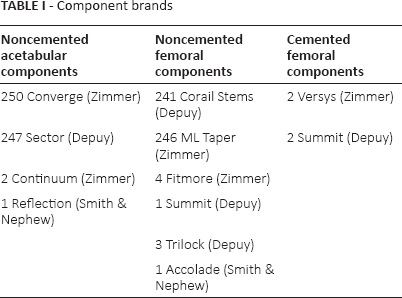
There were 317 females and 183 males, 218 left hips and 282 right hips. Diagnosis included 466 with osteoarthritis, 24 avascular necrosis, 4 acute femoral neck fractures, 2 rheumatoid arthritis, 2 conversion of ORIF of the hip, 1 developmental dysplasia and one Legg-Calvé-Perthes. The average age at time of operation was 66 years (range 29-93 years). The average patient weight at time of surgery was 177 pounds (range 105-365 lb), the average height 68 inches (range 52-78 in), and the average body mass index (BMI) 28.4 (range 18.0-50.2). The average hospital stay was 3.2 days (range 2-11 days).
Each THA was performed as a unilateral procedure. No simultaneous bilateral THAs were performed. The patients were evaluated for a minimum of 3 months postoperatively to identify perioperative complications. The patients were examined in the clinic at 1 week, 6 weeks, and 12 weeks postoperatively. Intraoperative and postoperative complications were documented. Major surgical complications were categorised as dislocations, infections, fractures with subsidence, fractures requiring reoperation, and reoperations for any other reason. The classification of major complications is as described by Woolson et al (16). Intraoperative calcar fractures requiring simple cerclage wiring at the time of operation and not requiring an alteration in postoperative rehabilitation were not considered in the category of major complications.
Anteroposterior pelvic radiographs of 497 of the 500 hips were obtained 3 months postoperatively. The radiographs were assessed for fractures, subsidence, presence of heterotopic ossification (Brooker Stage) (17), leg length discrepancy, and acetabular component inclination. The measurements were carried out by the operating surgeon. Leg lengths were measured by drawing a line across the base of the acetabular tear drops and referencing that line to a fixed point on the lesser trochanter, a technique described by Woolson et al (18). The measurements were performed on digital radiographs using the measurement software package by Citrix Systems. The measurements were calibrated using the radiographic measurement of the known femoral head diameter to account for variability in magnification.
Results
Progressive declines were seen in the major complication rate, the fracture rate, and lateral femoral cutaneous nerve defects from the 1st 100 cases to the last 100 cases in this series of 500 cases.
The overall rate for major complications for the series was 3.6% (Tab. II). From the 1st 100 cases to the 5th 100 cases, the major complication rate decreased from 5% to 2% (Tab. II). The overall rate of periprosthetic fracture for this series was 4.4%. The rate of intraoperative fractures was 2.6% and of postoperative fractures 1.8%. From the 1st 100 cases to the 5th 100 cases the total periprosthetic fracture rate declined from 9% to 2%, the intraoperative fracture rate declined from 7% to 0% and the postoperative facture rate fluctuated between 1% and 3% (Fig. 1). Lateral femoral cutaneous nerve deficits were identified in 27 out of 500 cases (5.4%). The rate declined from 13% to 3% (Fig. 2). 3 infections occurred in the series – 2 deep (0.4%) and 1 superficial (0.2%). 3 patients (0.6%) experienced anterior dislocations postoperatively. The dislocations occurred in case 9, case 42 and case 187 in the series. 9 hips (1.8%) required reoperation within the 1st 3 postoperative months. This rate fluctuated from 1% to 3% throughout the series (Tab. II).
Major complications
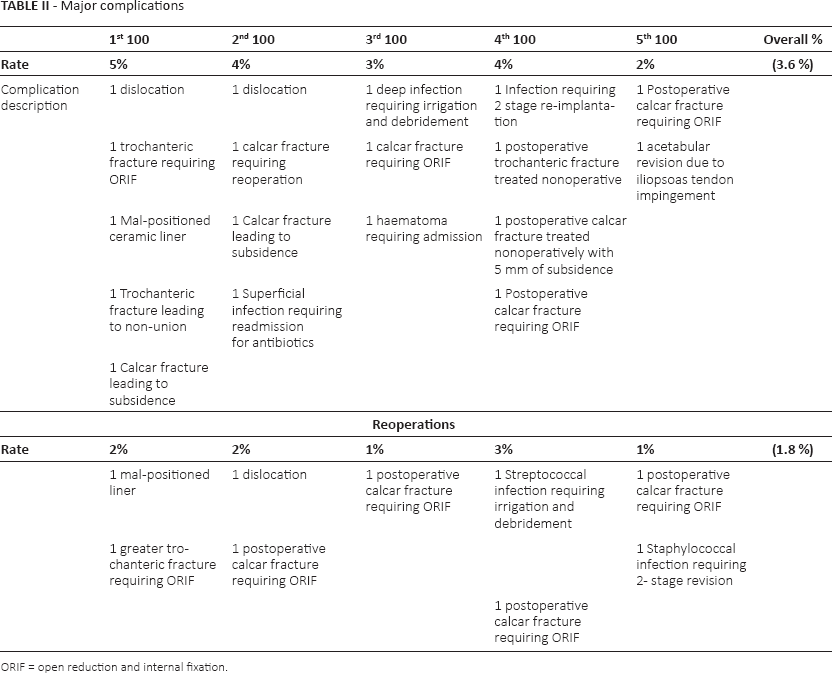
ORIF = open reduction and internal fixation.
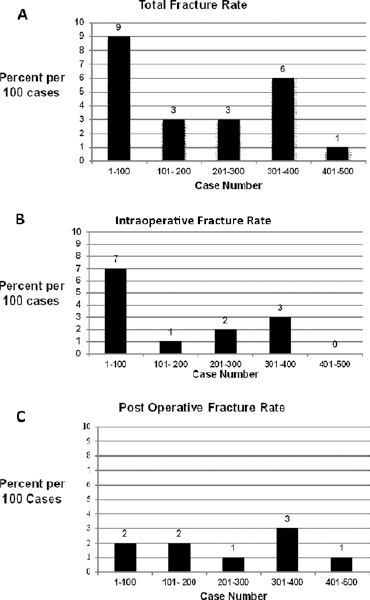
Graphs representing: (
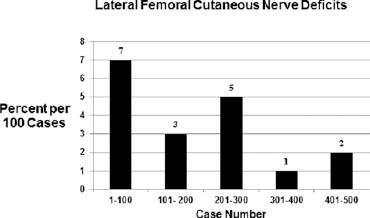
Graph representing rate of lateral femoral cutaneous nerve deficits.
497 patients had radiographic follow-up at 3 months postoperatively. A radiographic review showed the average acetabular inclination to be 38°, (range 24°-57°). There were 6 acetabular components with a measured inclination >50° and 8 cases in which the acetabular inclination was <30°. Subsidence of the femoral components was encountered in the 2 cases which sustained postoperative calcar fractures. 1 stem subsided 5 mm and one 3 mm. They were treated nonoperatively. The average leg length discrepancy for the entire series was 4 mm, (range 0-22 mm). 87% of the leg lengths were within 5 mm and 97% were within 10 mm. Patient complaints of leg length discrepancies occurred in 18 cases (3.6%). 7 were in the 1st 100 cases, declining to 2 in the 5th 100 cases.
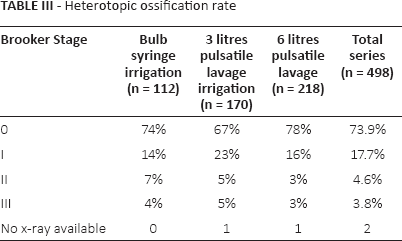
Heterotopic ossification Brooker Grade I was identified in 17.7% of the cases. Grade II was identified in 4.6 % of the hips and Grade III in 3.8%. No Grade IV heterotopic ossification was identified. 5 patients had received preoperative radiation therapy. 1 patient was reoperated on at 21 months for excision of the Grade III heterotopic ossification. This patient had received preoperative radiation therapy for the index procedure. Biopsy of the heterotopic bone at the time of excision revealed a low grade lymphoma. The volume and method of irrigation evolved throughout the series of hips. The change came about due to the recognition of recurring cases with heterotopic ossification. Bulb syringe irrigation was used in the 1st 112 cases. Pulsatile irrigation of 3 litres of normal saline was used at the end of the cases for the next 170 cases. For the last 218 cases, patients received 3 L of normal saline pulsatile lavage after preparation of the acetabulum followed by a 2nd 3 L of normal saline pulsatile lavage after preparation of the femur. The incidence of Brooker Stage II and III heterotopic ossification decreased as the method and the quantity of irrigation changed (Tab. III).
Heterotopic ossification rate
Discussion
The preservation of the abductor muscles, the minimization of leg length discrepancies, and the reduction in the incidence of dislocations are attractive reasons for considering the direct anterior approach to THA. However, in order to attain the benefits of the direct anterior approach the surgeon must first incur the cost of the learning curve. Woolson et al (16) reported a 9% incidence of major complications encountered by a cohort of community surgeons in becoming proficient with the direct anterior approach.
The rate of major complications, periprosthetic fractures, and lateral femoral cutaneous nerve injuries were at their highest in the 1st 100 patients and declined noticeably throughout the series with a spike of all 3 in the 4th 100 patients. This spike was well below the initial 100 patients in all 3 categories. Contrary to Woolson's report, our series had a major complication rate of 5% in the 1st 100 cases, decreasing to 2% in the last 100 cases.
The primary complication encountered throughout the learning curve was periprosthetic fracture both intraoperative and postoperative. The initial rate was high at 9% for the 1st 100 cases and had declined to 1% by the last 100 cases. The overall fracture rate of 4.4% (2.6% intraoperative and 1.8% postoperative) was similar to that of Matta et al (15). There are 2 factors which influence the fracture rate in this series. 1 is the use of a tapered femoral stem, which facilitates placement of the femoral component in the direct anterior approach. This stem design was used in the majority of cases in this series. The tapered stem produces increasing hoop stresses during broaching and insertion. An increase in intraoperative fractures has been identified with the use of noncemented femoral stems (19). Our intraoperative rate of 2.6% compares favourably to Berend et al's (20) intraoperative rate of 4.4% using a tapered stem through a posterior approach. The 2nd factor which directly relates to the direct anterior approach is the positioning of the femur. In preparing the femur and inserting the stem, the femur must be externally rotated, extended and elevated using a femoral lift. If the posterior capsule and external rotators are not sufficiently released, excess tension on the greater trochanter places it at risk of fracture. Half of the fractures sustained in the 1st 100 patients of this series were fractures of the greater trochanter. With increased experience with both a tapered stem and capsular release, the incidence of fractures declined. Intraoperative fractures were treated with simple cerclage wiring using 16 gauge wires for calcar fractures and figure-of-8 wiring as described by Huffman and Ries (21) for the greater trochanter fractures. 1 greater trochanter failed to heal but abduction strength was maintained and did not require repeat internal fixation.
Reported rates of lateral femoral cutaneous nerve (LFCN) deficits range from 2% to 67% in the literature (22-23-24-25-26). The reported rate in this series decreased from 7% in the 1st 100 cases to 2% in the last 100 cases. An uneven decline was seen with increasing experience; a spike in LFCN deficits was seen in the 3rd 100 cases. The incidence of LFCN injuries reported in the literature varies greatly and may be due to the retrospective nature of the studies. The same may be true of our study as it is also retrospective in nature. A more thorough study of this complication reported by Goulding et al (22) reveals a high incidence of injury to the LFCN.
The overall rate of return to the operating room with a follow up of 3 months was 1.5%. The initial rate of return was 4% for the 1st 100 cases declining to 1% for the last 100 cases. Postoperative periprosthetic fracture was the most common cause. Mal-seating of a ceramic liner was another cause for return as well as dislocation and infection. The low incidence of dislocation (0.6%) was comparable to Matta et al (15) as well as Siguier et al (27) using the direct anterior approach. This low rate compares favourably with the 3.3% reported by the Mayo Clinic (28) as well as the 3.9% reported in the Medicare data (29). The 0.6% rate of dislocation improved with surgeon experience with the procedure. The 3 dislocations occurred in the 1st 186 replacements of the series. No further dislocations have occurred in the last 324 cases.
With the use of radiographic assistance in all of the cases, accurate leg length within 5 mm was achieved in 87% of the cases. The incidence in perceived leg length discrepancies declined from 7% in the 1st 100 cases to 2% in the last 100 cases. This is similar to Woolson et al's series (18).
Lewinnek et al (30) described the acetabular safe zone with regards to dislocation between 30° and 50° of acetabular inclination. Acetabular component inclination demonstrated only 6 acetabular components >50°, 5 of which were in the 1st 100 patients. 8 cases had an inclination measured <30° in the series. The average inclination decreased throughout the series indicating a tendency of the surgeon to under incline the acetabular component.
Widely varying heterotopic ossification rates after total hip arthroplasty have been reported, as low as 1% and as high as 90% (31, 32). More recent studies in the 1990s and 2000s reported rates from 5.2% to 57.4% (33-34-35-36). Tippet's rate of heterotopic ossification was 41.5% using the direct anterior approach (37). Our overall rate of 26.1% is less than Tippet's but similar to Newman's rate of 24.3% (38). The rate of heterotopic ossification in Newman's study was a comparison of the direct anterior approach to posterior approach. The posterior approach in this study had a higher rate heterotopic ossification of 27.5%. The difference in rates between the 2 approaches was statistically significant. A published report by Bal et al (39) of the 2-incision techniques, reports a 26.5% incidence and a published study of the posterior mini-incision total hip by Edwards et al reported a rate of 10.2% (40).
The incidence of Grade II and III heterotopic ossification was reduced in this series through the alteration of irrigation methods with an increase in volume of irrigation. The overall rate of Brooker Grade II and III heterotopic ossification was 9%. Over the time course for this series, the protocol for wound irrigation was revised. In the initial 112 cases, bulb syringe irrigation was used following placement of the final implants. Since heterotopic ossification was identified in many of these cases, for the next 170 cases, 3 L of pulsatile lavage was used after placement of the final implants. For the final 218 patients, 3 L of pulsatile lavage was performed after reaming of the acetabulum and placement of the component followed by another 3 L of pulsatile lavage after placement of the femoral stem. There were no Brooker Grade IV cases in this series. The rate of Grade II and III heterotopic ossification declined from 11.6% to 10.1% and ultimately to 5.5%. Irrigation plays an important role in the reduction of heterotopic ossification. Another factor may involve the reduction of surgical trauma as experience is gained and surgical technique improves.
1 patient did require return to the operating room for excision of heterotopic ossification at 21 months after the index procedure. This patient had received 3 L of pulsatile lavage irrigation and had also had preoperative radiation therapy. The direct anterior approach is susceptible to heterotopic ossification and meticulous attention must be paid to removing all excessive bony debris with irrigation. Minimising surgical trauma also plays an important role in reducing heterotopic ossification. A lower threshold for heterotopic ossification prophylaxis whether radiation therapy or postoperative nonsteroidal medication should be considered.
The learning curve with regards to perioperative complications, periprosthetic fractures and radiographic leg length discrepancies improves throughout the course of the series but makes the most dramatic improvement after the 1st group of 100 patients. The incidence of heterotopic ossification improves throughout the series and is attributed to changes in irrigation technique and quantity as well as reduced surgical trauma with improved technique experience. The direct anterior approach has become our standard approach for total hip arthroplasty. With greater experience the approach may be applied to more complex cases. Severe dysplastic hips as well as conversions of ORIF of the acetabulum may have enhanced exposure through a posterior or Hardinge approach.
Footnotes
Financial support: None.
Conflict of interest: None.