Editorial
Select search scope: search across all journals or within the current journal

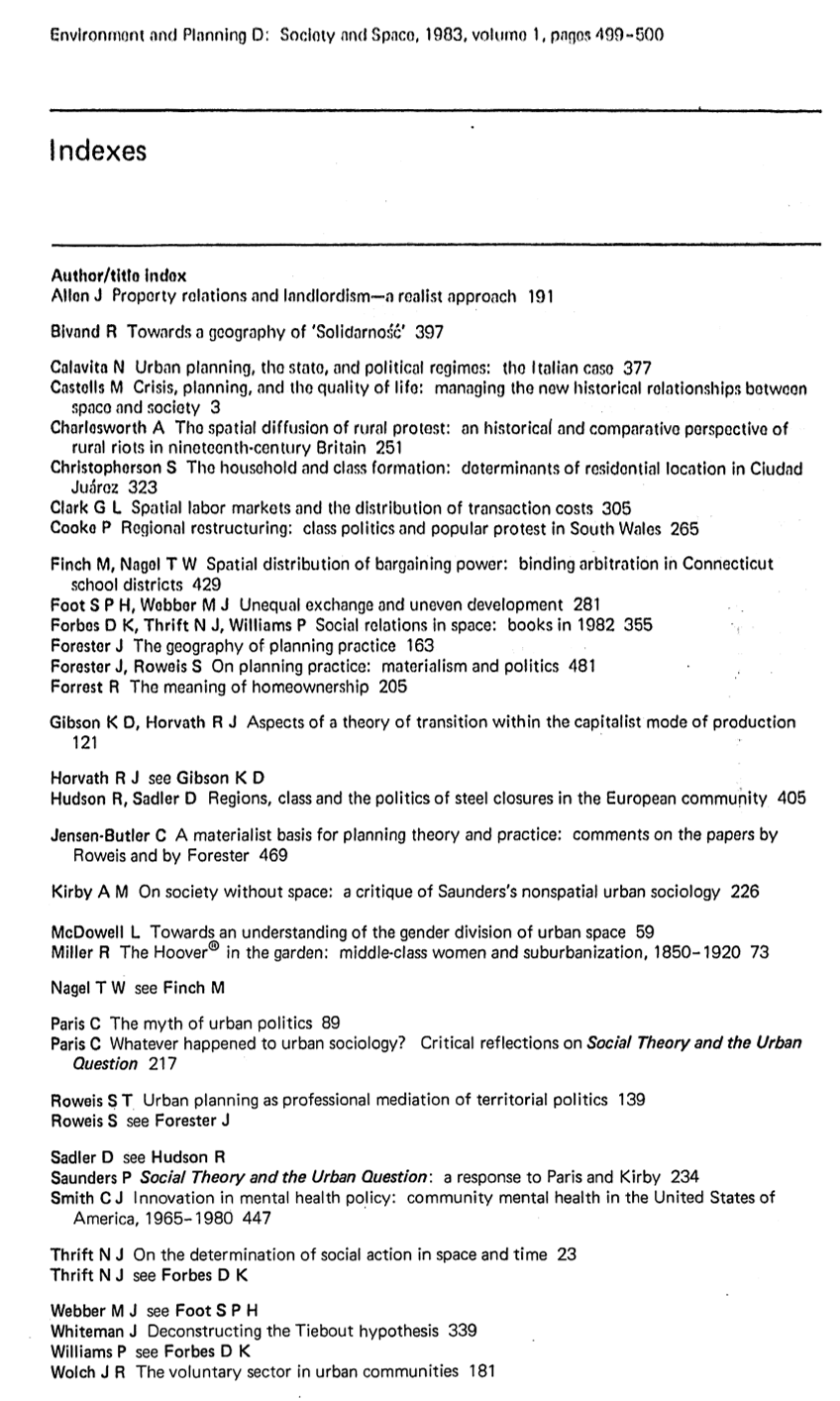
In this article, a study of State intervention in urban planning in post-World-War-II Italy is presented. These interventions are explained dialectically as attempted solutions to the contradictions and conflicts surrounding the use of urban land. The major contradiction centers around the necessity for a more rational urban development and the private control of urban land. The conflicts generated by this contradiction arc seen as historically specific and tied to changes in the class struggle. Through historical analysis, I show how various planning laws were the response to legitimation needs raised by developments in the class struggle. The Italian State, however, is constrained by: (1) its commitment to supporting capital accumulation through the private appropriation of urban land; and (2) its political indebtedness to real-estate interests, thus making attempts at land-use planning cither stillborn or inadequate and contradictory, generating, in turn, other contradictions and struggles.
A reflective review is undertaken of the initiation of Solidarność as a social movement and of its activity to date with special reference to its regional structure, Much weight is placed on the potential significance of the Union and its goals in the debate over human agency in history.
One expression of the changing international division of labour and the generalized crisis of capitalist production during the 1970s was that the steel industry in the European Community slid into a deep and seemingly intractable crisis with rapidly falling profits or escalating losses. In an attempt to restore profitability, private capital, national states, and the supranational EEC (European Economic Community) initiated a series of severe capacity and employment cuts, which were unevenly distributed within the EEC, concentrated both at national and at regional scales. This distribution was intimately related to the strategies of those directly employed in the steel industry and those indirectly dependent upon steel employment in contesting proposed closure plans. This paper examines in detail anticlosure campaigns in the Northeast of England and in the Nord and Lorraine in France, interpreting them in terms of territory and class as bases for social organization, and attempts to draw some more general theoretical and political implications from these specific cases.
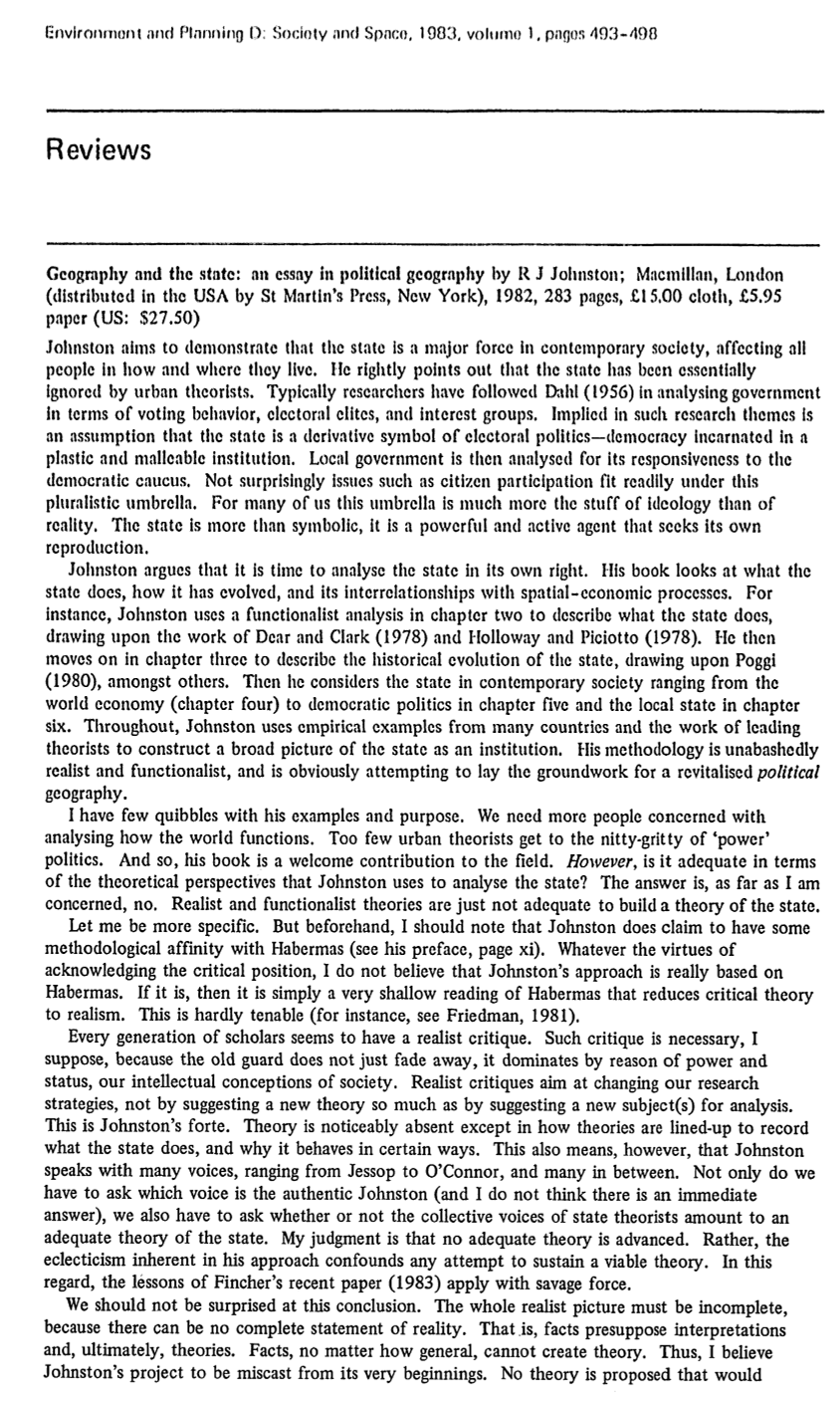
Traditionally, negotiations in Connecticut concerning teacher contract renewal are conducted at the local level between members of the district board of education and members of the district teacher union. However, with the adoption in Connecticut of ‘issue last offer’ binding arbitration, there has been an acceleration in the use of professional bargaining representatives, including attorneys and Statewide union agents. The proliferation of professional representatives, together with the introduction of professional arbitrators, helps explain many of the phenomena associated with the early years of this new procedure: namely, an initial increase in the proportion of school districts going to arbitration rather than settling during an earlier negotiation phase; an upsurge in the standardization of collective agreements at the expense of innovation and situational responsiveness; and, more important, a loss in the local ‘flavor’ of the negotiation process. This paper will critically examine the implications of these trends both for the political nature of educational dispute resolution in Connecticut and for the spatial distribution of bargaining power.
The Community Méntal Health Centers (CMHC) legislation in the early 1960s was the first real attempt at a national mental health policy in the United States of America. Federal funding was made available for the establishment of 1500 centers across the country. The goal was to provide access to quality mental health care for all US citizens by 1980. As a result of prolonged criticisms, the legislation was repealed by the incoming Reagan Administration in the early 1980s, In this paper, the twenty-year lifespan of this ‘innovation’ in mental health policy is reviewed and an evaluation of some of its most pervasive criticisms are presented.
Analysis of the practice of planning is increasingly being used to develop planning theory, The papers by Roweis and Forester in the second issue of
This paper is a response to Jensen-Butler's critique of our papers on planning practice. The critique asserts that our papers are predicated on an idealist cpistemology and that they lead to largely politically conservative conclusions. In this paper, we argue that this supposed critique of idealism: (a) cannot be sustained; (b) assumes its own idealist proportions; (c) evades practical issues; and (d) results