Article commentary
 Available accessArticle commentaryFirst published July, 2010pp. 1513-1518

Select search scope: search across all journals or within the current journal


 Available accessArticle commentaryFirst published July, 2010pp. 1513-1518Available accessArticle commentaryFirst published July, 2010pp. 1519-1520
 Available accessResearch articleFirst published July, 2010pp. 1521-1536
This paper discusses interdisciplinary collaboration between social and natural scientists from the perspective of ‘mess’. The literature on interdisciplinarity has generated a series of conventions about what it means to conduct interdisciplinary research. Building on the experience of a research project that brought social and natural scientists together with local residents to study flooding, we argue that interdisciplinarity can be understood as a response to mess, to the irreducibly complex problems of the world. Mess can be dealt with as an epistemological or ontological problem. We argue that discursive conventions focus on the epistemological dimensions of mess and thus have their limits. By considering the ontological dimensions of mess the whole range of objects that are involved in interdisciplinary research is brought into focus.
Available accessResearch articleFirst published July, 2010pp. 1537-1554For decades theoretical debates about political restructuring have resorted to and coconstructed geographical concepts of territory and scale, interpreting ‘new’ and ‘Euro’ regionalisms as processes of reterritorialization and rescaling (and the politics thereof). But nested and hierarchical theories of scale have been severely critiqued, and bounded notions of territory opened to question. How then to develop a more relational understanding of the region without trading one limiting theoretical master narrative for another? Drawing inspiration from recent attempts to do just this, in this paper I ask: what can we learn about the complex and relational spatiality of the region, and thus scale and territory, through the spatial vocabularies of regionalists themselves? Using the case study of the Northwestern Mediterranean, I explore the imaginaries and stratagems of Catalan regionalism and transboundary macroregionalism, particularly in the neighboring regions of Catalunya and the Comunitat Valenciana and their proposed integration in a Euroregion called the
Available accessResearch articleFirst published July, 2010pp. 1555-1576Over the past four decades, the Mozambican capital city of Maputo has undergone rapid changes. Although still governed by the (formerly socialist) party that inherited the city from a collapsing Portuguese colonial state in 1975, postsocialist Maputo recasts disparities in class and power. This paper negotiates these fractures, based on two walking transects through the central areas of the city conducted by the coauthors. Initially informed by ‘psychogeography’ literatures on negotiating and representing cities, these were supplemented by and enacted through a focus on security and policing. While the state uses police to secure vital interests, other sites and spaces experience limited policing. To bridge this security gap, commercial and ad hoc security providers are contracted to secure private homes and enterprises. We describe an increased and uneven commoditisation of security. The security landscape of central Maputo thus comprises a complex patchwork of privately secured micro enclaves that relay and rework enclaving on larger scales.
Available accessResearch articleFirst published July, 2010pp. 1577-1594The emergence of the controversy over airport-generated noise at Brussels Airport as an environmental issue on the national political agenda coincided with the inauguration of Belgium's first ‘purple–green’ government in 1999. The new government announced explicitly the dawning of a new political age in which old controversies and adversarial left–right politics were relegated to the dustbin of history. From now onwards, the interests of market actors, environmental concerns, and social objectives would be negotiated and reconciled in the interest of all within the framework of a common and consensually agreed objective of achieving environmentally sustainable, socially inclusive, and market-based development. The controversy over DHL's night flights at Brussels Airport would prove to be one of the first real test cases of this ‘Third Way’ postpolitical approach to policing socioenvironmental affairs. However, after several years of acrimonious argument, successive attempts to negotiate a compromise with all relevant partners, and increasingly more entrenched antagonistic dispute, DHL abandoned Brussels Airport as its main European hub. This sequence belied the initial optimism of the government's postpolitical approach and, we argue in this paper, stands emblematically for the failure of such postpolitical modes of policing socioenvironmental affairs. The objective of this paper is to explore, both theoretically and empirically, the contradictions and tensions associated with the postpolitical model. First, we situate theoretically the emergence and consolidation of postpolitical modes of governing and the colonisation of the space of the political by forms of consensual depoliticised governance. Second, we shall analyse how urban socioenvironmental governance procedures associated with the problem of noise at Brussels Airport express the attempts to institute postdemocratic modes of governance, while exploring the contradictions of this model. In addition, the failure of postdemocratic and postpolitical arrangements is discussed, and an urgent need to repoliticise urban socioecological relations is argued.
Available accessResearch articleFirst published July, 2010pp. 1595-1612This paper documents the rise and fall of a micro-learning region in Philadelphia. The central actors in this region are undocumented Mexican immigrants who until recently were able to draw on the intensity of their workplace interactions and their heterodox knowledge to produce new and innovative building techniques in the city's residential construction. The new knowledge they developed was primarily tacit. More significantly, the learning practices through which immigrant workers developed skills and innovated new techniques were also heavily tacit. Because these practices were never made formal and were never made explicit, they remained invisible and difficult to defend. With the housing-market collapse and subsequent decline in housing renovation in the south-center region of Philadelphia, this tacit knowledge, and the practices that gave it shape and significance, are no longer easily accessible. We draw on this case to demonstrate the importance of access to the political and economic resources to turn learning practices into visible structured institutions that protect knowledge and skill. Whether or not the practices that support knowledge development are themselves made explicit can determine whether the knowledge they produce becomes an innovation that is recognized and adopted or whether it remains confined to a set of ephemeral practices that exist only so long as they are being enacted.
Available accessResearch articleFirst published July, 2010pp. 1613-1635This paper evaluates the use of various place-based and people-based measures of accessibility in the context of public service delivery. While place-based measures examine the spatial separation between service locations and in a single reference location, people-based measures are based on detailed observations of an individual's activity schedule and space–time constraints. The aim of this paper is to contribute to previous methodological studies of accessibility by investigating the extent to which utility-based measures relying on the Burns–Miller framework relate to place- based and other people-based measures of individual accessibility. In total, four place-based and six people-based measures that are frequently used to evaluate urban service delivery are analyzed. The relationships between these measures are examined and their implications for the assessment of equity of urban service distribution are evaluated. We have found substantial differences between place-based and people-based measures, supporting previous findings in the relevant literature and extending them to utility-based space–time measures of accessibility. We also observed substantial differences within the group of people-based measures. It appears that measures which express the cardinality of a feasible opportunity choice set are quite different from measures which express the desirability of such a set. The salience of this difference is also borne out by the measurement of statistical dispersion of accessibility values, indicating that different measures provide markedly different insights into how equally service delivery is distributed among the population.
Available accessResearch articleFirst published July, 2010pp. 1636-1649Highly skilled workers are increasingly recognised as a key competitive asset for regional development, and claims have been made that emphasise the importance of certain amenities for the prospects of attracting this particular group of workers. We use a recent large-scale survey to investigate the relative importance of jobs versus amenities for the decision to migrate, as perceived by the migrants themselves. The paper thereby adds important insights to the existing literature that has hitherto mainly focused on analysing the extent to which aggregate migration flows correlate with employment-related or amenity-related factors. The results show that jobs are considerably more important for the decision to move among highly educated migrants compared with migrants with lower education.
Available accessResearch articleFirst published July, 2010pp. 1650-1668Socioeconomic deprivation accounts for much of the spatial inequality in health in the UK, but a significant proportion remains unexplained. It is highly likely that the physical environment is a key factor in this unexplained variation. The role of the socioeconomic environment in health inequalities has been studied using small-area measures of multiple socioeconomic deprivation that capture the burden of socioeconomic adversity. Although similar composite measures of the physical environment would greatly assist investigations of environmental determinants of health no such measures are available. In this study we developed two small-area measures of health-related multiple physical environmental deprivation for the UK. A thorough review and evidence appraisal process was used to identify health-relevant dimensions of physical environmental deprivation. As a result we selected both health-detrimental (air pollution, cold climate, industrial facilities) and health-beneficial (ultraviolet radiation and green space) dimensions. Datasets describing each of the selected dimensions were acquired, and rendered to UK Census Area Statistics wards (
Available accessResearch articleFirst published July, 2010pp. 1669-1685Local complementary currency systems (LCCSs), like the Local Exchange Trading System scheme in the English-speaking world, are one of the alternative economies organised to overcome the exclusionary aspects of the regular market economy and support those short of money. I analyse the benefits for the poor and unemployed of the Argentine variant, called
Available accessResearch articleFirst published July, 2010pp. 1686-1704This paper examines the development of environmental governance in Russia, using the concept of ecological modernization as an analytical framework for an empirical study. From an investigation into both the relationship between economic growth and environmental stress on the basis of the revised model of decoupling and the development of institutional capacity for environmental policy in recent years, this paper reveals that Russia's pathway to ecological modernization is now ‘closed’ in most spheres owing to the economic crisis that followed the collapse of the Soviet Union; this is in contrast to China's experience, wherein ecological modernization has been ‘forced’ as a national policy. Russia is considered to be a typical case of failure of realization of industrial restructuring leading to a relative reduction in environmental stress in a centrally planned economy. Moreover, the country's hyperdepression since the introduction of a market economy has hindered the search for a pathway to medium-term and long-term ecological modernization, which has been exchanged for short-term ‘ecological improvement without environmental policy’.
Available accessResearch articleFirst published July, 2010pp. 1705-1722Since the 1980s, reform, the open-door policy, and rapid economic growth have encouraged Chinese cities to become fast-growing and highly dynamic urban areas. They are subject to both innovations and international connectivity as well as to rising socioeconomic and ecological vulnerability. In this paper we sketch the main transformation processes of a traditional Chinese village in the megacity Guangzhou, South China, processes that are linked to the construction of a new railway station in its close proximity. Our research addresses the issue of how the inhabitants of this village view the restructuring of their living environment. What kind of demands or opportunities do they perceive? Do they feel stress with regard to ‘harm/loss’, ‘threat’, or ‘challenge’ and how do they cope with the changing structures and processes? People living in the same environment appraise exposure to certain risks differently, which explains varying coping modes. In this context the question is considered as to whether coping necessarily results in ‘visible’ outcomes (eg building houses to rent out and thus benefiting from in-migration) or whether it encompasses ‘invisible’ person-related processes. The primary aim of this paper is to enrich the geographical debate on vulnerability by taking a psychological perspective and presenting and applying the transactional stress model of Lazarus. This conceptual framework from cognitive psychology and schematises person and environment antecedents of stress and coping as well as appraisal and coping as mediating processes between the person and the environment. To facilitate understanding, the transactional stress model is exemplified on the basis of selected research data collected in the transforming village. With reference to different stress appraisals, examples of varying coping modes and coping efficiency are discussed.
Available accessResearch articleFirst published July, 2010pp. 1723-1738The Norwegian Government Pension Fund-Global is one of the world's largest sovereign wealth funds and is one of the most transparent institutions of its kind. It also has an explicit mission aimed at integrating long-term investment with a two-sided ethical commitment: to corporate engagement according to accepted global principles of best-practice corporate governance, and to ensuring that the fund is not associated with companies that pose a risk to global social and environmental justice. As such, the Norwegian fund has an ethical mandate—something remarkable when compared with other sovereign wealth funds. In this paper we argue that this mission is best understood in terms of procedural, rather than substantive, justice. Our argument is sustained by reference to recent work on the nature of state authority and legitimacy in democratic societies, the logic of institutional governance, and the functional integration of decision making. The paper focuses on the nature and significance of the recommendations from the advisory Council of Ethics and the exercise of powers related to standards of corporate governance. Implications are drawn for understanding the functional performance of the fund in the context of changing global financial markets.
Available accessResearch articleFirst published July, 2010pp. 1739-1761Emissions trading has created new forms of exchangeable property which become commodities when traded in markets designed to reduce greenhouse-gas emissions and mitigate climate change. This paper analyzes a set of social processes which influence who benefits from reductions in emissions generated by primary production from forest ecosystems. Informed by commodification literature, and property and access theory, we suggest that farmers and rural communities cannot derive full benefits from carbon sequestration because they lack key structural and relational mechanisms, such as capital, knowledge, expertise, technology, and, in some cases, even labour. We illustrate this argument by examining three ongoing carbon-forestry projects in China, Ecuador, and Mexico and we highlight its implications for future forestry mitigation projects and programmes.
Available accessBook reviewFirst published July, 2010pp. 1762-1765 Available accessCorrectionFirst published July, 2010pp. 1766-1766
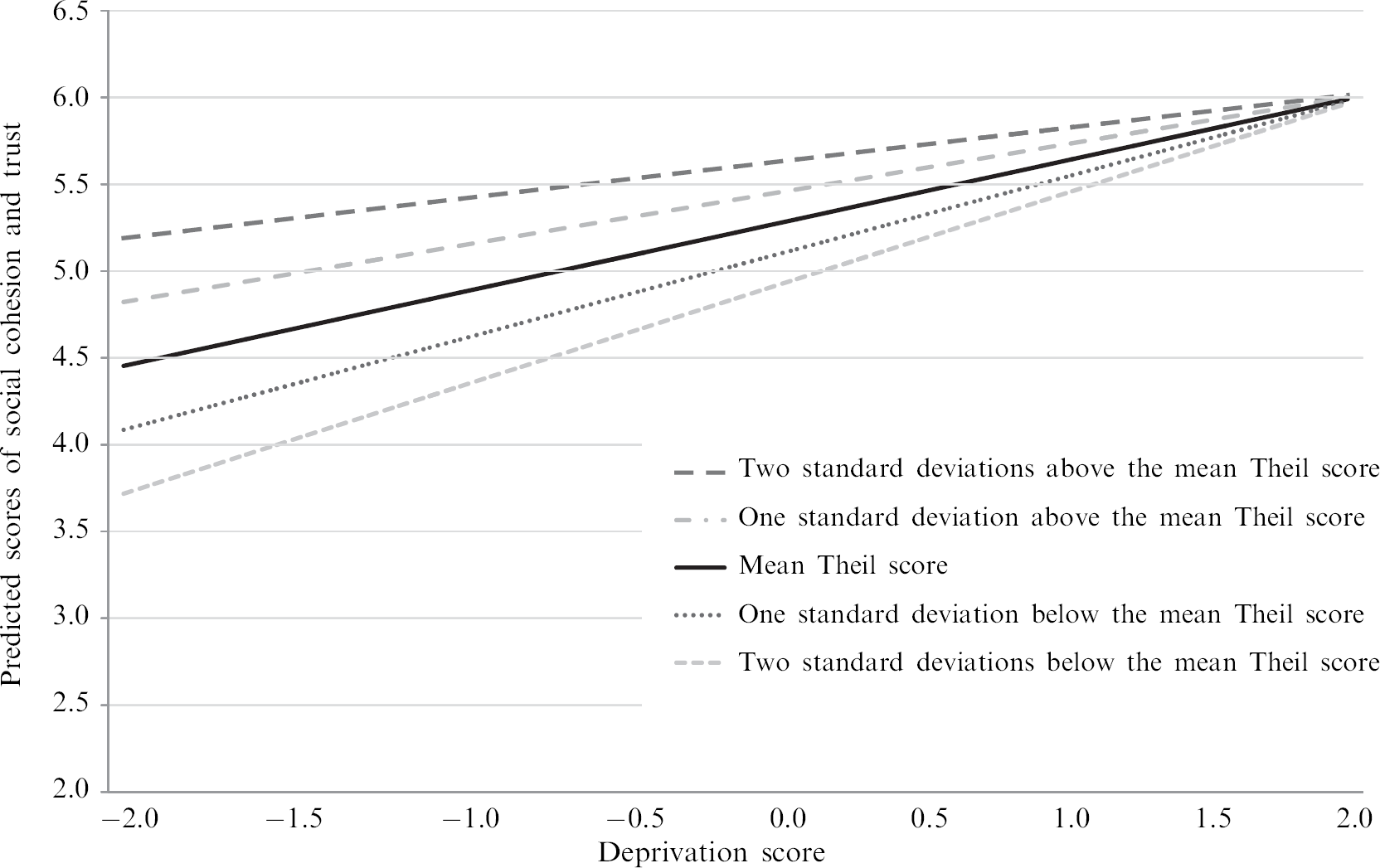
“Diversity or disadvantage? Putnam, Goodhart, ethnic heterogeneity, and collective efficacy” by Liz Twigg, Joanna Taylor, John Mohan
There are errors in the caption and in the label to the y-axis. The correct figure is:
Predicted scores of social cohesion and trust by levels of diversity and deprivation.